
Read the full history: The Native American Craft Behind Every Farm Basket
A farm before mass-produced housewares ran on baskets — not the decorative kind, but a whole working set, each one shaped for a single job: a shallow splint basket for gathering eggs without cracking them, a deep one for hauling feed to the hogs, a wide one for picking apples or berries without bruising them, a sturdy one for carrying wet laundry out to the line. None of them came from a store. A family that needed a basket usually split and wove it themselves, out of whatever ash, willow, or oak grew along the nearest creek bottom.
The method behind almost every one of these baskets was splint weaving: pounding a straight-grained log until its growth rings separated into thin, flexible ribbons of wood, then weaving those ribbons over a wooden mold or freehand into a shape that could take a beating for years. It was slow, physical work, and it produced something that didn’t exist any other way — which is exactly why the craft outlasted so many other homestead skills.
What it was
A splint basket is woven from long, thin strips of wood called splints, pulled from a log of black ash, white oak, willow, or hickory rather than cut from reed or cane. Black ash was especially prized in the Northeast and across the Appalachians because of a quirk in how the tree grows: its wood is ring-porous, meaning each year’s growth ring is bound to the next by a thin, weak layer of pores that will tear apart cleanly under the right kind of pounding, leaving long unbroken ribbons rather than splinters.
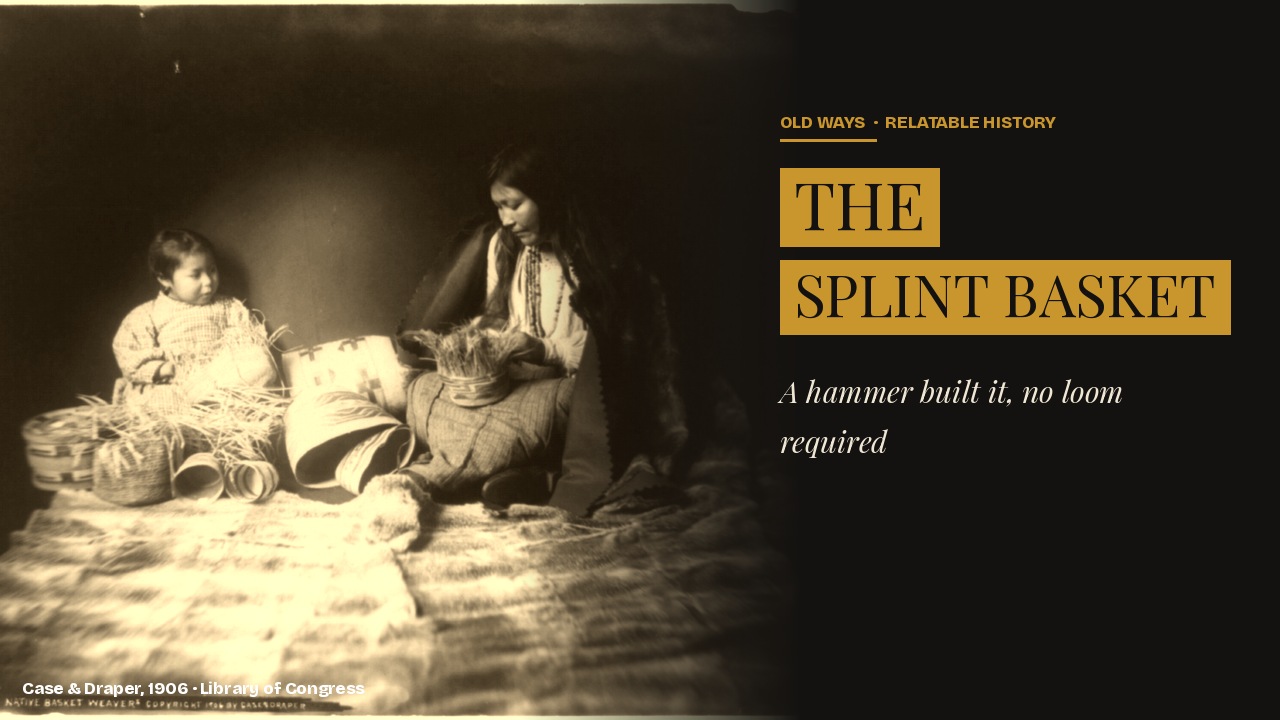
The tradition runs older in North America than the farms it later served. Native peoples across the eastern woodlands — the Haudenosaunee (Iroquois), the Cherokee, the Passamaquoddy and other Wabanaki nations among them — were splitting and weaving ash and oak splints for storage, carrying, and trade long before European settlement, and European settlers learned the technique largely by watching and trading with Native basket makers rather than inventing it independently. By the nineteenth century, splint basket making had become a shared rural craft practiced in Native and settler households alike, especially through Appalachia and the upper Northeast.
How it worked
Making the splints started with a straight log, cut to length and stripped of bark. The maker pounded it steadily along its whole length with the flat of an axe head or a wooden mallet, moving section by section, until the blows separated one growth ring from the next without tearing through either one — a skill that took real practice to judge by feel and sound alone. Each ring peeled away as a long, rough ribbon, which was then shaved smooth and even with a knife and split lengthwise into narrower strips of whatever width the basket called for.
Those splints had to stay damp to stay workable, so a basket maker kept a tub of water close by, dipping each strip before it went into the weave and working quickly once it came out, before it dried and stiffened. The weaving itself ran over a wooden mold for a consistent shape, or freehand for an irregular one, built up in a simple over-under pattern or, for a finer basket, a twill that crossed two or three strips at a time. A sturdy hoop of bent wood, lashed on last, finished the rim and gave the whole basket something rigid to hold its shape against years of hard use.
How people used it
Almost nothing on a working farm didn’t eventually pass through a basket. A shallow, wide-mouthed basket went to the henhouse for gathering eggs; a deeper one carried shelled corn or mash out to the hog pen; another, woven tighter and sized to the shoulder, went up the orchard ladder for picking apples without bruising a single one on the way down. Market baskets hauled garden surplus into town to sell, and a heavy-duty laundry basket carried wet wash out to the line and back, day after day, for years.
The skill itself traveled the same way most farm knowledge did — hand to hand, inside a family or a community, with no pattern book and no formal lesson. A parent, a grandparent, or a neighbor showed a child how to read the wood, how hard to swing the maul, how wide to split a strip for a given job, and the child kept making baskets that way for the rest of their life. Surplus baskets were often sold or traded at the general store, at market, or door to door, giving basket-making families a small but steady source of cash income alongside whatever else the farm produced.
How long it lasted
Splint basket making held on as everyday, practical equipment on American farms for most of the nineteenth century and well into the twentieth, especially in rural Appalachia and the upper Northeast where ash and good basket-making wood were close at hand. It began fading from daily use as cheap wire baskets, galvanized buckets, and eventually plastic containers spread through rural stores in the early-to-mid twentieth century, offering something lighter and faster to buy than a hand-split basket was to make.
The craft never disappeared the way some homestead skills did, though. It survived as a living heritage practice, carried forward by Native basket-making communities and by Appalachian craftspeople who kept teaching it generation to generation, and it’s enjoyed a real resurgence since the late twentieth century through craft fairs, heritage schools, and a renewed market for hand-split baskets as both tools and folk art. A black ash basket woven today uses essentially the same pounding-and-splitting method a maker would have used two hundred years ago.
Your turn
How many baskets do you think one farm went through in a year? Tell us in the comments.
Watch the full story

Sources and further reading
- Rachel Nash Law and Cynthia W. Taylor, Appalachian White Oak Basketmaking: Handing Down the Basket — available on Amazon.
- Haudenosaunee, Cherokee, Passamaquoddy, and other Wabanaki ash and oak splint basket-making traditions, and their influence on settler craft practice in Appalachia and the Northeast.
- Images: Library of Congress (Prints & Photographs Division, FSA/OWI).