
Read the full history: The History of Maple Sugaring, From Stone-Boiled Sap to a Stolen Fortune
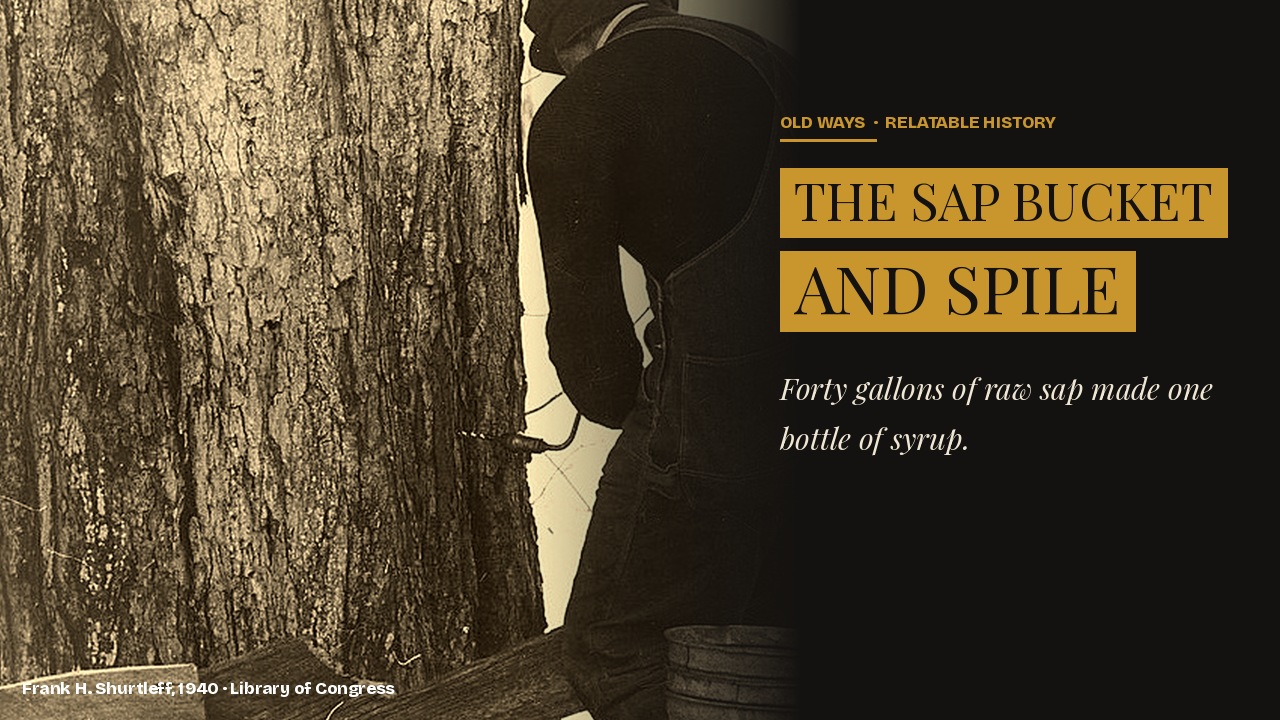
Forty gallons of raw sap went into a single bottle of maple syrup. That number sounds almost like a typo until you taste raw sap straight from a tap: it is nearly clear, barely sweet, and almost indistinguishable from water, because water is nearly all it is — somewhere around ninety-seven to ninety-eight percent, with only two to three percent sugar dissolved inside. Turning that thin liquid into syrup meant boiling away essentially everything but the sugar, which is why, for more than three centuries, maple sugaring was never a quick afternoon job. It was a season-long operation built around one small, unglamorous piece of equipment: a tapered wooden or metal tap called a spile, driven into a hole bored straight into a maple’s trunk, with a bucket hung beneath it to catch whatever dripped out.
The season itself lasted only a handful of weeks a year, in late winter, whenever nights still dropped below freezing but days climbed well above it — the exact swing in temperature that pushes sap up through a sugar maple’s trunk under its own pressure. Native peoples of the northeastern woodlands worked this freeze-thaw cycle for generations before any European settler arrived, tapping trees with a hatchet cut and a hollow reed or piece of bark and boiling the sap down in clay pots or with fire-heated stones dropped into birchbark containers. French missionaries traveling among them in the 1600s were among the first Europeans to write the process down, and the settlers who followed borrowed the method almost wholesale, swapping in a metal auger and a tin spile but changing little else about how the work actually got done.
What It Was
Two simple pieces of equipment had to come together at the same small hole for any of this to work. The spile itself began as nothing more than a short length of elderberry, sumac or basswood branch with its soft pith hollowed out, using a hot wire or a narrow gouge, until it formed a tube with a lip on one end. Driven a few inches into a hole bored through the bark and outer wood with a hand auger, the spile caught sap that would otherwise run down the trunk in a thin, wasted trickle and funneled it instead into a steady drip.
By the mid-1800s, most farms had traded carved wooden spiles for cheap tin ones, stamped out by the thousands and sold through farm-supply catalogs — more durable, easier to scrub clean between seasons, and quick to seat with a few taps of a hammer. Hanging from the spile’s lip was the bucket proper: a galvanized metal pail holding two to three gallons, fitted with a small slanted lid that kept rain, snow, bark and insects out while leaving a notch for sap to drip straight through. A healthy, mature sugar maple, at least ten to twelve inches across the trunk, could carry one tap without lasting harm for decades running — the small wound the auger left behind sealed over on its own well before the next season’s thaw. Sugar maples are not the only species that can be tapped; red and black maples will run too, but sugar maples carry the highest sugar content of the bunch, which is why a sugarbush, the working name for a stand of tapped trees, was almost always thinned to favor them over every other tree nearby.
How It Worked
Timing the whole operation came down to watching a thermometer, not a calendar. Sap only ran well on days when the temperature swung convincingly across freezing — nights in the twenties, days climbing into the forties — because that swing is what builds up positive pressure inside the trunk and pushes sap outward through any opening it can find, including a fresh tap hole. A warm spell with no hard freeze behind it, or a cold snap with no thaw ahead, could shut a whole sugarbush down for days at a stretch, no matter how many buckets were already hanging in the trees.
On a good run, a single tap could fill a two-to-three-gallon bucket within a day, sometimes twice in one thaw. That meant someone — often a farmer’s whole family, including children old enough to carry a full pail without spilling it — walked the same path through the sugarbush every morning and evening, emptying each bucket into a larger gathering tub or a sled-mounted holding tank, and hanging it back empty beneath its spile before moving on to the next tree. A modest farm might run two to three hundred taps across a single season; a larger operation ran into the thousands, which meant the gathering walk alone could eat most of a short winter day. The collected sap went straight to the sugarhouse that same day, since sap left standing too long in warm weather would sour and ruin an entire boiling batch.
How People Used It
Boiling, not tapping, was where most of the real labor actually went. A flat, wide evaporator pan — or, before purpose-built evaporators became common in the 1800s, simply a large iron kettle — sat over a wood fire kept burning around the clock during a heavy run, since the sap had to be boiled down the same day it was gathered. One worker’s whole task for days at a stretch was feeding that fire and skimming foam off the surface as the liquid reduced, watching for the exact moment the boiling sap thickened and sheeted off a dipping spoon instead of dripping — the only reliable sign that forty gallons of thin, clear sap had finally become one gallon of real syrup.
The work doubled as one of the only organized social events of a long, isolated winter. Neighboring families gathered at a sugaring-off, tasting the first fresh syrup straight from the pan, often poured hot over clean snow to set it into a soft, chewy taffy eaten right off a stick. Whatever wasn’t sold or kept as syrup was often boiled down further into hard maple sugar cakes, pressed into carved wooden molds — a form that traveled and stored far better than liquid syrup on a farm with no reliable refrigeration, and a sweetener that cost nothing but the labor of the season itself. Maple sugar cakes also traveled as a genuine trade good well beyond the farm that made them, swapped for other goods in cash-poor rural communities where a season’s worth of sugar could be worth more as barter than it ever was poured over breakfast.
How Long It Lasted
The bucket-and-spile method stayed essentially unchanged from well before European contact through most of the twentieth century — three hundred years or more of the same basic tools doing the same basic job. What finally ended it wasn’t a better bucket; it was a completely different way of moving the sap. Starting in the 1950s and spreading widely through the 1970s and into the 1980s, plastic tubing strung tree to tree, often pulled by a vacuum pump, let one crew gather sap from thousands of taps without ever walking a bucket line by hand. Buckets didn’t vanish overnight — plenty of small producers kept hanging them well past that changeover, since a few hundred taps didn’t justify the cost of a tubing system — but the labor math had shifted for good.
The method never disappeared completely. Hobbyist sugarers and small family operations across New England, the upper Midwest and Canada still hang metal buckets on wooden or tin spiles today, partly for the lower cost and partly because plenty of sugarmakers say the sap tastes no different gathered by hand than it does running through a mile of plastic line. Vermont alone still produces more than two million gallons of maple syrup most years, and a real, if small, share of that total still comes in one dripping bucket at a time.
So how many buckets do you think it actually took to fill one jug of syrup?
- Images: Library of Congress (FSA/OWI collection) and Wikimedia Commons.