
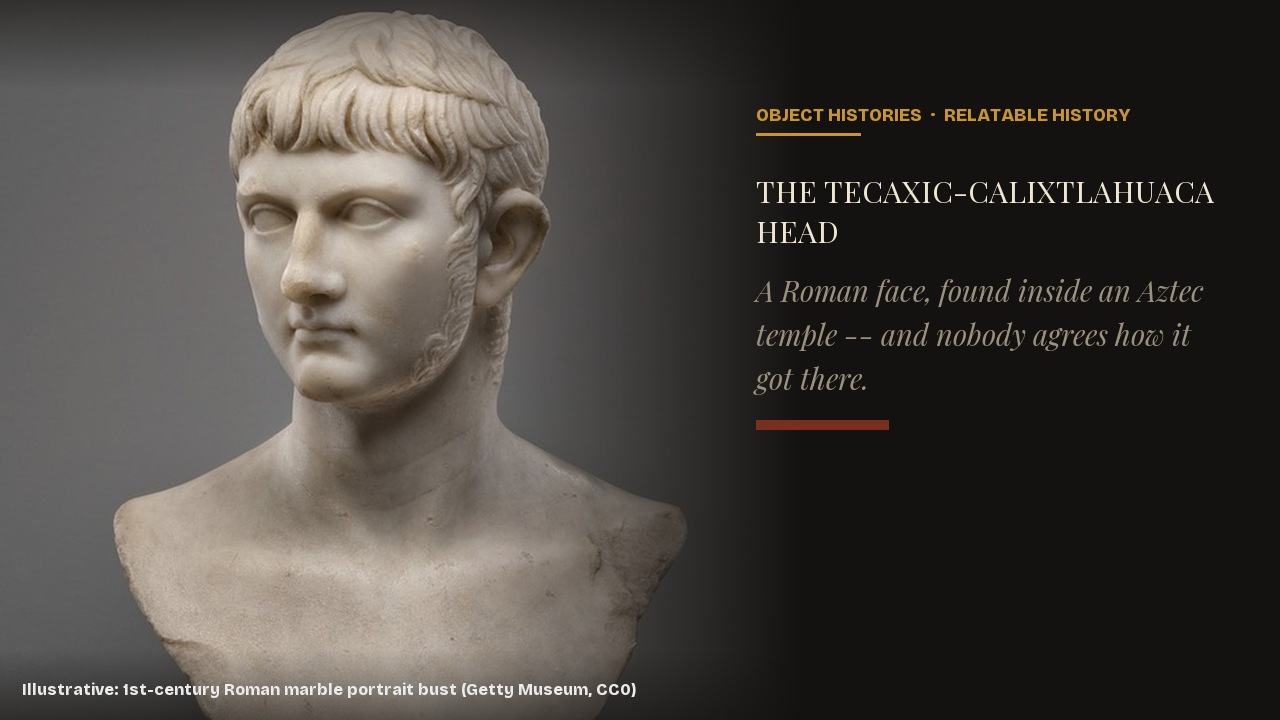
Read the full history: Is the Calixtlahuaca Head Really a Roman Artifact?
In 1933, archaeologist Jose Garcia Payon was excavating at Calixtlahuaca, a hilltop site in Mexico’s Toluca Valley. Beneath three intact stone floors of a pyramidal temple, his team found a burial offering of gold, turquoise, jet, shell and worked bone, dated by its context to somewhere between 1476 and 1510 — deep in the Aztec period. Mixed in with it was a small terracotta head that matched nothing else in the offering, and nothing in any known Mesoamerican style. Garcia Payon sat on the find for almost thirty years before publishing it in 1960.
We trace the full, genuinely unresolved case: Bernard Andreae’s unhedged identification of the head as a Severan-period Roman portrait (193-235 AD) based on the hairstyle and beard; the 1995 Heidelberg thermoluminescence test that dated the clay itself to somewhere between the 9th century BC and the mid-13th century AD — wide enough to rule out a modern fake, too wide to confirm Rome specifically, and a result its own authors say was later overstated; Romeo Hristov and Santiago Genoves’s 2001 case for an undisturbed find context; the competing claim that a dig participant planted the head as a prank on Garcia Payon decades earlier, disputed by his son and now unconfirmable since everyone involved is dead; the documented Roman-era settlement on Lanzarote that anchors the shipwreck-drift theory; and the pushback from skeptics like David Grove, who argue a single drifted artifact — even a genuine one — would prove a shipwreck, not a voyage of discovery.
Nearly a hundred years after it came out of the ground, no consensus paper has closed the case, no forgery has ever been proven, and no confirmed ancient Roman landfall in the Americas has ever been found to back it up.
Your turn
So where do you land — genuine anomaly, an honest excavation mix-up, or a prank that got out of hand nearly a century ago? Tell us in the comments.
Watch the full story
