
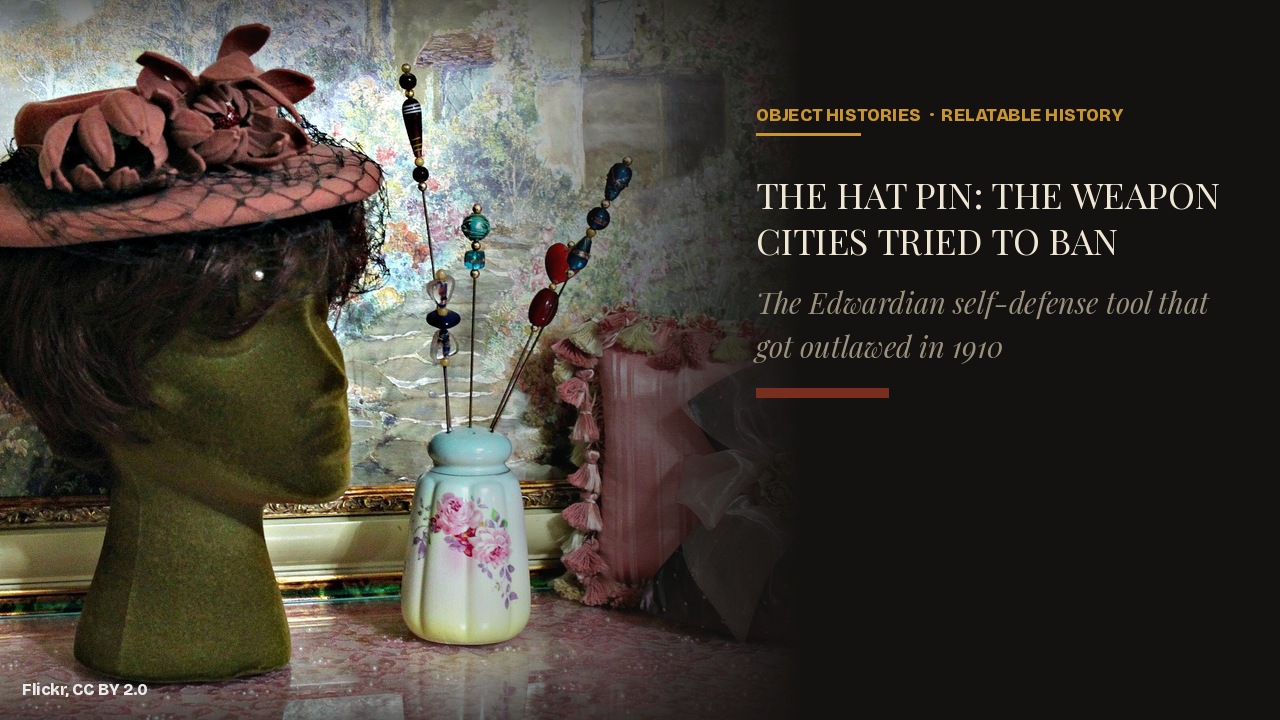
Read the full history: The Hatpin Peril: How a Fashion Pin Became an Outlawed Weapon
Cities once passed laws banning women’s hatpins as deadly weapons — fining women fifty dollars for a pin that stuck out too far past their own hat. The eight-to-twenty-inch steel pin that anchored a woman’s enormous Edwardian hat became a genuine tool of early-1900s street self-defense, then the center of a nationwide “hatpin peril” panic that spread as far as Chicago, Milwaukee, and the tram lines of Kristiania (now Oslo), Norway — before fashion itself, not the law, finally put it out of a job.
Key facts
- Edwardian hats required pins eight to twenty inches long just to stay anchored to a woman’s head.
- In 1903, Leoti Blaker used her hatpin to fend off a “masher” (a street harasser) in New York, and newspapers cheered her as a heroine.
- Chicago passed a $50 ordinance against oversized or weaponized hatpins in 1909–1910, and Milwaukee followed with its own ban.
- The panic reached as far as Kristiania (now Oslo), Norway, where it played out on the city’s tram lines.
- Police in multiple cities refused to enforce the bans, and at least one judge ruled a hatpin used in self-defense was legal.
- 1920s fashion, not the law, ended the hatpin’s reign, as hemlines rose and smaller hats replaced the giant “Merry Widow” styles.

Shop the history: