
In May 1903, a Kansas tourist named Leoti Blaker was riding a crowded stagecoach down Fifth Avenue when a well-dressed man in his fifties pressed against her and would not stop. She reached up, pulled a pin from her hat, and drove it into his arm. He yelped and fled. The Evening World ran her account the next day, and for the next several years American newspapers treated women who did what she did as folk heroes.
Seven years later, in March 1910, Chicago’s city council made the instrument of that defense a crime. Any hatpin whose point protruded more than half an inch beyond the crown of a hat was now illegal in public, carrying a fine of fifty dollars. When the vote was announced, women in the council gallery stood and shouted “Shame! Shame!”
Between those two moments sits one of the stranger episodes in American municipal history: a real, nationwide, briefly international panic over an eight-inch steel sewing accessory. Cities debated it, aldermen mocked each other over it, and at least one newspaper editorial blamed it for a man’s death. The “hatpin peril,” as the press came to call it, was never really about the pin. It was about what women had started doing with it.
An Eight-Inch Steel Shaft Did One Job: Keep an Enormous Hat in Place
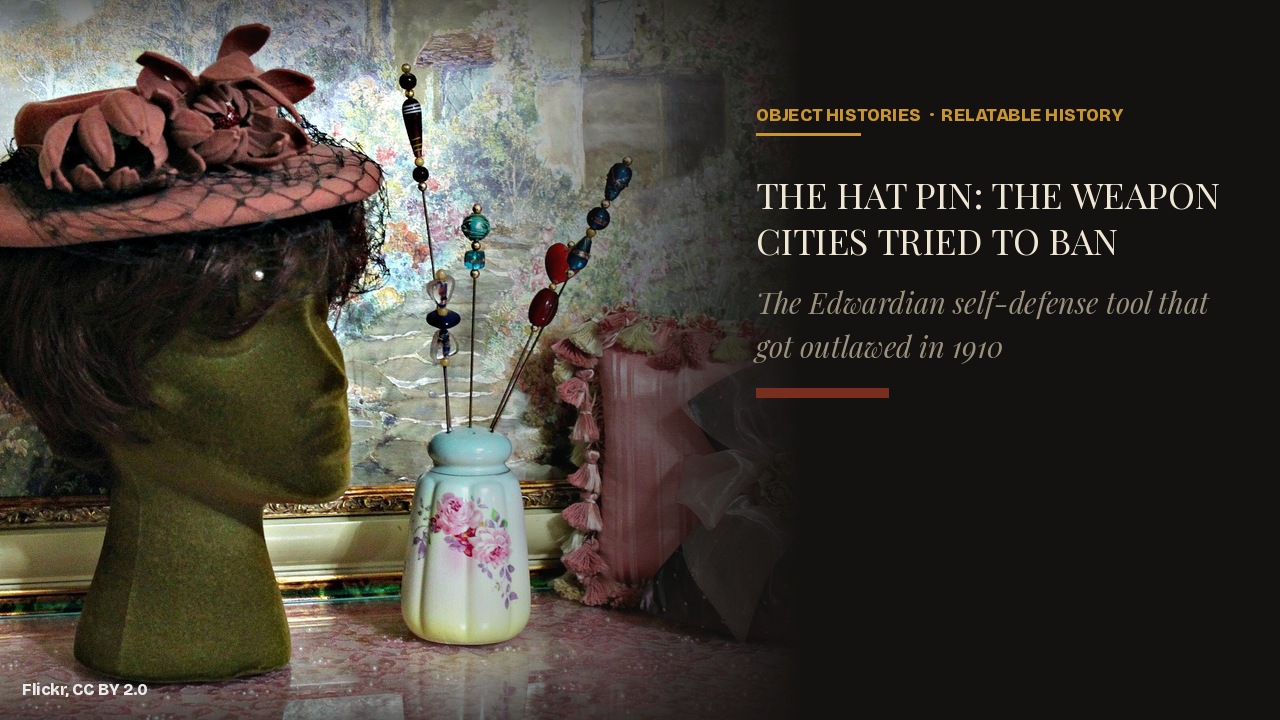
By the late Victorian period and into the Edwardian years, a woman’s hat was not a small object, and keeping it attached to hair rather than gravity took real engineering. Encyclopaedia Britannica puts the standard hatpin at about eight inches long, usually worn in pairs, with a visible head that was often faceted glass, enamel, or set with a stone. The shaft did the structural work; the head was there to be noticed.
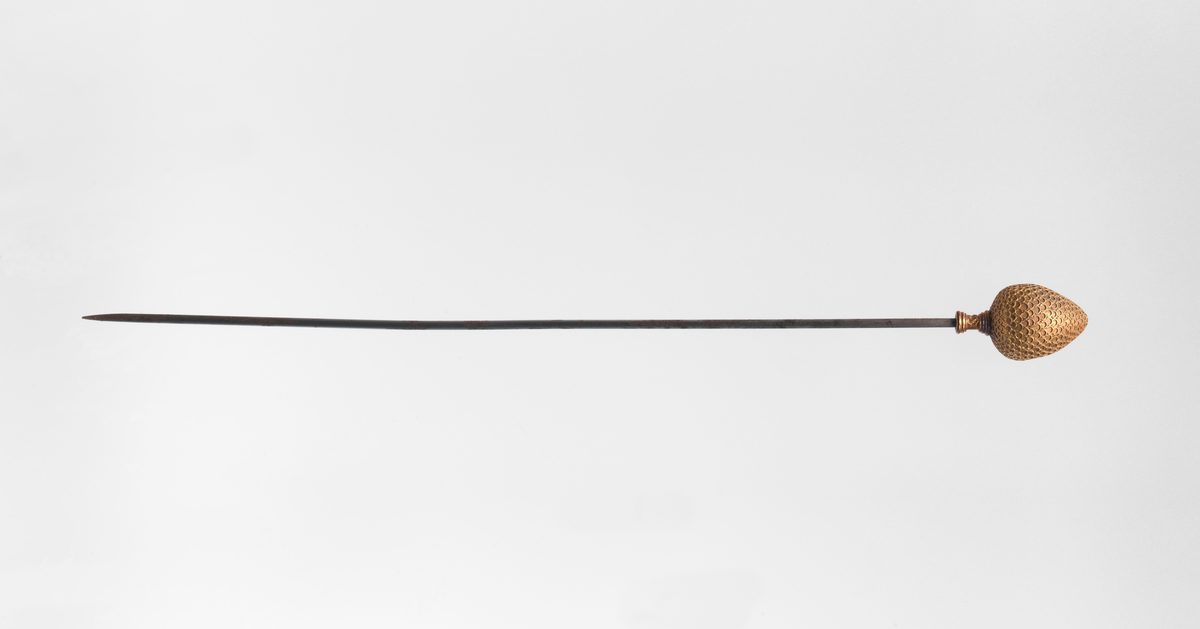
A surviving example in the Metropolitan Museum of Art’s collection shows what that could mean in practice: a gold-and-steel hat pin made around 1880 by Castellani, the Roman jewelry firm known for reviving ancient goldsmithing techniques, its finial shaped and filigreed to resemble a pine cone. The shaft itself runs nine and three-quarters inches of plain steel. The gold is confined to the part anyone was meant to see.
That design brief — a long, rigid, sharpened steel rod, worn in a woman’s hair, in public, every day — did not change for decades. What changed was what else women started using it for.
The Word for the Problem Already Existed
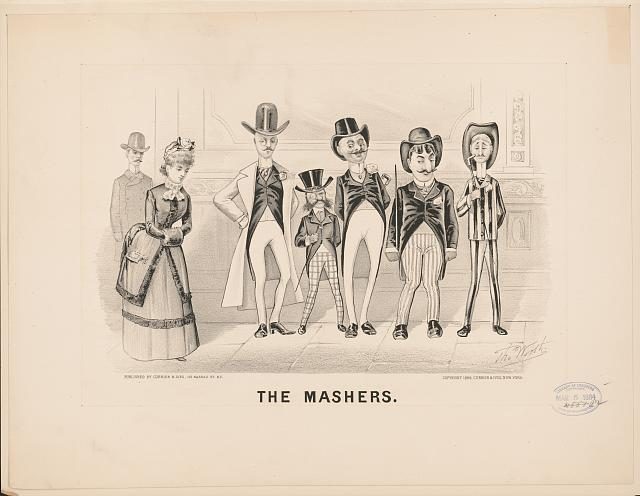
The men hatpins were eventually used against had a name years before anyone reached for a pin: a “masher.” The word came into vogue around 1882, describing a flamboyant young man who lingered at stage doors and pursued actresses and other women with unwanted, persistent attention. Linguist Anatoly Liberman, writing for Oxford University Press’s blog, traces the term to “mash” — to be infatuated, or to try to win someone’s affection — reinforced by the sound of words like “smash” and “mushy.” The behavior long predates the word, and the word long predates the legal fight that followed.
Visual evidence of how familiar the type already was survives from 1884, six years before Leoti Blaker was born: Currier & Ives published a print by Thomas Worth, simply titled “The Mashers,” caricaturing exactly this kind of man. The panic that erupted after 1900 was not the invention of a new nuisance. It was the public, organized refusal to go on tolerating an old one.
A String of Named Women Made the Hatpin Famous, One Headline at a Time
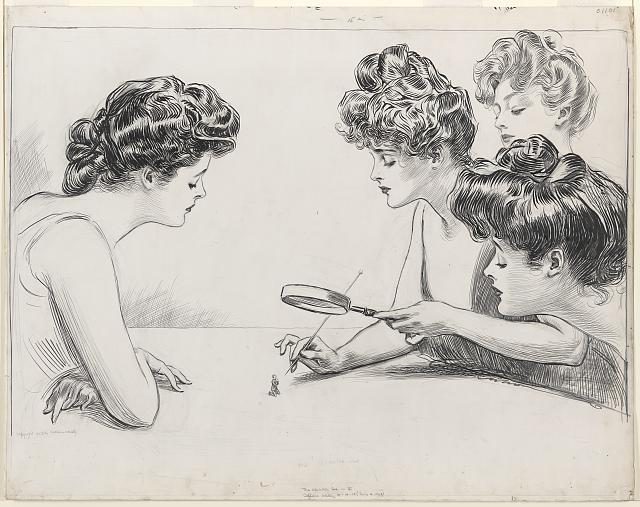
Leoti Blaker’s case became the best remembered, but it was neither first nor last. The San Francisco Examiner reported in August 1895 that a stenographer named Jennie Ryan drove her hatpin into a man who had been stalking her; he was later arrested for sending her threatening letters. In March 1898, Sadie Williams used hers to fight off a streetcar conductor’s attempted robbery. In April 1903, weeks before Blaker’s encounter, a woman named Mayme Andrews used a hatpin on a man who had followed and touched her in East St. Louis.
None of this went unnoticed at the highest levels. Theodore Roosevelt reportedly told reporters in September 1900 that “no man, however courageous he may be, likes to face a resolute woman with a hatpin in her hand” — a sitting president’s endorsement of the exact self-defense the newspapers were busy celebrating.
The stories kept accumulating into the next decade. In 1912, eighteen-year-old Elizabeth Foley used her hatpin against an armed robber on Bleecker Street after he struck her companion; the New York Times covered it as straight news, not novelty. By then the pin’s reputation had outgrown any single incident — which was exactly the problem, from a city council’s point of view.
City Councils Tried to Regulate the Pin Instead of the Men
Chicago’s 1910 ordinance was the best publicized version, but far from the only one. Newspapers reported hatpin-length restrictions proposed or passed in Milwaukee, Seattle, Brooklyn, New Orleans, and Colorado Springs over roughly the same years, and in 1900 New York state legislators had floated limiting hatpins to three inches — a proposal that never became law but captures how far officials were willing to go.
The Chicago debate ran for weeks before the vote. An heiress and drama student, Nan Davis, wrote an open letter to the council arguing against the ordinance forcefully enough that it was sent back to committee that March. Coverage around the same debate, including a lengthy illustrated editorial in the Indianapolis Star that May, blamed hatpins for a string of injuries, including one man said to have died of “blood poisoning” a week after an accidental scratch — a claim later historians have treated with real skepticism, since it rests entirely on uncorroborated contemporary reporting.
Supporters of restriction argued, with some justice, that a foot-long steel point worn at eye level in a crowded streetcar was a hazard whether or not its owner meant harm. Opponents argued, also with justice, that the city had no business regulating women’s clothing, and that for a woman walking home after dark the pin was often the only weapon she had. When Chicago’s measure passed anyway, the gallery’s “Shame! Shame!” was aimed squarely at that second argument having lost.
A small industry sprang up around compliance. Manufacturers sold rubber and metal point-protectors that slid over the exposed tip; women who could not afford one made do with cork or a bit of potato pressed onto the point. None of it settled the underlying argument, which was never really about an inch and a half of exposed steel.
Enforcement Was Nobody’s Priority, on Either Side of the Atlantic
What the ordinances rarely got was enthusiastic enforcement. Washington, D.C.’s police chief, Major Sylvester, was reportedly reluctant to disarm women who, in his view, needed the pin precisely because they went about the city unescorted and otherwise unarmed. Salt Lake City’s department showed a similar lack of appetite for writing citations. European officials were watching the same debate without rushing to copy it: in 1909, police chiefs in Hamburg and Paris were reported to be considering their own hatpin regulations, but considering is as far as the record shows most of them got.
At least one city tried the opposite approach: pricing the men’s behavior instead of the women’s defenses. An Omaha judge, Charles Foster, published an itemized schedule of fines for verbal harassment in 1913, running from five dollars for calling a woman “chicken” or “baby-doll” up to twenty-five dollars for “little cutie.” It was treated at the time as a rarity and a bit of a joke, which says something about how seriously officials generally took the idea of punishing the harassers rather than the hardware.
That gap, between what councils voted for and what police actually did, may be the most telling detail in the whole episode. A law nobody especially wants to enforce is usually a law written to settle an argument about propriety rather than to solve a safety problem — and the argument here was really about how much latitude an unaccompanied woman on a city street was entitled to.
Fashion, Not the Ordinances, Finally Ended the Hatpin’s Reign
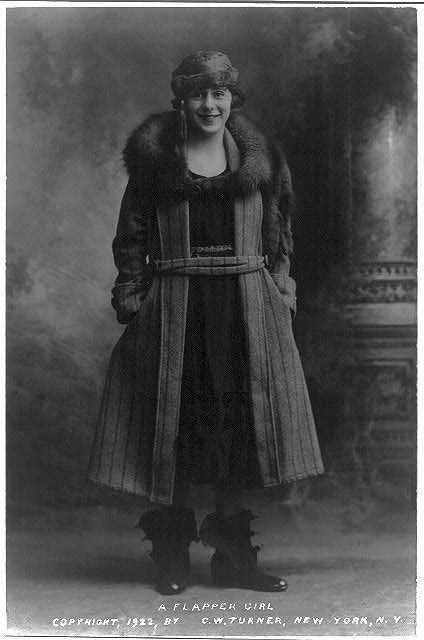
No city repealed its hatpin law with any fanfare; the debate simply ran out of relevance. By the years around the First World War, hairstyles were already shifting, and the change that mattered arrived from the beauty parlor rather than the council chamber. The bob — short, cropped hair that had scandalized hairdressers, doctors, and clergy when it first appeared — became fashionable through the 1920s, and the tight-fitting cloche hat, pulled down low over the forehead, was built specifically to sit over it, as the FIDM Museum’s collection notes describe. A cloche needed no eight-inch anchor. It needed almost no anchor at all.
The hatpin did not disappear so much as lose its reason to exist. The hats that required it went out of fashion, the hair the hats used to pin against went short, and an object that had briefly been a sewing notion, a weapon, and a civic controversy all at once became, within a decade, mostly a thing found in a grandmother’s jewelry box. The ordinances are still technically on the books in some of the cities that passed them. Nobody has needed to care for about a hundred years.
The pattern underneath the story is a familiar one. A problem that is really about one group of people’s behavior gets solved, on paper, by regulating an object instead — because an object is easier to define, measure, and fine than a person’s conduct is. It happened to the hatpin in 1910, and some version of the same argument resurfaces any time a city debates what a person may lawfully carry for their own protection. The pin itself was never the real problem. It was just the part of the problem that could be measured in inches.
Watch the full history
The video traces the hatpin from ordinary Edwardian hardware to legal flashpoint in about six minutes.

Related reading
- Were Tapeworm Diet Pills Real? — another object a century of marketing and moral panic turned into something more dangerous than advertised.
- Why the Spittoon Disappeared: The Laws That Made Spitting a Crime — the same civic playbook of ordinances aimed at an object instead of a behavior.
- The Dangerous History of Face Powder — From Roman Lead Paint to a Flapper’s Compact — another everyday item women relied on that drew official suspicion.
- Why Umbrellas Were Once Considered Unmanly — a reminder that ordinary accessories regularly got tangled up in gender politics.
Shop the history:
Works cited
- “Hatpin.” Encyclopaedia Britannica.
- Freedman, Estelle B. Redefining Rape: Sexual Violence in the Era of Suffrage and Segregation. Harvard University Press, 2013.
- Keyser, Hannah. “How the Hatpin Became a Tool of Women’s Liberation.” Mental Floss, December 22, 2014. Link.
- Zarrelli, Natalie. “How Women Defended Themselves Against Street Gropers 100 Years Ago.” HISTORY, A&E Television Networks. Link.
- “Masher Menace: When American Women First Confronted Their Sexual Harassers.” Collectors Weekly. Link.
- Alexandra, Rae. “Victorian Self-Defense: Women Stabbed Men With Their Hatpins.” KQED, October 24, 2025. Link.
- Walford, Jonathan. “Getting the Point: Hatpins as Weapons?” Fashion History Museum blog, July 19, 2021. Link.
- Liberman, Anatoly. “Masher.” OUPblog, Oxford University Press, January 2011.
- “Archeological-Revival Hat Pin.” The Metropolitan Museum of Art, accession 2015.489.14.
- “1920s Cloche.” FIDM Museum, Fashion Institute of Design & Merchandising. Link.