
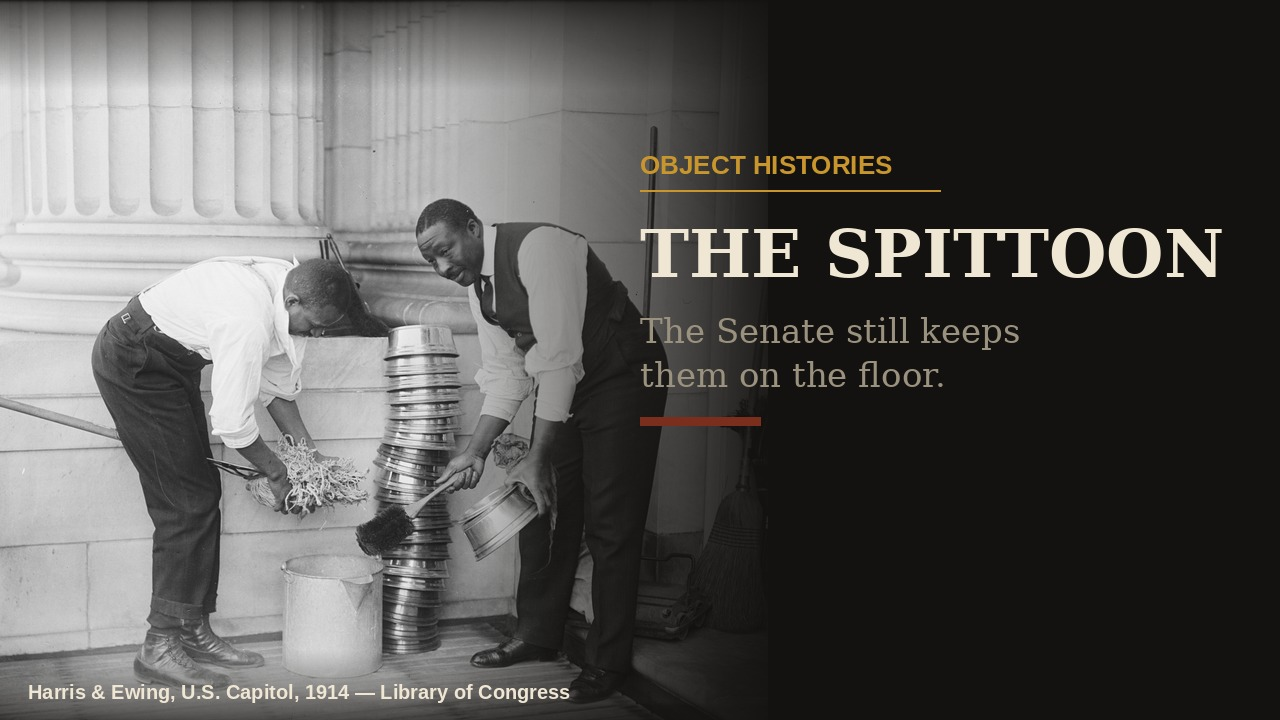
Between 1896 and 1910, New York City police made more than 2,500 arrests for an act that had never been a criminal offense anywhere in the country before that year: spitting on the sidewalk. The statute carried a fine of one to five dollars, or up to a year in jail, and within fourteen years some 150 other American cities had copied it — even though jail time turned out to be rare in practice, with the lowest fines the most common outcome. Nobody had banned the spittoon. What they had banned was the thing it existed to catch.
That distinction is the whole story. The spittoon did not go out of fashion the way a hat style does. It was legislated, lobbied and engineered out of existence over roughly two decades, by a coalition of women’s health reformers, a German bacteriologist, and a teenager with a patent for a cigarette-rolling machine. Each of them gets a section below, because none of them alone would have finished the job.
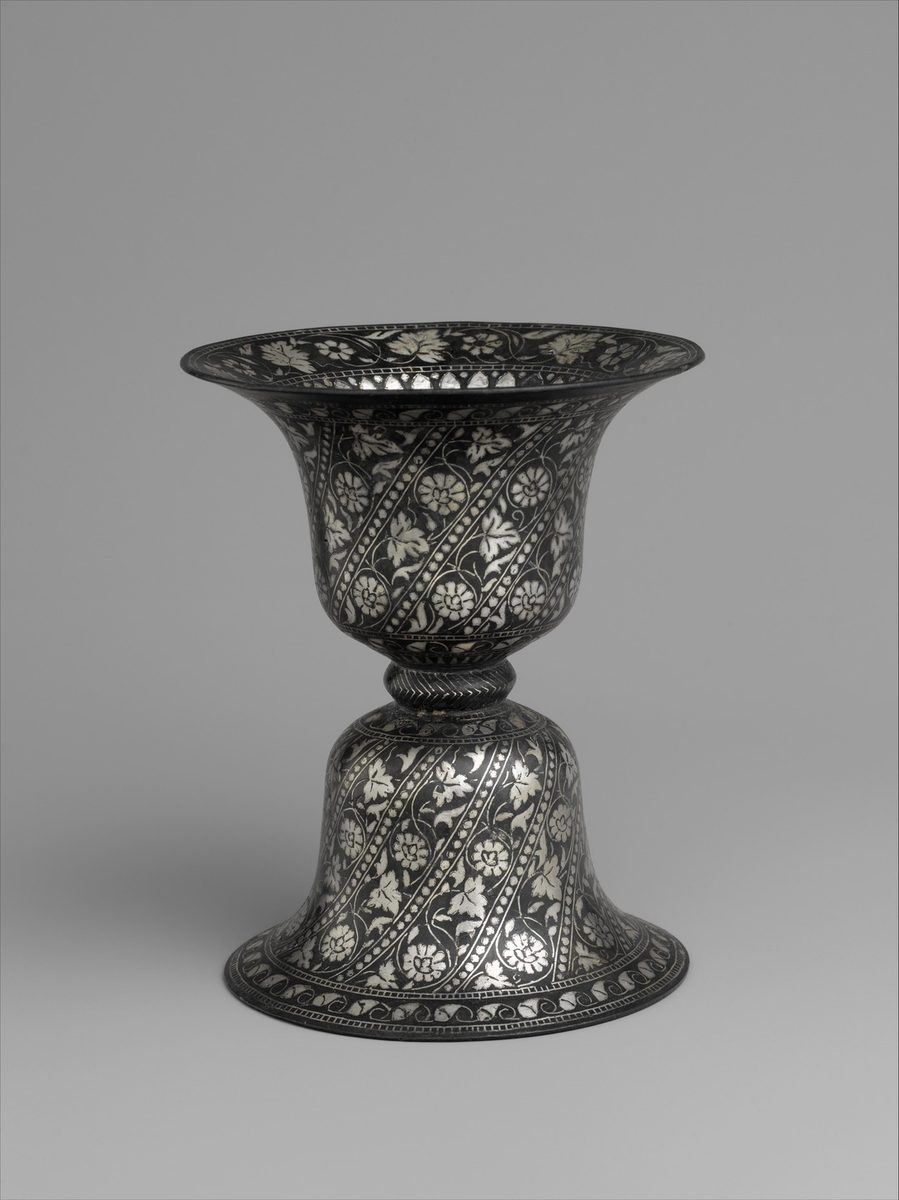
The word for the object is younger than the mess it was built to catch
Reference works cannot agree on when English got the word spittoon. Popular etymology dictionaries date the coinage to around 1811, built from spit plus the same -oon ending found in balloon and saloon. The Oxford English Dictionary is more conservative and dates its earliest documented use to 1840, a full generation later. Both agree the word replaced an older, blunter term, spitting box, attested from the 1680s — which tells you the object long predates any of its names.
Whichever date is right, the demand behind the word was already enormous by the time it caught on. Plug tobacco — pressed bricks of leaf sweetened with molasses, cheap and portable and usable with both hands busy — was the dominant form of tobacco consumption in the United States through most of the nineteenth century, and a country of chewers is a country that needs somewhere to spit. By the 1880s a trade catalogue could sell cuspidors in brass, copper, cast iron, glazed stoneware, even cut glass, and a single hotel or saloon might order them by the dozen.
The object itself is much older than any of this American history. The Charles Hosmer Morse Museum of American Art dates one of the earliest known spittoons to a porcelain example recovered from the tomb of a Tang dynasty emperor who reigned between 805 and 820 CE — a full millennium before Frances Trollope ever complained about American manners. What changed in the nineteenth-century United States was not the object but its market: Cincinnati’s Rookwood Pottery, an art studio better known for vases, produced hand-glazed ceramic cuspidors decorated with the same Asian-influenced motifs it used elsewhere in its line, including a 1883 piece by decorator Nicholas Joseph Hirschfeld now in the Morse Museum’s collection. A spittoon could signal wealth as easily as it signaled necessity, which is part of why the object took nearly two decades of deliberate legal pressure to dislodge once it was no longer wanted.
Germ theory turned a fixture into a hazard overnight
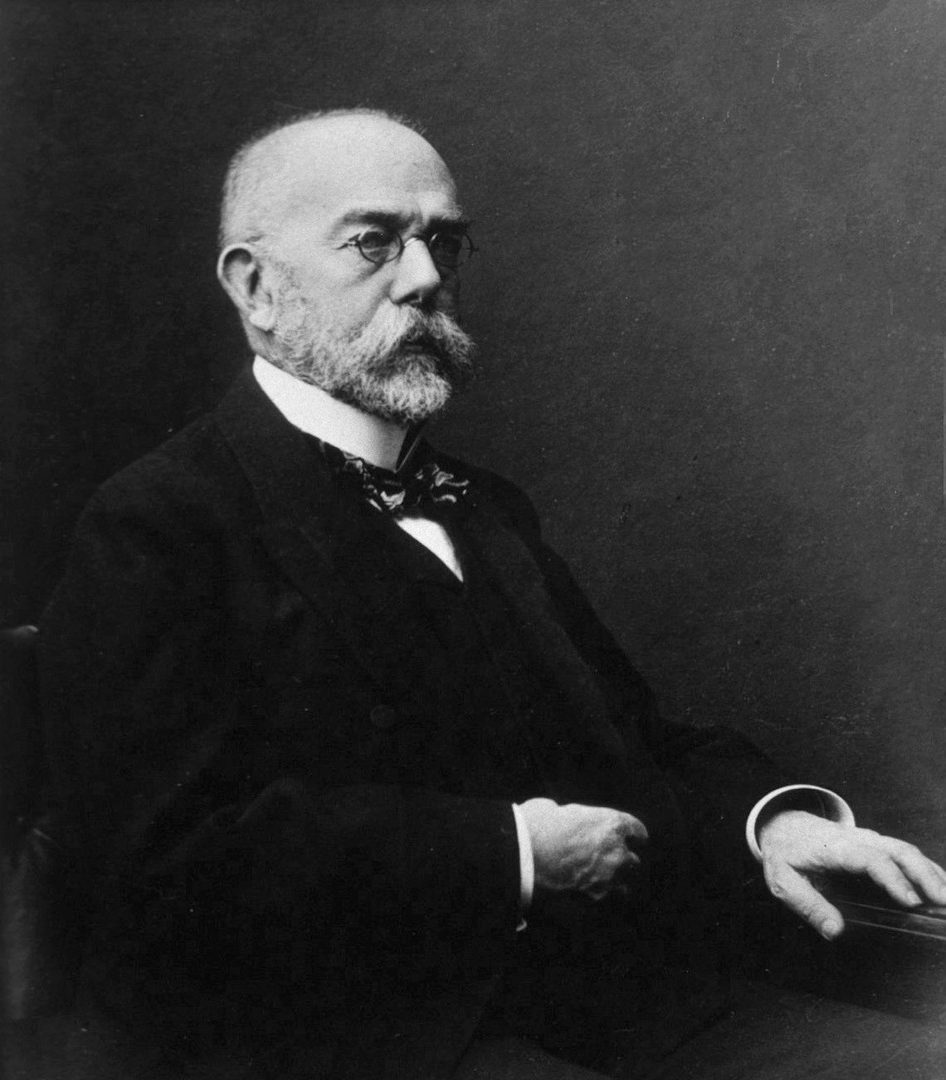
The pivot point has an exact date. On March 24, 1882, the German physician Robert Koch stood before the Physiological Society of Berlin and announced that he had isolated the bacillus responsible for tuberculosis — at the time the leading cause of death in the industrialized world. Koch’s announcement did not just identify a germ; it identified a transmission route. Sputum, once it dried on a floor or a sidewalk, could be ground into dust and inhaled, carrying the bacillus with it.
That single mechanism reclassified the spittoon. A vessel that had been a matter of manners — keep the juice off the carpet — became, in the space of a few years of medical reporting, an open dish of infectious material sitting on the floor of every bank, courtroom and railway car in the country. Physicians and public health officials did not need to invent a new argument against spitting. Koch had already handed them one.
A women’s health lobby wrote the law that actually changed behavior
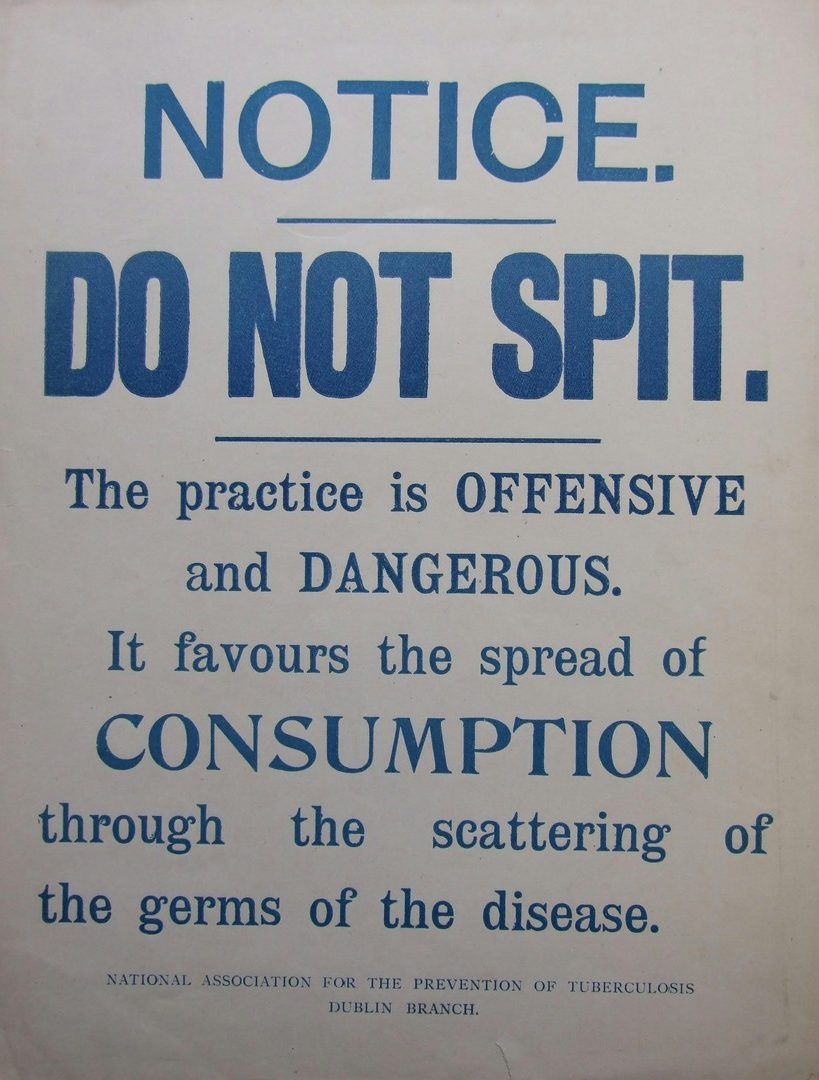
New York City moved first, and it moved because of sustained outside pressure rather than official initiative. Through the early 1890s the Ladies’ Health Protective Association, working alongside Brooklyn’s Anti-Tuberculosis Committee and later the National Tuberculosis Association, lobbied the city’s Board of Health for a public anti-spitting measure. Health commissioner Hermann Biggs, who had built his career on applying germ theory to municipal policy, carried it through. In 1896 New York adopted the country’s first anti-expectoration ordinance, banning spitting on sidewalks, in public buildings and on transit, with that one-to-five-dollar fine and up to a year’s imprisonment on the books. The law was controversial from the start — men wrote to newspapers protesting that it criminalized a natural impulse, and some spat directly on the anti-spitting posters as a form of protest — and enforcement soon retreated to the mildest fines rather than jail.
The campaigning groups papered the city with slogans designed to be unignorable: Spitting Is Dangerous, Indecent, and Against the Law; No Spit, No Consumption. It worked as policy in a way that etiquette advice never had. By 1910, New York had logged 2,513 spitting-related arrests, and roughly 150 other city governments across the country had enacted their own versions of the ordinance, converting a matter of personal habit into an enforceable municipal crime for the first time in American history.
The dentist’s chair is the one place the spittoon was upgraded, not banned
Everywhere else, the object was being legislated away. In one profession it was being engineered to stay. Before the late 1860s, dental patients rinsed into a plain brass spittoon that an assistant had to empty and scrub by hand between appointments. In 1867 the Whitcomb Fountain Spittoon introduced running water into the bowl itself, plumbed directly into the newly reclining dental chair pioneered that same year by James Beall Morrison. A continuous rinse kept the bowl visibly clean between patients without extra staff time, and the design proved durable enough that variations on it were still being patented decades later.
This is also where the politer name for the object earns its keep. Cuspidor comes from the Portuguese word for “spitter,” and while the general public mostly abandoned the term along with the object, dentistry never did. The little rinse basin fixed to a modern dental chair is a direct, unbroken descendant of the fountain cuspidor, which makes it very likely the single most-used spittoon in America today, encountered by millions of people who would never call it that.
Congress kept two, and said so on the record
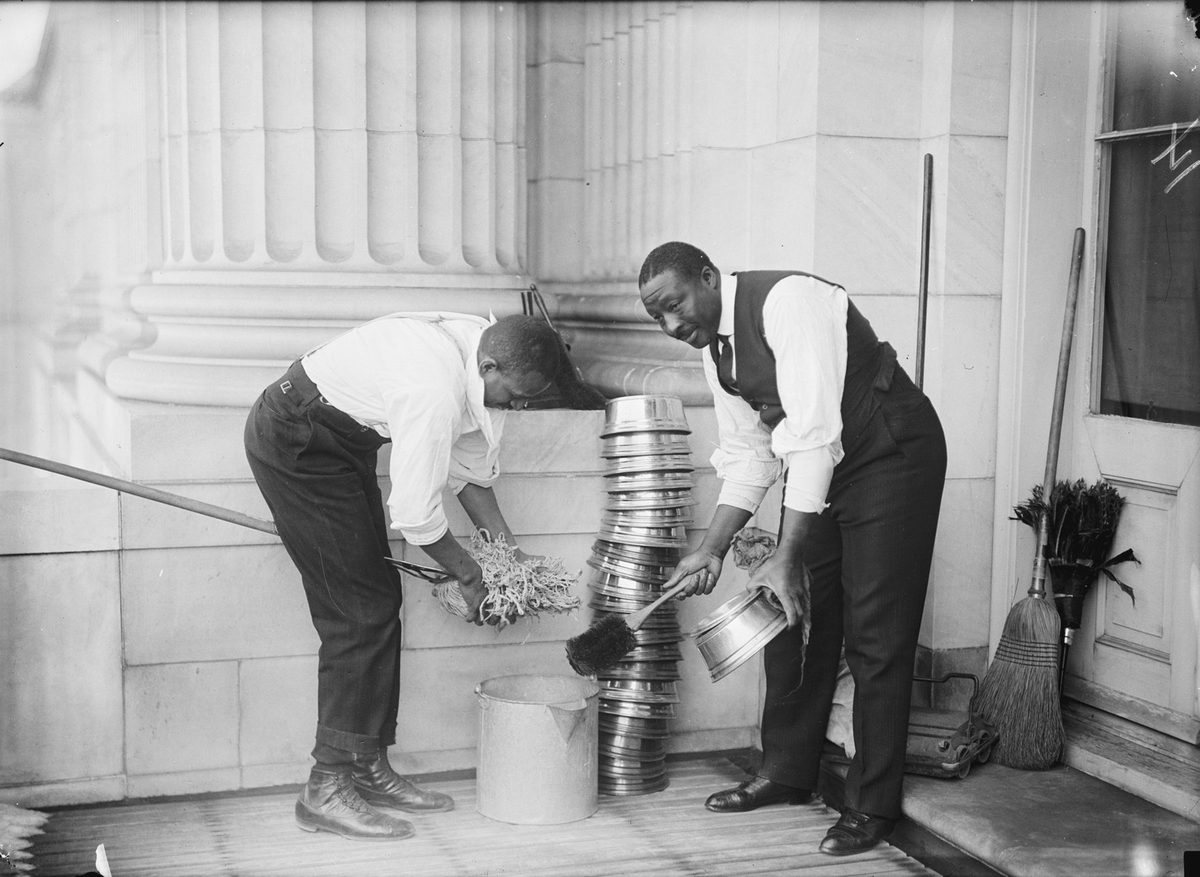
The United States Senate is a documented exception to the disappearance, and it is documented because a reporter asked. In 2013, Roll Call traced the chamber’s surviving spittoons back to a pair still sitting on the floor near the desks, unused for tobacco since Senator Herman E. Talmadge of Georgia left office in 1981. Asked about them in 2009, then–Majority Leader Harry Reid did not pretend they still served their original purpose. “I use mine to throw a few pieces of wastepaper in it,” he said. “It is traditional. That is the Senate.”
The House, by contrast, removed its desk spittoons entirely, even though the same Roll Call reporting found that its own rulebook, Jefferson’s Manual, still technically permits chewing and spitting on the floor at the presiding officer’s discretion — a rule with no clear record of ever being enforced. Dickens had toured both chambers in 1842 and advised visitors not to look at the floor, and not to pick anything up off it “with an ungloved hand on any account,” because the carpets, in his words, “do not admit of being described.” The Senate’s two brass pots are what is left of that carpet, kept on purpose, past the point of any practical need.
The spittoons are not even the chamber’s only surviving tobacco fixture. The Senate still keeps two ceremonial snuffboxes at the back of the chamber, one on the Republican side and one on the Democratic side, a tradition Roll Call traced back to Vice President Millard Fillmore, who in the 1850s grew tired of senators interrupting each other’s speeches to visit a shared snuff urn and had it replaced with two lacquer boxes instead. The tobacco itself was quietly removed within the past few decades, and the boxes now sit in protective cases — ceremonial in exactly the way the spittoons are, minus the wastepaper.
Half a world away, the same fight had to be refought from scratch
The American story reads like a closed case: a law, a campaign, a germ, a cigarette machine, and the object was gone within a generation. China’s experience shows that none of those causes was sufficient on its own, because the same fight had to happen there roughly a century later, against an entrenched habit that outlasted several rounds of enforcement.
In the early 1980s the Chinese government, under Deng Xiaoping, launched a nationwide anti-spitting campaign and deployed some 200,000 health inspectors in Beijing alone to fine offenders. The irony was not lost on observers: Deng himself was known to spit into a spittoon kept by his chair during formal meetings, including his tense 1982 negotiation with British Prime Minister Margaret Thatcher over the future of Hong Kong, and British officials reportedly could not agree afterward on whether the habit was genuine or a deliberate negotiating tactic. Two decades later, with the 2008 Beijing Olympics approaching, the city tried again: officials opened roughly 1,000 public anti-spitting education centers, complete with microscope displays of the bacteria in sputum, under banners reading “Keep fit. Don’t spit.” Shanghai even tried attaching purpose-built spittoons to street garbage cans, an experiment that mostly failed because residents mistook the fittings for ashtrays.

What actually killed it, in what order
Lay all of it side by side and the sequence in the American case is unusually legible for a piece of material culture. Koch’s 1882 discovery supplied the medical argument. The Ladies’ Health Protective Association and allied groups turned that argument into political pressure. Hermann Biggs and New York’s Board of Health turned the pressure into the 1896 ordinance, and a hundred and fifty cities copied the template within fourteen years. And running alongside all of it, James Bonsack’s 1881 patent for a cigarette-rolling machine — capable of producing tens of thousands of cigarettes a day where a hand roller managed a few hundred — made a spit-free alternative to chewing tobacco cheap enough to out-compete it within a generation. Remove any one of those four factors and the spittoon plausibly survives decades longer than it did.
What is left of it now sits in exactly the places you would expect a genuinely dead object to end up: a museum vitrine, an antique shop, two protected pots on a Senate carpet, and, quietly, the rinse basin on a dental chair, which is the only place the design was ever improved rather than outlawed. Ask which of those four endings the twenty-first century will hand to something you use every day without a second thought.
Watch the full history
The video version follows the object itself, from the Senate floor back to the saloons, hotels and courtrooms that needed it.

Related reading
- How One Farmer’s Patent Rebuilt the American Barn
- Butter and Egg Money: How Farm Wives Financed the Household
- Why the World’s First Bicycle Craze Collapsed in Eighteen Months
- The Farm Soap That Almost Never Hardened Into a Bar
Shop the era
- Brass spittoon (Old West saloon-style replica)
- American Notes, by Charles Dickens (Penguin Classics)
- The Cigarette Century, by Allan M. Brandt
Works cited
- Abrams, Jeanne E. “‘Spitting Is Dangerous, Indecent, and against the Law!’ Legislating Health Behavior during the American Tuberculosis Crusade.” Journal of the History of Medicine and Allied Sciences 68, no. 3 (2013): 416–450.
- “When a Women-Led Campaign Made It Illegal to Spit in Public in New York City.” Smithsonian Magazine. Link.
- “Cuspidor, 1883.” The Charles Hosmer Morse Museum of American Art, Collection Highlights.
- “A Long Battle Against Public Spitting: New York City’s 1896 Anti-Expectoration Law.” Tenement Museum.
- “Please Have a Seat: The Evolution of the Dental Chair.” Virtual Dental Museum, University of the Pacific. Link.
- Fuller, Matt. “Tobacco Use: You’ve Come a Long Way, Congress.” Roll Call, June 24, 2013. Link.
- “Spittoon Outlives Its Use as Diplomatic Ploy.” The Irish Times. Link.
- “China’s Olympic Effort to Brush Up Spitting Image.” The Irish Times. Link.
- “History of World TB Day.” Centers for Disease Control and Prevention.
- Bonsack, James A. “Cigarette-Machine.” US Patent 238,640, filed September 4, 1880, issued March 8, 1881. Link.
- Trollope, Frances. Domestic Manners of the Americans. London: Whittaker, Treacher & Co., 1832.
- Dickens, Charles. American Notes for General Circulation. London: Chapman & Hall, 1842.