
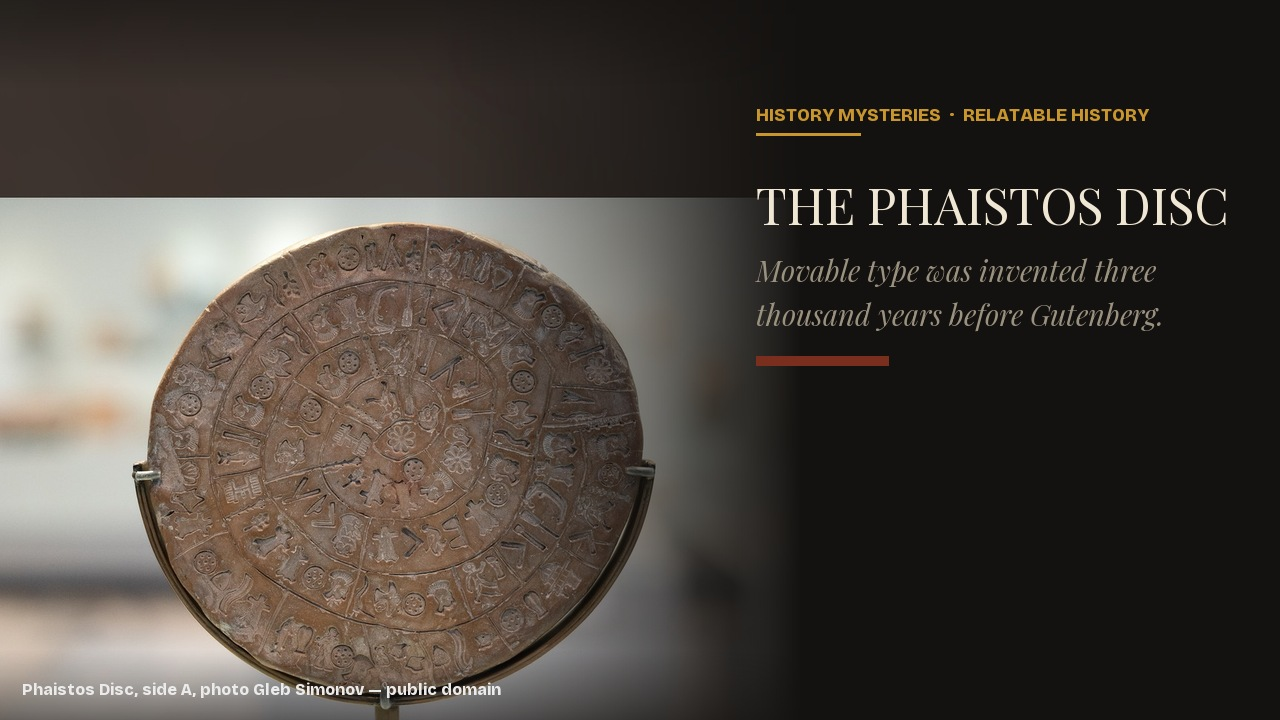
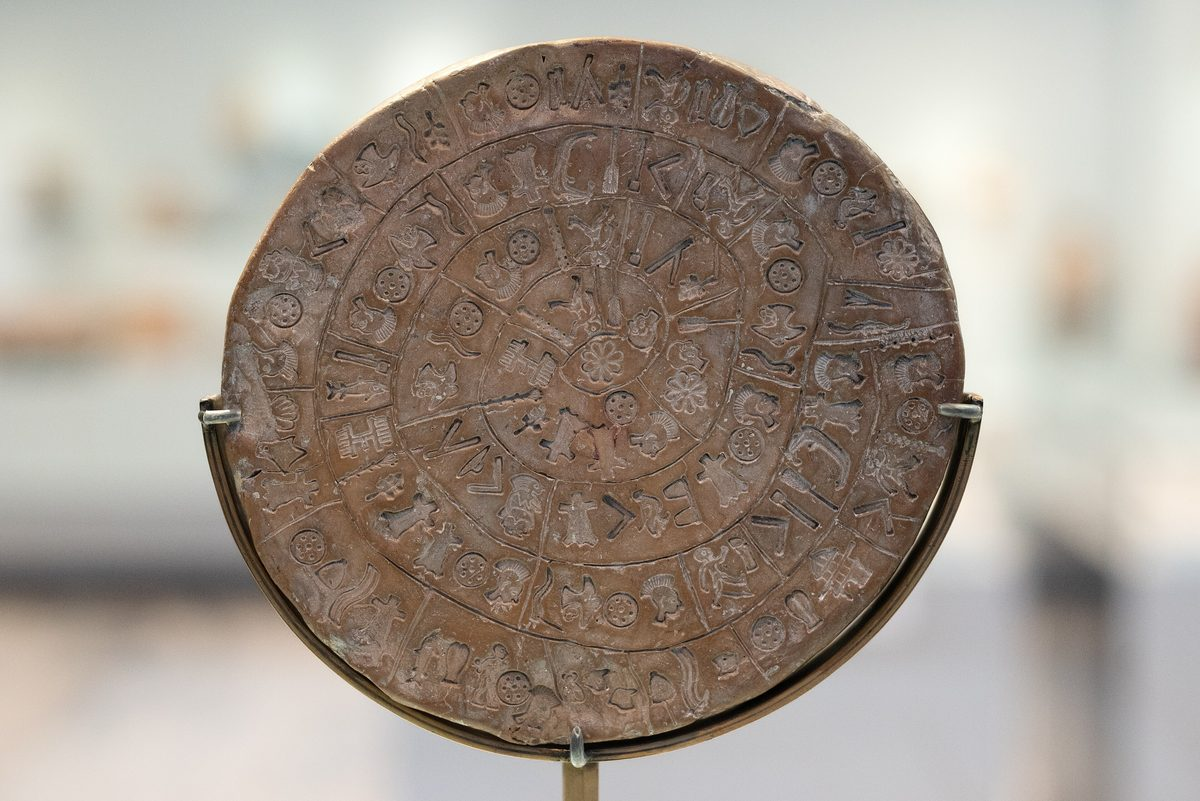
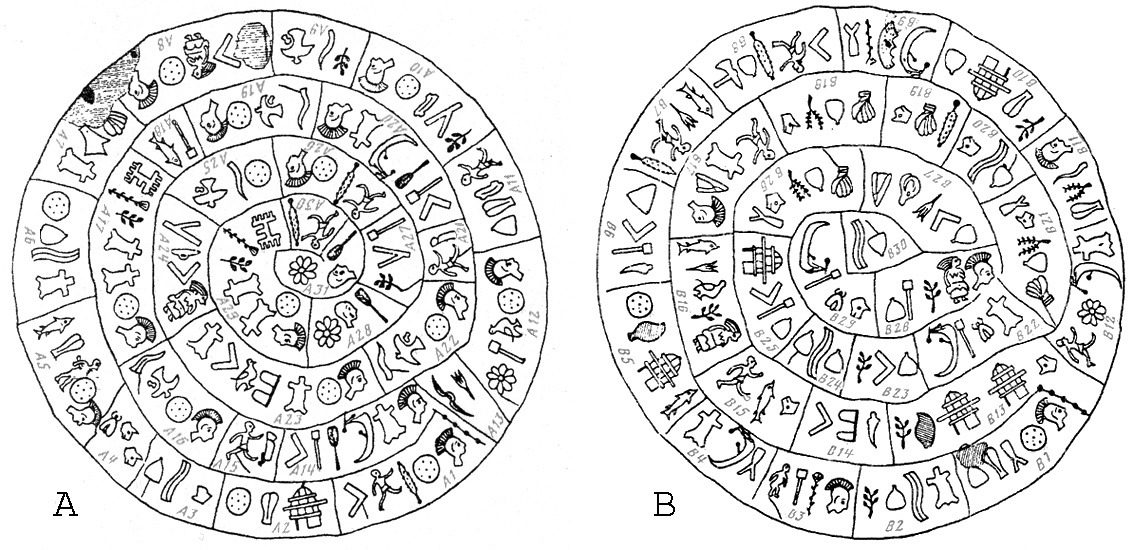
On the evening of 3 July 1908, a local foreman working an Italian excavation at the Bronze Age palace of Phaistos, on the south coast of Crete, turned up a disc of fired clay about the size of a salad plate. It was not a planned find from a careful trench; it came out of a disturbed layer of ash and debris during routine digging, and the archaeologist in charge, Luigi Pernier, is the one who recognised what he was holding. Both faces were covered edge to centre in a spiral of small stamped pictures — two hundred and forty-one of them, made from only forty-five distinct designs.
That detail is the quiet bombshell at the centre of the object. The signs were not drawn, scratched, or incised the way every other Bronze Age script on Crete was written. Each one was pressed into the still-wet clay with its own carved punch, and the same forty-five punches were used over and over to build the whole text. A craftsman in the second millennium BC appears to have owned a working set of reusable type, roughly three thousand years before Johannes Gutenberg is credited with inventing the idea in Mainz.
More than a century of study has not settled what the disc says, what the stamps were made of, or even — according to one determined critic — whether it is an authentic Bronze Age object at all. What follows is the state of that argument: what is actually documented, where the evidence runs out, and the three competing explanations currently on the table.
The disc turned up in a destruction layer, not a sealed deposit
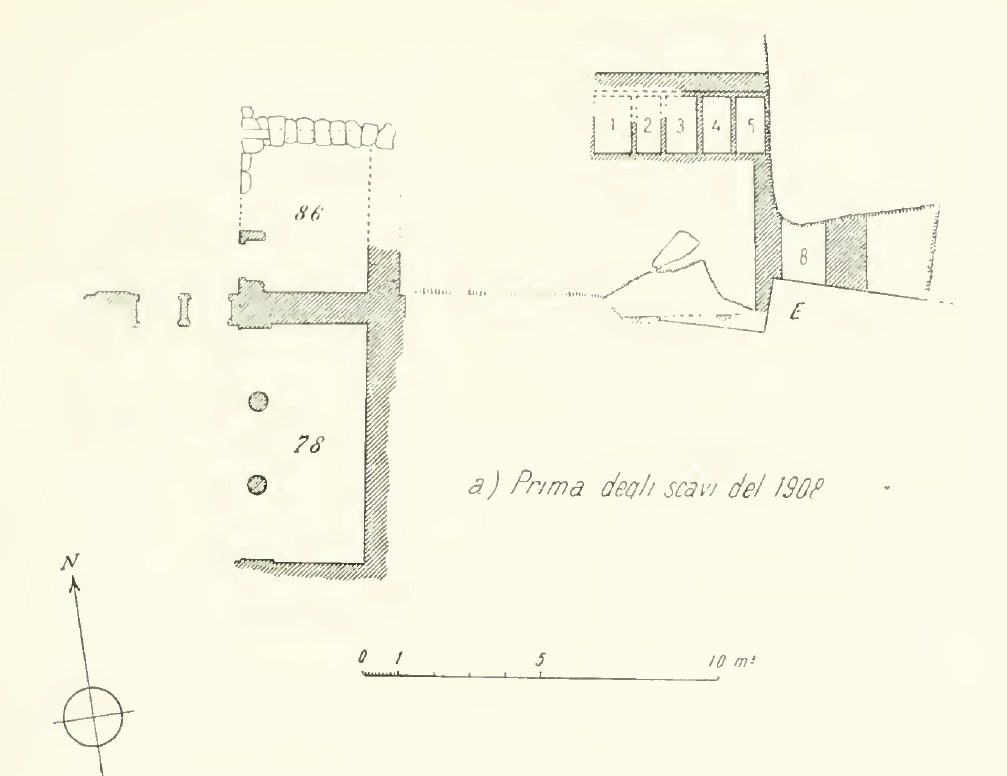
Phaistos was one of several Minoan palatial centres on Crete, and by 1908 the Italian Archaeological Mission had been excavating there for several years. The disc came from Room 101 of what excavators call the North-Eastern Complex, in a context that later fieldwork has described as a disturbed destruction level rather than an intact, datable floor deposit. That matters more than it might sound: a destruction layer can mix material from more than one period, which is part of why the disc’s exact date has never been pinned down as tightly as archaeologists would like.
The conventional dating places it in the Middle Minoan period, somewhere around 1700 BC, but more recent fieldwork by the archaeologist Pietro Militello has argued for a narrower window at the start of the Middle Minoan IIIA phase, without being able to fully rule out the slightly earlier Middle Minoan IIB. No second disc, no workshop, and no cache of punches has ever turned up anywhere on Crete to anchor the question further. Whatever made the Phaistos Disc, it appears to have been a one-off, or the only one that happened to survive.
Every sign was stamped with a reusable punch, not written by hand
Pernier noticed the stamping almost immediately, and it has never been seriously disputed: close inspection of the clay shows the crisp, repeated edges of a die pressed into soft material, not the varying pressure and angle of a hand-held stylus. The forty-five distinct pictures — among them a plumed human head, a pedestrian figure, a shield, a ship, a fish, a bird, and a helmet, according to the sign catalogue built up from Pernier’s original publication and refined over the following decades — recur in different combinations across the full 241 (by some counts 242) impressions.
That is the detail that gets the disc compared to movable type. True movable type requires more than repeatable stamps: it requires the idea that a finite set of reusable symbols can be rearranged to produce any text you like, which is exactly what the Phaistos Disc’s maker was doing with forty-five punches and a lump of wet clay. Nothing else survives from Bronze Age Crete, or from the wider Bronze Age Mediterranean, that was produced this way. Every contemporary Cretan script — Cretan Hieroglyphic, and the still undeciphered Linear A — was incised sign by sign.
There is a second, easily missed detail in the clay itself: the disc was deliberately fired after it was stamped, hardening it into something closer to pottery than to a working note. Most surviving Linear A and Linear B documents from the Aegean Bronze Age were never meant to last that long — they are everyday clay tablets that happened to be baked solid by accident, when the buildings storing them burned down. Whoever made the Phaistos Disc chose to fix it permanently on purpose, which is a strange amount of care to spend on an object if it was only ever meant to be read once and discarded.
The layout was built to be read a specific way — we just don’t know the language
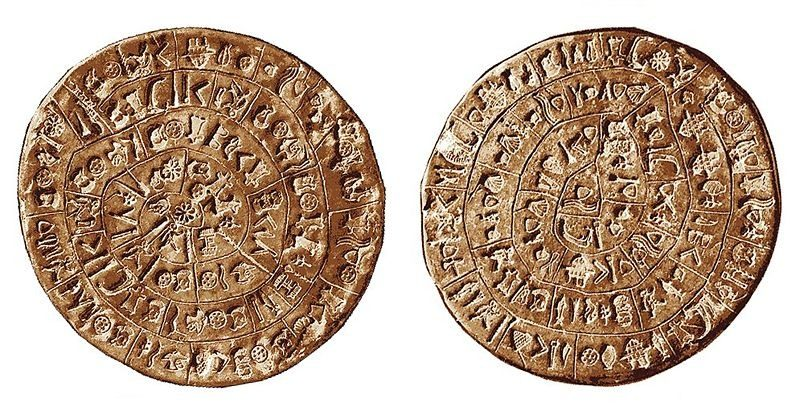
The signs run in a spiral from the rim toward the centre of each face, and vertical incised lines divide that spiral into roughly sixty-one clusters, almost certainly marking word or phrase boundaries. A small vertical line topped with five dots sits on the outer edge of both sides, which most researchers take as a marker of where the reading begins and which direction it runs. In other words, the disc was clearly built as a text meant to be followed in a specific order by somebody — the structure is confident and consistent. What nobody has established is what language sat behind that structure, which is the single biggest reason every decipherment attempt has run aground.
A text this short — a few hundred sign-instances, drawn from only forty-five distinct signs — is close to the theoretical floor for statistical decipherment of an unknown script in an unknown language. Linear B was cracked in the 1950s partly because hundreds of tablets existed to cross-check patterns against. The Phaistos Disc is one object. No second disc, no bilingual inscription, and no related long document in the same system has ever been found to check a proposed reading against.
One specialist spent decades arguing it’s a modern forgery
In 2008, on the disc’s hundredth anniversary, the art historian and Minerva magazine editor Jerome Eisenberg published a long argument that the Phaistos Disc is not Bronze Age at all, but a hoax perpetrated around the time of its announced discovery. His case rested on the disc’s unusually crisp condition for an object that had supposedly spent over three thousand years in the ground, the absence of any comparable find before or since, and what he read as inconsistencies in the firing and the find circumstances.
The strongest answer to that argument has come from later fieldwork rather than from re-examining the disc itself. Writing in 2024, the archaeologist Giorgia Baldacci pointed to pot-marks and impressed pottery decoration excavated at Phaistos and nearby sites well after 1908, carrying shapes that match several of the disc’s forty-five signs. A forger working in 1908 could not have copied comparanda that archaeologists would not dig up for decades. That does not erase every question Eisenberg raised, but it is the kind of evidence that is very hard to explain away on a forgery theory, and it is a large part of why most specialists continue to treat the disc as genuine.
Every proposed decipherment so far has been rejected by other specialists
That hasn’t stopped people from trying to read it, and the record of those attempts is itself part of the story. The French independent scholar Jean Faucounau was one of several to publish a full decipherment, which the Mycenologist Yves Duhoux dismantled in a 2000 review in the American Journal of Archaeology, concluding that the proposed method could not be distinguished from chance. The most widely reported attempt came in 2014, when Gareth Owens, after several years comparing the disc’s signs to tentative Linear A sound values, announced that the most frequently recurring word appeared to mean “mother,” and proposed the whole text was a prayer or hymn addressed to a mother goddess.
The pushback from other specialists was immediate and specific. The Mycenologist Thomas Palaima noted that “every proposed decipherment… fails the standard of probability,” and the script scholar Brent Davis called Owens’s readings “based on a stack of unverifiable assumptions,” pointing out that Linear A itself remains undeciphered, so building sound values for one unread script on tentative guesses from another unread script compounds the uncertainty rather than resolving it. Owens himself was careful to say the language underneath both scripts is still unknown. The “mother goddess” reading has not been accepted by the field, but it remains the decipherment claim most people have actually heard of.
Part of why it travelled so widely is how it was announced: Owens presented the findings through a University of Crete press release rather than a peer-reviewed paper, which is exactly backwards from how a decipherment normally earns acceptance. A journal article lets other specialists check the method before the public hears the conclusion; a press release does the opposite, and Palaima’s and Davis’s objections were, in effect, specialists catching up with a claim the wire services had already run with.
The newest theory says it was never a text at all
As recently as January 2026, an independent researcher, Constantinos Ragazas, circulated an analysis proposing that the disc is not writing in any language but the board for a game, in the tradition of Bronze Age spiral-track games like Egyptian mehen. The argument leans on physical evidence rather than linguistics: the stamped impressions on one face sit noticeably shallower than on the other, consistent with the clay having partly dried between two separate work sessions, and the outer ring of sign-compartments faces outward as if meant to be read by players seated around the object rather than by one person following a spiral inward. This proposal has not gone through peer review and has not displaced the long-standing assumption that the disc carries language, but it is a reminder that even the premise that this is a text — not just its content — is still being argued over, a full century after it was dug up.
The same analysis also describes the disc as having been found unfired, in a palace storage context, and reads that as evidence it was an abandoned prototype rather than a completed object. That sits oddly next to the museum’s own description of the clay as intentionally fired before it ever left the ground — one more point on which the sources genuinely disagree, and a reminder that even the disc’s basic physical history isn’t settled, let alone its meaning.
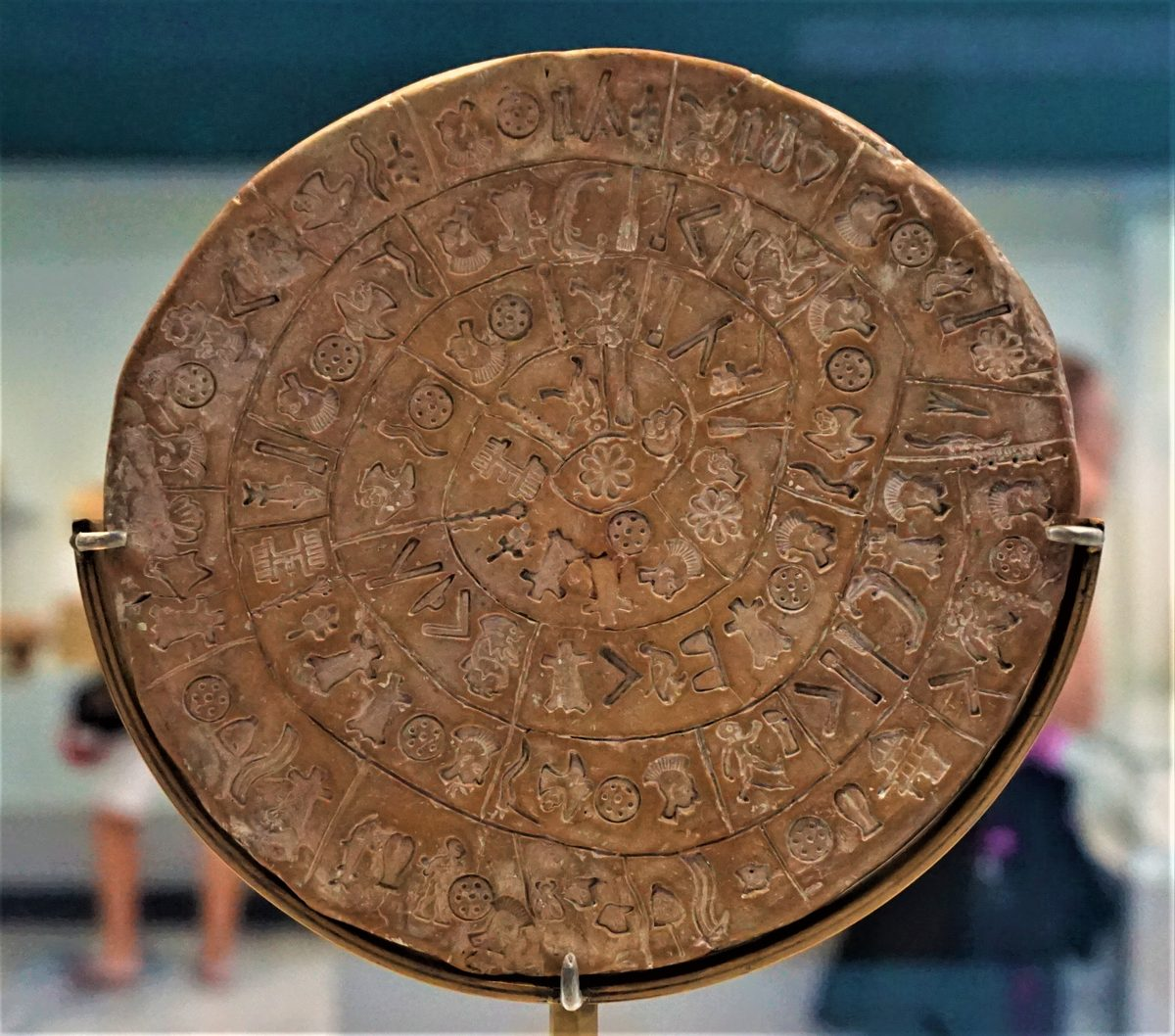
None of the three disputes — genuine artefact or forgery, language or game, and if language, which one — has been closed. What is not in dispute is where the object itself ended up: it has been on display at the Heraklion Archaeological Museum on Crete since well before any of these theories existed, available to be photographed, measured, and argued over by anyone who wants to try their own reading. A century of attempts means a century of new arguments, and there is no sign the disc is done generating them. The punches that stamped it have never surfaced, no workshop has been identified, and no second disc has ever been found to compare it against — which means every new theory about the Phaistos Disc has to be built from the same single object the last one was, and the next theory almost certainly will be too.
Watch the full history
No long-form video exists yet for this topic — the original 44-second short below covers the stamped signs and the movable-type comparison; this article is where the forgery claim, the decipherment fight, and the 2026 board-game theory are laid out in full.

Related reading
- Why Linear A Still Can’t Be Read — the other undeciphered Minoan script, found on the same island
- Why Nobody Can Read the Voynich Manuscript — a different unreadable document, with its own forgery debate
- Why Nobody Can Read Easter Island’s Own Writing System — another script that outlived the people who could read it
- The Mystery of the Beale Ciphers, Explained — a text nobody can crack, minus the archaeology
Works cited
- Baldacci, Giorgia. “The Phaistos Disc: Placing an Enigmatic Artefact in its Cultural Context.” In Writing from Invention to Decipherment. Oxford University Press, 2024.
- Baldacci, Giorgia. “The Phaistos Disk: An Enigmatic Artifact in its Cultural Context.” Ancient Near East Today, American Society of Overseas Research. Link.
- Olivier, Jean-Pierre. “Le disque de Phaistos.” Bulletin de Correspondance Hellénique 99, no. 1 (1975). Link.
- Duhoux, Yves. “How Not to Decipher the Phaistos Disc: A Review.” American Journal of Archaeology 104, no. 3 (2000): 597–600.
- Eisenberg, Jerome. “The Phaistos Disk: A One-Hundred-Year-Old Hoax?” Minerva 19, no. 4 (2008). Link.
- Ngo, Robin. “Has the Phaistos Disk Been Deciphered?” Bible History Daily, Biblical Archaeology Society, October 30, 2014. Link.
- “Phaistos Disk May Be a Prayer to a Mother Goddess.” University of Crete, via Phys.org, October 27, 2014.
- “Object Lesson: The Phaistos Disc.” World Archaeology, issue 84. Link.
- Heraklion Archaeological Museum. “The Phaistos Disc.” Prehistoric Exhibits.
- Godart, Louis. Le Disque de Phaistos: l’Énigme d’une Écriture. Editions Itanos, 1995.
- “The Phaistos Disc May Be the Board of a Millennia-Old Game Rather Than an Indecipherable Text.” La Brújula Verde, January 2026. Link.
- Unicode Technical Committee. “Proposal to Encode Phaistos Disc Signs,” response document L2/11-166 (2011), citing L. Godart, 1995. Link.