
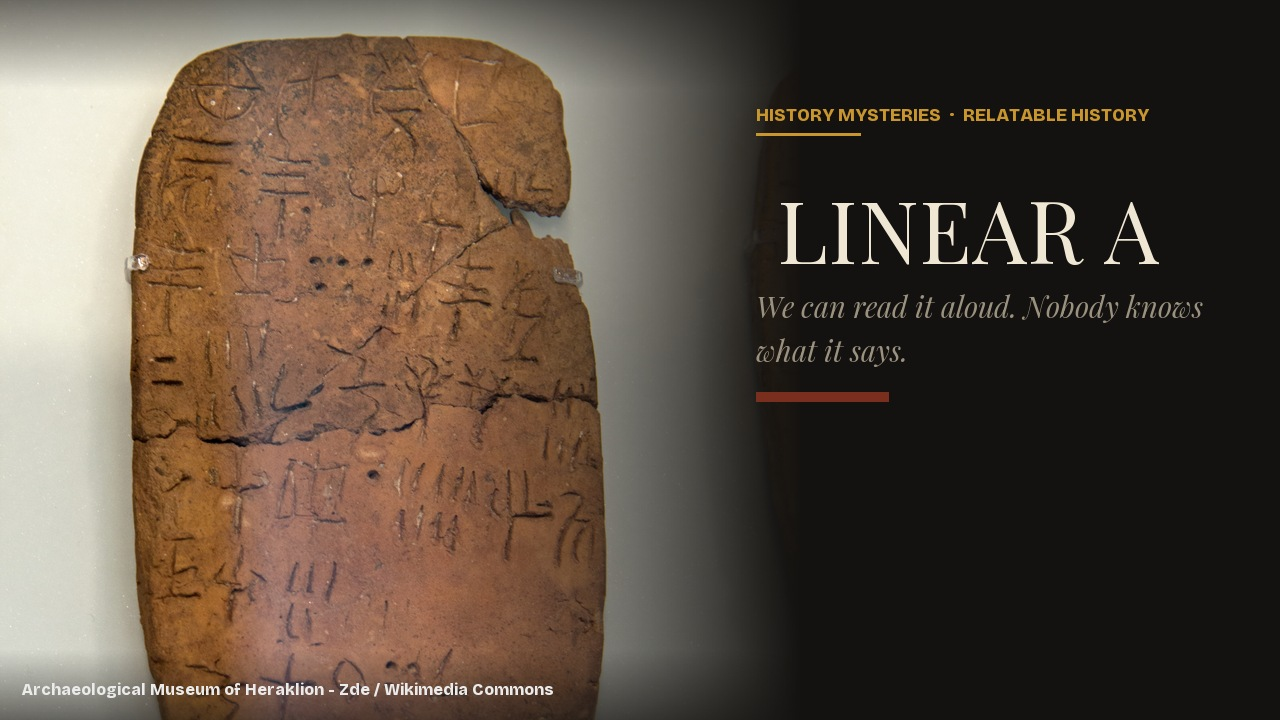
For a little over seventy years, it has been possible to open a Linear A tablet, work through its signs one at a time, and say the word out loud. That is not how undeciphered scripts usually behave. Most of them are silent shapes with no sound attached at all. Linear A hands you the sound and keeps the meaning.
The reason is an accident of what came after it. Linear A’s successor script, Linear B, was deciphered in 1952 and turned out to record an early form of Greek. The two scripts share the large majority of their signs, and where the sound values can be checked against a third, independently confirmed script, they line up closely. That means a Linear A tablet can be sounded out almost sign for sign using Linear B’s alphabet. What comes out is not Greek, and it is not any other language anyone has been able to identify. It is real, pronounceable syllables that go nowhere.
That gap between pronounceable and readable is why Linear A still can’t be read, even with a working phonetic key in hand, and it has now outlasted the study of most scripts that did get deciphered. Here is where that key comes from, why it stops short, and what more than a century of digging, cataloguing, and one very new computational claim have managed to recover instead.
Arthur Evans dug up two scripts and could only name their shapes
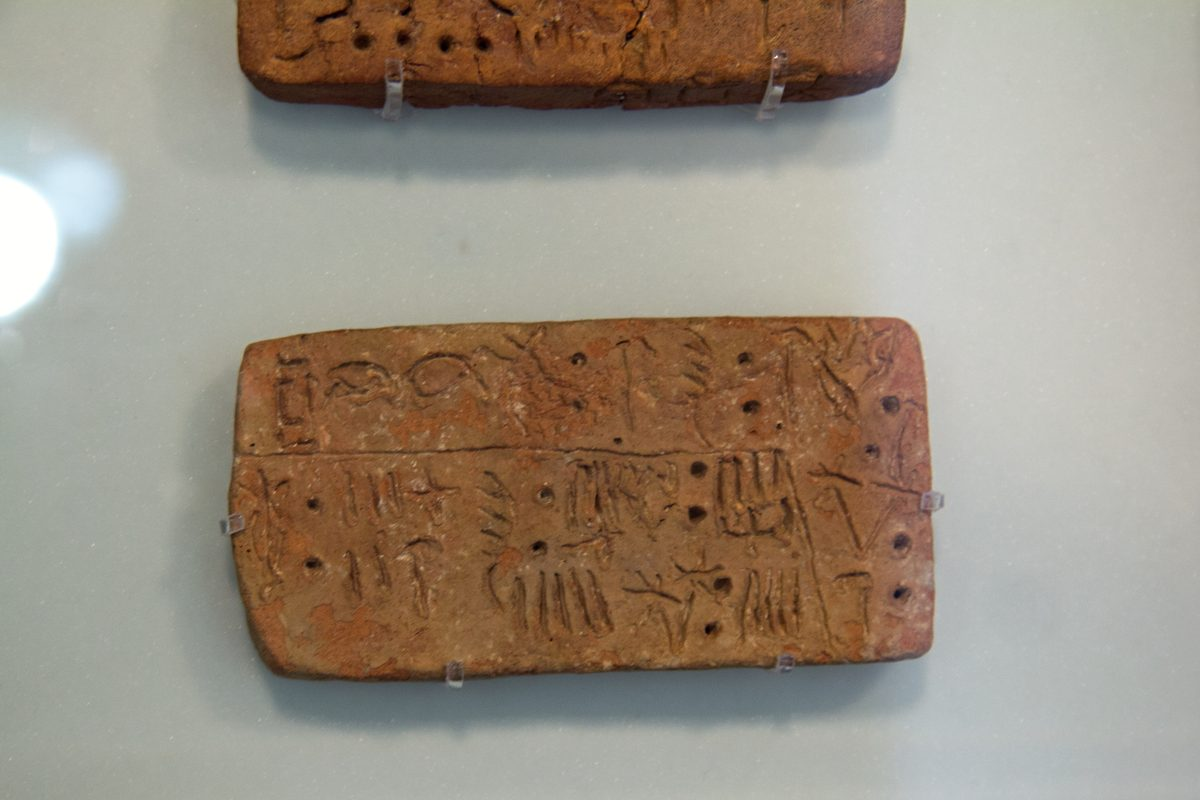
Arthur Evans began excavating at Knossos, on Crete, in 1900. He found a writing system he had not expected, in two related but distinct forms, and named both for the plainest thing he could say about them: their characters were simply lines incised in clay, in contrast to the more pictorial signs of a third, older script he called Cretan Hieroglyphic. The older of his two linear scripts he labelled Linear A. The younger he labelled Linear B.
Linear A was in use from roughly 1800 to 1450 BCE, the period Aegean archaeologists call the Middle and early Late Minoan. Cretan Hieroglyphic and Linear A overlapped for part of that span before Linear A took over as the island’s dominant script. Then, within a few decades of 1450 BCE, the Minoan palace system collapsed in a wave of destructions, and Linear A administration stopped with it, a couple of centuries before the wider Bronze Age collapse took down palace economies across the eastern Mediterranean. A new script, Linear B, appears fifty to seventy-five years later on Crete and the Greek mainland, built directly on Linear A’s signs but serving a different administration entirely.
Evans spent the following decades excavating and partially reconstructing Knossos, and his papers and finds now sit largely in the Ashmolean Museum at Oxford, where he had been curator since 1884. What he could not do, in his lifetime or for nearly fifty years after, was read a word of either script he had found.
The script that broke made the one that didn’t look breakable
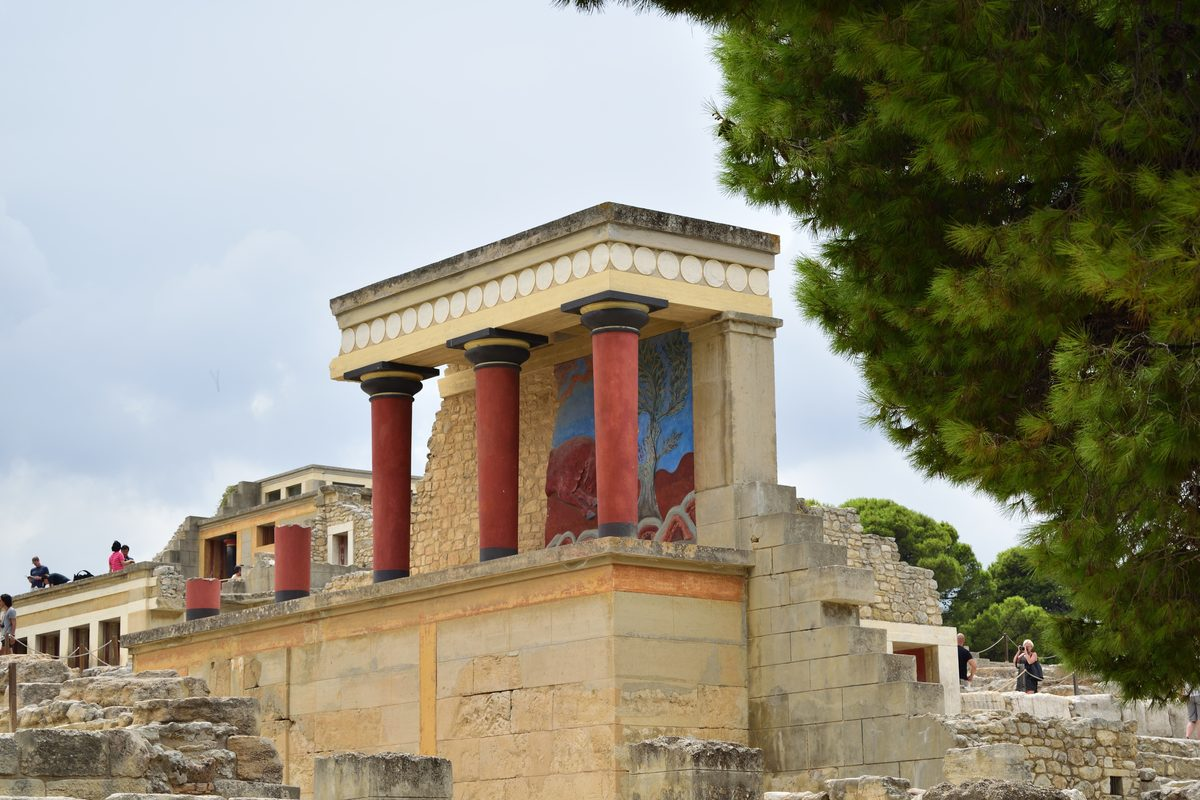
Linear B fell first. Michael Ventris, an architect working on the problem in his spare time, announced in 1952 that the script recorded an early form of Greek, centuries older than Homer — the oldest written Greek then known. He had no bilingual text to work from. What he had was a hunch about place names: certain sign-groups repeated in patterns that looked like they could be Cretan and mainland toponyms already known from later Greek, and when he tried reading them as Greek words, the grammar started working. Cambridge classicist John Chadwick joined the effort within weeks of the announcement, and the two confirmed and extended the decipherment together.
Because Linear A and Linear B share most of their signs, the temptation to treat Ventris’s result as half of Linear A’s answer is obvious, and scholars did not resist it for long. Where a sign’s Linear B value can be cross-checked against the Cypriot syllabary, a separate script that also descends from Linear A, roughly ten core signs show a clean three-way match. That gives real confidence in at least a working sound value for a meaningful share of the Linear A syllabary, and by extension for tablets that use it.
What it does not give is a language. The words that come out of a sounded-out Linear A tablet do not resolve into Greek, or into any other language with a known grammar and vocabulary to check them against. Researchers refer to the language underneath as “Minoan” for lack of anything better, and it has been proposed at various points to be an early Anatolian language related to Luwian, a Semitic language, an Indo-European language of some other branch, or something with no surviving relatives at all. A 2024 computational study that measured Linear A signs against Ancient Egyptian, Luwian, Hittite, Proto-Celtic and Uralic vocabulary found only isolated, uncertain word matches in each direction — not the kind of systematic overlap a real relationship would produce. The honest label for Minoan remains unclassified.

The entire written record fits on two pages
Roughly 1,400 Linear A inscriptions survive, carrying about 7,400 individual signs between them. Another 1,100 or so inscribed objects have turned up too damaged or worn to read and are not counted in that total. The Kansas classicist John Younger, who has spent decades cataloguing the corpus, has pointed out what that actually amounts to in practical terms: typeset at twelve-point type with standard margins, every surviving word of Linear A fits on one and eight-tenths pages of letter paper.
Linear B, by comparison, survives in roughly 6,000 texts. That difference matters more than it might seem to. Decipherment, whether by a hunch about place names or by statistical pattern-matching, depends on repetition — on seeing the same word or sign-cluster often enough, in enough different contexts, to triangulate what it must mean. A corpus that fits on two pages does not generate enough repetition to triangulate much of anything. Small samples are a genuine, structural limit on what any method, however clever, can extract from this particular body of text.
Almost half of it comes from one archive at the edge of a fire
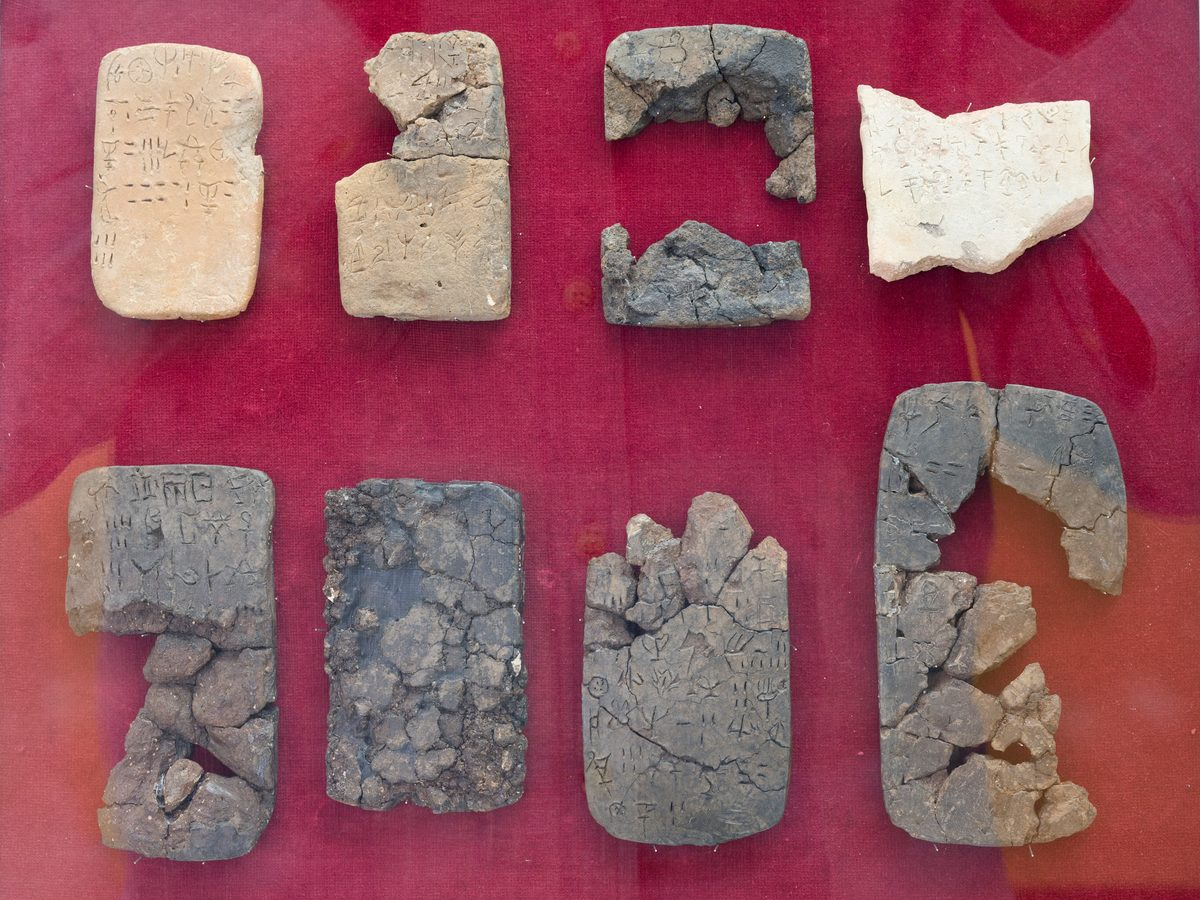
The surviving inscriptions are not evenly spread across Crete. Roughly half of all known Linear A objects — 1,269 of them — come from a single site, Hagia Triada in the south of the island. Zakros, on the eastern coast, has produced 595. Khania has 313, Phaistos 65, Knossos itself only 32, and Palaikastro 23. Every other findspot on Crete or in the wider Aegean has yielded fewer than twenty.
That lopsided distribution has a specific, almost accidental cause. Most Linear A documents were unfired clay, meant to be read, acted on, and then soaked down and reused — ordinary paperwork, not archival record. What survives in any quantity comes overwhelmingly from the final decades before the Late Minoan IB destructions around 1450 BCE, when fires that burned down Minoan administrative buildings accidentally fired the clay tablets inside them, baking documents that were never meant to last into some of the only ones that did. Hagia Triada’s outsized share of the corpus is, in a real sense, a record of how badly it burned.
The genre of what survives is heavily administrative: counts of grain, oil, wine, livestock, textiles, and people, organised by place-name and quantity rather than written as sentences — the same numbers-first record-keeping that kept England’s medieval exchequer running on wooden tally sticks. A smaller set of religious or votive objects — stone libation tables and vessels from sanctuary sites — carry a short, repeated formula that scholars can describe structurally even without being able to translate it.
Why Linear A Still Can’t Be Read Without a Rosetta Stone
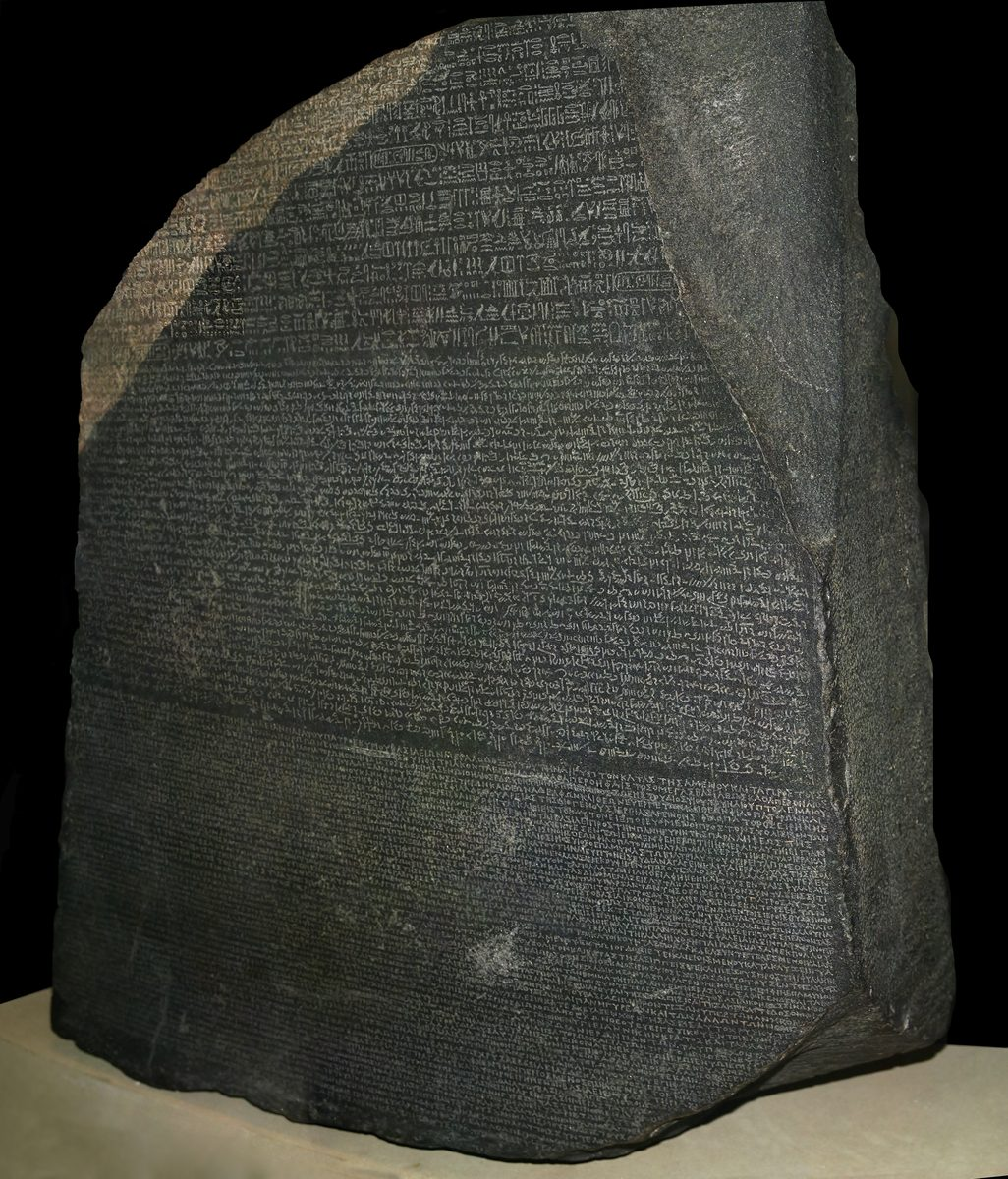
Every other major decipherment of an ancient script in the last two centuries has leaned on a bilingual or trilingual text. Egyptian hieroglyphs fell after the Rosetta Stone gave scholars the same decree in hieroglyphic, Demotic, and Greek. Old Persian cuneiform fell to the Behistun Inscription, carved in three languages on a Persian cliff face, and that decipherment in turn opened the door to Akkadian. Linear B is the outlier that makes the comparison sting: Ventris broke it without a bilingual, but only because the language underneath, Greek, was already known in later form, which let him check his guesses about place names against something real.
Linear A has neither door available. No bilingual inscription pairing Linear A with any known script or language has ever been found, on Crete or anywhere else, despite more than a hundred and twenty-five years of excavation across the island and the wider eastern Mediterranean. A handful of possible Linear A traces turn up outside Crete — fragments at Troy, Samothrace, and Tel Haror among them — but they are short, disputed, and not remotely bilingual. And because the underlying language has no identified living or historical relative, the second route Ventris used, checking a guess against a known language, is not available either — the same wall that keeps Easter Island’s rongorongo script unread nearly two centuries after Europeans first saw it. Linear A is a script whose sound is largely recovered and whose sense has no way in.
A 2026 attempt to read the tablets without reading the language
In January 2026, the historian Ararat Petrosyan published a different kind of approach, as a guest article rather than in a peer-reviewed journal, which is worth flagging up front: it has not been through the review process that the academic sources above have. The method does not try to translate Linear A at all. Instead, it classifies what a tablet was for — an inventory record, a labour record, a ritual distribution, an export document, a strategic reserve — using only its numbers, which sign-types appear together, and where on Crete it was excavated. None of that requires reading a single word, which puts it closer in spirit to the numerical patience behind the Beale ciphers than to a conventional decipherment.
Tested blind against five tablets from different Minoan archives, the method reportedly identified the correct administrative category with about 71 percent average accuracy. It did best on strategic-reserve records, at 85 to 95 percent, and on labour records, around 88 percent; it did worst on export records, as low as 55 percent, where the evidence was thinnest. Those are claims from a single self-published test, not a replicated result, and they should be read that way. What they do illustrate is a real and separate insight: administrative logic — how a bureaucracy organises quantities, storage, and labour — can sometimes be reconstructed from structure alone, independent of whether the underlying language is understood.
Watch the full history
The video covers Evans’s dig, the 1952 decipherment of Linear B, and the size of the surviving Linear A corpus in just over three minutes.

Related reading
- Was the Baghdad Battery Real? What the Evidence Actually Shows
- How Wooden Tally Sticks Ran England’s Treasury for 600 Years
- Who Really Invented the Telegraph Key (It Wasn’t Samuel Morse)
- How Semaphore Flags Actually Worked at Sea
Works cited
- Salgarella, Ester. Writing in Bronze Age Crete: ‘Minoan’ Linear A. Cambridge Elements. Cambridge University Press, 2025. DOI: 10.1017/9781009520041.
- Perono Cacciafoco, Francesco. “Minoan Cryptanalysis: Computational Approaches to Deciphering Linear A and Assessing Its Connections with Language Families from the Mediterranean and the Black Sea Areas.” Information 15, no. 2 (2024): 73. DOI: 10.3390/info15020073. (mdpi.com returns 403 to automated requests; cited as print.)
- Godart, Louis, and Jean-Pierre Olivier. Recueil des inscriptions en linéaire A (GORILA). 5 vols. École française d’Athènes, 1976–1985.
- Younger, John G. “Linear A Texts and Inscriptions in Phonetic Transcription.” University of Kansas, Department of Classics. (academia.edu returns 403 to automated requests; cited as print.)
- “Sir Arthur Evans: Linear B.” Sir Arthur Evans Archive, Ashmolean Museum, University of Oxford. Link.
- “Michael Ventris.” Encyclopaedia Britannica. (britannica.com returns 403 to automated requests; cited as print.)
- “The Decipherment of Linear B.” Mycenaean Epigraphy Group, Faculty of Classics, University of Cambridge. Link.
- “Explore the Rosetta Stone.” Collection Online, British Museum. (britishmuseum.org returns 403 to automated requests; cited as print.)
- Petrosyan, Ararat. “Scholars Reconstruct Linear A Meanings Without Cracking the Language.” GreekReporter.com, January 15, 2026. Guest article; the method has not been published in a peer-reviewed venue. (greekreporter.com returns 403 to automated requests; cited as print.)