
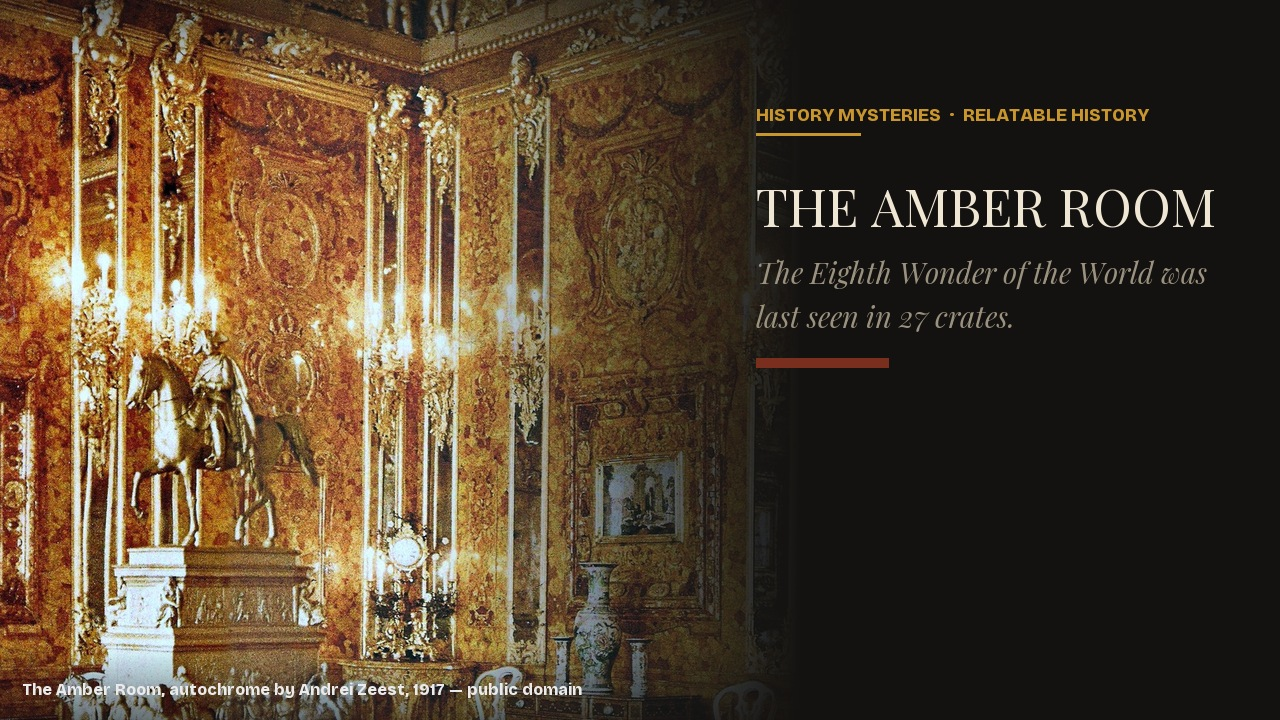
In January 1945, the German official in charge of the Amber Room’s safekeeping received an order: pack it up. His men worked the amber panels into twenty-four strongboxes, finished the job on January 15, and stacked the crates in the courtyard of Königsberg Castle to await transport to a mine in Saxony. The crates never left the courtyard. They were still there, and then they weren’t, and nobody has produced a credible account of what happened in between.
That sequence matters because it contradicts the version of this story most people know — the one where the Amber Room simply burns up with the castle in an Allied air raid. The castle was bombed in August 1944, five months before that repacking order. Whatever was lost here, it survived the fire everyone blames for its disappearance, only to vanish afterward in a far more mundane way: a stack of crates in a courtyard, unguarded long enough for someone to make them disappear.
The object behind all this was a fully amber-panelled chamber, a diplomatic gift from Prussia to Russia, installed outside St. Petersburg for two centuries before German forces dismantled it in 1941. Two of the men who spent their lives trying to find it again died in the same year, by different and disputed causes, having never agreed with each other about where it went.
The room was built once in Prussia and rebuilt once in Russia before it vanished a third time
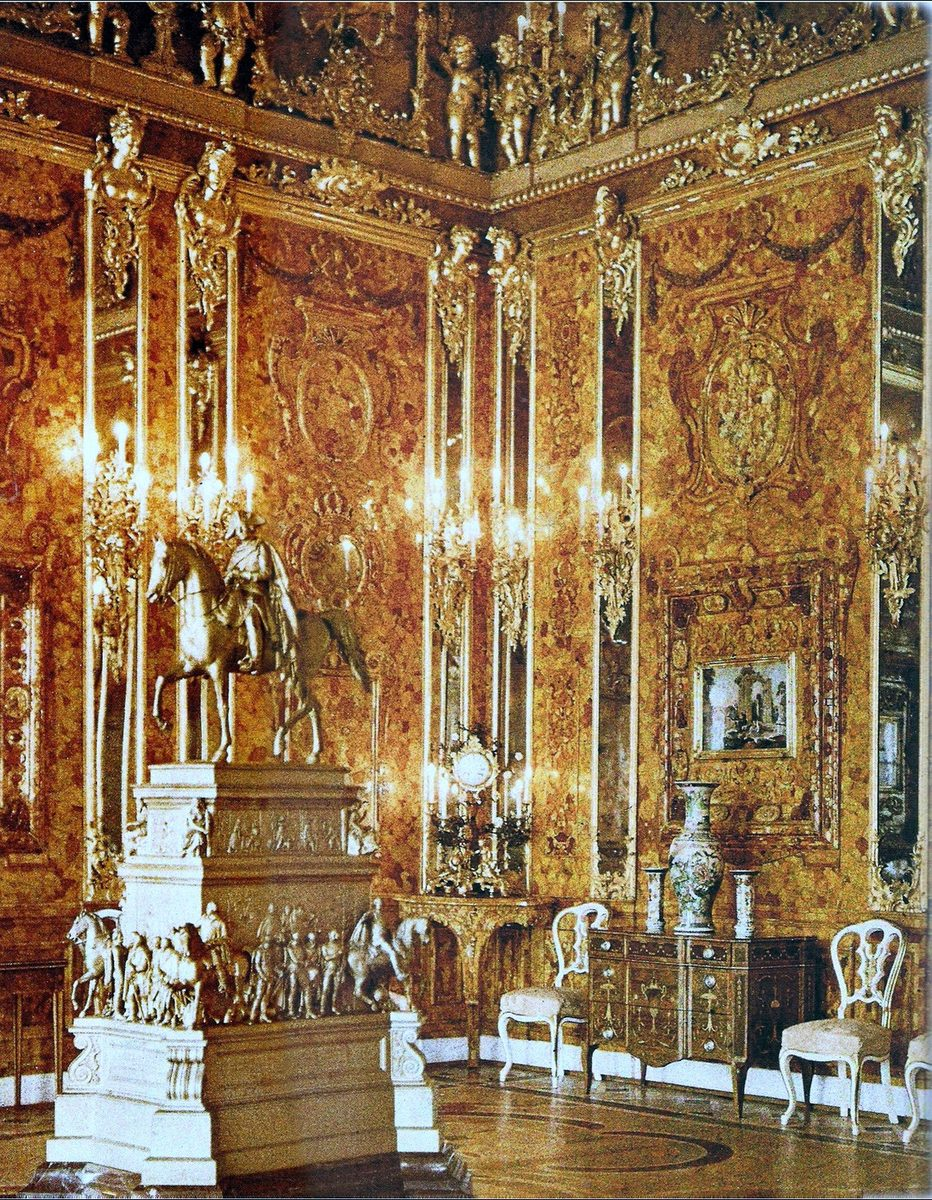
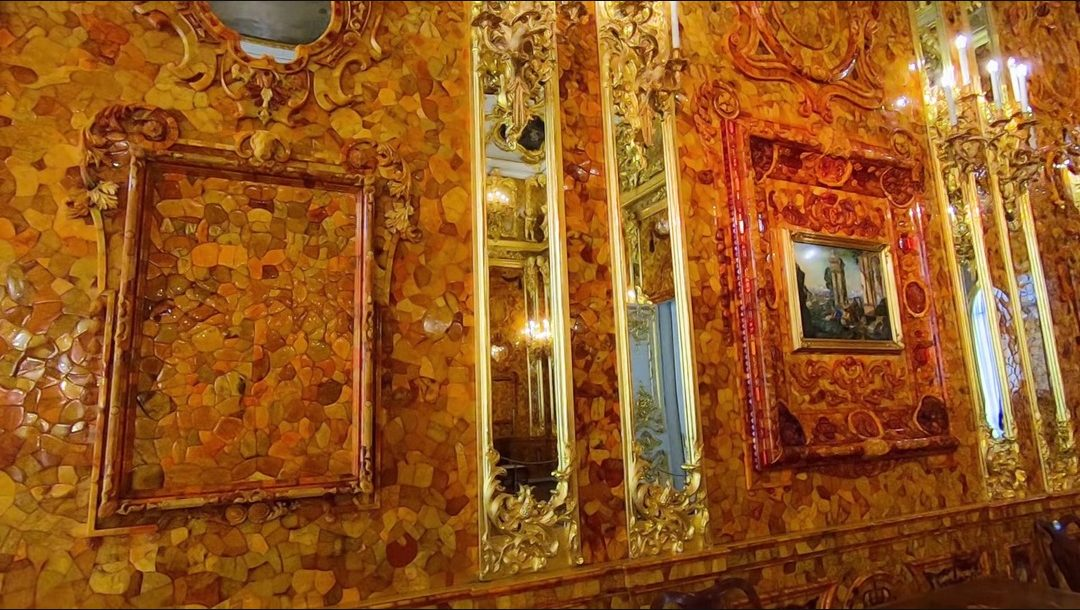
Work on the room began in 1701 at the Prussian court, designed by the sculptor Andreas Schlüter and executed first by the craftsman Gottfried Wolfram, then finished by two master amber-workers from Danzig, Gottfried Turau and Ernst Schacht, under Frederick I of Prussia. In 1716, Frederick’s son and successor, Frederick William I, gave the finished room to Tsar Peter the Great, cementing an alliance against Sweden. It took until 1755 for the room to find its final form: installed at the Catherine Palace outside St. Petersburg, the Italian architect Bartolomeo Francesco Rastrelli enlarged it to cover roughly 74 square metres of wall, using close to six tonnes of amber and semi-precious stone across twelve main panels, some standing more than 3.5 metres high.
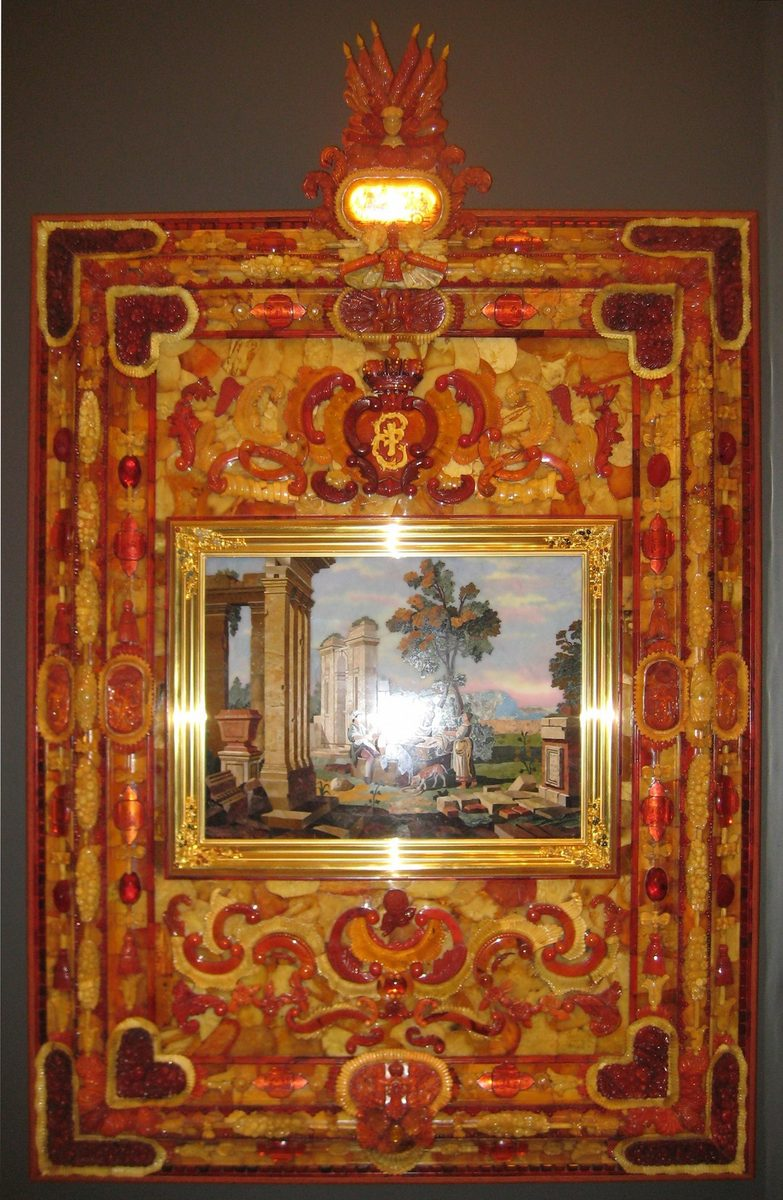
None of that amber was decorative in the way a modern reader might picture. Mosaic panels were built up from amber slices of deliberately varied colour, mounted on oak backing with bronze foil behind them to intensify the glow, held in place with an adhesive of pine resin and beeswax. Carved amber ornament covered roughly eighty percent of the wall surface, and four small stone mosaics by the Florentine artist Giuseppe Zocchi, each an allegory for one of the senses, were set directly into the amber panelling — the detail that would matter most, decades later. It was, by any measure, one of the most materially extravagant rooms ever built, and Russians had taken to calling it the Eighth Wonder of the World well before anyone needed a more dramatic reason to.
The amber itself was not an abstract luxury import. Baltic amber is fossilised resin from conifers that grew across the region roughly 40 to 50 million years ago, concentrated in a layer geologists call the Blue Earth, found almost nowhere in workable quantity outside the Samland peninsula near what is now Kaliningrad — the same stretch of coast the room’s crates would, two centuries later, be shipped toward rather than away from.
Soviet curators tried to hide the room, not move it, because the amber itself could not survive a fast evacuation
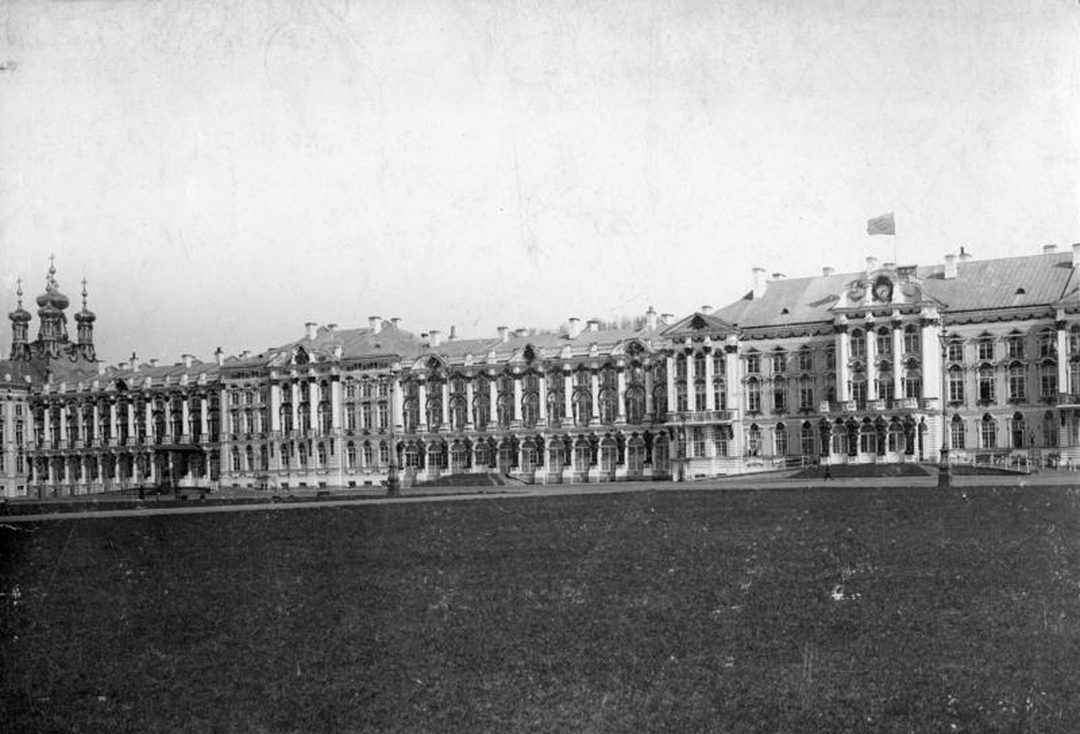
When German forces advanced on Leningrad in the summer of 1941, palace staff attempted to remove the panels for evacuation along with the rest of the Catherine Palace’s treasures. The amber, dried and brittle after two centuries, began to crumble as soon as they tried. Rather than risk destroying it outright, the curators — among them Anatoly Kuchumov, the palace’s chief curator, a man who would go on to spend much of the rest of his career looking for the room he failed to save here — left it in place and built a false wall over it, reportedly disguised under ordinary wallpaper, gambling that the room would simply be overlooked.
It was not. German officers recognised the room for what it was, and a Wehrmacht officer, Rittmeister Graf Solms-Laubach, supervised a team that dismantled the entire chamber in thirty-six hours. The panels were packed into twenty-seven crates and shipped out of the city on October 14, 1941, bound for Königsberg, more than 500 kilometres to the west — a place with its own, very direct connection to the room’s materials, since the amber itself had almost certainly been mined from deposits along that same stretch of Baltic coast in the first place.
Erich Koch ordered it packed again in January 1945 — and that is where the documented trail actually goes cold
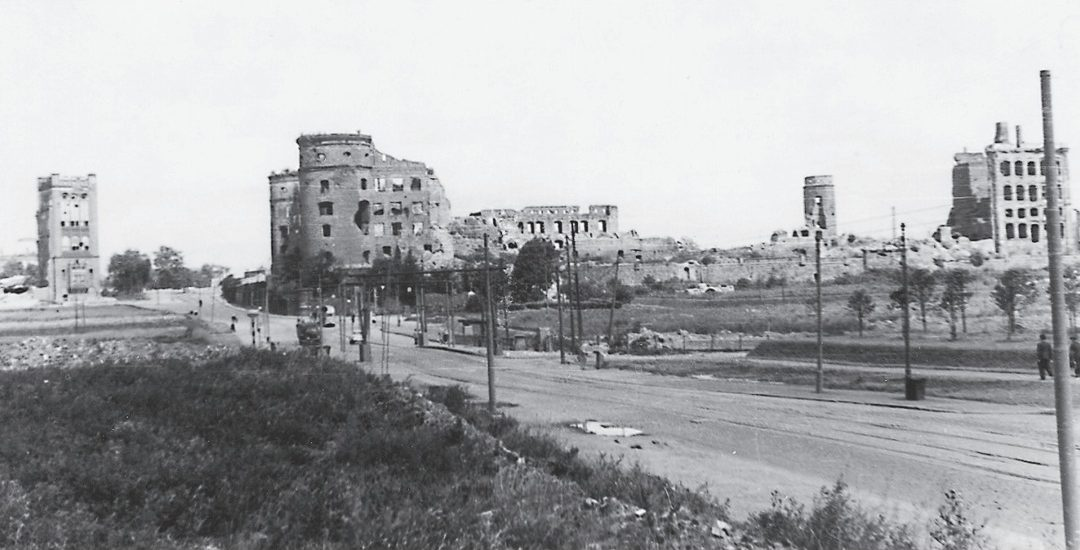
Reassembled, the room went on display at Königsberg Castle under the direction of Alfred Rohde, the city’s amber-art expert and head of its art collections, who personally oversaw the reconstruction in 1941 and 1942. Erich Koch, the regional Nazi Party chief, had it presented as German property “restored” to its rightful place. It survived the British bombing raids that gutted much of Königsberg in August 1944, apparently stored away from the worst of the damage.
What happened next is the part most retellings skip. As Soviet forces closed in during the winter of 1944 to 1945, Koch ordered the room packed again, this time for evacuation to Wechselburg in Saxony. The job was finished on January 15, 1945, and the crates were stacked in the castle courtyard. Then they were gone. Rohde, questioned by Soviet investigators after the war, reportedly gave inconsistent answers about which wing of the castle the room had last been stored in — evasive enough that one historian examining the case concluded he was still trying to protect German interests even as the city collapsed around him. Rohde and his wife died of typhus and starvation in Königsberg in December 1945, by which point the Soviet army had held the ruined city for months.
The two searchers who took the case most seriously died within months of each other
For decades afterward, the hunt for the Amber Room ran on two separate, uncoordinated tracks. Georg Stein, a West German farmer turned amateur investigator, spent years and his own fortune chasing leads through salt mines and sealed bunkers across the former East Prussia. On the other side of the Iron Curtain, Paul Enke, an East German Stasi officer, pursued an overlapping but frequently contradictory set of theories using state resources Stein never had. Neither man’s leads panned out, and the two rarely agreed on where to look next.
In 1987, both men died. Stein was found in a Bavarian forest; accounts differ on whether his body showed a gunshot wound or a surgical-looking cut, and on whether it was suicide, as officially recorded, or something else, as his family believed. Enke died the same year by unrelated, undramatic causes. Between them they had spent roughly four decades and substantial sums narrowing the question down to four broad possibilities that still circulate today — it burned in 1944 or 1945, it is hidden somewhere in or around the former Königsberg, it went down with a ship evacuating the region across the Baltic, or Stalin had already swapped it for a convincing fake before the Germans ever got the real one — without ever producing evidence that settled on one of them.
Exactly one fragment of the original room has ever been confirmed to survive
In 1997, a small stone mosaic panel depicting an allegory of touch and smell — one of the four Zocchi panels set into the amber walls — surfaced in Bremen, offered for sale by the family of a German soldier connected to the unit that had handled the room during the war. A separate line of inquiry around the same period identified a man named Hans Achterman as holding another fragment through his father’s wartime involvement in the packing. German authorities seized the Bremen panel, and after authentication it was returned to Russia, where it is now displayed as the only unambiguously genuine piece of the original room known to exist anywhere. Every other claimed sighting, recovered crate, or located bunker in the decades since — including a widely reported 2017 claim involving a sealed door in a Polish fortification — has gone unsubstantiated.
Rebuilding it took twenty-four years, six tonnes of new amber, and two governments’ money
Soviet authorities approved a full reconstruction in 1979, working from surviving black-and-white photographs, a single color photograph taken in 1917, salvaged fragments, and whatever archival descriptions could be found. Researchers used spectroscopic analysis to determine the original adhesive’s exact composition — roughly 40 percent beeswax and 60 percent dammar resin — before developing a reversible modern substitute that could be removed without damaging the amber if later restoration was ever needed.
The project consumed close to six thousand kilograms of amber, sourced from the same Sambian peninsula deposits near Kaliningrad that had supplied the original room centuries earlier, and ultimately required roughly 100,000 individual pieces across more than 150 square metres of reconstructed surface. Funding very nearly killed the project: the Soviet government had invested about $7.85 million by 1991, when the USSR collapsed with less than half the panels finished. The German energy company Ruhrgas contributed a further $3.5 million in 1999, explicitly framed as a gesture of postwar reconciliation, which let Russian craftsmen finish the work in time for a May 2003 unveiling that both Russian President Vladimir Putin and German Chancellor Gerhard Schröder attended — the two countries that had spent six decades blaming each other for losing the original, jointly reopening a copy of it.
Line up the documented dates and the mystery narrows rather than widens, even if it does not close. The room did not burn with the castle in August 1944; it was still being repacked into strongboxes in a courtyard four months later. Nobody who searched hardest for it afterward, including a curator who had tried to save it in the first place and two independent investigators who gave decades and, in one disputed case, possibly his life to the question, ever agreed on where those strongboxes went next.
What survives for certain is smaller and stranger than the room itself: one stone panel that was never made of amber at all, recovered from a family who did not fully understand what they had, and a twenty-four-year, two-government reconstruction of everything else, built from black-and-white photographs, one color snapshot from 1917, and a chemist’s analysis of two-hundred-year-old glue. Cellar, shipwreck, or ashes was the question the short version left open. The paper trail argues for something plainer and harder to romanticise: a handful of people, under collapsing authority, moved some crates in a hurry during the last winter of a lost war, and nobody with a reason to find them again ever has.
Watch the full history
The short version of this story gets the room, the theft, and the 1997 mosaic into under a minute.

Related reading
- Why Nobody Can Read the Voynich Manuscript
- The True Story Behind the Flannan Isles Lighthouse Mystery
- The Mystery of the Beale Ciphers, Explained
- The Roman Legion That Vanished From The Record
Works cited
- Shor, Russell. “The History and Reconstruction of the Amber Room.” Gems & Gemology 54, no. 4 (Winter 2018). Link.
- Blumberg, Jess. “A Brief History of the Amber Room.” Smithsonian Magazine, July 31, 2007.
- Lyons, Chuck. “The Mystery of the Amber Room.” Warfare History Network.
- Bachmann, Stefan, and April Genevieve Tucholke. “The Enduring Mystery of the Amber Room, Coveted by Tsars, Nazis, and Treasure Hunters.” Atlas Obscura, February 14, 2024.
- “Amber Room.” Encyclopaedia Britannica.
- Janssen, Karl-Heinz. “Forty-Five Years Later and They’re Still Hunting for the Legendary Amber Room.” The Art Newspaper, January 1, 1992. Link.
- Matheau-Raven, E. R. “Baltic Amber from Kaliningrad.” Deposits Magazine, October 13, 2021.