
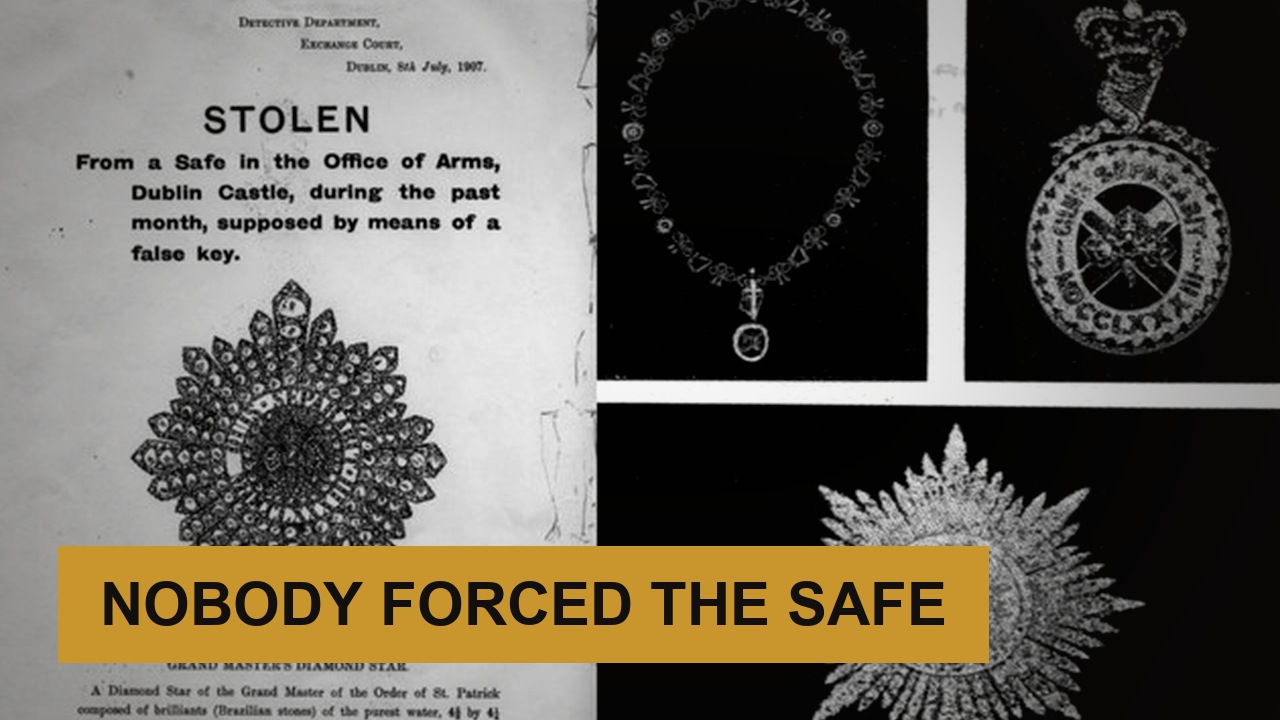
Whoever opened the safe holding Ireland’s crown jewels did not force the lock. They did not cut a key. And before they walked out of Dublin Castle on a July afternoon in 1907, they stopped to unclip a ribbon from one of the pieces and set it back down, neatly, inside its case.
That is the one physical clue the case has ever produced, and more than a century of investigation — by the Dublin Metropolitan Police, by a Scotland Yard chief inspector, and by a viceregal commission that sat in the very room the jewels had been kept in — has never explained it. The star, the badge and five gold collars worth a fortune vanished from a safe that only two keys could open, and the person who held both of them was never charged with anything.
Here is what the record, not the legend, actually says.
Ireland’s “Crown Jewels” Were Never a Crown
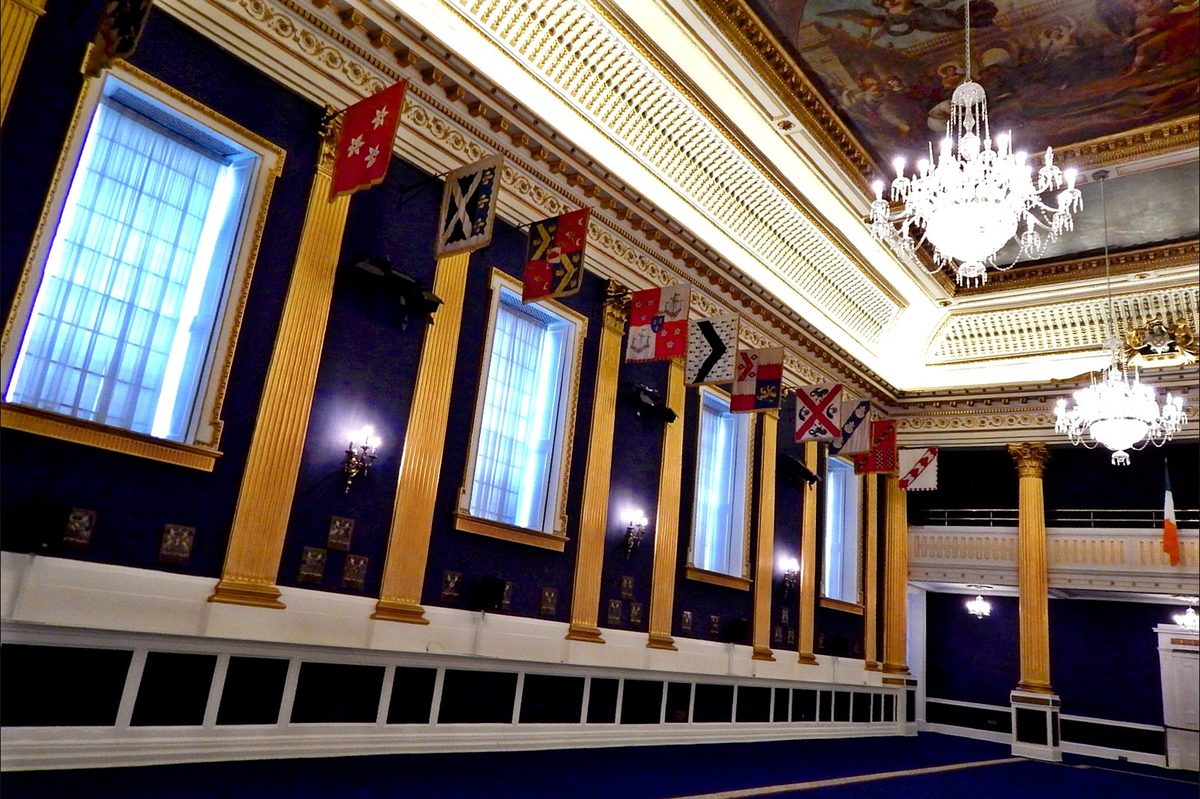
The name is a newspaper invention. Ireland had no coronation regalia, because no monarch was ever crowned there. What went missing was the insignia of the Order of St Patrick, the order of chivalry King George III founded in 1783 as Ireland’s answer to England’s Order of the Garter and Scotland’s Order of the Thistle. The Lord Lieutenant of Ireland wore the pieces as the order’s Grand Master, and its knights were installed at ceremonies in Saint Patrick’s Hall, inside Dublin Castle itself.
The regalia being looked for in 1907 dated to 1831, when King William IV had the order’s jewels remade. The crown jewellers Rundell, Bridge and Company set 394 stones — most of them drawn from the late Queen Charlotte’s own jewellery, along with stones from George III’s Order of the Bath star — into a diamond star, an oval diamond badge topped with a crowned harp, and five gold collars. The finished pieces reached Dublin Castle on 15 March 1831. By the time they disappeared, contemporary reporting put their worth at roughly £50,000; a Dublin police notice printed that same July itemised the star alone at £14,000 and the badge at £16,000, a gap between the round estimate and the itemised one that nobody at the time bothered to reconcile. In today’s money, either figure runs into the millions. Only two monarchs ever actually wore the finished insignia in person, Queen Victoria and Edward VII, both on visits to Ireland.
A Safe That Didn’t Fit Its Own Strongroom
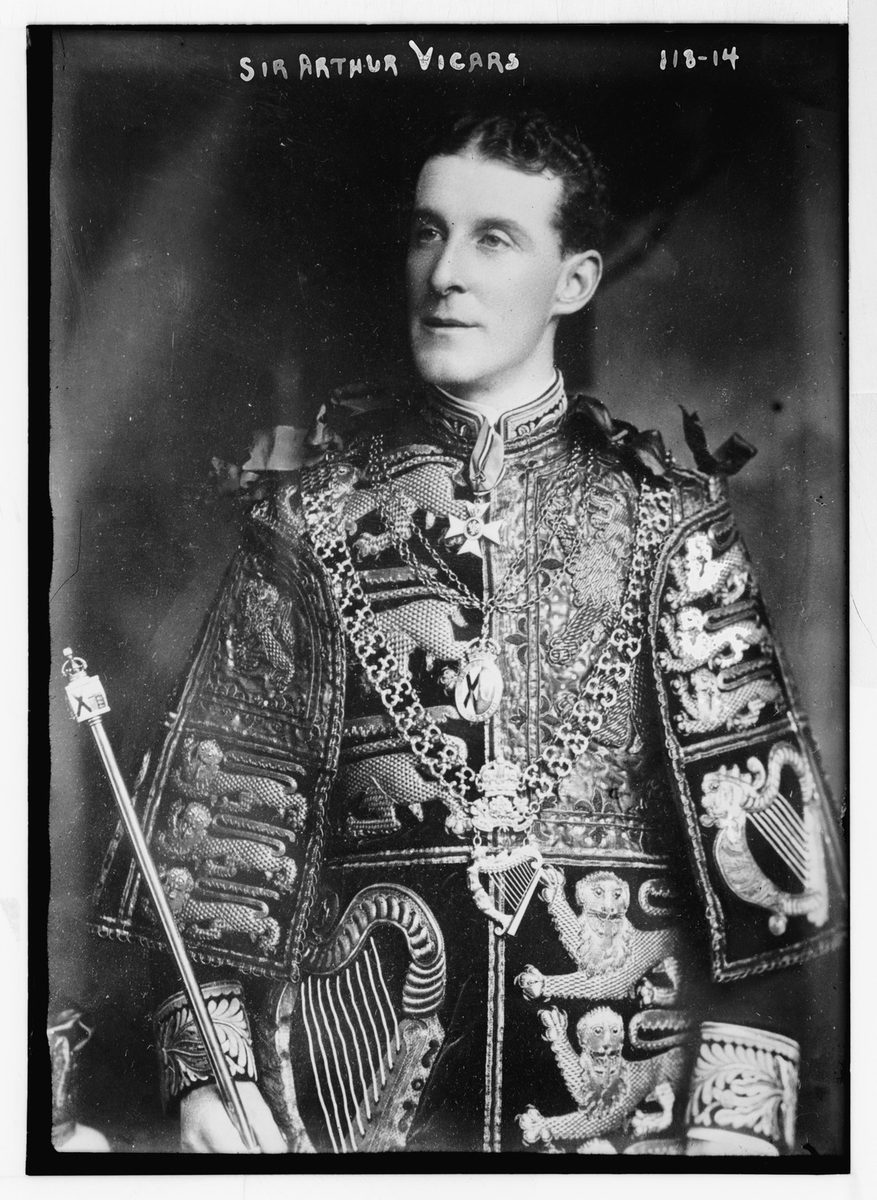
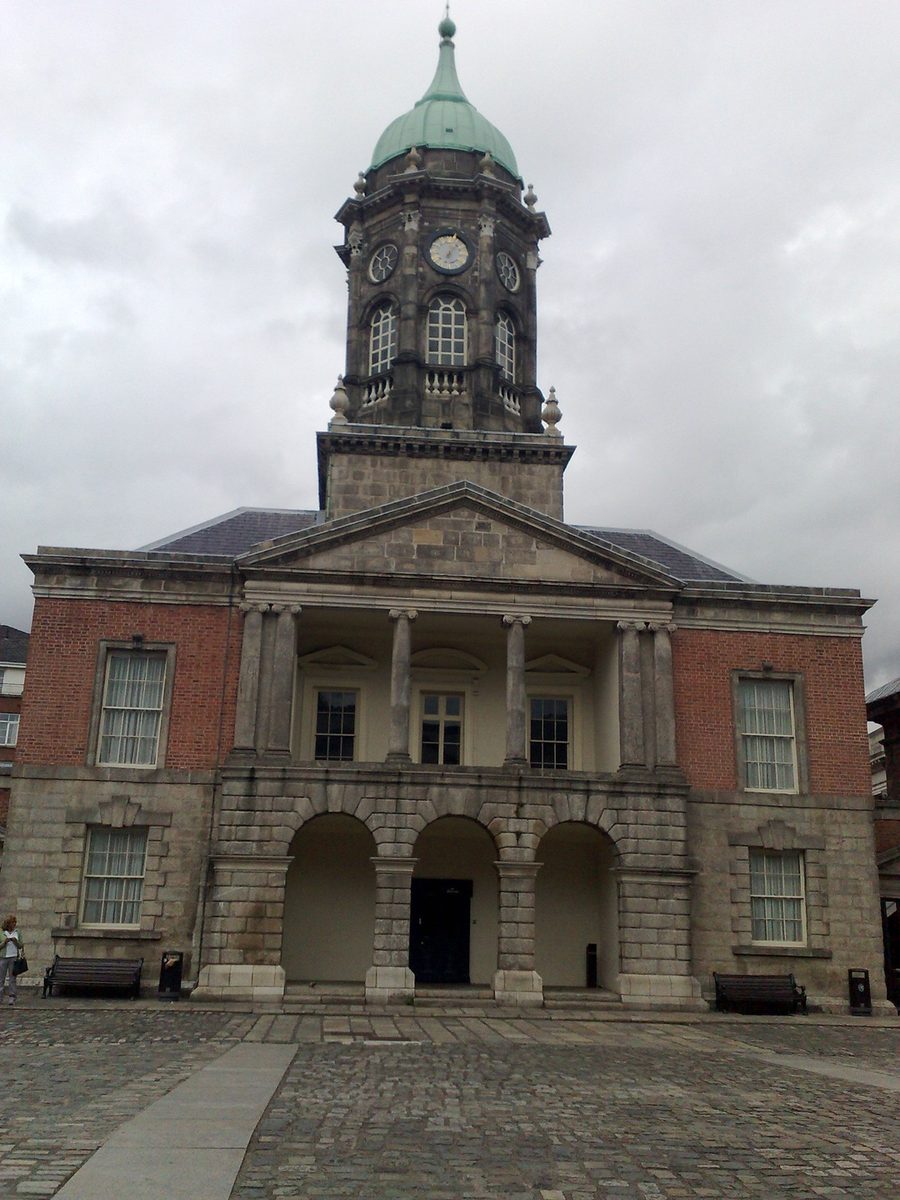
Until 1903 the regalia lived in a bank vault. That November, Sir Arthur Vicars — Ulster King of Arms, Ireland’s chief herald, and the official statutorily responsible for the jewels — moved his Office of Arms into the Bedford Tower, the clock-towered building on the north side of the Castle’s Upper Yard, where a new strongroom had been purpose-built to hold them.
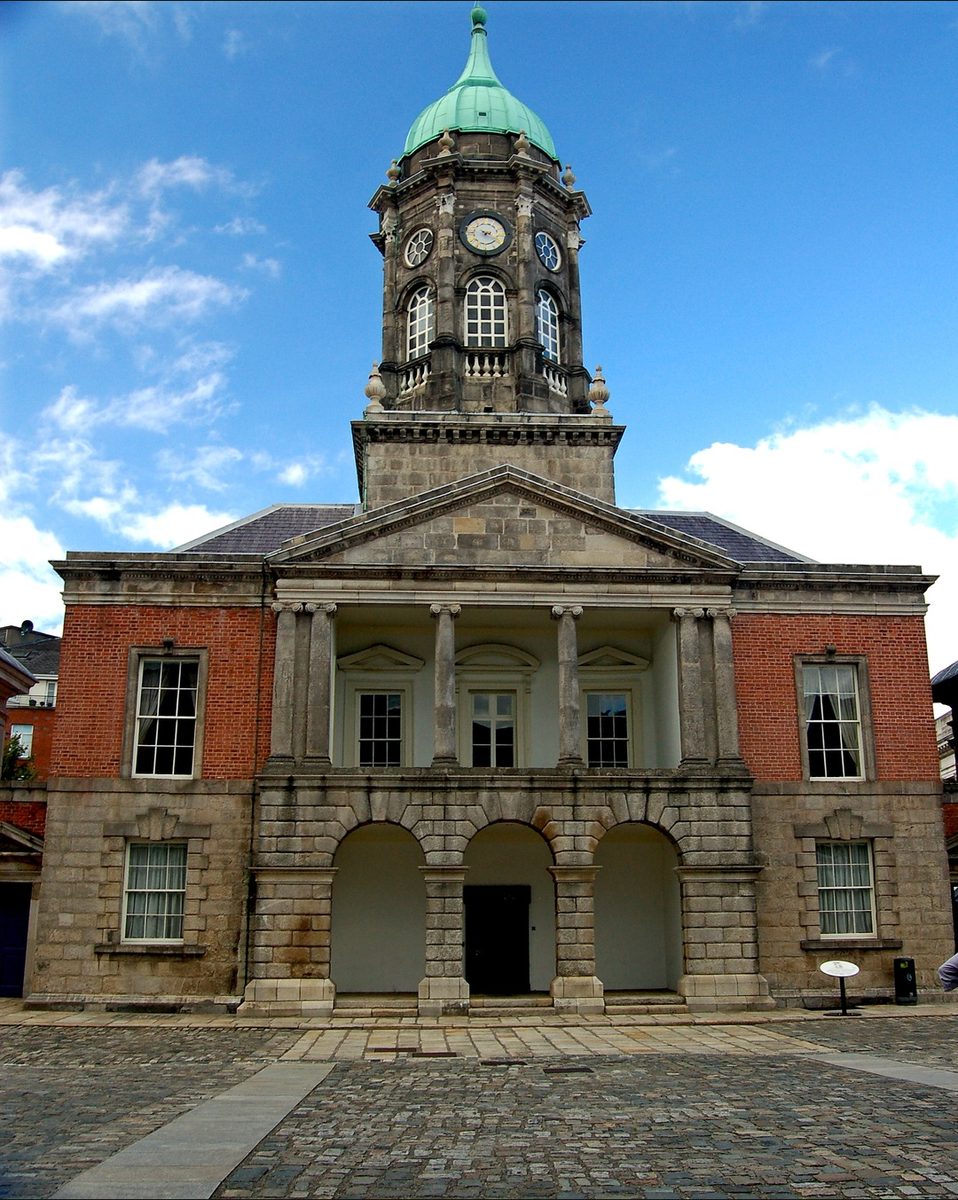
The safe bought for that strongroom would not fit through its door. Rather than solve that problem, Vicars had the safe set down in his library instead — the room he showed visitors into — and it stayed there, unmoved and effectively unsecured by the room built for it, for the next four years. Seven latch-keys opened the Bedford Tower itself, shared among Vicars and his small staff. Only two keys opened the safe, and Vicars kept both: one on his person, the other locked in a desk at his home in Clonskeagh. He was, by his own inquiry’s account, casual with them — fond of showing the insignia off to guests, and once the victim of a practical joke in which the Lord Lieutenant’s own son lifted a key off him and had the jewels mailed back for a laugh.
Three Weeks of Open Doors
Vicars last showed the regalia to a visitor, a librarian to the Duke of Northumberland, on 11 June 1907. What happened in the weeks after is the part no inquiry ever satisfactorily accounted for. By Dublin Castle’s own later account, the building’s doors and the strongroom door were each found standing open on more than one occasion in the run-up to the theft, and on at least one of those occasions the office cleaner, Mrs Farrell, is said to have found someone already inside the strongroom. Nothing was done about it each time; no lock was changed.
On the morning of Saturday 6 July, Mrs Farrell found the strongroom’s outer door unlocked again. Early that afternoon, Vicars handed the office messenger, William Stivey, a dead knight’s collar and told him to put it away. Stivey came straight back: the safe was already open, and the star, the badge, the five collars and a quantity of Vicars’s own family jewellery, also kept there, were all gone. The safe had not been forced, and the cases inside had been opened rather than broken into. And the thief, with the badge already in hand, had taken the time to detach its ribbon and clasp and lay them back in the empty case — the one piece that ever came back, and the one detail that has never been explained.
Scotland Yard’s Report That Vanished
The timing could not have been worse for the administration: King Edward VII was due in Dublin within days to open an exhibition, and a new knight was to be invested at the Castle during his visit. The investiture was cancelled. Scotland Yard sent over Detective Chief Inspector John Kane, who investigated and wrote a report that named a suspect. Dublin’s administration rejected his conclusion, and Kane was recalled to London within days. His report was never published and has never surfaced since.
Vicars became convinced the thief was his own deputy, the Dublin Herald Francis Shackleton — younger brother of the Antarctic explorer Ernest Shackleton, and a man seriously in debt, for whom Vicars had personally guaranteed loans. Vicars said so to Kane directly and, later, in his own will. Shackleton’s defenders pointed out that he was not in Dublin when the loss was discovered. No charge was ever brought against him over the jewels; he was convicted of an unrelated fraud in 1913 and served fifteen months, which has kept him at the centre of the story ever since without ever placing him in the room.
A Commission Built Not to Find a Thief
In January 1908, the Lord Lieutenant, Lord Aberdeen, convened a viceregal commission under the judge James Johnston Shaw. It first met on 10 January, sitting inside the Office of Arms itself, with the press and public barred and no power to compel a witness to attend. Its terms of reference were narrow by design: not who had taken the regalia, but only whether Vicars, as custodian, had exercised due vigilance and proper care. Vicars refused to appear without the power to subpoena witnesses himself, and got no such power. About two weeks later the commission found that he had not taken proper care and that the keys ought to have been lodged at his bank. He was dismissed on 30 January 1908, and his small staff left with him.
The inquiry’s narrowness bred its own controversy. Between 1912 and 1914 the Irish MP Laurence Ginnell raised the case repeatedly in the House of Commons, alleging that named officials at the Castle had been allowed to resign rather than face prosecution, and that the commission had been a “hushing” inquiry convened to protect people above Vicars rather than to find the thief. The Chief Secretary for Ireland, Augustine Birrell, denied shielding anyone, said the police had found no evidence sufficient to prosecute anybody, and invited Ginnell to take his allegations to the police directly. He never produced a document to support them, and none has surfaced since — the claim remains exactly that: a claim in the record, not a finding in it.
What Became of Everyone Involved
Vicars spent years afterward insisting on his innocence. In 1913 he won £5,000 in libel damages from a London paper that had accused him of complicity. He retired to Kilmorna House in County Kerry, where, on 14 April 1921, during the War of Independence, an IRA unit shot him dead in his garden over a note accusing him of being an informer — a killing unconnected to the jewels, but one that permanently closed off whatever he still knew. Shackleton, having served his sentence for the unrelated fraud, was released in 1915 and largely disappears from the record after that. Two other Office of Arms men named at various points as possible accomplices both died violently within the following decade: Pierce Gun Mahony in a shooting accident in 1914, and Francis Bennett-Goldney in a car crash in 1918. A former army officer sometimes linked to the theft, Captain Richard Gorges, was convicted of manslaughter in 1915 after killing a policeman during a separate incident.
The Jewels That Never Resurfaced
Two approaches came close to producing answers and produced nothing instead. A Dublin jeweller, James Weldon, said a man approached him around 1908 offering to sell the regalia; roughly twenty years later he was reportedly approached again and passed the letter to the head of the Irish government, W. T. Cosgrave, who is said to have remarked only that the jewels were the state’s anyway, so it might as well have them. Nothing came of either approach. A 1983 Garda search of the Dublin mountains, following an anonymous tip, used dogs and metal detectors and found nothing. A 1998 claim that the regalia lay hidden at Vicars’s old Kerry estate is now generally treated as a hoax.
Theories have multiplied in the vacuum: that republican or unionist sympathisers staged the theft for political embarrassment; that Lord Aberdeen’s own son took the pieces as a drunken prank and quietly returned most of them; even, in one fringe version, that a stone from the regalia ended up decades later in jewellery worn by Queen Elizabeth II, a claim Buckingham Palace has specifically denied. None of it is documented. Most historians now assume the stones were broken up and recut not long after the theft, which would make the case literally unsolvable in the one sense that matters most: there may be nothing left, anywhere, for anyone to find. The Order of St Patrick stopped making new appointments in the 1930s, and its last surviving knight died in 1974, so there is no one left to invest with the regalia even if it walked back through the Castle gate tomorrow.
Watch the full history
The video covers the theft itself, the vanished Scotland Yard report, and the commission that was never asked to find the thief, in just over nine minutes.

Related reading
- The Pomander Was Built on Miasma Theory, and Outlived It
- Everything People Used to Hide Inside a Fur Muff
- Why We Wear Poppies for Remembrance, and Who Built the Tradition
- Who Invented the Two-Minute Silence?
Works cited
- Duffy, Jennifer. “The Theft of the Irish Crown Jewels.” Dublin Castle, Office of Public Works. Link.
- O’Riordan, Tomás. “The Theft of the Irish Crown Jewels, 1907.” History Ireland.
- DJangi, Parissa. “Why the Case of Ireland’s Missing Crown Jewels Remains Unsolved After More Than a Century.” National Geographic, 14 November 2024. Link.
- The National Archives (Kew). Crown Jewels Commission (Ireland) (Shaw Commission): Reports and Papers. Ref. BS 22, 1907–1911. Link.
- Vice-Regal Commission (James J. Shaw, chairman). Circumstances of the Loss of the Regalia of the Order of Saint Patrick. Cmd. 3906. HMSO, 1908.
- “Crown Jewels Commission (Ireland).” HC Deb 30 January 1908, vol 183, c240. Link.
- “Crown Jewels, Dublin.” HC Deb 20 December 1912, vol 45, cc1955–62. Link.
- Dungan, Myles. The Stealing of the Irish Crown Jewels: An Unsolved Crime. Dublin: Town House, 2003.
- Bamford, Francis, and Viola Bankes. Vicious Circle: The Case of the Missing Irish Crown Jewels. London: Parrish, 1965.