
In September 1806, on the last leg of his way home, William Clark wrote in his journal that he had to refill his ink stand every single day, because “at least 9/10 of which must evaperate.” A year earlier, his co-captain Meriwether Lewis had noted that the ink froze solid in his pen. Neither man was describing a minor annoyance. They were describing the actual, daily experience of owning an inkwell, for most of the three thousand years the object existed.
That is the part the romantic version leaves out. An inkwell is usually presented as a pretty desk accessory — brass, glass, silver, maybe carved from something exotic — and plenty of surviving examples are exactly that. But the actual job of the thing was to keep a liquid from evaporating, freezing, going moldy, or quietly dissolving the paper it was poured onto. Almost every variation the inkwell went through, across three continents and three thousand years, was someone’s attempt to solve one of those four problems.
This is the story of how an inkwell actually worked, not just what it looked like sitting on the desk.
How an inkwell actually worked before it ever held a drop of liquid
The word implies a well of liquid ink, ready to dip a pen into. But the earliest and longest-running solution to the ink problem skipped liquid storage entirely. A surviving Egyptian scribe’s kit at the Metropolitan Museum of Art — a wooden palette, three reed brushes, a skein of thread and some sheets of papyrus, found in the rubbish of a tomb forecourt at Thebes and dated to the Late Period, roughly 664 to 332 B.C. — still holds its ink as a solid, unused cake set into a recess in the wood.
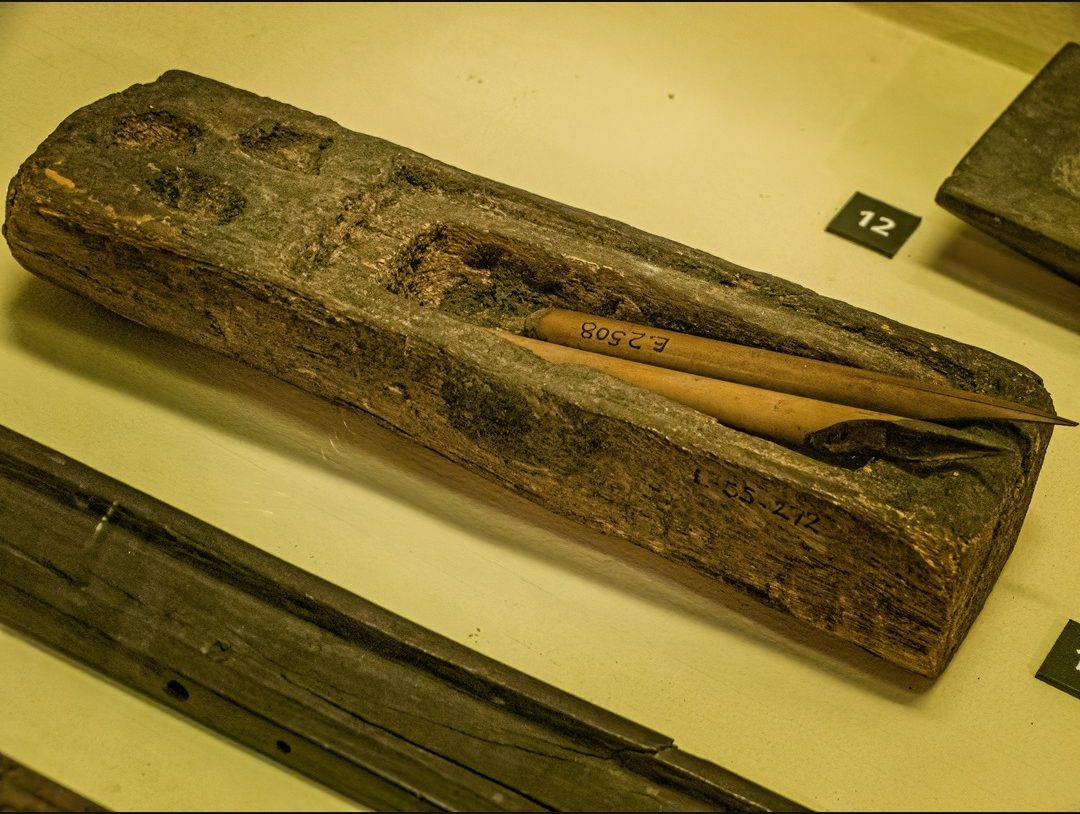
A dry cake of ink cannot evaporate, freeze, or spoil, because it isn’t a liquid until the scribe decides it should be. The method was to wet a brush and work it against the cake, exactly the way a child mixes a dry watercolor pan today, and only make as much wet ink as the next line of text required. The tradeoff was labor, not chemistry: someone had to remix ink constantly throughout a working day, rather than once. For a civilization organized around a large, dedicated class of professional scribes, that tradeoff made sense. It would keep making sense, in one form or another, for thousands of years after Egyptian scribal culture itself had ended — a pen could change completely, the way the reed eventually gave way to the quill, while the question of how to store the ink barely moved at all.
The ink itself was a slow chemical reaction — and it was quietly destroying the page
Once writing moved to liquid ink, the dominant recipe for most of Western history was iron gall ink: oak galls (the hard growths a tree produces around a wasp larva) steeped for tannin, combined with iron sulfate and bound with gum arabic so it would flow off a quill. According to the Iron Gall Ink Website, a conservation-research project devoted to the chemistry of the stuff, the tannin-iron reaction itself was known in antiquity — Pliny the Elder described an iron salt turning a tannin-soaked surface black — but nobody seems to have deliberately written with it until centuries later. The earliest ink recipe that actually describes the reaction appears in a fifth-century encyclopedia compiled in Carthage. By the end of the medieval period it had become Europe’s primary ink, and it stayed dominant until synthetic dyes arrived in the twentieth century. West German government specifications still required iron gall ink for official records as late as 1974.
The reason it won is the same reason it was dangerous. William J. Barrow, a document restorer who tested historical inks for The American Archivist in 1948, found that iron gall ink resisted fading and could not be scraped or washed off a document, which made it the obvious choice for anything meant to survive as a legal or official record — the same logic that, centuries earlier, had English clerks tallying the royal accounts with notched wooden sticks rather than trust a page alone. But making iron gall ink produces sulfuric acid as a byproduct, and that acid migrates into the surrounding paper. Barrow’s tests showed black iron gall inks were consistently more acidic, and more damaging to the paper fibers, than the browner inks some writers ended up with by accident. The brown color, he noted, usually meant the writer had simply used too few galls relative to iron sulfate — a finding the eighteenth-century chemist William Lewis had already worked out in the 1760s. Centuries of documents written in the “best” ink were, in a real chemical sense, built to eventually eat themselves.
Because the liquid didn’t travel, the inkwell was mostly a fight against physics
Clark’s evaporating ink stand and Lewis’s frozen pen weren’t bad luck. Liquid ink is water-based, and water does what water does. Meriwether Lewis bought dry ink for the expedition, almost certainly in stick or cake form, according to the National Park Service’s own account of the supply list — which meant someone still had to scrape it into a portable inkwell and dissolve it in water, probably close to daily, because temperature swings on the trail made a mixed batch unreliable fast.
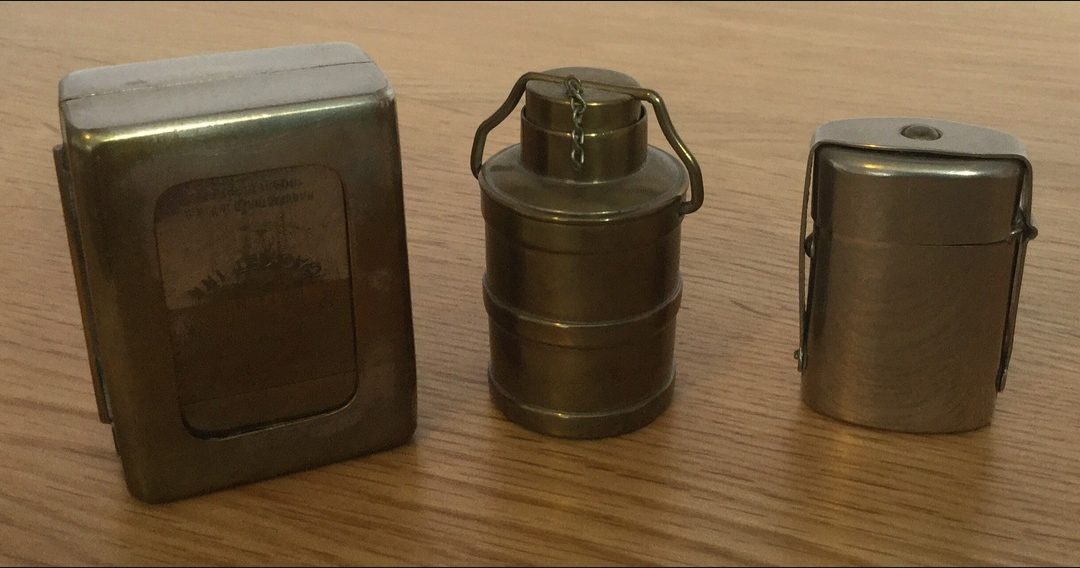
Colonial Americans a generation earlier had hit the same wall and reached for the same fix. Barrow’s research describes dry ink powder advertised for sale in the Williamsburg Gazette, sold precisely because a powder shipped, stored, and survived a frost better than a bottle of liquid. The Renaissance physician Giovanni Battista Caneparius, whose advice on ink-making circulated for generations, recommended storing the mixed liquid in lead, glass, glazed earthenware or a hardened gourd, always kept covered against dust. Some later ink-makers added spirits to a bottle specifically to keep it from freezing in winter, even though critics pointed out that this made the ink less soluble and the color fade faster. There was no single correct answer. There was only an endless set of small trades between shelf life, freeze resistance, and how good the ink looked on the page.
The Islamic world’s answer was to fuse the pen case and the inkwell into a single sealed object
Rather than solve portability with a better bottle, scribes across the medieval Islamic world carried a combined pen case and inkwell, called a qalamdan, built as one sealed unit: reed pens in a long compartment, ink in a fitted well at one end, the whole thing closed against spills and dust in transit. Surviving luxury examples show how high the object’s status could climb — the Metropolitan Museum of Art holds a pen case and inkwell from the Deccan or North India, 16th or 17th century or later, made of gold and inlaid with diamonds, rubies and emeralds. An object that size and weight was never meant to travel in anyone’s pocket; it was a display of the owner’s rank disguised as stationery, in much the same spirit that later drove the elaborate etiquette around calling cards — an everyday object turned into a small performance of status.
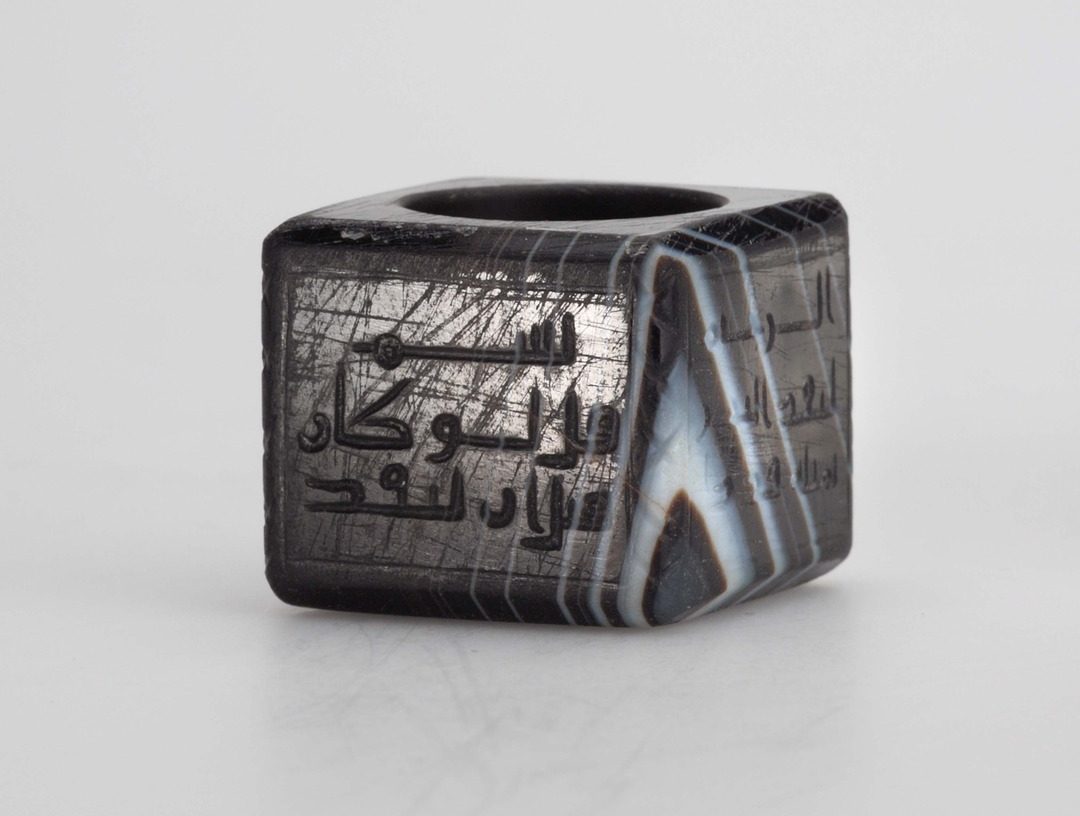
Plainer versions were working tools for a specific kind of writing. The Walters Art Museum’s inkwell, made around 1200 by an Iranian metalworker named Muhammad ibn Abu Sahl al-Harawi, is inlaid copper alloy inscribed with blessings for its owner’s “might and triumph” and good fortune. The museum describes it as a ceremonial piece, probably made for writing official state documents — the inscriptions suit an object meant to be seen on a court official’s desk, not hidden in a saddlebag.
Status symbol on one end of the social scale, disposable glass on the other
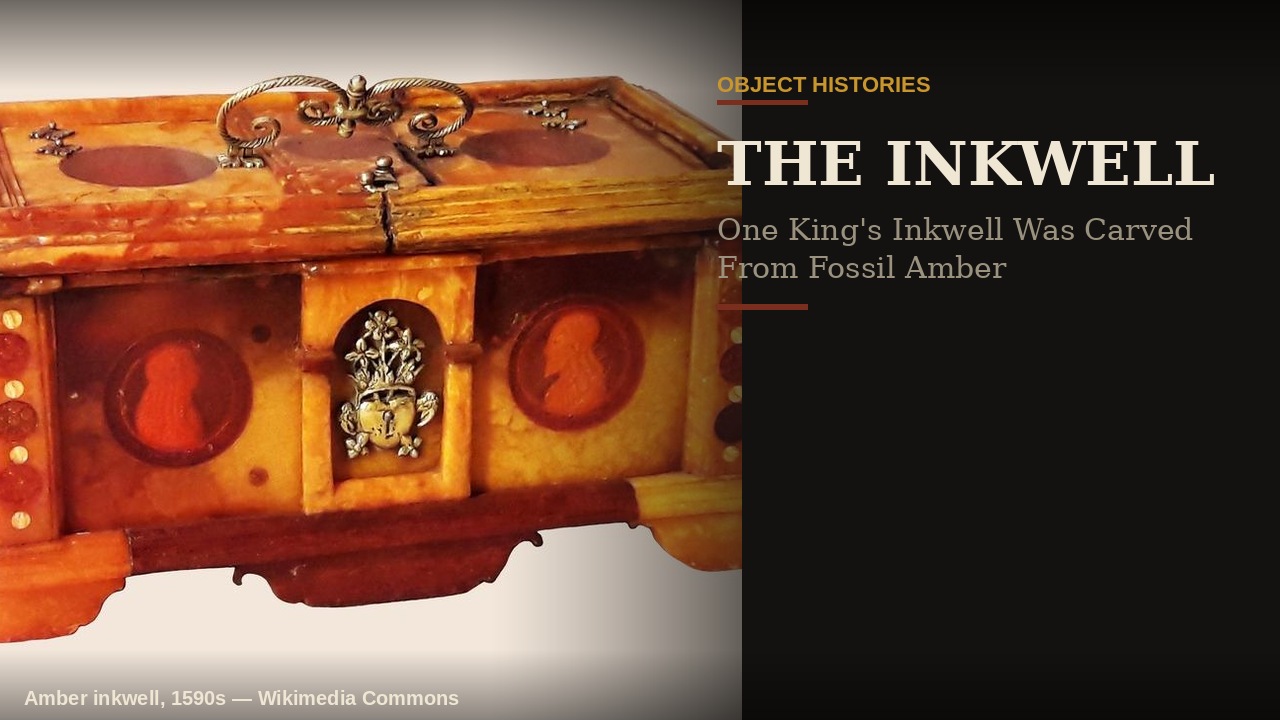
Europe’s wealthy ran the same display logic Islamic courts did. A Polish royal amber inkwell from the 1590s, carved and mounted in gilt silver, survives today in a European royal treasury — amber that old wasn’t worn as jewelry so much as carved into something meant to last.
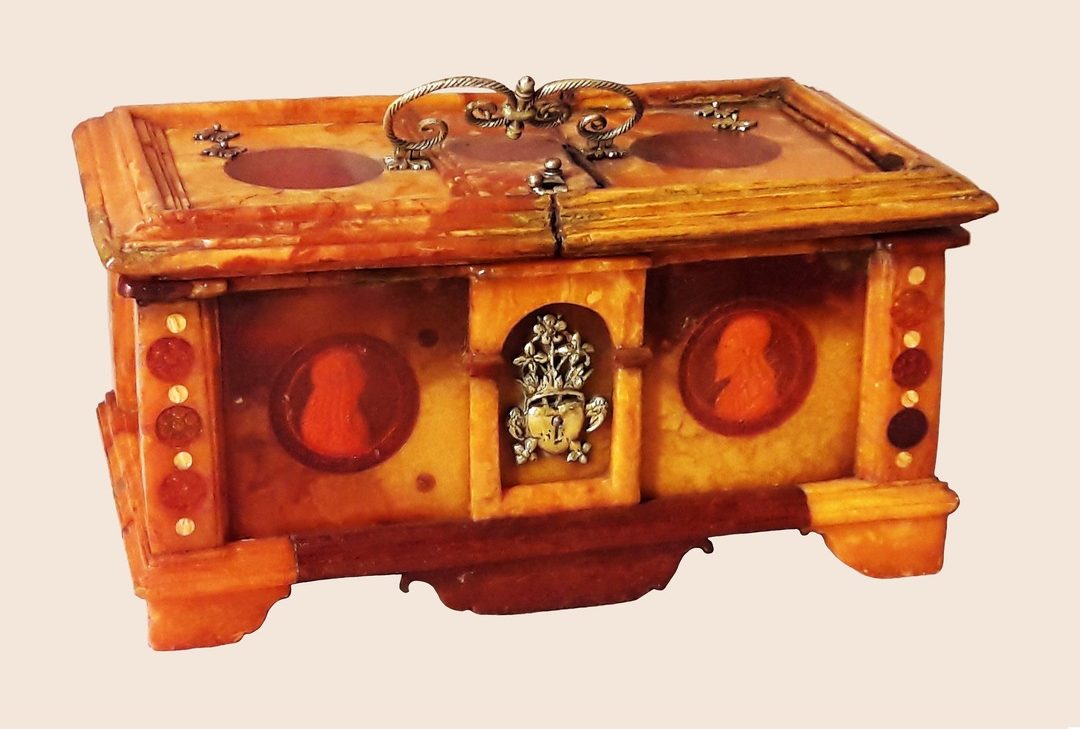
By the Industrial Age, the same shape of object had been pushed to the opposite end of the price scale, sometimes on purpose. The Victoria and Albert Museum holds an urn-shaped gilt-metal inkstand with blue enamel and painted roses, made in Austria around 1867 by the firm Dziedzinsky and Hanusch. The museum’s own acquisition record says it was bought at the 1867 Paris Exhibition specifically “as an illustration of cheapness of manufacture” — in other words, the museum wanted an object that looked like luxury stationery and cost almost nothing to make, as proof of what industrial technique could now fake. That single acquisition note is a tidier summary of the next fifty years than any single glass inkwell could be.
Mass production put one in a hole in every school desk, with its own designated employee
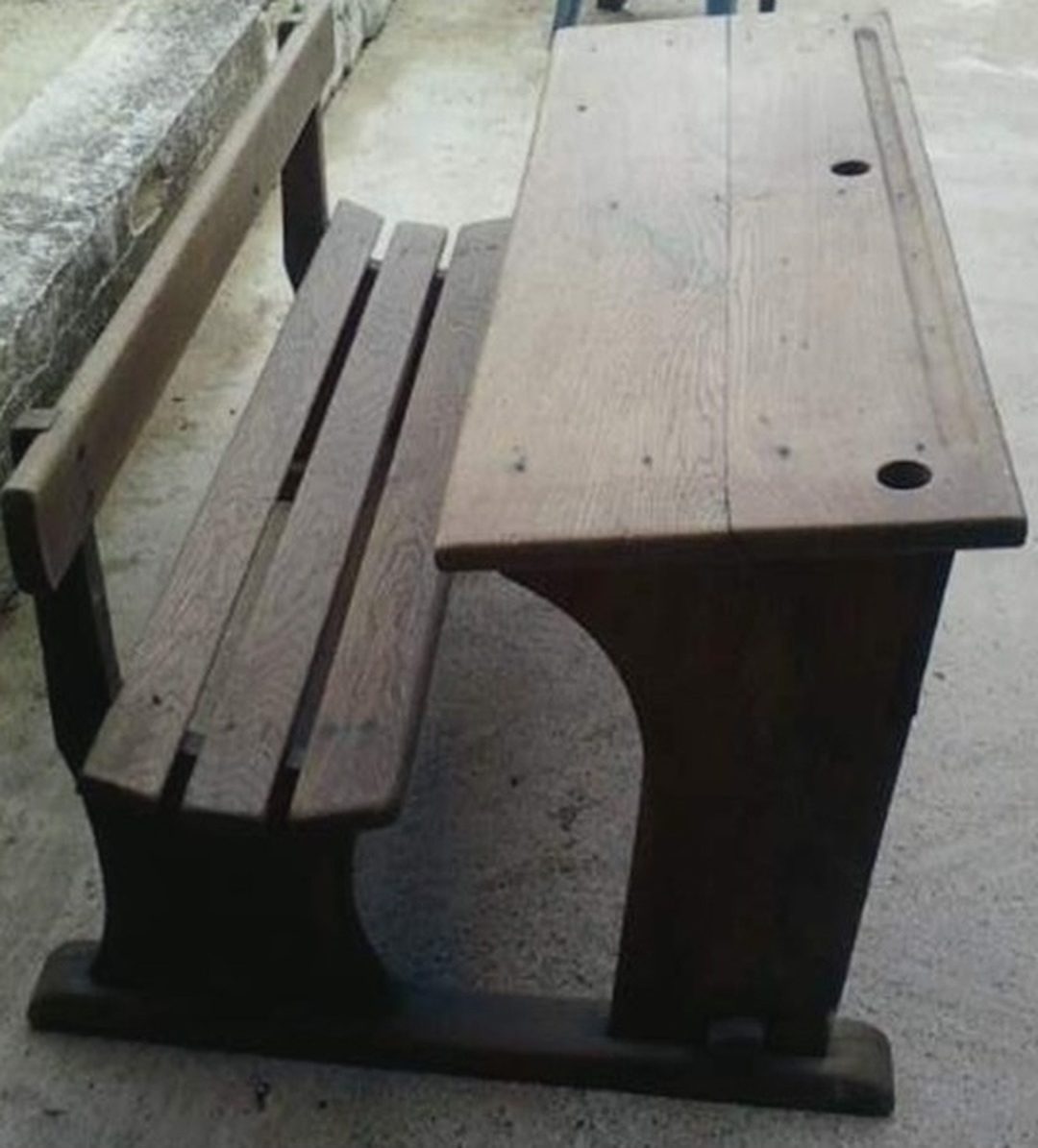
By the Victorian period the inkwell had finished its slide from treasury object to compulsory classroom fixture. English and French schoolrooms cut a round hole into the corner of every pupil’s desk to hold a small ceramic inkwell, refilled by a child given the job of ink monitor: pouring from one large bottle — the Islington Education Library Service’s teaching collection preserves a bottle labeled “Stephen’s Blue-Black Writing Fluid,” marked as suitable where permanence was essential — into each desk’s pot before lessons began. Pupils dipped steel-nibbed pens over and over through a day’s copybook practice, the same steel nib that finally made the centuries-old quill obsolete. Blotting the page was often punished. In an unheated room, the ink could simply freeze, the same problem Lewis had met on the trail sixty years earlier, now sitting in a child’s desk.
The glass side of the industry grew just as fast. Colored glass inkwells were manufactured across the United States from the mid-1800s into the 1920s, cheaply enough that an ordinary household could afford one, with the final three decades of the nineteenth century as the peak of the style. The Emry Davis Company became a major manufacturer, selling branded inkwells as giveaways to insurance companies, railroads and U.S. Steel; the S. Silliman Company of Chester, Connecticut was already listing inkwells on an 1850s price sheet, and its travelling inkwells sold especially well during the Civil War. The first American inkstand patent was granted in 1811, to A. H. Quincy of Boston, and from roughly 1840 into the early twentieth century, patent offices issued hundreds more for inkwells, inkstands and ink bottles — including a wave of novelty snail-shaped designs patented in 1879 and 1880. A 1902 Sears catalog still listed one of those snail inkwells, but at thirty-five cents, down from a dollar. A falling price on a novelty item is usually the sound of a fad ending, and this one was.
Watch the full history
The video version covers the same three thousand years — Egyptian reed pens, medieval ink, Renaissance silver and the schoolroom — in about six minutes.

What finally ended the daily argument
The fix, when it came, didn’t improve the ink. It removed the inkwell from the process altogether. A fountain pen carries its own small reservoir, sealed against evaporation and insulated well enough that freezing stopped being a daily concern, which meant a writer no longer needed to dip, refill, or budget for how much of the batch would evaporate before lunch. The ballpoint pen, decades later, finished the job by doing away with liquid ink entirely. Neither invention made ink itself any better. They just finally took the vessel out of the writer’s hands.
The glass and ceramic inkwells that mass production had scattered across every desk and classroom in the Western world didn’t disappear so much as stop being replaced. They are collected now by specialists — the kind of collectors who sort a glass inkwell by mold seam and patent date the way a coin collector sorts by mint mark — which is its own small irony: an object that once needed a designated child to keep it filled now has its own devoted hobbyist society.
None of that makes the inkwell a simple object, or a merely decorative one. For three thousand years it was the unglamorous center of an engineering problem that never had a clean solution: how to keep a working liquid wet, warm, and chemically stable for exactly as long as someone needed to write, and not a minute longer. It is a little surprising that the fix took until the twentieth century. It is less surprising, once you’ve read William Clark’s journal, that people kept filling the thing every single day in the meantime.
Related reading
- How Quill Pens Were Actually Made, and Why Steel Killed Them
- The Real History of the Fountain Pen Is Older Than You Think
- The Secret Code of Victorian Calling Card Etiquette
- How Wooden Tally Sticks Ran England’s Treasury for 600 Years
Works cited
- Barrow, William J. “Black Writing Ink of the Colonial Period.” The American Archivist 11, no. 4 (1948): 291–307. Link.
- The Metropolitan Museum of Art. “Scribe’s Palette and Brushes.” Dynasty 26–30, ca. 664–332 B.C. Accession 28.9.5a–g.
- “History of Iron Gall Ink.” The Iron Gall Ink Website, Institute for the Conservation of Historic and Artistic Works. Link.
- National Park Service. “Ink and the Lewis and Clark Expedition.” Link.
- Victoria and Albert Museum. Inkstand, Dziedzinsky and Hanusch, Austria, ca. 1867. Museum no. 605:1-1869. Link.
- The Metropolitan Museum of Art. “Pen Case and Inkwell (davat-i daulat).” Deccan or North India, 16th–17th century or later.
- The Walters Art Museum. “Inkwell with ‘Kufic’ and ‘Naskhi’ Inscriptions.” Muhammad ibn Abu Sahl al-Harawi, Iran, ca. 1200. Accession 54.514.
- “Let’s Talk About Ink.” Bottles and Extras, Federation of Historical Bottle Collectors, Fall 2005. Link.
- “Ink Bottle, Victorian (Original).” Islington Education Library Service, Object Lessons handling collection. Link.
- Harper, Douglas. “Inkhorn.” Online Etymology Dictionary.