
In 2022, a physicist at McMaster University recreated a handful of historical skin-whitening recipes in her lab and brushed them onto pig skin, the closest practical stand-in for pale human skin. Most of the old formulas barely let any lead through. One did not behave like the others. A simple paste of white lead and vinegar — the exact mixture tradition says Elizabeth I of England used to cover her smallpox scars — let far more lead pass through the skin than anything else tested. The study’s author called the result preliminary but said it was reason enough to revisit whether the Virgin Queen’s final illness had anything to do with her own dressing table.
That is the part of the powder compact’s story that rarely makes it into the antique shop description. By the time the compact as we know it — a flat, hinged case with a mirror, a puff, and a window of pressed powder — became a fashion object in the 1920s, face powder had already been a documented health hazard for roughly two thousand years. The compact did not invent the danger. It eventually helped end it, by making the powder inside it something a government agency was finally willing to regulate.
This is the story of that long arc: a scandal, then a status symbol, then a soldier’s keepsake, then, finally, a law.
Roman and Egyptian women were already managing the trade-off between beauty and poison
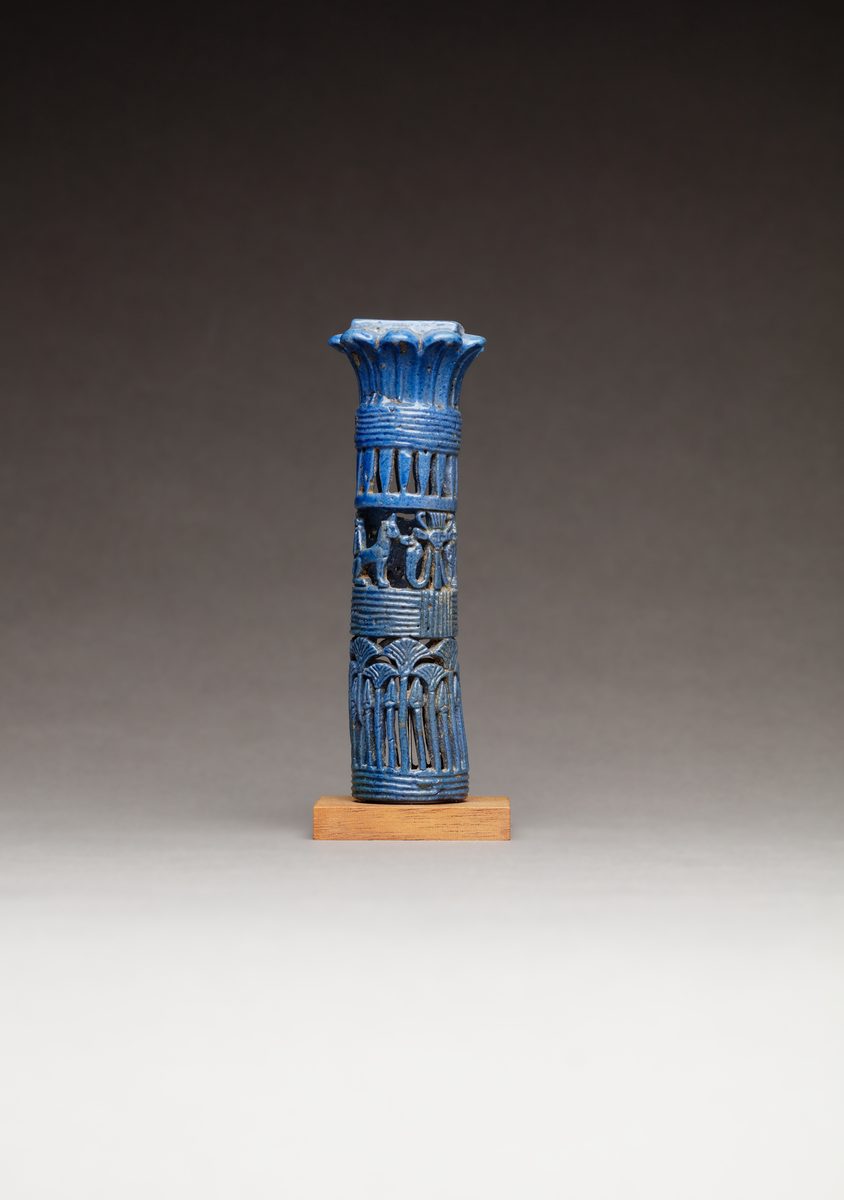
The impulse behind the powder compact is far older than the object itself. Ancient Egyptian cosmetic kits regularly included kohl — a dark powder, often made from galena (lead sulfide), applied heavily around the eyes with a small stick or tube. The style is unmistakable from tomb paintings and surviving kohl containers, some carved into elaborate shapes meant to sit on a dressing table rather than be hidden away. The practice was not purely vain: ancient Egyptians also credited kohl with reducing the sun’s glare and warding off eye infection, and some modern toxicologists have noted that certain lead compounds can have mild antimicrobial effects on the skin’s surface, which may be part of why a demonstrably toxic substance remained in daily use for thousands of years.
Rome took the logic a step further, onto the face itself. Roman writers describe fashionable women whitening their complexions with cerussa — a paste of white lead mixed with vinegar, sometimes called by the Greek term psimythium — applied as a base coat before rouge and other color were added on top. The classicist F. T. Walton’s 1946 survey of a Roman woman’s toilette catalogues the full kit: pastes, pigments, and tools that a wealthy Roman household would have kept close to the mirror, alongside the slaves whose job it was to apply them. A pale face read as a mark of leisure and status, since it signaled a life spent indoors rather than working a field under the sun. Getting it meant painting the skin with a metal that, as Roman physicians already understood in a general sense, caused sickness when it accumulated in the body.
The Renaissance intensified the recipe, and gave England the Elizabeth I legend
The same basic formula — white lead bound with vinegar, sometimes egg white — resurfaces across Renaissance Europe under the name Venetian ceruse, prized for producing an especially smooth, porcelain-like finish. By the sixteenth century it had become closely associated with aristocratic English fashion, and above all with Elizabeth I, whose later portraits show a flat, mask-like white complexion that art historians have long linked to a bout of smallpox in 1562, which the queen is said to have spent the rest of her life concealing.
Whether ceruse actually hastened her death is, honestly, still an open question, and the popular version of the story — that vanity poisoned the Virgin Queen — is thinner on contemporary evidence than the legend suggests. No surviving account from her own physicians draws a direct line between her cosmetics and her final illness in 1603. What changed the conversation was the 2022 McMaster University experiment described above: when Fiona McNeill’s team tested a simple white-lead-and-vinegar recipe specifically associated with Elizabeth against several more complex period formulas, hers was the one that moved the most lead through skin. The result does not prove cosmetics killed her. It does suggest the old legend deserves to be taken more seriously as a hypothesis than it has been treated as either pure myth or settled fact.
For three centuries after that, visible makeup was something only disreputable women wore in public
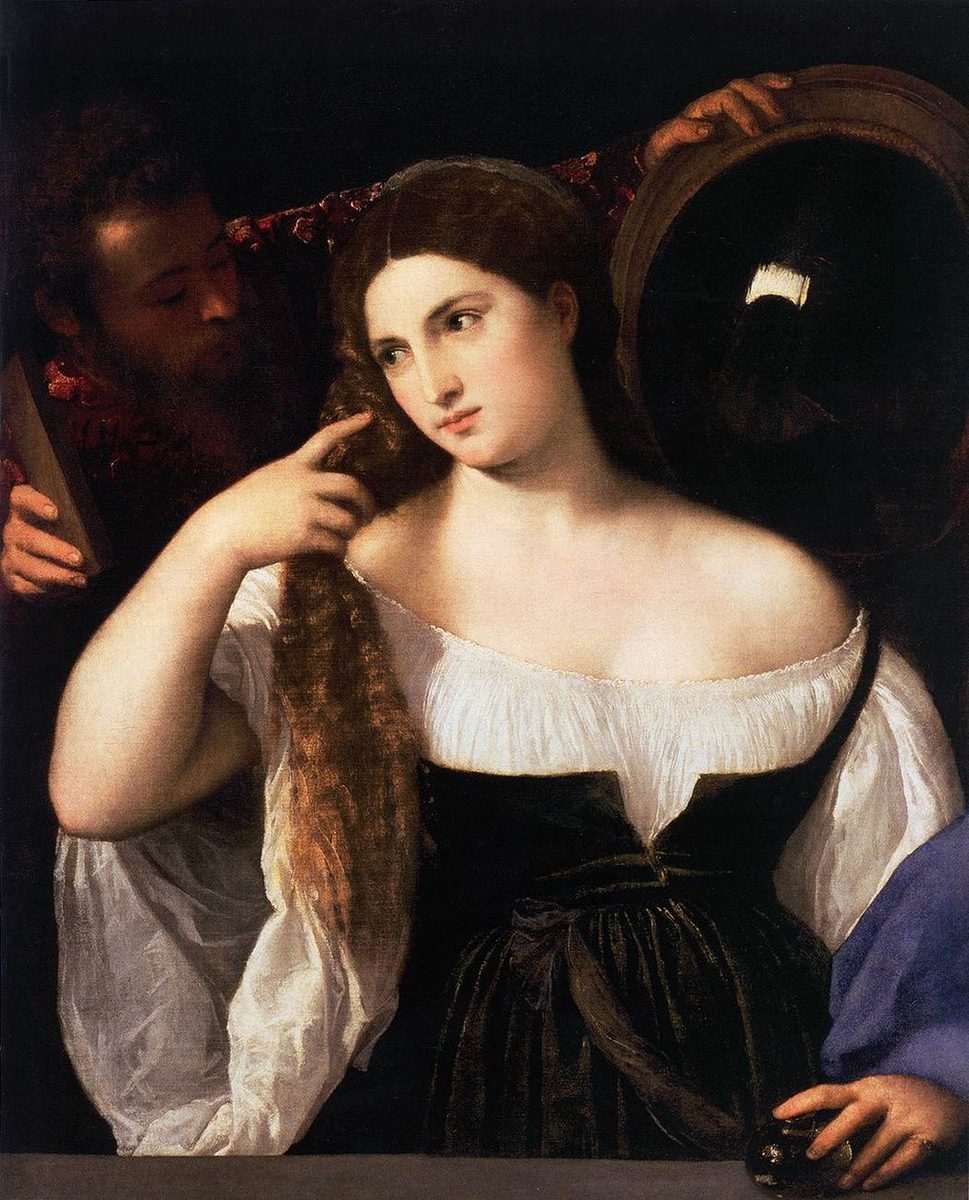
What follows the Renaissance is less a story about chemistry and more one about etiquette. By the Victorian era, the pendulum had swung hard against visible cosmetics. A respectable woman was assumed to need no help at all; powder, rouge, and dye were coded as the tools of actresses and women of the demimonde, to be used privately, if at all, and never acknowledged. The toilette — the ritual of grooming at a mirror, assisted by a maid or companion — moved entirely behind closed doors. It is a much older ritual than any specific era: Titian was already painting a woman having her hair arranged before a hand mirror in Venice around 1515, two centuries before the Victorians made concealment into a moral rule rather than just a practical one. What the nineteenth century added was the stigma. Touching up one’s face at a public table, the way a modern compact invites, would have been unthinkable.
The word “compact” didn’t exist yet — early versions were called vanity cases, and they stayed private
The flat, pocket-sized case that holds powder, a puff, and a mirror in one hinged unit is largely a twentieth-century object. Earlier small cosmetic containers — often called vanity cases, dressing cases, or chatelaine accessories — existed from at least the late nineteenth century, but they were dressing-table objects, not handbag objects, and “compact” as the common name for the pocket version only standardized in the 1910s and 1920s, as the case shrank, flattened, and started being designed to be seen rather than hidden in a drawer. The object existed before the behavior around it changed. What changed next was not the hardware. It was where, and in front of whom, women were willing to use it.
Flappers turned a private ritual into deliberate public performance
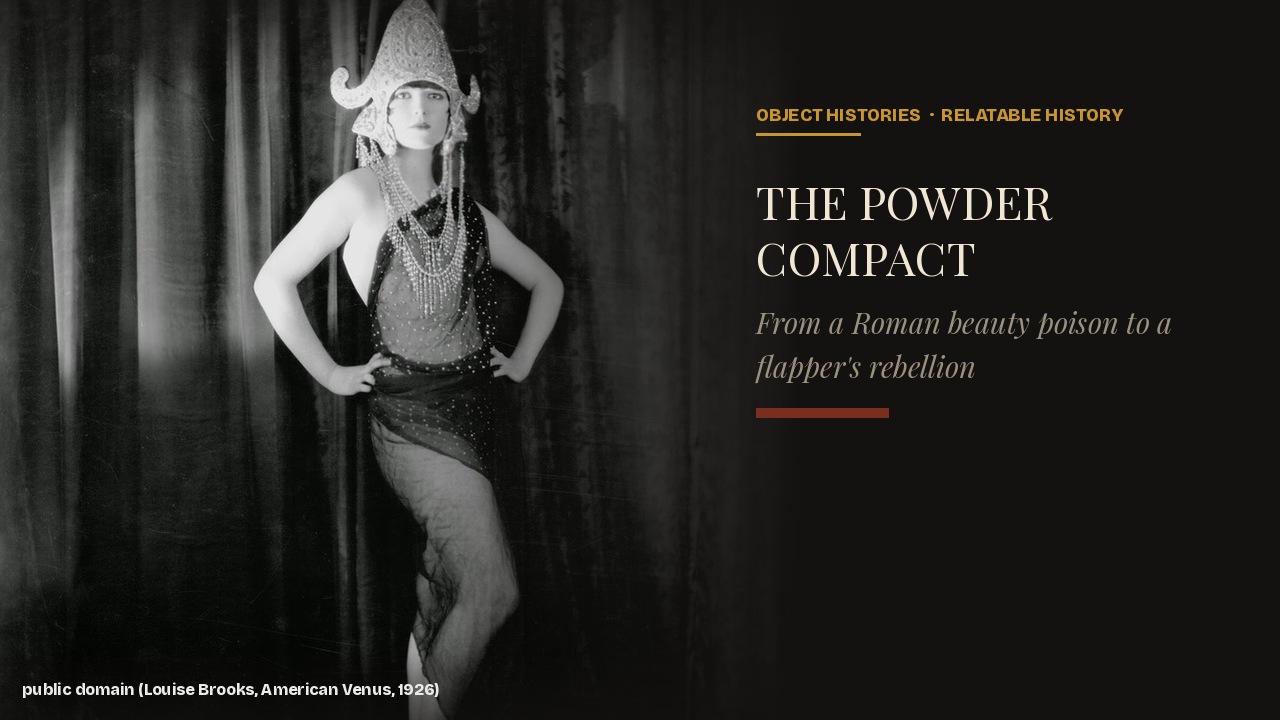
Through the 1920s, a new generation of young women began doing, in full view, exactly what etiquette had forbidden a decade earlier: pulling out a compact at a restaurant table, a theatre seat, or a dance floor and touching up their powder in front of everyone. It was not an accident or a lapse in manners. It was closer to a small, repeatable act of defiance, consistent with the flapper’s broader rejection of Victorian restraint — bobbed hair, shorter hemlines, cigarettes in public. The compact was perfectly suited to the gesture: small enough to produce with a flourish, finished well enough to be worn like jewelry, and built around a mirror that let the woman watching herself be watched doing it. Manufacturers responded fast. Compacts were advertised and sold as fashion accessories in their own right through the decade, no longer apologized for, no longer hidden.
Cartier and Van Cleef & Arpels turned the compact into wearable jewelry
At the luxury end of the market, the compact became an excuse for serious jewelers to do serious work. The 1922 discovery of Tutankhamun’s tomb set off a wave of Egyptian-revival design across European decorative arts, and compact and vanity-case makers were enthusiastic participants: Cartier produced vanity cases decorated with temple-gate motifs and hieroglyph-inspired ornament, rendered in gold, enamel, and hardstones, aimed at clients who wanted to carry a piece of the craze in their handbag. English firms worked a smaller, equally serious version of the same market: a gold vanity case made by the London firm Ramsden and Roed in 1934–35, reeded and enamelled and sold through retailers including Asprey, Garrard, and Dunhill, now held by the Victoria and Albert Museum, shows how far down the chain of luxury retail these objects traveled — made by a specialist manufacturer, badged and sold by a separate prestige name.
Van Cleef & Arpels took the idea furthest with the minaudière, a rigid metal evening case built to hold everything a woman might need for a night out — cigarettes, lighter, powder, lipstick, a comb — in one compartment-filled box carried like a clutch. According to the Maison’s own account, the idea came from watching a loyal client, the American socialite Florence Jay Gould, store her evening essentials in a plain white metal box; Charles Arpels, grandson of the firm’s co-founder, turned that habit into a formal product line. By the 1930s, in other words, a compact-adjacent object could be serious jewelry design, not just a cosmetic tool.
World War II changed the material the compact was made from, not what it meant
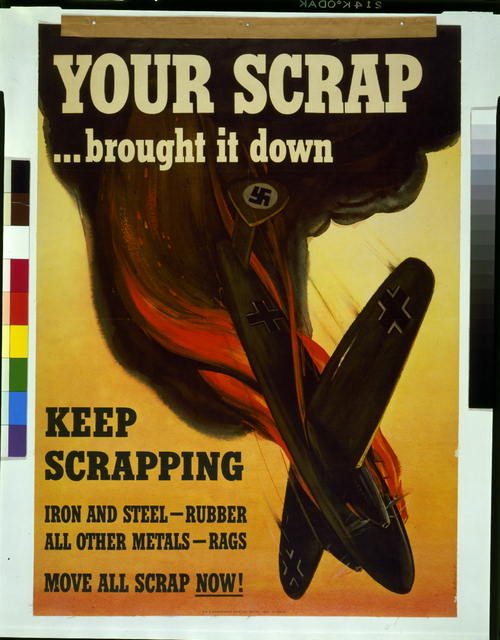
Wartime metal shortages hit the compact industry directly. From 1942, the US and Britain restricted brass, steel, and other strategic metals in consumer goods, and manufacturers who had built compacts out of plated base metal pivoted to plastic, Bakelite, and wood instead. The shift shows up clearly in the advertising and propaganda of the period: posters urging households to turn in scrap metal for the war effort, like the U.S. Government Printing Office’s 1942 “Your Scrap—Brought It Down” design, showing a downed Nazi warplane in flames, were part of the same material squeeze that forced compact makers to improvise.
What the metal shortage did not change was the object’s role as a gift. If anything, the war gave the compact its most sentimental chapter. Research from the University of York’s Digital Museum of Dress Accessories, led by art historian Cordula Van Wyhe, documents what collectors call “sweetheart compacts”: cases bought in bulk by American and British military units, stamped with regimental or divisional insignia, and sold to servicemen at post exchanges to send home to wives and girlfriends. Surviving examples carry handwritten inscriptions that turn mass-produced objects into intensely personal ones — one US Army compact in the York collection is engraved “To Agnes with Love Ed Apr. 4 1941,” while a silver niello compact made in wartime Thailand reads “To Mary Babyface from an Englishman in Singapore,” the kind of private joke that only makes sense between two people.
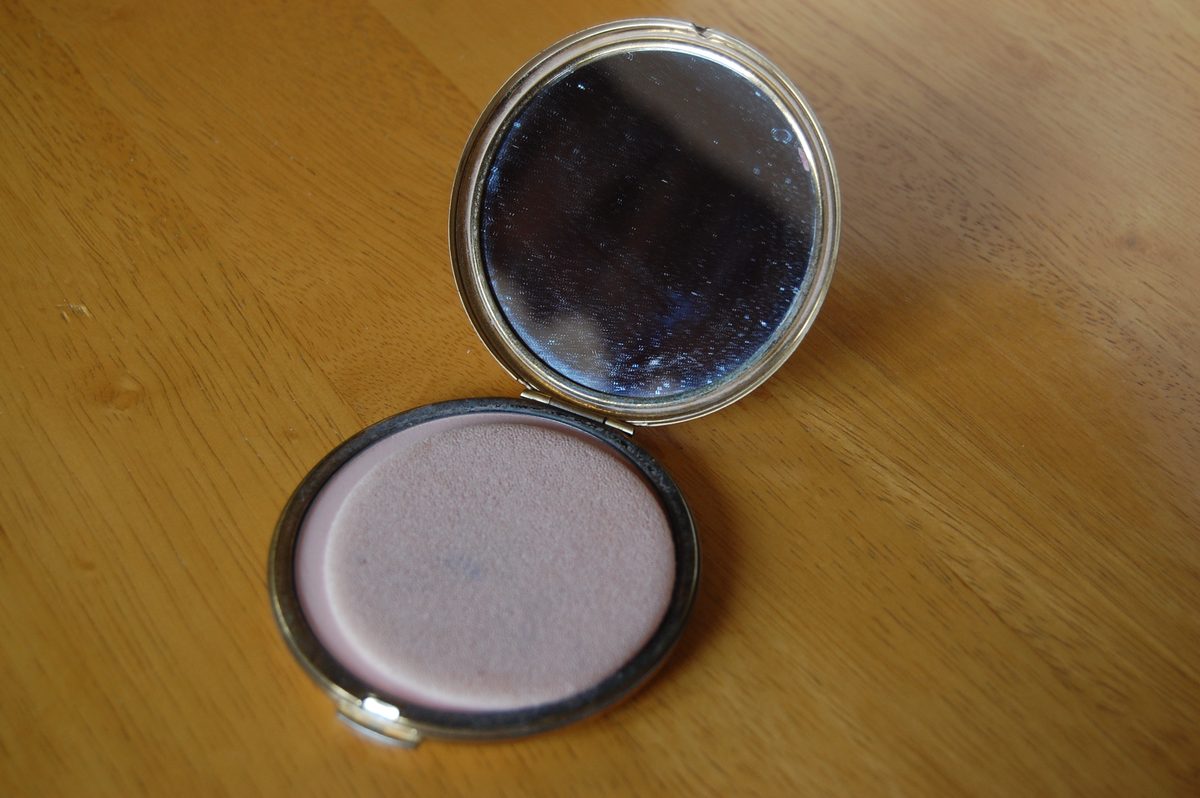
By the postwar years, mass-market compact makers were producing on an industrial scale. The English firm Stratton & Co, which traced back to a small badge-making business George Laughton bought for £50 in 1909, had by then abandoned the wireless and radar equipment it made during the war and refocused entirely on compacts and vanity cases, supplying everything from department-store lines to Woolworths counters. The compact had gone from forbidden, to rebellious, to glamorous, to mass-produced and sentimental, all within about twenty-five years.
The powder itself didn’t get regulated until 1938 — and a blinding was part of why
For all the attention paid to the case, almost none of this history addressed what was actually inside it. The United States had no meaningful legal mechanism for pulling a dangerous cosmetic off the market until 1938, and the law that finally did it was prompted in large part by a product with no direct connection to face powder at all. Lash Lure, an eyelash and eyebrow dye sold in the early 1930s, contained paraphenylenediamine, a coal-tar dye now recognized as a potent allergen. It was never tested for safety and did not disclose its ingredients. In the case that became the scandal’s public face, a woman’s eyebrows were plucked before the dye was applied; the exposed skin became infected, the infection spread to her eyes, and she went blind. The Food and Drug Administration, which had no power to seize the product under the existing 1906 law, instead put “before and after” photographs of her injury on display at the 1933 Chicago World’s Fair as part of a traveling exhibit nicknamed the American Chamber of Horrors, built specifically to show Congress what the agency could not legally stop.
Reform stalled for five years regardless, and it took an unrelated catastrophe — the 1937 Elixir Sulfanilamide disaster, in which a poorly tested drug solvent killed roughly a hundred people, many of them children — to finally force Congress’s hand. The Federal Food, Drug, and Cosmetic Act passed in 1938, and for the first time gave the FDA real seizure authority over cosmetics as a category, not just drugs. Lash Lure was the first product confiscated under the new law. It was a narrow, specific fix, and it did not retroactively make every historical face powder recipe safe. But it marked the first time any government agency had the legal standing to ask what, exactly, was in the powder a woman was putting on her face — a question that had gone functionally unasked since ancient Rome.
Watch the full history
The video version covers the same arc in just under six minutes, from the Egyptian kohl pot to the wartime sweetheart compact.

Related reading
- The Dangerous History of Face Powder — From Roman Lead Paint to a Flapper’s Compact
- How Derinkuyu’s Underground City Actually Worked
- Why Is It Called a Fob? The Pocket Before the Chain
- How an Ofrenda Is Actually Built
If you want to go deeper
A couple of starting points if this sent you looking for your own compact or a longer read :
Works cited
- Walton, F. T. “My Lady’s Toilet.” Greece & Rome 15, no. 44 (1946): 68–73. Link.
- McNeill, Fiona. “Analysis: Dying for Makeup — Lead Cosmetics Poisoned 18th-Century European Socialites in Search of Whiter Skin.” McMaster University News, February 28, 2022. Link.
- Vanity Case, 1934–1935, Ramsden and Roed. Victoria and Albert Museum, London, museum no. M.164&A-1987. Link.
- “Florence Jay Gould: Icon and Inspiration.” Van Cleef & Arpels, La Maison. Accessed November 2026.
- “A Little Known History of Jarrett, Rainsford & Laughton (Stratton & Co.).” The Vintage Compact Shop. Accessed November 2026.
- Van Wyhe, Cordula. “Nothing Said ‘Love’ More Than a Powder Compact, Art Historians Reveal.” University of York, News and Events, February 14, 2023. Link.
- Bennett, James. “Lash Lure.” Cosmetics and Skin. Link.
- “80 Years of the Federal Food, Drug, and Cosmetic Act.” U.S. Food and Drug Administration. Link.
Loose and pressed powder compacts held on through the middle of the twentieth century and then faded, gradually, as liquid and cream foundations, disposable packaging, and changing beauty routines made the ritual of flipping open a mirrored case at the table feel old-fashioned rather than daring. What survives now is mostly in collections: museum vanity cases like the Victoria and Albert’s Ramsden and Roed piece, specialist dealers built entirely around Stratton, Kigu, and Elgin American compacts, and a steady market of people who want the specific object their grandmother or a wartime sweetheart once carried.
What that object actually represents, across roughly two thousand years, is a case study in how slowly beauty standards and consumer safety have moved together. A Roman woman whitening her face with lead, an Elizabethan courtier doing the same with a recipe a modern physicist would later flag as unusually dangerous, a flapper defying etiquette at a restaurant table, and a soldier engraving a wartime compact with his sweetheart’s name were all, in their very different ways, trusting a small metal case with something that mattered to them. It took until 1938 for anyone to have the legal authority to ask whether that trust was well placed.