
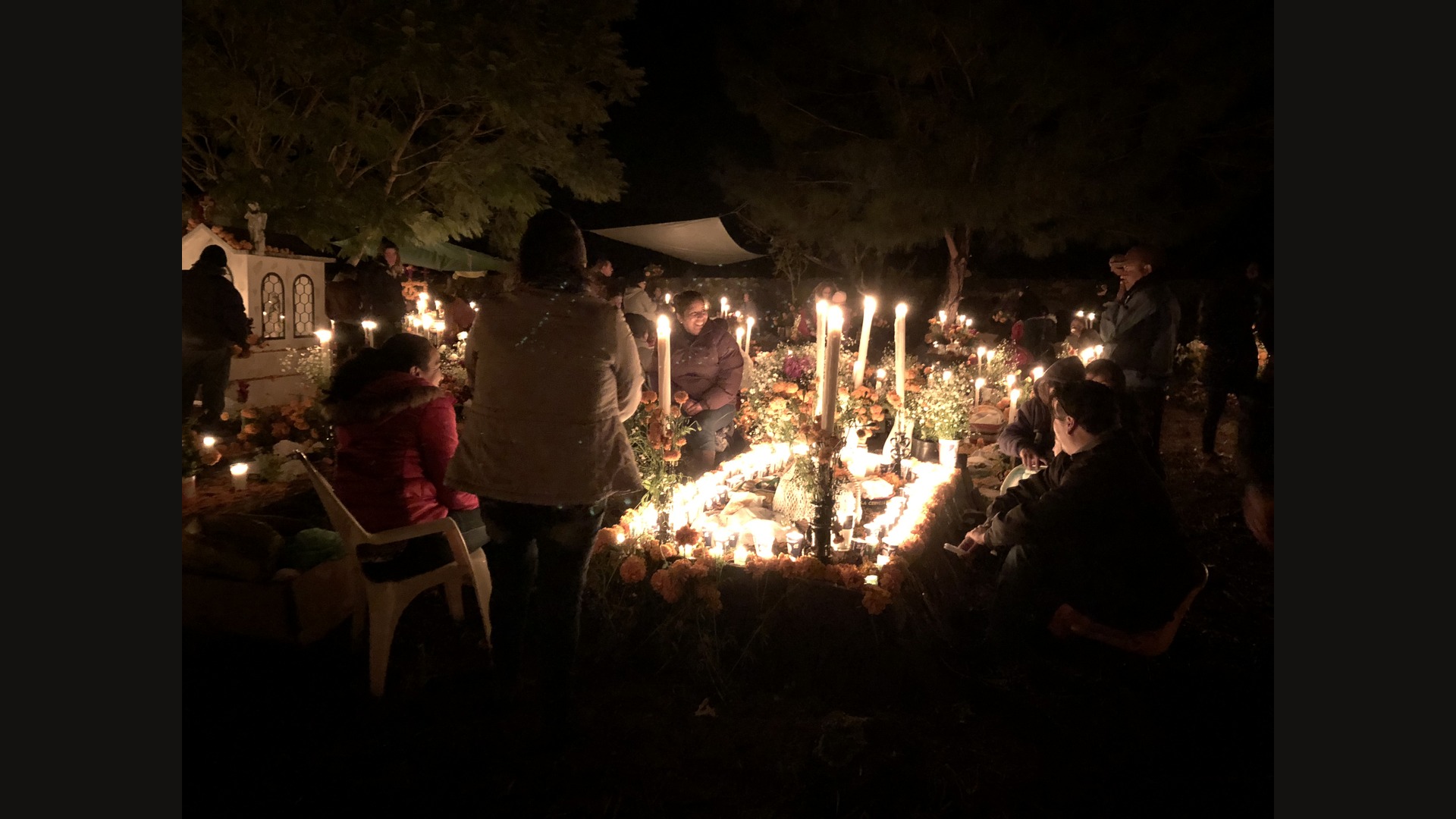
Every October, Mexico City’s parks department writes a check to hundreds of small farmers for a crop it has no other reason to buy. In 2026 those farmers delivered more than ten million cempasúchil marigold plants — a 53.8 percent jump over the year before — and the city government put in more than $428,000 to make sure the order got filled. The flowers are not an afterthought bought once the altar is already built. They are the one material in the whole tradition with an actual subsidy line behind it, renewed every autumn like a harvest contract, because in the fields where they are grown, that is essentially what it is.
An ofrenda gets described, often, as four simple jobs: call the dead back, light their way, feed them, let them go again. What that description leaves out is how much actual infrastructure sits behind each job once you look past the symbolism — a flower economy, a single paper-cutting town, an incense with a documented religious history older than the Mexican state, and two lakeside vigils that now draw crowds a small country’s tourism board plans around. The altar’s two most famous props, the sugar skull and the holiday’s disputed Aztec pedigree, already have their own stories told elsewhere on this site. This is the story of what actually gets hauled, cut, burned, and rowed into place to make the rest of it happen.
None of it, notably, is new money chasing an old tradition. It is old infrastructure that happens to still be running, now with a government line item attached.
The Flowers Still Grow on Fields the Aztecs Engineered
The cempasúchil marigold most of this season’s altars will use is grown, in large part, on chinampas — artificial islands built up by hand from lake mud, reeds, and rotting vegetation in the shallow lakes of the Mexico City basin. UNESCO’s own listing for the Historic Centre of Mexico City and Xochimilco calls the chinampa landscape the only remaining reminder of pre-Hispanic land use anywhere in the basin’s former lagoons. The technique predates the Spanish by centuries; what has changed is mainly the crop grown on it, not the engineering underneath.
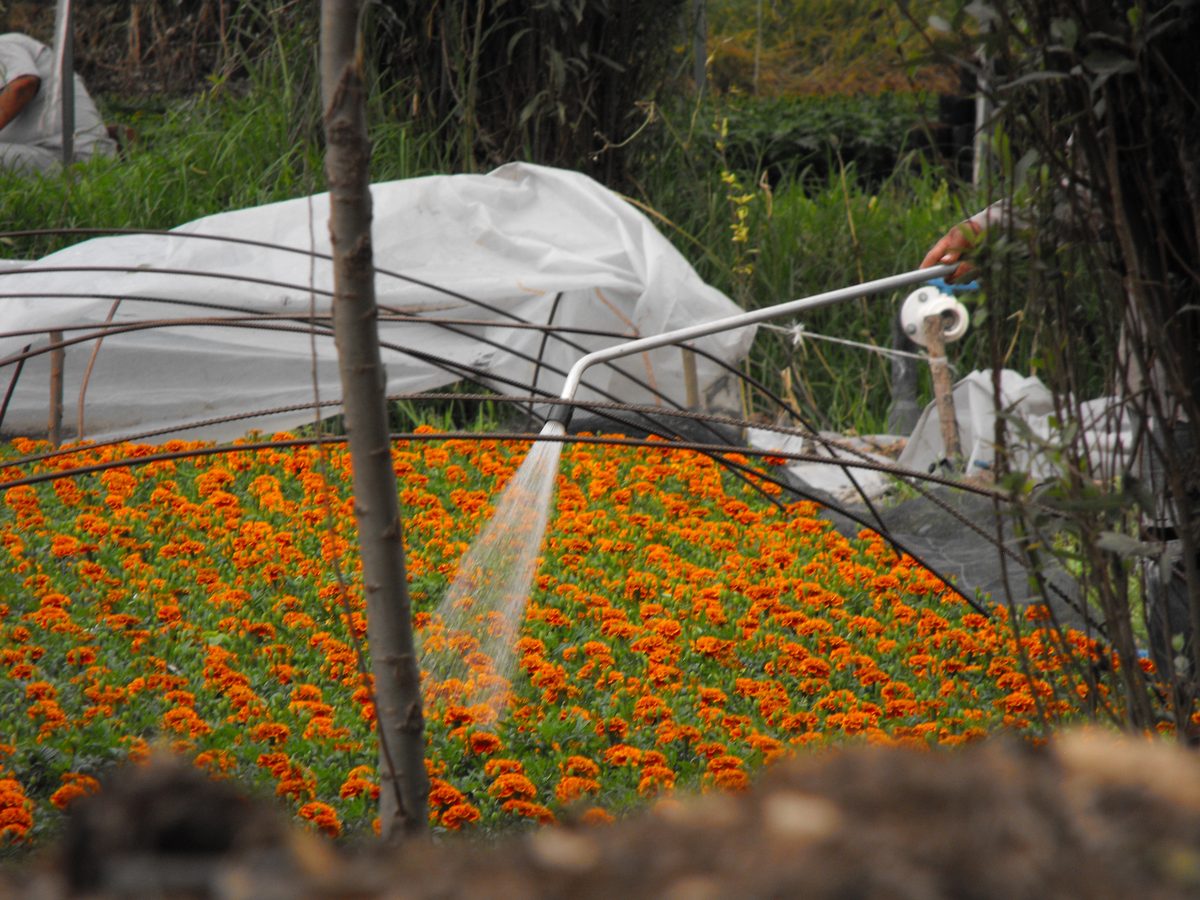
The construction method has not changed since before the conquest: stakes driven into the lakebed, fenced in with woven branches, then filled and built up with mud and rotting lake vegetation until the plot stands above the waterline, with willow trees planted along the edges to root the whole plot in place. A chinampa built this way can stay productive for generations with nothing more than routine upkeep.
Xochimilco, the borough that still farms the densest surviving network of chinampas, produced a record crop for the 2026 season: more than ten million plants, up 53.8 percent on the year before. Mexico City’s government paid out more than 8 million pesos (roughly $428,100) to directly support 597 registered growers, with individual plants retailing for 15 to 30 pesos (about $0.80 to $1.60) once they reach market. That is not a folk-craft subsidy in the sentimental sense — it is an agricultural support program for a crop whose entire commercial demand is concentrated into roughly one week a year.
The timing is not coincidental, either. UNESCO’s file on the festival describes it as marking the end of the annual maize cultivation cycle, and cempasúchil is a late-bloomer by design of the calendar it was bred into: it flowers reliably in the last days of October across central Mexico, which made it the obvious, cheap, locally abundant material for an altar that needed to be built on a fixed date every year, no matter what else was happening that season.
The Paper Takes One Town, a Mallet, and Fifty Sheets at a Time
Papel picado, the perforated paper banners strung over nearly every altar and street in the days around the holiday, has a documented lineage that starts well before tissue paper existed in Mexico at all. The Otomí community of San Pablito, in the Sierra Norte of Puebla, made ceremonial paper art from amate, a bark paper produced by boiling and pounding tree fiber, for use in sacred ritual. What changed the craft into something closer to today’s banners was a side effect of global trade: in the sixteenth century, tissue paper — papel de China — arrived in Mexico aboard the Manila-Acapulco galleons, and local artisans adapted their cutting tradition to the new, far more fragile material.
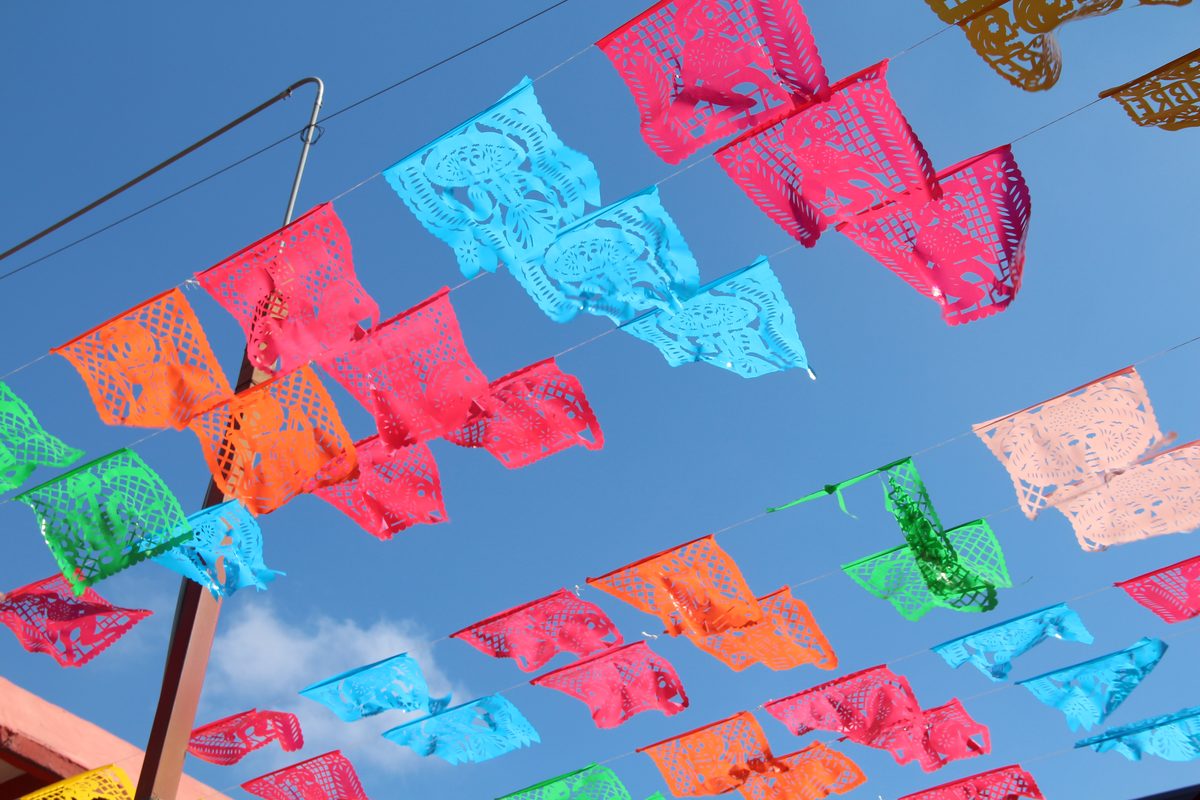
The specific technique practiced today is credited to one town: San Salvador Huixcolotla, in Puebla, where artisans stack dozens of sheets of tissue paper — traditionally forty to fifty at once — and cut the whole stack in a single pass with a small mallet and a set of chisels shaped for different parts of the design, producing dozens of identical banners from one carved pattern. By the nineteenth and early twentieth centuries the craft was a staple of festivities across central and southern Mexico. Hung over an ofrenda, the paper is read as standing in for air among the traditional four elements on the altar; purple and black are read as the colors of death, orange and yellow as an echo of the marigolds lighting the spirits’ way beneath it.
The Smoke Has a Documented Job Going Back to a Sunken Cenote
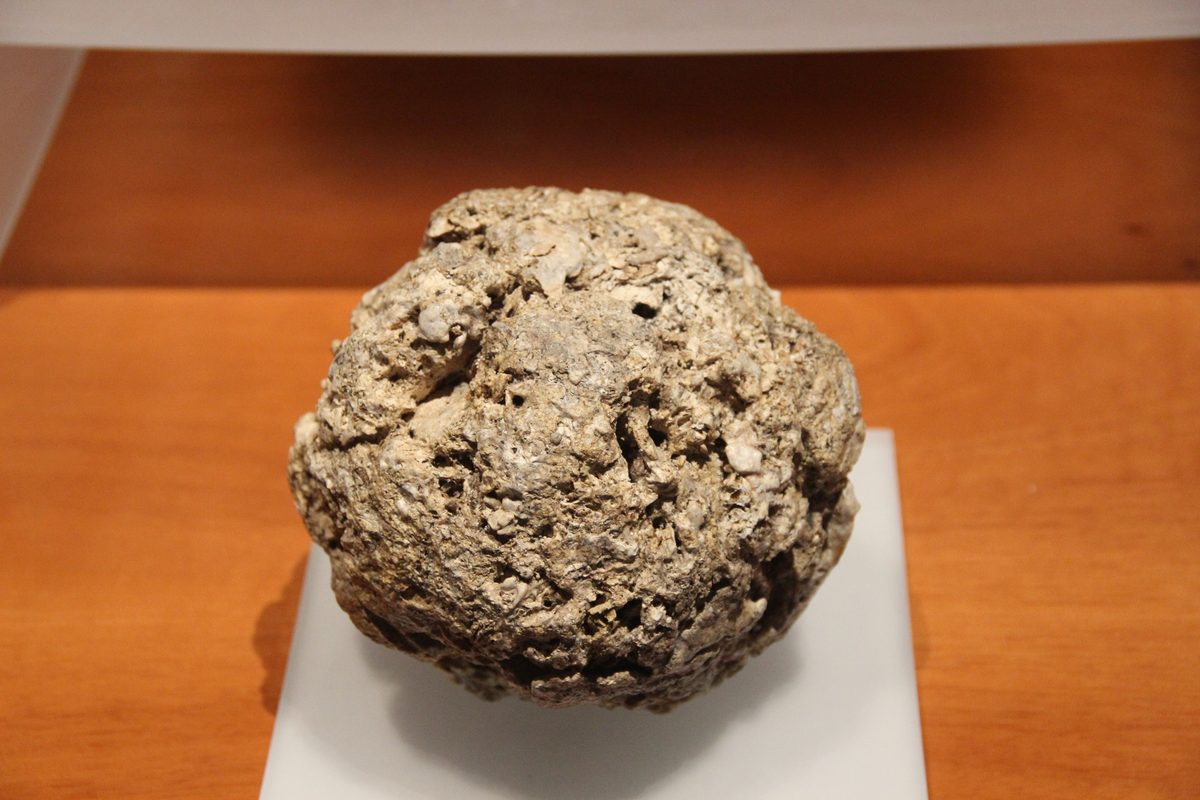
Copal, the resin incense burned at most home altars, is not decorative smoke. Its religious use in Mesoamerica is old enough to have left physical evidence: a ceramic tripod bowl recovered from the Sacred Cenote at Chichén Itzá, dated to roughly 1300 to 1450 CE, was found packed with copal resin and jadeite beads together, a deliberate offering rather than household debris. The bowl now sits in Harvard’s Peabody Museum of Archaeology and Ethnology. Whatever that specific pairing of resin and stone meant to the people who placed it in the water, it was clearly not incidental.
That same resin, burned the same basic way, is what fills the air at an ofrenda or a cemetery vigil today: the smoke is understood to mark out sacred space and to help clear a path for the dead to cross, the same rough function incense performs in a great many unrelated religious traditions. What is unusual here is not the idea but the continuity — a specific resin, from a specific regional tree, doing a specific symbolic job across a documented span of roughly seven hundred years and counting, through a colonial period, a national holiday calendar reshuffle, and a UNESCO inscription, without the smoke itself needing to change at all.
A Farming Town’s Vigil Was Built to Outlast a Spanish Ban
San Andrés Mixquic, a chinampa farming settlement on what was once the shore of Lake Chalco, keeps one of the best-documented versions of the altar tradition’s companion ritual: the graveside vigil. Families spend the days beforehand cleaning and repairing family tombs, then on November 2 decorate them with cempasúchil, candles, and, in some cases, elaborate images of saints or crosses built out of flower petals or colored sawdust. After dark, the town’s church bells mark the start of what residents call the Alumbrada: the lights dim, and the cemetery around the church fills with candlelight and copal smoke until morning.
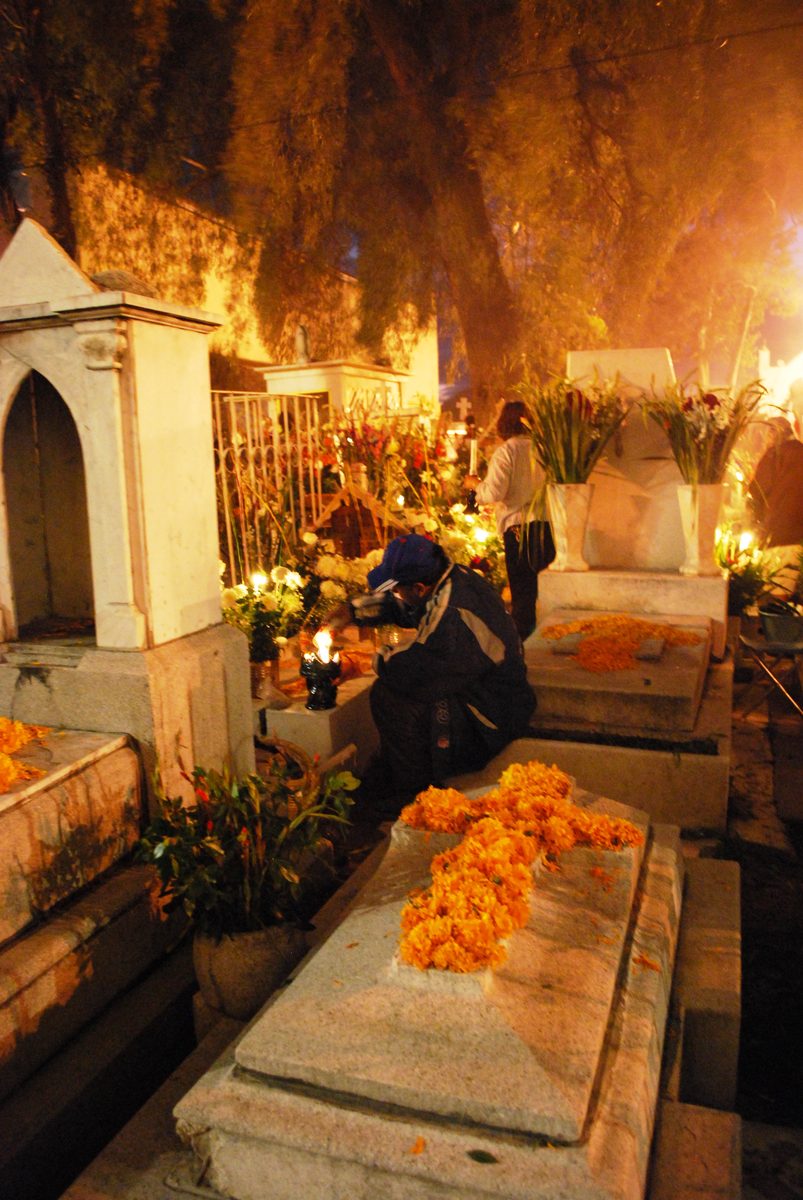
Mixquic’s private side is matched by a very public one. Families also build home altars in garages and passageways along the side streets, open to any visitor who wants to look, often with a basket out for tips. Reporting from the ground describes thousands of outsiders arriving for the event, with November 2 drawing the largest crowds of the festival’s several days — a town that built its vigil as a private, parish-scale practice now runs it half as a tourism operation every single year, by necessity rather than choice.
On a Lake, the Dead Are Said to Arrive by Canoe
The Purépecha communities around Lake Pátzcuaro, in Michoacán, keep a version of the vigil built specifically around water. On the island of Janitzio, the morning of November 1 belongs to children: a ceremony known locally as Kejtzitakua Zapicheri, the “Wake of the Little Angels,” decorates children’s graves with toys and sweets between seven and ten in the morning. After dark, fishermen row out across the lake in candlelit canoes for the Animecha Kejtzíatakua, working butterfly-shaped fishing nets in a slow, deliberate pattern meant to represent souls returning across the water — a ritual tied, in local telling, to the belief that the monarch butterflies arriving in Michoacán’s forests at exactly this time of year are carrying the dead home with them.
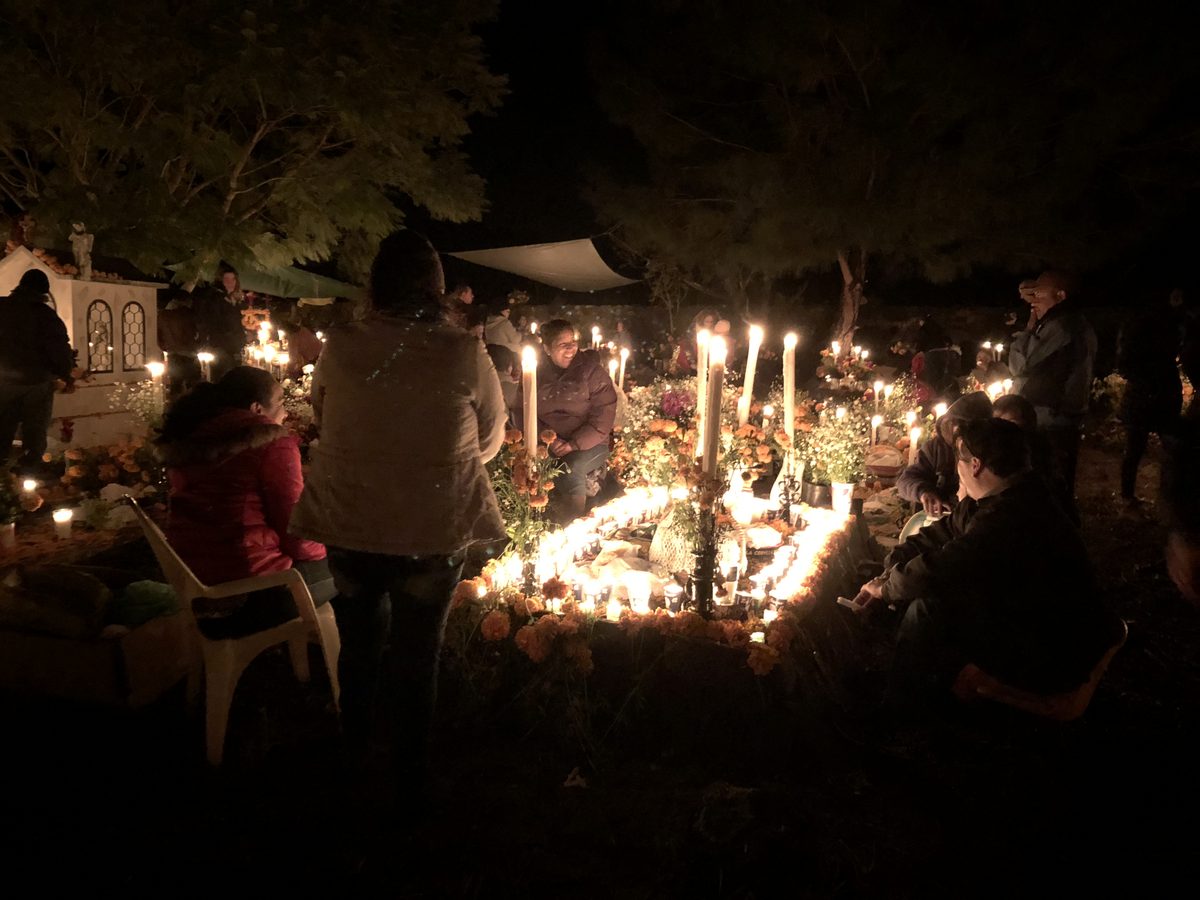
The monarch migration is not folklore dressed up as biology. The butterflies travel roughly 2,800 miles from southern Canada and the northern United States to a handful of oyamel fir forests in the mountains of Michoacán and neighboring México state, arriving in the last days of October and the first days of November almost every year — the same calendar window the Purépecha vigil has always kept, whichever belief came first.
From midnight to dawn, women and children keep the hilltop cemetery vigil with candles, food, and flowers while the church bell tolls through the night; by some accounts the men wait outside the gates until morning rather than enter. Lake towns like Cucuchucho keep smaller versions of the same practice without Janitzio’s crowds. Janitzio’s own vigil alone is reported to draw more than 100,000 visitors most years, and Michoacán’s state tourism office has projected more than 300,000 visitors statewide for the holiday, worth roughly 250 million pesos (about $12.4 million) to local businesses — alongside a separate 4.5-million-peso (about $223,000) state fund specifically to help Purépecha communities afford the materials for their own ceremonies. A ritual the Spanish crown once tried to extinguish is now, in part, funded by the Mexican state that succeeded it.
Watch the full history
The video companion walks through what each altar object is actually for — the marigolds, the candles, the salt, the photograph — in about eight minutes.

None of this — the flowers, the paper, the smoke, the lake — needed electricity, and until quite recently, none of it needed much money either. What has changed is who is paying attention to the logistics. A city parks budget now treats the marigold harvest as a line item; a state tourism office now plans road closures and hotel capacity around a lakeside vigil that used to be a strictly local affair. Whether that is the tradition being commercialized or simply being noticed and supported is a genuinely open question, and not the one this piece set out to answer.
The other open question — how far back any of this actually goes, and how much of the imagery is a nineteenth- and twentieth-century invention laid over a much older calendar — has its own long, contested paper trail, which is covered in detail in this site’s look at the pre-Hispanic debate. The single most famous object on the altar has a similarly specific, separately documented route from a Spanish apothecary’s medicine cabinet to a Toluca market stall, told in full in the story of the sugar skull. What a marigold field, a paper-cutter’s stack of fifty sheets, and a rowboat on a cold lake have in common is less glamorous than either of those stories, and arguably more useful to know: they are most of the actual machinery that makes the night work, year after year, whoever is watching.
Related reading
- Why Sugar Skulls Get a Name Written on the Forehead
- Is the Day of the Dead Really a Pre-Hispanic Tradition?
- The Print Trail That Turned a Pumpkin Into a Jack-o’-Lantern
- Inside the Medieval Pilgrim Badge Industry
Works cited
- UNESCO Intangible Cultural Heritage. “Indigenous Festivity Dedicated to the Dead.” Representative List of the Intangible Cultural Heritage of Humanity. Inscribed 2008; originally proclaimed 2003. Link.
- UNESCO World Heritage Centre. “Historic Centre of Mexico City and Xochimilco.” World Heritage List, no. 412.
- MND Staff. “With Day of the Dead Less Than a Week Away, Mexico City’s Cempasúchil Production Hits Record Heights.” Mexico News Daily, October 27, 2026.
- “Papel Picado: Mexico’s Festive Paper Art.” Horniman Museum and Gardens. Link.
- The Metropolitan Museum of Art. “Golden Kingdoms: The Sacred Cenote at Chichén Itzá.” Perspectives.
- Carey, Lydia. “Mixquíc’s Day of the Dead Is Part Spectacle, Part Intimate Tradition.” Mexico News Daily, November 2, 2021.
- “Day of the Dead in Janitzio.” Mexican Folk Art Guide. Link.
- “More Than 300,000 Tourists Expected in Michoacán for Day of the Dead.” Mexico News Daily, October 6, 2022.
- “First Monarch Butterflies Reach Sanctuaries in Michoacán, México State.” Mexico News Daily, November 7, 2018.