
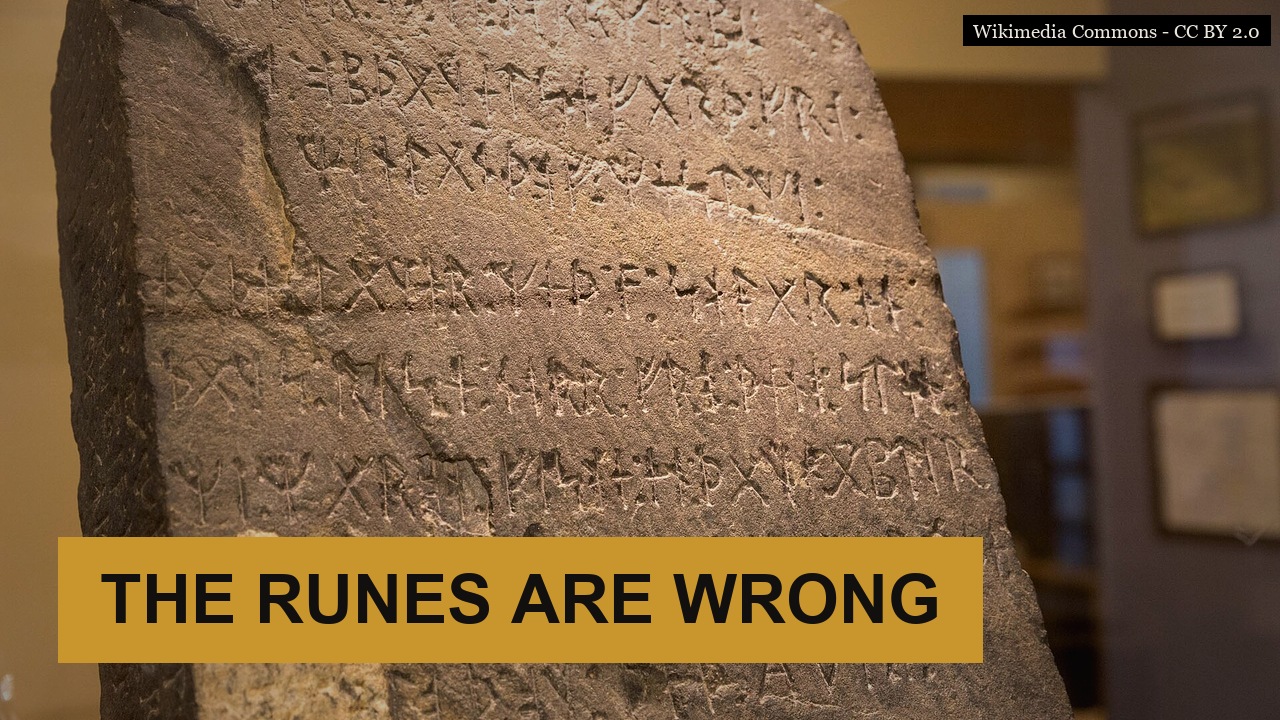
Every rune carved into the Kensington Runestone has, by now, been traced to a real place and a real time, and neither one is medieval Vinland. In 2019 a Swedish schoolteacher and her students found the same alphabet scratched into the ceiling of a hired hand’s room on a farm in Hälsingland, cut years before the stone’s discoverer ever left Sweden. A nearby barn carries two names in the identical letters, dated 1870 and 1877. The alphabet has an address now. What it has never had, in more than a century of argument, is a confessed carver.
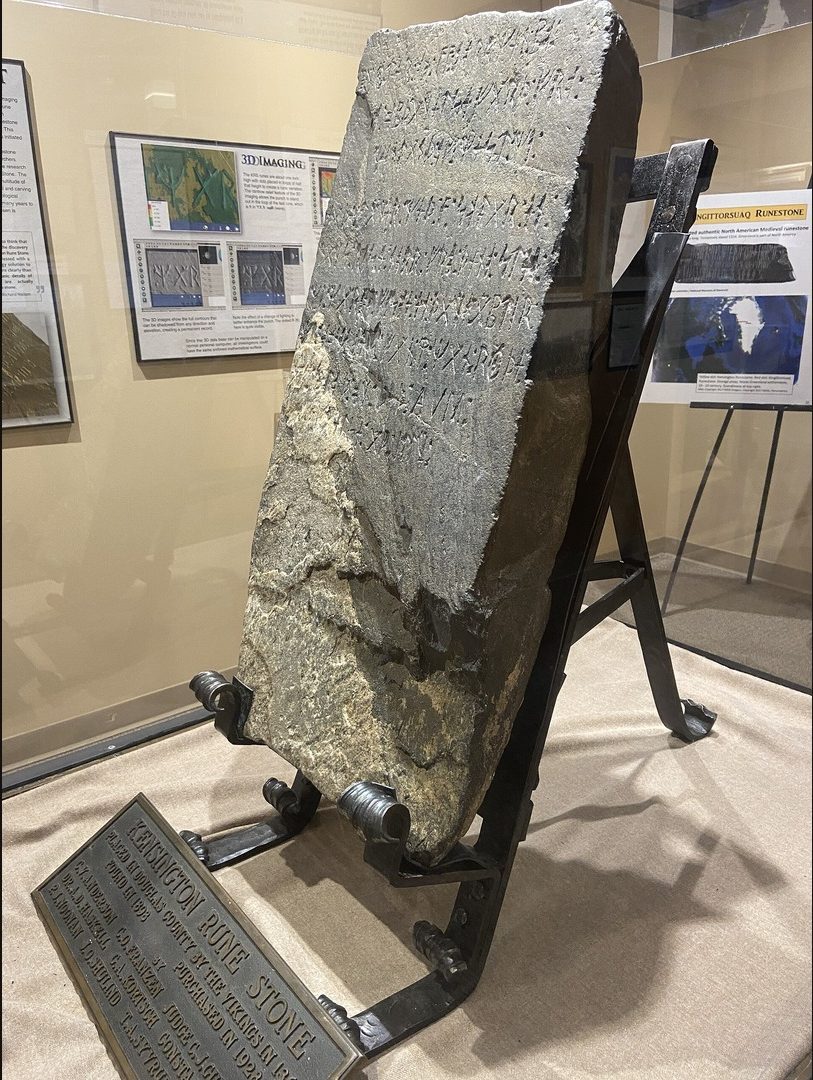
The stone itself is a 202-pound slab of greywacke that a Minnesota farmer said he pulled from a poplar’s roots in November 1898. Nine lines of runes run down its face; three more continue along one edge. Translated, the inscription describes eight Geats and twenty-two Norwegians on an exploration journey from Vinland, a camp beside two skerries, a day spent fishing, and a return to find ten companions “red with blood and dead.” It closes with a date: 1362. If genuine, it would be the oldest written document ever recovered from the interior of North America, physical proof that Scandinavians reached the Great Lakes more than a century before Columbus sailed from Spain.
It is not genuine, in the judgment of essentially every runologist and historical linguist who has examined it since 1899. What makes the case worth revisiting is not that verdict, which has not moved in decades, but how it was reached, and why it took until 2019 to trace the alphabet all the way back to the farms it actually came from.
A Farmer, a Tree Stump, and a Claim Nobody Could Verify
Olof Ohman was a Swedish immigrant nineteen years into American life when he bought forty acres of scrub poplar in Solem Township, Douglas County, near the small town of Kensington. Clearing the land in November 1898, he levered a stunted poplar out of the ground near the crest of a low knoll above a wetland and found a stone slab lying face down among its roots. His ten-year-old son Edward noticed marks on the underside. Ohman’s own first guess, by his later account, was that they had uncovered an Indian almanac.
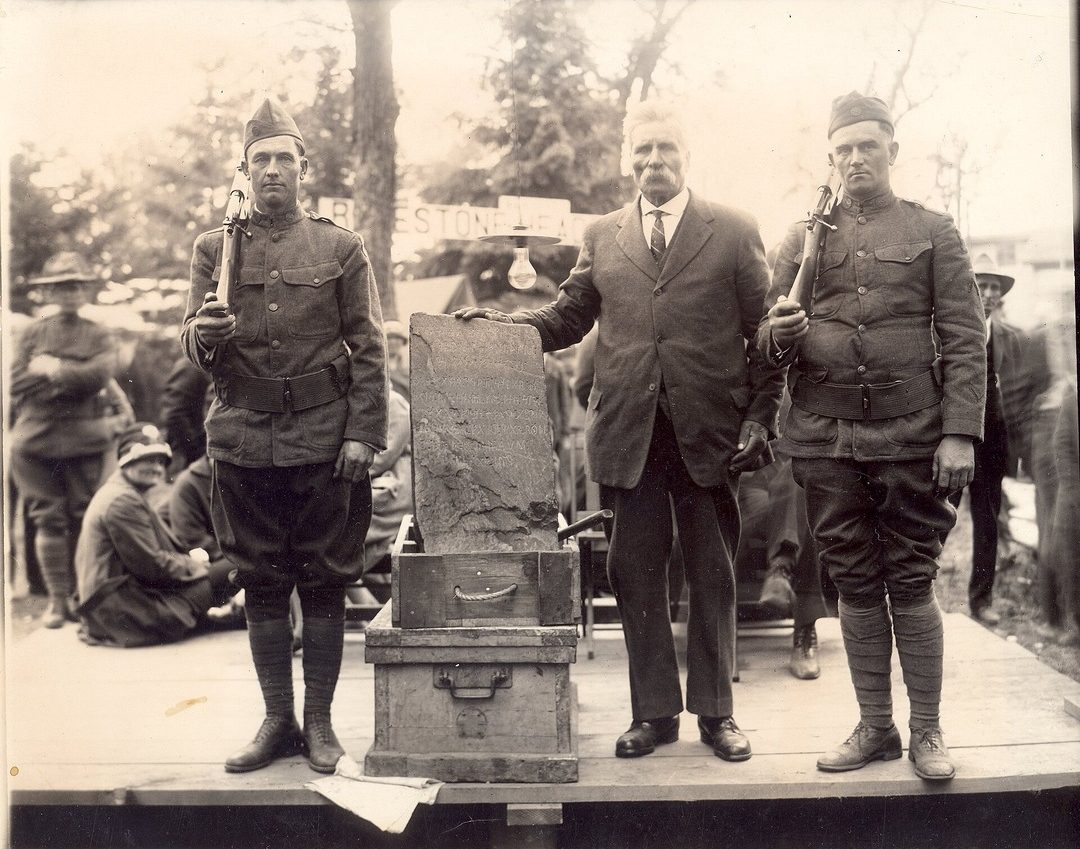
The slab he hauled out weighs 202 pounds and measures roughly 30 by 16 by 6 inches. Nine lines of runic text run down the face; three more continue along one narrow edge, finished off with the letters A, V, M, read as an abbreviation of Ave Virgo Maria, a plea for protection. Nothing else about the claim has ever been corroborated on the ground. No camp, no graves, no additional Norse tool or weapon has turned up at or near the find site in the twelve decades since, despite repeated searching. A medieval Scandinavian expedition that reached Minnesota and lost ten men to violence would be one of the best-documented non-events in archaeology: an inscription with no supporting material culture anywhere around it.
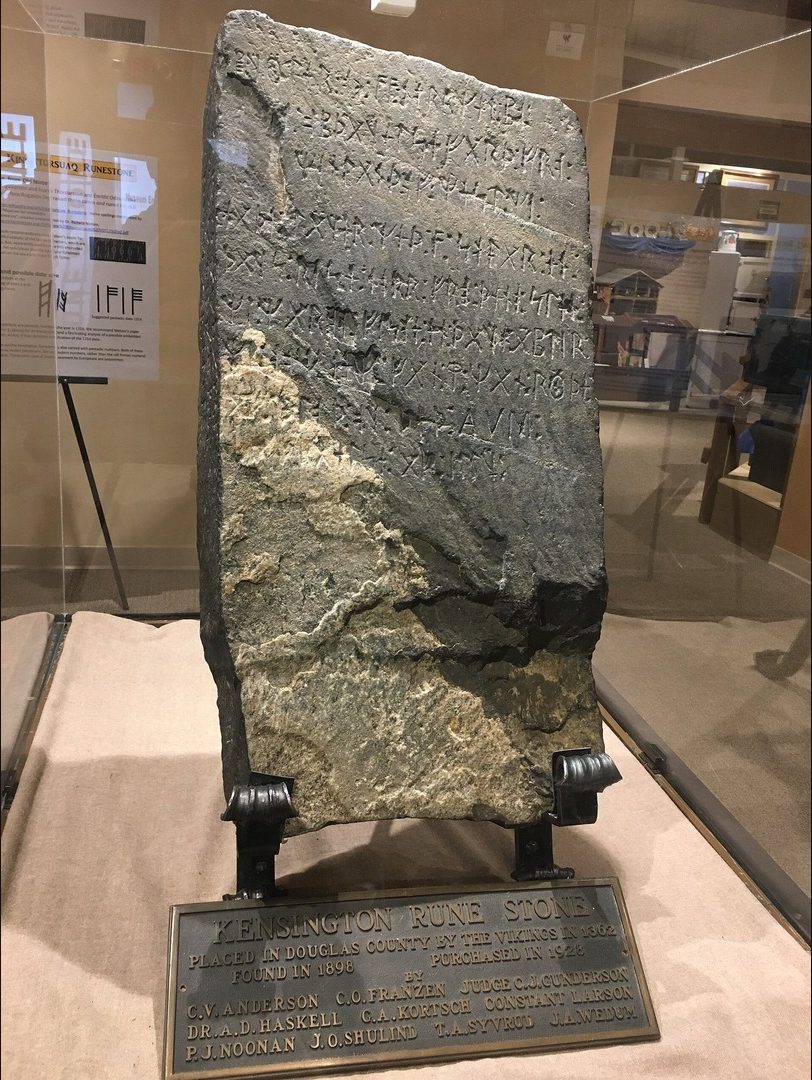
Scandinavia’s Leading Runologists Rejected It Within Weeks
News of the find reached a Swedish-American newspaper, Svenska Amerikanska Posten, in a letter dated January 1, 1899. Olaus Breda, a professor of Scandinavian languages at the University of Minnesota, translated the inscription for the student paper the Ariel two weeks later and judged it probably spurious on the spot. He then sent his copies east and across the Atlantic to the people best positioned to judge it: Oluf Rygh, Sophus Bugge, Gustav Storm, Magnus Olsen and Adolf Noreen, the senior Scandinavian philologists of the day, working out of Christiania, now Oslo. By April 1899 they had answered. Their verdict was unanimous: a forgery, and a recent one.
That should have ended the matter. It did not, because a Norwegian-American amateur historian named Hjalmar Holand took up the stone around 1907 and would not let it go for the next forty years. His first piece on it ran in the Norwegian-language paper Skandinaven in January 1908; by 1910 he was publishing in the Journal of American History under the title “First Authoritative Investigation of Oldest Document in America.” In 1911, Ohman sold the stone to the Minnesota Historical Society for ten dollars, a bill of sale the Society still holds.
The Historical Society’s Own 1910 Report Split the Case Down the Middle
The Society’s museum committee delivered its preliminary report in May 1910 and published it that December, later folding it into the Society’s Collections, volume 15. It is a genuinely divided document. The geologist Newton Horace Winchell compared the weathering inside the carved grooves against the untouched back of the slab and estimated roughly five hundred years of exposure, enough to make a fourteenth-century date plausible. But Winchell’s own report hedged that conclusion in its very first line: “The first impression derived from the inscription is that it is of recent date, and not 548 years old.” He also noted that the chisel marks themselves still looked fresh, and that the poplars growing over the find site were thirty to forty years old, where the man who had excavated the site the year after the discovery remembered them as ten to twelve.
The committee’s companion linguist, George T. Flom, was unhedged: he found what he called a strong apparent divergence between the Kensington runes and genuine fourteenth-century runes, and judged the language itself to be modern Swedish rather than medieval Old Swedish.
What the published report left out is just as telling. The historian Frederick Jackson Turner was privately consulted and wrote a seven-page letter, dated February 10, 1910, declining to rule on authenticity but insisting the question “should be worked out deliberately and not on the basis of assumptions one way or the other.” The museum committee that endorsed the stone’s case never saw that letter, and the Society’s own executive council never formally endorsed the committee’s favorable conclusions at all. A document sold to the public for a century as the Minnesota Historical Society’s verdict was, underneath, a report its own governing board had quietly declined to sign.
The Deciding Evidence Was Always Grammar, Not Geology
By the mid-twentieth century the argument had largely left the field and moved into the seminar room, because the grammar does not fit any defensible fourteenth-century Scandinavian. Old Swedish of that period inflected its nouns through four grammatical cases; the Kensington inscription has none. It lacks the plural verb forms the period required. And the phrase it uses for the voyage itself, opdagelsefärd, a voyage of discovery, is not attested in Scandinavian, Low Franconian or Low German writing before the sixteenth century, though it was a word the Norwegian historian Gustav Storm, one of the five scholars who had condemned the stone in 1899, used constantly in his own prose that same decade.
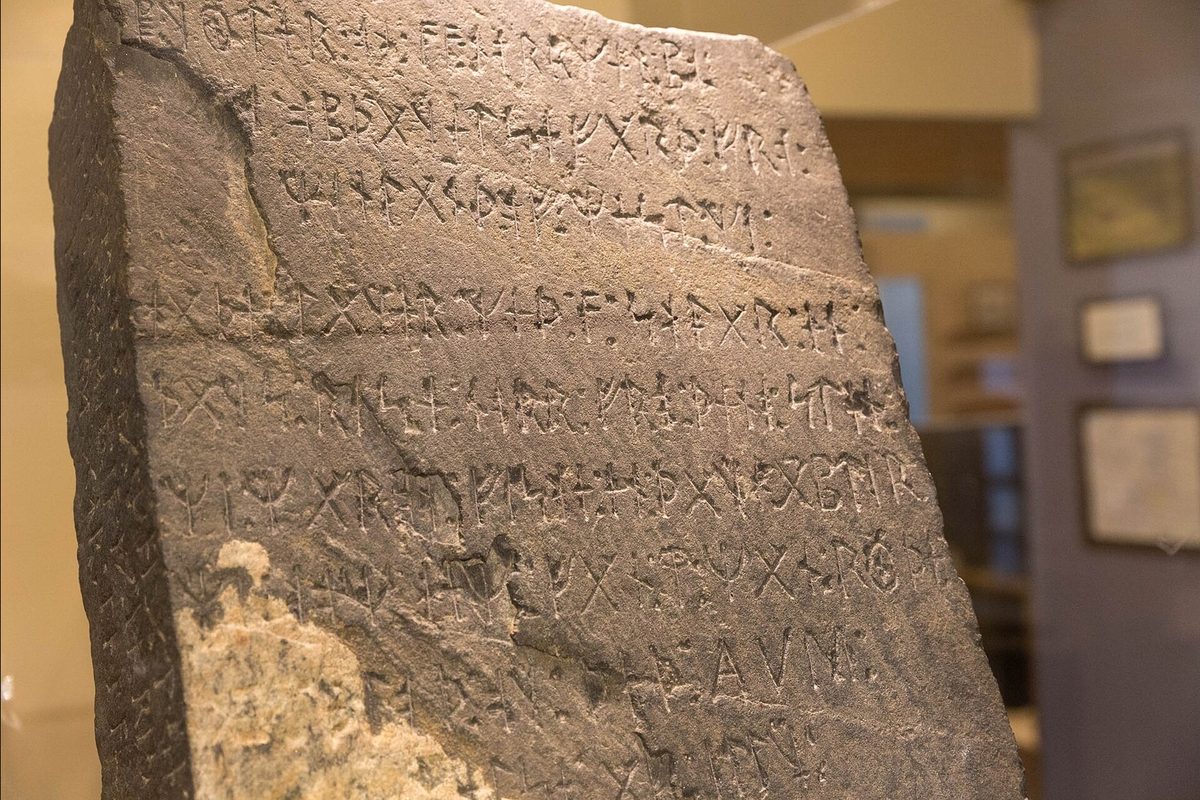
The alphabet carries the same problem. At least seven runes on the stone, including the characters for ä and ö, appear in no standard medieval runic row anywhere; its numeral system, while a genuine Scandinavian counting method, is documented mainly from recent centuries rather than any verified medieval monument. The clearest statement of the problem came, oddly, from a scholar arguing for authenticity. S. N. Hagen conceded in print that “the Kensington alphabet is a synthesis of older unsimplified runes, later dotted runes, and a number of Latin letters,” and pointed out that its forms for a, n, s and t were old Danish letter shapes that had already dropped out of use before the fourteenth century began.
A Trip to the Smithsonian Didn’t Settle Anything Either
The stone’s best publicity came decades after the scholarly verdict. On February 17, 1948, it traveled to Washington for display at the United States National Museum, part of the Smithsonian Institution; a press release issued at the time claimed that “the confirming evidence that the stone constitutes a genuine record is so strong” that the museum felt justified in exhibiting it as such. It returned to St. Paul on February 25, 1949.
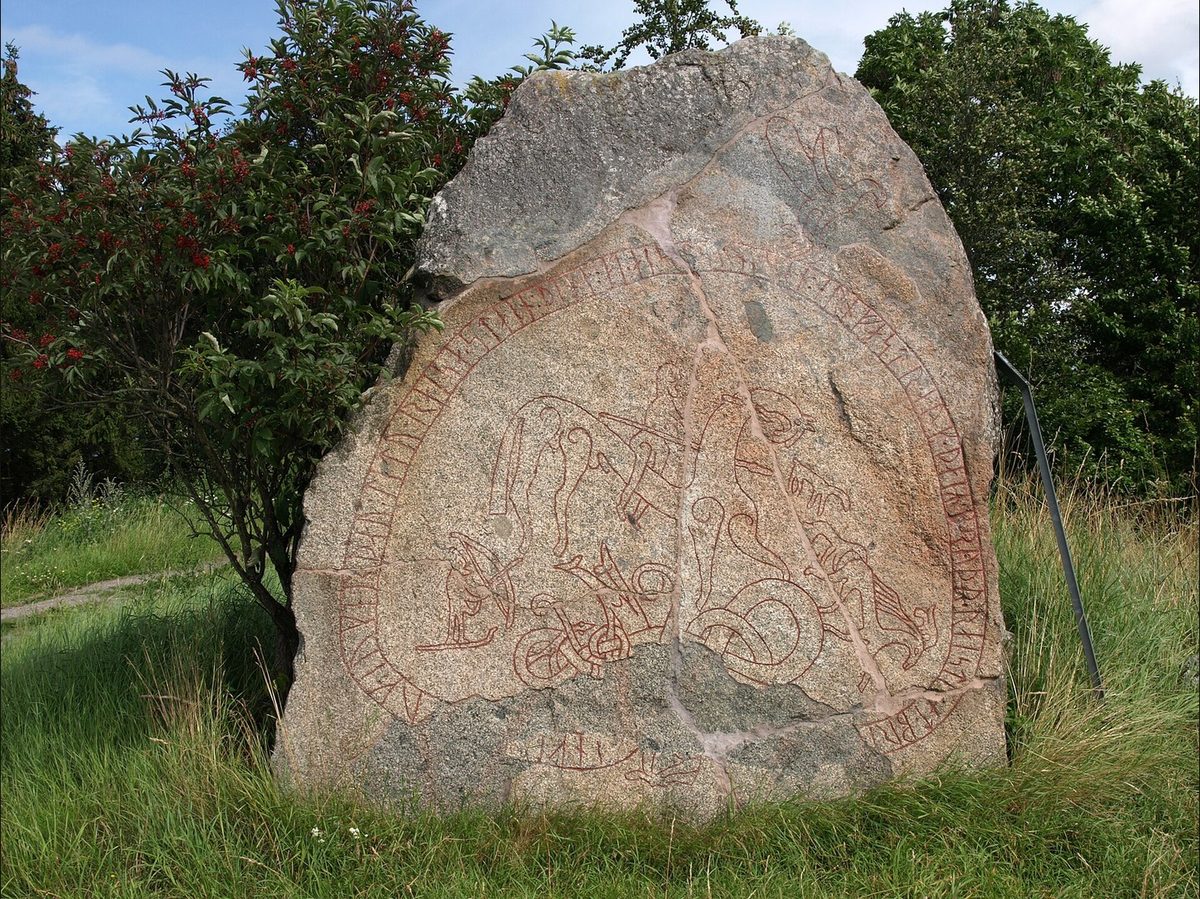
The display produced one serious scholarly defense and one sharp rebuttal, in the same year. The Danish philologist William Thalbitzer argued in the Smithsonian’s own Miscellaneous Collections, pairing the Kensington inscription with a disputed runestone from Greenland and concluding that “it seems to me that, after all, the inscription may be authentic,” even as the journal’s own editorial note called him simply “a distinguished Danish authority,” not an impartial one. The Swedish scholar Sven B. F. Jansson answered that same year in Nordisk Tidskrift with a judgment that has held up far better: the inscription on the Kensington Runestone is a hoax.
Erik Wahlgren’s 1958 book, The Kensington Stone: A Mystery Solved, and Theodore Blegen’s 1968 follow-up, The Kensington Rune Stone: New Light on an Old Riddle, closed the question for most of the field. Wahlgren had already argued, in a 1959 American Heritage piece, that the linguistic and runological sections of the Society’s own favorable 1910 report had been almost exclusively Holand’s work rather than independent scholarship, a claim that undercuts the report’s authority far more than Winchell’s geology ever could.
The Defense Never Entirely Stopped, and Neither Did the Confession Problem
Belief in the stone outlived the scholarly consensus against it. Decades later, the amateur researcher Richard Nielsen and the forensic geologist Scott Wolter argued in print and in a 2006 book that overlooked features, including a notch cut into the stone’s A-V-M abbreviation, were legitimate medieval scribal conventions rather than modern mistakes. Wolter separately re-examined the weathering in the grooves and argued the carving was genuinely old; runologists answered that the cuts show none of the rounding two centuries of Minnesota freeze-thaw ought to have produced.
What nobody has ever supplied, on either side of that argument, is a name. A neighbor named John Gran is said to have admitted a hand in carving the stone, but that claim reached the historical record only secondhand, relayed in a 1967 interview and not printed until Minnesota History ran it in 1976. Gran lived on for years after making the alleged admission and never repeated it publicly himself. No chisel has surfaced, no draft, no witnessed confession, no diary entry. Ohman was never shown to have had any training in runes, and he denied carving the stone for the rest of his life.
By 2019, the Alphabet Finally Had a Street Address
The breakthrough, when it came, was philological rather than forensic. In 2003 the Swedish linguist Tryggve Sköld matched the Kensington runes against handwritten rune charts from Dala-Floda, in the province of Dalarna, dated 1883 and 1885. It was a striking match and an impossible one: Ohman had sailed for America in 1879, four years before those particular charts were written down.
Magnus Källström, a runologist at Sweden’s National Heritage Board, pushed the search further north and west, into Hälsingland, the province Ohman actually came from, born in the parish of Forsa. Källström traced the same unusual letterforms to a carved wooden measuring stick from the parish of Haverö. Then, in 2019, a teacher named Anna Björk and her students at a local school worked through runic graffiti scratched into the ceiling of a hired hand’s room at the Ersk-Mats farm in Hassela and read out a single word: diefvulen, the devil. A neighboring barn carries two more names in the same letters, dated 1870 and 1877, cut well over a decade before Ohman ever boarded a ship. “There was no runic system like this in the Middle Ages,” Källström has said of the whole cluster. “There is no doubt that it says diefvulen.”
The heritage board’s own reading of the evidence is now straightforward. This was never a lost medieval script waiting to be rediscovered on a Minnesota hillside. It was a living, home-grown folk alphabet, used informally across Hälsingland and the neighboring Medelpad region through the nineteenth century, and carried to America in the memory, if not the luggage, of the ordinary emigrants who had grown up writing it on farmhouse ceilings and barn timbers.
Watch the full history
The nine-minute video below walks through the find, the split 1910 report and the Smithsonian’s brief, unconvincing rehabilitation of the stone in order; the Hälsingland tracing above goes a step further than it had room for.

What that leaves is not a record of Norse exploration but a window onto the world that produced the claim of one. By 1898, a large and increasingly organized Scandinavian-American population was pushing back against an American foundation myth that began the continent’s history with Columbus in 1492. A genuine medieval Norse inscription in the Minnesota interior would have handed a slice of that origin story back to Scandinavian immigrants’ own ancestors, three and a half centuries ahead of an Italian sailing for Spain. Holand’s forty-year campaign was never really separate from that argument. It was explicit about it, down to open talk of unseating Columbus Day itself. Whatever Olof Ohman intended when he leaned into the roots of that poplar tree, the stone did exactly that cultural work for the better part of a hundred years.
What survives now is not a Viking expedition’s log. It is a nineteenth-century Hälsingland farmhand’s private alphabet, carried across an ocean and cut, by somebody’s hand, into two hundred pounds of Minnesota greywacke. The letters finally have a documented home. The hand that used them on this particular stone still does not.
Who carves two hundred pounds of stone, buries forty years’ worth of a Swedish parish’s own handwriting inside it, and never once comes forward to claim it?
Related reading
- Why Nobody Can Read the Voynich Manuscript — another undeciphered-text mystery where the writing itself is the crime scene.
- Why the Dorabella Cipher Remains Unsolved — a short, handwritten code that has outlasted every attempt to crack it.
- The Kecksburg NASA Files Nobody Can Find — a different kind of missing paper trail, this time inside a federal agency.
- What Really Happened to the Florentine Diamond — an object whose authenticity and whereabouts have been argued over for a century.
Works cited
- Minnesota Historical Society Museum Committee. The Kensington Rune Stone: Preliminary Report to the Minnesota Historical Society. Presented May 9, 1910; published December 1910; reprinted in Minnesota Historical Society Collections, vol. 15 (1915). Link.
- Thalbitzer, William. “Two Runic Stones, from Greenland and Minnesota.” Smithsonian Miscellaneous Collections, vol. 116, no. 3. Smithsonian Institution, 1951.
- Wahlgren, Erik. The Kensington Stone: A Mystery Solved. University of Wisconsin Press, 1958.
- Wahlgren, Erik. “The Case of the Kensington Rune Stone.” American Heritage 10, no. 3 (April 1959). Link.
- Blegen, Theodore C. “Frederick J. Turner and the Kensington Puzzle.” Minnesota History 39, no. 4 (Winter 1964): 133–140. Link.
- Blegen, Theodore C. The Kensington Rune Stone: New Light on an Old Riddle. Minnesota Historical Society, 1968.
- Hjorthén, Adam. “A Viking in New York: The Kensington Runestone at the 1964–1965 World’s Fair.” Minnesota History 63, no. 1 (Spring 2012): 4–14. Link.
- Källström, Magnus. “Kensington Runes in Hälsingland.” Swedish National Heritage Board (Riksantikvarieämbetet), 2019/2020. Link.
- “How the Runes Went From Hassela to Minnesota.” Swedish National Heritage Board (Riksantikvarieämbetet), 2020. Link.
- Hancock, Peter A. “The Kensington Runestone.” In Hoax Springs Eternal: The Psychology of Cognitive Deception, 72–95. Cambridge University Press, 2015. Link.
- “Kensington Runestone.” MNopedia, Minnesota Historical Society. Link.
- Nielsen, Richard, and Scott F. Wolter. The Kensington Rune Stone: Compelling New Evidence. Lake Superior Agate Publishing, 2006.