
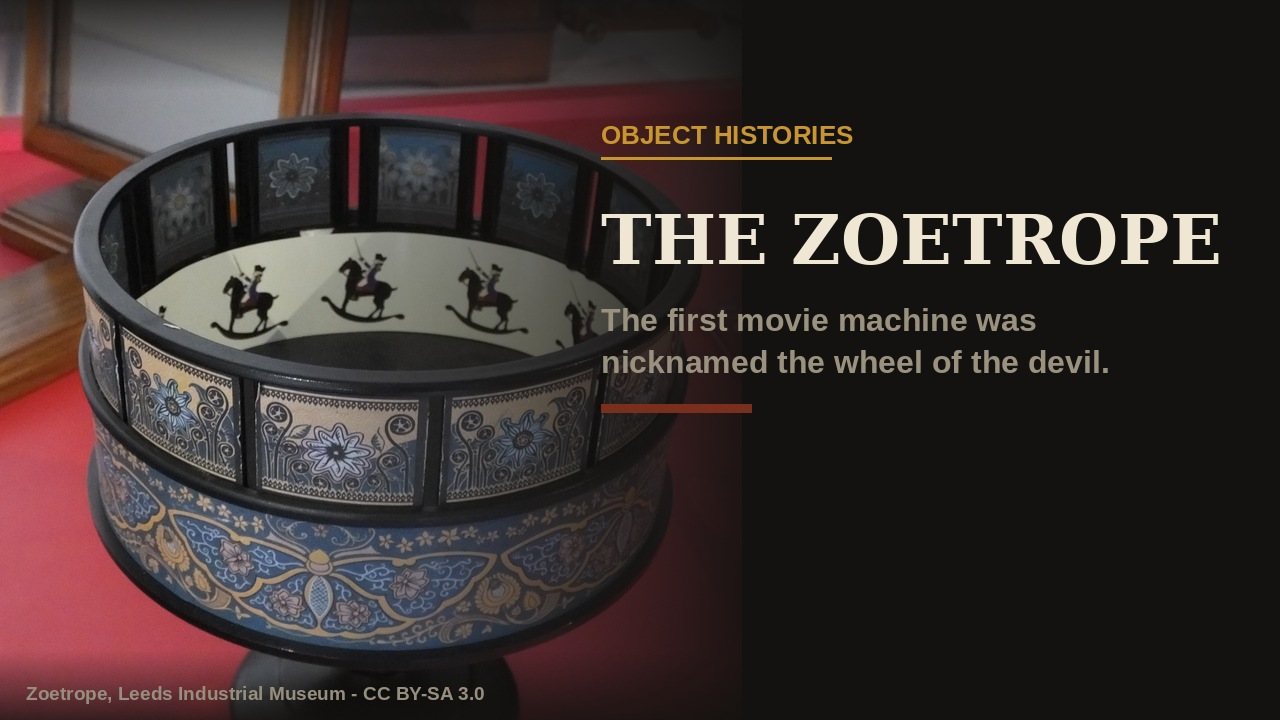
A Chinese court miscellany from the first century describes a craftsman’s lamp whose painted figures seemed to run. A Bath mathematician published the complete optical and mechanical theory of a spinning picture-drum in 1834 and never built one to sell. And in the spring of 1867, two separate patents for essentially the same machine landed in two different countries seven weeks apart, both tracing back to one small game company in Springfield, Massachusetts.
Ask who invented the zoetrope and you can defend at least three answers, from three parties who never met and one of whom may not have known what he was describing. The popular version of this object’s story skips straight from “ancient Chinese toy” to “Victorian parlour hit” in one sentence. The real version is a slow-motion argument over credit that professional historians were still refereeing as recently as 2022.
None of the people with the strongest claim made much money from it. The man who did invented nothing — he was a lithographer recovering from a bankruptcy caused, more or less, by Abraham Lincoln’s beard.
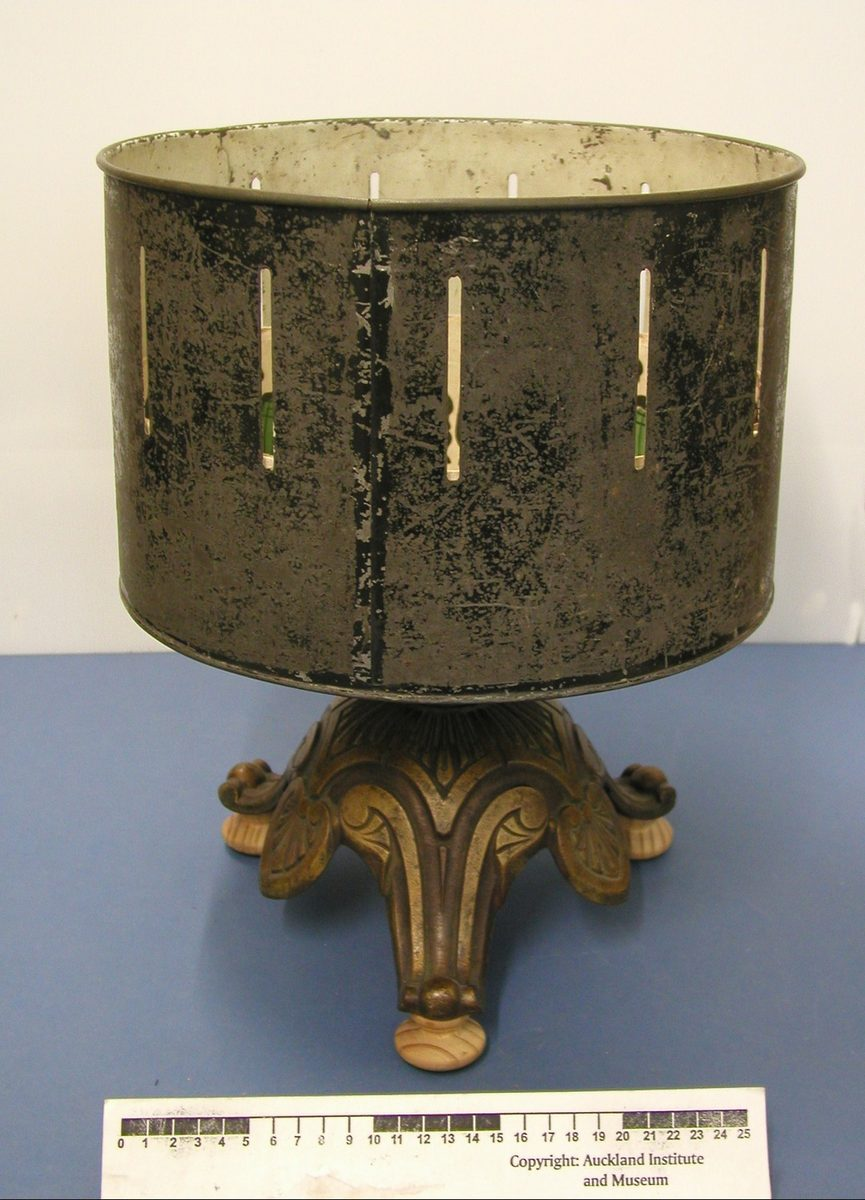
A Han-dynasty record describes a lamp that made painted figures move — but historians disagree about what it actually showed
The earliest candidate comes from the Xijing Zaji, “Miscellaneous Records of the Western Capital,” a collection of short accounts of the Han-dynasty court. It credits a craftsman named Ding Huan, working around the first century CE, with an “always-full lamp” topped by an umbrella-shaped canopy. Heat rising from the flame turned a vaned opening at the top of the canopy, and the lower part of the canopy — a cylinder with translucent panels painted with animals and figures — turned with it.
The historian of Chinese science Joseph Needham classed this device, and a family of related “trotting horse lamps” known in China from well before 1000 CE, as a variety of zoetrope that may have originated there entirely independently of anything in Europe. But Needham’s own account is careful rather than triumphant: it is genuinely unclear from the surviving text whether sufficiently fast rotation gave the painted figures on Ding Huan’s lamp an illusion of movement, in the way a real zoetrope does, or whether the account simply describes painted images physically revolving past a viewer, which is a different and much less interesting effect. The Xijing Zaji is a literary miscellany, not an engineering manual, and it was never intended to settle the question a modern reader wants answered.
Whatever it showed, the device left no known lineage. Nothing connects Ding Huan’s lamp to the European instruments built two millennia later; the mechanism, if it worked the way the zoetrope works, was rediscovered from scratch. That makes it either the earliest known ancestor of the idea or an interesting dead end, depending on how much weight you put on eight sentences in a collection of court anecdotes.
A mathematician solved the whole problem in 1834 and couldn’t give it away
The documented, continuous European lineage starts with a joke about a wheel. In 1824 Peter Mark Roget — yes, the Roget of the thesaurus — presented a paper to the Royal Society explaining why a passing cart wheel, seen through vertical railings, appears to bend and curl instead of turning normally. His answer involved how the eye assembles brief glimpses into a single impression, and it caught the attention of two men who would build on it directly: Michael Faraday, who experimented with spinning cardboard discs, and the Belgian physicist Joseph Plateau, who in 1832 built the phenakistiscope, a slotted disc that produced a genuine moving image when spun in front of a mirror. It worked. It also required a mirror and let exactly one person look at a time.
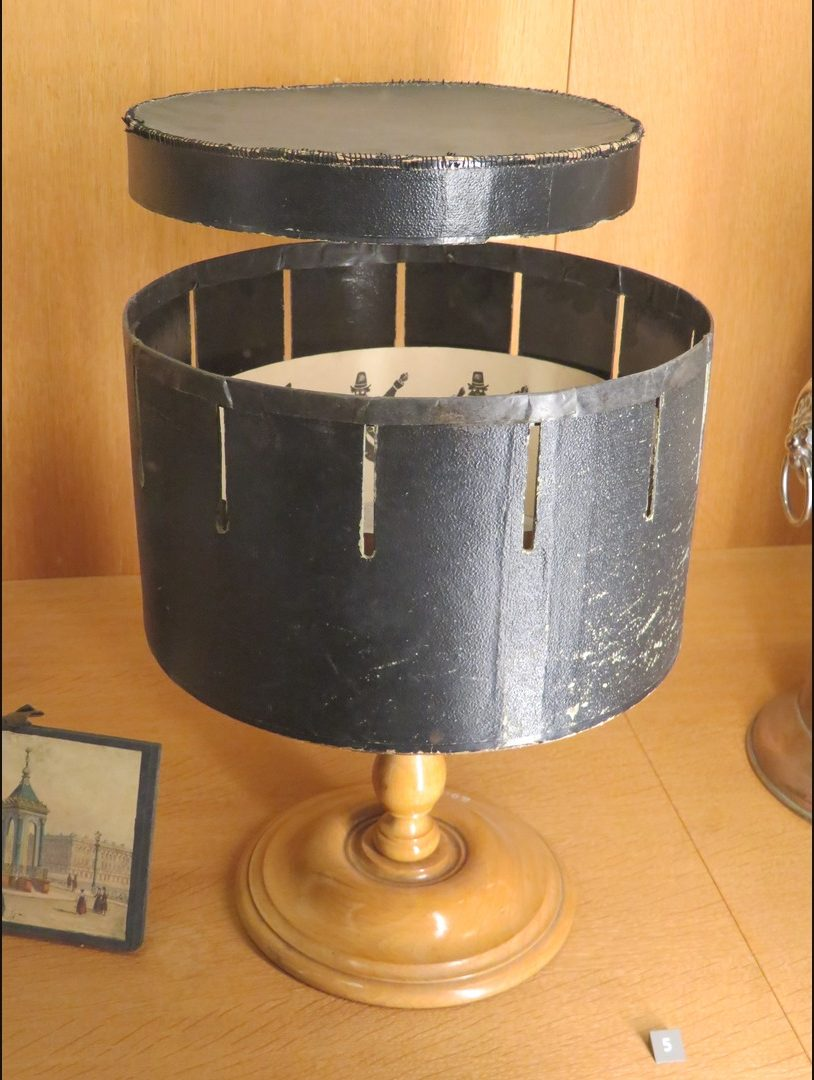
William George Horner, a schoolmaster in Bath better remembered today by mathematics students for Horner’s method of solving polynomial equations, read Plateau’s work and saw the fix. Put the drawings on the inside of a spinning drum instead of a disc, cut viewing slits around the drum itself, and the mirror becomes unnecessary — and several people can crowd round and watch at once. He published the idea in the Philosophical Magazine in January 1834, under the title “On the Properties of the Dædaleum, a New Instrument of Optical Illusion,” naming it for Daedalus, the mythical craftsman who built wings.
Then nothing happened. No manufacturer picked it up. No version went on sale anywhere. Horner died in Bath in 1837, three years later, and his obituaries discussed his mathematics without mentioning the drum at all. For more than thirty years, the complete design for what would become a global toy sat published, unread by anyone with the means to build it commercially.
So who really invented the zoetrope — Hallett or Lincoln?
The revival, when it came, produced its own dispute. On 6 March 1867, a UK patent (No. 629) for “An Improved Mode of and Means for Producing Optical Illusions” was granted to a man named Henry Watson Hallett of Chancery Lane, London — who identified himself in the filing as a former resident of Springfield, Massachusetts, communicating the invention on behalf of Milton Bradley of that city. Seven weeks later, on 23 April 1867, the United States granted patent 64,117 for a near-identical drum — the design with viewing slits set above the picture strip, so strips could be swapped without disturbing the slits — to William Ensign Lincoln, an undergraduate at Brown University in Providence, Rhode Island. Lincoln, too, had assigned his rights to Milton Bradley.
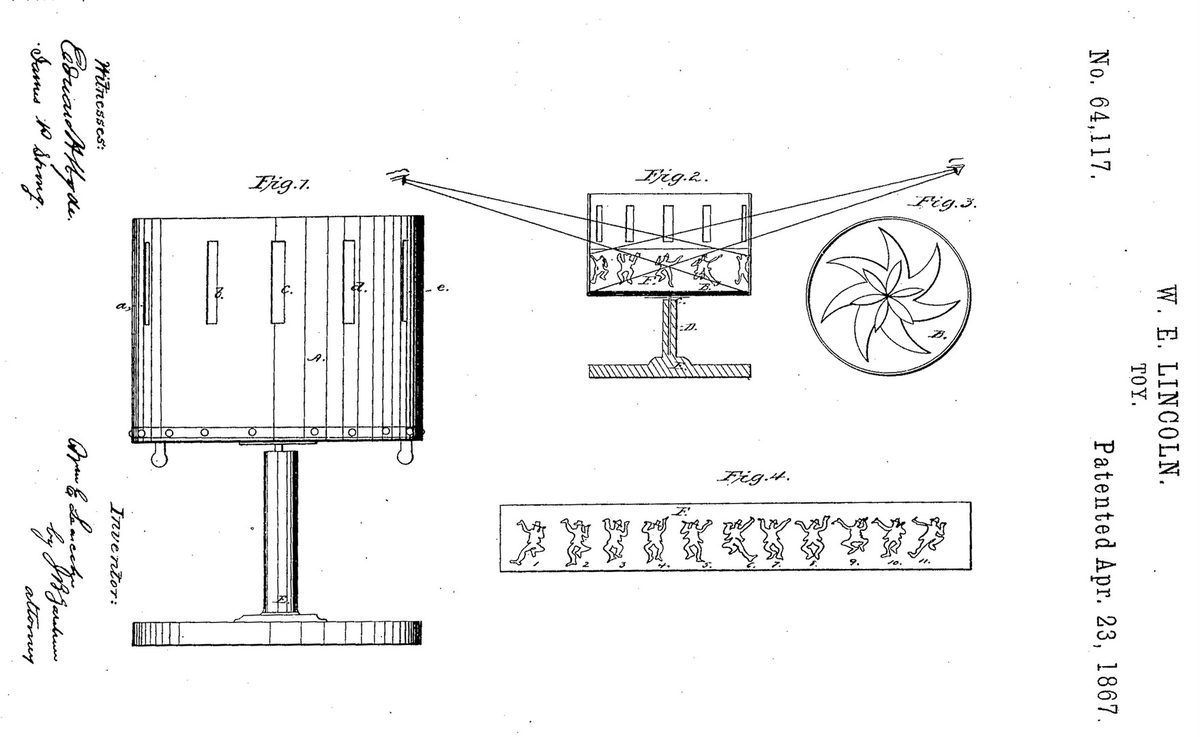
Most popular histories, including the toy’s own retrospectives, settle this by treating Lincoln as the inventor, on the reasoning that his is the U.S. patent everyone recognises and it names an identifiable young inventor rather than an intermediary. Film historian Deac Rossell complicated that story by simply asking why an earlier UK patent existed at all, and the film scholar Christine Veras went further: her 2022 study of the surviving patent-office archives found that Lincoln’s application was actually filed on 27 July 1866, months before Hallett’s UK filing, giving Lincoln a genuine priority claim despite the later grant date — and that three connected patent filings that year, in Britain, the United States, and France, all trace back to the same small circle around Milton Bradley’s company. Whether “inventor” means the person whose patent issued first, whose application was filed first, or whose name the marketing eventually settled on is a question serious researchers were still untangling a century and a half after the fact.
The man who put it on shelves was recovering from a bankruptcy caused by a beard
Milton Bradley invented none of this. In 1860 he was a Springfield lithographer who had printed and sold a portrait of an obscure Republican presidential nominee named Abraham Lincoln — no relation to the zoetrope’s William Ensign Lincoln. The prints sold well until the real Lincoln grew the beard that made every clean-shaven copy instantly wrong. Refunds were demanded. Bradley burned what stock he had left and was, by his own later account, close to ruined.
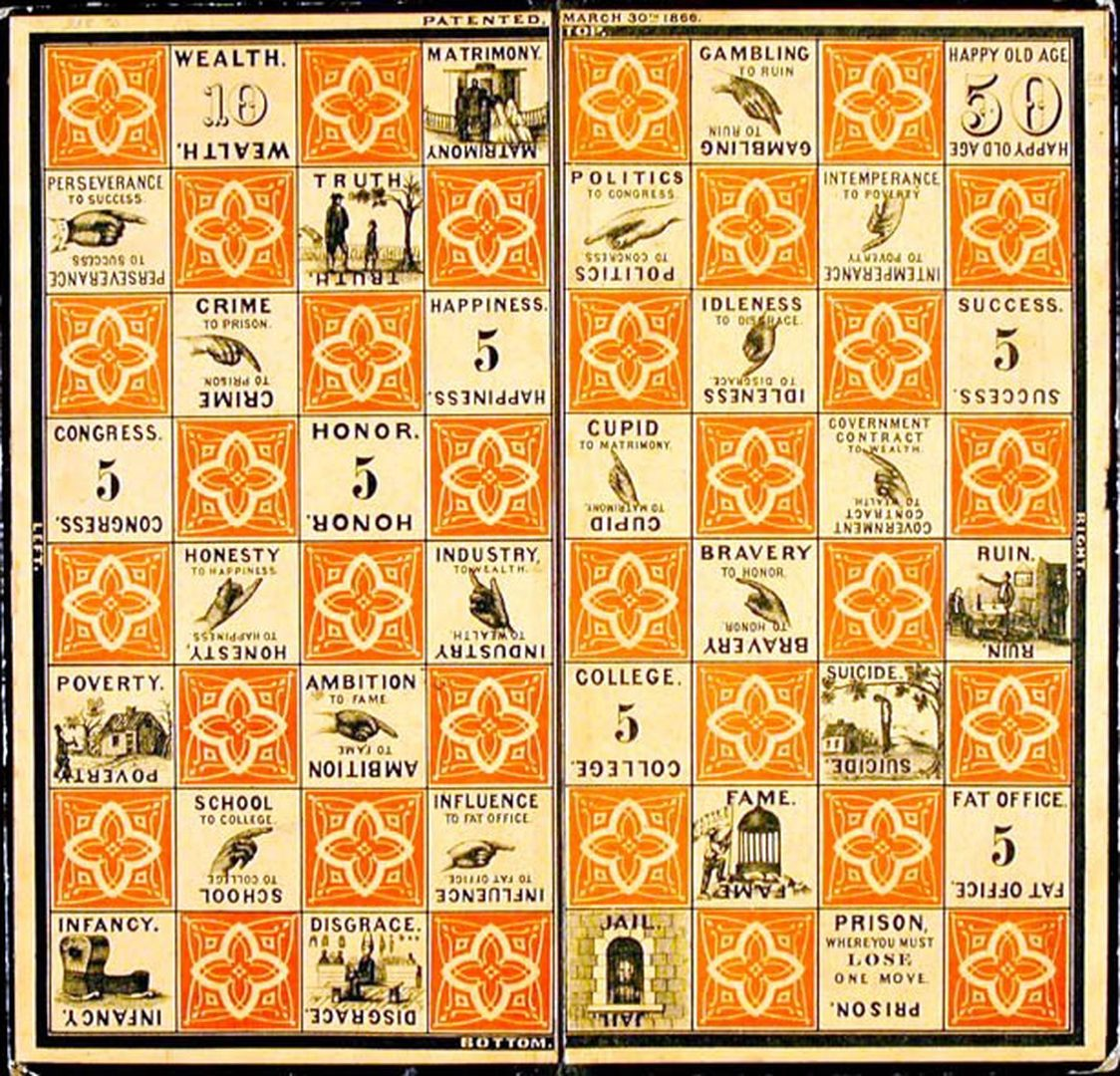
Rather than quit lithography, he printed a board game instead. The Checkered Game of Life, released that same winter, sold out its first run of roughly 45,000 copies within a year — a genuine hit, and enough to turn Bradley from a nearly bankrupt printer into an established manufacturer of parlour amusements. By 1867, when Lincoln’s model drum arrived at his door on the advice of a Providence bookseller, Bradley had exactly the distribution and manufacturing operation the idea had always lacked. He renamed the Dædaleum the zoetrope, Greek for “wheel of life,” and sold it in tin and in decorated wood on both sides of the Atlantic.
The scale surprised even the retailers. English newspapers covered zoetrope demonstrations at civic bazaars, church socials and literary society meetings through the winter of 1867–68, one reporting that a strip called “Raining Pitchforks” had produced “shouts of gleeful laughter.” For the 1867 holiday season, the London Stereoscopic and Photographic Company, which held the UK licensing rights, installed a Giant Zoetrope on the stage of the Crystal Palace’s Concert Hall in south London: a drum some 17½ feet across, heavy enough to require its own gas engine to turn it, seating up to 350 spectators at a time for four shows a day. On a single day that January, Crystal Palace recorded more than 4,500 admissions. A toy that Horner could not give away in 1834 was pulling paying crowds by the thousand thirty -three years later, in a machine built by the same idea.
For a century, everyone explained the illusion incorrectly
Roget, Faraday and Plateau’s generation attributed the effect to “persistence of vision” — the notion that the retina holds on to an image for a fraction of a second after it disappears, so that one drawing hasn’t faded before the next arrives. It is still the explanation most commonly repeated. It is also, by the account of later vision science, not really what is happening. The psychologist Max Wertheimer’s 1912 study of apparent motion identified a distinct perceptual effect, now called beta movement, in which the brain actively interprets two different still images shown in close succession as a single object moving between two positions — a piece of active pattern-making, not a passive afterglow on the retina. The zoetrope worked for roughly eighty years before anyone had the correct account of why it worked.
The idea outlived the toy by more than a century
The zoetrope’s real legacy is how many later inventions are exactly its principle with better engineering. In 1877 the French inventor Émile Reynaud patented the praxinoscope, which replaced the viewing slits with an inner ring of mirrors, producing a brighter and steadier image without the flicker of looking through gaps. By 1888 he had patented a much larger version, the Théâtre Optique, capable of running hand-painted strips hundreds of frames long. On 28 October 1892, at the Musée Grevin in Paris, Reynaud opened his Pantomimes Lumineuses to a paying public — three short animated stories, each ten to fifteen minutes long, repeated as a regular show. Over the next eight years he gave more than 12,800 performances to over half a million visitors, three years before the Lumière brothers held their first paid film screening.
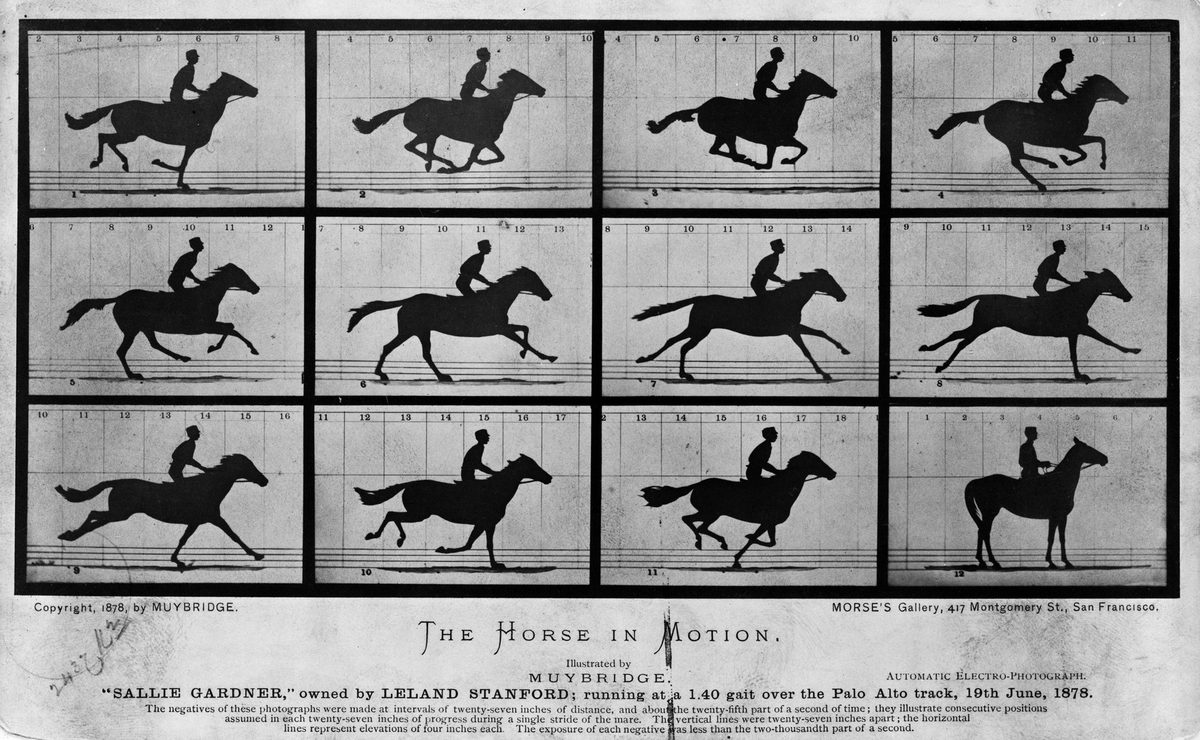
In the United States, Eadweard Muybridge used the same slice-and-replay logic in reverse. In 1878 he photographed a galloping horse with a battery of cameras to settle a wager over whether all four hooves ever left the ground at once. He then loaded the resulting sequence into a modified projecting zoetrope of his own design to play the images back as continuous motion — cutting movement into slices and reassembling it, exactly Horner’s method, applied to photographs of a real animal instead of drawings of an imagined one.
The idea has never fully retired. In 1980 the artist Bill Brand installed Masstransiscope in the disused Myrtle Avenue subway station in Brooklyn: 228 hand-painted panels behind a bank of vertical slits, built at the scale of a full subway platform. Passengers on passing trains, rather than the artwork, do the moving; from the window of a northbound express the panels resolve into roughly twenty seconds of animation. Restored by the Metropolitan Transportation Authority in 2008, it now belongs to the permanent collection of the agency’s public art program — a working zoetrope, on the same principle Horner published in 1834, still running in a New York subway tunnel.
So who invented the zoetrope? The honest answer is that nobody invented it all at once. Someone in Han-dynasty China may have noticed the effect and built something that hinted at it. A Bath mathematician worked out the complete mechanism and had no way to sell it. Two men on opposite sides of the Atlantic filed competing claims to the commercial version within weeks of each other, and it took a peer-reviewed paper in 2022 to work out whose paperwork actually came first. And the person who made any money from it had invented nothing — he simply had a warehouse to fill after a presidential beard emptied his last one. If that is what it takes to get a good idea into the world, the wheel of the devil earned its name honestly.
Watch the full history
The video version tells the Horner-to-Milton-Bradley story in just over six minutes, with the strips, the drums and the patent in view.

Related reading
- How a Root Cellar Kept Vegetables All Winter: The Farm’s Biggest Refrigerator Was a Hole in the Ground
- How Ear Trumpets Worked: The Physics, the Disguises, and What a Brass Horn Really Did for Hearing
- The Nimitz Tic Tac Encounter: What the Official Record Actually Says
- How a Springhouse Worked: The Farm Refrigerator That Ran on a Spring
Shop the styles/items featured in this video:
- Brainstorm Toys Zoetrope, the classic animation toy
- Flip book animation kit with LED light pad
- Muybridge galloping horse motion-study print
- Milton Bradley’s The Game of Life (modern edition)
Works cited
- Veras, Christine. “Reanimating the History and the Forgotten Characteristics of the Zoetrope.” Early Popular Visual Culture, 2022. Link.
- Horner, W. G. “On the Properties of the Dædaleum, a New Instrument of Optical Illusion.” London and Edinburgh Philosophical Magazine, 3rd series, vol. 4 (January 1834): 36–41. Link.
- Roget, Peter Mark. “Explanation of an Optical Deception in the Appearance of the Spokes of a Wheel Seen through Vertical Apertures.” Philosophical Transactions of the Royal Society of London 115 (1825): 131–140.
- Needham, Joseph. Science and Civilisation in China, vol. 4, part 2: Mechanical Engineering. Cambridge University Press, 1965.
- Wertheimer, Max. “Experimentelle Studien über das Sehen von Bewegung.” Zeitschrift für Psychologie 61 (1912): 161–265.
- Lincoln, William E. United States Patent 64,117, “Toy.” Issued 23 April 1867. Link.
- Yale Peabody Museum. Zoetrope, collection record YPM-HST-050145.A. Link.
- MTA Arts & Design. “Masstransiscope.”
- Smithsonian National Museum of American History. “Checkered Game of Life,” object record nmah_321475.
- “Milton Bradley Makes His Fortune on Life’s Checkered Past.” New England Historical Society. Link.
- Rossell, Deac. “A Few Words on the Zoetrope.” The Magic Lantern, journal of the Magic Lantern Society. Link.