
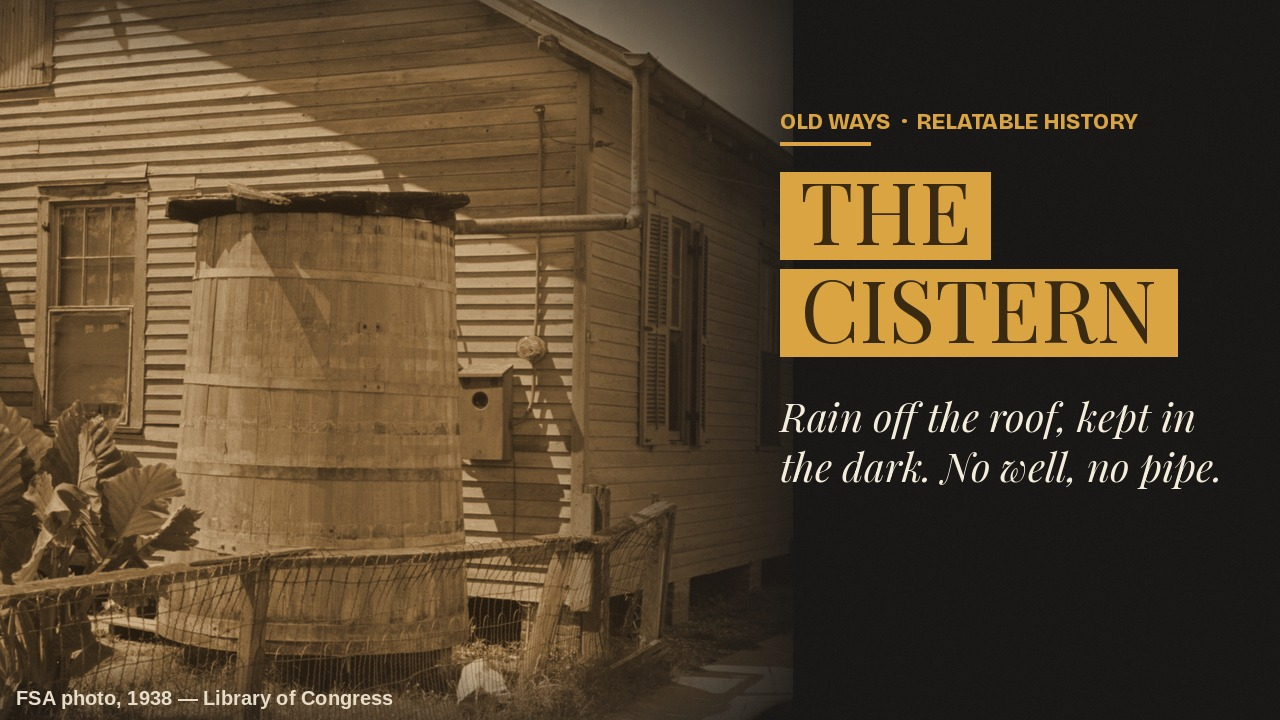
A cistern looks like the simplest piece of engineering there is: a hole in the ground that catches rain. Judged by what it has been asked to do, though, it is one of the most quietly consequential objects in human infrastructure. A network of them once ran an entire desert city with no river. A buried system of them, built after one catastrophe, is still standing by to save a modern American city from the next one. And in one country, catching rain off your own roof is not a lifestyle choice or a hobby — it is the law, enforced with fines, because there is genuinely no other water to drink.
None of that is about the tank itself. A cistern is just a box that holds water. What makes the history interesting is what people built around it: channels cut into solid rock to reach it, city ordinances written to protect it, and public-health studies run on what is actually floating in it. Three places show that range especially clearly — a Nabataean caravan city in the Jordanian desert, a California city built out of wood and doomed to burn, and a British island territory with no rivers at all.

Petra ran a desert city on captured rain and nothing else
Petra, the rock-cut city in what is now southern Jordan, sits in a region that receives roughly six inches of rain a year. It should not have been able to support a city of thirty thousand people, caravans passing through on the incense trade, and the elaborate stone monuments carved into its cliffs. It did, for centuries, because the Nabataeans who built it treated water capture as seriously as they treated architecture.
The system started outside the city. A spring called Ain Musa fed channels that ran for miles, including two carved directly into the rock walls of the Siq, the narrow canyon that forms Petra’s main approach. Engineering research on the site describes a network that combined supply canals, an aqueduct, a tunnel, dams and cisterns into a single citywide system, rather than leaving each household to fend for itself. Water was distributed from the Siq channels into hundreds of cisterns scattered through the city, cut into the rock and sealed with waterproof cement, several of which still hold water today.
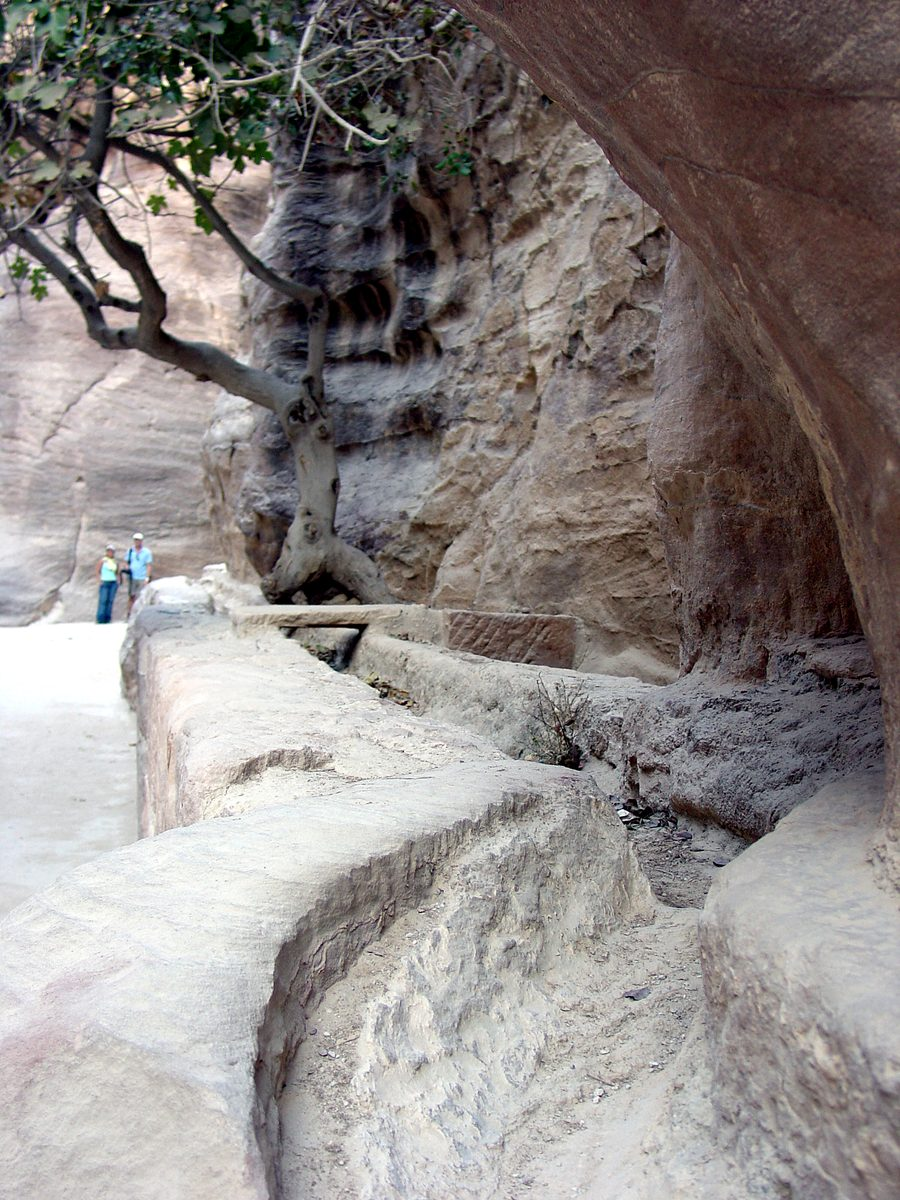
The same engineering also had to solve the opposite problem. Petra’s winter rains could arrive as flash floods, and a flood moving through a canyon city is as dangerous as a drought is to a desert one. The Nabataeans built diversion dams and bypass tunnels that routed the worst of the runoff around the city center and toward the cisterns instead of through it — using the same infrastructure to manage too much water and too little, which is the harder design problem a cistern system has to solve. The American Society of Civil Engineers recognizes Petra’s water system as a historic civil engineering landmark for exactly this reason: it is not one clever trick but an integrated system, built roughly two thousand years before the word “infrastructure” existed.
Scale is what separates Petra’s system from an ordinary household rain barrel. This was not a scatter of individual households each solving their own water problem; it was a single engineered network serving a city that, at its height, is estimated to have held more than thirty thousand residents in one of the driest inhabited regions on earth. Cisterns were cut wherever the rock allowed, from small domestic tanks tucked beside tombs to large public reservoirs, and the entire network was tied together by the channel system rather than left to individual improvisation — which is precisely why it still shows up in civil-engineering literature as a case study rather than an archaeological curiosity.
San Francisco buried a second water system just to fight fires
Nearly two thousand years later and on the other side of the world, a very different city reached a similar conclusion: a single water supply is a single point of failure, and a cistern network is the backup. San Francisco’s early history was a string of fires. Built quickly out of wood during the Gold Rush, the young city burned significantly six times in its first two or three years, and a fire on May 4, 1850, destroyed three blocks of its most valuable buildings. The city’s response was to sink a 12,000-gallon cistern at Portsmouth Square, the first of what became a citywide network built specifically for firefighting and disconnected from the ordinary drinking-water pipes.
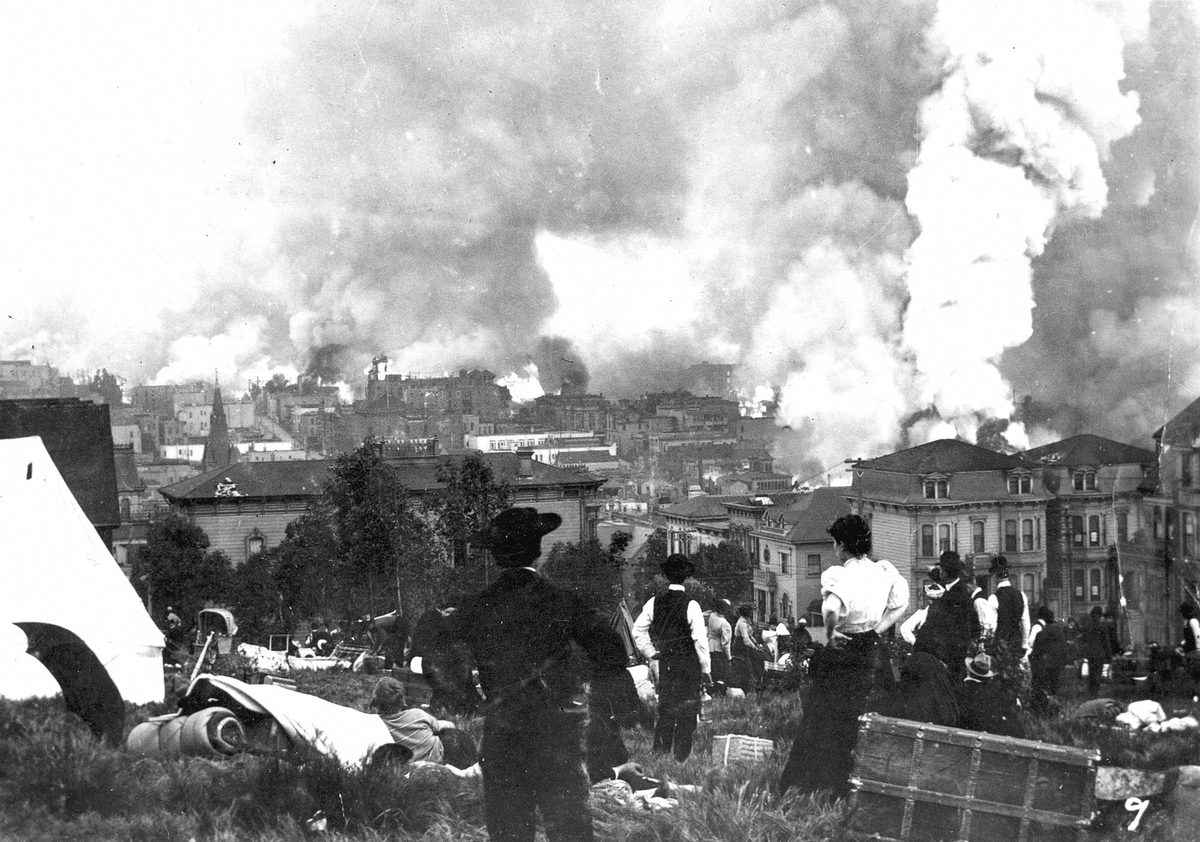
By the early twentieth century the city had grown confident enough in its modern water mains to let the old cistern system shrink to about two dozen tanks. Then, on April 18, 1906, an earthquake ruptured water mains across the city at the exact moment that broken gas lines were starting fires. The municipal system that was supposed to fight those fires had no pressure left to fight them with. What water the department did have came largely from the cisterns that were still in the ground — and citywide, some estimates put the destruction from the resulting fires at as much as ninety percent of the total damage, a scale that made the case for redundant water storage impossible to argue with.
San Francisco’s answer was to build more, and bigger. Between 1912 and 1940 the city added a network of cisterns holding 75,000 gallons or more apiece, spaced roughly every three blocks, entirely separate from the municipal supply and from the high-pressure hydrant system that was also built after 1906. Today the San Francisco Fire Department maintains 172 of these underground tanks, with a combined capacity of about 11 million gallons, sitting quietly under manhole covers stamped CISTERN and S.F.F.D. None of them has been called into service since 1906. All of them are still inspected and kept full, on the theory that the next major earthquake will behave the same way the last one did.
The cisterns themselves are simple concrete-lined tanks, but the network around them is not: San Francisco split the whole system into three zones with valves that can isolate a damaged section without shutting down the rest, specifically because the 1906 earthquake had shown how a single break could take out an entire pipeline at once. Above ground, each cistern is marked only by a ring of bricks set into the pavement with two manhole covers — a detail unremarkable enough that most residents walk past dozens of them without ever noticing what is underneath.
In Bermuda, catching rain off your roof is not optional
Petra and San Francisco both treated the cistern as insurance against a bad day. Bermuda treats it as ordinary life, because the island has no rivers, no lakes and no reliable freshwater underground — just porous limestone that will not hold a well. Since English colonists arrived in the early seventeenth century, rain caught off the roof has been the primary source of drinking water, and the island’s architecture evolved around that single fact. The distinctive white, stepped limestone roofs seen across Bermuda are not a style choice; each step is cut to slow the water and route it into gutters and then down into a tank, usually built into the foundation of the house itself.
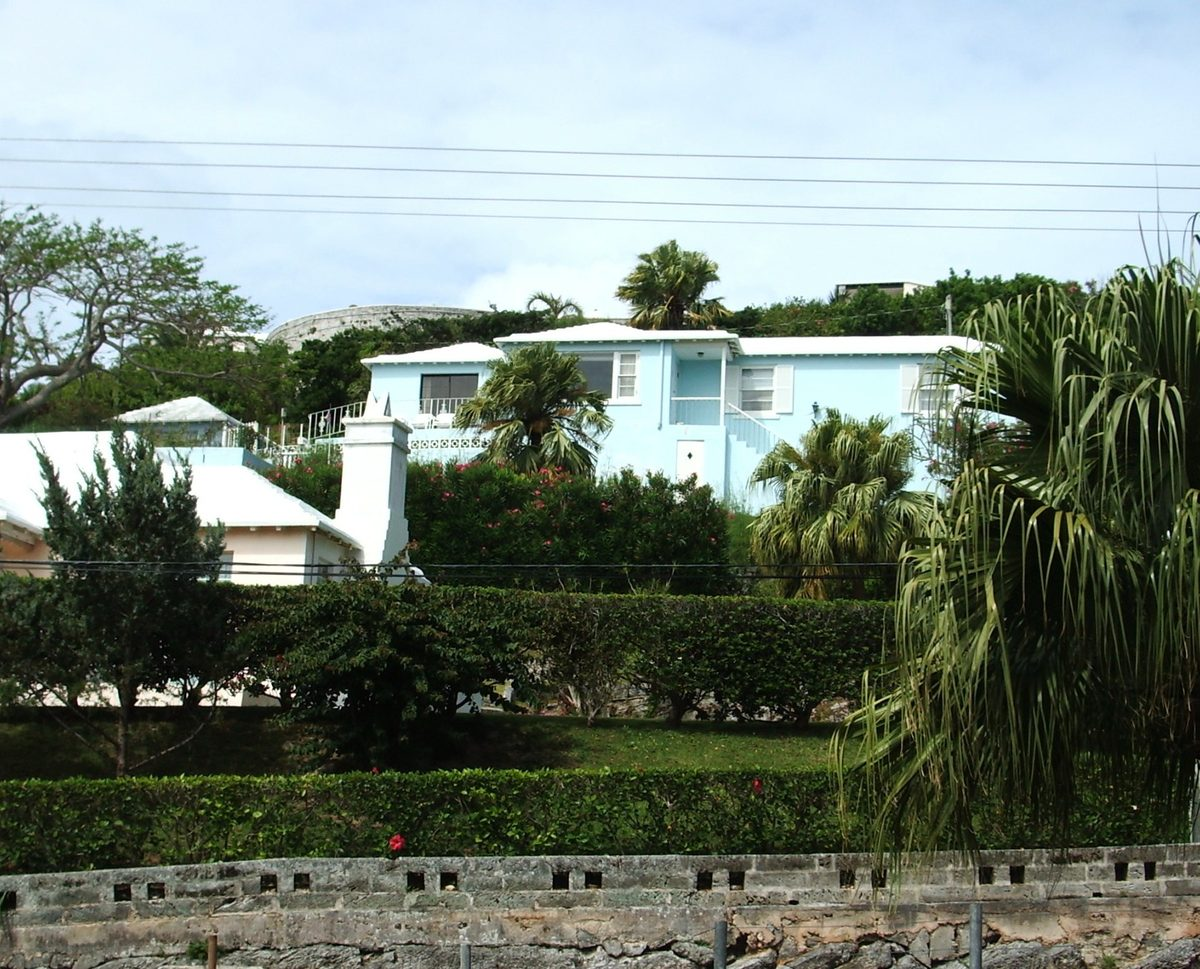
Bermuda formalized the practice into law with the Public Health (Water Storage) Regulations of 1951, still in force today. The regulations require that any occupied building have at least four fifths of its roof guttered for rainwater collection, and that its storage tank hold at least one hundred gallons for every ten square feet of that catchment area — a formula that ties the size of a building’s roof directly to the size of its legally required water supply. The rules go further into the mechanics than most water law does: tanks must be built of stone, concrete or galvanized iron, must have an inspection door, and their ventilation openings must be screened specifically to keep mosquitoes out. Failing to comply is a prosecutable offense, with escalating fines for repeat violations and for each day a violation continues.
What the law does not solve is whether the water is actually clean. A 2008 study in the Canadian Journal of Microbiology sampled water from 102 Bermuda households selected at random from the electoral register and found total coliform bacteria in roughly ninety percent of the tanks tested, and E. coli in about two thirds of them. The same study found that tanks cleaned within the previous year were measurably less contaminated than those that had not been — which is exactly the six-year cleaning cycle the regulations require, and a reminder that a law can mandate the size of a tank without being able to mandate what happens to the water once it is inside one.
The gap between the law and the water quality is not unique to Bermuda; it is close to universal in rainwater harvesting, which is why a simple technique called the first flush has become close to standard practice wherever cisterns are still built. The idea is to divert the first few minutes of any rainstorm away from the tank entirely, since that is when a roof sheds the dust, bird droppings and dead leaves that have accumulated on it since the last rain, and only let the cleaner water that follows continue into storage. It is a cheap fix for a problem that a law about roof area and tank capacity cannot solve on its own: a catchment can be perfectly sized and still deliver contaminated water, because the contamination is not in the sizing. It is on the roof.
The part every cistern still has to get right
Petra’s engineers, San Francisco’s fire wardens and Bermuda’s public health inspectors were all, underneath the very different stakes, solving the same short list of problems: get the water off a surface and into storage efficiently, keep what has landed on that surface out of the tank, and keep the tank itself from becoming a hazard on its own. Modern rainwater-harvesting guidance from the U.S. Environmental Protection Agency still describes the same basic components a Nabataean engineer would recognize: a catchment surface, a conveyance system, a way to divert the dirtiest first flush of a storm, and a sealed, screened storage tank. The materials have changed. The problem has not.
That is the real argument for treating the cistern as more than a farmhouse curiosity. It is one of the few pieces of technology that has been independently reinvented, in almost identical form, by desert traders, American frontier families, a fire department, and an entire national government, because gravity and rainfall do not care which civilization is asking the question. Wherever a roof and a container meet a place with too little water and too much of it in the wrong season, something very like a cistern shows up.
Watch the full history
The video companion covers how an American farm cistern itself was built and used, day to day — the parts this article deliberately leaves to it.

Related reading
- Why the Penny-Farthing’s Wheel Had to Be So Big
- How a Hand Pump Worked: Lifting Well Water With Nothing but Air Pressure
- How the Daguerreotype Actually Worked, and Why It Was Dangerous
- Who Invented the Mousetrap? The Rat War That Made It Necessary
Works cited
- Ortloff, Charles R. “Hydraulic Engineering at 100 BC–AD 300 Nabataean Petra (Jordan).” Water 12, no. 12 (2020): 3498. MDPI. Link.
- American Society of Civil Engineers. “Petra.” Historic Civil Engineering Landmarks. Link.
- San Francisco Fire Department. “Water Supply Systems.” Division of Support Services. Link.
- Patowary, Kaushik. “San Francisco’s Hidden Cisterns.” Amusing Planet, January 18, 2021. Link.
- Public Health (Water Storage) Regulations 1951, Bermuda SR&O 69/1951, made under the Public Health Act 1949, Laws of Bermuda Title 11 (1989 Revision). Link.
- Lévesque, B., D. Pereg, E. Watkinson, J.S. Maguire, L. Bissonnette, S. Gingras, P. Rouja, M.G. Bergeron, and É. Dewailly. “Assessment of Microbiological Quality of Drinking Water from Household Tanks in Bermuda.” Canadian Journal of Microbiology 54, no. 6 (2008): 495–500. Link.
- “Cistern.” Encyclopaedia Britannica. Link.
- U.S. Environmental Protection Agency. “Rainwater Harvesting Practices.” Semi-Arid Green Infrastructure Toolbox. Link.