
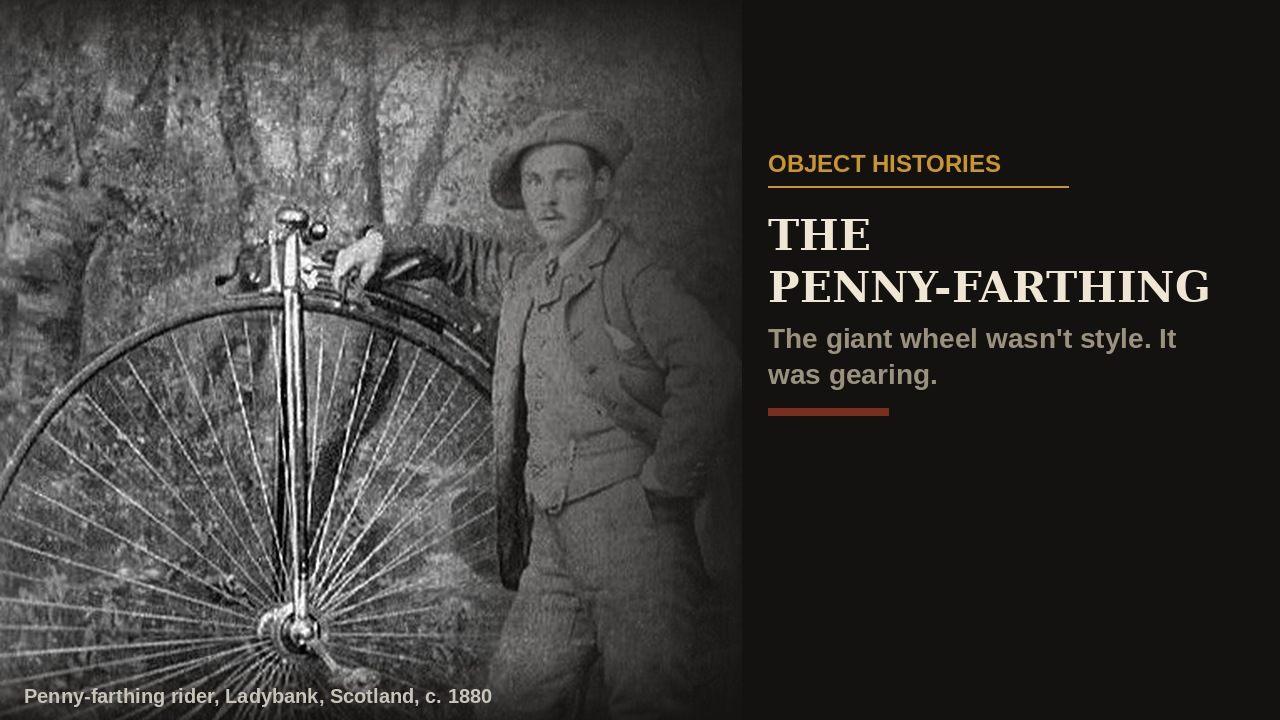
For about fifteen years, the fastest thing a person could buy stood five feet tall at the axle, had no brakes worth the name, and would throw a careless rider head first onto the road at the first pothole. It was not a fad born of Victorian bad taste. It was the direct, unavoidable output of a single missing part: nobody had yet built a chain.
Until they did, a bicycle had exactly one way to go faster, and it had nothing to do with the rider’s strength. It had to do with geometry. Understanding that one constraint explains almost everything strange about the machine we now call the penny-farthing — its size, its price, its danger, and the surprising speed with which it vanished once an alternative existed.
A bicycle with no gearbox has exactly one dial to turn
On an early high-wheeler, the pedals were not connected to the wheel through any chain, sprocket or gear train. They were bolted directly to the hub. Push the pedal, and the wheel it is attached to rotates by precisely the same amount — not more, not less. There was no mechanism anywhere on the machine capable of making one turn of the legs produce more than one turn of the wheel.
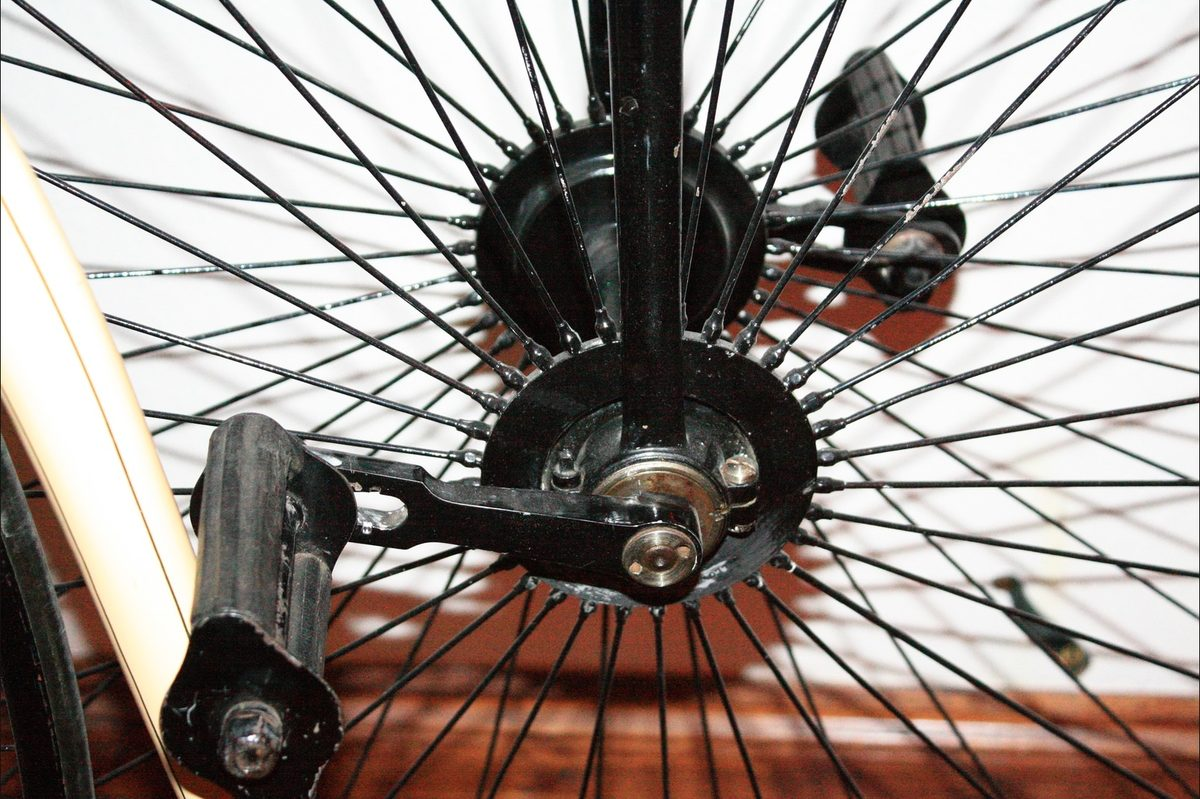
That single fact fixes a bicycle’s top speed to the size of its driven wheel, because distance covered per pedal stroke is just the wheel’s circumference. A small wheel, spun as fast as a rider’s legs can manage, still only carries you a small wheel’s worth of distance per turn. Engineers today would call this a fixed 1:1 drive ratio and reach for a different sprocket size to change it. In the eighteen-seventies, the only lever available was the wheel itself. Build it bigger, and each stroke of the legs covers more ground. There was no second option.
A missing horse population may have started the whole project
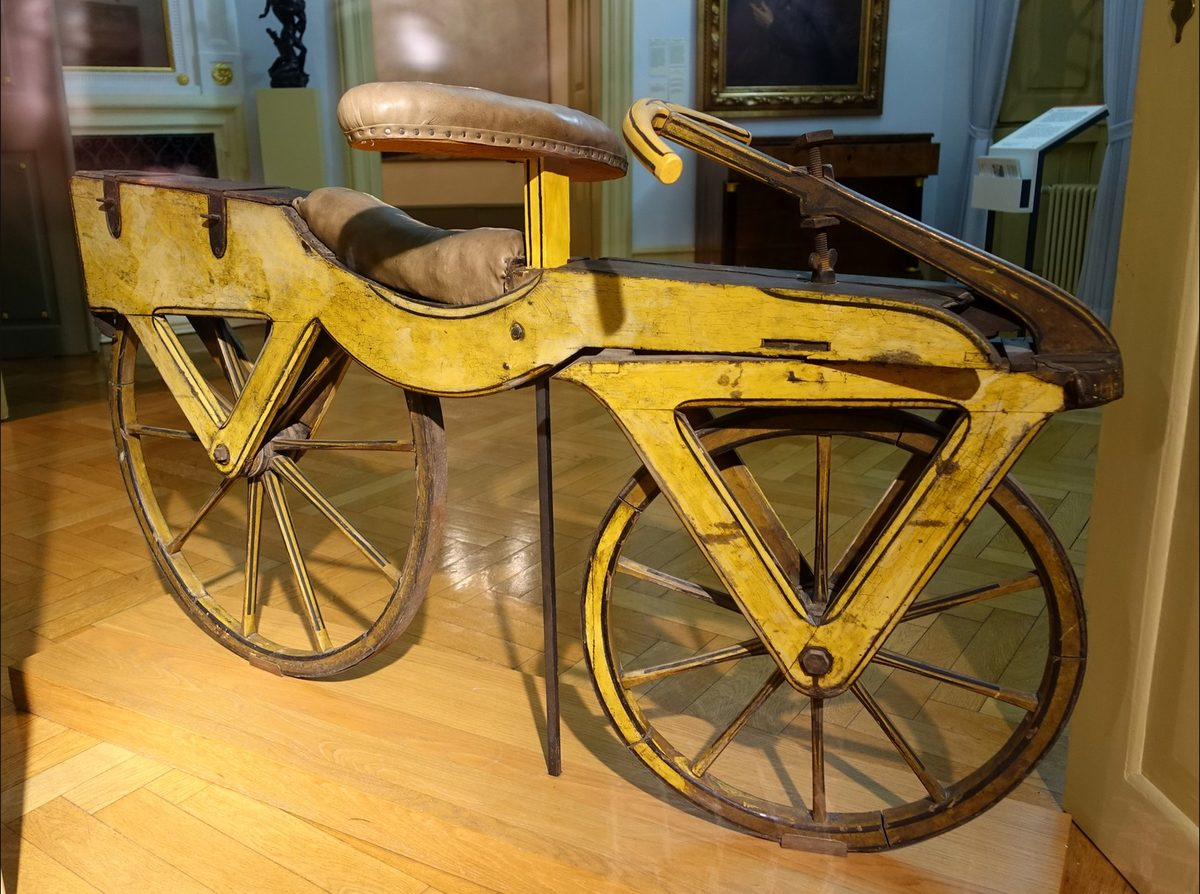
The chainless bicycle’s own ancestor had no pedals at all. In 1817 a German civil servant, Karl von Drais, showed off a two-wheeled machine with a saddle and a steerable front wheel that its rider propelled by walking, or running, astride it — a Laufmaschine, or running machine. Historians have connected its debut to a genuine catastrophe: Mount Tambora had erupted in the Dutch East Indies in 1815, cooling the northern hemisphere enough to wreck harvests and starve draft animals across Europe the following year, remembered as the year without a summer. A horseless way to get around had obvious appeal.
How much of Drais’s motivation was actually Tambora is genuinely disputed. His biographer Hans-Erhard Lessing pushed the volcanic connection hardest, but Drais had already been experimenting with human-powered vehicles before 1815, and Europe’s harvests had been poor since around 1812 for reasons that had nothing to do with Indonesian geology. Drais also left no writing from 1817 that ties his invention explicitly to dying horses. The kindest reading is that a bad decade for agriculture made the idea’s timing lucky rather than causal.
Either way, the Laufmaschine sat unsolved for half a century, because nobody had given it a drive. The fix, when it came, was almost insultingly simple: a Paris workshop under Pierre Michaux, helped by a mechanic named Pierre Lallement, bolted cranks and pedals straight onto the front wheel in the eighteen-sixties. Riders nicknamed the result the boneshaker, for what its iron tyres and wooden wheels did to a body on cobblestones. It was still, mechanically, exactly the machine described above: whatever the wheel’s size, one pedal stroke bought you one wheel’s worth of road.
A sewing-machine works in the English Midlands became the fix
The boneshaker crossed the Channel by way of a Coventry engineer named James Starley, who by 1857 was managing foreman at the Coventry Sewing Machine Company. In November 1868 he bought a Michaux velocipede in Paris and brought it back to show his employer, Josiah Turner. Turner was impressed enough to take an export order for four hundred Coventry-built velocipedes bound for France — the moment a sewing-machine factory became a bicycle factory, and the moment Coventry became, for the next several decades, the industrial capital of the bicycle.
Starley kept refining the machine rather than just copying it. In 1870, with William Hillman, he patented the Ariel, generally reckoned the first all-metal bicycle, with a wheel that could be tensioned like a drum head. In 1874 he patented tangent spoking, angling the spokes so they ran at an angle to the hub rather than straight out from the centre. That single change mattered enormously: it let a wire wheel carry the twisting force of pedalling as well as the rider’s weight, which is what made a wheel tall enough to reach a grown man’s hip both light enough to ride and strong enough not to collapse. Starley is still credited by cycling historians as the figure who turned the bicycle from a curiosity into an industry.
Fitted like a suit, and named only after it was obsolete
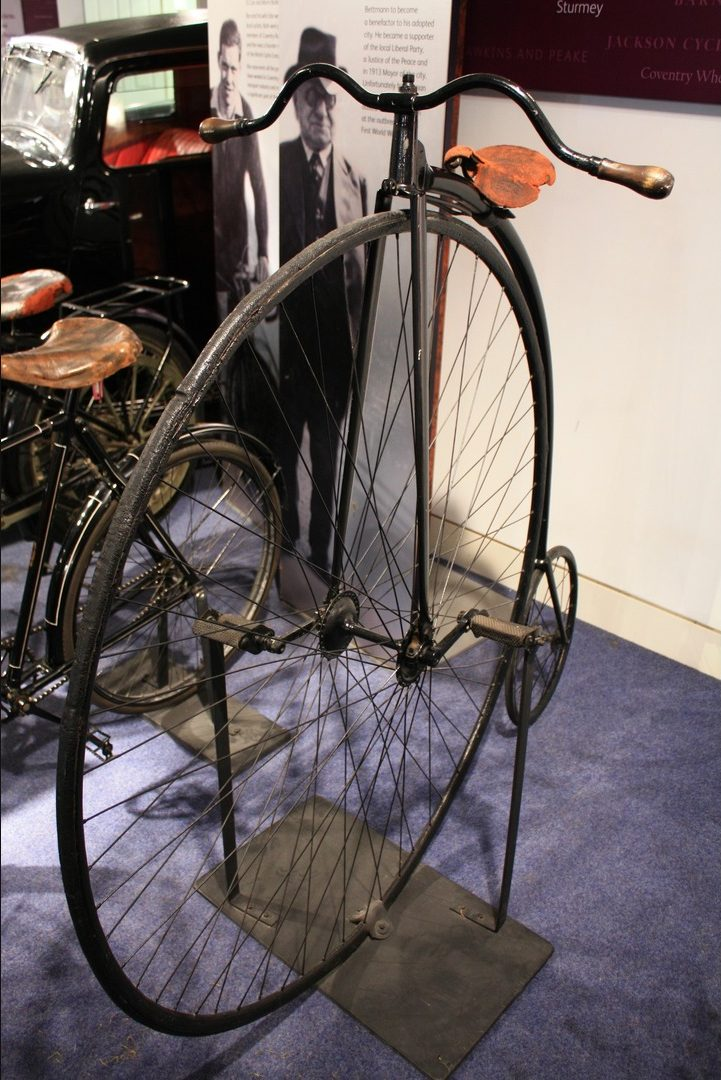
Because the wheel set your speed, shops sold high-wheelers the way a tailor sells trousers: they measured the customer’s inside leg and sold the largest wheel that leg could still reach around on the downstroke. A short rider might end up on a forty-inch wheel; a very tall one on sixty inches or more. Riders described their machines by wheel diameter the way a driver today quotes engine size, and the biggest wheels genuinely moved: a skilled rider on a fifty-inch Ordinary could sustain something close to twenty miles an hour, startling speed for the road surfaces of the day.
That height came at a real cost, and not only in money, although the machines were expensive enough to function as a status object for young professional men. The rider’s weight sat high and slightly ahead of the front axle. Any sudden stop — a rut, a loose stone, a startled dog — pivoted the whole frame forward around that axle and pitched the rider over the handlebars, legs trapped behind them, from a height equivalent to a first-floor window ledge. Riders called it taking a header, a phrase that survives in English long after almost everyone using it has forgotten it describes a fall from a Victorian bicycle. The Danes, less charitably, called the whole machine the vaeltepeter — toppling Peter.
Oddly, the machine did not get its now-familiar name until it was already being replaced. Throughout its own heyday people simply called it the bicycle, or the Ordinary once a rival design existed to distinguish it from. The nickname penny-farthing, comparing the large front wheel and small rear wheel to the mismatched pair of British coins, does not turn up in print until 1891, in the magazine Bicycling News — by which point the machine it named was already being crowded off the road.
Clubs, bugles, and an unlikely campaign for paved roads
None of the danger or expense slowed adoption. Riders formed clubs with captains, uniforms and bugle calls almost as soon as the machine existed: the Pickwick Bicycle Club in London in 1870, the Bicycle Touring Club in 1878. In 1880, delegates from thirty-one American cycling clubs met in Newport, Rhode Island, and founded the League of American Wheelmen. Within a few years that organisation was pushing a cause almost nobody else cared about: paved, well-maintained roads. Its Good Roads magazine, launched in 1892, reached a circulation of a million within three years, and the lobbying it generated helped produce the federal Office of Road Inquiry in 1893, a full generation before the automobile would need the same roads.
Thirteen thousand miles to prove the machine could take it
The single most extreme demonstration of what a high-wheeler could do belongs to Thomas Stevens, an Englishman living in San Francisco. In April 1884 he set out from that city on a black-enamelled, nickel-wheeled fifty-inch Columbia Standard, built by the Pope Manufacturing Company, carrying a spare shirt, a raincoat that doubled as bedroll, and a revolver. He reached Boston in early August, roughly thirty-seven hundred miles later, then spent the winter planning a longer trip. In May 1885 he sailed for Liverpool and kept riding, across Europe, the Ottoman lands and Asia, reaching Yokohama in December 1886. The full journey ran to something like thirteen thousand five hundred miles, and made Stevens the first person to circle the globe on a bicycle — on a machine that, by his own account, tried repeatedly to put him on the ground.
The chain and a rubber tube ended it in under five years
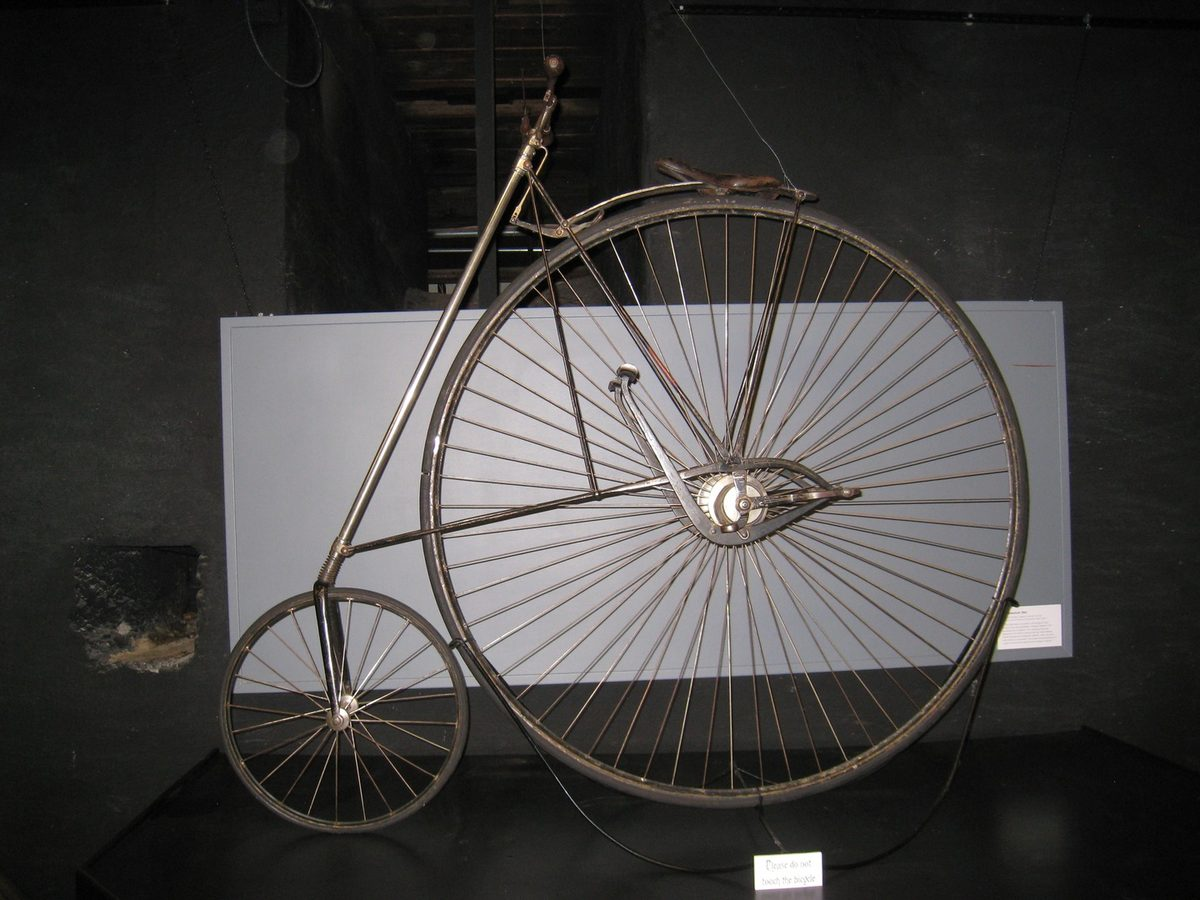
Manufacturers knew exactly what was wrong with the design and kept trying to engineer around the header rather than the wheel size. The American Star, built from 1881, simply put the small wheel in front and the large one behind, so a stumble pitched the rider backward into the saddle instead of forward over the bars; one was even ridden down the steps of the United States Capitol in 1885 as a publicity stunt. Others built low-slung, lever-driven dwarf machines. All of them were still working around a wheel sized to a leg, because none of them had solved the actual arithmetic problem.
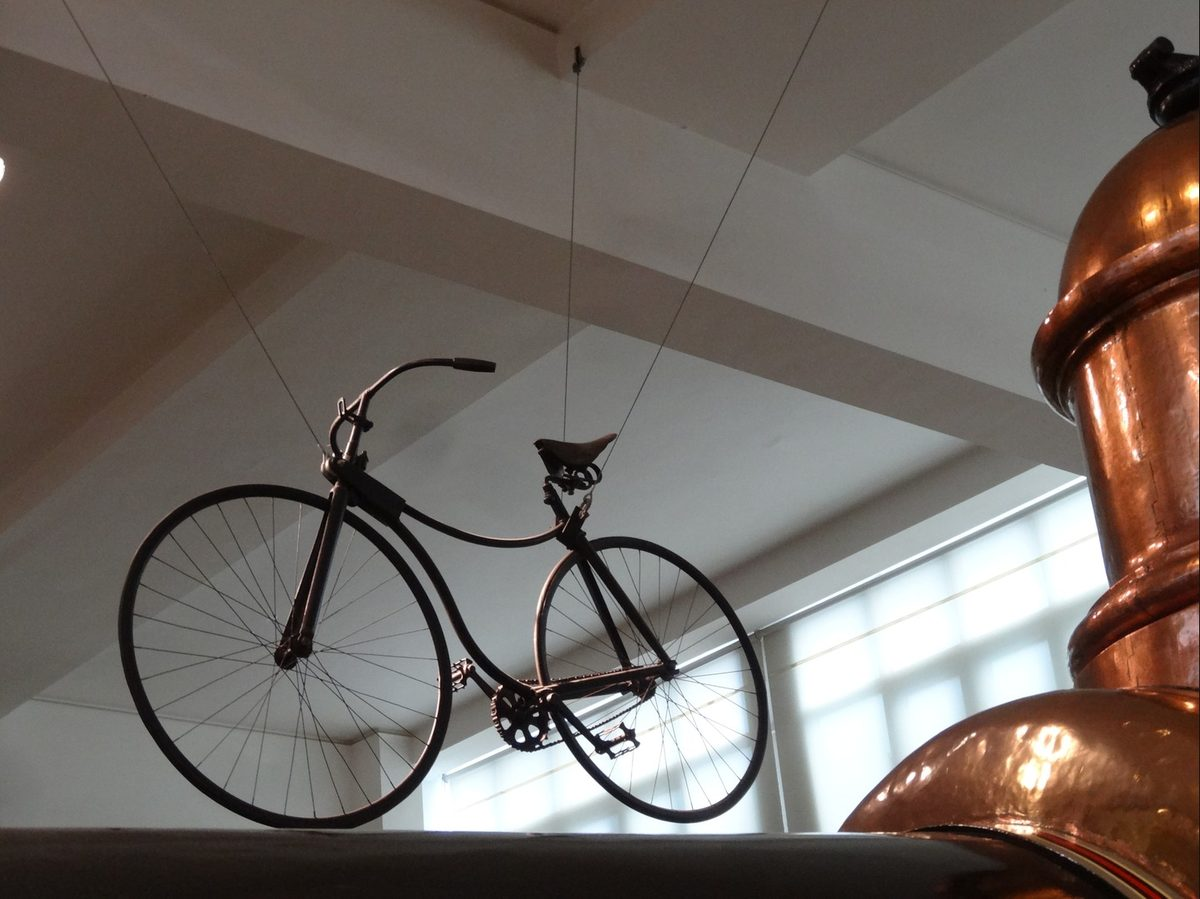
The real solution arrived in 1885, when James Starley’s nephew, John Kemp Starley, connected the pedals to the rear wheel of a modest, similarly-sized pair of wheels with a chain and sprockets, and called the result the Rover. Gearing was now a question of tooth counts rather than leg length; a small sprocket driving a large one could deliver more than one wheel-turn per pedal stroke without the wheel itself growing an inch. Three years later, in Belfast, a veterinarian named John Boyd Dunlop wrapped an inflated rubber tube in canvas and glued it to a wooden rim for his son’s tricycle, after the boy complained about the discomfort of solid tyres on cobbled streets. Dunlop patented the pneumatic tyre in December 1888, and when a previously unremarkable racer named Willie Hume started beating national champions on Dunlop-shod wheels the following spring, the advantage was impossible to ignore. Between the chain and the tyre, the giant wheel’s last two arguments — speed and comfort — both evaporated within half a decade.
The market collapse that followed was remarkably fast for a product that had defined an entire industry. Within about five years the Ordinary was essentially unsellable, replaced by a safety bicycle that was cheaper to build, safe enough for a child to learn on, and, because it could be ridden in a skirt, open for the first time to women — which is why cycling’s boom in the eighteen-nineties shows up as often in histories of women’s dress and mobility as it does in histories of transport.
What the wheel was actually telling you
Seen from a design standpoint rather than a costume-drama one, the penny-farthing was never an eccentric Victorian indulgence. It was the correct, load-bearing answer to a specific missing part, built by engineers who understood exactly what they were trading away — stability and an easy dismount — for the only kind of speed the technology of the day could offer. The moment a chain and a pneumatic tyre supplied the part that had been missing, the giant wheel had no remaining argument in its favour, and the market removed it almost overnight.
What lingers from the machine is mostly language: taking a header for a bad fall, and a coin-pair nickname that only stuck once the thing it described was already gone. Would you have risked a ride?
Watch the full history
The video version covers the same mechanical story, from Drais’s running machine to the chain drive that ended it, in under seven minutes.

Related reading
- How a Hand Pump Worked: Lifting Well Water With Nothing but Air Pressure
- How the Daguerreotype Actually Worked, and Why It Was Dangerous
- Who Invented the Mousetrap? The Rat War That Made It Necessary
- Drying Fruit and Herbs: How a Farm Kept Food Without a Freezer | Old Ways
Shop the styles/items featured in this video
- Thomas Stevens, Around the World on a Bicycle — his own account of the ride described above.
- David V. Herlihy, Bicycle: The History — the standard scholarly history of the machine.
- 1870 High Wheeler penny-farthing metal model
Works cited
- Herlihy, David V. Bicycle: The History. Yale University Press, 2004.
- “James Starley.” Encyclopaedia Britannica.
- “Penny-farthing.” Encyclopaedia Britannica.
- “The Coventry Sewing Machine Company.” Coventry Society, 23 May 2025. Link.
- “Story of the First Trip Around the World on a Bicycle — in 1884.” Missouri Bicycle and Pedestrian Federation. Link.
- “How Bicyclists Paved the Way for Modern Highways.” HISTORY, A&E Television Networks. Link.
- Harper, Douglas. “pennyfarthing (n.).” Online Etymology Dictionary. Link.
- “John Boyd Dunlop.” History Ireland. Link.
- “The Volcano That Gave Us the Bicycle.” EuroGeoSurveys.
- “1876 James Starley Tangent-Spoked 48″ Ordinary — ‘The Tangent’.” The Online Bicycle Museum. Link.
- “Bicycle Bicentennial.” American Society of Mechanical Engineers. Link.