
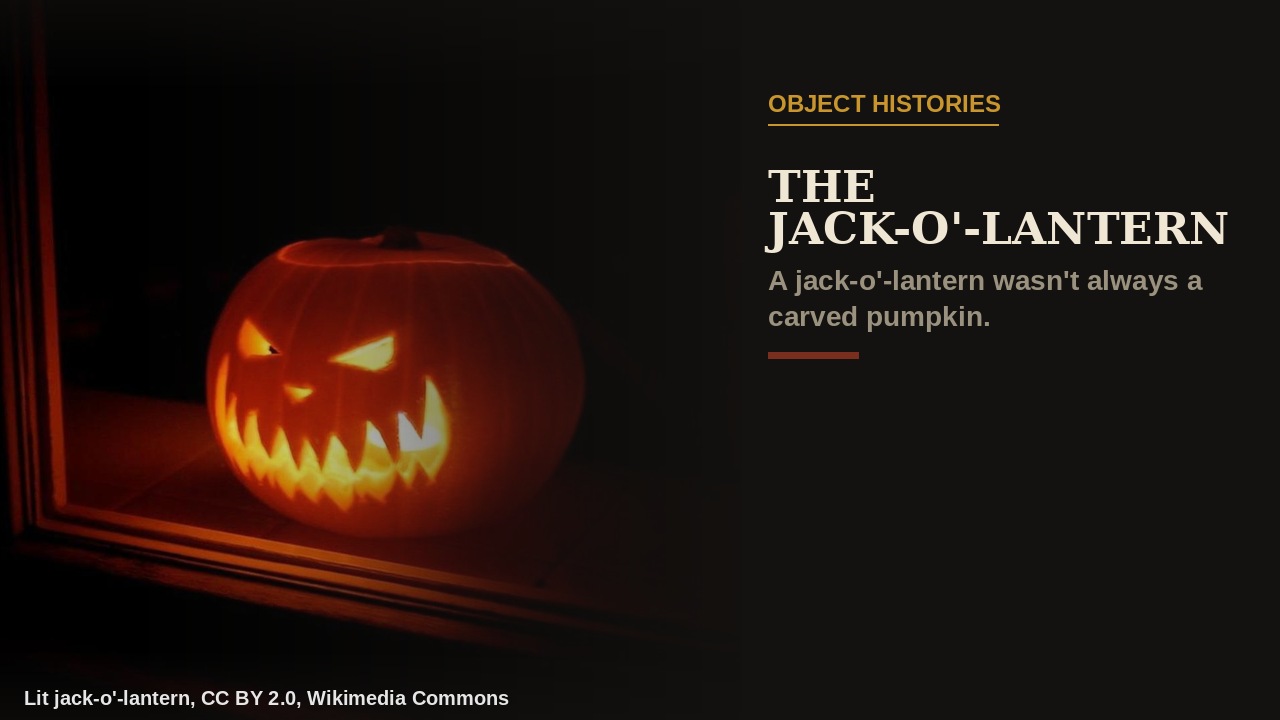
On November 23, 1867, Harper’s Weekly ran a full-page engraving of a grinning carved pumpkin on its front page, under the headline “The Pumpkin Effigy.” It is one of the earliest printed pictures of what we would now instantly call a jack-o’-lantern. And the article beneath it was not about Halloween. It did not mention the holiday at all.
That is the strange shape of the actual paper trail behind America’s most familiar autumn object. The popular version of this story skips straight from Irish turnips to pumpkin patches, as if the swap happened overnight in someone’s immigrant kitchen. The printed record — fiction, newspapers, a magazine poem, a classified-ad-style party write-up — shows something slower and more interesting: three separate writers reached for the same object across half a century, for three different reasons, before anyone settled on the image sold at every drugstore in October.
None of that paper trail runs through the folklore everyone already knows. It runs through a smashed vegetable beside a creek, a lawyer’s insult in a short story about greed, a witch’s garden ornament, and a newspaper writer mourning a custom that was, as it turned out, about to do the opposite of dying.
Washington Irving Never Describes a Carved Face
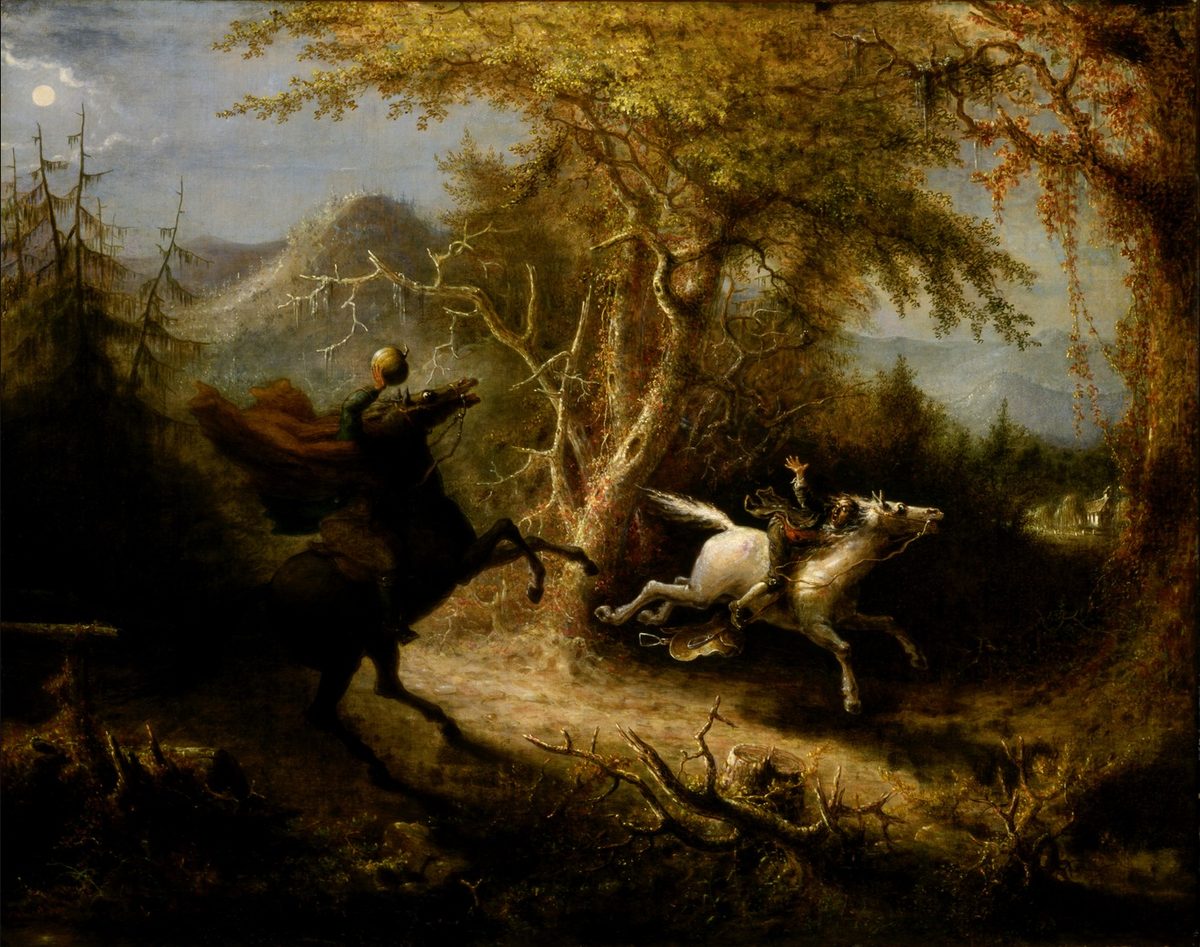
Start with the document everyone cites and almost no one has actually reread. In Washington Irving’s 1820 tale, the morning after the Headless Horseman runs schoolteacher Ichabod Crane out of Sleepy Hollow, search parties go looking for him along the route he fled. What they find is specific and nothing more: “the hat of the unfortunate Ichabod, and close beside it a shattered pumpkin.” A few pages earlier, Irving has the horseman “rising in his stirrups, and in the very act of hurling his head at him.”
Put those two lines together and the inference writes itself: the horseman’s “head” was a pumpkin all along, thrown at Ichabod and smashed somewhere unseen. Irving lets the reader do that work. He never once describes a carved face, lit from within, sitting on anyone’s shoulders. As the historian William Cronon puts it in his foreword to Cindy Ott’s history of the vegetable, the pumpkin in Irving’s story is “just an ordinary vegetable with no carved face on it at all.” The grinning jack-o’-lantern head is an illustrator’s addition, bolted onto the story by generations of artists filling in a gap Irving left open on purpose.
Irving had real material to draw on. He first heard versions of the local ghost stories while staying near Tarrytown during an 1798 yellow fever outbreak, according to the historian Elizabeth Bradley — among them a tale tracing back to a Hessian trooper from the Revolutionary War whose head was said to have been carried off by a cannonball. The village of Sleepy Hollow itself is partly Irving’s doing twice over: it was known as North Tarrytown until 1996, when it renamed itself after the story he had set there a century and three-quarters earlier, and put the Headless Horseman on its own fire trucks and police cars.
Hawthorne Put the Word in Print Fifteen Years Before He Carved a Face
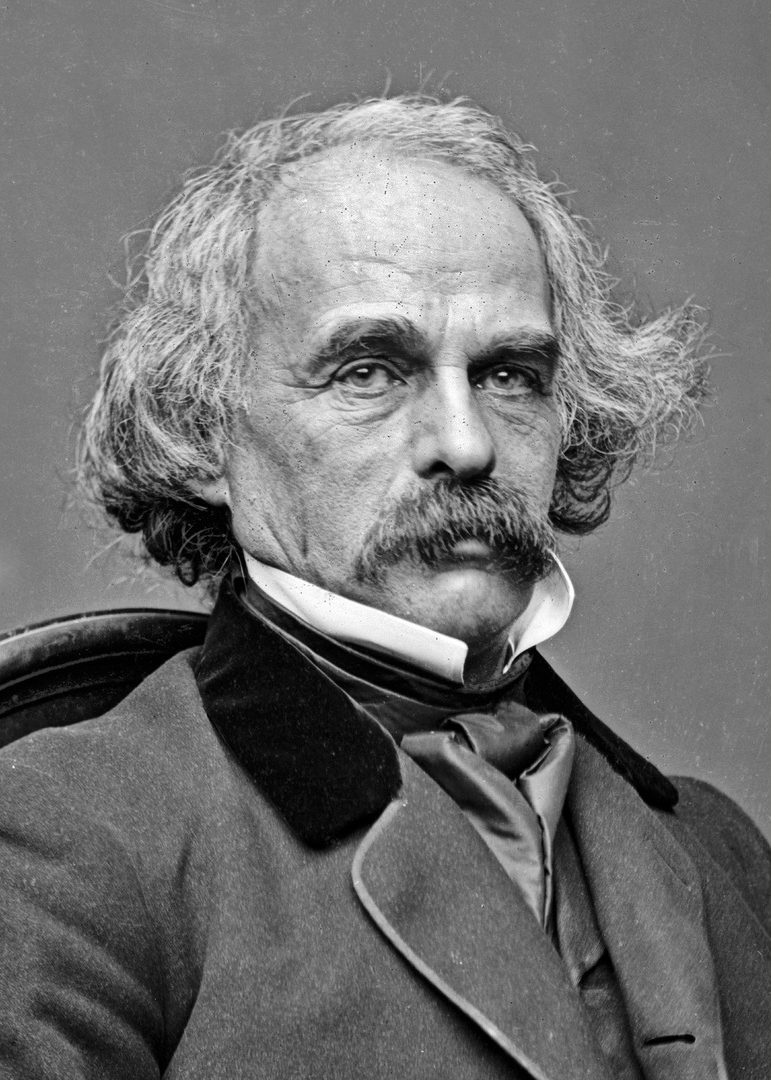
The word itself reaches American fiction earlier than the carved object does, and it arrives meaning something closer to its older sense — a mysterious, mocking light — than to a vegetable at all. In December 1835, The New-England Magazine published Nathaniel Hawthorne’s “The Great Carbuncle,” about a group of treasure hunters chasing a legendary glowing gem in the White Mountains. When one character plans to hide the recovered carbuncle under his cloak, another mocks him for it: “Hide it under that cloak, say’st thou? Why, it will gleam through the holes, and make thee look like a Jack o’lanthern!”
That is not a description of a hollowed-out vegetable. It is an insult built on the much older meaning of the phrase: a man whose light gives him away, the same wandering-glow sense that named marsh gas for two centuries before anyone thought to carve a turnip. Hawthorne’s readers in 1835 would have pictured a swamp light shining through a coat, not a porch decoration. The carved vegetable had not yet taken the word over.
By 1852, Hawthorne Gave the Face Actual Features
Fifteen years later, Hawthorne wrote the object into American fiction with a level of specificity no earlier printed American text manages. “Feathertop: A Moralized Legend” ran across two issues of The International Magazine in February and March 1852. In it, the witch Mother Rigby builds a scarecrow out of a broken flail, a pudding stick, a hoe handle, and a meal-bag stuffed with straw — and for a head, “a somewhat withered and shrivelled pumpkin, in which Mother Rigby cut two holes for the eyes, and a slit for the mouth,” leaving a bluish knob in the middle to pass for a nose. Surveying her work, Rigby allows that “many a fine gentleman has a pumpkin-head, as well as my scarecrow.”
This is the earliest American printed text to describe an actual carved pumpkin face — eyes, mouth, nose, all cut by hand — fifteen years before Harper’s Weekly ever drew one. It does not glow from inside the gourd itself, contrary to how the scene gets remembered. The light in the passage comes from the live coal in the pipe Rigby has the scarecrow smoke to stay animated, which “threw a gleam over the scarecrow’s visage.” Hawthorne, in other words, wrote a lit face fifteen years before any American newspaper printed a picture of one — he just lit it with a pipe, not a candle inside the shell.
The First Printed Picture Wasn’t Even About Halloween
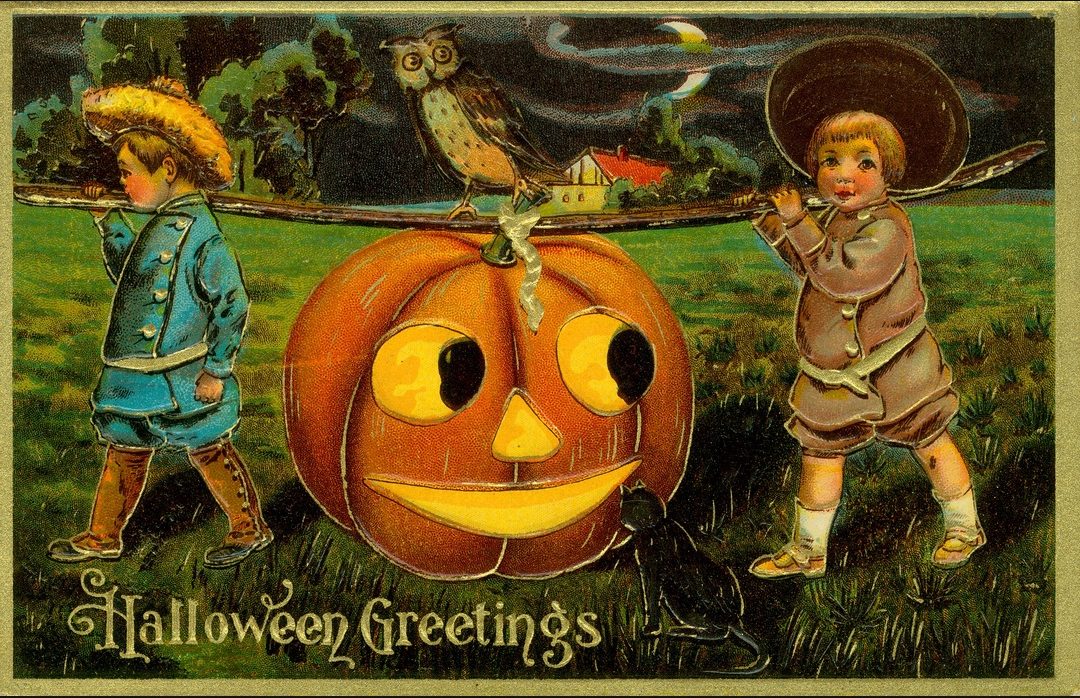
Which brings the trail back to that November 1867 front page. The engraving, drawn by L. W. Atwater and run alongside a poem titled simply “The Pumpkin,” is framed as a eulogy, not a holiday feature. The accompanying text describes carving a scowling face into a pumpkin and lighting it from within as a “quaint old custom” of “mischievous urchins” using the lit face to frighten passers-by at night — and credits the English, not the Irish, with starting it. The writer regrets that the “rising generation” had mostly given the prank up.
Two things about that are worth sitting with. First, whoever wrote the piece did not connect the custom to Halloween at all — the holiday isn’t mentioned. Second, the writer had the trend exactly backward. Far from a dying prank, the jack-o’-lantern was roughly two decades from becoming the single most recognizable image of an American holiday that, at the time, barely existed as a mass celebration yet. Whatever it was documenting, it was documenting the custom’s quietest moment, not its last one.
Parlor Parties Did What the Prank Never Could
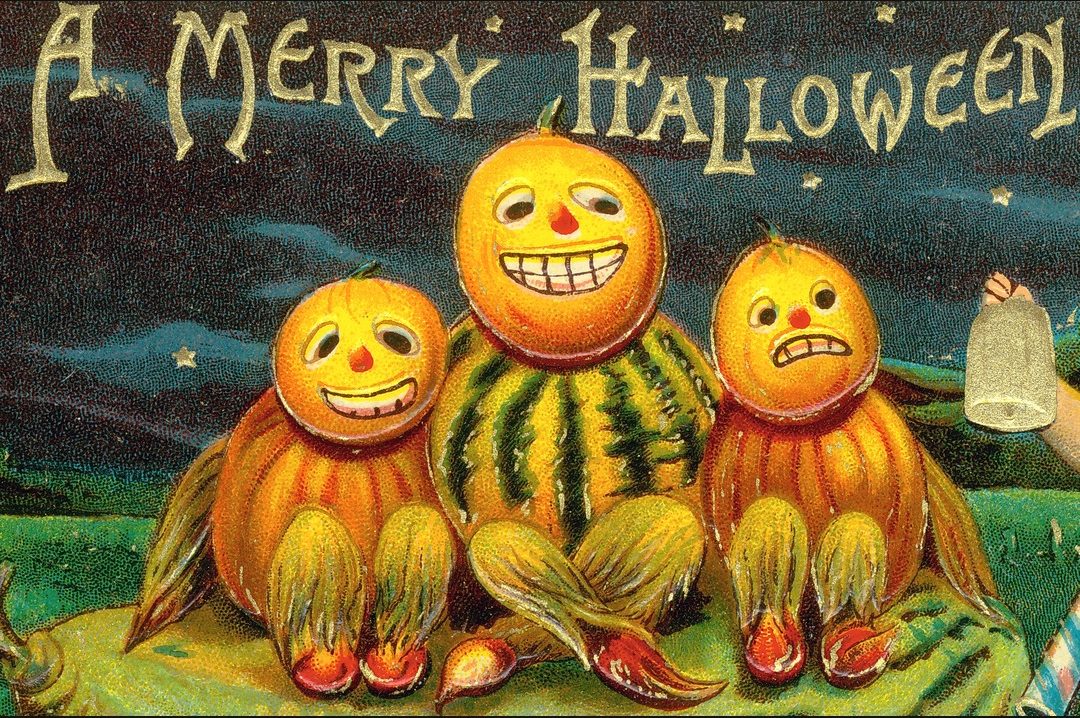
Through most of the 1800s, American Halloween customs leaned destructive rather than decorative: tipping over outhouses, hoisting farm wagons onto barn roofs, unhinging gates up and down a street in a single night. What finally tamed the holiday into something with pumpkins on a mantelpiece, rather than smashed on a road, was a shift toward hosted parties aimed at making the night about hospitality instead of damage.
One of the better-documented examples comes from Ashland, Oregon, in October 1892, when Mr. and Mrs. G. M. Grainger hosted a Halloween party on Granite Street in honor of a guest named Carrie Beekman. The invitation was written in rhyme and asked guests to reply in verse, with a prize offered for the best one. The decorations were jack-o’-lanterns alongside sheet ghosts and paper witches, the entertainment was fortune-telling, and the menu ran to popcorn and pumpkin pie. None of it required anyone’s barn gate to come off its hinges.
The historian Cindy Ott, who wrote the fullest cultural history of the American pumpkin, traces the appeal to something broader than one holiday. English colonists had first grown pumpkins as, in her words, “a food of last resort” — plain, filling, and unglamorous. By the back half of the 1800s, as more Americans moved into cities and further from working farms, the same unglamorous vegetable turned into nostalgic material for paintings and poetry: what Ott calls “this spectacular symbol of natural abundance.” A carved, lit pumpkin on a porch did double duty — Halloween prop and harvest-season set piece at once — which is likely exactly why it outcompeted every other prank-night custom on offer.
The Industry the Print Record Led To
Once the image had settled into place, it became a business, and the business shows up in patent filings rather than folklore. Paul Bardeen, a Denver safety engineer looking for a safer way to let his own children help carve, developed some of the first purpose-built carving saws, knives, and printed pattern sheets in his own home in the early 1980s, though he never patented any of them himself. After he died in 1983, his children decided a marketable version of his kit would honor the work, and formed the company now known as Pumpkin Masters. His son John filed the first mass-market carving-kit patent in 1989. The U.S. Patent and Trademark Office has issued roughly thirty patents for pumpkin- or vegetable-carving tools since, almost all of them in the last four decades: contoured cookie-cutter shapes for faces in 1981 and 1987, flexible plastic poking plates in 2001, metal punch-out kits in 2008, even a battery-powered carving knife in 2009. A custom that needed no equipment at all in 1867 had, within roughly a century, generated its own small patent arms race.
The clearest present-day descendant of that 1867 engraving is a seasonal attraction a few miles south of the village Irving actually named — at Van Cortlandt Manor in Croton-on-Hudson, New York, not in Sleepy Hollow itself, a mix-up repeated often enough that it is worth correcting here. The Great Jack O’Lantern Blaze, run by Historic Hudson Valley, marked its twentieth anniversary there in 2024, lighting what local reporting describes as thousands of intricately carved jack-o’-lanterns across the property each autumn night — carved, these days, with tools that trace a direct line back to one family’s kitchen table in Denver.
Watch the full history
The video version follows the object from Stingy Jack’s hollowed turnip to tonight’s porch pumpkin in under six minutes.

Related reading
- The Original Jack-o’-Lanterns Were Turnips, Not Pumpkins — the Irish turnip original this pumpkin replaced
- How Tarot Became Fortune Telling, 300 Years Later — another folk custom that drifted from belief into a commercial product
- The Real History of the Fortune Teller Machine — a different piece of Americana built on carnival-era folk magic
- How the Magic Lantern Became Europe’s First Horror Show — a folk-adjacent entertainment that print and industry turned into mass culture
Shop
Shop the book behind this story:
Works cited
- Irving, Washington. “The Legend of Sleepy Hollow.” In The Sketch Book of Geoffrey Crayon, 1820. Link.
- Bradley, Elizabeth, interviewed by Scott Simon. “Washington Irving’s Headless Horseman Of Sleepy Hollow Turns 200.” Weekend Edition Saturday, NPR, October 24, 2020. Link.
- Hawthorne, Nathaniel. “The Great Carbuncle.” The New-England Magazine, December 1835. Collected in Twice-Told Tales, 1837.
- Hawthorne, Nathaniel. “Feathertop: A Moralized Legend.” The International Magazine, February–March 1852.
- Atwater, L. W. (illustrator). “The Pumpkin Effigy.” Harper’s Weekly, November 23, 1867, p. 737. House Divided Project, Dickinson College. Link.
- Ott, Cindy. Pumpkin: The Curious History of an American Icon. University of Washington Press, 2012.
- Cronon, William. Foreword to Pumpkin: The Curious History of an American Icon, by Cindy Ott. University of Washington Press, 2012.
- Mullaly, Alice. “As It Was: 1892 House Party Displaces Halloween Tricks.” Jefferson Public Radio, October 30, 2019. Link.
- Pezzullo, Rick. “The Great Jack O’Lantern Blaze Opens Friday the 13th.” The Hudson Independent, September 12, 2024. Link.
- “The Patents Designed to Make Carving Your Pumpkin a Little Less Messy.” Smithsonian Magazine.
The next time a lit pumpkin sits on a porch, it is worth remembering that for most of its printed life it was something else first: a punchline, a half-finished scarecrow, and a newspaper’s eulogy for a custom that, it turned out, had barely begun.