
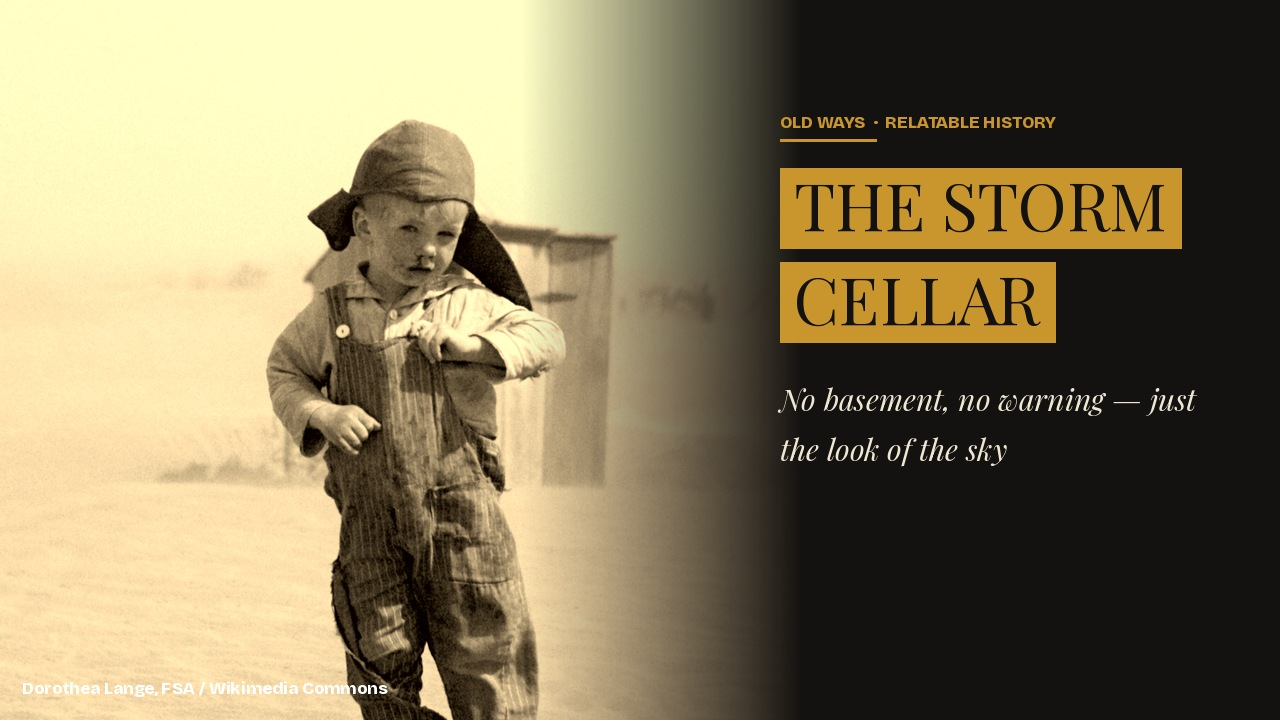
For roughly sixty years, the United States government did not issue tornado warnings. Not because tornadoes weren’t happening — they were happening constantly, across the same stretch of plains year after year — but because the men in charge of the forecasts had decided that an official willing to say “tornado” out loud, with no reliable way to say exactly where or when, would do more harm than good. So a farm family standing in a Kansas or Oklahoma yard in, say, 1930, watching a particular shade of green come into the sky, had no tornado warnings to listen for at all. What they had instead was a hole in the ground: the storm cellar.
That hole in the ground is the subject of this article, and it deserves more credit than it usually gets. The storm cellar — also called a cyclone cellar, a fraidy-hole, or simply “the cave” depending on which part of the plains you were standing in — was not a basement. It was a separate structure, dug apart from the house on purpose, and for most of its working life it was the single most effective piece of severe-weather technology available to an ordinary American family. It had no moving parts. It also outperformed the federal government’s own information policy for decades.
Understanding why requires looking at both halves of the story together: the room itself, and the almost unbelievable gap in warning that made the room necessary in the first place.
A room built apart from the house, on purpose
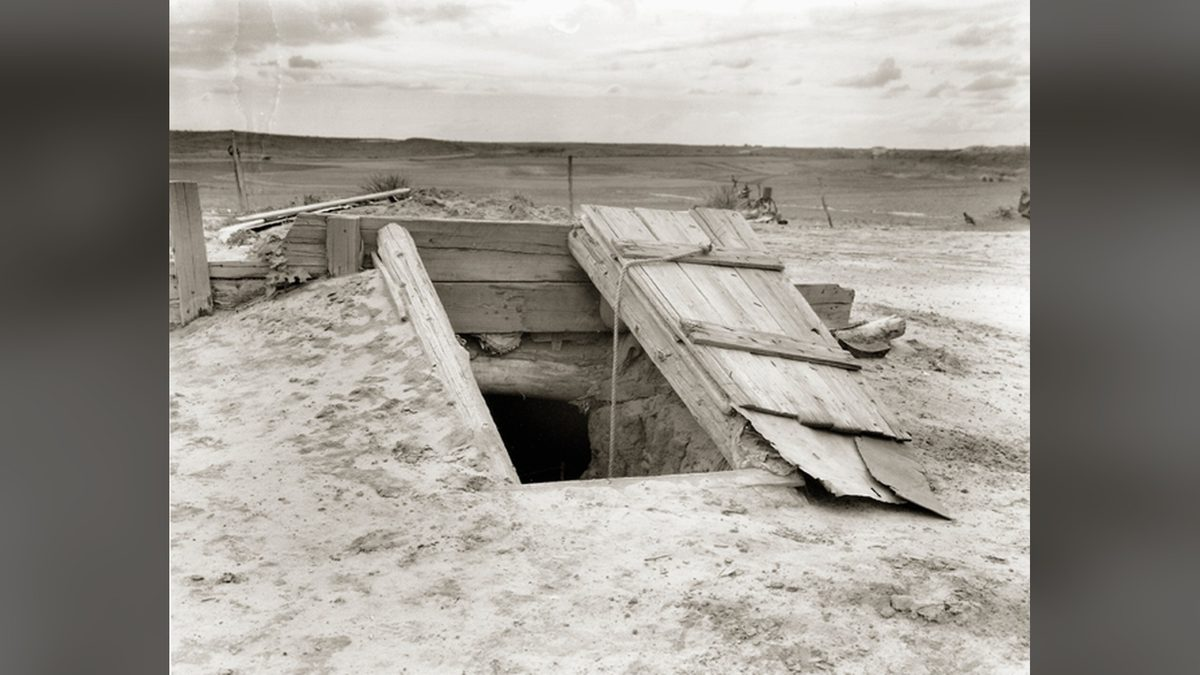
Plenty of farmhouses on the Great Plains simply had no basement to retreat to. Early homesteads were dugouts cut into a hillside or sod houses built up from the prairie itself — the Oklahoma Historical Society’s Sod House Museum, built by homesteader Marshal McCully in August 1894, used roughly half an acre of cut prairie sod, about ninety-six tons of it, laid up like oversized bricks to form two rooms. Structures like that were not engineered to carry a second underground story; the ground beneath them was the foundation and the walls were cut from the same dirt everyone was standing on. By the historical society’s count, something like a million sod buildings went up across the plains and prairie provinces between 1903 and 1913 alone. None of them came with a basement stair.
So families dug a second, separate structure out in the yard instead: a room cut several feet into the earth, roofed over with timber and then mounded with more earth on top, entered through a heavy door set at a steep angle in the ground rather than a vertical one in a wall. Kansas writer Beryl Clotfelter, recalling his family’s cellar from a Reno County farm, described the type precisely — a slanted door concealing a short run of steps down to a small room with concrete walls and floor, capped with “a slightly domed roof” of earth and grass. The Historic American Buildings Survey recorded the same basic shape again and again across Texas farmsteads in the twentieth century: a poured-concrete box sunk into the yard, a sloped plank or metal door hinged at the high end, sod or sand mounded over the top to help insulate it and to keep the structure from simply collapsing under its own roof load.
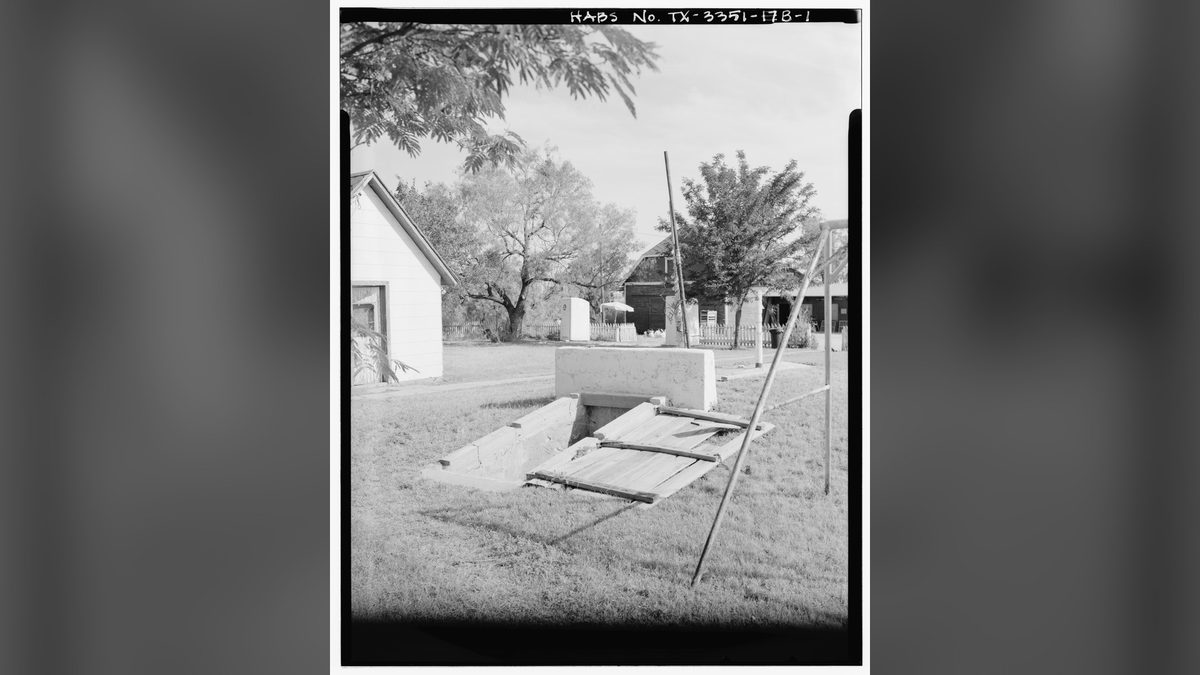
The angle of the door was not incidental. A door set flush with the ground and opening upward is exactly what a tornado’s pressure differential and flying debris are worst at tearing loose; a door sloped against a thick earthen bank, braced from below, is much harder to rip open from the outside. Families who could afford it poured a short concrete retaining wall and stairwell; families who couldn’t simply packed the excavation’s dirt walls and hoped. Either way, the room itself sat six to eight feet below grade on a typical Plains farm — deep enough that straight-line structural wind and flying debris genuinely could not reach the people inside, which is the entire engineering principle a storm cellar runs on and the same principle a modern underground safe room still runs on today.
It was a root cellar eleven months a year
Very few families dug a hole this size for one purpose. An underground room on the Plains holds a remarkably steady temperature — roughly fifty to fifty-five degrees Fahrenheit year-round, cool enough in July to keep food from spoiling and warm enough in January that stored vegetables don’t freeze solid. That is precisely the temperature range a root cellar needs, and the storm cellar and the root cellar were, on most farms, simply the same room. Clotfelter’s cellar had shelves “loaded with glass jars of canned food” lining the walls his family ducked past on the way to shelter. Historian Molly Rozum, surveying homestead sites in northwest South Dakota, found families referring to the structure simply as “the cave” — by 1912, one Frontier County, Nebraska-area claim included a nine-by-twenty-six-foot example dug specifically to double as storage.
That dual use is worth pausing on, because it explains why the storm cellar survived as a building type for as long as it did, well past the point where a purpose-built shelter alone might have seemed worth the labor. Digging a room out of raw prairie sod by hand was real work. A family was far more willing to do it — and to maintain it, re-sod the roof every few years, keep the door hinges greased — when the room was earning its keep three hundred and sixty days a year as a pantry, and only occasionally earning it as a bunker.
Storm cellars existed because tornado warnings didn’t
Here is the part of the story that makes the cellar necessary rather than merely prudent. In the 1880s, U.S. Army Signal Corps officer John Park Finley spent years studying tornado damage across the Midwest and, after a deadly February 1884 outbreak, published fifteen rules for recognizing tornado-favorable conditions. Finley’s research was genuinely good. It was also shelved as a forecasting tool. The Signal Corps, and later the civilian Weather Bureau that took over forecasting duties, formally discouraged — and for long stretches effectively banned — the word “tornado” from public forecasts, on the theory that an agency with no reliable way to say exactly where and when a tornado would touch down should not risk inciting panic, or worse, false alarms that would undermine public trust in the forecasts altogether.
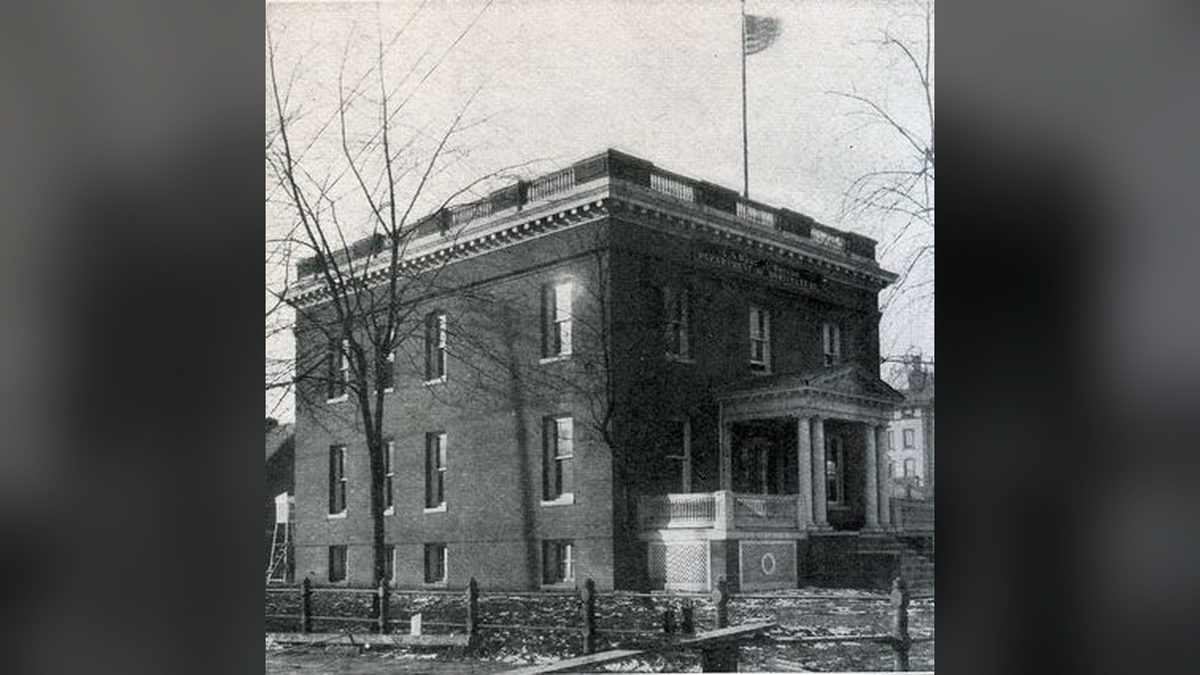
The practical result was that the nation’s official weather service spent the better part of six decades describing tornado-producing weather in euphemism. The National Weather Service’s own heritage project, reviewing the forecasts issued ahead of the deadliest tornado in American history, notes that the Weather Bureau’s language that day warned only of “rains and strong shifting winds” — not a tornado, because the word itself was effectively off-limits. A farm family listening to the forecast, or more likely not listening to any forecast at all, had no mechanism by which the federal government would tell them a tornado specifically was coming. What they had was their own eyes, a barometer if the house owned one, and whoever in the family had the job of standing at the cellar door watching the horizon when the sky turned the wrong color.
The day the gap in warning became impossible to ignore
On March 18, 1925, a tornado formed near Ellington, Missouri, shortly after one in the afternoon and did not lift again until nearly four-thirty, having crossed Missouri, Illinois, and Indiana along a path the National Weather Service puts at roughly 219 miles — the longest, and to this day the deadliest, tornado track ever recorded in the United States. It killed at least 695 people. In Murphysboro, Illinois alone it destroyed 154 city blocks and killed 234 residents, the highest single-community death toll from any tornado in American history; 33 more children and teachers died when it hit the De Soto school. The tornado averaged better than sixty miles an hour across the ground, outrunning anyone trying to flee it on foot, and by the time it reached southern Illinois it was moving close to seventy-five.
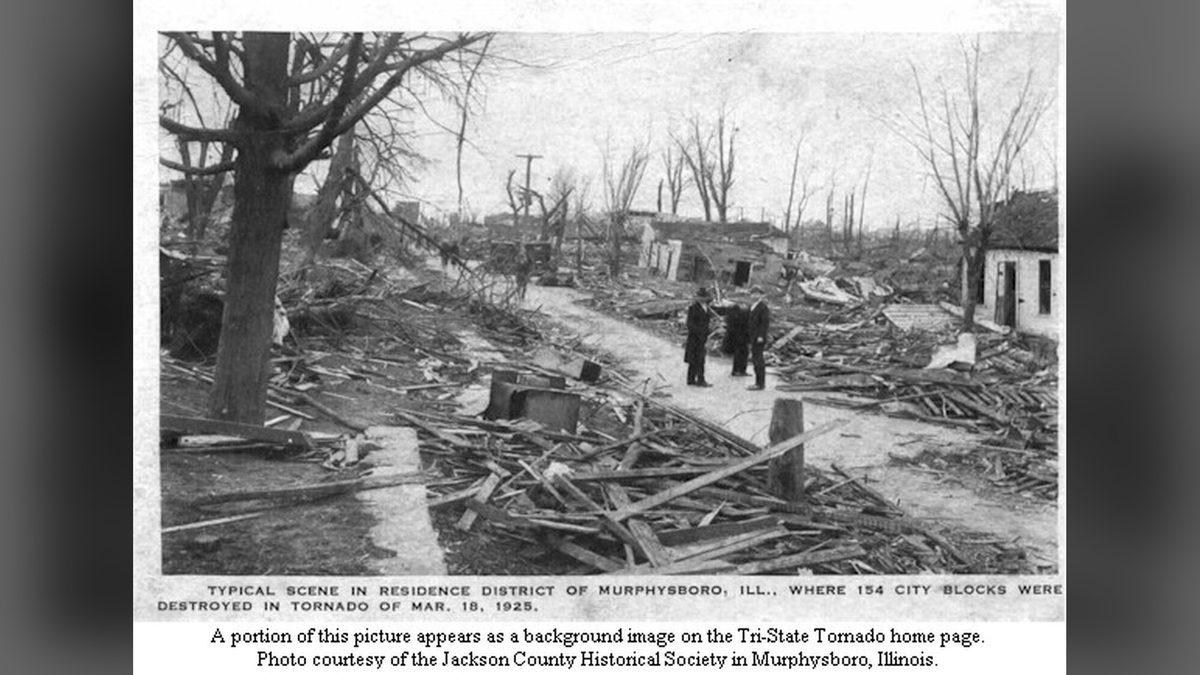
Cellars were, by every surviving account, the difference between the people who lived and the people who didn’t. The National Weather Service’s own retrospective on the storm records families who made it underground in time and families who very nearly didn’t — one account describes a household reaching their cellar with seconds to spare, only to find a fallen tree blocking the door behind them. There was no siren warning those families; there was no advance bulletin using the word that would have told them precisely what was coming. There was only whatever instinct, folklore, and family habit had trained them to do when the sky looked like that, and whether or not they had somewhere underground to go when it did.
A base commander orders an experiment nobody thought would work
The event that finally broke the standoff happened not on a farm but on an air base. On the night of March 20, 1948, a tornado tore through Tinker Air Force Base in Oklahoma, destroying roughly ten million dollars of aircraft and property. An investigating board concluded, after the fact, that the storm had been unforecastable with existing methods — which was simply standard doctrine at the time. Base commander Major General Fred S. Borum was not satisfied with that answer, and ordered two staff meteorologists, Major Ernest Fawbush and Captain Robert Miller, to find out whether tornado forecasting was possible at all.
Over the next few days Fawbush and Miller pulled the surface and upper-air charts from the March 20th storm and compared them against the charts from a string of other past tornado outbreaks, looking for a repeatable pattern. On March 25th, five days after the first tornado, they watched the same pattern reassemble over Oklahoma in real time — and issued a forecast predicting a tornado at Tinker that afternoon. It was the first operational tornado forecast in American history. The base evacuated hangared aircraft and moved personnel to shelter; the tornado arrived as predicted and caused six million dollars in damage, with no injuries. A 1951 review of the Fawbush-Miller method found that 67 of the 75 tornado forecasts issued under it to that point had verified. The case for forecasting, made with embarrassing clarity by an Air Force weather station, was the beginning of the end for the sixty-year information blackout — the Weather Bureau’s public tornado forecasts and the national warning network that eventually followed it grew directly out of what Fawbush and Miller demonstrated that week.
What replaced the hole in the ground
None of this made the storm cellar obsolete overnight — a public forecast only works if it reaches you, and rural radio and telephone coverage lagged the forecasting breakthrough by years in plenty of places. But it marked the point where “watch the sky yourself” stopped being a family’s only option and started being a backup to an actual warning system. The underground room itself never really left; it simply modernized. The Federal Emergency Management Agency’s current guidance on residential safe rooms specifies a structure engineered to resist a defined wind load and, critically, tested against wind-borne debris impact — a two-by-four fired from a cannon at speed, essentially, which is a design requirement the 1890s sod-and-timber cellar never had to meet and almost certainly would have failed. Safe rooms today can be built above grade, in-ground, or inside an existing basement, but the underlying logic is the one a Plains family already understood a century earlier: get enough mass and depth between yourself and the wind, and the storm becomes survivable.
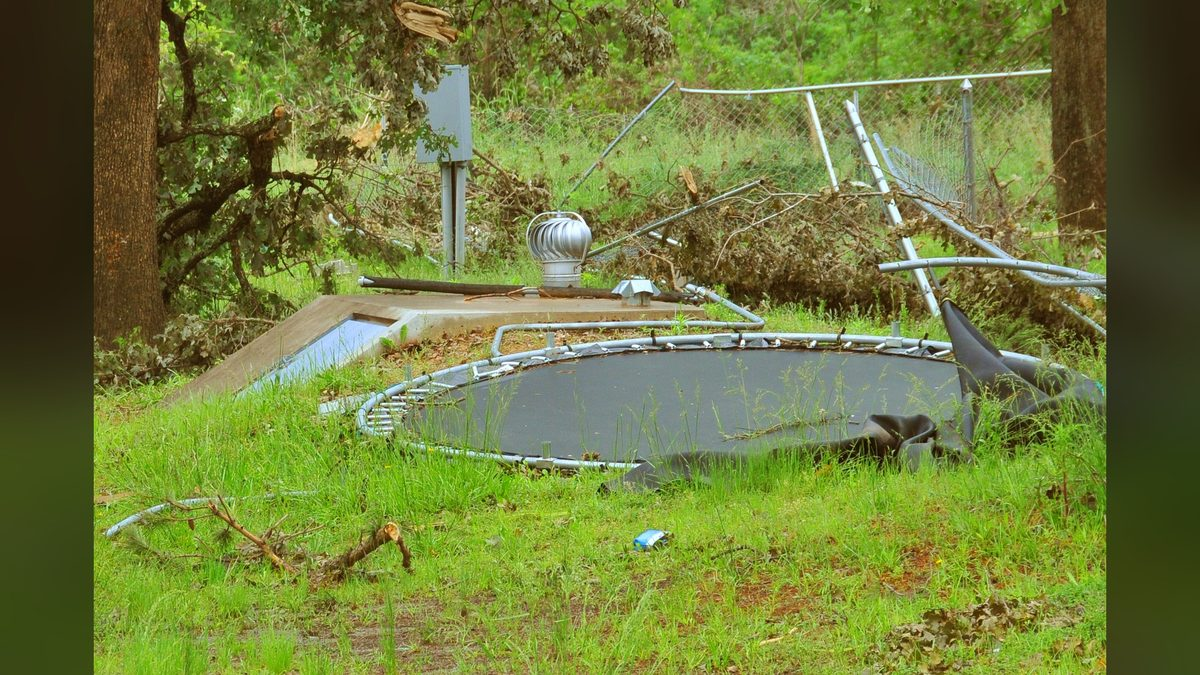
What the cellar represents, in the end, is a kind of folk engineering that filled a gap its own government had created and then was slow to close. It cost a family nothing but labor and dirt, required no electricity, no telephone line, no federal forecast using a word the federal government wasn’t allowed to use — and it worked. The storm cellar is a reminder that the most important piece of safety technology in a given era isn’t always the most sophisticated one available; sometimes it’s the one built by people who had correctly concluded that no one else was coming to warn them, and acted accordingly.
So: how would you have survived a tornado with no warning and no basement? On the Plains, for the better part of a century, the answer was the same for almost everyone — you dug the room yourself, you stocked it with the winter’s food, and you kept someone at the door watching the sky, because for a very long time, watching the sky yourself was the only warning system there was.
Watch the full history
The video version covers the cellar’s construction, its double life as a root cellar, and the Dust Bowl years that made it a daily habit, in about eight minutes.

Related reading
- How Sod Houses Were Built on the Nebraska Prairie — the same lack of a basement that made a separate storm cellar necessary in the first place.
- How a Root Cellar Kept Vegetables All Winter — the storm cellar’s everyday job the other 364 days of the year.
- The Real History of Rainwater Cisterns — another dug-out Plains structure built to survive weather the house itself couldn’t.
- The Egg Money History of the Farmhouse Henhouse — the rest of the working farmyard the cellar sat inside.
Works cited
- National Weather Service, Paducah, KY. “The Tri-State Tornado of March 18, 1925.” Link.
- National Weather Service Heritage Project. “The Tri-State Tornado of 1925.” Link.
- NOAA Office of the Chief Administrative Officer, Celebrating 200 Years. “History of Tornado Forecasting.”
- Tinker Air Force Base Public Affairs. “Tinker Airmen First to Predict Tornadoes.”
- Federal Emergency Management Agency. “Residential Safe Rooms” fact sheet.
- Oklahoma Historical Society. “Sod House Museum.” Link.
- Clotfelter, Beryl. “Tornadoes in Kansas.” Rootstalk, Grinnell College, vol. 9, no. 1. Link.
- Antle, Jay. “Surviving the Storm.” Kansas Heritage, Kansas Historical Society, Summer 2005. Link.
- Rozum, Molly P. “It’s Weathered Many a Storm: The Enduring Sod House in Northwest South Dakota.” South Dakota History 47, no. 4 (2017). Link.