
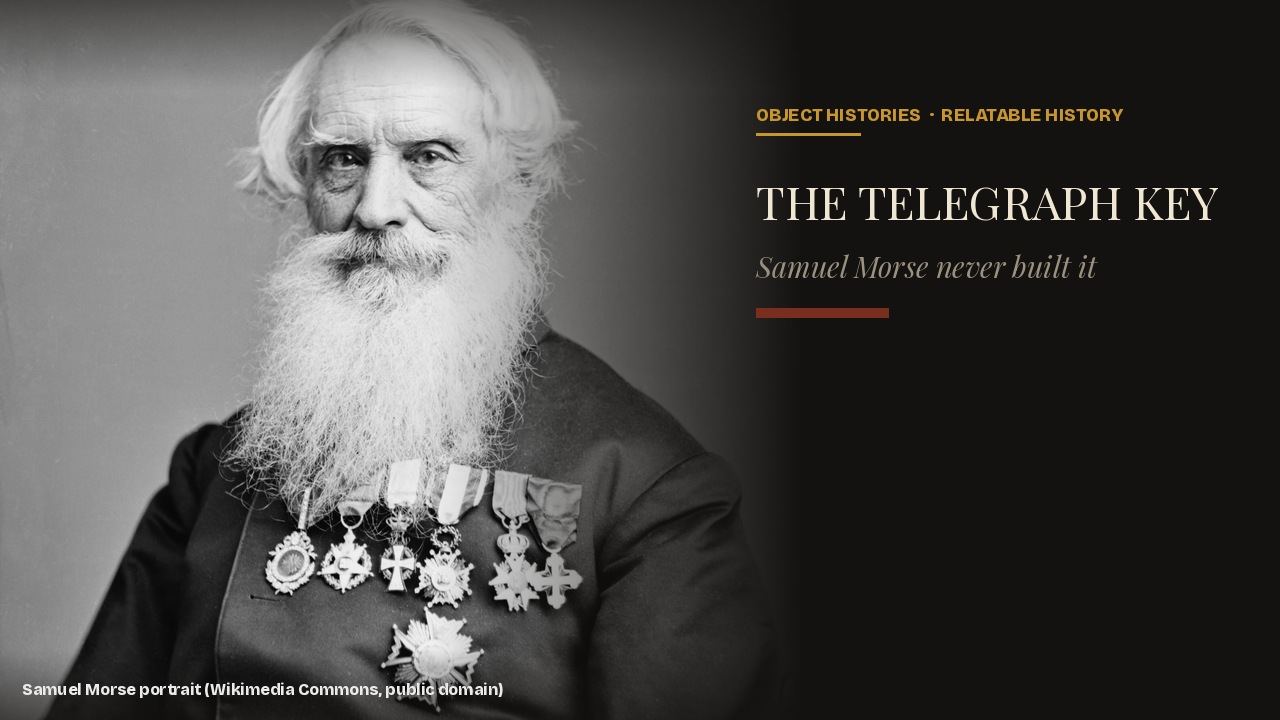
Search the phrase “who invented the telegraph” and every result points to Samuel Morse. But the physical object an operator actually touched — the lever-and-contact key that opened and closed the circuit, the device that eventually carried Morse’s name into everyday English — was designed, built, and rebuilt by a machinist named Alfred Vail, working in his family’s ironworks in Morristown, New Jersey. Vail also rewrote Morse’s original code from an unworkable numeric system into the alphabet of dots and dashes still called Morse code today.
None of this is a fringe revisionist claim. It comes from the Smithsonian’s own holdings of Vail’s research notebooks and correspondence, from the patent-dispute record that reached the Supreme Court, and from Vail’s own 1845 book about the project. The record is not ambiguous about who built the thing. It is only ambiguous about why his name didn’t survive attached to it.
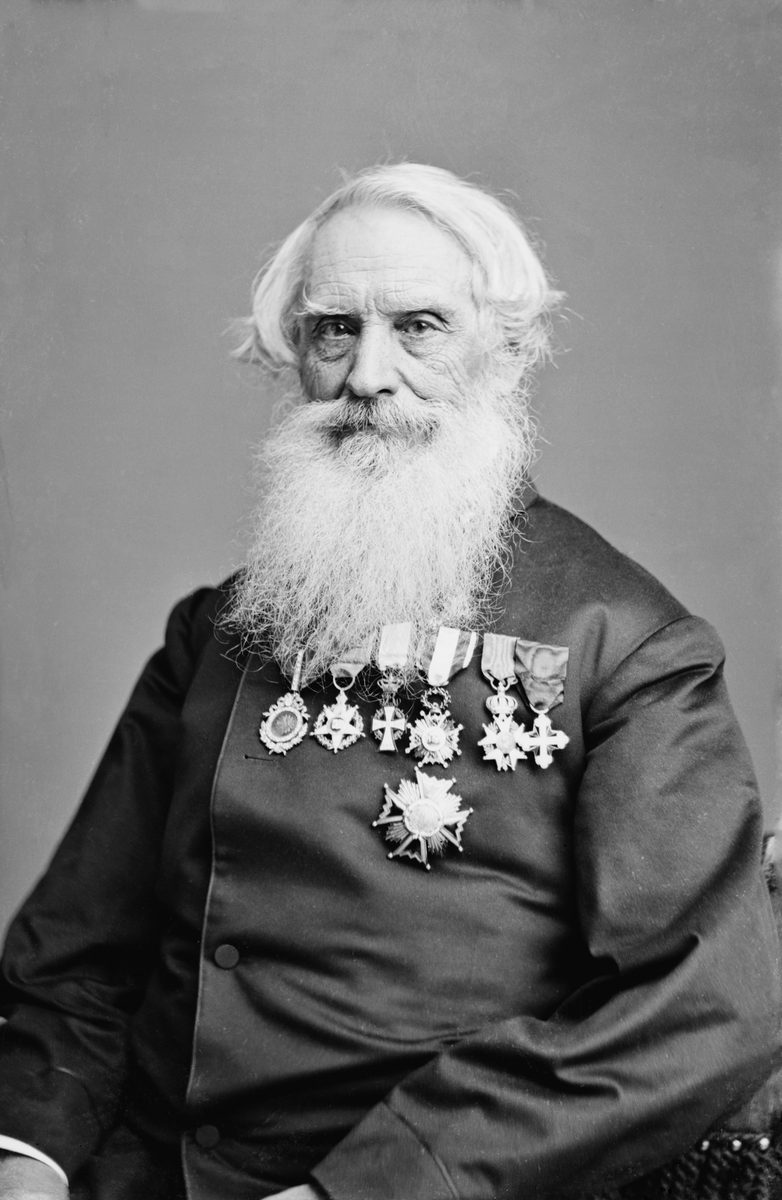
A portrait painter had the idea; he needed someone who could build things
Morse was a professional portrait painter, one of the most respected in America, when a conversation with a fellow passenger on a transatlantic crossing in 1832 introduced him to the basics of electromagnetism. He spent the next five years sketching a device and a signaling code, and by 1837 he had a crude working prototype and a patent application. What he did not have was a way to build a reliable version of it, or the money to try.
In September 1837, a young machinist named Alfred Vail watched Morse demonstrate the prototype at what is now New York University and proposed a partnership. Under the contract they signed, Vail and his father would finance the American and foreign patents and build the actual machinery, at Vail’s own expense, in exchange for a share of the rights. The work moved to the Vail family’s Speedwell Ironworks in Morristown, one of the few shops in the country with the metalworking skill the project needed.
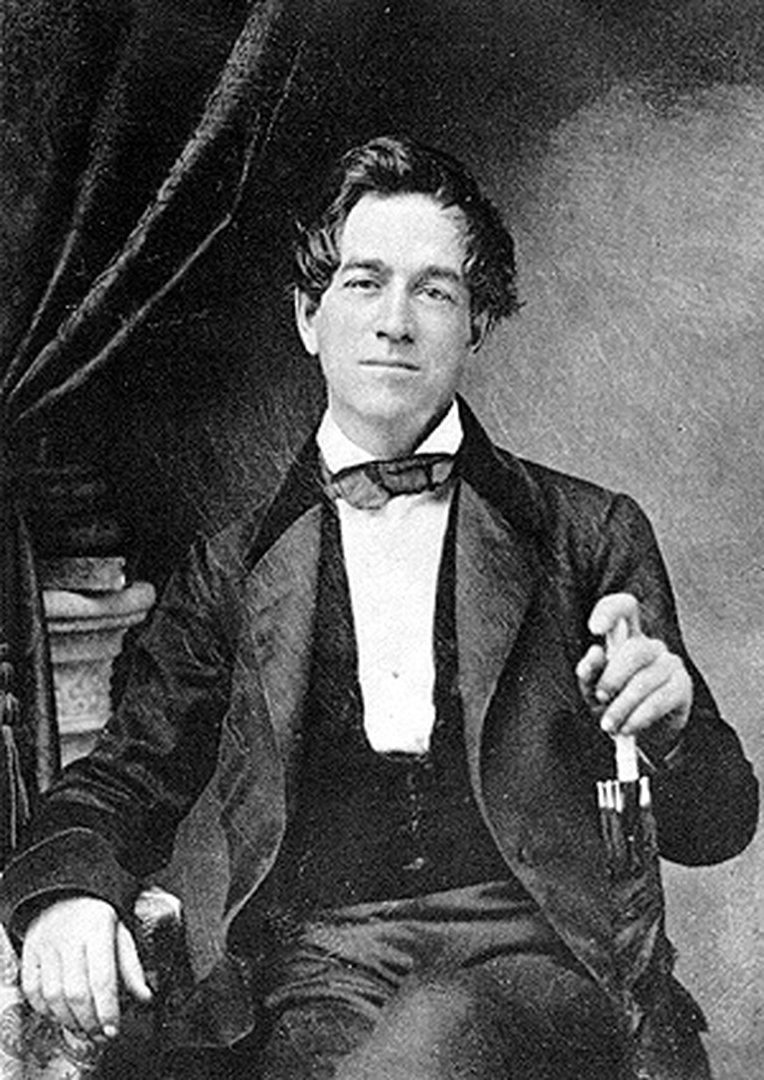
Vail rebuilt Morse’s numeric code into the alphabet still used today
Morse’s original code was not dots and dashes. It was a system of numbers, each corresponding to a word in a printed dictionary, which meant an operator had to flip through a codebook for every single word of a message — slow, clumsy, and useless at any real speed. Vail redesigned it into the system of short and long pulses, assigned directly to letters, that the world still calls Morse code, even though the historical record is clear that Vail did the actual engineering of it.
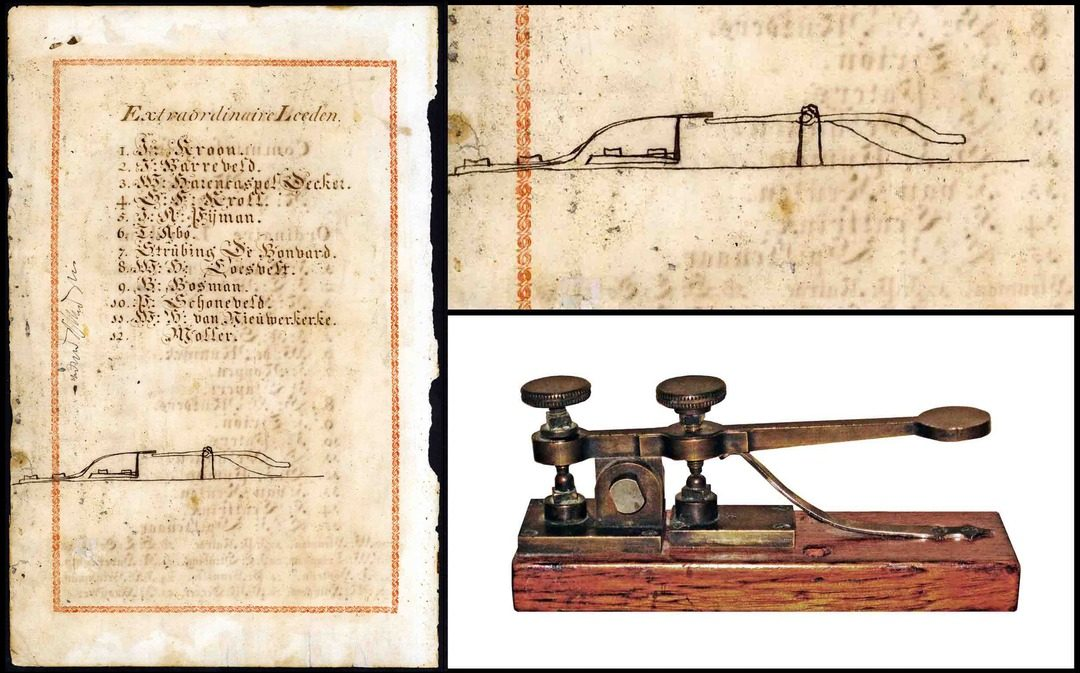
Vail made comparable changes to the hardware. He replaced the pendulum mechanism Morse had used to space out signals with a weight-driven mechanism, swapped Morse’s pencil marker for a spring-loaded steel pen that indented the code cleanly into paper tape, and refined the register — the receiving instrument that physically punched out the incoming pulses. The transmitting key itself, the simple lever an operator presses to open and close the circuit, was Vail’s design from the ground up.
Congress paid for a real test, and Vail strung the wire himself
Morse and Vail demonstrated the system publicly for the first time in January 1838, sending a message across two miles of wire at Speedwell Ironworks. It worked, and it impressed everyone who saw it, but turning a demonstration into a functioning network took money Morse spent years failing to raise, while competing against several rival telegraph systems under development in Britain and the United States.
Congress finally appropriated $30,000 in 1843 to build an experimental line between Washington and Baltimore. Vail was the one who physically strung the wire and repaired failing sections as the line went up. On May 24, 1844, with Vail at the receiving key in Baltimore, Morse sent the line’s first official message from the Supreme Court chamber in the Capitol: “What hath God wrought,” a phrase suggested by a friend’s daughter, drawn from the Book of Numbers. Vail then sent the same message back, closing the loop and proving the line worked in both directions. The strip of paper tape recording those pulses survives today as one of the best-known artifacts of 19th-century American technology.

The Supreme Court narrowed Morse’s patent, but left him sole inventor of record
The telegraph’s rapid spread after 1844 brought lawsuits along with success. Rival inventors, including Henry O’Reilly and Alexander Bain, challenged Morse’s patent for years, arguing they deserved credit for parts of the system. The dispute reached the Supreme Court as O’Reilly v. Morse, decided in 1854. Chief Justice Roger Taney’s opinion actually cut against Morse in one specific and significant way: it struck down Morse’s eighth patent claim, which had tried to cover any use of electromagnetism whatsoever to print characters at a distance, regardless of the machinery used. The Court ruled that too broad to patent — an abstract principle, not a specific invention — a decision still cited today in patent-eligibility law. But the ruling upheld Morse’s narrower claims over the specific telegraph system he had patented, which was enough to cement his legal and public standing as the telegraph’s inventor for the rest of his life, with Vail’s actual engineering work nowhere named in the decision.
A second, quieter dispute ran alongside the patent fight. Vail’s own 1845 book about the project failed to credit Joseph Henry, the Smithsonian Institution’s first secretary, whose research on high-intensity electromagnets Morse had drawn on directly. That omission triggered years of argument over how much of the underlying science belonged to Henry rather than to Morse or Vail — a reminder that the credit question around this invention runs in more than one direction.
A two-mile demonstration became tens of thousands of miles of wire
The Speedwell Ironworks test in January 1838 was modest by design — the message sent that day was simply “A patient waiter is no loser,” chosen to prove the system could spell out ordinary language rather than to say anything important. What followed the 1844 Washington-to-Baltimore line was not modest at all. Telegraph companies strung wire alongside railroad rights-of-way throughout the late 1840s and 1850s, since railroads and telegraph lines solved each other’s problems: the telegraph let a railroad coordinate train movements safely on single-track lines, and the railroad’s cleared, maintained right-of-way gave the telegraph company a ready-made path across the country. By the time of the Civil War, tens of thousands of miles of line crossed the United States, and a transcontinental telegraph connected the coasts in 1861, years before a transcontinental railroad did the same.
The key itself had to keep up with that scale. American railroad telegraphy wired its circuits differently from European systems, with shared battery power supplied only at stations on either end of a line rather than at every stop, which meant an idle key needed a shorting switch to keep the circuit closed for the stations further down the line. It is a small mechanical detail, but it is the kind of adaptation that shows the key was never a finished object — it kept being re-engineered, station by station, as the network grew far larger than Vail or Morse had built it for.
Operators learned to recognize each other by touch alone
A genuine culture grew up around the key once telegraph lines crisscrossed the country. Every operator’s hand produced a slightly different rhythm and spacing when sending code, a personal signature operators called a “fist.” An 1897 study in the Psychological Review documented that experienced telegraphers could identify individual senders after only a few words, purely from timing and touch, the way a familiar voice is recognized without needing to see who is speaking. The same phenomenon later had military uses: both Allied and Axis intelligence services in the twentieth century tracked ships, submarines, and army units by matching a distinctive fist to a known operator, a technique that outlived the telegraph itself and carried over into wartime radio interception.
Vail left the business in 1848 and died largely written out of the story
Vail received a one-eighth interest in the telegraph patent for his work, a fraction of what Morse retained. He left the telegraph business in 1848 over disagreements about credit and pay, and died in 1859 at fifty. Morse, by contrast, spent the rest of his life celebrated as the telegraph’s sole inventor, won his legal fights, became wealthy and well known, helped found what is now Vassar College, and had towns and streets named after him across the country.
Vail’s own papers — research notebooks, correspondence with Morse, patent drafts, and journals — eventually reached the Smithsonian Institution, where they are held today as Record Unit 7055, alongside a separate collection of Vail family papers at the New Jersey Historical Society. It is largely from those archives, read closely in recent decades, that historians have reconstructed how much of the physical telegraph key, the code, and the working line was actually Vail’s doing rather than Morse’s.
Watch the full history
The video companion covers the same partnership, the same patent fight, and the same missing name in about six minutes.

Related reading
- What the Records Actually Show About the Shag Harbour UFO
- How Farmers Harvested Wheat With a Grain Cradle
- What Were Roman Dodecahedra Actually Used For?
- Why Nobody Can Read Easter Island’s Own Writing System
Works cited
- Bellizzi, Courtney. “A Forgotten History: Alfred Vail and Samuel Morse.” Smithsonian Institution Archives, 24 May 2011.
- O’Reilly v. Morse, 56 U.S. (15 How.) 62 (1854). U.S. Reports, Library of Congress. Link.
- Silverman, Kenneth. Lightning Man: The Accursed Life of Samuel F. B. Morse. Knopf, 2003.
- Connor, Joseph. “Morse’s Partner Argued He Invented Famous Code — to No A-Vail.” HistoryNet, 25 May 2020. Link.
- Vail, Alfred. The American Electro Magnetic Telegraph. Lea and Blanchard, 1845.
- New Jersey Historical Society. “Guide to the Alfred Vail (1807–1859), Inventor, Papers 1826–1918, MG 50.” Link.
- Hochfelder, David. “Joseph Henry: Inventor of the Telegraph?” Smithsonian Institution, Joseph Henry Papers Project.
- Bryan, William Lowe, and Noble Harter. “Studies in the Physiology and Psychology of the Telegraphic Language.” Psychological Review 4, no. 1 (1897): 27–53. Link.
- National Museum of American History, Smithsonian Institution. Telegraph key and register collection records (Record Unit 7055, Alfred Vail Papers).