
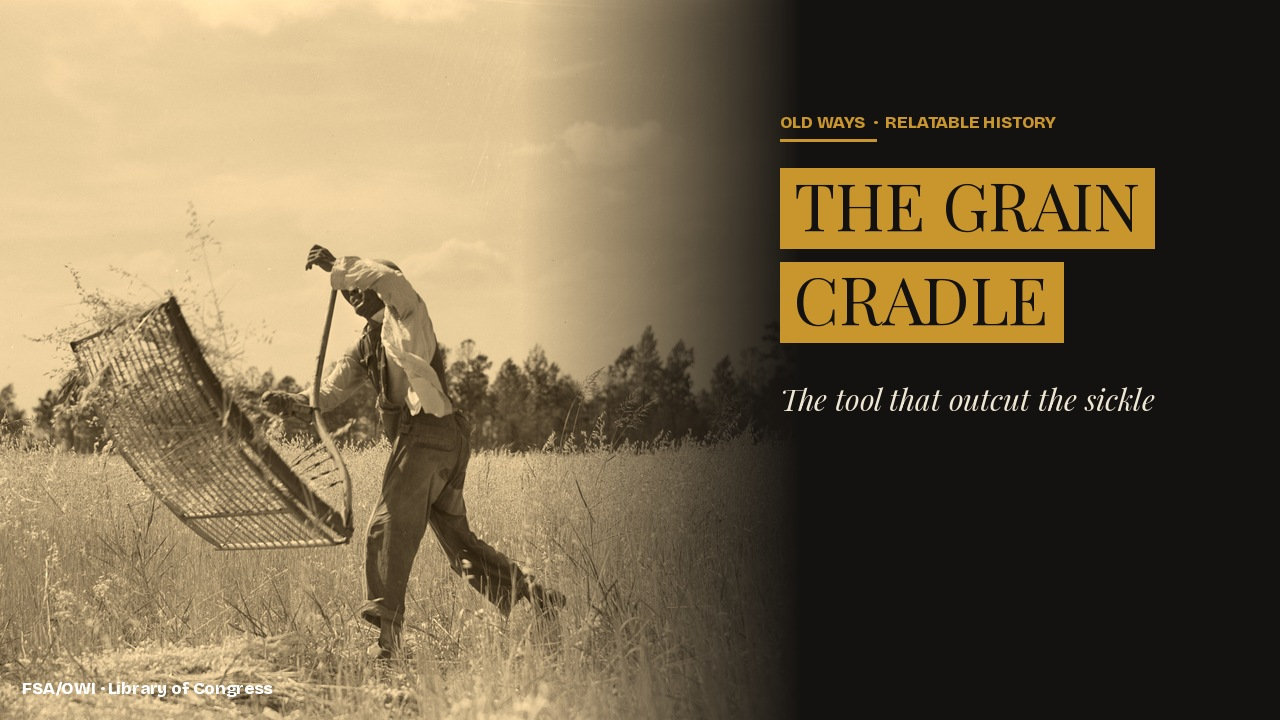
For about forty years, doubling a farm’s wheat harvest took no animal, no gearing and no patent worth suing over. It took a claw. A light wooden frame of three to six curved fingers, bolted just above a scythe blade, let one man cut and lay wheat almost three times faster than his grandfather could with a sickle — and cheaper, for a working lifetime, than anything a blacksmith or a machine shop could sell him.
That tool was the grain cradle, and between roughly 1800 and the 1880s it set the pace of the American harvest. It shows up in almost no textbook chapter of its own, wedged as it is between the sickle it replaced and the mechanical reaper that replaced it in turn. But the cradle is where the real story of the reaper begins, because it is the machine the reaper had to beat, and for the first twenty years of trying, it usually didn’t.
The tool itself was almost nothing: a frame, some fingers, a wider blade. What it changed was everything downstream of it — how many hands a harvest needed, how much grain a family actually kept, and how fast a farm could grow before the harvest itself became the limit on its size.
The problem was never cutting the wheat. It was keeping it.
For most of agricultural history, grain was cut with a sickle: a short, curved hand blade that forced the reaper to grip a handful of stalks with one hand and cut them with the other, stooped over the whole time. It was miserable, but it was controllable — the reaper decided exactly where each handful went.
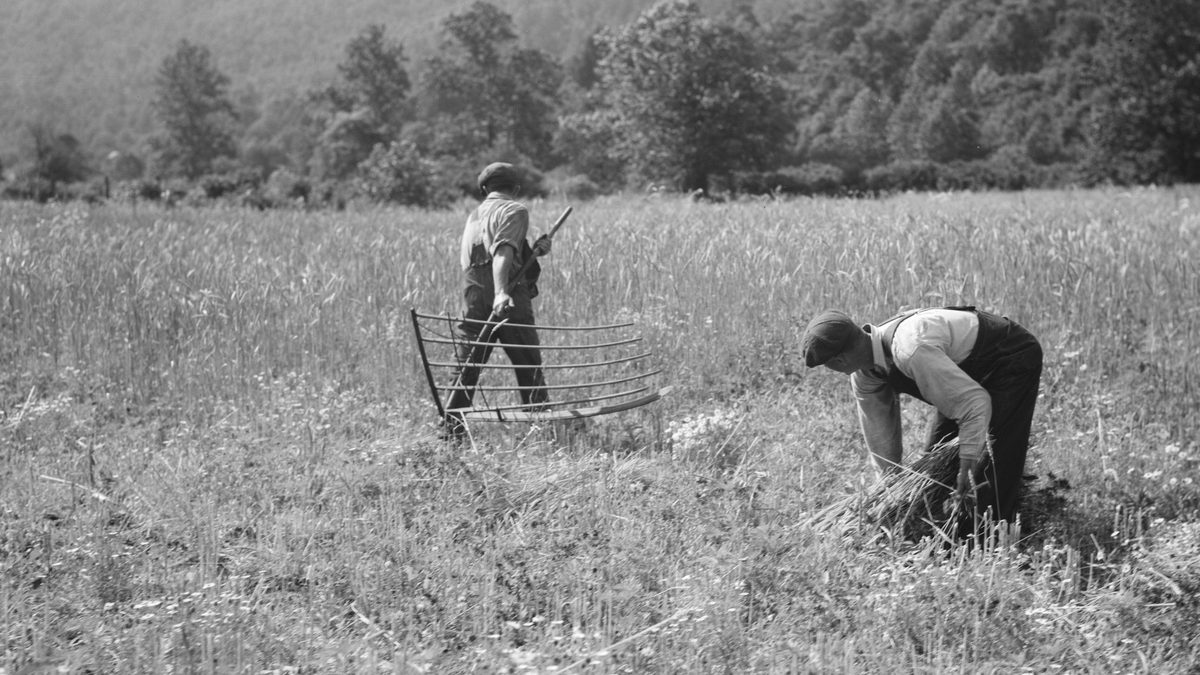
A plain scythe, swung standing up, cut far more wheat per stroke. But a scythe has no way to hold what it cuts. The stalks fell in a tangled heap, heads pointing every direction, and every handful a binder tried to gather afterward shook loose more grain than the harvest could afford to lose. For centuries this traded one problem for another: cut fast and lose the crop, or cut slow and keep it.
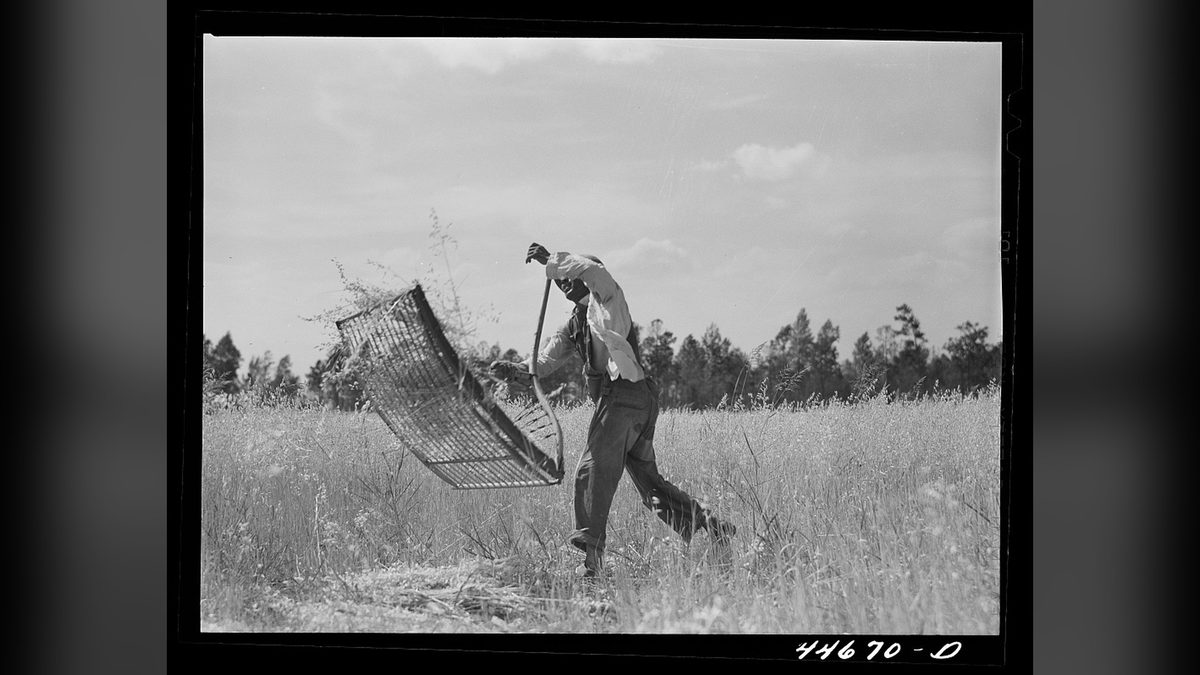
The grain cradle’s whole design answers that single trade-off. It doesn’t cut any differently from a scythe. What it adds is a catch: as the blade drops the stalks, the curved fingers above it hold them in place through the rest of the swing, so that at the end of the stroke the mower can tip the frame and lay the entire cut in one even, aligned row instead of a scattered pile.
Three to six fingers, and getting the curve wrong ruined the whole tool
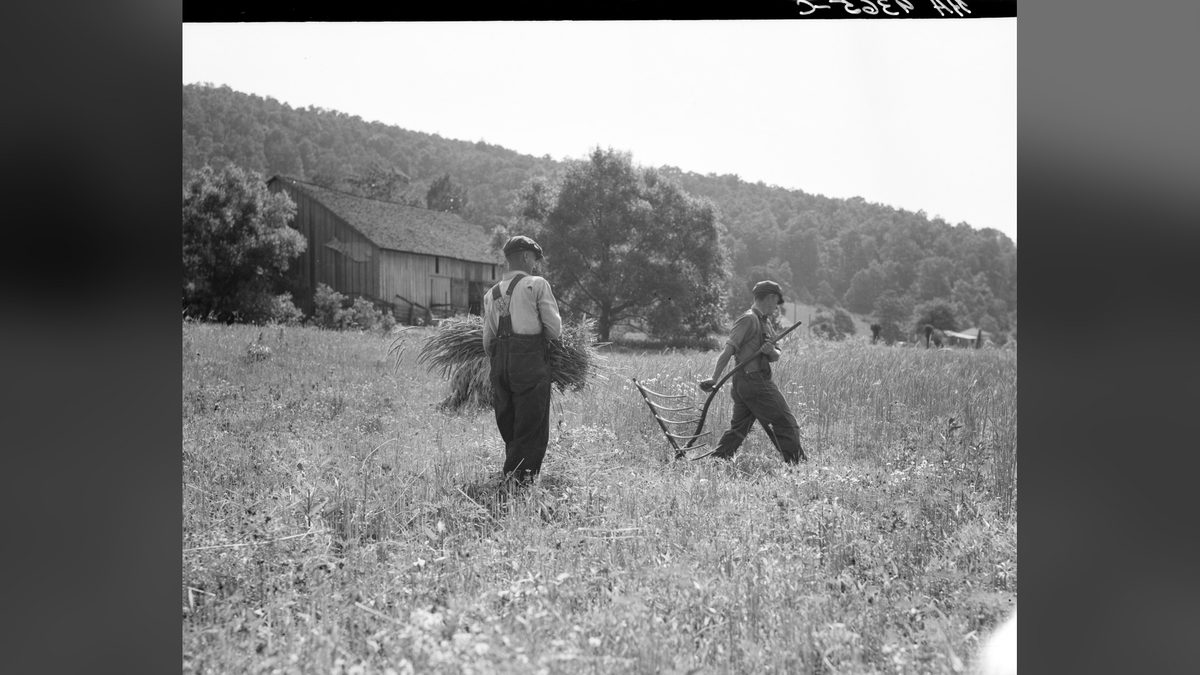
American cradles commonly carried three, four, five or six wooden fingers, curved to parallel the scythe blade and mounted on a light frame attached to the snath, the long wooden handle. The blade itself was cut wider than an ordinary grass scythe, so the falling stalks had a surface to slide back against instead of dropping straight through the fingers.
Getting that curve right mattered more than it sounds. If the fingers didn’t match the sweep of the blade, stalks were pulled down without being cut cleanly, or they fell through the gaps, or they jammed against the frame. Mid-nineteenth-century catalogs sold adjustable finger mounts for exactly this reason, and a farmer who inherited or bought a mismatched cradle simply had a worse tool for the same effort.
Weight was its own design problem. A heavier cradle held up better against thick, tangled grain, which is why sturdier versions were built in the South for heavy crops and for hemp, while lighter frames of wood and wire spread through New England after about 1800. In 1837 a Maine cradle-maker named Charles Vaughan patented a lighter “Scotch bow” design that was easier to swing all day, and it’s telling that farmers kept improving the tool for decades after the mechanical reaper had already been patented — the cradle was still worth the effort.
None of this was expensive. Baltimore hardware dealers were advertising five- and six-finger cradles for about five dollars apiece in 1858, and by the time the 1897 Sears, Roebuck catalog listed a four-finger “grape vine” pattern cradle, the price had dropped to two dollars and twenty-five cents. A mechanical reaper cost many times that, plus a team of horses to pull it and a field flat and large enough to make the investment worthwhile — which is exactly the gap that kept the cheap wooden claw in service on small farms for decades after the machine existed.
A cradler set the pace, and everyone else worked to keep up
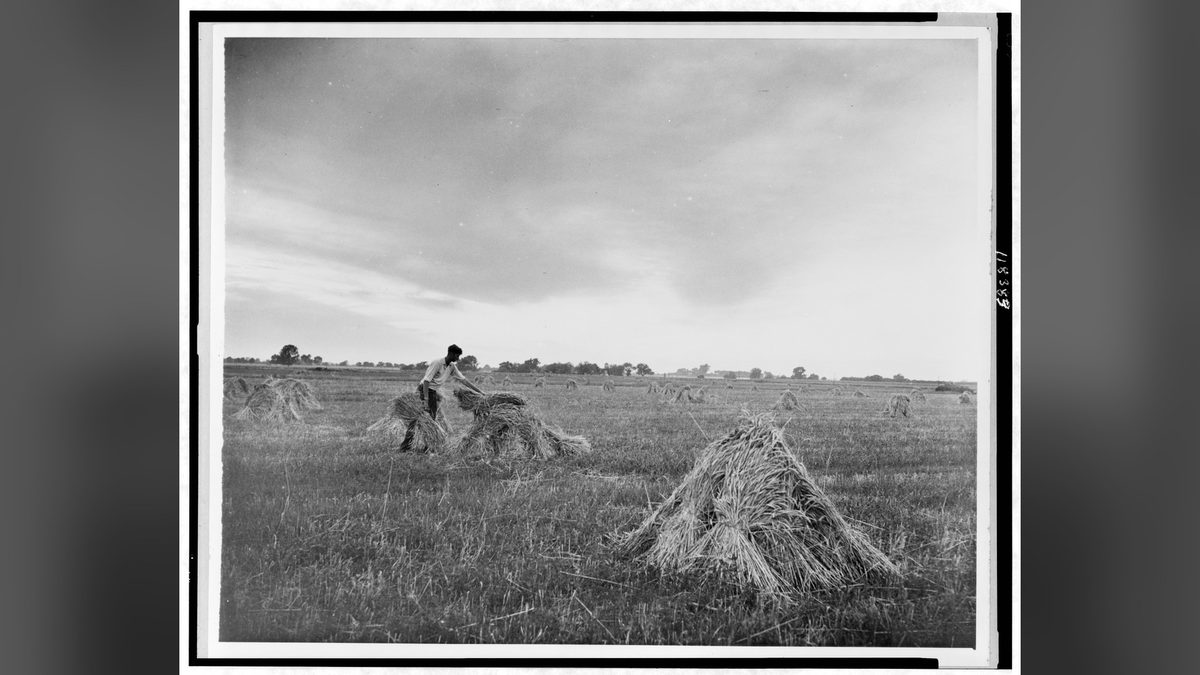
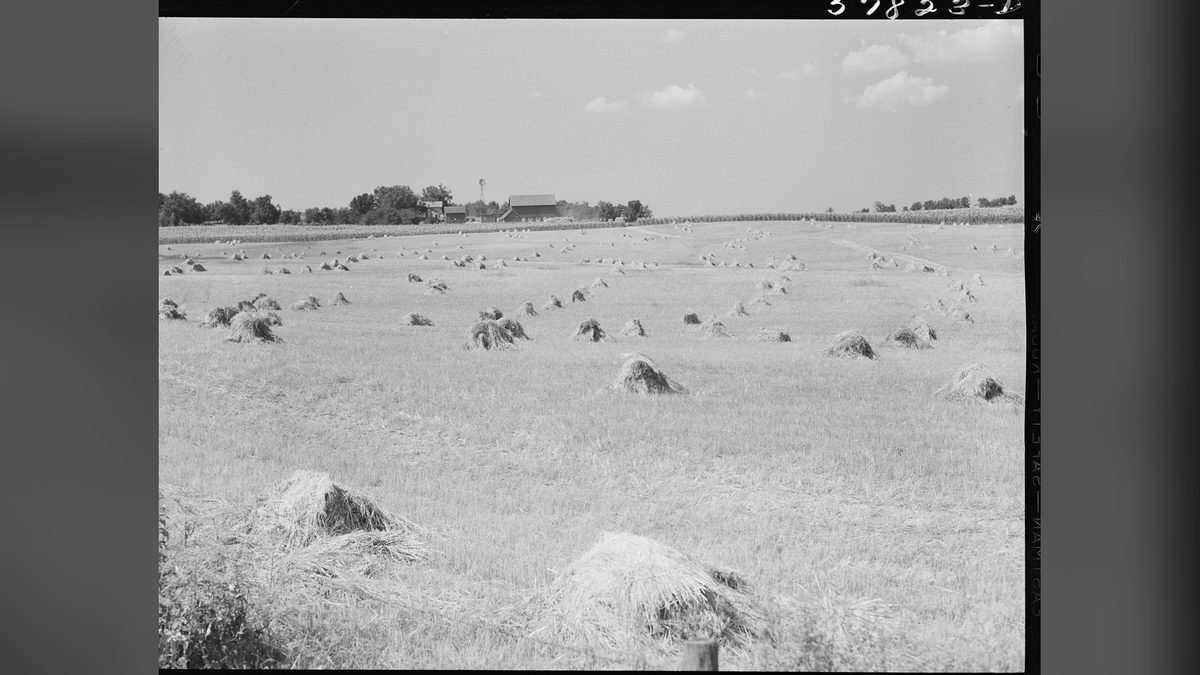
Cutting grain with a cradle was never solitary work. The cradler went first, swinging from before sunrise until the midday heat made the stalks too brittle to cut cleanly. One or two binders followed, gathering each swath into an armful and twisting it tight with a handful of the wheat’s own straw — no twine needed. Shockers then stood the finished sheaves upright in small stacks, heads together, to keep drying in the field before threshing.
A skilled cradler was the most valuable hand on the crew, and it showed in his pay: experienced men who could handle the tool well reportedly earned roughly double the wage of an ordinary farm laborer during the harvest weeks. That premium is a fair measure of how much the cradle actually saved a farm, since a harvest that came in a few days late, or badly bound, could cost far more than a hand’s extra wages.
The arithmetic that made this worthwhile was simple and hard: an experienced cradler could cut about two acres of wheat in a single day, against perhaps half an acre or a bit more by sickle — a family working sickles together might clear only two acres between several people. Two acres of wheat, cut and bound, typically yielded somewhere in the range of fifty to seventy bushels of grain, which is the number a nineteenth-century farm family actually lived on through the following winter.
Not every region made the same trade
Here the record gets genuinely uneven, and it’s worth saying so rather than flattening it. The cradle cut faster than the sickle everywhere, but it also shattered more grain loose in the process — the same broken heads a plain scythe had always produced, just fewer of them. In parts of the South, where wheat was often a secondary crop and losing a larger share of a smaller harvest mattered more, many farmers kept reaping with sickles well into the nineteenth century even as the cradle became standard across the Mid-Atlantic and New England.
Economic historians have also disagreed about why the cradle’s eventual replacement, the mechanical reaper, took as long as it did to catch on. Both Cyrus McCormick and Obed Hussey patented working reapers in the 1830s, but most farmers kept swinging cradles for another two decades. In the 1960s the economist Paul David argued that most farms simply weren’t large enough to justify the machine’s cost until the 1850s, when rising labor prices in the expanding Midwest tipped the arithmetic. Writing later, the economist Alan Olmstead pushed back, arguing that David’s model missed how often neighboring farmers pooled a single reaper across several fields, and that the reaper itself kept improving for decades after its first patent rather than arriving fully formed. Both points matter for the same reason: the cradle didn’t lose to the reaper on the day the reaper was patented. It lost slowly, farm by farm, as the economics shifted under it.
The reaper that finally ended it had a contested birth of its own
The traditional version of the reaper’s origin credits Cyrus McCormick alone, working from a design his father had spent years failing to perfect at the family’s Virginia farm. Cyrus built a working model in six weeks in 1831 and demonstrated it cutting oats nearby. For decades the McCormick Harvesting Machine Company’s own advertising treated that moment as the singular birth of automated agriculture.
The fuller record is messier, and more interesting. Historians who have examined the 1831 machine agree that Cyrus and his father Robert both contributed to it, and so, by most accounts, did Jo Anderson, a man the McCormick family enslaved, and a local blacksmith named John McCown who helped build it. Cyrus’s younger brother Leander spent much of the 1870s onward quietly gathering statements arguing their father deserved the real credit, a claim the family company worked hard to suppress for the sake of its own branding. Meanwhile Obed Hussey, whose 1833 patent actually beat McCormick’s by roughly a year and whose machines were already working in at least eight states before McCormick sold his first reliable model, wrote late in life that eighteen years fighting for credit in the harvest field and the patent office had cost him more than whaling in the Pacific ever had. He died in a train accident in 1860, a year before his patent rights were extended posthumously; McCormick’s were not.
None of that dispute changes what happened to the cradle. By the 1870s a horse-drawn reaper was cutting ten to fifteen acres a day, seven or eight times what the fastest cradler could manage, and self-tying binders finished the job within another decade. The grain cradle held on longest exactly where a reaper couldn’t turn or wasn’t worth the debt: small fields, hillside farms, and the awkward corners a machine had to leave for a man with a claw and a strong back. The last American patent for a grain cradle was filed in 1924, a full ninety years after Hussey and McCormick both filed theirs — a reminder that an obsolete tool and a dead tool are not the same thing.
That gap between obsolete and dead is really the whole shape of the story. A grain cradle never became a museum curiosity the way a stone axe did. It was still being patented, still being sold out of hardware catalogs, and still being swung on farms too small or too steep to justify a machine, for the better part of a century after the tool that was supposed to replace it existed. The reaper didn’t switch the cradle off. It just kept shrinking the number of fields where the cheaper, older tool still made more sense than the debt.
Watch the full history
The video version covers the same swing, the same crew, and the same forty-year run in just under four minutes.

Related reading
- Why a Corn Crib’s Walls Lean Outward, and Why It Never Fell Over
- How the Magic Lantern Became Europe’s First Horror Show
- How the Well Sweep Drew Water Before There Were Pumps
- Who Really Invented the Rickshaw? Three Rival Claims, One Vehicle
From the shop
If you want the hand-tool side of this in full — scythe, cradle, sharpening and all — David Tresemer and Peter Vido’s The Scythe Book: Mowing Hay, Cutting Weeds, and Harvesting Small Grains with Hand Tools (Stackpole Books) is still the standard guide. See it on Amazon.
Works cited
- David, Paul A. “The Mechanization of Reaping in the Ante-Bellum Midwest.” In Industrialization in Two Systems: Essays in Honor of Alexander Gerschenkron, edited by Henry Rosovsky, 3–39. John Wiley & Sons, 1966.
- Scheuerman, Richard D., and Alexander C. McGregor. Harvest Heritage: Agricultural Origins and Heirloom Crops of the Pacific Northwest. Washington State University Press, 2013. Excerpted as “Harvests in the 1800s,” Farm Collector, January 24, 2019. Link.
- Rhodes, Karl. “Reaping the Benefits of the Reaper.” Econ Focus, Federal Reserve Bank of Richmond, Third/Fourth Quarter 2016. Link.
- Van Vleck, Richard. “American Grain Cradles.” American Artifacts, 1996/1998. Link.
- National Museum of American History, Smithsonian Institution. “McCormick Reaper Model.” Object AG.33A01.1.
- National Museum of American History, Smithsonian Institution. “Patent Model, Grain Cradle.” Object AG.271335.
- “Cyrus McCormick.” National Inventors Hall of Fame. Link.
- “Obed Hussey.” Encyclopaedia Britannica.