

A dumbwaiter’s whole job, for most of its history, was to make a person disappear. Not literally — the person was still in the house, usually in a basement or a cellar, doing the actual work of cooking and hauling. The dumbwaiter’s job was to make sure nobody at the table had to see them, hear them, or think about them while the meal happened. That is a strange design brief for a piece of furniture, and it produced a stranger object: something built, quite deliberately, to be able to say nothing at all.
The name gives it away. In English, a servant who could not speak was called “dumb,” and a piece of furniture that filled a servant’s role without a servant’s mouth was a dumb waiter — as one nineteenth-century reference explained it, an object that “answers all the purposes of a waiter, and is not possessed of an insolent tongue.” That joke stopped being funny fairly quickly once the device left the dining room. Within a century it was hauling garbage out of tenement kitchens, and within two it was moving classified files for the Central Intelligence Agency.
Here is the fuller story of an object best known today as a nostalgic little door in an old apartment wall: how it was built around one man’s discomfort with his own household, how it became the New York tenement’s most dangerous fixture, and how the exact same idea — a shaft that moves something vertically so a person doesn’t have to — ended up at the heart of American intelligence-gathering and inside the Library of Congress.
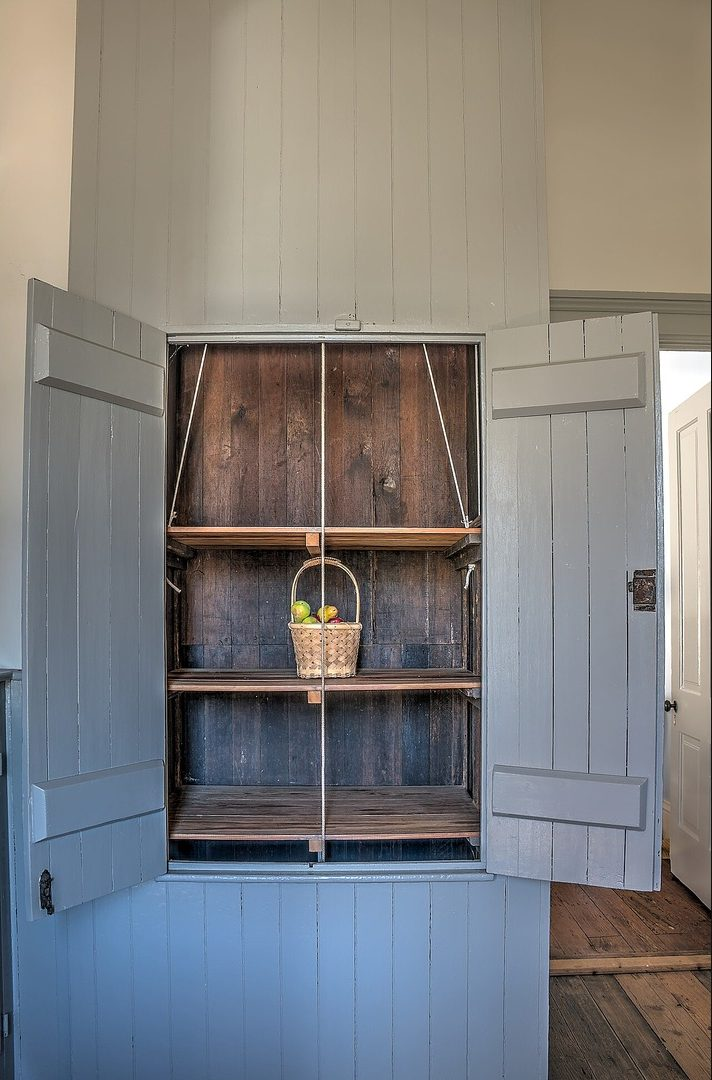
Thomas Jefferson didn’t invent it, but he perfected the silence
The furniture form predates Jefferson. English dining rooms had been using small tiered stands and wheeled serving tables through much of the eighteenth century, and the French court had its own version: mechanized tables that could be raised through the floor from the kitchen below, engineered so a monarch could dine without a servant present at all. Jefferson encountered this world during his five years as a diplomat in Paris, and he came home with more than a taste for the furniture — he came home with a theory of why it mattered.
At Monticello, and earlier at the President’s House in Washington, Jefferson used at least three distinct devices under the name “dumbwaiter”: small tiered stands on casters, a revolving serving door with shelves fixed to its back, and, most elaborately, a pair of vertical lifts built into the dining room mantel that hauled bottles up from the wine cellar directly below. A person in the cellar loaded the box; a rope and pulley did the rest. His Paris household had owned five tiered stands, sold off as unfashionably common when he left France, and replaced with sturdier ones bought in Philadelphia — two of which survive today with joinery details that match Monticello’s own workshop.
Margaret Bayard Smith, a Washington writer who dined with him regularly, recorded exactly what problem Jefferson thought this solved. At small dinners, she wrote, a dumbwaiter was placed by each guest, “so as to make the attendance of servants entirely unnecessary, believing as he did, that much of the domestic and even public discord was produced by the mutilated and misconstructed repetition of free conversation at dinner tables, by these mute but not inattentive listeners.” The servants Jefferson was describing were, in his own household, enslaved people, and architectural historians have since read the Monticello dumbwaiters as something closer to an instrument of control than a convenience — a device built to let Jefferson’s guests speak freely by engineering the people who might repeat it out of the room entirely.
Smith also described a second apparatus Jefferson installed at both Monticello and the President’s House, working the same trick by a different mechanism: “a set of shelves were so contrived in the wall, that on touching a spring they turned into the room loaded with the dishes placed on them by the servants… and by the same process the removed dishes were conveyed out of the room.” No door ever opened on a person. Food simply appeared, and disappeared again, as if the house were serving itself.
Architectural historians who have studied Monticello’s floor plan point out that the dumbwaiters were not an isolated gadget but part of a whole strategy of separation. The dining room sat above a basement passage reserved for the enslaved household staff, so that the vertical shafts were the only point where the two levels of the house physically met — a door that opened only long enough to pass a bottle through, then closed again. Guests upstairs got an unobstructed view over the plantation through the dining room windows and an unobstructed conversation at the table; the labor that produced both was arranged so neither had to be seen.
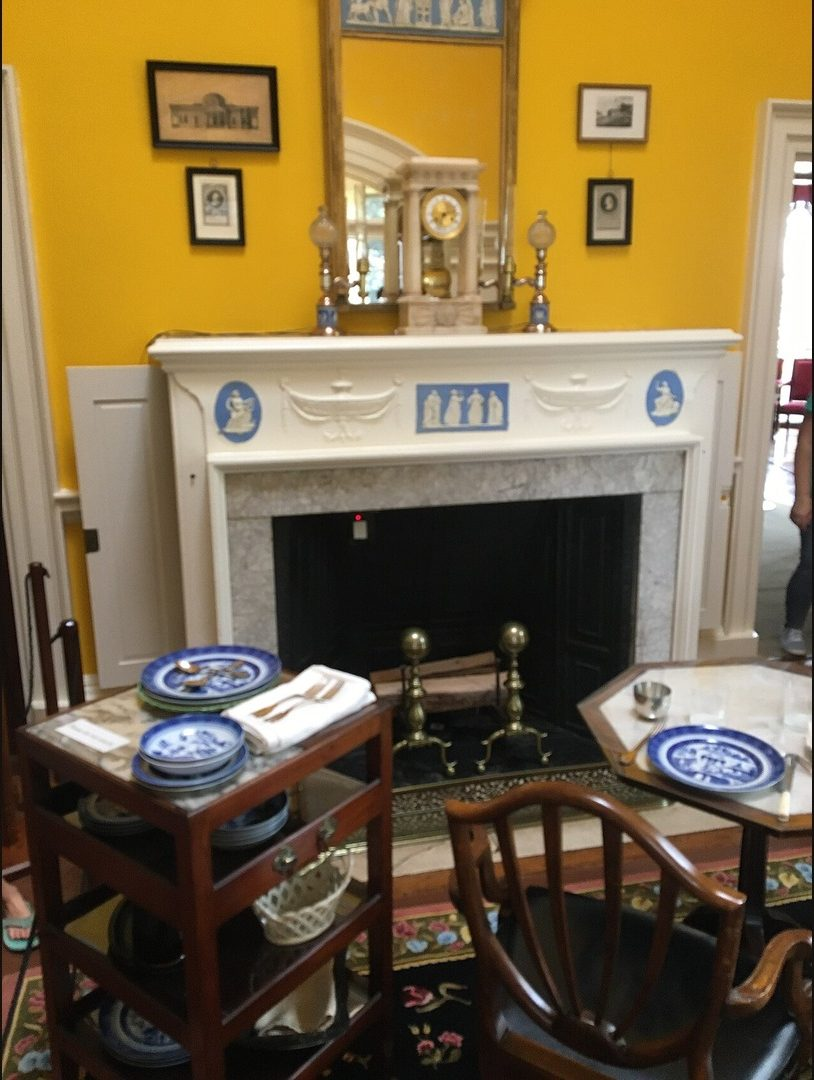
The idea was catching before the mechanism was any good
Jefferson’s version was influential in a small, wealthy circle. The Ohio senator Thomas Worthington, who dined with Jefferson in Washington, went home and had his own architect build a pair of revolving serving shelves into his house at Adena, near Chillicothe, in 1806 – 07, apparently copying the trick directly. But a hand-loaded box on a rope, however cleverly hidden in a mantel, is not a labor-saving device. It still needed a person standing by in the cellar for the whole meal. What Jefferson had built was really a piece of stagecraft: it looked automatic from the dining room, and was entirely manual from the other side of the wall.
That gap between appearance and mechanism is what changed over the following century, as American cities went vertical and gave the dumbwaiter an entirely different reason to exist.
New York turned it into industrial equipment, and patented it hard
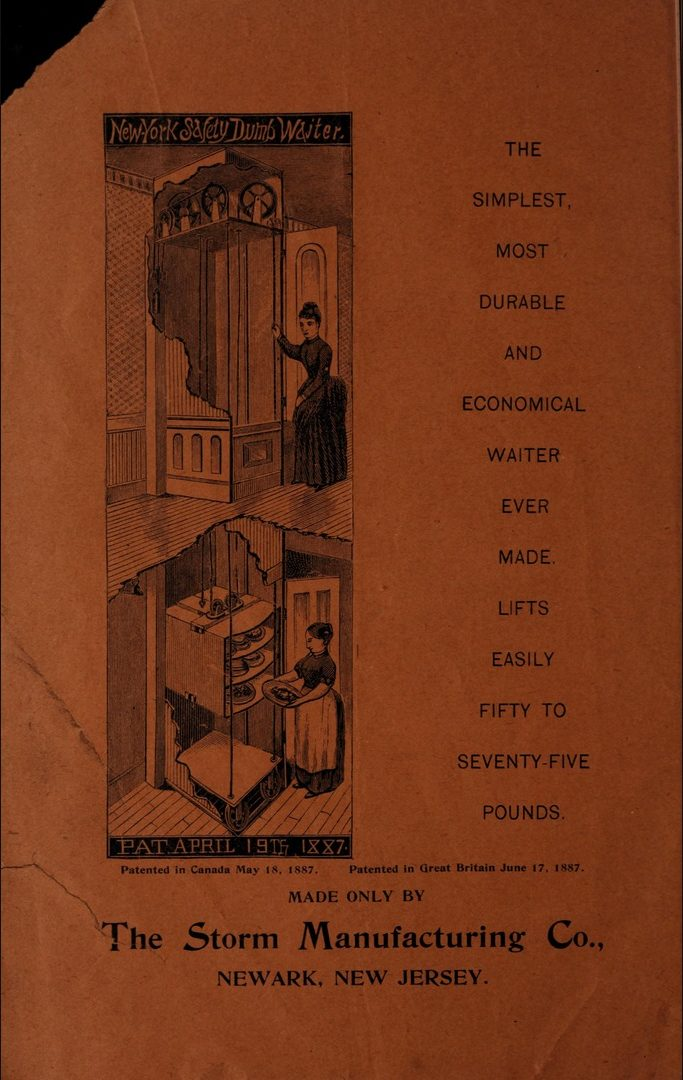
By the 1870s, New York was stacking families five and six stories high, and hotels and restaurants were separating their kitchens from their dining rooms by whole floors. A city built like that needs a reliable way to move food, coal, ice, and laundry straight up and down, and the tiered dining-room curiosity was repurposed into exactly that. American inventors filed more than a hundred patents containing the word “dumbwaiter” between 1850 and 1899 alone, refining counterweights, brakes, and guide rails until a hand-rope car could be trusted to carry real weight, reliably, several times a day, for years. Manufacturers sold the results under brand names like Cannon’s Patent Dumb Waiter and the Storm company’s “New York Safety Dumb Waiter,” advertised as strong enough for fifty or seventy-five pounds and cheap enough for any builder to install as standard.
The advertising for these machines is its own small window into who was expected to operate them. Trade catalogs of the 1880s and 1890s routinely illustrated the mechanical dumbwaiter with a woman pulling the hand rope, positioning the device as an upgrade to servants’ and housewives’ labor rather than a replacement for it. By the 1920s, agricultural equipment makers were photographing farm wives operating dumbwaiters as part of campaigns promoting “good domestic practice,” filed in company archives right alongside photographs of sanitary garbage pails. The object that began as a way to remove a servant from the room had become, a century later, a small monument to how much unpaid household labor was expected to run invisibly and efficiently in the background.
In the tenements, it became a garbage chute, a party line, and a fire hazard
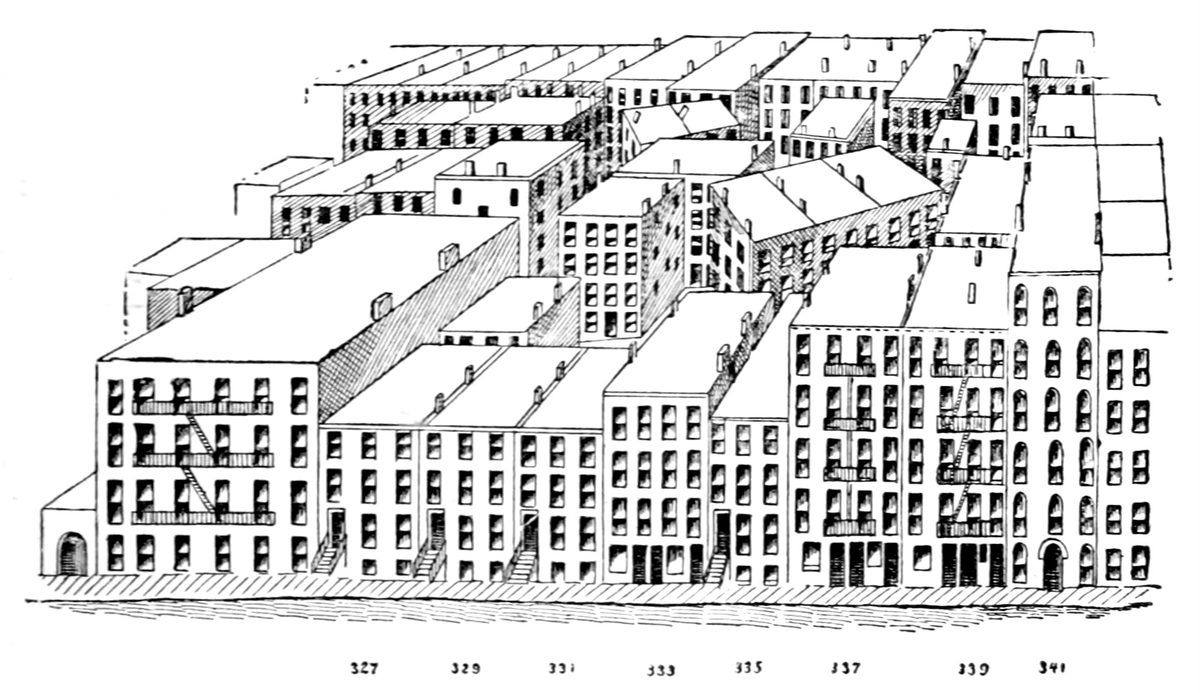
New York’s housing law made the dumbwaiter shaft a legal requirement, not just a convenience. The Tenement House Act of 1879 mandated air shafts in new construction, and builders routed the shared dumbwaiter shaft through the same narrow gap, giving every kitchen on every floor a door onto one continuous vertical channel. Tenants used it exactly as intended — sending trash down to the building’s janitor, hauling ice and groceries up — and also in ways no inspector had planned for: neighbors held whole conversations through the open shaft doors, children climbed inside and rode it, and more than one burglar used it as an unguarded route between floors.
The real problem was fire. A shaft that ran uninterrupted from the basement to the roof, lined with garbage and cooking grease, was an efficient flue: a fire on a lower floor could travel the length of the building through the dumbwaiter shaft far faster than it could spread room to room. New York’s Tenement House Act of 1901, passed after years of investigation into exactly this kind of hazard, did away with the narrow shaft model altogether in new buildings, replacing it with open courtyards for light, air, and garbage collection. Existing tenements kept their dumbwaiters for decades longer, but the pressure to close them off only grew, and by the middle of the twentieth century most of the city’s tenement dumbwaiter doors had been bricked, boarded, or welded shut for good.
The dumbwaiter’s reputation as something faintly sinister — a hidden passage inside a supposedly solid wall — outlived the shafts themselves. Harold Pinter built an entire one-act play around that unease in 1957: two hired killers wait in a basement room while a dumbwaiter in the wall keeps rattling down food orders they have no way to fill, an object delivering instructions from an authority neither of them can see or question. It is not a coincidence that the most famous literary dumbwaiter is used to unsettle rather than to serve.
It quietly became the machine that moves paperwork, not dinner
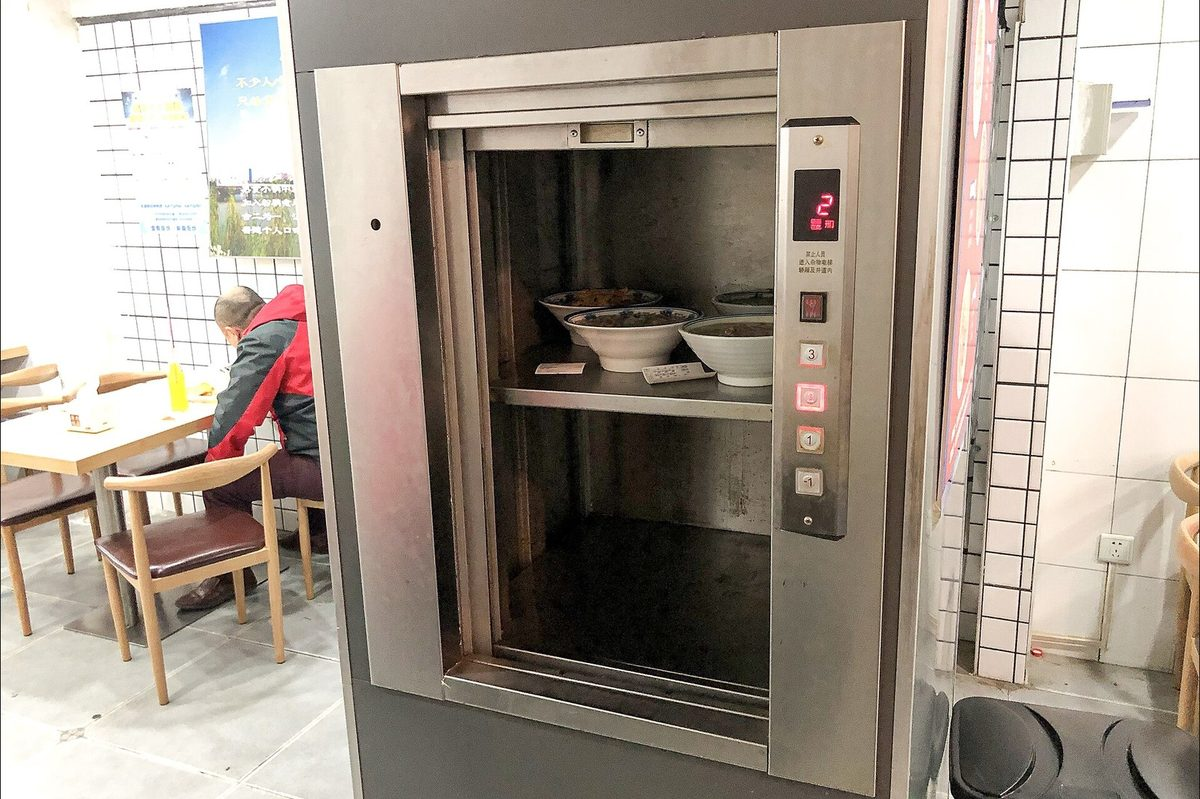
The twentieth century gave the dumbwaiter one more job, and this one had nothing to do with food at all. As government agencies and large institutions drowned in paper, the same shaft-and-car mechanism that once carried a bottle of wine turned out to be an efficient way to move files between floors. The United Nations Secretariat installed one running the full 483-foot height of its New York building in 1954 to move mail and documents. The CIA’s Langley headquarters, built in 1958, specified fire-rated masonry shafts for dumbwaiters carrying files between departments, and the agency’s Archives and Records Center used one to move boxes of records it measured, tellingly, in the same productivity units it used to measure its own staff’s output. The volume of paper the agency was processing had risen five-fold between 1938 and 1965, and no amount of mechanical hauling ever really caught up — one overworked records clerk complained in an internal memo that staff were so overloaded they “cannot take on another piece of paper or another form,” even as the dumbwaiters kept running. The device built to spare Thomas Jefferson’s guests from hearing too much had become, in its federal old age, a small cog straining against an agency that could not stop generating more to move.
Even the Library of Congress runs one: a dumbwaiter at the center of the Main Reading Room in the Thomas Jefferson Building still connects the circulation desk to a lower control room, part of a book-delivery system that once reached all the way to the Capitol. A 2022 proposal to remove it in favor of an open viewing gallery drew an organized protest from the library’s own staff, who argued the device was inseparable from the building’s working history. The renovation was shelved. The dumbwaiter that began as a way to erase a servant from a dining room ended up, in its oldest surviving American use, doing the one thing dumbwaiters were never supposed to do: becoming a piece of history worth actively fighting to keep.
Watch the full history
The video version covers Jefferson’s hidden wine lifts, the tenement shaft, and the 1887 patent boom in about seven minutes.

Related reading
- Inside the Pneumatic Tube Networks That Once Ran a City’s Mail
- How the Wood Cookstove Ran the American Kitchen for a Century
- The Public Health Panic That Made Baby Cages Seem Safe
- How the Farm Windmill Pumped Water on the Great Plains
Works cited
- Chen, Shirley Dongwei. “The Dumbwaiter in America.” The Avery Review, Issue 67. Link.
- Read, Alice Gray. “Monticello’s Dumbwaiters.” Journal of Architectural Education (1984–) 48, no. 3 (1995): 168–171.
- Smith, Margaret Bayard. The First Forty Years of Washington Society, Portrayed by the Family Letters of Mrs. Samuel Harrison Smith (Margaret Bayard). Edited by Gaillard Hunt. New York: Scribner, 1906. 387–88.
- “Dumbwaiters.” Thomas Jefferson’s Monticello, Thomas Jefferson Encyclopedia.
- “Dumbwaiters in Place of Servants.” White House Historical Association. Link.
- “The Early Tenements of New York—Dark, Dank, and Dangerous.” NYC Department of Records & Information Services, 2019. Link.
- “Tenement House Act of 1901.” Village Preservation, 2016. Link.
- Pinter, Harold. The Dumb Waiter. London: Faber and Faber, 1960. Link.