
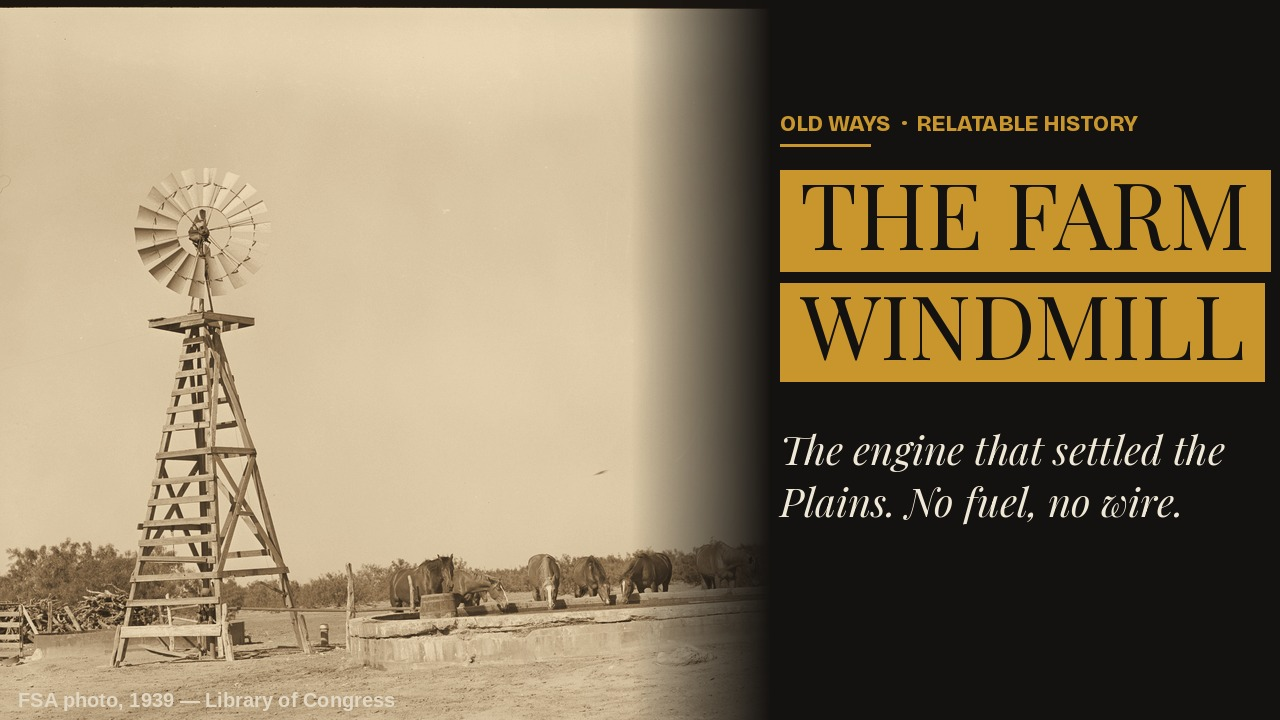
By 1920, more than seven hundred companies in the United States had at some point manufactured a farm windmill. Today exactly one still does, out of a single factory in San Angelo, Texas, turning out roughly a thousand a year to a design that has barely changed since the 1880s.
That collapse from hundreds of makers to one is not really a story about a market failing. It is a story about a machine that got the engineering right early enough, and simply enough, that there was very little left to improve once the basic head and gearing were settled. Almost everything interesting about the farm windmill happened in about sixty years, between a Connecticut machinist’s patent in 1854 and a wave of federal power lines in the 1930s, and the object that came out the other end is still standing in pastures from Texas to Nebraska.
A Connecticut machinist solved a problem the Dutch never had to
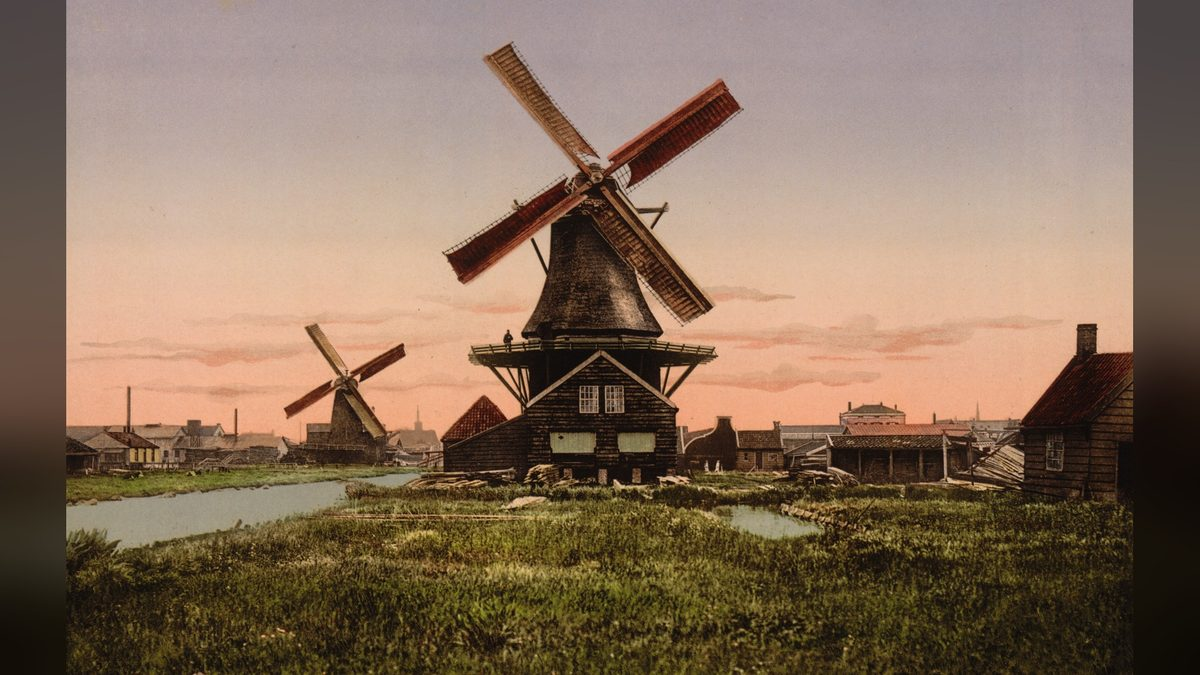
Windmills for pumping and grinding had existed in Europe for centuries, but they all shared one requirement that made them useless on an American homestead: a miller. Someone had to be on site to turn the sails into a shifting wind and to reef them before a gale tore the mill apart. A settler a mile from the nearest neighbor, with a well and nobody to spare, could not staff a mill that way.
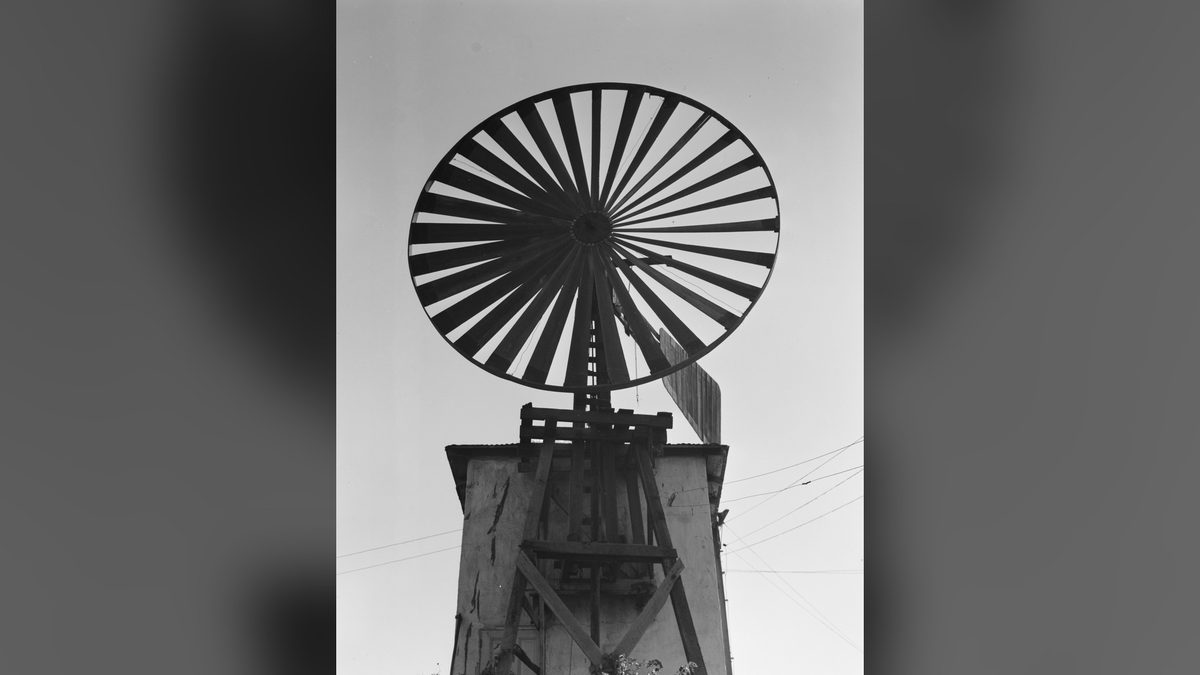
Daniel Halladay, a machinist in Ellington, Connecticut, solved that problem in 1854 at the prompting of a local pump dealer named John Burnham, who understood that a windmill nobody had to babysit would sell a great many pumps. Halladay’s patent, issued that August, built the wheel out of hinged wooden sections: in a strong wind they swung edge-on to spill it and swung back as it eased, while a tail vane kept the whole head pointed into whatever direction the wind was blowing. No one had to touch it, in a storm or in a calm.
The demand was immediate enough that Halladay’s own company could not keep up alone, and it was eventually absorbed into the United States Wind Engine and Pump Company, which moved production to Batavia, Illinois, to be closer to the prairie market and to the railroads, which became the mill’s first major institutional customer, pumping boiler water for steam locomotives at tank stops across the plains.
An engineer’s five thousand tests replaced wood with steel
Halladay’s wooden-sectioned wheel worked, but it was heavy, expensive to ship, and needed regular carpentry. The design that actually conquered the Plains came from a Chicago engineer named Thomas O. Perry, hired in the 1880s by a manufacturer named LaVerne Noyes. Perry had previously worked for the U.S. Wind Engine Company, and he approached the wheel itself as an unsolved problem in aerodynamics rather than a settled piece of folk carpentry.
Over more than five thousand recorded trials on sixty-one different experimental wheels, Perry found that a curved sheet-steel blade outperformed a flat wooden one by a wide margin — on the order of 87 percent more efficient at the same wind speed. Noyes and Perry’s company introduced the result in 1888 as the Aermotor, an all-steel, back-geared mill that competitors initially mocked as the “mathematical windmill.” It sold twenty-four units in its first year. By 1892 it was selling roughly twenty thousand a year.
That is the entire competitive history of the American farm windmill in miniature: a craft object built by trial and custom, replaced within a single generation by an industrially engineered one, after which the market consolidated hard around whoever had actually done the testing.
The mechanism was almost insultingly simple once it was right
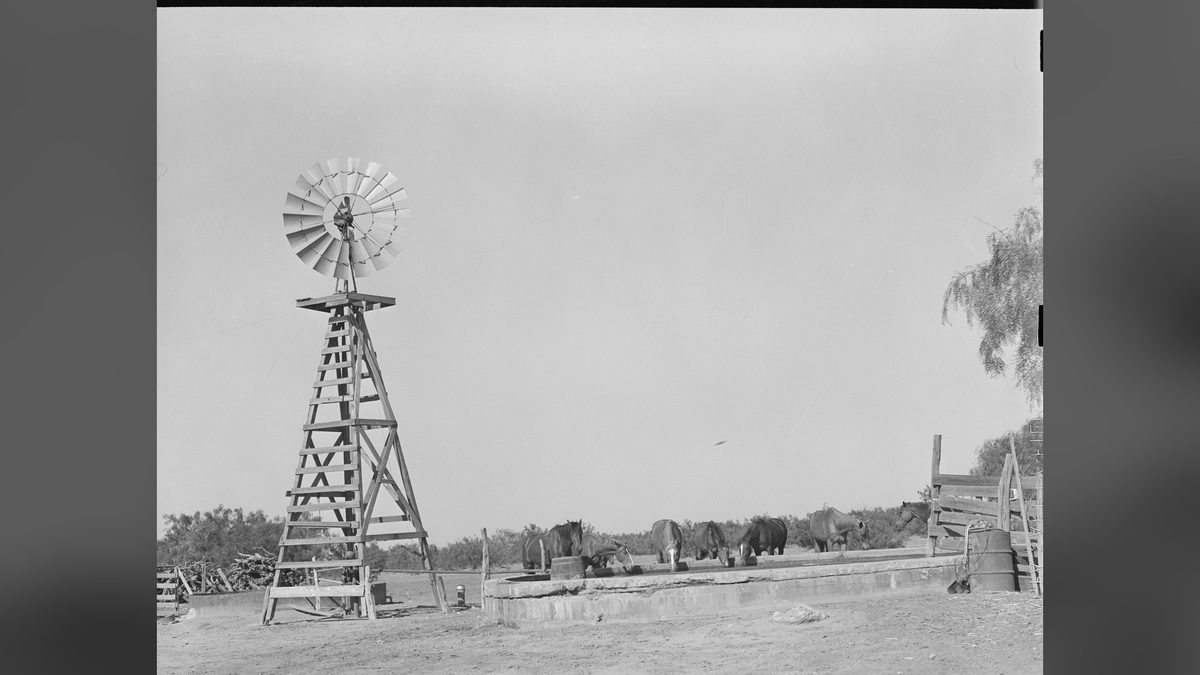
A typical farm mill stood on a tower thirty to forty feet tall, topped by a steel wheel usually six to ten feet across, angled slightly off-center on its shaft so that a hard gust pushed it sideways against a spring rather than head-on into the gearing. A wire ran from a lever at the tower’s base up to the tail vane; pulling it folded the vane alongside the wheel and stopped the mill, which was the entire braking system.
Turning motion came off a small crankshaft geared so the wheel spun several revolutions for every single stroke of the pump rod — the reason a mill could still work water in a light breeze that would have stalled a direct-drive machine. That crank drove a sucker rod straight down the well casing to a brass cylinder sitting below the water table, fitted with two simple check valves: the rod’s upstroke lifted a slug of water, and its downstroke sealed the valve so the column above it held rather than falling back. There was no motor, no fuel, and after 1915 barely any maintenance at all — that year Aermotor introduced a fully enclosed, oil-bathed gear case, refined a few years later into the long-lived Model 602, cutting a chore that had meant climbing the tower every week down to once a year.
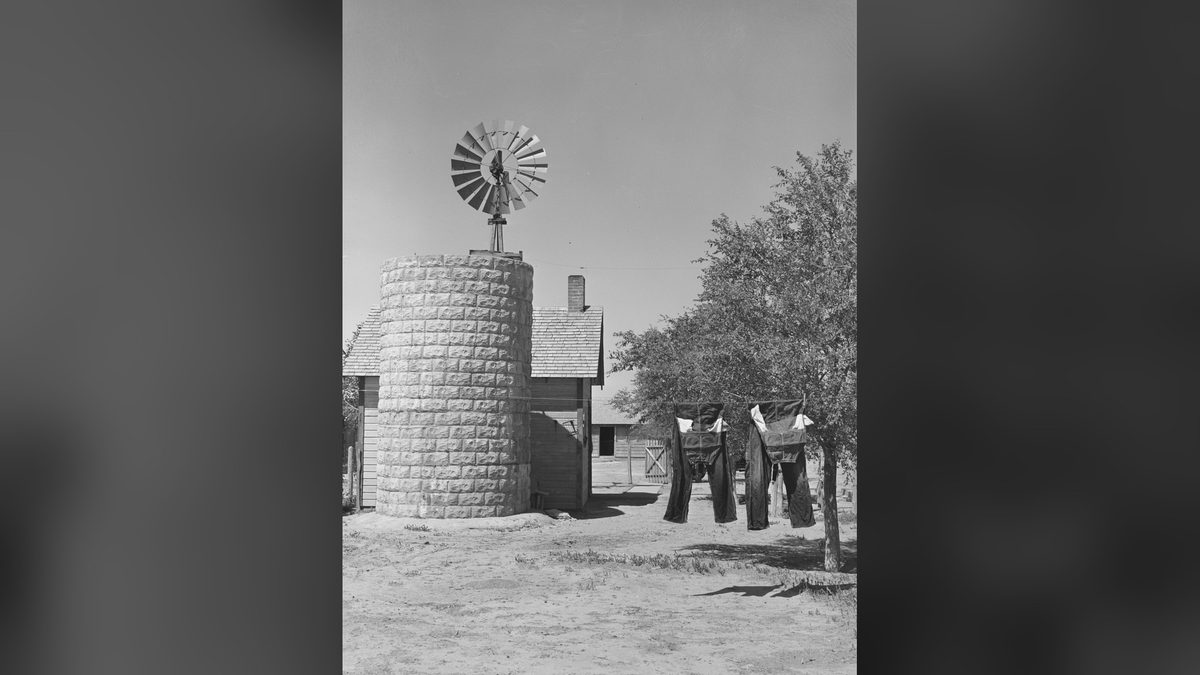
One ranch alone ran more than three hundred of them
Nowhere shows the scale of the thing better than the XIT Ranch, a three-million-acre spread across the Texas Panhandle that had been granted to its owners in exchange for building the state capitol in Austin. By 1900 the XIT was operating roughly 335 windmills and a hundred earthen dams, at a total cost estimated near half a million dollars, to water cattle across country with no natural surface water at all. One of its towers, near what is now Littlefield, reportedly stood 132 feet tall before it blew down in 1926; a shorter replica occupies roughly the same spot today.
Running that many mills required its own labor category: the windmiller, whose entire job was riding a circuit with an oil can and a wrench, because before 1915 an open-geared mill needed grease every week or it would grind itself apart. A single ranch hand might be responsible for dozens of towers spread across a landscape with no roads to speak of, and a missed mill in a dry August could mean a pasture with no water in it at all.
The other constant worry was the opposite problem: no wind at all. A hot, still stretch of August could silence every wheel on a spread at once, and a family without a backup tank learned to listen for the creak of the mill the way they listened for a change in the weather. Some outfits kept a small gasoline or kerosene engine on standby for exactly this, geared to the same sucker rod as the windmill so either could drive the pump, though on most homesteads the fuel and the machine were an expense nobody could really spare, and they simply waited the calm out.
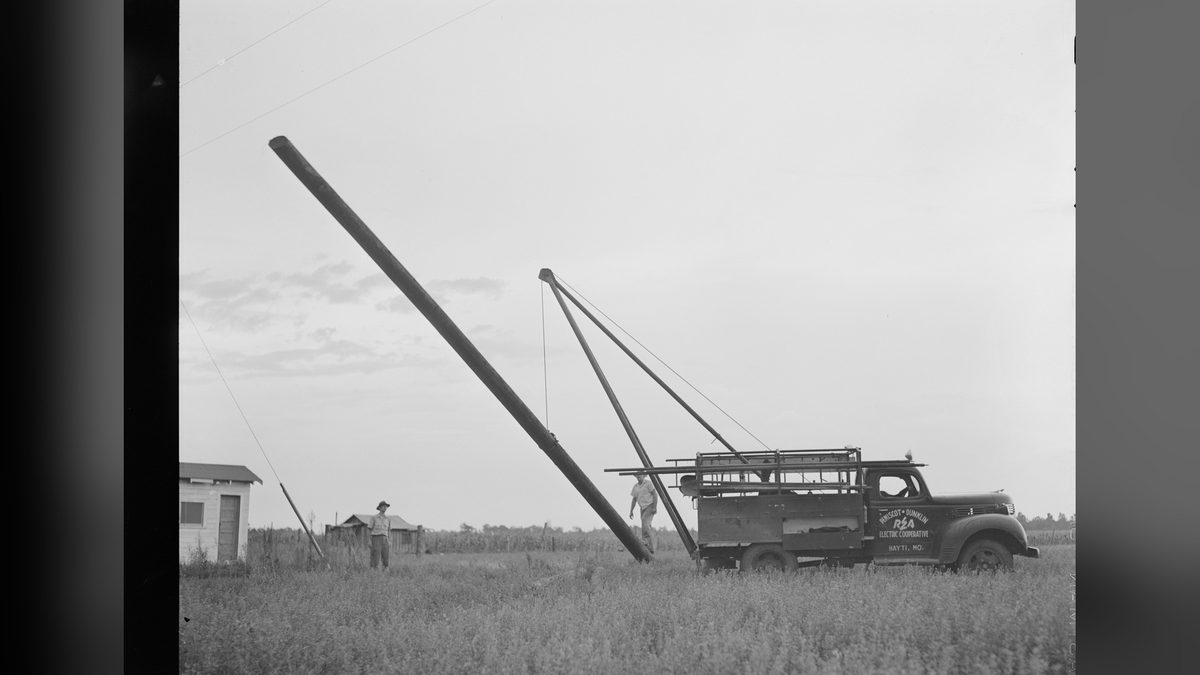
The republic wired around it in a generation
The farm windmill’s best years were the 1920s and early 1930s, when the American Plains were about as thick with towers as they would ever be. Two things ended that. Agricultural prices collapsed after 1921 and stayed weak through the Depression, which starved the replacement market even as old mills wore out. Then, starting with President Franklin Roosevelt’s 1935 executive order and the Rural Electrification Act that followed in 1936, federally backed cooperatives began stringing power lines down county roads that private utilities had judged too costly to serve.
The scale of that change is difficult to overstate: at the program’s start, close to ninety percent of American farms had no electricity; by 1950, that figure was down near twenty percent. An electric pump did the same work as a windmill on any day of the year, wind or none, for a few cents of current, and it did not need a windmiller. Most windmill manufacturers had closed by the late 1930s, and the war finished the rest: zinc and steel rationing during the Second World War pushed several of the survivors into munitions production instead.
The one company that never stopped
Aermotor is the exception, and its survival is really a footnote to Perry’s original engineering rather than any later innovation. The company changed hands and cities more than once — it landed in San Angelo, Texas, in 1986 under new ownership — but the mill it builds today uses the same back-geared head and the same curved steel blade profile that won the efficiency argument in the 1880s. Ranches far enough from a power line never fully gave up the windmill, and that steady, unglamorous demand is what has kept one factory running continuously for well over a century while everyone else who ever built one stopped.
What is left of the boom years is now mostly a matter of preservation rather than use: retired towers standing derelict over abandoned wells across the Plains, and a dedicated collection of more than 160 restored mills at the American Windmill Museum in Lubbock, Texas, assembled from decades of one enthusiast’s effort to document machines that were otherwise simply being scrapped. The engineering problem the farm windmill solved — how to lift water with no fuel, no operator, and no wire — has not gone away. It has just stopped being anyone’s daily problem.
Watch the full history
The video version covers the same invention and the same ranch, in just over four minutes, with the machine itself on screen.

Related reading
- The Real History of Rainwater Cisterns
- Why the Penny-Farthing’s Wheel Had to Be So Big
- How a Hand Pump Worked: Lifting Well Water With Nothing but Air Pressure
- How the Daguerreotype Actually Worked, and Why It Was Dangerous
Shop the items in this history
Works cited
- Gillis, Christopher C. Still Turning: A History of Aermotor Windmills. Tarleton State University Southwestern Studies in the Humanities. Texas A&M University Press, 2015. Link.
- U.S. Patent No. 11,629. Daniel Halladay, “Improved Governor for Windmills.” Issued August 29, 1854. Link.
- “Halladay’s Revolutionary Windmill.” Today in History, Connecticut History, a CTHumanities project. Link.
- “Windmills.” Handbook of Texas Online, Texas State Historical Association. Link.
- “XIT Ranch.” Handbook of Texas Online, Texas State Historical Association. Link.
- “History of the Aermotor Windmill Corporation.” Gas Engine Magazine. Link.
- “Rise of the Self-Oiling Windmill.” Farm Collector. Link.
- Bowers, D. Clayton. “Rural Electrification Administration.” EH.net Encyclopedia, Economic History Association.
- “Texas Primer: The Windmill.” Texas Monthly.