
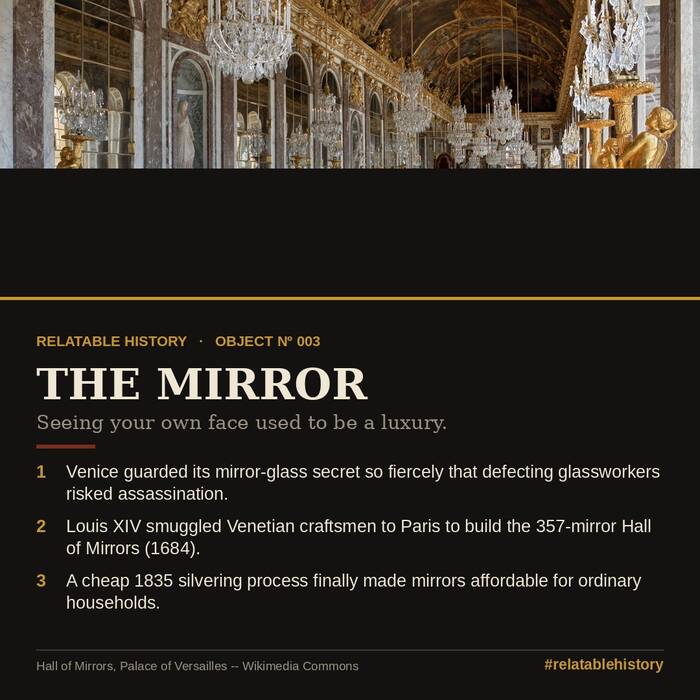
For about a hundred and fifty years, the recipe for a clear glass mirror was one of the most closely guarded trade secrets in Europe, and Venice enforced that secrecy the way it enforced everything else that mattered to its economy: by statute. Glassworkers were confined to a single island, forbidden to practice their craft abroad, and subject, under the guild’s own rules, to steep fines or imprisonment if they tried to leave without permission. When a French king decided he wanted the Venice mirror-making secret for his own country, getting it out took something closer to an intelligence operation than a trade negotiation.
The object at the center of that intrigue gets approximately zero scrutiny today. It hangs over a bathroom sink, or stands in a hallway, and nobody looks at it twice except to check their hair. But the ordinary glass mirror took roughly eight thousand years to become that unremarkable, moving from polished volcanic rock in a Neolithic settlement, to a prized grave good in Bronze Age China, to a monopoly a European state was prepared to defend with its own legal system, to a chemistry problem one German professor worked out almost in passing in 1835.
Here is how an object everyone now owns and nobody thinks twice about got that way, and why, for a little while, owning the wrong one could genuinely cost you.
Long before glass, people polished rock, bronze, and copper
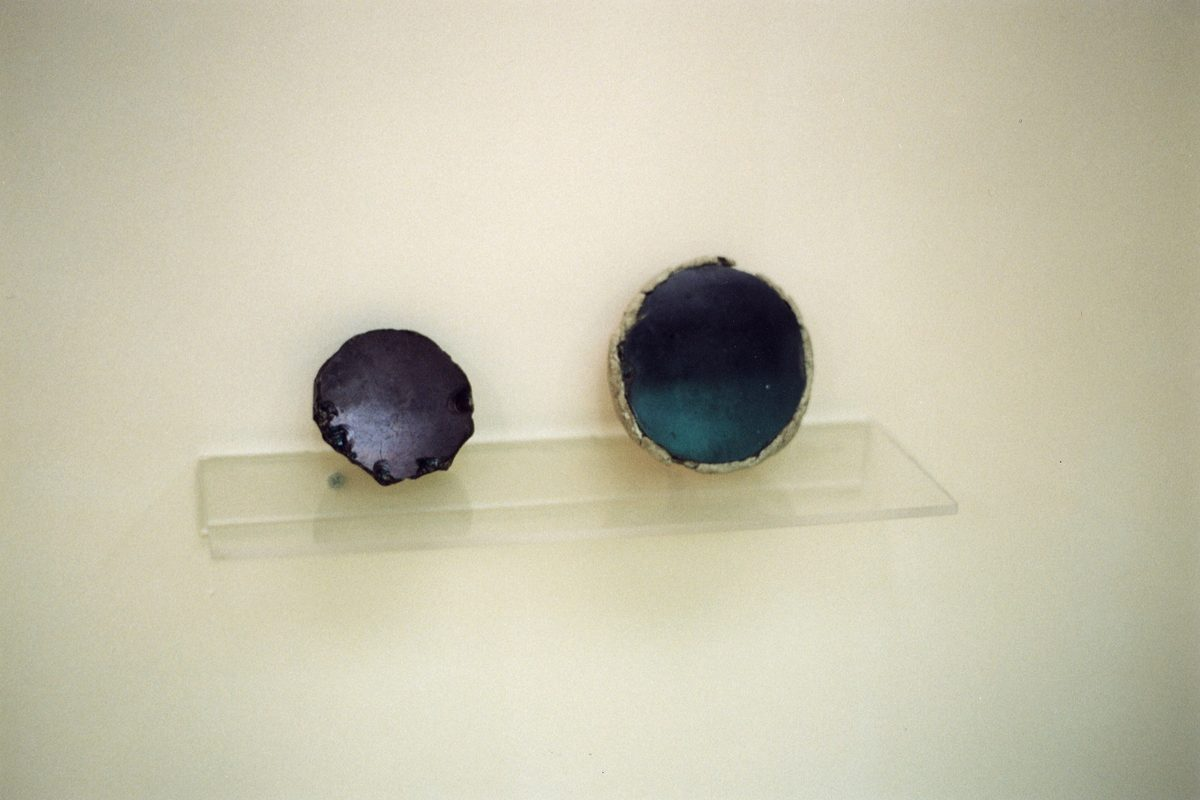
The oldest known mirrors aren’t glass at all. At Çatalhöyük, a Neolithic settlement in central Turkey, archaeologists have recovered eight complete obsidian mirrors, polished discs of volcanic glass roughly nine centimeters across, dated to about 6,500 to 6,200 BCE and found mostly in graves. That makes them among the oldest mirrors yet found anywhere, and their excavators are honestly still unsure what they were for: personal grooming, a divination tool, or possibly, as one peer-reviewed paper speculates without quite committing to it, some kind of proto-astronomical instrument for watching the sky. It’s a question with an odd echo roughly eight thousand years later, when Greek engineers built the Antikythera mechanism, a device that genuinely did track the heavens with startling mechanical precision.
Metal mirrors followed, and carried more symbolic weight than the stone ones had. Egyptian artisans polished discs of bronze and copper into hand mirrors that were religious objects as much as practical ones: the Metropolitan Museum of Art notes that Egyptian mirrors, especially those decorated with imagery of the goddess Hathor, were used to symbolize the goddess herself at certain events, tying an everyday grooming tool to solar and fertility symbolism. In China, bronze mirrors took on a different kind of significance: the dead were buried with them. A Han dynasty bronze mirror in the British Museum’s collection, cast with the geometric “TLV” pattern and carrying an inscribed poem, reflects what the museum’s own curators describe as part of a broader search for harmony with the cosmos, tied to an elaborate set of beliefs about the journey to immortality. Centuries later, the Roman writer Pliny the Elder would credit the Phoenician city of Sidon with inventing the glass mirror, backed with metal to give it a reflective coat. He was technically right, though Sidon’s glass mirrors were cloudy and inferior to almost anything that came after.
Venice turned a glassmaking trick into a monopoly backed by law
The breakthrough that actually mattered came out of Venice, and more specifically out of the island the Venetian government had already set aside for its glass industry. Around 1291, officials ordered the city’s glassworkers relocated to Murano, officially because their furnaces were a fire hazard in a city built largely of wood, and unofficially because an island was far easier to police than a city full of back alleys and foreign merchants. Leaving the Republic without permission, or teaching the craft to outsiders, carried the threat of steep fines or imprisonment under the guild’s own statutes.
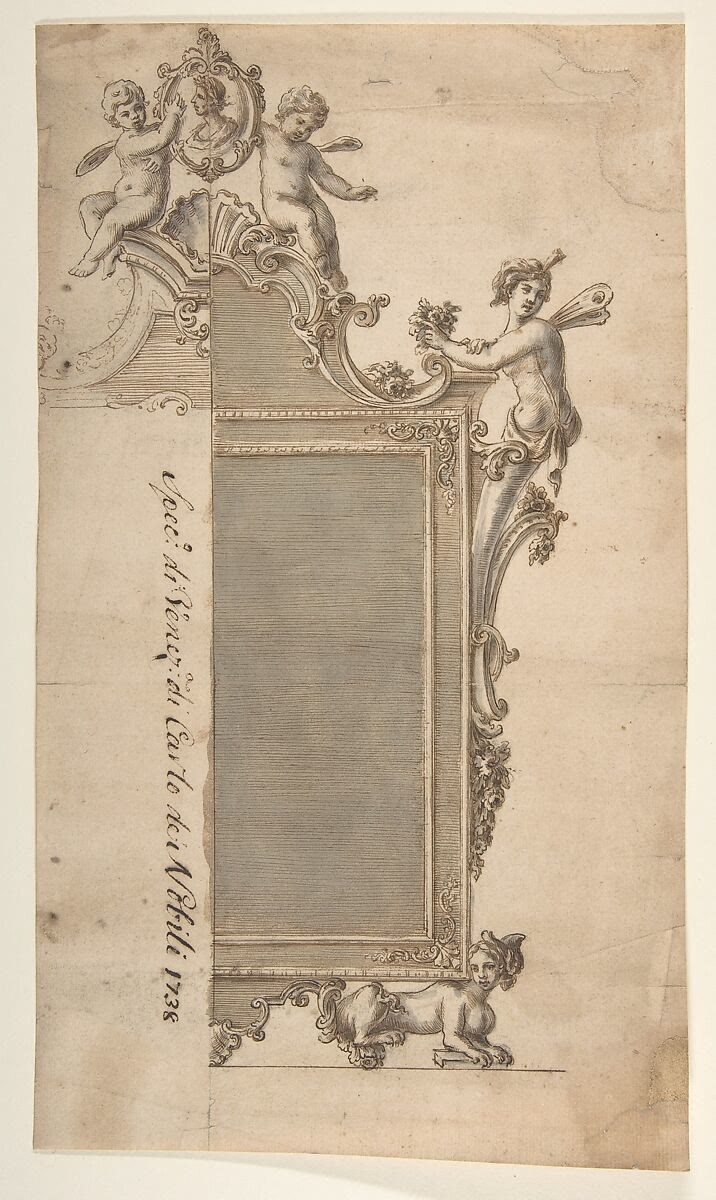
Then, around 1507 by one often-cited account, Murano’s craftsmen worked out how to back a sheet of flat glass with an amalgam of tin and mercury, producing something close to a true mirror: clear, flat, and genuinely reflective, rather than the cloudy convex glass that had been the best Europe could manage for centuries. Venice understood immediately what it had, and spent roughly the next hundred and fifty years as the only serious source of fine mirrors in Europe. Writer Katy Kelleher, surveying the period for Longreads, cites one contemporary account valuing a fine Venetian mirror at several times what a painting by a Renaissance master would fetch. A good mirror, in other words, was not a household item. It was a diplomatic asset.
Louis XIV effectively stole the secret, then built a hallway to prove it
Which is exactly why Louis XIV wanted it. In the early 1660s, the king’s finance minister, Jean-Baptiste Colbert, set about acquiring Venice’s method for France, and the effort that followed looked a great deal like industrial espionage because it was. Colbert’s agents lured several Murano craftsmen to Paris in secret; according to Kelleher’s account of the period, more than one of the men who left died under circumstances their contemporaries found suspicious, and competition over the secret reportedly extended to threats against the families the glassworkers had left behind on the island. Whatever the precise truth of any individual death, the broader point holds up across every version of the story historians tell: Venice treated the loss of its monopoly as something worth that level of retaliation.
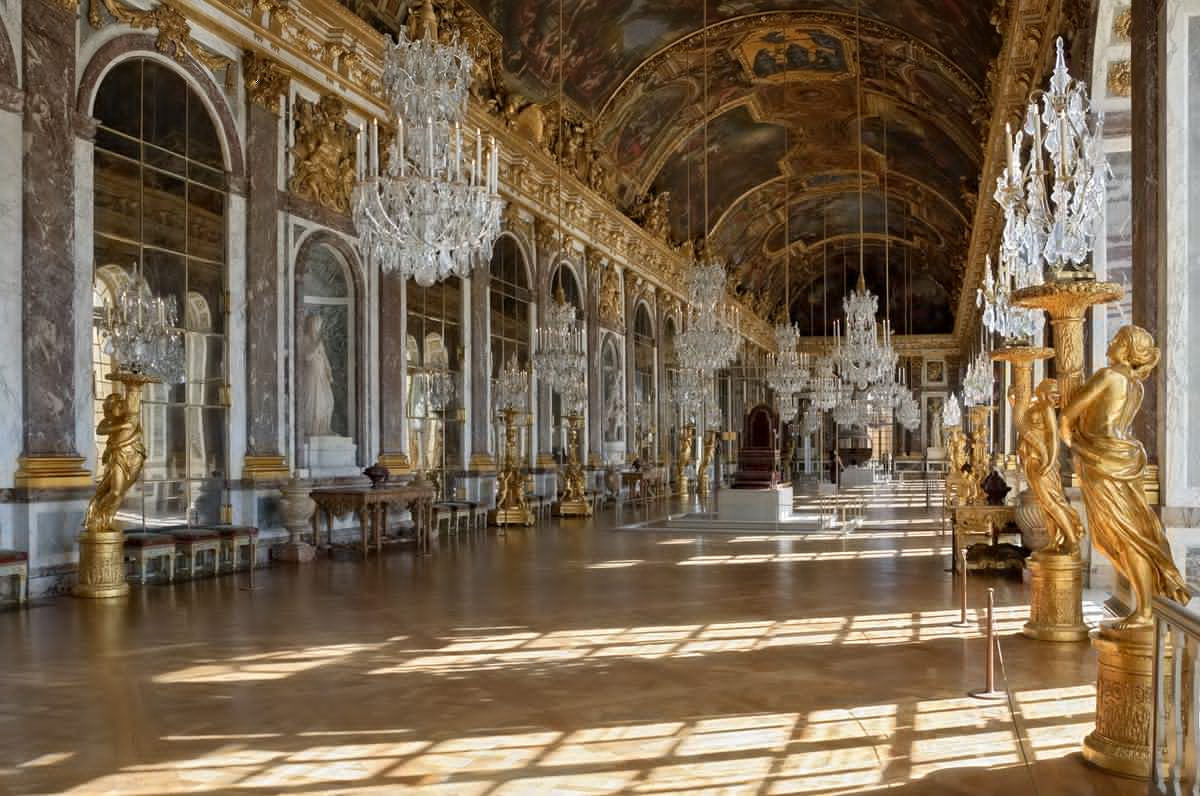
Colbert chartered a royal glassworks, the Manufacture Royale de Glaces, in 1665 to put the acquired expertise to use, though by most accounts the French glassmakers needed several more years, until around 1670, before they could produce mirror glass that didn’t simply embarrass the Venetian competition. Once they could, Louis XIV had exactly the extravagant proof he wanted. The Hall of Mirrors at the Palace of Versailles, completed in 1684 to designs by Jules Hardouin-Mansart, lined a single gallery with 357 individual mirrors facing the palace gardens. It was built, in part, as a deliberate insult to a monopoly France had just broken, and it worked: within decades, France rather than Venice was Europe’s name in luxury mirror glass.
Mirrors stayed a luxury for another century and a half, until a chemist made the secret pointless
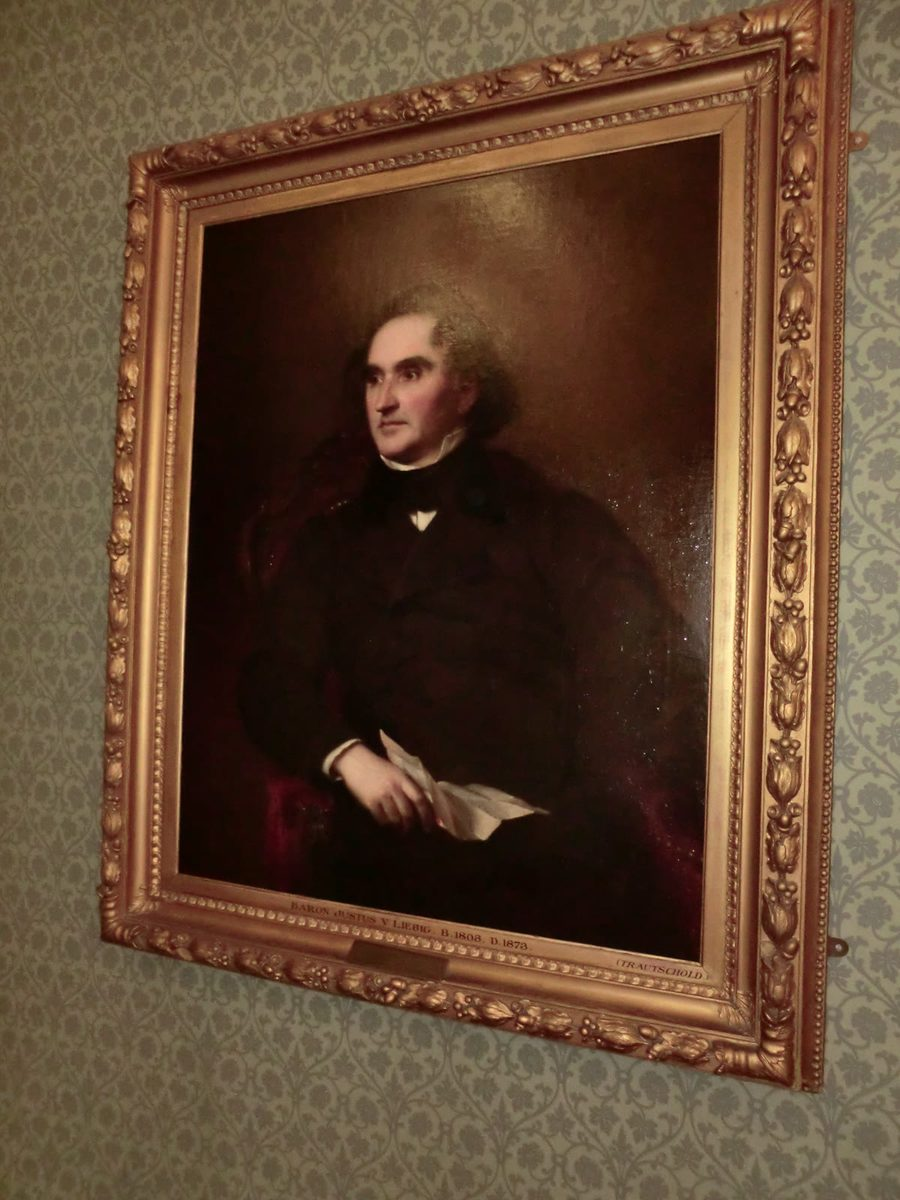
Even after Versailles, a decorative mirror remained a wealthy household’s purchase rather than an ordinary one, for roughly another hundred and fifty years. What finally broke that wasn’t a king or a spy. It was a chemistry problem solved on a lab bench. In 1835, the German chemist Justus von Liebig worked out a reaction that deposited a thin, even coat of metallic silver directly onto glass by reducing silver nitrate in solution, with no toxic tin-mercury paste, no furnace apprenticeship, and no guild secrecy required. According to Joe Schwarcz of McGill University’s Office for Science and Society, the method made mirrors “widely available” almost overnight, because unlike the Venetian process it was simple enough that, in his words, “everyone was amazed at the ease” with which a high-quality reflective surface could now be produced. A few years earlier, in 1839, a French inventor had put a related set of silver-based reactions to a completely different use, fixing a picture instead of reflecting one, in the process that launched photography. Within a few decades of Liebig’s discovery, factories across Europe and the United States were mass-producing silvered mirrors, and an object Venice had once defended as a state secret was hanging in ordinary houses everywhere.
Once mirrors were cheap, people found stranger things to do with them
Cheap mirrors found new jobs almost immediately. In 1911, the driver Ray Harroun entered the first Indianapolis 500 in a car of his own design, the Marmon Wasp, built to carry only himself. Other drivers objected that the design was dangerous, since it left no seat for the riding mechanic whose job was partly to watch for cars coming up from behind. Harroun’s answer was to bolt a small mirror onto brackets above the steering wheel, a fix the Encyclopedia of Indianapolis credits as the first rearview mirror used in competitive racing. The objection didn’t stick, Harroun won the race, and the rearview mirror eventually became standard equipment on cars generally.

Scientists found a stranger use still. In 1970, the psychologist Gordon Gallup published an experiment in the journal Science in which he marked anesthetized chimpanzees with a spot of red dye on the eyebrow ridge and ear, then measured how often they touched the marked spot once they were awake. Without a mirror in the cage, the chimps touched the mark about once; with a mirror restored, self-directed touching jumped to somewhere between four and ten times, which Gallup took as evidence the animals recognized the reflection as themselves rather than as a stranger. The mark test became the standard measure of self-recognition in animal cognition research, and later studies reported apparent passes in species from dolphins to magpies. The magpie result in particular has not held up well: a 2020 attempt to replicate the original study, published in the Journal of Comparative Psychology, found no clear evidence of self-recognition in the birds at all, a useful reminder that one dramatic result involving a mirror doesn’t always survive a second look. A century earlier, Victorians had already found a far less scientific use for mirrored and lensed images: the stereoscope, a parlour device that used a pair of offset photographs to trick the eye into seeing depth.
And through all of that, one belief about mirrors never quite caught up with how ordinary they’d become. Break one, folklore insists, and you’re owed seven years of bad luck, a superstition writer Madeleine D’Este traces partly to an old Roman belief that a mirror held a fragment of a person’s soul, so that shattering it tore the soul loose, and partly to an old idea that the body renews itself completely every seven years. Nobody can say for certain which explanation, if either, is the real one; superstitions rarely come with footnotes.
What’s verifiable is the arc of the object itself: a Neolithic grave good, a Venetian state secret enforced by statute, a hallway at Versailles built to humiliate a rival country, and finally a laboratory reaction simple enough to make the whole fight look, in hindsight, almost unnecessary. The next glance in the mirror on your way out the door costs nothing. For most of the object’s history, making that possible would have cost someone a great deal.
Watch the full history
The short video covers the same arc, Venice’s monopoly, Versailles, and the chemist who ended it, in under two minutes.

Related reading
- Why the Fork Was Once Considered Sinful — another everyday object that spent centuries as a suspect, status-laden import before becoming completely unremarkable
- The 2,600-Year History of the Chamber Pot, From Athens to the Sewer — a reminder that ordinary household objects carry more engineering and class history than they let on
- How the Sedan Chair Actually Worked, and Why It Started as a Scandal — another early modern status object whose history is stranger than its everyday use suggests
- The Warming-Pan Baby: The Bed-Warmer Behind a Royal Scandal — a different household object that got tangled up in the politics of a seventeenth-century court
Works cited
- Vit, Josef, and Michael A. Rappenglück. “Looking Through a Telescope with an Obsidian Mirror. Could Specialists of Ancient Cultures Have Been Able to View the Night Sky Using Such an Instrument?” Mediterranean Archaeology and Archaeometry 16, no. 4 (2016): 7–15.
- Pliny the Elder. Natural History, Book XXXVI, 36.193, on Sidon and the invention of the glass mirror. Link.
- The Metropolitan Museum of Art. Mirror with Hathor-head handle, New Kingdom, Egypt. Collection record.
- The British Museum. Bronze “TLV” mirror, Western Han dynasty. Collection record, object A_1973-0726-54.
- Morelli, Laura. “Murano Glass: A Brief History.” lauramorelli.com.
- Hung, Wu. “Mirror Fever.” Lapham’s Quarterly. Link.
- Kelleher, Katy. “The Ugly History of Beautiful Things: Mirrors.” Longreads, July 11, 2019.
- Schwarcz, Joe. “How Are Mirrors Made?” McGill Office for Science and Society. Link.
- Gallup, Gordon G., Jr. “Chimpanzees: Self Recognition.” Science 167, no. 3914 (1970): 86–87.
- “Ray Harroun.” Encyclopedia of Indianapolis. Link.
- Soler, M., J. M. Colmenero, T. Pérez-Contreras, and J. M. Peralta-Sánchez. “Replication of the Mirror Mark Test Experiment in the Magpie (Pica pica) Does Not Provide Evidence of Self-Recognition.” Journal of Comparative Psychology 134, no. 4 (2020): 363–371.
- D’Este, Madeleine. “Seven Years Bad Luck?” FolkloreThursday, August 24, 2017. Link.