
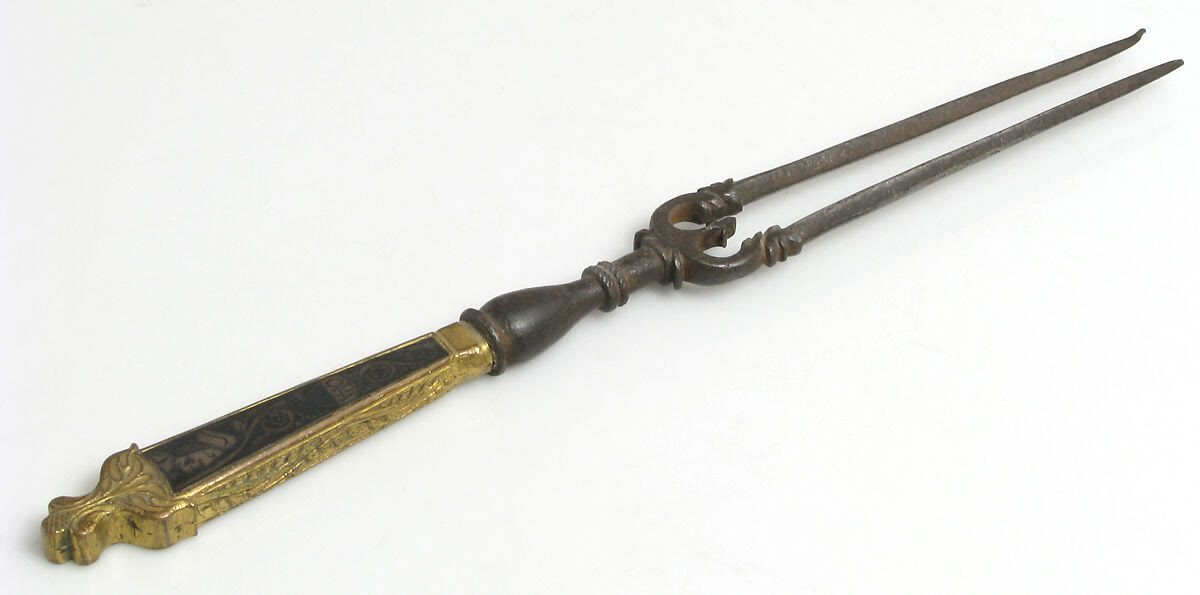
Sometime around 1070, a reform-minded Italian cardinal named Peter Damian sat down to write a tract condemning female vanity, and one of the examples he reached for was a piece of cutlery. A noblewoman married into the doge’s household in Venice, he wrote, refused to touch her food with her fingers the way everyone else did. Instead she had her servants cut it into small pieces, which she then lifted to her mouth with a little golden, two-pronged instrument. When she died of plague not long afterward, Damian and the writers who repeated his story for centuries treated it as more or less deserved.
That is, as far as the written record goes, the first time a fork gets personally blamed for a woman’s death. It would not be the last time the object drew that kind of moral weight. For roughly seven hundred years after Damian’s complaint, the fork was once considered sinful, foreign, or simply absurd almost everywhere it traveled, well before it was accepted as an ordinary tool.
The argument against it was rarely about hygiene or practicality. It was about what a fork implied: that your own fingers, given to you by God, were no longer good enough. Tracking that argument from a cardinal’s letter to a Victorian dinner table says less about cutlery than it does about how slowly a culture lets go of a reason to disapprove of something.

Why the fork was once considered sinful in the first place
The Metropolitan Museum of Art’s curatorial notes on an Italian fork in its collection date Peter Damian’s letter to roughly 1070 to 1072, and describe its subject as “the Byzantine wife of the doge of Venice,” who “refused to follow the Western custom” of eating by hand. Later retellings, including several popular histories, sharpen the story into a single, dateable event: a Byzantine emperor’s niece who married into the doge’s family in 1004 and brought a golden fork to her wedding feast, to the horror of the assembled clergy. The two versions do not quite line up — Damian was writing some sixty to seventy years after 1004, about a woman he identifies only by her marriage, not her name — and historians who have gone back to the letter note that it reads as a moral example built around a real but second-hand rumor, not an eyewitness account. What survives intact across every version is the verdict: a Venetian clergyman is quoted as saying that God, in his wisdom, had already provided man with natural forks — his fingers — and that anything else was an insult to the arrangement.
It is worth being precise about what was actually being objected to. Forks for cooking and for serving — lifting meat out of a pot, holding it steady for carving — had existed for centuries and attracted no controversy at all. What scandalized Damian’s readers was a fork used at the table, by an individual diner, for food already on her own plate. That was read as a claim of refinement so excessive it tipped into vanity, the specific sin Damian’s tract was actually about. The fork was collateral damage in an argument about female luxury that would have found another target if this one hadn’t been sitting on the table.
Italy normalized it first, and pasta had something to do with it
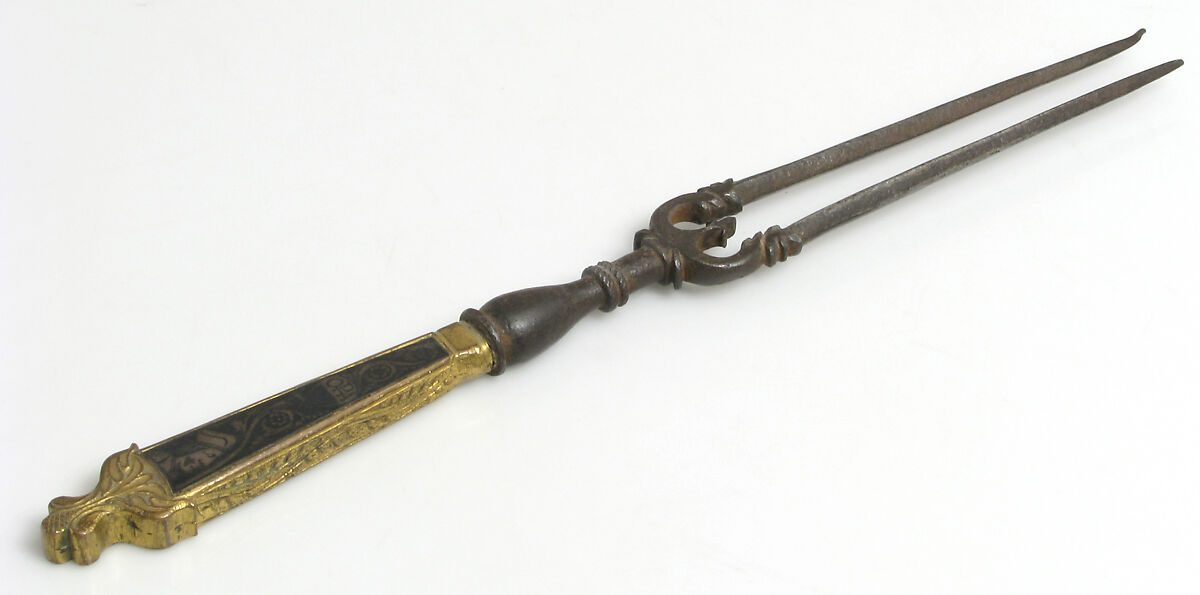
The object itself was slow to change. A fifteenth-century Italian fork now in the Metropolitan Museum’s collection — iron and copper alloy, partly gilded, with silver and niello decoration — shows the form that spread through Italy over the following two centuries: two slim, widely spaced tines, closer to a long skewer than to the four-tine fork in a modern drawer. According to the museum’s own account, these smaller forks were first used mainly for fruit, especially anything that stained the fingers, such as blackberries, and for serving sweetmeats; forks sized for meat and general carving became common only in the sixteenth century, and even then mostly off to the side of the actual eating.
Italy’s path to acceptance ran through food that genuinely did not cooperate with fingers. Long pasta, slicked in sauce and too hot and slippery to manage by hand without a fight, gave the fork a practical argument that the Venetian clergy’s objections never had to answer. By the time Italian noble households were setting fork, knife and spoon together as a matter of course, the rest of Catholic Europe still largely regarded the habit as a foreign eccentricity — elegant, maybe, but faintly ridiculous, the sort of thing Italians did because they were Italian.

Catherine de’ Medici brought it to France, and the French court mocked it anyway
The fork’s next major move has an unusually exact date attached to it. In 1533, the Florentine noblewoman Catherine de’ Medici married the future King Henry II of France, and her household brought Italian silver forks along with her. The Metropolitan Museum’s own account of the object’s spread places the French introduction at “around 1553,” roughly two decades later, which is a useful reminder that “introduced” and “adopted” are not the same event. A fork can arrive in a country’s luggage a generation before it arrives at that country’s actual dinner table, and France’s gap between the two was a long one.
Adoption at the French court was neither quick nor universal. Fork use remained rare enough into the following century that it was still a mark worth mocking: a king of France who used one in public could expect to be teased for it as an affectation, dressing, as one later account of the court’s attitude put it, “like a lady.” Matched sets of fork and spoon, the “couvert” that now seems like the most basic unit of a table setting, did not become a standard furnishing until the second half of the seventeenth century — roughly a hundred and fifty years after Catherine’s forks first entered the country.

England turned it into an insult you could be called to your face
No single figure illustrates England’s resistance better than Thomas Coryate, an English traveler who toured Italy and returned home in 1608 carrying, among his souvenirs, the habit of eating with a fork. He wrote up the practice approvingly in his sprawling 1611 travelogue Crudities, arguing that it kept a diner’s fingers clean and noting, in his own words, that “the Italian cannot by any means endure to have his dish touched with fingers.” For his trouble, Coryate was handed a nickname that stuck for the rest of his life: “Furcifer,” a Latin insult meaning, roughly, fork-bearer or gallows-rogue. Ben Jonson had already put a similar joke on stage two years earlier, in 1606, when Volpone used an onstage fork as a quick visual signal of overdone, foreign affectation that an English audience was expected to find absurd on sight.
Forks did not vanish from England after that, but they stayed luxury items handled with self-conscious irony for most of the seventeenth century. English court fashion warmed to them somewhat after the 1660 Restoration, when exiled royalists returned from Continental courts with Continental habits, but the record is blunt about how long full acceptance actually took: using a fork to eat, rather than only to serve, did not become the unremarkable default across Britain until the nineteenth century — a full two hundred years after Coryate earned his nickname for doing exactly that.
Colonial America skipped the fork and invented a workaround instead
The earliest known English-language reference to a table fork is not a complaint but a bequest: a 1463 will, held in English probate records and cited by researchers at Brown University’s Joukowsky Institute for Archaeology, leaves “my silvir forke for grene gyngour” — a silver fork for eating preserved green ginger — to a named heir, treating the object as valuable enough to list individually alongside plate and jewelry. That same scarcity crossed the Atlantic largely unchanged. Massachusetts Bay governor John Winthrop is recorded as having owned a fork in the 1630s, which made him unusual; archaeological surveys of colonial households find that forks do not turn up in any numbers in the archaeological and probate record until well into the following century.
Colonists without forks did not simply eat clumsily. English table knives of the period were typically blunt and rounded rather than pointed, precisely because a knife at the table was not supposed to double as a weapon, which made them poor at spearing food. The practical answer, documented by food historians, was what later writers nicknamed the “zigzag” method: cut with the knife in the right hand, switch the knife down, and bring the food to the mouth with fingers or a spoon. The habit outlasted the colonial period by a wide margin. When the English writer Frances Trollope toured the United States in the late 1820s, she singled out American table manners, forks very much included, for some of her sharpest mockery in Domestic Manners of the Americans. It was not until around the 1850s that forks were reliably established in ordinary American households, which puts the full journey from Peter Damian’s letter to an unremarkable fork beside an American dinner plate at something close to eight hundred years.
Watch the full history
The short video that started this one covers the Venice wedding feast and the eight-hundred-year fight that followed in under a minute and a half — the long version is the thirteen paragraphs above it.

The sociologist Norbert Elias spent much of The Civilizing Process arguing that exactly this kind of slow-motion argument over table manners is never really about the table. A new standard of self-restraint — not touching your food, not reaching across the dish, not licking your fingers — spreads downward from a court or an elite that wants a visible way to mark itself off from everyone eating the old way. The fork is a near-perfect test case for that argument, because it is cheap, portable and entirely optional: nothing about human anatomy required it, which is exactly why it took a cardinal, a queen, a mocked traveler and roughly twenty-eight generations to become invisible.
It is invisible now. Nobody who picks up a fork today is making a claim about vanity, nationality or godliness, and that is precisely the point: an object stops being an argument once everyone has quietly agreed to lose it. The fork on your table spent the better part of a millennium as a live question about who you were and what you believed. It just finally stopped asking.
Related reading
- The 2,600-Year History of the Chamber Pot, From Athens to the Sewer
- How Wooden Tally Sticks Ran England’s Treasury for 600 Years
- How Cider, Not Beer, Became Colonial America’s Everyday Drink
- The 24 Years Wampum Was Legal Tender in Massachusetts
Shop the styles/items featured in this video
- Consider the Fork: A History of How We Cook and Eat (book)
- Antique-style silver flatware set
- Medieval and Renaissance dining history (book)
Works cited
- Rebora, Giovanni. Culture of the Fork: A Brief History of Everyday Food and Haute Cuisine in Europe. Translated by Albert Sonnenfeld. Columbia University Press, 2001. Link.
- Elias, Norbert. The Civilizing Process: The History of Manners. Translated by Edmund Jephcott. Urizen Books, 1978.
- Deetz, James. In Small Things Forgotten: An Archaeology of Early American Life. Rev. ed. Anchor Books, 1996.
- “Fork,” Italian, 15th century, iron, copper alloy, silver and niello. Accession no. 2010.180.1. The Metropolitan Museum of Art..
- Kennedy, Lesley. “Why the Fork Was Once Considered Scandalous.” HISTORY, June 16, 2025. Link.
- Bramen, Lisa. “A History of Western Eating Utensils, From the Scandalous Fork to the Incredible Spork.” Smithsonian Magazine, July 31, 2009..
- Dennison, Matthew. “Curious Questions: Who Invented the Fork?” Country Life, January 21, 2023. Link.
- Joukowsky Institute for Archaeology and the Ancient World, Brown University. “13 Things: The Fork.” Link.