
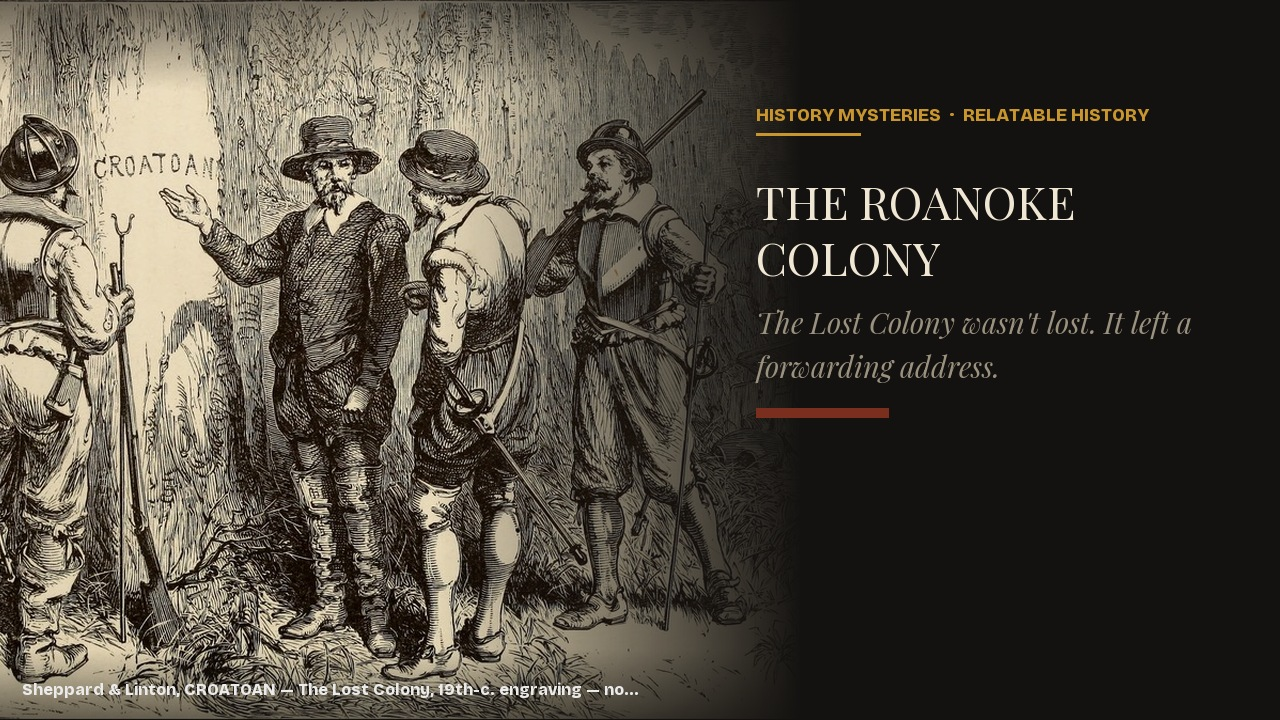
In August 1590, the English governor John White waded ashore at the lost colony of Roanoke and found nobody home. Not a body. Not a grave. Not a single sign of a struggle. More than a hundred English men, women and children — including his own infant granddaughter — had gone from a fenced settlement on the North Carolina coast, and the only message they left behind was one word, carved in plain capital letters into a gatepost: CROATOAN.
Four hundred and thirty-six years later, that word is still the single most argued-over clue in American colonial history. For most of that time, the honest answer to what happened to the Lost Colony was simply: nobody knows. That is no longer entirely true. Archaeologists working the sandy soil of North Carolina’s Outer Banks over the past decade have started pulling up the first physical evidence that actually corroborates one of the old theories, and it is forcing historians to take the word on the post more literally than they have in a century.
Even the headcount is argued over. The National Park Service’s own pages cite both 118 colonists who sailed from England in 1587 and 116 who had vanished by 1590 — two children, including the governor’s granddaughter, were born on the island in between. Other historians most often round the number to 115 or 117. Nobody kept a clean roll, because nobody expected to need one.
The lost colony of Roanoke was meant to be a staging post, not a destination
The 1587 voyage was Sir Walter Raleigh’s second attempt at an American colony, and a deliberately different one from his first. In 1585 he had sent a military garrison under Ralph Lane to Roanoke Island; it survived less than a year, nearly starved, fought an open war with the local Secotan leader Wingina, and was carried home by Francis Drake’s fleet in 1586 before Raleigh’s own relief ships could even arrive. The 1587 expedition was built to avoid every one of those mistakes. It was a civilian colony of families, roughly ninety men alongside around seventeen women and nine boys, sent not to garrison Roanoke again but to found a permanent settlement on the Chesapeake Bay, a hundred and fifty miles to the north.
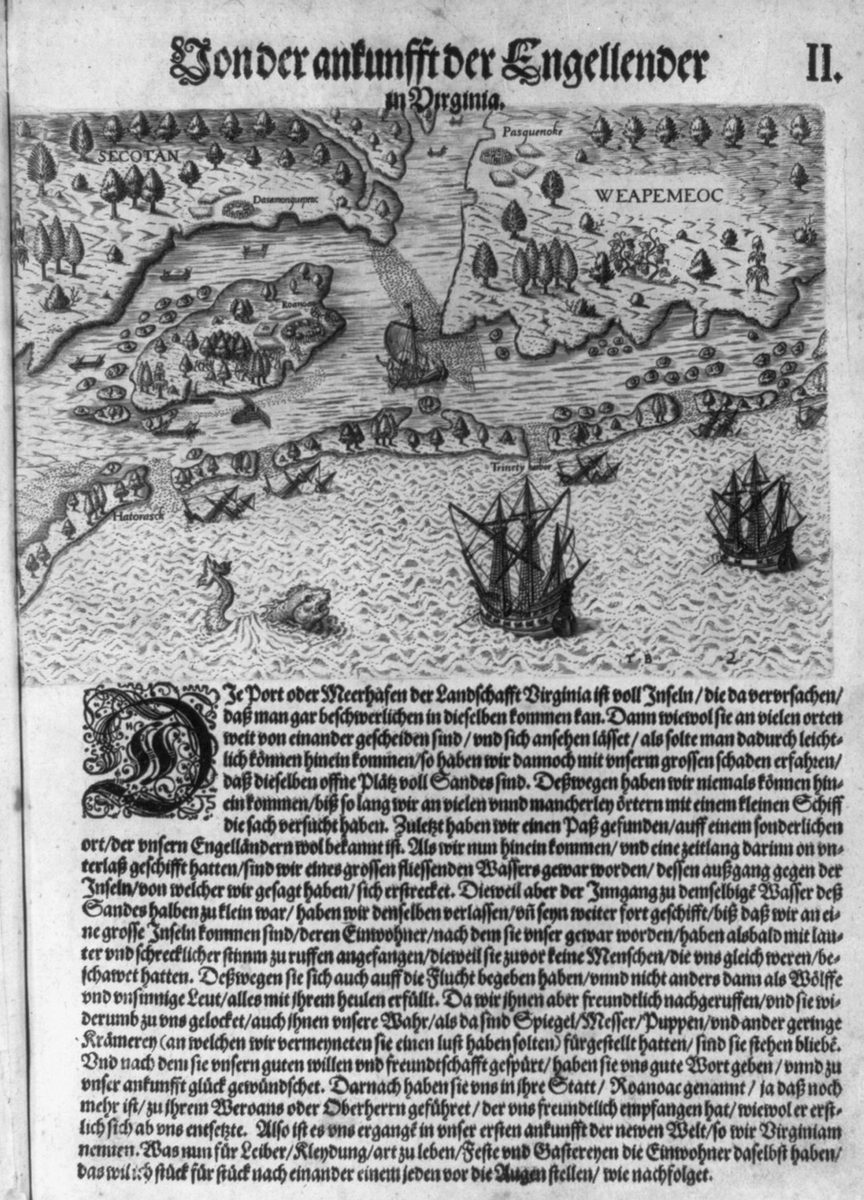
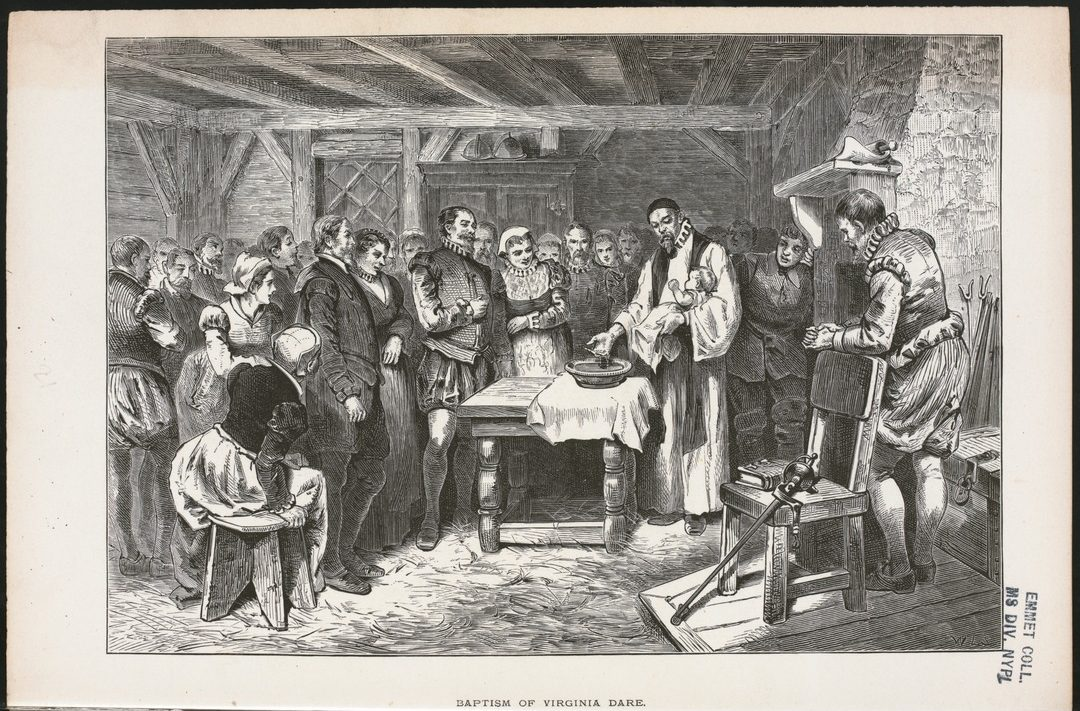
They never reached it. The expedition’s pilot, Simon Fernandes, put the colonists ashore at Roanoke instead and refused to carry them any further — historians still debate whether he was simply behind schedule for the privateering season or acting on orders nobody wrote down. Their governor was John White, an artist and mapmaker who had sailed with the 1585 garrison and painted some of the most detailed watercolours of Algonquian life ever made by an Englishman. Within days of landing, a colonist named George Howe was killed while crabbing alone, a reminder that Lane’s war had not been forgotten by the people who lived there. Five days after that, on 18 August 1587, White’s daughter Eleanor gave birth to a girl. They named her Virginia, after the colony, and she was the first English child born anywhere in the Americas.
White sailed home for supplies, and a war with Spain swallowed three years
Within a month, the colonists persuaded White — against his own wishes, he later wrote — to sail back to England for supplies and reinforcements, reasoning that the colony’s own governor would get a faster hearing from Raleigh than anyone else could. White left in late August 1587, planning to return within the year. He reached England in November to find the country bracing for invasion: the Spanish Armada was being assembled, and Queen Elizabeth had ordered every seaworthy ship held in English ports for home defence. A small relief attempt in 1588, with two lightly armed pinnaces, turned into an opportunistic raid on French and Spanish shipping instead of a supply run; both vessels were battered in a fight with French privateers and limped home without ever reaching Roanoke.
White did not get passage back across the Atlantic until 1590, and even then only as a passenger on a privateering voyage under John Watts, whose captains had their own agenda and were in no hurry to detour for a governor’s family. White finally sighted Roanoke Island on 18 August 1590 — by coincidence, his granddaughter Virginia Dare’s third birthday. He had been gone for three years.
What he found, and the detail that still shapes every theory
White’s own account, later printed in Richard Hakluyt’s Principal Navigations, is specific and strange. The houses had been taken down, not burned or smashed — a controlled, deliberate dismantling rather than the aftermath of a raid. A new, sturdy palisade had gone up around the site, as if to secure something against animals, or against a siege that never came. The chests White himself had buried for safekeeping before leaving had been dug up; his books were ruined by rain, his armour rusted through, his maps and pictures mildewed and torn, and the disturbed ground suggested Native hands had been through the contents, not an enemy’s.
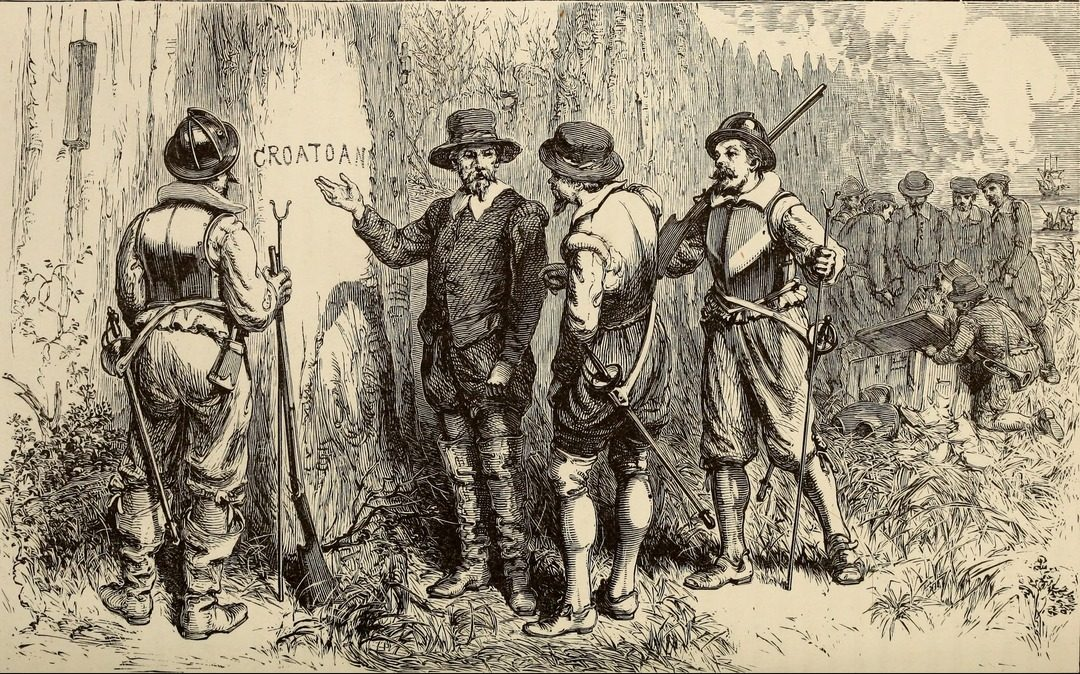
Before he had left in 1587, White and the colonists had agreed on a signal: if they had to abandon the settlement, they would carve the name of wherever they had gone; if they left under attack or in danger, they would add a cross above it. On a gatepost, in what White called “fair Roman letters,” was carved CROATOAN. On a nearby tree, the shorter CRO. There was no cross anywhere. By the colonists’ own prearranged code, they were telling him exactly where they had gone, and that they had gone safely.
A storm, not indifference, stopped the search
Croatoan was the name of an island roughly fifty miles south of Roanoke — today’s Hatteras Island — and of the people who lived there, longtime allies of the colony through Manteo, an Algonquian leader who had sailed to England and back and been baptised at Roanoke. White intended to sail there directly. Instead, the weather turned. His ship lost an anchor in rough seas, fresh water ran short, and the sailors — aboard a privateering voyage with no real stake in the colony — refused to risk the vessels any further so late in hurricane season. The plan was to winter in the Caribbean and return to Croatoan in spring. It never happened. Funding and attention in England had moved on to the war, and later, to Raleigh’s own fall from favour. White died in Ireland around 1593, writing to Hakluyt that he had been forced to commit his daughter, granddaughter and the rest of the colonists “into the hands of the Almighty.” He never saw any of them again.
Six theories, and the one the evidence now favours
The National Park Service’s own analysis at Fort Raleigh lays out the main candidates, and most fall apart on contact with White’s own account. A hurricane is contradicted by houses that were dismantled, not wrecked. Famine and disease are weakened by the absence of any graves. A Spanish attack is a real possibility — a Spanish captain, Vicente González, did scout the Carolina coast in 1588 looking for the English colony and found an abandoned boat slip — but White saw no evidence of a fight either. A migration to the Chesapeake, the colony’s original destination, was favoured by the historian David Beers Quinn, but no confirmed Roanoke-era English artefact has ever turned up there.
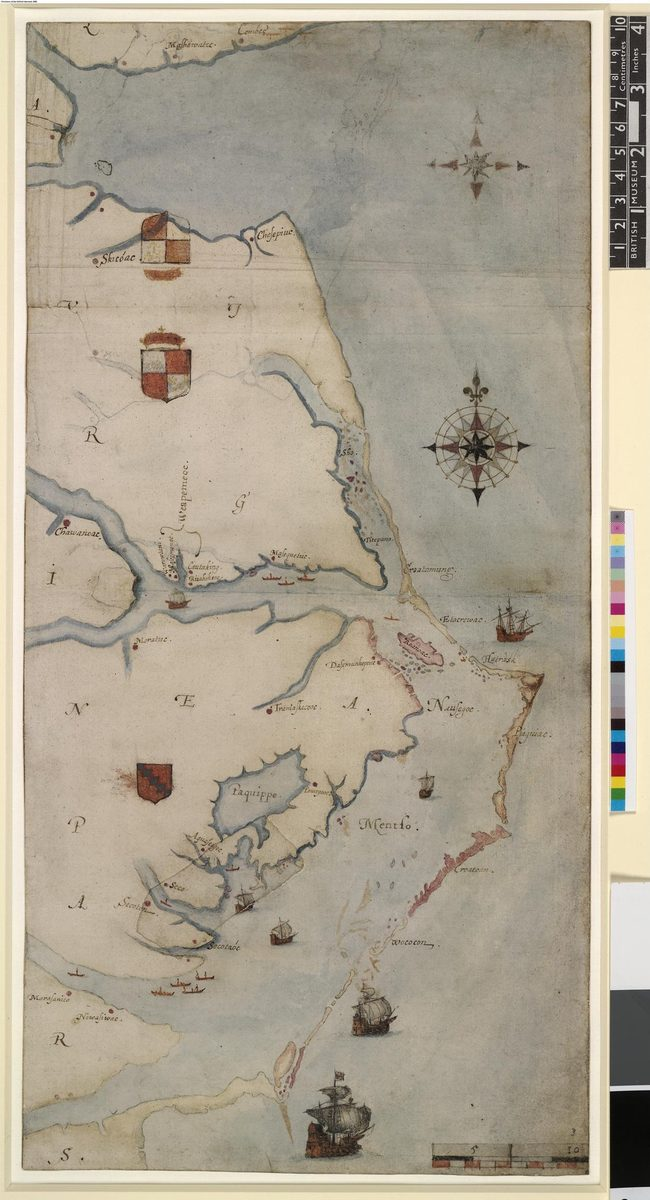
Two theories are no longer purely speculative. One points inland: a patched-over area on White’s own 1585 map of the region, rediscovered under infrared and raking light by the First Colony Foundation, conceals a four-pointed fort symbol roughly fifty miles west of Roanoke, near the Albemarle Sound. Excavations at two riverside sites there, labelled Site X and Site Y, have since turned up genuine English material from the right period in a place no Roanoke colonist is otherwise documented to have reached. The other points to Croatoan itself: testimony gathered at Jamestown around 1608, recorded by the colonial official William Strachey, had a Powhatan visitor named Machumps describe English survivors who had lived peacefully among Native communities for years before most were killed, not long before Jamestown’s own founding, by forces loyal to the paramount chief Wahunsonacock. Taken together, the two theories are not even mutually exclusive: nothing requires that all of the colonists went to the same place, or met the same fate.
What’s actually coming out of the sand
The most famous single artefact in the whole case turned out to be a disappointment. A signet-style ring recovered on Hatteras Island in 1998 was reported at the time as gold, which would have made it powerful evidence of an English colonist of some standing living among the Croatoan. Re-tested with X-ray fluorescence at East Carolina University in 2017, it turned out to be brass. That does not rule out a colonist’s hand — brass trinkets travelled through Native trade networks too, and a kept heirloom does not have to be precious to matter to whoever kept it — but it took the single strongest physical clue off the table.
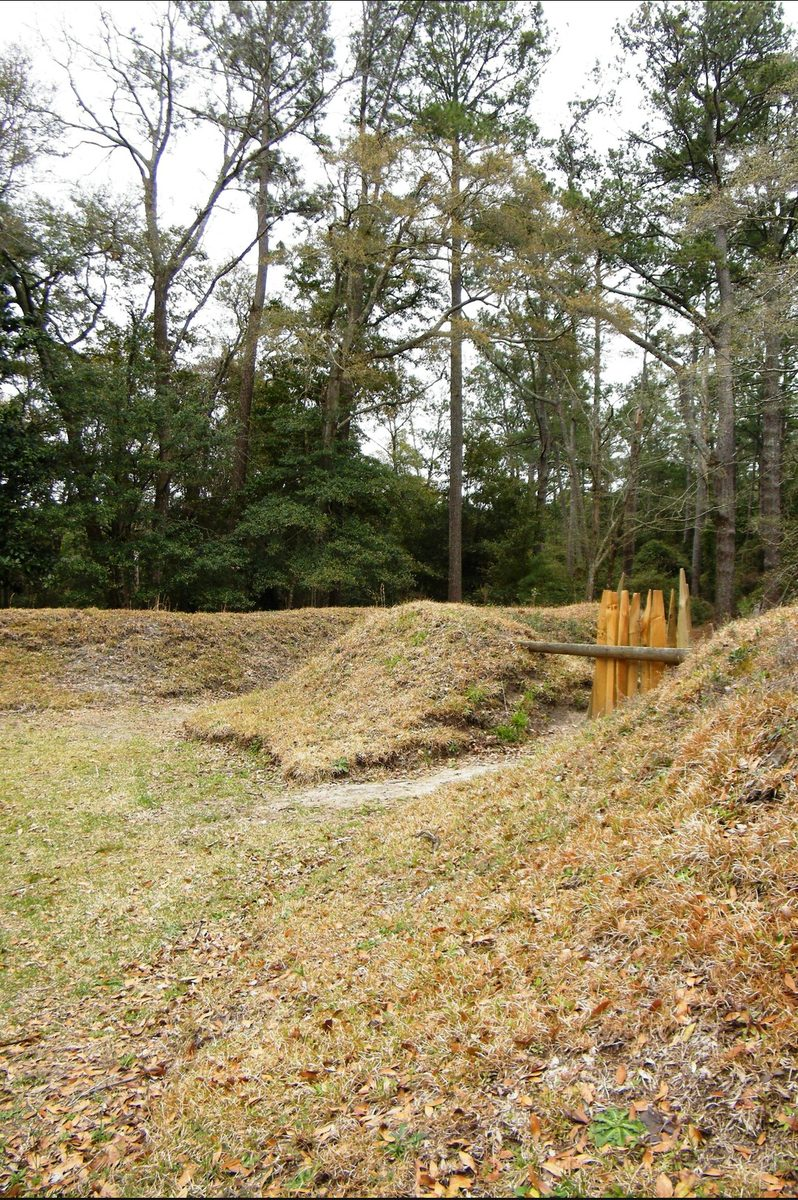
What has replaced it is slower and less dramatic: pottery, gun flints and other English material from the Site X and Site Y digs inland, and, since 2023, a copper wire ring recovered directly on Roanoke Island at what researchers believe was an Algonquian settlement of real local standing. The Algonquian of the region are not known to have had the metallurgy to draw copper wire themselves, which points to direct contact with the English, whether through trade or through colonists actually living alongside them. A 2024 reassessment by the archaeologist Eric Klingelhofer goes further still, arguing that Manteo’s own Croatoan allies likely had a settlement much closer to Roanoke than the fifty miles historians have assumed for a century — near modern Mashoes, across a narrow sound rather than a long coastal hike. If he is right, the colonists would not have needed a difficult fifty-mile journey to reach safety. They would only have needed a short crossing.
Nobody has found a mass grave, a wrecked ship, or a single skeleton that can be confidently identified as a Roanoke colonist. What is accumulating instead is a slow case for the least dramatic explanation of all: that most of the colonists did not die together, in one place, on one day. They dispersed, in stages and apparently by plan, into Algonquian communities that had been trading with and feeding them since 1587 — and within a generation their descendants, if they had any, would have been indistinguishable from their hosts. That is a far harder thing to excavate than a massacre, which is as good a reason as any why it has taken four centuries to start finding it.
Perhaps the real irony of the “Lost Colony” is that the people who lived through it left the clearest instruction they could manage for anyone who came looking: exactly where they had gone, carved in plain letters, with the one symbol that would have meant trouble deliberately left off. White arrived home to read it four hundred years before anyone was equipped to go check.
Watch the full history
No long-form video exists yet for this mystery — the clip below is the original 57-second short that first told the story.

Related reading
- What Actually Happened to the Amber Room — another case where something simply vanished, and the evidence had to catch up centuries later
- The True Story Behind the Flannan Isles Lighthouse Mystery — another vanishing with no bodies and no sign of a struggle
- Why Nobody Can Read the Voynich Manuscript — another centuries-old puzzle still being tested against new evidence
- The 24 Years Wampum Was Legal Tender in Massachusetts — more on how deeply English colonists in this period depended on Native American trade networks
Works cited
- Fort Raleigh National Historic Site. “1587: The Lost Colony.” U.S. National Park Service. Link.
- Fort Raleigh National Historic Site. “Major Theories of the Lost Colony.” U.S. National Park Service. Link.
- John White. La Virginea Pars, watercolour map, c. 1585-1590. British Museum, registration no. 1906,0509.1.3.
- First Colony Foundation. “Hidden Images Revealed on Elizabethan Map of America.” Link.
- First Colony Foundation. “Pottery and Copper Jewelry Unearthed in North Carolina.” Link.
- Tabb, Kip. “Maps May Yield Clearest Clues to ‘Nation’s Oldest Mystery.’” Coastal Review, October 2024. Link.
- Lawler, Andrew. “The Mystery of Roanoke Endures Yet Another Cruel Twist.” Smithsonian Magazine, April 7, 2017.
- Aron, Paul. “What Happened to the Lost Colony?” Trend & Tradition (Colonial Williamsburg Foundation), Spring 2025.
- Quinn, David Beers. Set Fair for Roanoke: Voyages and Colonies, 1584–1606. University of North Carolina Press, 1985.
- Horn, James. A Kingdom Strange: The Brief and Tragic History of the Lost Colony of Roanoke. Basic Books, 2010.