
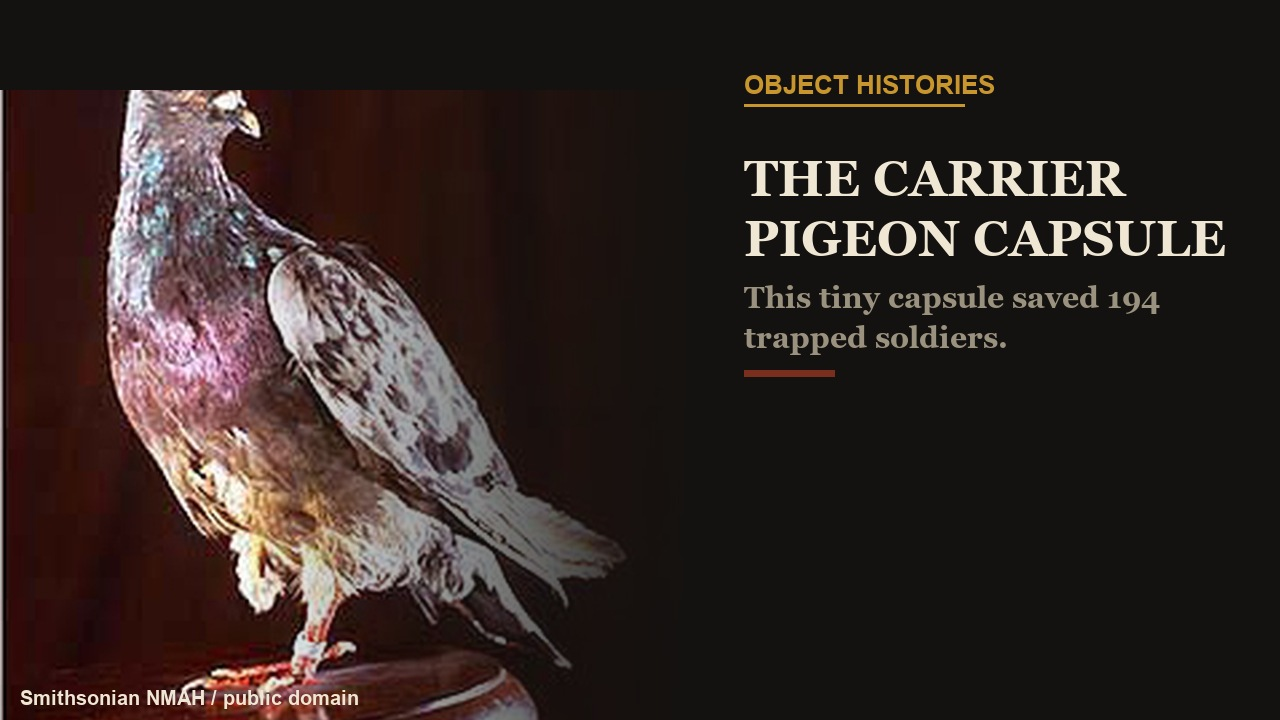
In 2021, conservators at the Smithsonian ran a DNA test on a stuffed pigeon that has sat in a display case since the early 1920s, mounted mid-stride with its head turned and its right leg missing. The result corrected something the bird’s own service record had gotten wrong for a century: Cher Ami, the most famous messenger pigeon in American military history, was male. Three years before that pigeon died of its wounds, it had carried the only working line of communication a surrounded American battalion had left in the Argonne Forest — not a radio, not a wire, but a scrap of paper rolled into a capsule not much bigger than a shirt button and lashed to one leg.
That capsule, not the bird and not the legend built around it, is the actual subject here: how carrier pigeons carried messages across two world wars and the half-century before them. It had already been moving news and money faster than governments could move themselves for seventy years before that flight, and kept being issued, in redesigned form, for another quarter-century afterward. It crossed a national border ahead of the telegraph. It carried letters out of a besieged capital on film too small to read without a projector. By the time the armies of two world wars were finished with it, hundreds of thousands of birds were wearing one.
What follows is the century that capsule actually worked in: the news service that used it before any war did, the organizations that mass-produced it, the single flight that made it famous, a correction to how that flight is usually told, and the argument biologists still have over how the animal wearing it knew which way home was.
The Capsule Was Built to Weigh Almost Nothing
A pigeon’s load limit is small — a fit bird can carry only a few percent of its own body weight without its flight suffering — so the capsule’s whole design brief was to disappear into that margin. The standardized versions the U.S. Navy issued from the 1890s onward were plain aluminum tubes a little over an inch long, threaded shut, clipped to a band above the foot.
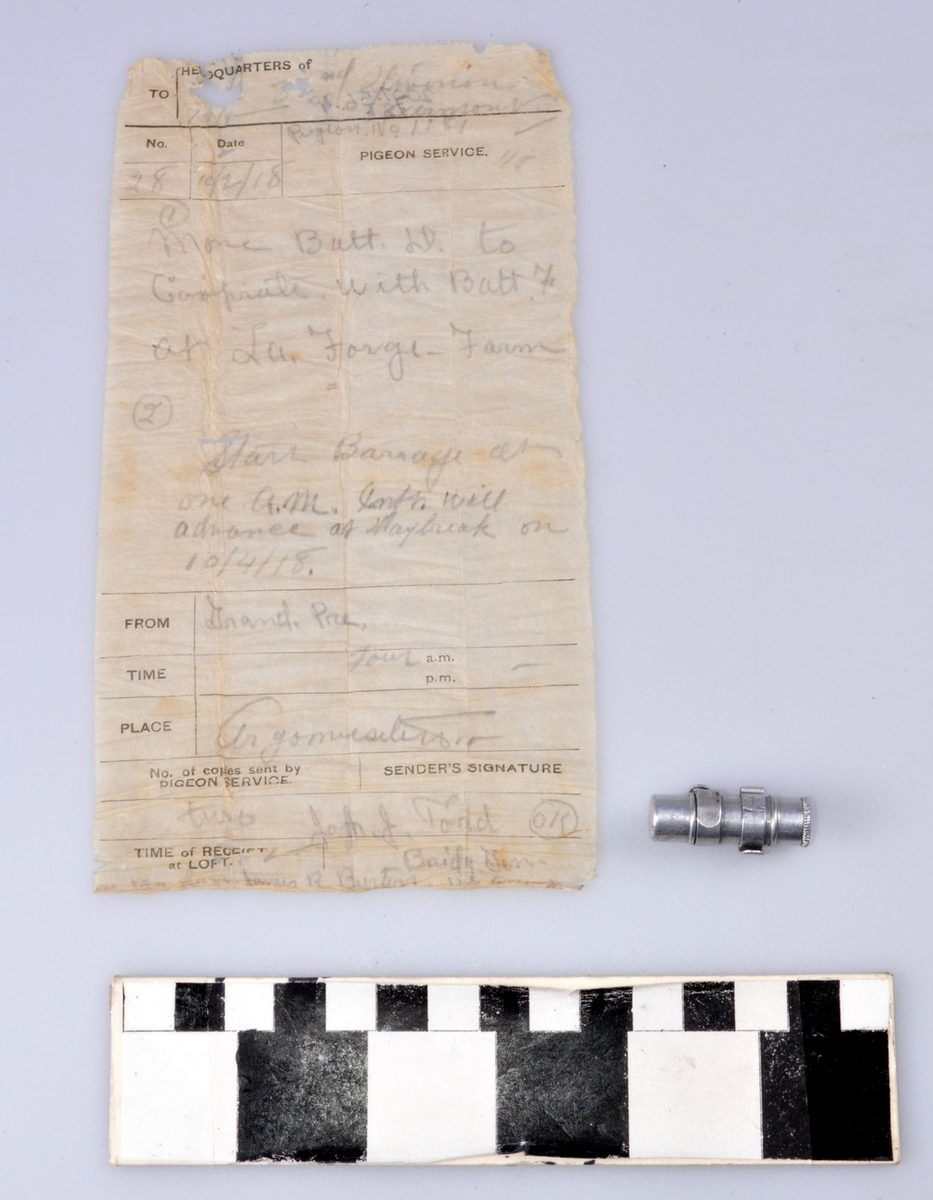
By the Second World War the design had split by job. Britain’s National Pigeon Service issued a red capsule, about the size of a 35mm film canister, for anything urgent enough to break a bird’s routine; black plastic capsules covered ordinary traffic. American services kept the same color logic in aluminum and, later, plastic tubes that twisted open rather than unscrewed.
What never changed was the part that actually mattered: the capsule held one short message, in the sender’s own hand, and needed no infrastructure beyond the bird that carried it. A telegraph needed a wire for its entire length. A courier needed a road. A pigeon needed sky, and the capsule needed only to survive whatever hit the bird wearing it.
Carrier Pigeons Carried Messages Long Before They Carried Orders
The capsule’s first major customer was not an army but a newswire. In 1850, a young entrepreneur named Paul Julius Reuter noticed a gap in the electric telegraph line between Brussels and Aachen and filled it with pigeons, flying stock prices between the two cities faster than the mail train could carry them. The business that stunt built eventually became Reuters.
Twenty years later the same bird did the opposite job: it kept a besieged capital in touch with the outside world after every other channel had failed. During the Siege of Paris in 1870 and 1871, the French government floated mail out of the city on gas balloons — sixty-seven of them went up over the 128-day blockade, carrying more than 11,000 kilograms of letters outward. Balloons, though, could only fly with the wind, which meant they could only leave. Getting a reply back into Paris required a bird that could fly against it.
A photographer named René Dagron solved the volume problem by shrinking the message rather than the bird. He photographed letters and reduced them onto collodion film at more than forty times smaller than the original, then rolled the film into quills light enough that a single pigeon could carry twenty of them at once. On arrival the film was flattened against glass and projected with a magic lantern so a clerk could transcribe it by hand. Between November 1870 and the city’s surrender on January 28, 1871, Dagron’s service is credited with carrying roughly 115,000 messages into Paris, each one capped at twenty words of strictly personal, non-military news.
Not every idea that siege produced worked. Postal officials also tried floating hollow zinc spheres down the Seine from outside the city, hoping nets inside Paris would catch them; the service began on January 4, 1871, and recovered not a single ball before the siege ended. The pigeon, unglamorous as it was, was the only two-way channel that actually worked.
The U.S. Army Built a Pigeon Air Force Almost From Scratch
The Signal Corps’ Pigeon Service got official authorization in November 1917, and by the end of the First World War it had sent more than 15,000 trained birds to the American Expeditionary Forces, organized into pigeon companies that assigned a group to every corps and division. Running it took 324 soldiers.
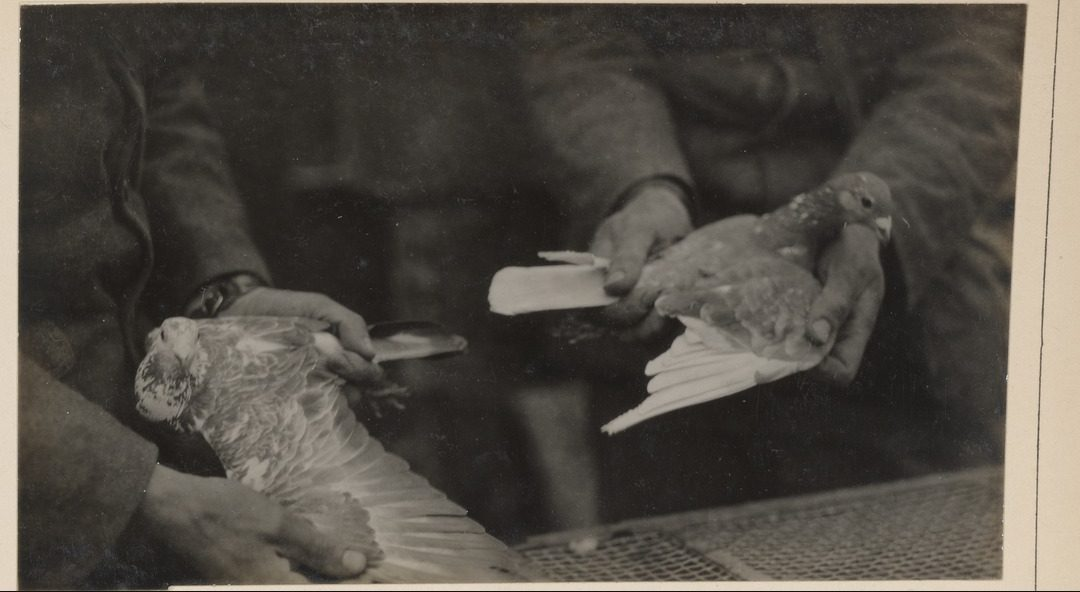
The mechanics were almost comically simple given what rode on them: a soldier at the front clipped a capsule to a bird’s leg band, wrote the message, rolled it inside, and released the bird toward the rear. The pigeon flew home to one place only — its own mobile loft, trucked as close to the line as the front allowed — where a handler waited at the trap for the wingbeats that meant a message had arrived.
Most of that traffic was unglamorous and anonymous, which is part of the point: the pigeon named Mocker carried thirty-three messages over the course of the war, including one on September 12, 1918, that located enemy artillery precisely enough for American guns to silence it within twenty minutes. Nobody remembers Mocker. The system worked whether or not a single flight became famous.
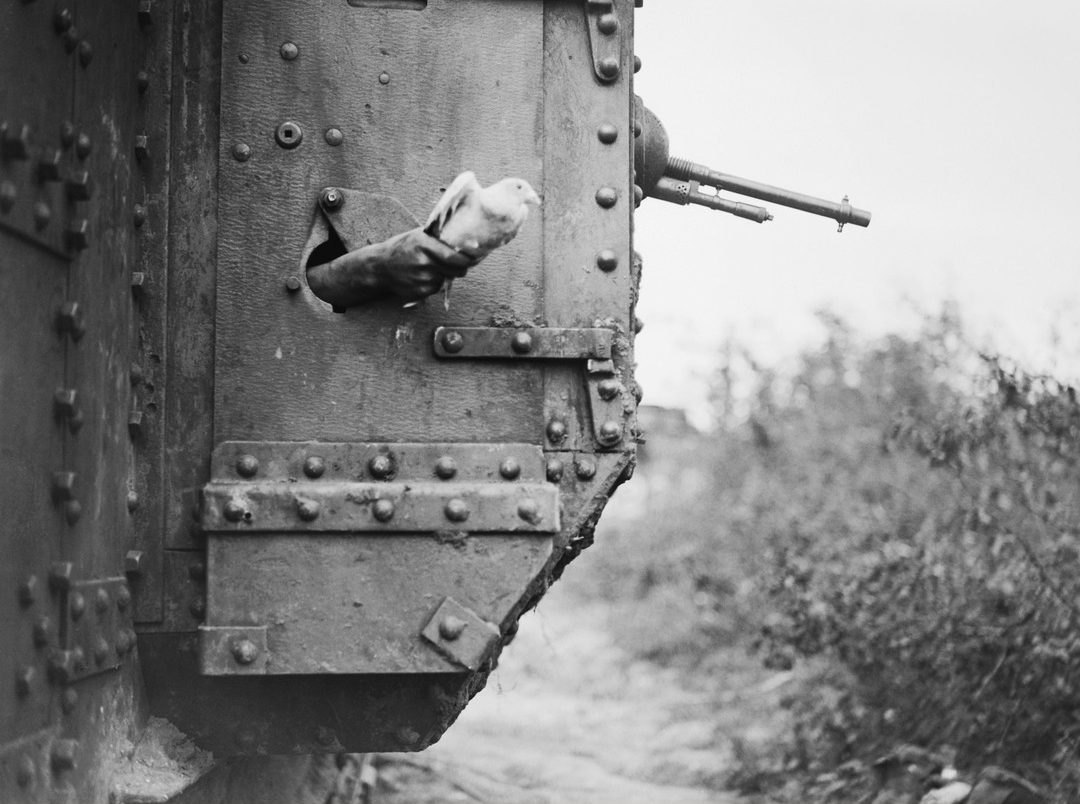
The British used the same bird even more aggressively, releasing pigeons from tanks and from forward observation posts that had no other way to report back once they’d outrun their own wire. A bird cost nothing to feed for the length of one flight and needed no trench dug to protect it.
What Cher Ami’s Flight Actually Shows, and a Correction Worth Making
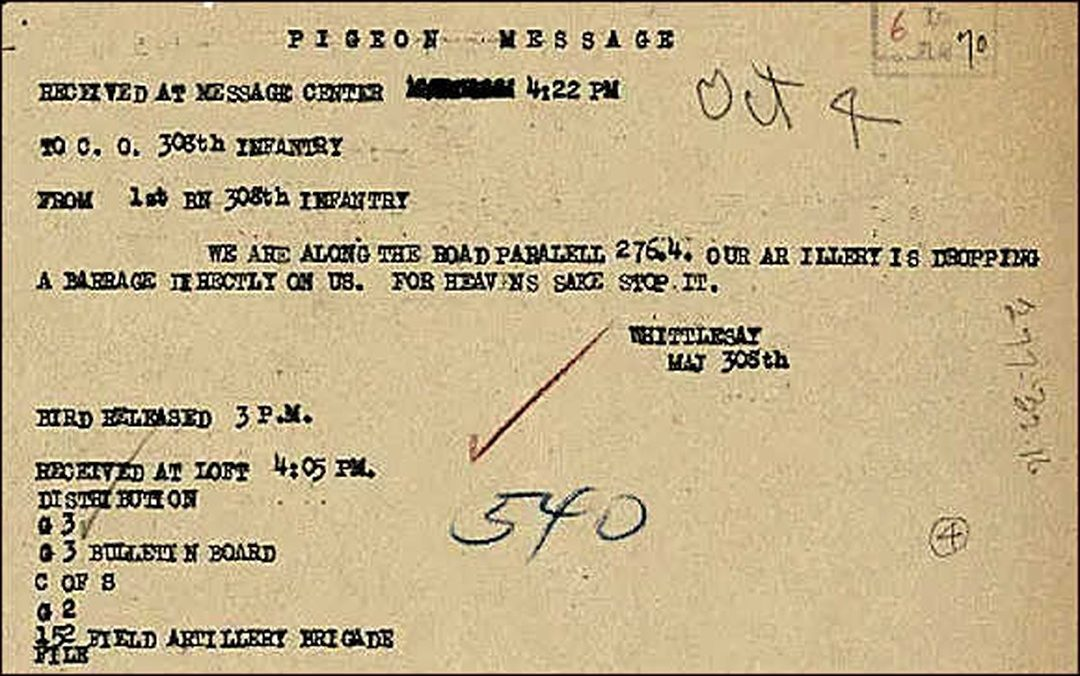
The record, as the Smithsonian preserves it, is specific. On October 4, 1918, Private Omer Richards released Cher Ami carrying a message from Major Charles Whittlesey’s cut-off battalion in the Argonne: “We are along the road parallel 276.4. Our own artillery is dropping a barrage directly on us. For heaven’s sake stop it.” The bird covered roughly twenty-five miles in about twenty-five minutes and arrived with a wound cutting through the breastbone and a right leg so badly damaged the Army amputated it.
Here is where the popular version usually gets something wrong: Cher Ami is frequently described as a Dickin Medal recipient. That is not possible on the dates alone — the Dickin Medal, Britain’s award for animal valor, was not created until 1943, a quarter-century after Cher Ami’s flight and death. The honors Cher Ami actually received were the French Croix de Guerre with palm, induction into the Racing Pigeon Hall of Fame in 1931, a gold medal from the Organized Bodies of American Pigeon Fanciers, and, in 2019, a separate and much newer American commendation, the Animals in War and Peace Medal of Bravery.
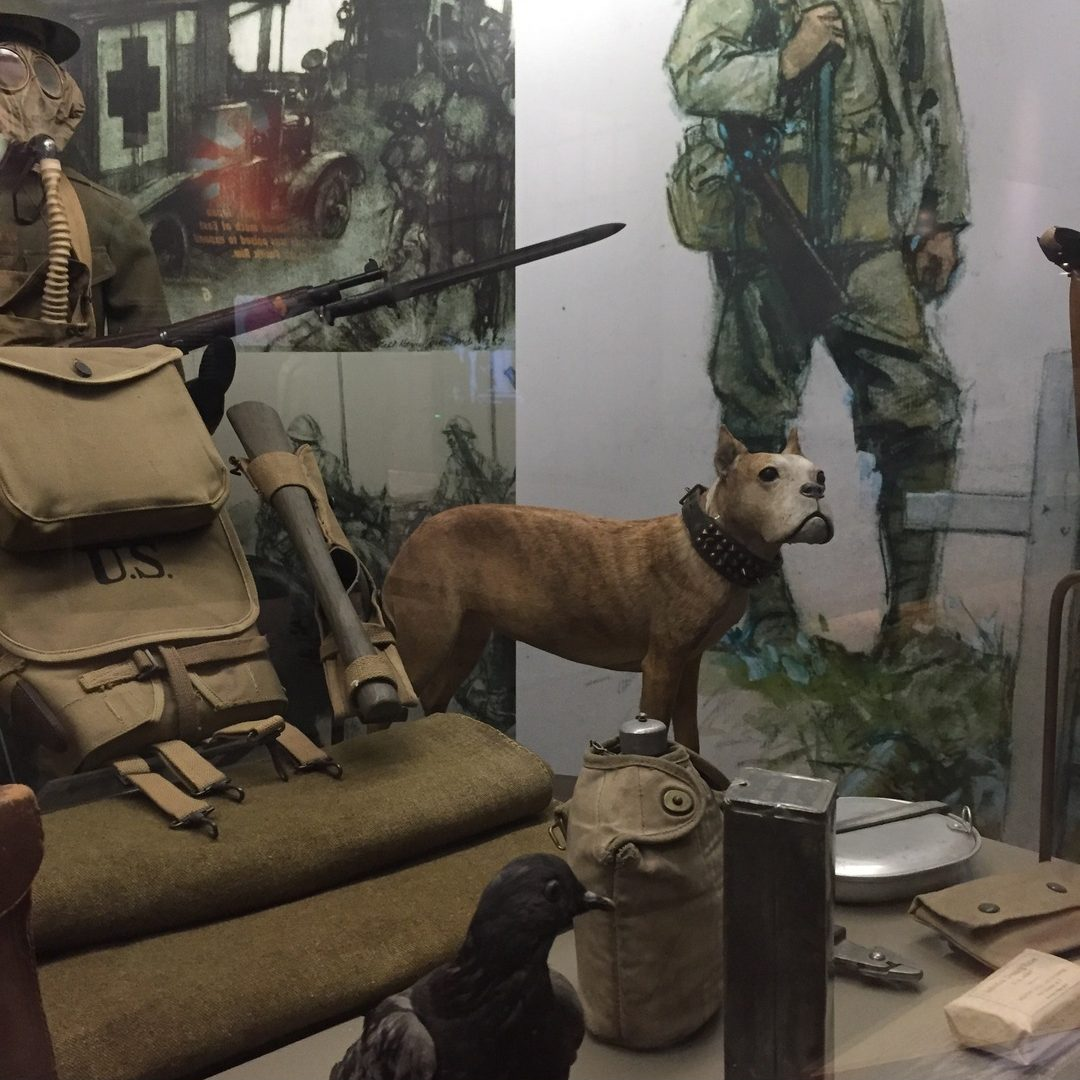
The pigeon died of its wounds on June 13, 1919, and was mounted by taxidermist Nelson R. Wood, which is how a bird that flew in 1918 ended up available for DNA testing in 2021. That test is also why “Cher Ami” — French for dear friend, a gender-neutral name — had been called “she” for a hundred years before the record was corrected. The mount is on permanent exhibit at the National Museum of American History.
Britain Trained a Quarter-Million Birds for the Next War
By the Second World War, the scale had grown again. The U.S. Signal Corps furnished some 54,000 pigeons to the armed services, roughly 36,000 of which deployed overseas; a breeding facility at Fort Monmouth could produce 1,000 birds a month, and around 40,000 more came free from civilian racing-pigeon fanciers who donated them outright. Under combat conditions, more than 95 percent of messages carried by U.S. Army pigeons reportedly got through.
Britain’s National Pigeon Service was larger still, though sources do not agree on by how much: one account puts it at roughly 200,000 birds, another at more than a quarter of a million. Nobody was keeping one master ledger across a program built largely from volunteers’ own lofts, so the gap between those two figures is itself a fair measure of how decentralized the whole operation actually was.
The most celebrated bird from that program never served Britain at all. On October 18, 1943, British troops of the 169th Infantry Brigade took the Italian village of Calvi Vecchia well ahead of schedule, with their radio out and Allied bombers already inbound to hit a target the brigade itself was now standing in. A pigeon named G.I. Joe covered twenty miles in twenty minutes to deliver the order calling off the raid, reportedly minutes before the bombers were due — credited with saving roughly a thousand Allied troops. London’s Lord Mayor awarded him the Dickin Medal in 1946, the first time it went to an animal that wasn’t British.
That medal, instituted in 1943 by PDSA founder Maria Dickin, has gone to seventy-six animals across every conflict since: thirty-eight dogs, thirty-two pigeons, four horses and one cat. Pigeons remain its single largest category, which is a fairly precise measure of how much weight — literal and otherwise — got put on a bird that fits in one hand.
Nobody Fully Agrees on How a Pigeon Finds Its Way Home
Every program above assumed the same unexplained trick: a bird released from a place it had never been, often hundreds of miles from its loft with no landmarks and no scent trail of its own making to follow, turns and flies home anyway. Militaries built entire communications strategies on that ability without anyone being able to say with confidence how it worked.
The two leading explanations compete directly. One holds that pigeons sense the Earth’s magnetic field through receptors linked to the trigeminal nerve in the upper beak and navigate by a kind of magnetic map. The other holds that they navigate largely by smell, building a mental map of atmospheric odors that varies by direction and distance from home. A 2009 study in the Journal of Experimental Biology tested both directly, surgically disabling trigeminal magnetic sensing in one group of pigeons and olfactory sensing in another before releasing both from unfamiliar sites. The magnetically impaired birds navigated about as well as untouched controls. The birds deprived of smell were dramatically worse at finding their way home.
That is evidence, not a verdict. Researchers still argue over how an odor map could function at the scale of hundreds of miles, and work on magnetic cues under other conditions continues. It is worth sitting with the honest version: a century of militaries, newswires and besieged governments built working communications systems around an animal ability that remains, in its mechanism, an open scientific question.
The capsule itself stopped mattering once electronics caught up. Militaries didn’t replace the pigeon with a better bird; they replaced the whole channel once encrypted radio became both reliable and secure enough to trust with the same traffic, and pigeon lofts stood down through the 1940s and 1950s on both sides of the Atlantic. What the capsule leaves behind is a fairly blunt reminder of how badly a pre-digital world needed a channel that couldn’t be cut, jammed, or wiretapped — and how far institutions were willing to go, breeding and training an actual air force out of a hobbyist’s bird, to get one.
Every one of those capsules depended on trusting an animal that cannot be given an order, only released. That may be the real reason nobody ever bothered improving on the capsule itself across a hundred years of otherwise constant upgrades. The hard problem was never the tube. It was always the bird.
Watch the full history
The short covers Cher Ami’s wounded flight out of the Argonne in under a minute; this is the century-long system that single flight was part of.

Related reading
- Who Really Invented the Telegraph Key (It Wasn’t Samuel Morse)
- Inside the Pneumatic Tube Networks That Once Ran a City’s Mail
- Wax Cylinder Recordings: How an Office Machine Ended Up Saving Languages
- Who Invented the Zipper? It Took Three Men and Sixty-Six Years
Shop the books mentioned
Works cited
- Smithsonian National Museum of American History. “Cher Ami.” Object record, catalog no. 1986.0711.01.
- “Animals in War and Peace: Signal Corps Pigeon Recognition.” U.S. Army, army.mil.
- “Honoring Those Who Served: Pigeon Memorial.” U.S. Army, army.mil.
- Naval History and Heritage Command. “The Navy’s Use of Carrier Pigeons.” history.navy.mil.
- PDSA. “PDSA Dickin Medal.” Link.
- Norman, Jeremy M. “René Dagron Operates the Pigeon Post into Paris.” HistoryofInformation.com. Link.
- Smithsonian National Postal Museum. “Siege of Paris Mail.” Exhibition page, postalmuseum.si.edu.
- Ponsford, Dominic. “Happy 200th Birthday to Paul Julius Reuter.” Press Gazette, 2016.
- Gagliardo, Anna, et al. “Navigational Abilities of Adult and Experienced Homing Pigeons Deprived of Olfactory or Trigeminally Mediated Magnetic Information.” Journal of Experimental Biology 212, no. 19 (2009): 3119-3124.
- Whitlock, Flint. “The National Pigeon Service: Our Fine Feathered Friends.” Warfare History Network.
- Jensen, Karen. “Birds of War.” World War II magazine, January 2009, via HistoryNet. Link.