
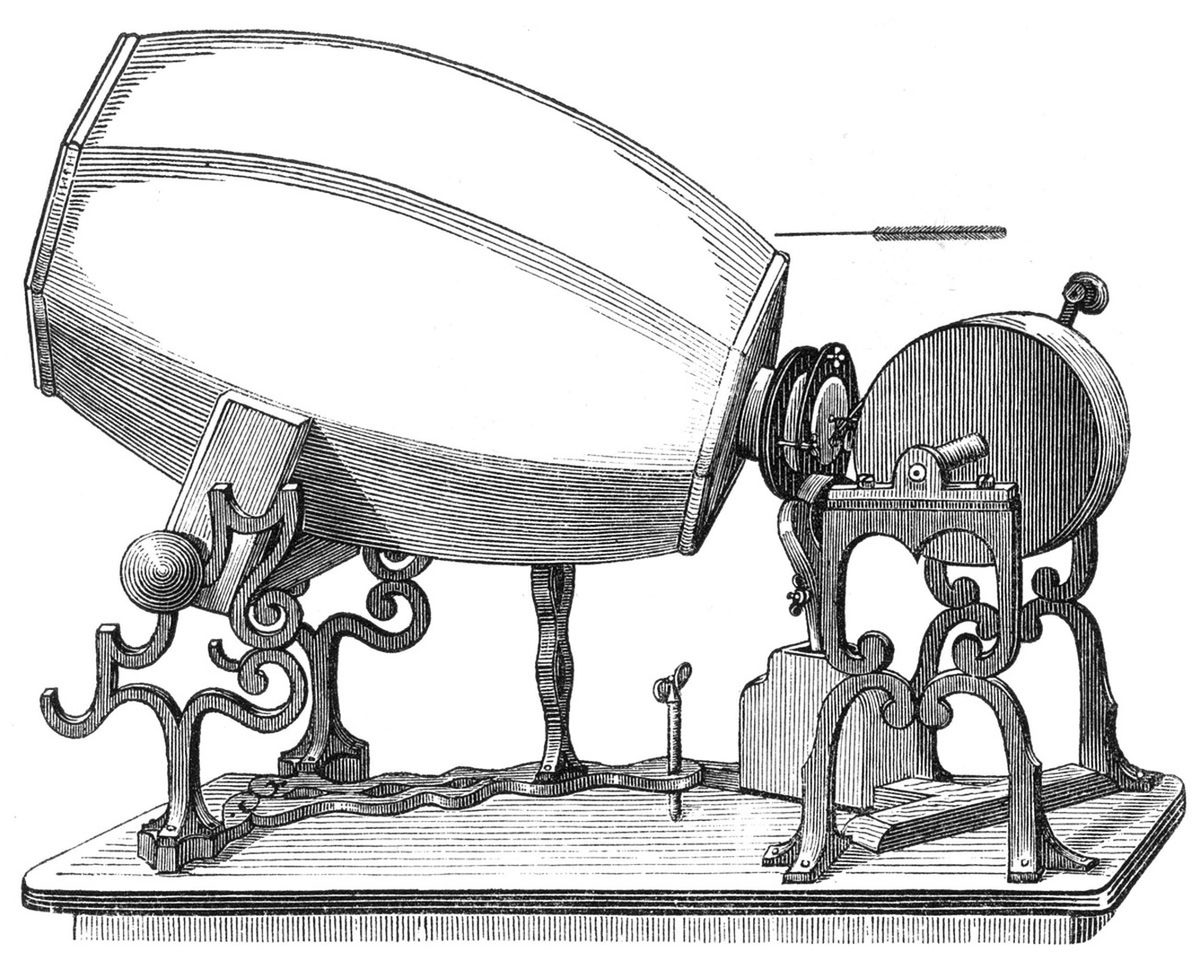
In April 1860, a Parisian print compositor named Édouard-Léon Scott de Martinville sang a few bars of “Au clair de la lune” into a horn-shaped funnel wired to a bristle stylus. The stylus traced the sound as a wavering line onto paper blackened with lamp soot. He had recorded a human voice seventeen years before Thomas Edison built anything that could talk back — and he had no way to play it back, and no apparent wish to. His phonautograph was built to draw sound, not to reproduce it, unlike the wax cylinder recordings that followed two decades later. The recording sat in an archive, unheard, for 148 years, until audio historians scanned the soot in 2008 and used restoration software to reconstruct the sound.
That gap between recording a sound and choosing to play it back is the real hinge of this story, and Edison did not close it on purpose either. He was trying to speed up the telegraph. What he built by accident, in December 1877, became the first machine in history that could store a sound and give it back later — and when he sat down the following June to write out what the thing was actually good for, music finished fourth.
The machine that resulted, and the fragile wax tubes it later played, went on to fail commercially at exactly the job Edison built it for, succeed wildly at a job he ranked far below it, and end up preserving something else again: the only surviving recorded voices of people and languages that nobody living has ever heard speak.
A Frenchman recorded a voice seventeen years before Edison — and never tried to play it back
Scott de Martinville patented his phonautograph in 1857 as a laboratory instrument, meant to make the physical shape of sound visible for study, the way an oscilloscope does today. It worked: the machine translated a voice into a wavering trace on paper. What it could not do was turn that trace back into sound, because nobody — including its inventor — had worked out how. For Scott de Martinville, the tracing was the point. Sound had been written down; nobody expected to hear it again. First Sounds, a group of American audio historians and preservationists, retrieved and digitized his phonautograms in 2008 using optical-scanning software developed at Lawrence Berkeley National Laboratory to convert the soot-blackened lines back into audio.
The reverse problem — how to get sound back out of a trace — was worked out on paper before anyone built a machine that did it. In April 1877, a French poet named Charles Cros deposited a sealed description of a device he called the paleophone, or “voice of the past,” with the Académie des Sciences in Paris. Cros proposed etching a groove that a stylus could later re-trace to reproduce the original sound. He had no laboratory and no funding, and never built a working model. The Académie opened his sealed envelope that December — by which point Edison, on the other side of the Atlantic, had already filed a patent for a machine that did what Cros had only described, and had one running in his own workshop. Cros’s idea was correct and, by him, essentially unbuildable. Edison’s was closer to an accident, and he built it in about thirty hours.
Edison stumbled into recorded sound while trying to build a faster telegraph
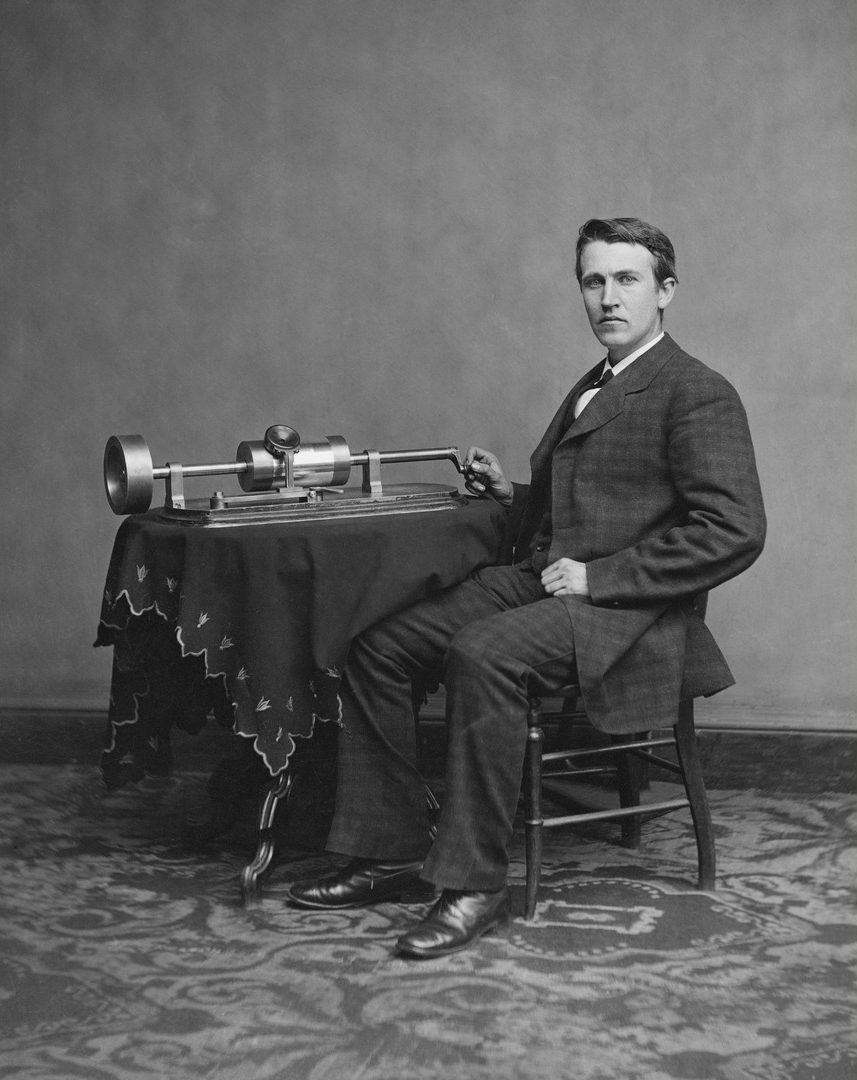
Edison did not set out to record sound. In 1877 his Menlo Park laboratory was trying to build a faster telegraph repeater, a machine that would emboss incoming Morse signals onto a moving paper disc for replay down the line at higher speed. He noticed that when the embossed paper ran through quickly, the indentations produced a faint, garbled sound resembling speech, and wondered what would happen with a diaphragm and needle instead of a telegraph key.
He sketched a tinfoil-wrapped cylinder with a mouthpiece on one side and a separate playback stylus on the other, and handed the drawing to his instrument maker, John Kruesi, who built it in roughly thirty hours without, by most accounts, believing it would work. (The often-cited date of August 12, 1877 is now considered unreliable; Edison’s assistant Charles Batchelor’s diary suggests the machine was actually finished and first tested in early December.) Edison turned the crank, spoke the opening line of “Mary had a little lamb” into the mouthpiece, reset the stylus, and cranked again. The cylinder repeated his words back to him almost perfectly. Nobody in the room had ever heard a machine talk, because no machine ever had.
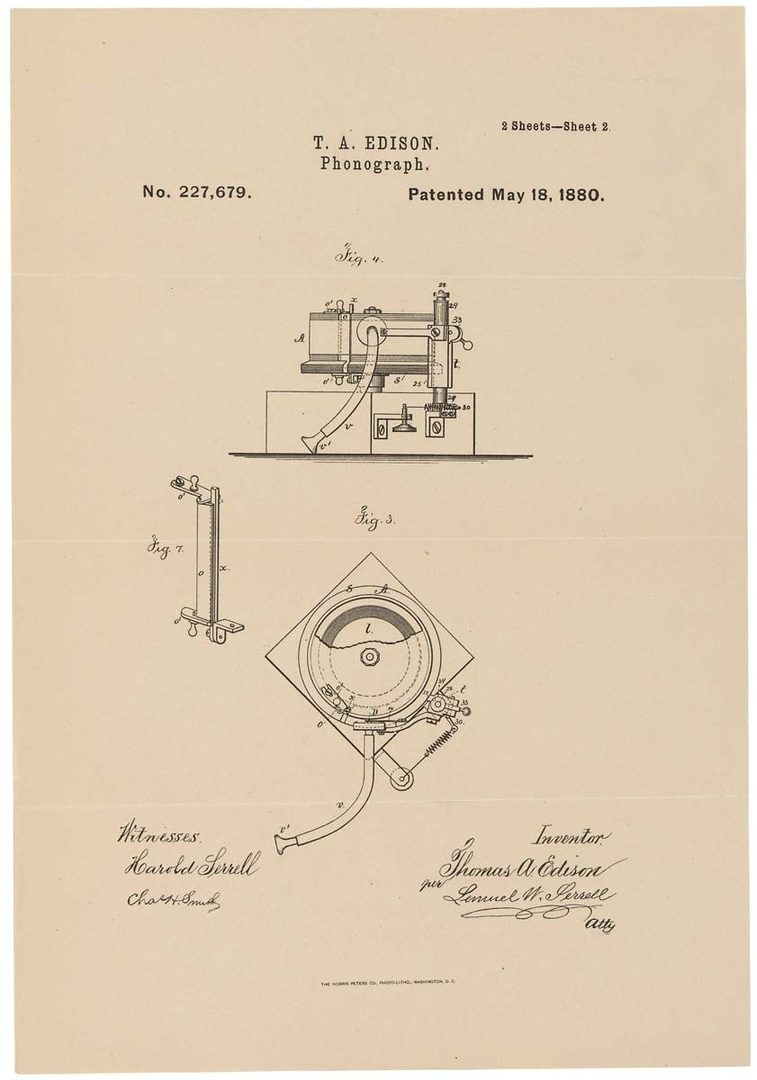
Edison filed for a patent on December 24, 1877; it was granted on February 19, 1878. He demonstrated the device to the editors of Scientific American, and was invited to the White House, where President Rutherford B. Hayes reportedly kept the household up past midnight so more of the family could hear it. Newspapers took to calling Edison the Wizard of Menlo Park almost immediately.
Edison ranked music fourth on his own list of what the phonograph was for
That June, Edison published an article in the North American Review laying out what he believed his invention was actually for, and the list is the strangest artifact in the whole story. Letter-writing and dictation came first. Phonographic books for the blind were second. Teaching elocution was third. Reproducing music was fourth — below dictation, below audiobooks, below speech lessons. Below music he listed a “family record” of relatives’ voices and the words of the dying, music boxes and toys, clocks that announced the time aloud, the preservation of languages, recordings for classroom use, and finally, pairing the phonograph with the telephone so that calls could be captured rather than heard once and lost. Edison had invented what would become the recording industry and filed it, on paper, under office equipment.
He then more or less dropped the project. Tinfoil made a poor recording medium: a sheet held its shape for only a handful of playings before the embossed grooves flattened out, and removing it from the cylinder without destroying the recording was close to impossible. Edison had a bigger idea to chase — the incandescent light bulb — which consumed most of his attention for the next several years, and the phonograph, still built around foil, sat largely untouched while its inventor went and invented something else entirely.
Tinfoil failed, wax won, and Edison refused to work with the lab that fixed it
Tinfoil’s flaws gave a rival laboratory its opening. In 1880 Alexander Graham Bell used the $10,000 French Volta Prize, awarded for inventing the telephone, to fund a Washington laboratory where he worked with his cousin Chichester Bell and instrument maker Charles Sumner Tainter on the phonograph’s most obvious weakness. Their fix was wax: instead of a needle denting foil, a floating stylus could cut a groove into a wax-coated cardboard cylinder, and a cut groove held its shape through far more playings. The design was patented on May 4, 1886, and shown publicly as the graphophone. Representatives of the lab approached Edison about collaborating. He refused, and set out to beat them at their own fix instead.
By 1888 Edison had built his own solid-wax cylinder machine, which he called the Perfected Phonograph, closely following the wax-and-floating-stylus approach Bell and Tainter had already patented. Both the graphophone and Edison’s new phonograph were then bought up by a businessman named Jesse Lippincott, who became sole licensee of the Bell-Tainter patents, purchased Edison’s phonograph company outright, and combined the machines under a new company, the North American Phonograph Company, formed in July 1888. Lippincott saw only one market for the device: the office. He leased phonographs to regional operating companies as dictation machines — exactly the use Edison had listed first in 1878.
It failed. Stenographers resisted the machines meant to replace or assist them, the wax cylinders were fragile and costly to replace, and the leasing business never covered its costs. Lippincott fell ill in 1890 and lost control of the company to Edison, its largest creditor, who shifted the business from leasing to outright sales. The underlying problem did not go away, and the North American Phonograph Company went bankrupt in 1894.
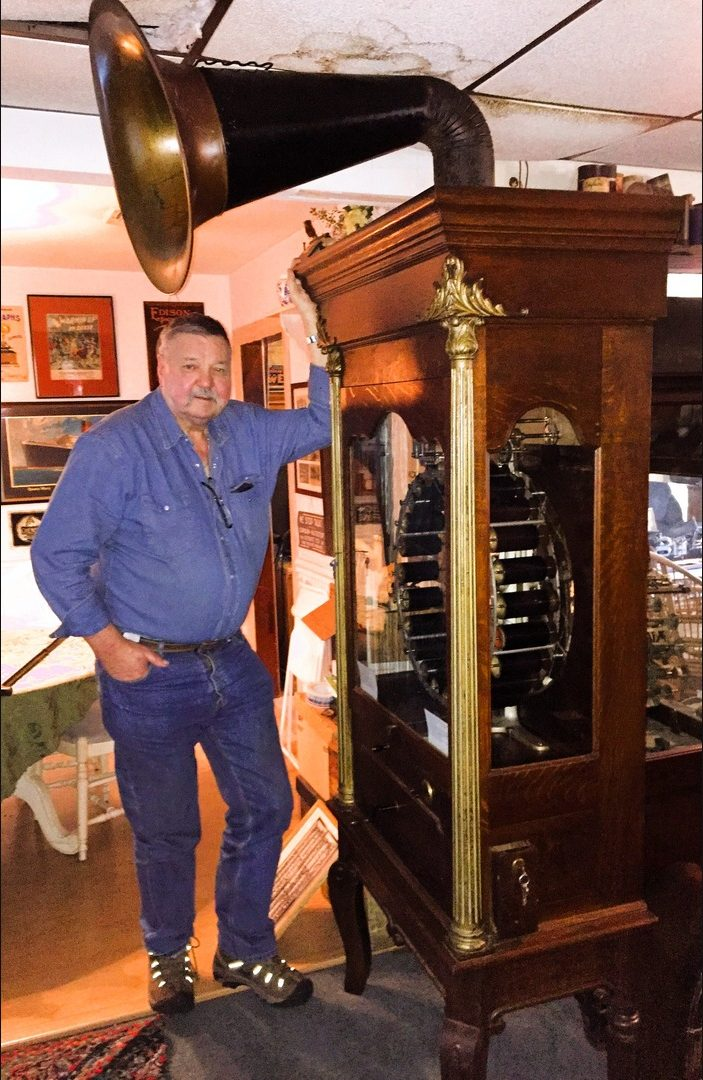
A saloon nickel machine did the job Edison’s dictation business couldn’t
On November 23, 1889, two San Francisco men named Louis Glass and William S. Arnold installed a modified Edison Class M phonograph in the Palais Royale Saloon. They had fitted it with a coin mechanism and four separate stethoscope-style listening tubes: drop a nickel in a slot, put a tube to your ear, and hear whatever cylinder was loaded, alone even in a crowded barroom. It earned roughly a thousand dollars in its first six months. By May 1890, fifteen of the machines were installed around the Bay Area, including on the Oakland-San Francisco ferries, and at the industry’s first national convention that year Glass reported his invention had taken in more than four thousand dollars in nickels.
Nothing on Edison’s 1878 list mentioned coin slots or saloons. The entertainment use he had ranked fourth turned out to be the one people would pay for directly and repeatedly, while the office dictation business kept failing. Not every entertainment idea landed: in 1890 the Edison Phonograph Toy Manufacturing Company built a talking doll with a tiny wax cylinder in its torso, reciting a nursery rhyme. The sound was thin and unsettling coming out of a doll’s chest, sales collapsed within months, and Edison’s arrangement with the doll company ended by March 1891.
The cheapest item on Edison’s own list is why wax cylinder recordings still matter
Until a mechanical fix arrived, there was no way to copy a wax cylinder. Every single cylinder sold had to be performed into a bank of recording horns, live, take after take, for as long as demand lasted. George W. Johnson, recruited in New York in early 1890 by two rival phonograph distributors, became the first Black recording artist in America this way, singing and whistling two songs for a flat fee per two-minute cylinder. Recorded-sound historian Tim Brooks estimates Johnson’s total sales at 25,000 to 50,000 individual cylinders between 1890 and 1895 — meaning Johnson performed the same two songs, alone in front of a bank of horns, that many separate times. They were the best-selling recordings in the country, and making them was piecework in the most literal sense.
A fix for mass duplication did not arrive until 1901, when Edison’s operation began producing “gold moulded” cylinders: a hardened wax master coated in a thin layer of gold by vapor deposition, from which as many as 150 duplicate cylinders could be pressed in a single day. Before that fix existed, the same live-recording-only limitation had already been put to a very different use — and it is the one item on Edison’s 1878 list, the preservation of languages, that this format actually delivered on. In March 1890, an anthropologist named Jesse Walter Fewkes carried a phonograph to Calais, Maine, and recorded Passamaquoddy speakers Noel Josephs and Peter Selmore performing songs and stories: the first ethnographic field recordings made anywhere with the new technology. Decades of the same practice followed. Frances Densmore, working for the Smithsonian’s Bureau of American Ethnology from 1907 onward, eventually recorded more than 2,000 wax cylinders of Native American music and speech across dozens of nations, now held mostly at the Library of Congress’s American Folklife Center. In a number of documented cases, those cylinders are the only surviving recordings of a language or a specific ceremonial song.
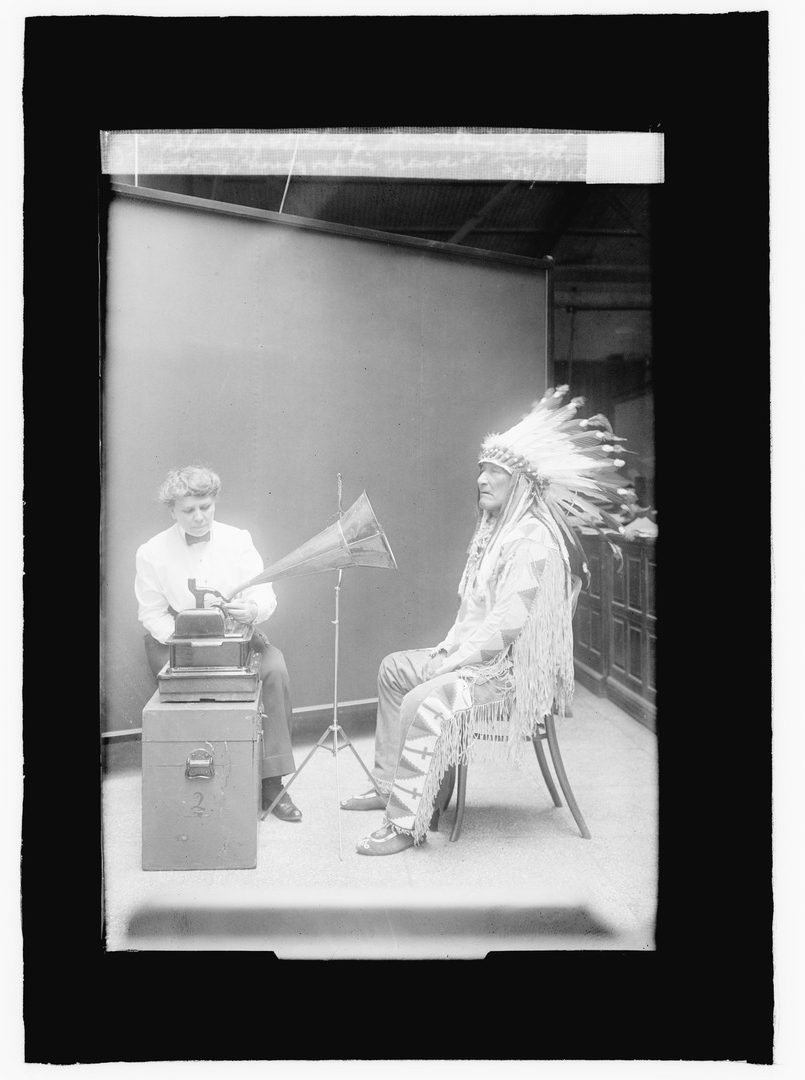
The cylinder lost the format war, and Edison kept making it until days before Wall Street crashed
None of this saved the wax cylinder as a format. Emile Berliner’s flat disc, developed through the 1890s, could be stamped from a single metal master by the thousand, played louder, and stored flat on a shelf instead of standing in a fragile tube. By the mid-1910s the disc had effectively won: Columbia stopped making cylinders in 1909, and the smaller U.S. Phonograph Company gave up its cylinder line in 1913, leaving Edison the format’s last serious maker.
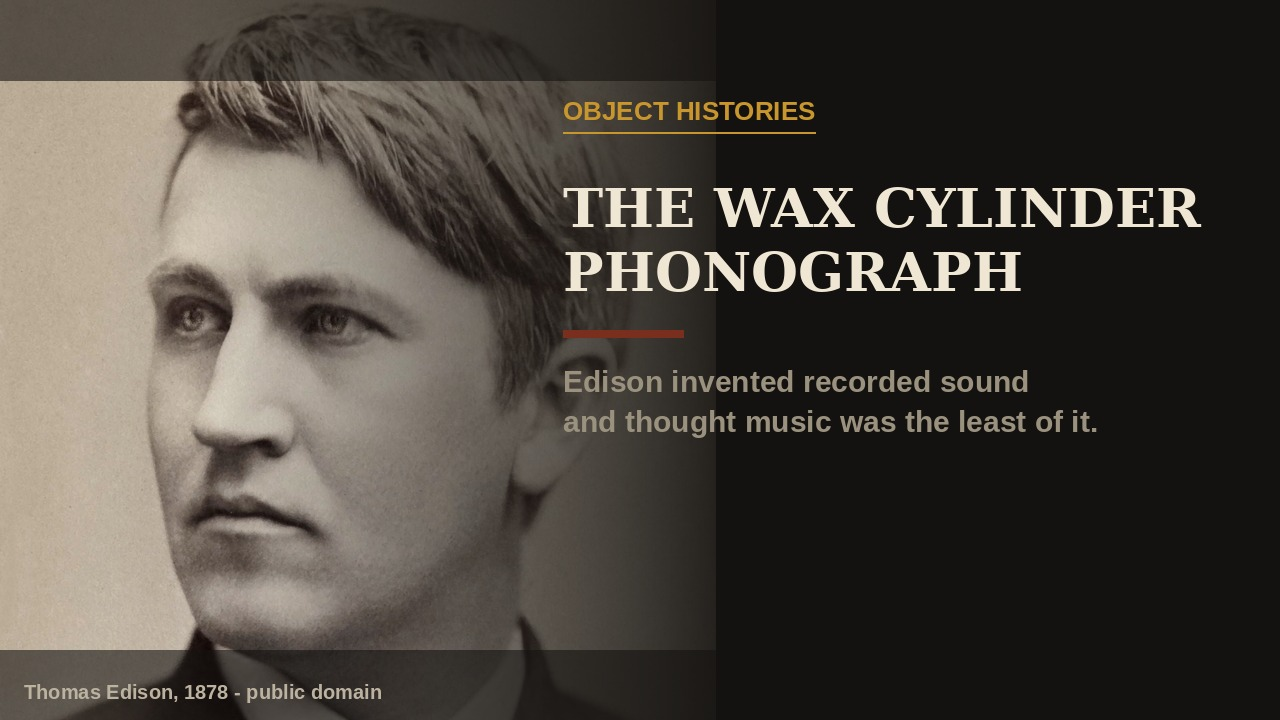
Edison kept going anyway. In 1908 he introduced the four-minute Amberol cylinder to compete with discs on playing time, and in 1912 the unbreakable Blue Amberol, made of celluloid over plaster rather than wax. He conceded the format war in 1913 by launching his own Edison Disc Phonograph alongside the cylinder line, but never dropped cylinders outright. Thomas A. Edison, Inc. ordered its phonograph record business closed on October 21, 1929, and halted production within days — right around the stock market crash that began with Black Thursday on October 24.
He had been right about one thing on his 1878 list. Dictation machines using shaved, reusable wax cylinders remained standard office equipment for decades after the entertainment cylinder died, evolving into Ediphones and, later, the office Dictaphones of mid-century America. Edison had filed the phonograph under office equipment in 1878. He was only about fifty years early, and the machine ended up mattering for reasons that were not on his list at all.
Watch the full history
The video version covers the invention, the format war, and Edison’s own ranked list of uses in just under eight minutes.

The wax cylinder’s real legacy is not the format that won — it lost, decisively — and not even the recording industry it accidentally founded, which soon moved on to disc, then tape, then formats Edison could not have imagined. Its legacy is the narrow use he ranked eighth out of ten: hundreds of hours of Passamaquoddy, Ojibwe, Blackfeet and dozens of other nations’ songs and speech, captured because a fragile wax tube happened to be the only recording technology available the moment fieldworkers went looking.
None of it was Edison’s plan. He built a machine to speed up the telegraph, believed its real future was in the office, and was wrong about nearly everything else on his own list. What survives is mostly the accident: thousands of two-minute tubes of wax holding voices that would otherwise have vanished with the people who made them, some now digitized and returned to the communities that first sang into the horn.
Would you want your voice preserved for a hundred years?
Related reading
- How Icehouses Worked Before Refrigeration: The Physics, the Industry, and the People Who Cut the Ice
- Who Invented the Zoetrope? Three Men Have a Claim
- How a Root Cellar Kept Vegetables All Winter: The Farm’s Biggest Refrigerator Was a Hole in the Ground
- How Ear Trumpets Worked: The Physics, the Disguises, and What a Brass Horn Really Did for Hearing
Shop the items in this history
- Audio-Technica AT-LP120XUSB turntable (converts vinyl to digital)
- Vintage-style copper horn gramophone replica
- The Wizard of Menlo Park by Randall Stross (Edison biography)
- Digital voice recorder, the dictation machine’s descendant
Works cited
- Gelatt, Roland. The Fabulous Phonograph: From Tin Foil to High Fidelity. J. B. Lippincott Company, 1955.
- Millard, André. America on Record: A History of Recorded Sound. Cambridge University Press, 1995.
- “History of the Cylinder Phonograph.” Inventing Entertainment: The Early Motion Pictures and Sound Recordings of the Edison Companies. Library of Congress. (loc.gov; retrieved via cache, direct requests blocked by bot wall)
- “Origins of Sound Recording: Édouard-Léon Scott de Martinville.” Thomas Edison National Historical Park, U.S. National Park Service. Link.
- “Édouard-Léon Scott de Martinville.” First Sounds. Link.
- Revak, Jessica. “Jesse Walter Fewkes Field Recordings of the Passamaquoddy Indians (1890).” Library of Congress National Recording Preservation Board. Link.
- “Frances Densmore Chippewa/Ojibwe Cylinder Collection (1907–1910).” Library of Congress National Recording Preservation Board. Link.
- Brooks, Tim. “George W. Johnson, the First Black Recording Star.” timbrooks.net. Link.
- “Flashback 1889: Coin-Op Phonograph Foreshadows Jukebox.” Sound & Vision, December 1, 2016. (soundandvision.com; site blocks automated requests)
- “Closing Edison’s Phonograph Division: The Internal Company Documents (October–November 1929).” Mainspring Press, June 15, 2024. (mainspringpress.org; site blocks automated requests)