
The first American patent for chewing gum was filed by a dentist who wanted to build stronger jaws, not sell candy, and it went nowhere. The version that conquered the world started two years later and came out of a completely different failure: an exiled president’s attempt to invent a cheap rubber substitute. That tangle of accidents is closer to how chewing gum was invented than the tidy origin story most people repeat.
None of it happened in a vacuum, either. People on three different continents had already been chewing tree resin for thousands of years before a single patent existed, for reasons that had nothing to do with each other and everything to do with how satisfying it is to chew something.
People Were Chewing Resin Thousands of Years Before Anyone Called It Gum
Nine thousand six hundred years before anyone patented a rubber substitute, a group of teenagers on the west coast of Sweden were already chewing gum. Archaeologists excavating a site called Huseby Klev found small blackened lumps of birch bark tar, each one carrying the clear imprint of human teeth, in a pit dated to roughly 10,040 to 9,610 years before the present. The lumps were boiled-down tree pitch, probably softened by chewing for use as an adhesive, or simply because it felt good in the mouth. What makes them remarkable is not the chewing. It is what survived inside them: enough saliva, trapped in the resin for ten millennia, that researchers extracted full human genomes from three separate chewers, along with the bacterial signature of the gum disease at least one of them had.
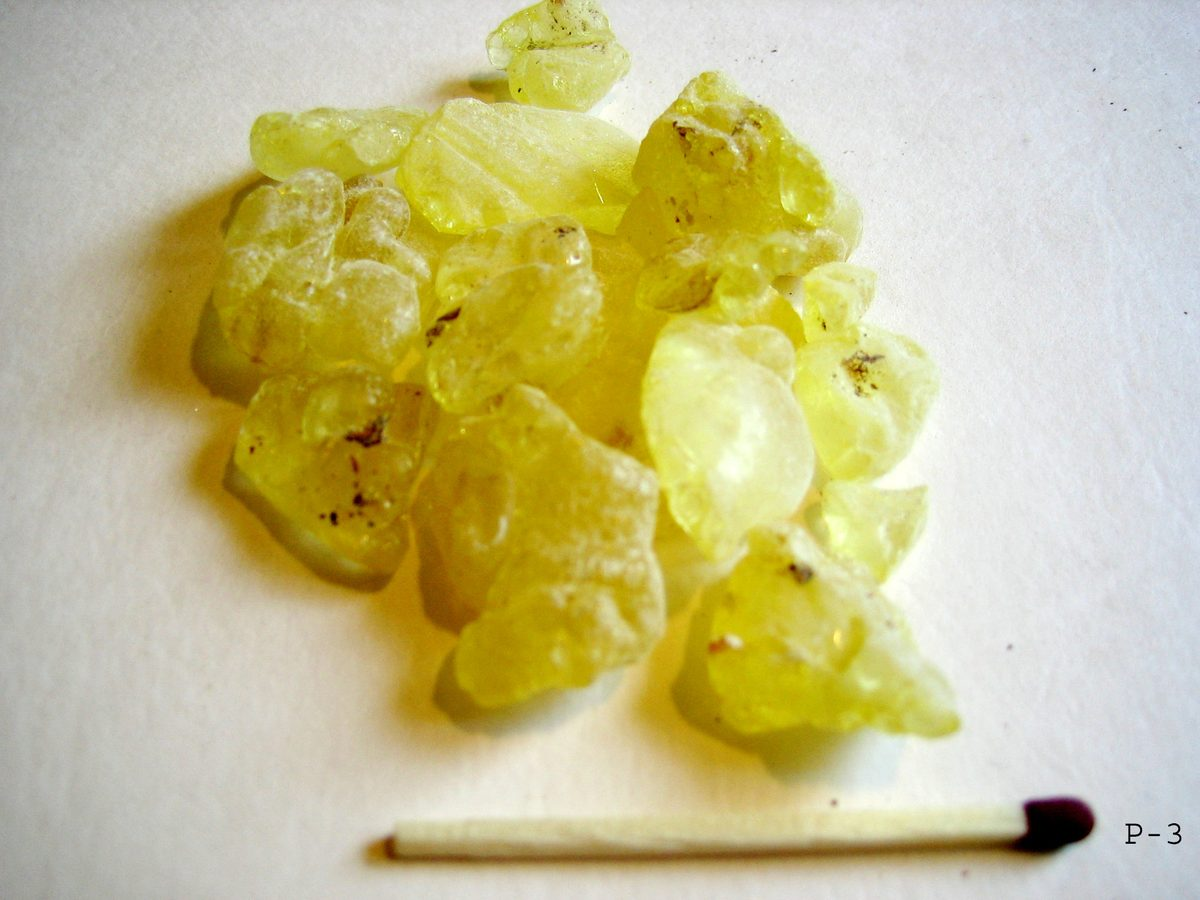
Mastic did a similar job for the ancient Mediterranean. Resin tapped from Pistacia lentiscus trees, concentrated almost entirely on the Greek island of Chios, was chewed by the Romans to clean their teeth and sweeten their breath, and the practice never really stopped — mastic is still harvested and sold on Chios today. Half a world away, the Maya were doing something similar with an entirely different tree. They called it tzictli: a firm white latex tapped from the sapodilla tree across the Yucatan Peninsula, chewed for at least a thousand years before any European set foot in the region, and later adopted by the Aztecs for the same purpose.
Three unrelated cultures on three different continents independently landed on the same basic idea with three unrelated trees, centuries or millennia apart. None of them had a word for “gum” as a product you could buy. That part took a ruined army.
How Chewing Gum Was Invented by a Ruined General’s Failed Rubber Scheme
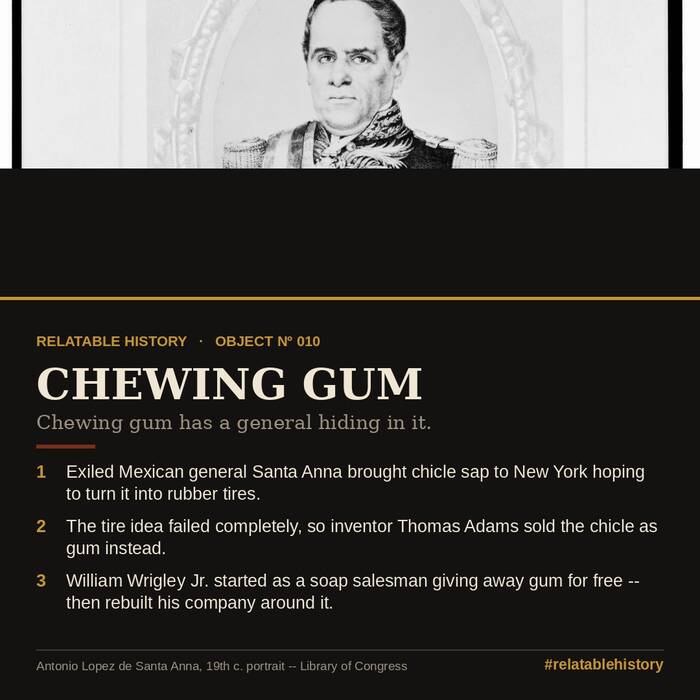
By 1869, Antonio López de Santa Anna had lost almost everything a nineteenth-century Mexican general could lose. He had lost the Alamo, lost Texas, lost the Mexican-American War, and been removed from the presidency he had held, on and off, eleven separate times. Exiled on Staten Island and nearly broke, he had one asset left: a stash of chicle, the same sapodilla latex the Maya had chewed for a millennium, which he hoped could become something far more lucrative than gum. Vulcanized rubber was reshaping American manufacturing, and Santa Anna believed chicle might be a cheap substitute for it, usable in tires, rubber boots, almost anything. He brought it to a Staten Island photographer and part-time inventor named Thomas Adams.
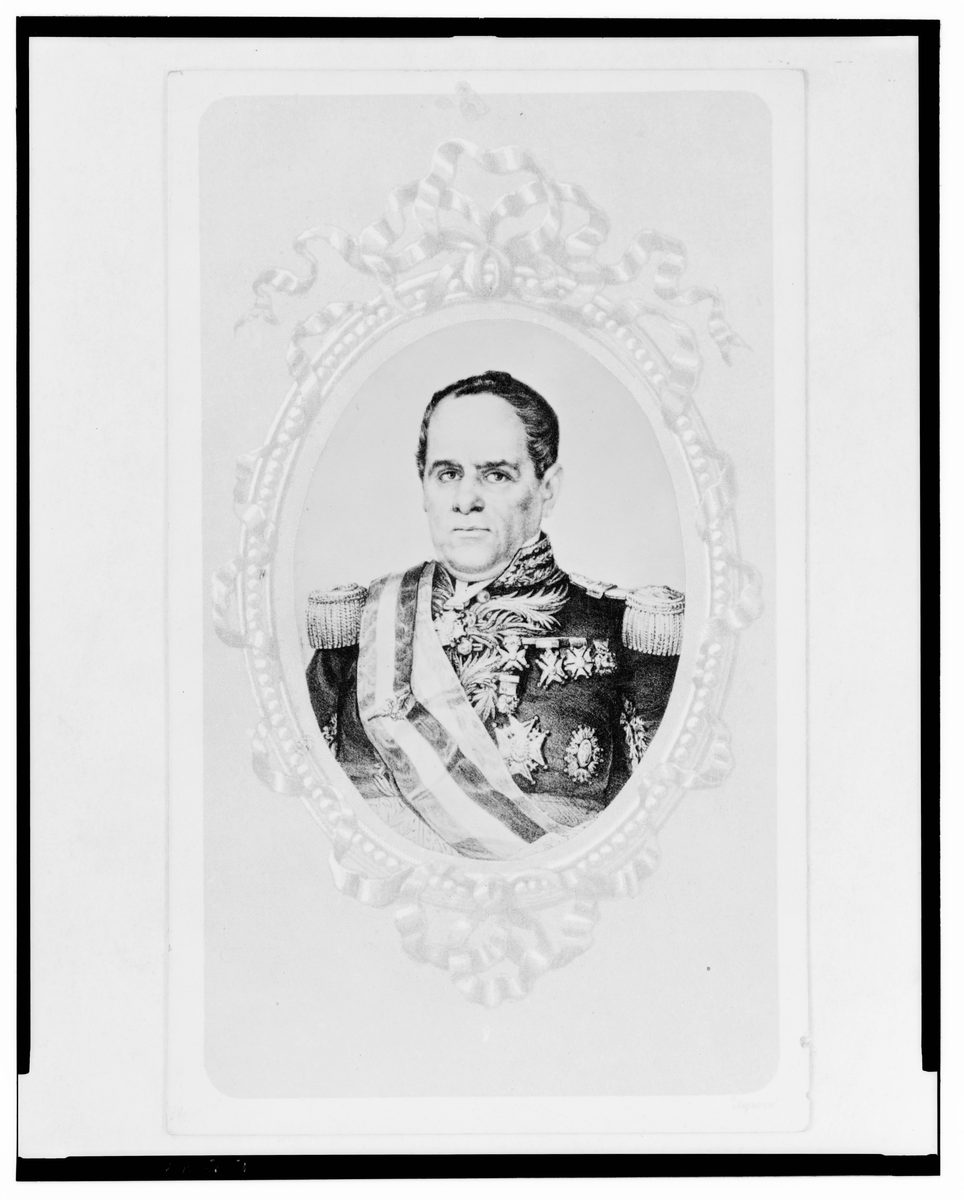
Exactly how the two men struck their arrangement, and how much Santa Anna ever profited from it, is genuinely disputed — the general’s own accounts of his American exile are unreliable, and Adams left no detailed record of the deal. What is well documented is what happened next. For more than a year, Adams boiled batch after batch of chicle, trying every method he knew to vulcanize it. It never once behaved like rubber.
What he did instead is the part that counts as an invention. Adams already knew that drugstores sold a crude paraffin-wax gum, and that chicle, straight off the tree, chewed better than wax ever could. So he abandoned the rubber scheme, rolled plain, unflavored chicle into pellets by hand, and sold them through a local drugstore. They sold out immediately. On February 14, 1871, Adams patented a chicle-preparation process — softening the raw sap in hot water to strip out bark and impurities, yielding a product he described as free of odor or taste until it warmed in a chewer’s mouth. He called it Adams New York Gum No. 1.
The Patent Nobody Remembers, and the One That Built an Industry
Adams was not actually first. Two years earlier, on December 28, 1869, an Ohio dentist named William F. Semple had filed the very first American chewing-gum patent, number 98,304. Semple’s gum had nothing to do with chicle: his formula dissolved rubber in naphtha and alcohol, then mixed the resulting jelly with powdered chalk and licorice root, and he pitched it less as a treat than as a dental tool — a “dentifrice,” in his own patent language, that would scour teeth clean while giving the jaw a workout. Semple never built a company around it. He simply held the patent, and by the time Adams’s chicle gum took off two years later, the dentist’s rubber-and-chalk version was already forgotten. Timing, not originality, decided whose name survived.
The chicle supply chain behind Adams’s success was its own specialized trade. Workers called chicleros cut a herringbone pattern of overlapping diagonal gashes into a sapodilla tree’s bark, spaced roughly sixteen inches apart up the trunk, so the latex bled downward into a bag tied at the base. The raw sap ferments almost immediately, so it had to be boiled down within days: three to six hours of careful stirring over a low fire, reducing it to roughly a third of its original moisture without scorching it. The cooked chicle was poured into greased wooden molds to set into blocks of fifteen to thirty pounds, then carried out of the forest by mule. Chicleros were paid by the pound, which meant the fastest way to earn more was to cut deeper and tap harder — a practice that scarred, and eventually killed, many of the trees it depended on. By the late 1880s, Adams’s operation was turning that raw material into roughly five tons of finished gum a day, with flavored lines like the licorice-scented Black Jack and the wildly popular Tutti-Frutti, which, according to company lore, became the first product ever sold from a vending machine, installed on a New York City subway platform in 1888.
A Soap Salesman’s Giveaway Built the Biggest Gum Company on Earth
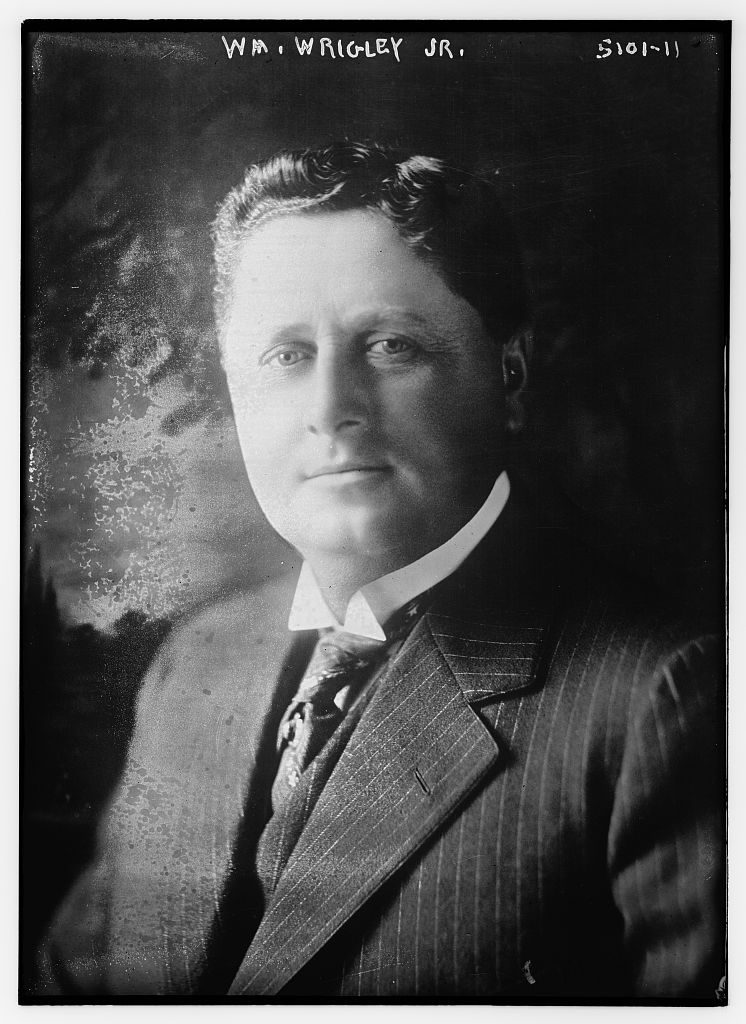
Gum’s second founder started out selling something else entirely. In the early 1890s, William Wrigley Jr. was a Chicago soap salesman who threw in free baking powder as an incentive with every purchase. Customers, he noticed, wanted the baking powder more than the soap. So he switched products and started throwing in free sticks of chewing gum instead. Customers wanted the gum more than the baking powder. By 1893, Wrigley had dropped soap and baking powder both, launching Juicy Fruit and Wrigley’s Spearmint and betting his entire company on gum.
He was also a genuinely aggressive advertiser for his era. During the financial panic of 1907, when most companies were cutting spending, Wrigley borrowed $250,000 and used it to buy newspaper and billboard space going for pennies on the dollar during the panic — roughly $1.5 million worth of placements at those depressed prices — paired with free-sample coupons for retailers. The gamble carried Wrigley’s Spearmint from a regional product to national distribution by 1910. In 1915 he went further still: his company mailed free samples of gum to an estimated 1.5 million Americans, a scale of unsolicited direct marketing almost nobody had attempted before. Wrigley’s own stated philosophy was blunt: tell them quick, and tell them often.
Two World Wars Turned an American Habit Into a Global One
Gum’s spread beyond the United States has a specific cause, and it is not advertising. The U.S. Army’s quartermaster department placed standing orders for millions of packages of chewing gum during the First World War, enough that every American soldier serving overseas received it as a regular part of his rations — a practice the Second World War expanded dramatically. Wrigley, by then the dominant manufacturer, discontinued its Spearmint, Doublemint, and Juicy Fruit brands for the domestic civilian market entirely, redirecting production to the military so troops overseas would not go without. In their place, the company introduced a new brand, Orbit, in 1944, sold at home as a wartime substitute while the familiar flavors went to war; a “Remember This Wrapper” advertising campaign promised Americans their old brands back once the fighting ended.
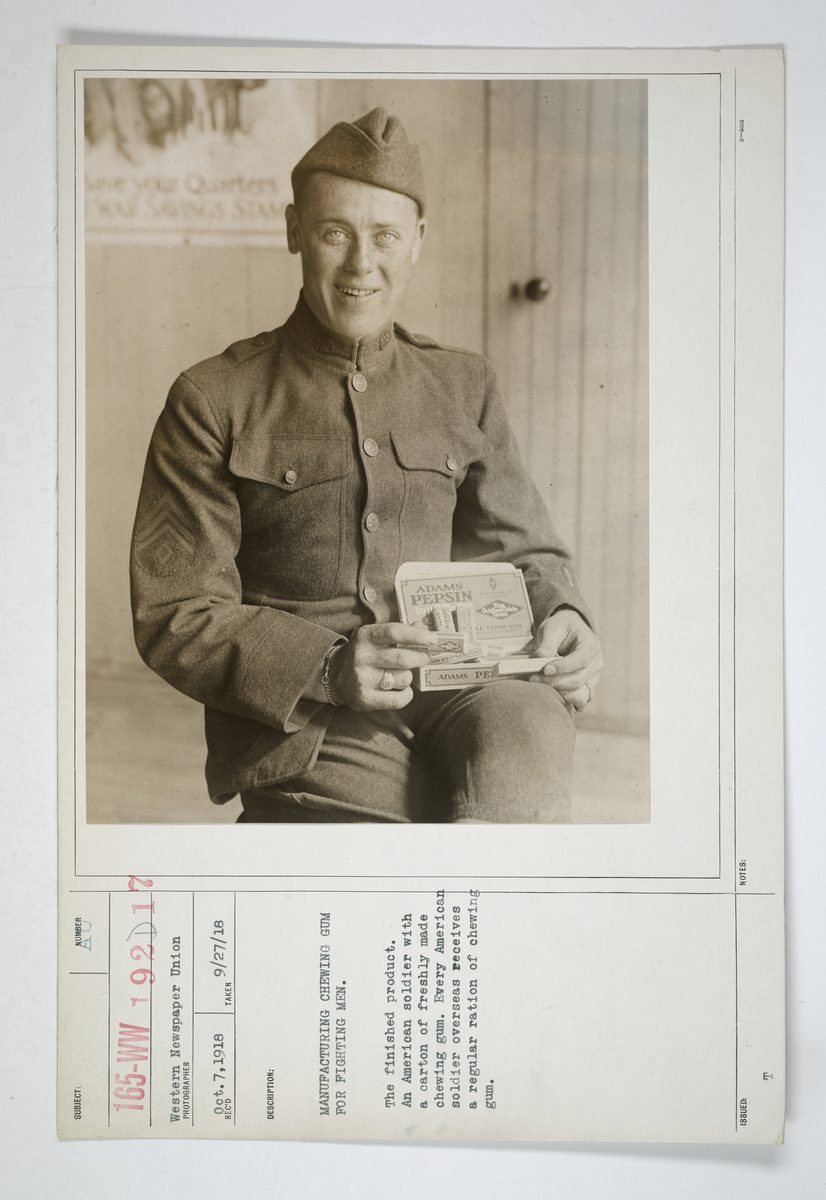
Overseas, gum became something closer to diplomacy than confectionery. American soldiers handed out sticks to children across liberated Europe and occupied Japan, and “got any gum, chum” became one of the first scraps of English plenty of those children learned. It is a small, sticky explanation for why chewing gum still reads as reflexively American almost everywhere it is sold, decades after Wrigley’s wartime rationing ended and Orbit was quietly discontinued.
An Accountant With No Chemistry Training Solved What Professional Chemists Couldn’t
Bubble gum took far longer to invent than ordinary chewing gum, because blowing a bubble and chewing a stick require almost opposite properties: enough elasticity to stretch into a thin film without tearing, but not so much stickiness that the result is impossible to peel off skin and hair afterward. A Philadelphia candy manufacturer named Frank Fleer, a German immigrant, tried to solve it as early as 1906 with a formula called Blibber-Blubber. It stretched beautifully and burst badly, leaving a sticky residue that reportedly had to be scraped off children’s faces. It never reached shelves, and Fleer died in 1921 without cracking the problem.
It was finally solved in 1928, inside the same Fleer factory, by a twenty-three-year-old accountant named Walter Diemer who had no chemistry training at all. Experimenting with gum-base batches on his own time, Diemer landed on a mixture elastic enough to blow and pop without turning to shrapnel, and easy enough to clean off a face or a sidewalk. The batch came out an unappealing gray, so he dyed it pink — the color bubble gum has stayed, almost without exception, for nearly a century since. Diemer named it Dubble Bubble. He received no royalties and no formula credit beyond his regular salary; by his own later account, the accountant who solved what chemists at his own company could not held no grudge about it.
What Replaced the Sap, and the Wall Built Entirely From What’s Left Over
Chicle itself did not survive its own success. Sapodilla trees take years to recover after tapping, and by the mid-twentieth century global demand for chewing gum had outgrown what Central American forests could sustainably supply without being stripped bare for it. Through the 1950s and 1960s, manufacturers largely replaced natural chicle with synthetic gum bases built from petroleum-derived polymers — cheaper, more consistent between batches, and no longer dependent on a chiclero’s machete and a mule train. The overwhelming majority of gum chewed today has never touched a sapodilla tree; chicle has become a boutique ingredient for a handful of brands that market themselves on exactly that history.
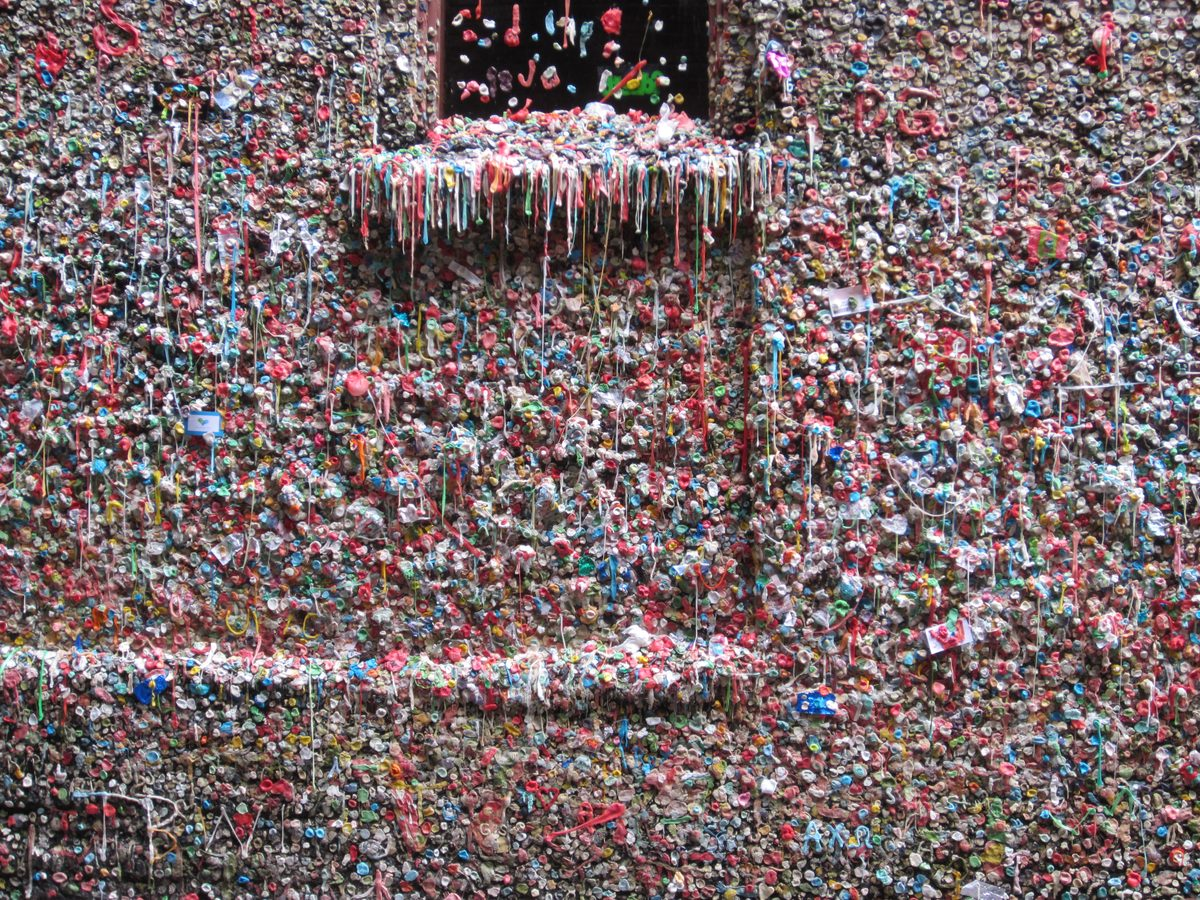
What that synthetic base supplies, above all, is durability, and nowhere is that more visible than a stretch of brick alley in downtown Seattle. The Gum Wall at Pike Place Market began almost by accident around 1991 or 1992, when patrons lining up outside the Unexpected Productions theater in Post Alley started sticking chewed gum to the wall while they waited, sometimes pressing a penny into it first. Market management initially hated it, sending complaint letters and scraping it down by hand through the 1990s and 2000s, before eventually giving up and letting it become a tourist attraction in its own right. In 2015, a cleaning crew used industrial steam and pressure-washing equipment to strip roughly 2,350 pounds of gum off the bricks in a single project — and the wall was visibly re-covered within weeks. The same chemistry that lets a piece of gum survive the near-disappearance of its own raw material is exactly what makes it survive a power washer.
Look at the chain long enough and the strangeness of it stops being about any one person. A Stone Age teenager, Mediterranean islanders, Maya and Aztec chewers, a disgraced general, a failed rubber inventor, a forgotten dentist, a soap salesman, a factory accountant, and two world wars’ worth of quartermasters all contributed something to the object now sitting in a drawer or a pocket nearby. None of them set out to build a global industry. Most were trying to solve a completely different problem — tire rubber, dental hygiene, a company’s sagging soap sales, a sticky mess on a child’s face — and gum was what came out the other side.
Santa Anna, the man whose failed scheme started the specific chain that led to Adams, never got his fortune. He died in Mexico City in 1874, five years after handing over the chicle, having never vulcanized a single usable tire and having not lived to see what chicle eventually became worth. The industry he unintentionally founded went on to survive two world wars, a dentist’s forgotten patent, an accountant’s accidental chemistry, and the near-total disappearance of its own raw material — landing, somehow, on a brick wall in Seattle that people still cannot stop adding to.
Watch the full history
The short video version compresses this into about ninety seconds, built around the Santa Anna-to-Adams chain that started it all.

Related reading
- How Carrier Pigeons Carried Messages Through Two World Wars — another object that quietly ran through both world wars
- Who Invented the Zipper? It Took Three Men and Sixty-Six Years — another everyday object with a forgotten first inventor
- Why Sunglasses Were Invented to Hide Things, Not Block the Sun — a Wrigley-era consumer object with a surprising original purpose
- Why a Corn Crib’s Walls Lean Outward, and Why It Never Fell Over — a Food & Drink object history from the same Modern Era
Shop the styles/items featured in this video
- Bazooka Bubble Gum Bulk, 225 Count
- Extra Sugar-Free Gum, Variety Pack (6 flavors)
- Vintage-Style Gumball Machine, 11-Inch
Works cited
- Kashuba, Natalija, Emrah Kırdök, Hege Damlien, Mikael A. Manninen, Bengt Nordqvist, Per Persson, and Anders Götherström. “Ancient DNA from Mastics Solidifies Connection Between Material Culture and Genetics of Mesolithic Hunter-Gatherers in Scandinavia.” Communications Biology 2 (2019). Link.
- Silver, Margarita Gokun. “Chios: Visit the Aegean Island Renowned for Mastic Sap.” National Geographic, November 15, 2019. Link.
- Mathews, Jennifer P. Chicle: The Chewing Gum of the Americas, From the Ancient Maya to William Wrigley. University of Arizona Press, 2009. Link.
- Lundell, Cyrus Longworth. “Chicle Exploitation in the Sapodilla Forest of the Yucatan Peninsula.” Papers from the Department of Botany, University of Michigan, no. 438. Field & Laboratory, 1933.
- Semple, William F. “Improved Chewing-Gum.” U.S. Patent 98,304, issued December 28, 1869. Link.
- Adams, Thomas. “Improvement in Chewing-Gum.” U.S. Patent 111,798, issued February 14, 1871. Link.
- Fiegl, Amanda. “A Brief History of Chewing Gum.” Smithsonian Magazine, June 16, 2009.
- Buck, David. “Chewing Gum Marketing History: Your Fresh Breath Goes On and On.” Tedium, February 24, 2021. Link.
- “Wm. Wrigley Jr. Company.” International Directory of Company Histories, via Encyclopedia.com. Link.
- Green, Richard. “Chewing Gum in WWI (Photos).” The Unwritten Record, U.S. National Archives, September 24, 2019. Link.
- Wolfman-Arent, Avi. “Bubble Gum Was Invented by a Philadelphia Candy Accountant.” Billy Penn, August 12, 2023. Link.
- Cassidy, Benjamin. “Seattle’s Gum Wall: An Oral History.” Seattle Met, March 29, 2022. Link.