
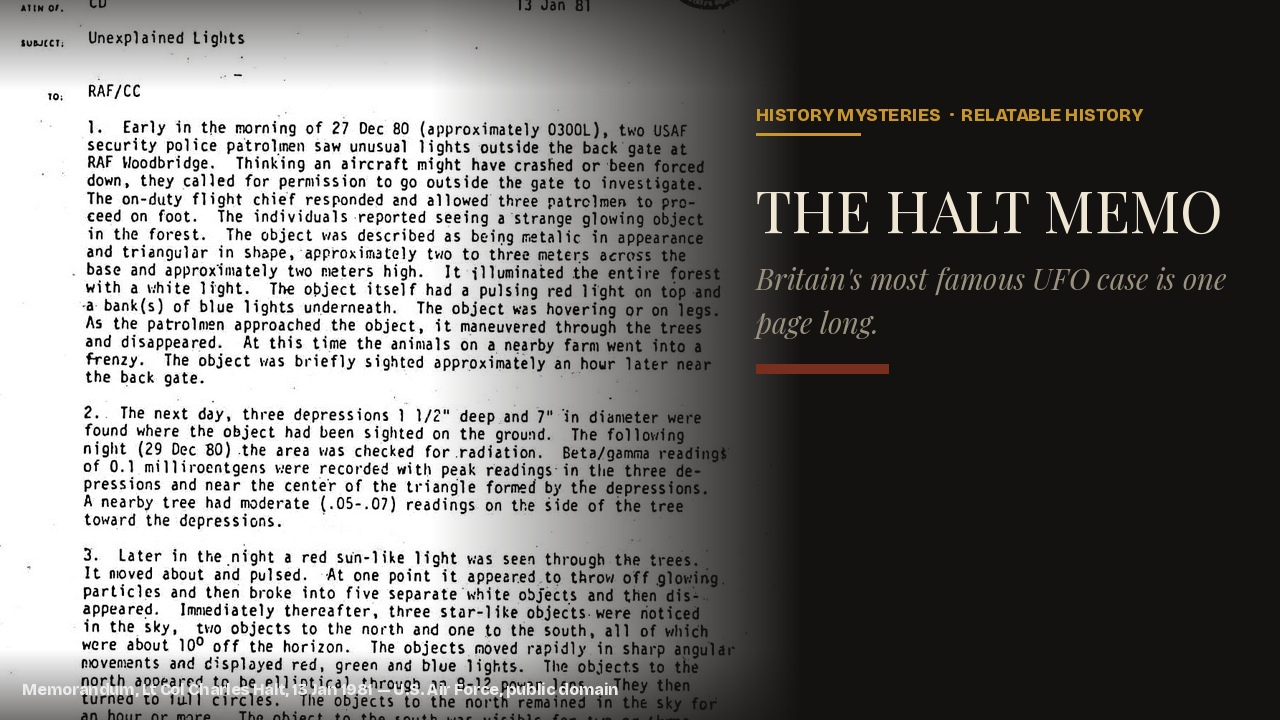
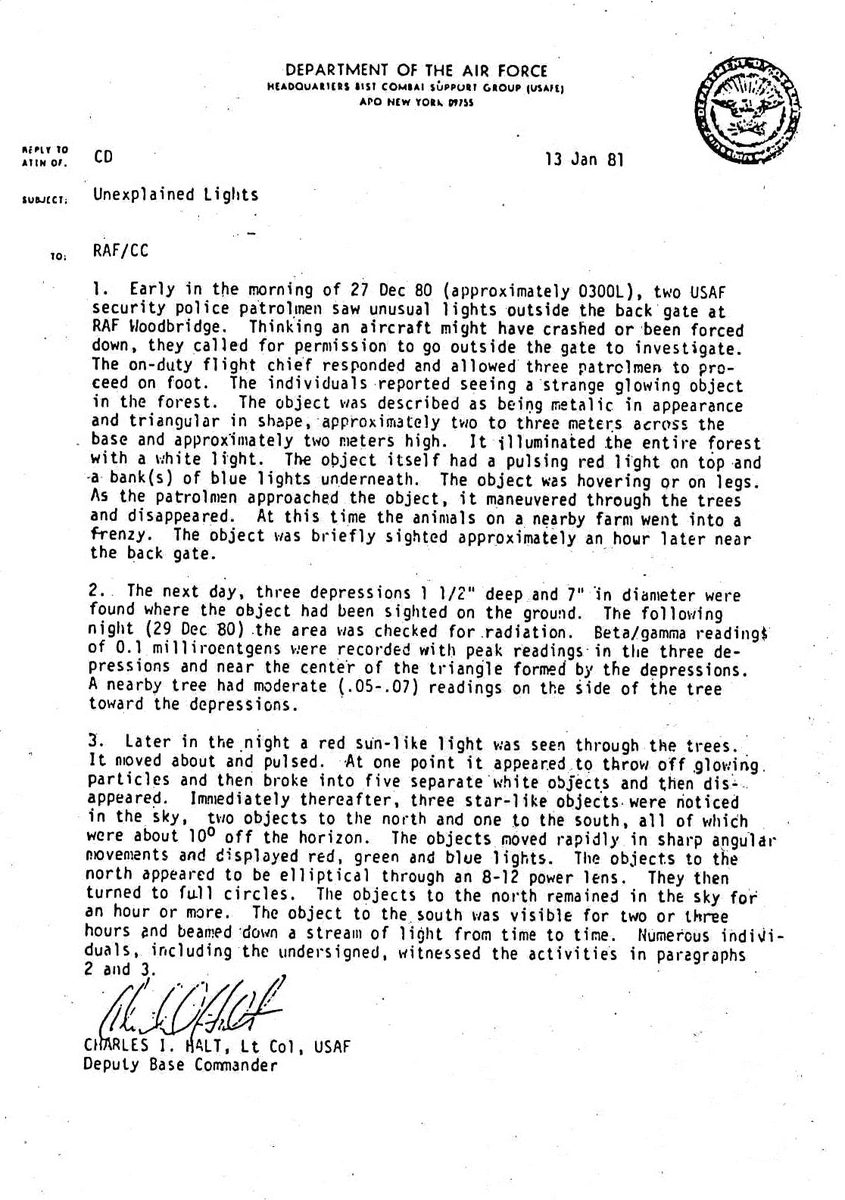
The British government’s entire official record of its most famous UFO case is one page. It is typed, it has a typo in “metallic,” and it is signed by a real lieutenant colonel of the United States Air Force who put his own name and rank to it. Nobody disputes that the page is genuine — it sat for years in a Ministry of Defence file before being declassified and is now catalogued at the National Archives in Kew as DEFE 24/152. The argument that has run for more than forty years is entirely about what it describes.
That argument is the Rendlesham Forest UFO case, often called Britain’s Roswell: three nights of lights seen by American servicemen stationed at RAF Woodbridge in Suffolk in December 1980, written up by their deputy base commander, filed with the Ministry of Defence, and investigated to varying degrees of seriousness ever since. It is unusual among UFO cases in having an abundance of what every other case lacks — a contemporaneous official document, named witnesses, a specific location that can still be visited, and a fully worked skeptical explanation that accounts for most of it. What it still lacks is agreement.
An Air Force officer put his own name to three paragraphs of lights in the woods
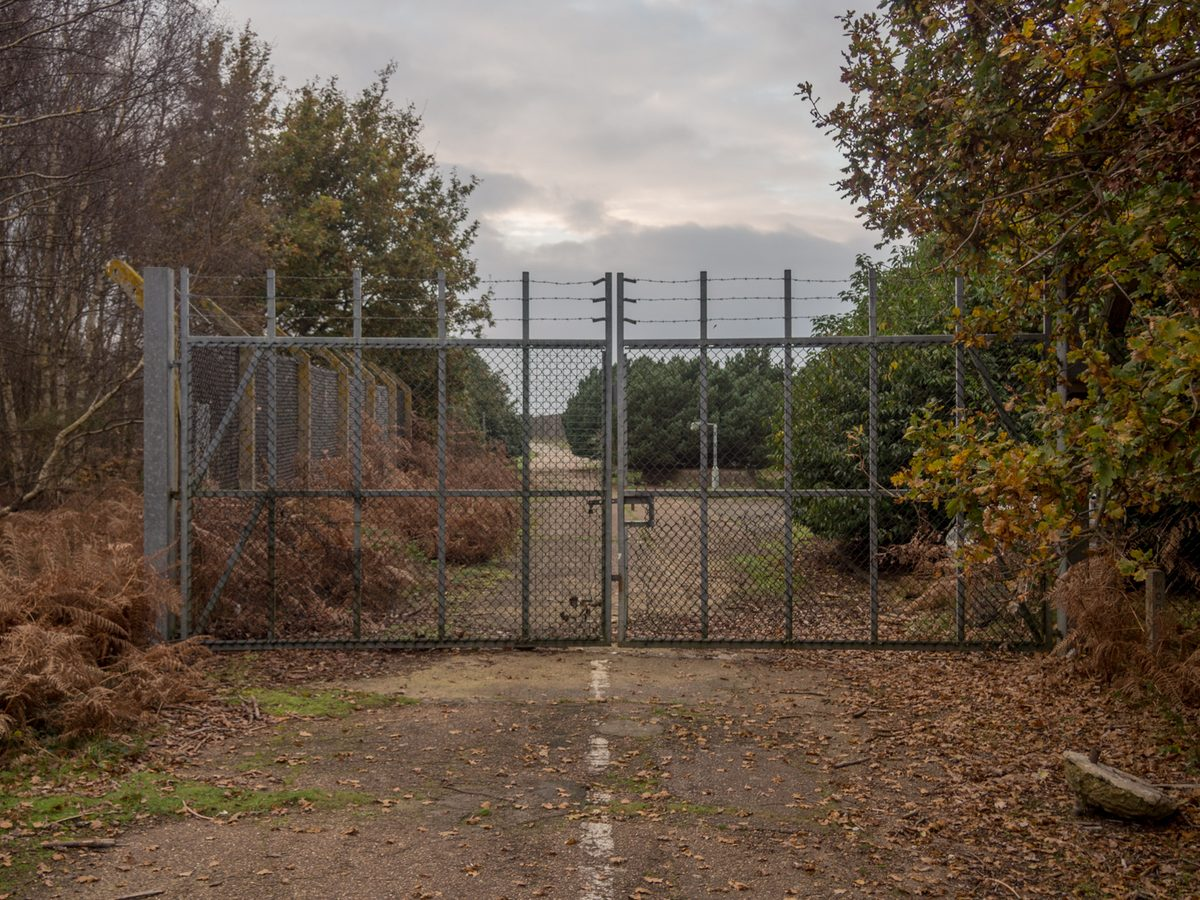
Early on the morning of 27 December 1980, at around 3 a.m., two USAF security patrolmen at RAF Woodbridge saw unusual lights beyond the back gate and radioed in, thinking a small aircraft might have come down. Three patrolmen went out on foot and reported a glowing, metallic, triangular object in the forest, roughly two to three metres across the base and two metres high, with a pulsing red light on top and a bank of blue lights underneath. As they approached, it manoeuvred through the trees and disappeared; a nearby farm’s animals went into a frenzy, and the object was briefly seen again near the gate about an hour later.
Two weeks later, on 13 January 1981, Lieutenant Colonel Charles I. Halt — the deputy base commander, who had led a follow-up investigation on the night of 29 December — wrote the memo. Addressed to the RAF station commander and headed “Unexplained Lights,” it records three ground depressions found the next day, each an inch and a half deep and seven inches across; radiation readings of 0.1 milliroentgens peaking in those depressions against a background of roughly 0.03–0.07; and a later sighting of a pulsing red light that “appeared to throw off glowing particles” before resolving into star-like objects that moved in sharp angular turns for an hour or more. Halt signed it himself, as a witness as well as the author.
The Ministry of Defence filed it and moved on, because nothing showed up on radar
The memo went up through RAF channels to the Ministry of Defence, where it landed with a department — known internally as DS8, later S4(Air) — whose job was to log reports of unusual aerial activity and check whether any represented a threat to UK airspace. By the Ministry’s own account, declassified decades later, its interest was narrow and consistent: did the report correspond to anything on radar, and did it suggest hostile or unauthorised use of British airspace. On both counts the file was marked no.
A 1995 position paper prepared for the defence minister, Lord Trefgarne, put the department’s reasoning in writing: it was, the MoD held, “highly unlikely that any violation of UK airspace would be heralded by such a display of lights.” Not everyone in government agreed with how incurious that left the file. Lord Hill-Norton, a former Chief of the Defence Staff, pressed the Ministry for years afterwards, arguing that an incident this well-witnessed by trained military personnel deserved more than a shrug — calling the MoD’s handling of it “a potential banana skin” precisely because the alternative to extraterrestrial lights was that American servicemen had seriously misperceived something ordinary, which is its own kind of problem for an airbase.
The memo itself stayed inside the Ministry for almost three years. The case only became public in October 1983, when the News of the World ran the story after obtaining a copy, and the Ministry’s own file on the incident — later released to researchers — shows correspondence about it continuing as late as 1995, mostly consisting of the public and MPs asking for a fuller account and the department restating the same “no defence significance” position each time.
A lighthouse five miles away flashes exactly where the lights were seen
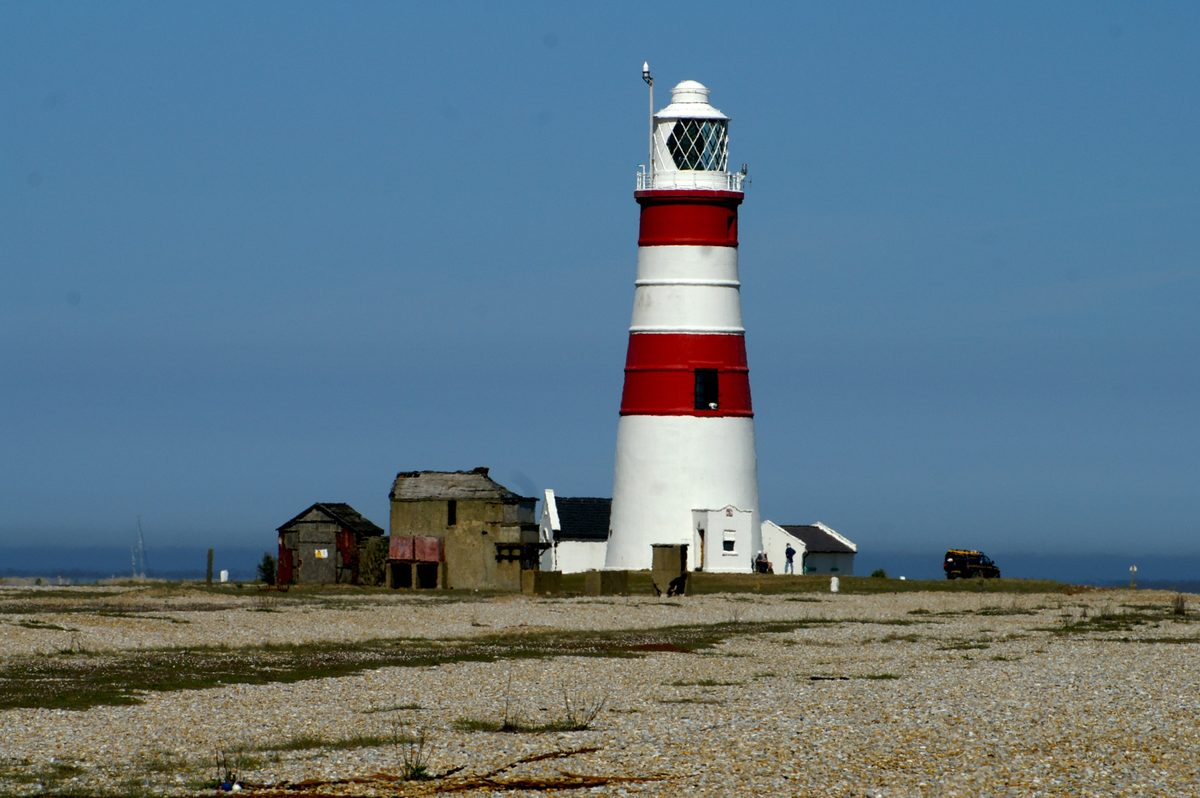
The most developed skeptical account comes from the astronomy writer Ian Ridpath, who began investigating within a few years of the incident and published his findings in The Skeptical Inquirer in 1986. His central claim is straightforward: the Orford Ness lighthouse stands about five miles east of the forest on the Suffolk coast, and in 1980 it flashed white every five seconds — a timing that matches contemporaneous descriptions of a pulsing light far better than anything extraterrestrial would need to.
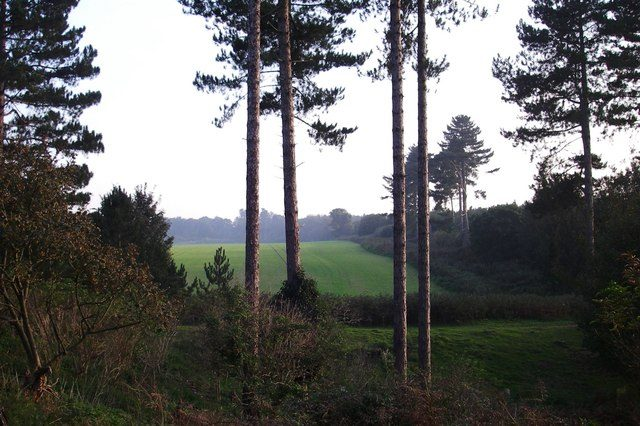
Geometry does the rest of the explaining. The forest sits on slightly higher ground than the coast, so a beam that should pass well overhead can appear to skim the treeline from inside the forest — and because trees block a direct line of sight to the tower itself, an observer sees only the light, not its obviously lighthouse-shaped source. Vince Thurkettle, a local forester interviewed by Ridpath, said the beam “seemed to hover a few feet above ground level” when viewed from exactly the spot the patrolmen described, and that newcomers walking the forest at night routinely mistake it for something close and low rather than something five miles off and high.
The ground marks and the burn scars turned out to be older than the sighting
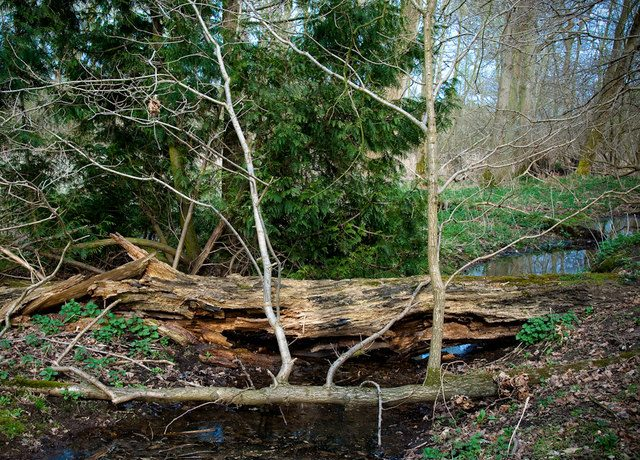
The physical traces fare no better under Ridpath’s investigation. The three depressions, he found, matched rabbit diggings already present in the area and visibly irregular rather than arranged in a clean geometric pattern — and far too small and too close together to have supported a landed object the size Halt’s memo describes. What witnesses described as scorch or burn marks on nearby trees turned out, on inspection, to be axe cuts made by the forestry workers who managed the plantation, with pine resin weeping from the cuts and discolouring the bark in a way that can look charred from a distance.
The radiation readings are the one piece of physical evidence that needs no debunking, because they were never especially high: 0.1 milliroentgens per hour is within the range of ordinary background radiation from cosmic rays and the soil itself, and the memo itself only calls the elevated reading “moderate.” It is consistent with an unremarkable patch of Suffolk forest, which is a strange thing to have to argue but is exactly the point: almost none of the physical record requires anything exotic to explain it.
Thirty years on, Halt still disputes the lighthouse, and the geometry still doesn’t fully agree with him
Where the case genuinely remains unsettled is Halt’s own position, which has not moved. In a sworn affidavit in June 2010, he restated that he and others observed multiple distinct objects, including one that sent a “laser-like beam” down near the patrolmen’s feet and another that moved toward the neighbouring RAF Bentwaters and beamed light into its weapons storage area — details not in his original 1981 memo. He has specifically rejected the lighthouse explanation for at least one of the lights, stating in the affidavit that the Orford Ness beam was “as much as 40 degrees to the right” of the unexplained light he was watching.
Ridpath’s rebuttal is that this specific claim is hard to square with Halt’s own contemporaneous tape recording made that night, which places the light in roughly the direction the lighthouse actually stands, and that a thirty-year-old recollection of a bearing measured in degrees, with no instrument to measure it, is a thin basis for overturning a timing match that still holds. Neither side has new physical evidence to offer; what exists is two readings of the same handful of old recordings, and a trust question about which thirty-year-old memory to credit.
A colleague’s notebook added a stranger claim decades later, and its own dates don’t agree with each other
The case picked up a second, stranger layer in the 2000s. Sergeant Jim Penniston, one of the three patrolmen who approached the object, said nothing publicly in the mid-1990s beyond describing the encounter itself. By 1996 he was telling an interviewer he had taken real-time notes and sketches during a close encounter with a landed craft; by the incident’s 30th anniversary in 2010 he had added that the same notebook contained pages of binary code “telepathically downloaded” into his mind the day after.
Ridpath’s examination of the notebook itself finds the claim hard to support on its own terms: the dated entries carry the date “27 Dec 80” and a time of 12:20, when the incident Halt documented happened in the small hours of the 26th, and Penniston has given more than one explanation for the mismatch over the years. John Burroughs, who was with him throughout, has said Penniston was not keeping a notebook or making sketches as the encounter happened. None of that proves the binary-code story false by itself, but a claim resting on a document whose own internal dates don’t agree with the rest of the record is not one this article can treat as established.
The Rendlesham Forest UFO case still isn’t closed, even though the lighthouse is gone
Orford Ness lighthouse was decommissioned by Trinity House in June 2013, as the North Sea ate away at the shingle spit beneath it, and the structure was demolished in 2020 after a charitable trust salvaged what it could. The one physical landmark at the centre of the skeptical case is now gone. The memo that started the whole argument is not: it sits in a public file at Kew, next to routine correspondence from the early 1980s, exactly where Halt’s own signature put it.
What Rendlesham Forest offers that most UFO cases cannot is a paper trail solid enough to argue about in the first place — the same quality that makes Project Blue Book’s closing report and the Nimitz encounter’s official record worth reading on their own terms rather than taking anyone’s word for them. The forest, the gate and the memo’s file reference can all still be checked by anyone who wants to. Forty-five years on, that is still more than most of this kind of story leaves behind.
Watch the short
No long-form video exists yet for this case; the original 46-second short covers the memo and the lighthouse in brief.

Related reading
- How Project Blue Book Investigated UFO Reports
- What Was Project Mogul? The Secret Program Behind the Roswell Myth
- What the Records Actually Show About the Shag Harbour UFO
- The Nimitz Tic Tac Encounter: What the Official Record Actually Says
Works cited
- Halt, Charles I. Memorandum, “Unexplained Lights,” 13 January 1981. The National Archives, Kew, DEFE 24/152. Digitised copy released under FOIA Case 97-F-1677. Link.
- Clarke, David. “Top 10 UFO Documents at the National Archives.” drdavidclarke.co.uk, 15 March 2018.
- Clarke, David. Script for the National Archives “UFO Files” podcast, August 2009, quoting Lord Trefgarne’s 1995 ministerial position and Lord Hill-Norton’s dissent. Link.
- Ridpath, Ian. “The Woodbridge UFO Incident: Investigation of a claimed UFO landing near a U.S. Air Force base in Britain puts it in a new light.” The Skeptical Inquirer 11 (Fall 1986): 77. Link.
- Ridpath, Ian. “Rendlesham Forest UFO: the lighthouse explanation.” ianridpath.com.
- Ridpath, Ian. “Colonel Halt’s affidavit — Rendlesham Forest UFO case.” ianridpath.com.
- Ridpath, Ian. “Jim Penniston’s notebook.” ianridpath.com.
- Kearley, Susie. “The End of England’s Orfordness Lighthouse.” Lighthouse Digest. Link.