
In April 1966, the Air Force’s own in-house UFO expert sat down in front of the House Committee on Armed Services and told Congress, in effect, that the investigation he had spent fourteen years working on was not good enough. His name was J. Allen Hynek, and he was the astronomer the Air Force paid to find ordinary explanations for the UFO reports that kept arriving. He had found plenty. What he told the committee was that far too few people were doing the looking.
The committee’s own report bears this out in a way that is almost comic against the program’s later reputation as a sprawling cover-up. After reviewing more than ten thousand case files, the congressmen noted that the Air Force’s entire UFO effort consisted of one officer, one sergeant, and a secretary. That was the staff behind a program that, by the time it closed three years later, had a name recognized by most of the country: Project Blue Book.
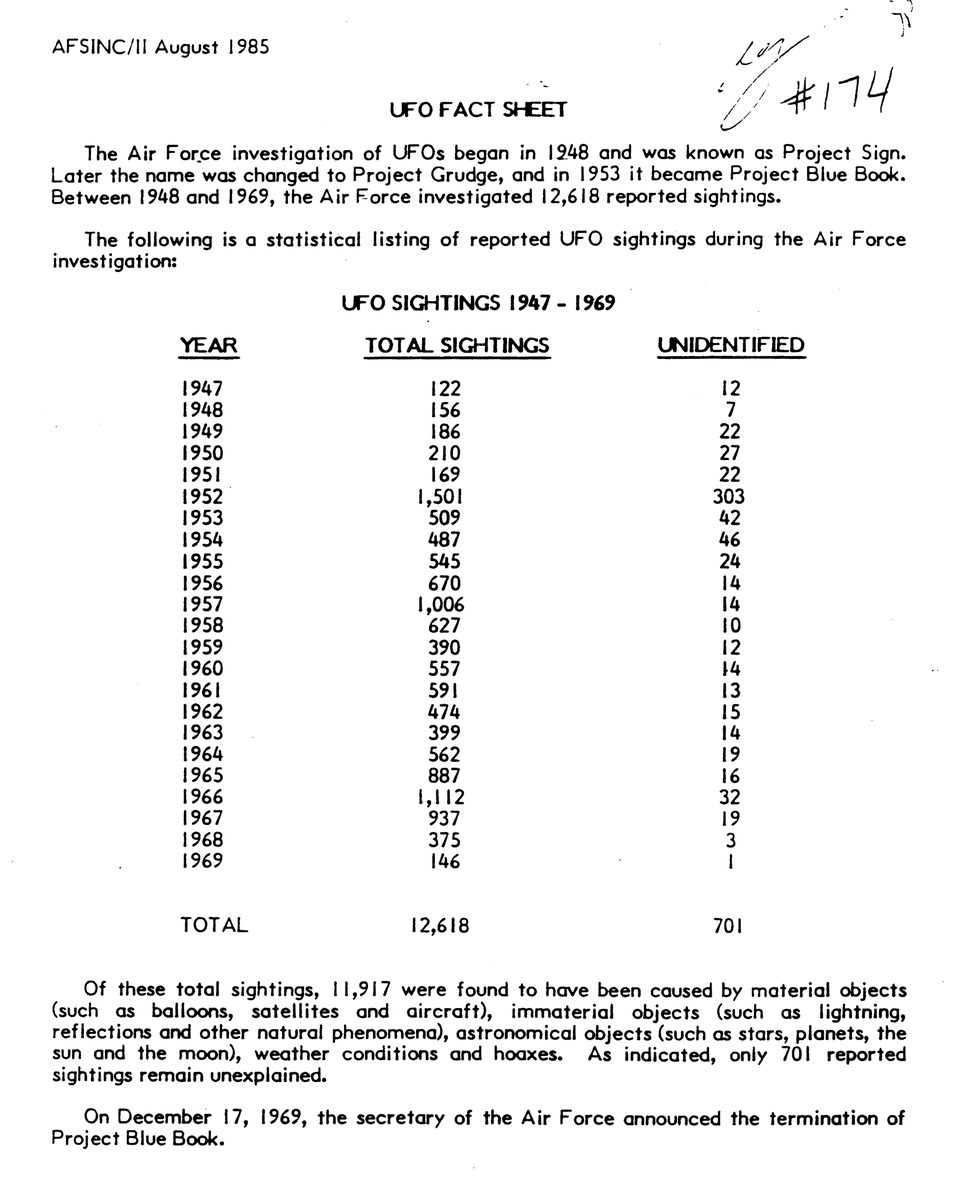
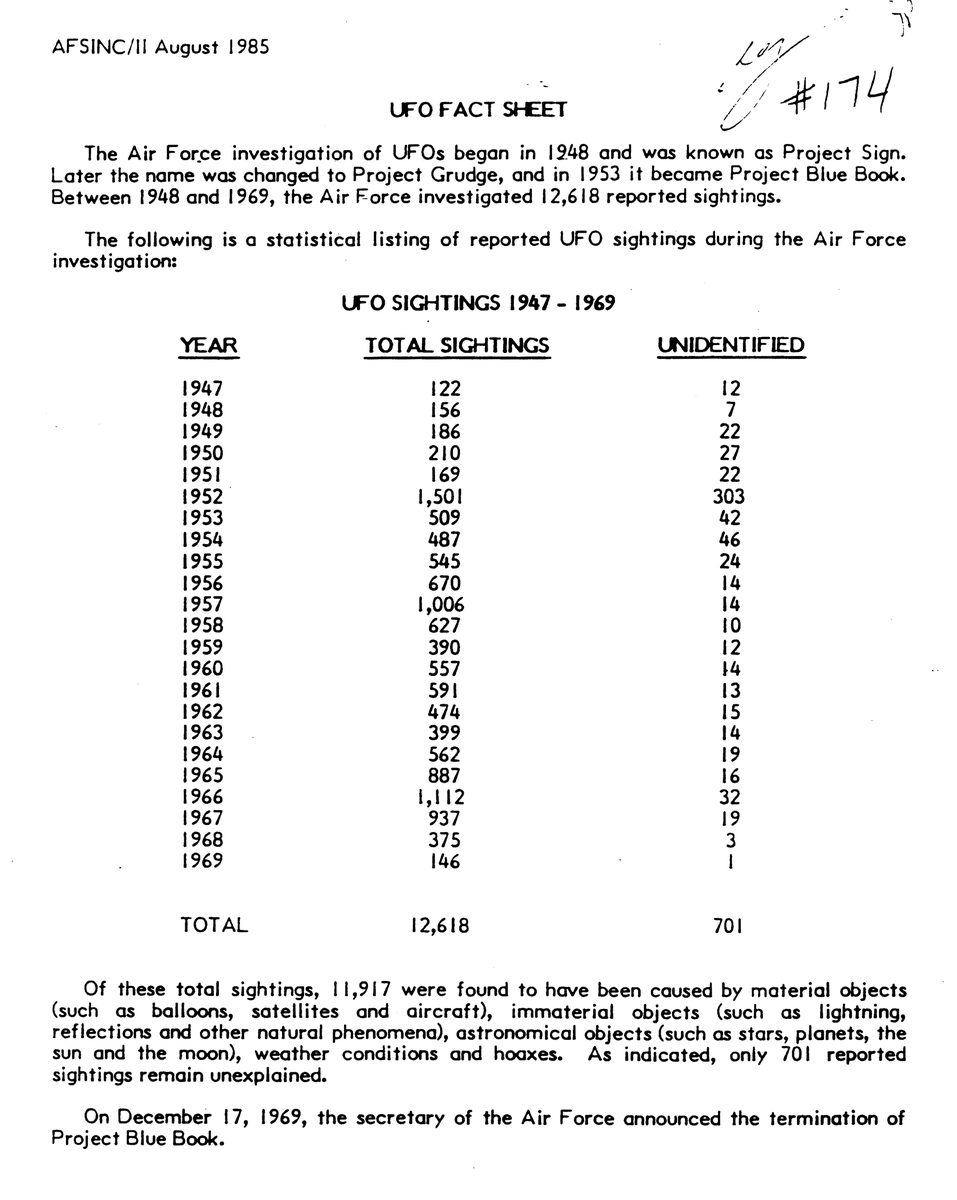
Over twenty-two years and three successive names, that small office built a paper record of 12,618 reported sightings. Eleven thousand, nine hundred and seventeen of them were eventually attached to an aircraft, a balloon, a planet, or a cloud. The remaining 701 were not, and the Air Force’s own files still describe them that way. The more interesting story, though, is not the leftover column of unsolved cases. It is how an under-staffed Cold War paperwork operation ended up shaping fifty years of how Americans think about the subject.
The Air Force investigated UFO reports under three different names
Blue Book was not the Air Force’s first attempt at this. It was the third. The service opened Project Sign in 1947, the same year a wave of “flying saucer” reports across the country put the subject in front of the public for the first time. Project Sign was folded into a successor, Project Grudge, in 1949, and the Air Force reorganized the effort again in 1952, giving it the name that stuck.
Running it at the start of the 1950s was Captain Edward J. Ruppelt, and the astronomer attached to it from the beginning, on loan from Ohio State University and later Northwestern, was Hynek. Their job was straightforward on paper: take in a report, request the basic facts — time, location, duration, weather, witness reliability — and work through the mundane possibilities before anything went in the unexplained column. In practice, that meant a lot of the Air Force’s UFO investigation was two men and their correspondents comparing a drawing made by a frightened pilot against a weather bureau’s balloon-launch logs.
A classified government panel decided the real danger was public panic, not aircraft
By January 1953, UFO reports had become frequent enough that the CIA’s Office of Scientific Intelligence convened a panel of outside physicists to review what the Air Force had collected. It was led by Howard Percy Robertson, a mathematical physicist at Caltech, and it interviewed Ruppelt and Hynek directly about Blue Book’s case files.
The panel’s physics conclusions were unremarkable: most of what it reviewed had ordinary explanations, consistent with what Blue Book itself was finding. Its security conclusions were the interesting part. The panelists worried less about the objects than about the public’s reaction to them — the risk that a saturated communications channel, flooded with reports of lights in the sky, could be exploited by an adversary to mask a real attack, and that sustained public fascination was a vulnerability in its own right. Their recommendation was a public education campaign, using television, magazine articles, and even studios like Disney to train Americans to shrug off a flying saucer report. The Robertson Panel’s own findings stayed classified until 1975, which meant that for twenty-two years, the group that had quietly shaped how the Air Force talked about UFOs in public was itself one of the better-kept secrets of the whole affair.
A Wisconsin farmer said a landed craft’s occupant handed him pancakes, and Blue Book’s own scientist drove out to look
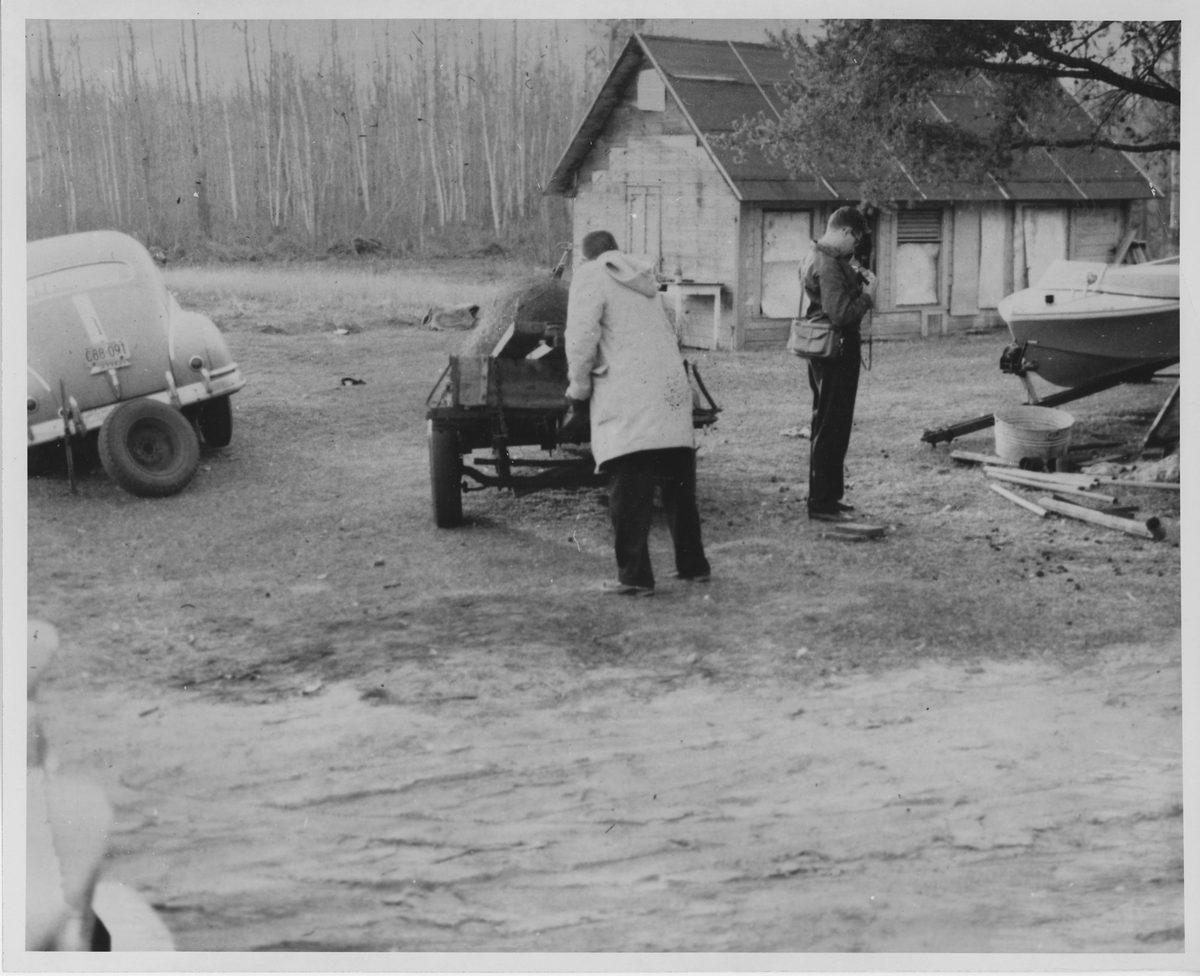
Most Blue Book files are reports: a time, a shape, a direction of travel. The case from Eagle River, Wisconsin is one of the exceptions, and it is a useful reminder that “investigation” sometimes meant exactly what the word suggests. On April 18, 1961, a farmer named Joe Simonton told the county sheriff that a silvery craft had landed near his farmhouse, that a small occupant in a dark turtleneck had asked him for water, and that in exchange for a filled jug he had been handed four perforated pancakes.
Hynek went to Wisconsin himself, took custody of one of the pancakes, and logged it as evidence in Blue Book’s own file. A federal laboratory later analyzed it and found nothing stranger than hydrogenated oil and buckwheat flour — a pancake, chemically speaking, with no evidence of anything else mixed in. The Air Force’s conclusion was not that Simonton was lying; its working theory was that a sincere, reliable witness had somehow folded a dream into his memory of making breakfast. The file register, for what it’s worth, still lists the case as a Close Encounter of the Third Kind — a term Hynek had not yet invented when he drove to Eagle River, and would only publish eleven years later.
A sitting president asked for an explanation, and got a hastily arranged press conference
The case that did the most to put Blue Book’s predecessor office under pressure happened in the capital itself. Over a run of nights in July 1952, air traffic controllers at Washington National Airport tracked unexplained radar returns moving over restricted airspace, while pilots in the air separately reported unexplained lights. An airline captain flying nearby, S. C. Pierman, described them afterward as moving like falling stars without tails, only far faster, and was certain they weren’t aircraft. Jets scrambled from Andrews Air Force Base couldn’t catch them; witnesses said the objects outran the interceptors and the radar returns reappeared once the fighters left the area.
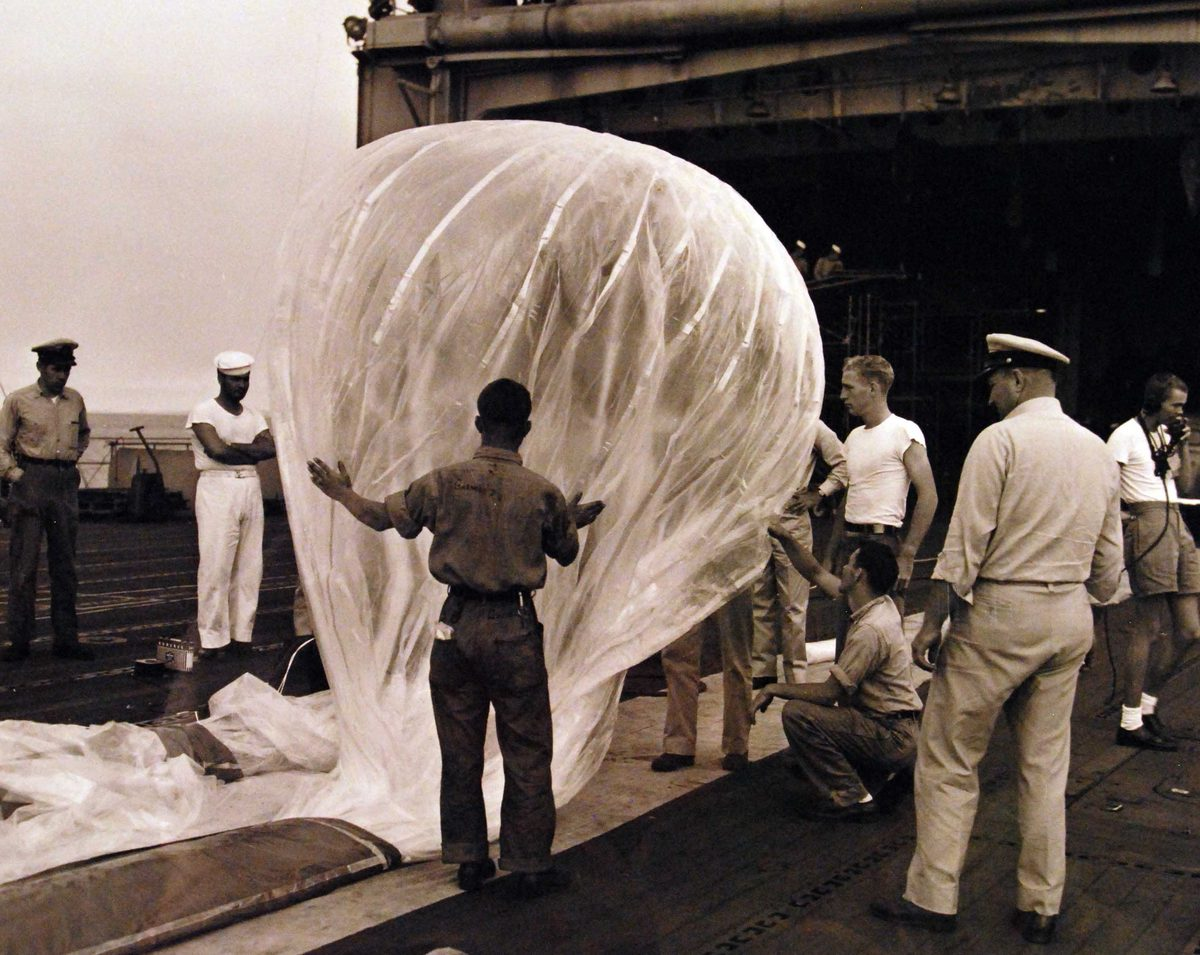
President Truman himself asked the Air Force for an explanation, which is the detail that separates this case from most of the other 12,617. The answer, when it came at a hastily convened press conference meant to calm public alarm, was a temperature inversion — a layer of warm air sitting over cooler air near the ground, a known condition that can bend radar waves and produce exactly the kind of phantom returns controllers had logged. It is also, mechanically, a close cousin of the explanation behind a large share of Blue Book’s case files generally: high-altitude research balloons, aircraft contrails, and optical effects in the atmosphere accounted for most of the 11,917 solved reports, which is a far less dramatic story than jets chasing lights over the capital, but it is the story the paperwork actually supports.
A botched explanation in Michigan put a future president on the record demanding better
Fourteen years into the program, in March 1966, dozens of people in southeastern Michigan reported unexplained lights over a week of sightings. Hynek was dispatched, and under pressure to give reporters something at a crowded press conference, offered a preliminary theory: marsh gas, igniting naturally over wet ground, could account for at least some of what people had seen. It became, almost instantly, a punchline.
Among the people who were not amused was the Michigan congressman then serving as House Minority Leader, Gerald Ford, who issued a public statement arguing that his constituents deserved a better answer than a swamp. Ford’s complaint helped force the hearing where Hynek got to make his actual case the following month: not that the sightings were extraterrestrial, but that fourteen years of a one-officer-and-a-secretary operation wasn’t a serious enough scientific effort to settle the question either way. The House committee agreed enough to recommend that the Air Force fund outside university research into the subject.
A study the Air Force itself commissioned ended the Air Force’s own program
That recommendation produced, later in 1966, a contract with the University of Colorado and a research team led by the physicist Edward U. Condon. The Condon Committee spent more than two years working through a sample of cases, and its lengthy final report — published in January 1969 as Scientific Study of Unidentified Flying Objects — concluded that nothing it had examined justified further government-funded investigation. A review panel convened separately by the National Academy of Sciences endorsed that conclusion.
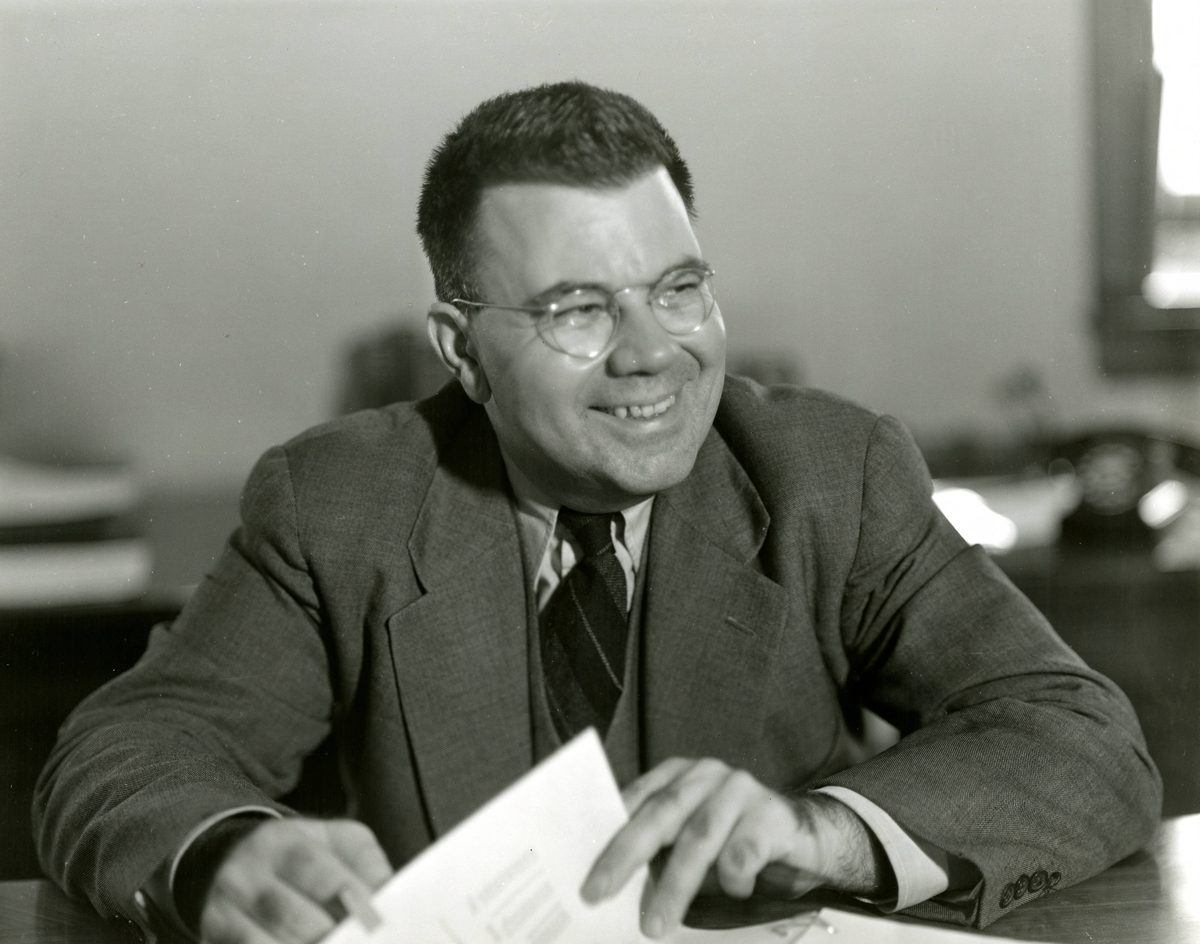
The Air Force acted on it quickly. On December 17, 1969, the Secretary of the Air Force announced that Project Blue Book was ending, citing the Colorado study, the Academy’s review, and the Air Force’s own two decades of experience as the basis for the decision. The paperwork — roughly 42 cubic feet of case files, administrative records, and intelligence office documents, along with ninety-four rolls of microfilm — was transferred to the National Archives, where it has sat open to public research ever since. Nobody has reopened the 701 unresolved files; nobody at the Air Force has reclassified them either.
What a single scientist’s change of mind says about the whole record
Hynek did not stop after 1969. He spent the rest of his career arguing for exactly the kind of sustained, well-funded scientific study the Condon Report had just declined to recommend, founded the Center for UFO Studies in 1973 to pursue it independently, and in 1972 published the close-encounter classification system that still structures how UFO reports get sorted today. The man hired to make the subject go away became, by his own later account, one of its more credible advocates for taking it seriously — not because he had found proof of anything, but because he had spent longer looking at the unresolved cases than almost anyone else alive, and did not think the file should simply close.
That is the tension sitting underneath the whole record Blue Book left behind. The program’s statistics argue for mundane explanations across the overwhelming majority of what it collected, and the government agencies that reviewed it, twice, agreed. Its own chief scientist argued that the statistics did not settle the remaining 701 cases, and nothing in the paperwork since has settled them either. Both things are true of the same set of file folders, which is probably the most honest thing that can be said about an archive built by a one-officer office and left, deliberately, open at the National Archives for anyone to go check for themselves.
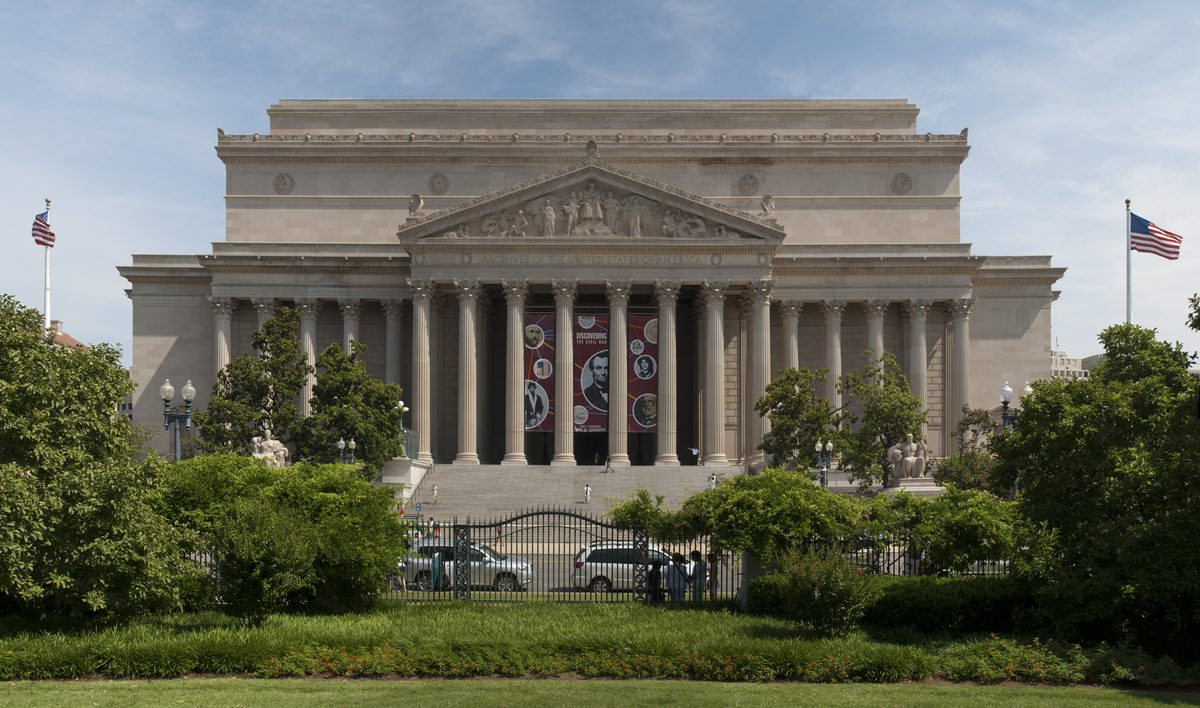
Nobody has gone back and closed those 701 files, and nobody has reopened them either. They are just sitting at the National Archives in Washington, in the same chronological order Blue Book’s two-person office left them in, waiting on whichever citizen eventually decides to be the one who reads case number one.
Watch the full history
The video companion to this article covers the headline numbers in under a minute; the pancake, the panel, and the Michigan hearing are the parts that didn’t fit.

Related reading
- Why the Tunguska Explosion Left No Crater
- Why Were the Nazca Lines Made? What the Evidence Actually Shows
- Why Sunglasses Were Invented to Hide Things, Not Block the Sun
- How Carrier Pigeons Carried Messages Through Two World Wars
Works cited
- U.S. National Archives and Records Administration. “Project BLUE BOOK — Unidentified Flying Objects.” Research our Records. Link.
- National Archives Foundation. “50 Years Ago: Government Stops Investigating UFOs.” Link.
- Mabry, Rebecca. “Saucers Over Washington: The History of Project Blue Book.” Prologue, National Archives, December 19, 2019. Link.
- U.S. Air Force, Office of Public Affairs. Fact Sheet: Unidentified Flying Objects and Air Force Project Blue Book. October 1987.
- “How the CIA Tried to Quell UFO Panic During the Cold War.” History.com, A&E Television Networks. Link.
- “Meet J. Allen Hynek, the Astronomer Who First Classified UFO ‘Close Encounters.’” History.com, A&E Television Networks. Link.
- “UFOs Over Washington: The 1952 Sighting That Upended Decades of Denial” and related coverage. History.com, A&E Television Networks. Link.
- “When Gerald Ford Demanded Answers for UFO Sightings in Michigan.” Michigan Public Radio, October 10, 2013. Link.
- Center for UFO Studies. “Classic UFO Cases.” Founded by J. Allen Hynek, 1973.
- Condon, Edward U., et al. Scientific Study of Unidentified Flying Objects. University of Colorado, 1968. Defense Technical Information Center. Link.
- U.S. House of Representatives, Committee on Armed Services. Unidentified Flying Objects, hearing, 89th Congress, 2nd session, April 5, 1966. U.S. Government Publishing Office. Link.