
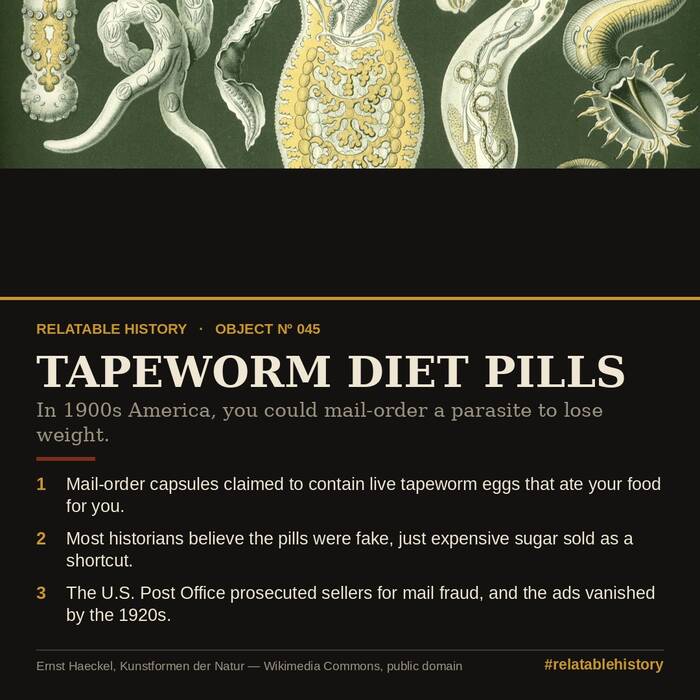
In December 1912, a woman in Peoria, Illinois told a reporter that she had paid twenty-five dollars for a diet pill and found what looked like segments of a tapeworm packed inside the capsule. The story ran in papers across the country. Asked about it directly, U.S. Surgeon General Rupert Blue was blunt: it was, he said, simply untrue. Nobody at the federal Hygienic Laboratory had ever seen such a pill, tested one, or traced one back to a manufacturer.
More than a century later, “were tapeworm diet pills real” is still one of the most confidently answered questions in internet folklore — usually with a vintage advertisement offered as proof. The honest answer, after investigators, archivists and parasitologists have all taken a turn looking, is that the evidence for an actual, mass-marketed capsule containing a real tapeworm egg is far thinner than the legend built on top of it. What is well documented is something almost stranger: a quack weight-loss industry that was entirely real, prosecuted all the way to the Supreme Court, and sold on duller ingredients than anyone selling the tapeworm story ever needed.
Every Specific Sighting Dissolves Under Examination
The earliest documented brush with the idea has nothing to do with weight loss at all. In 1899, a traveling medicine-show operator named W. I. Swain was arrested twice in Peoria, Indiana, for practicing medicine without a license. Part of his act involved showing patients a capsule that supposedly contained an artificial tapeworm as proof that his treatment had expelled one — a stunt aimed at validating a cure, not selling a diet.
The 1912 Peoria story is the one that actually entered the weight-loss canon, and it collapsed almost immediately: both Surgeon General Blue and Dr. John F. Anderson, director of the Hygienic Laboratory, called it a fine yarn with nothing behind it. A similar, equally unverified report surfaced in a Marion, Ohio paper in 1914, describing a woman who had paid three hundred dollars for a liquid capsule said to contain “some form of life.” No pill, no manufacturer, and no second witness ever turned up in either case.
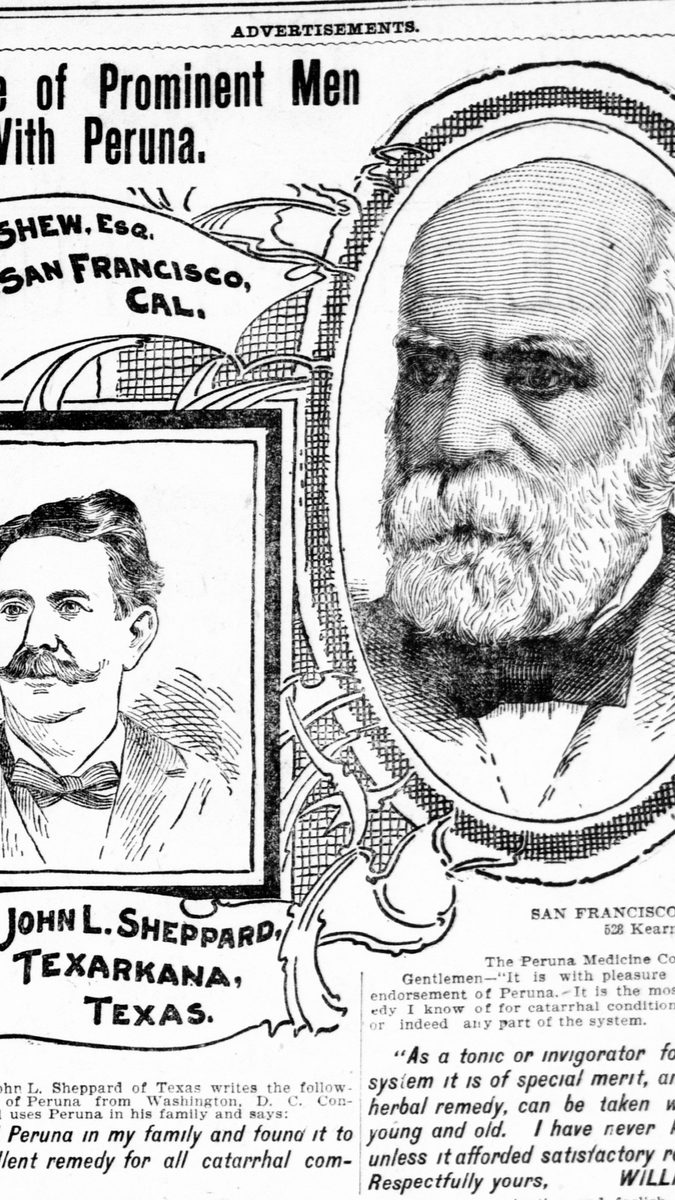
Even the physical evidence usually cited online doesn’t hold up. A widely shared poster, dated to 1898 and purporting to advertise a tapeworm diet pill by name, has been examined by researchers studying the myth’s origins and found to use type styles and layout conventions that didn’t exist yet in 1898 — a modern fake dressed as a period artifact, which is itself a useful data point about how badly people want this story to be documented.
None of this means the mail-order medicine trade was small or harmless — it was enormous, and the tapeworm story’s plausibility depends entirely on how genuinely strange that trade already was. Catalogs and cheap magazines of the period carried ads for pills, tonics and electric belts claiming to cure everything from tuberculosis to baldness, most of them unregulated because, before 1906, nothing in federal law required a company to disclose what a bottle actually contained. A fake tapeworm pill would have been only slightly stranger than dozens of products that were real, which is exactly why the rumor was so easy to believe and so hard to kill once it started.
Regulators Looked Specifically for This Pill and Never Found One
If a tapeworm diet pill had actually been sold at scale, it would have left a paper trail, because the agencies built to catch exactly this kind of fraud were unusually active in this period. The American Medical Association’s Bureau of Investigation, run for decades by chemist Arthur J. Cramp, fielded public inquiries about tapeworm diet pills in at least 1930, 1932 and 1953. Each time, Cramp’s office came back with nothing: no product, no seller, no customer who could produce the thing itself.
That absence matters because the surrounding record is otherwise thorough. The Food and Drug Administration’s published enforcement actions, called Notices of Judgment, and the AMA’s own compendium of fraudulent cures, Nostrums and Quackery, both catalogue hundreds of real weight-loss products from this exact period. None of them is a tapeworm pill. What they actually contained was far less exotic: desiccated thyroid gland, laxative salts, iodine compounds, and in several cases nothing pharmacologically active at all — just starch, talc and a confident label.
Marmola Was the Pill That Actually Reached the Supreme Court
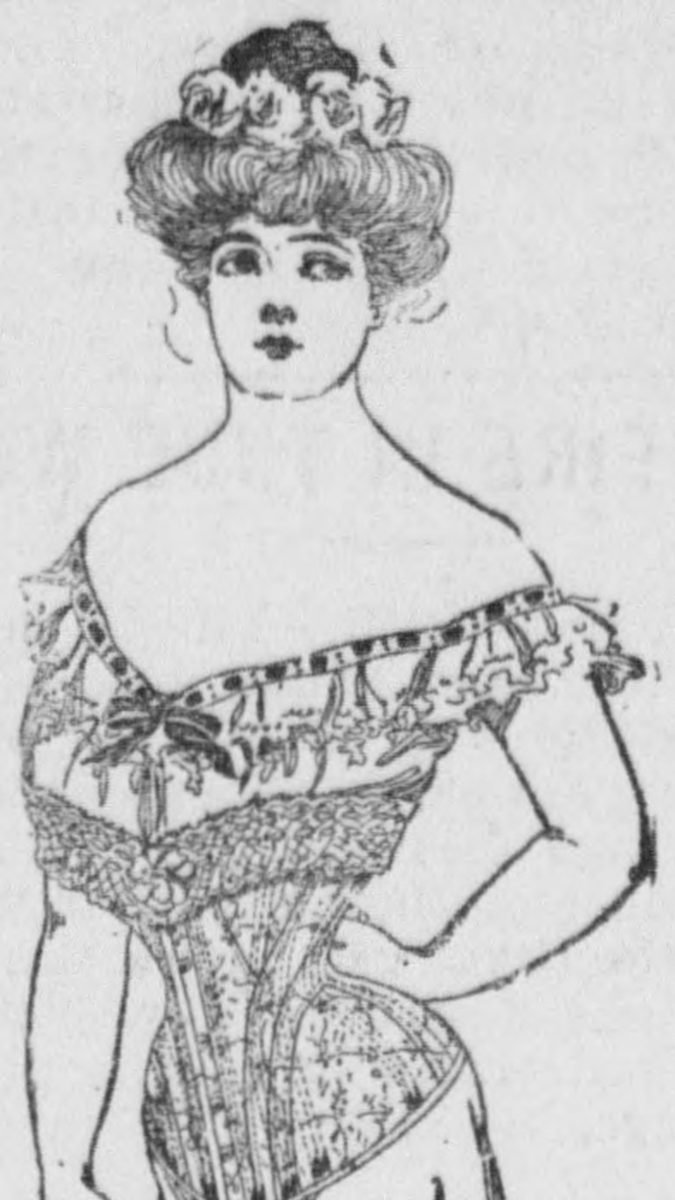
The best-documented weight-loss fraud of the era wasn’t shy about a tapeworm, because it didn’t need one. Marmola, sold from the early 1900s through the 1930s, was a tablet of desiccated thyroid extract mixed with a laxative, marketed with scientific-sounding copy, stacks of customer testimonials, and an endorsement from the silent film actress Constance Talmadge. Thyroid extract does speed up metabolism, which is exactly why unsupervised use of it is dangerous, but the ads promised effortless, risk-free slimming.
The Federal Trade Commission sued Marmola’s maker, the Raladam Company, and lost at the Supreme Court in 1931 on a technicality: the FTC Act’s Section 5, as written then, required proof that competitors were being harmed, not that consumers were being deceived. Congress closed that gap with the 1938 Wheeler–Lea Act, which rewrote Section 5 around “unfair or deceptive acts or practices” against the public directly. The FTC went after Raladam a second time and won in 1942, with Justice Hugo Black pointing to the company’s own long record of misleading claims.
That eleven-year legal fight, not a mail-order parasite, is what a documented quack diet case in this period actually looked like: a named company, a traceable ingredient, two Supreme Court opinions, and an act of Congress written specifically to close the loophole it had exposed. The mercury cure for syphilis survived its own disproof for a similar reason — not because anyone hid the evidence, but because the law took a long time to catch up with what the evidence already showed.
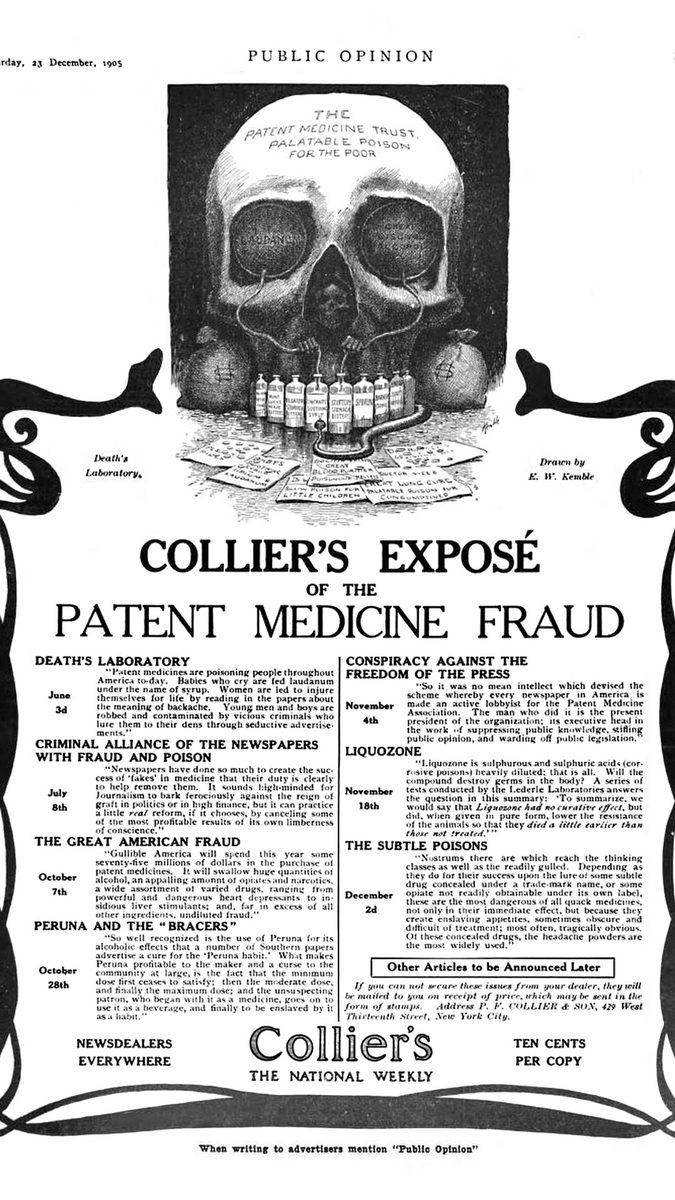
The pressure that eventually produced that law came largely from the press, not from government. Starting in 1905, journalist Samuel Hopkins Adams ran an eleven-part investigative series in Collier’s Weekly titled “The Great American Fraud,” naming specific products, testing their ingredients, and printing the results. The series is widely credited with building the public pressure that helped pass the 1906 Pure Food and Drug Act, the first federal law requiring that medicine labels disclose certain dangerous ingredients. It is a measure of how thoroughly Adams and his successors combed this industry that a tapeworm pill never once turns up in their reporting either.
Swallowing an Actual Tapeworm Egg Would Be Far Worse Than the Ads Implied
Here the legend runs into something the ad copy never seems to grapple with: the biology it describes is backwards in a way that makes it more dangerous, not less. A tapeworm infection picked up the ordinary way — by eating undercooked beef or pork carrying larval cysts — produces taeniasis, an adult worm living in the intestine, which the World Health Organization notes “usually causes few clinical symptoms.” That is the comparatively mild version of the story the diet-pill legend is trading on — and even then, the three species that infect humans are not small: the beef tapeworm, Taenia saginata, can reach five meters, and the fish tapeworm, Diphyllobothrium latum, can reach ten, coiled inside a single person’s intestine for years.
Swallowing the egg itself, which is what every version of the tapeworm-pill pitch specifically describes, produces a different disease entirely: cysticercosis. The eggs hatch and the larvae migrate out of the gut into muscle, skin, the eyes, and sometimes the central nervous system. When larvae reach the brain — neurocysticercosis — the WHO lists severe headache, blindness, seizures and death among the possible outcomes, and identifies it as the single most frequent preventable cause of epilepsy worldwide, responsible for up to seventy percent of epilepsy cases in regions where the infection is common. A pill built exactly as the legend describes it — a capsule of live eggs, swallowed on purpose — would not have been a quirky shortcut to a smaller waist. It would have been a real and serious way to risk a seizure disorder.

The Legend Found Its Perfect Modern Face in Maria Callas
No case did more to keep the story alive than the opera singer Maria Callas, who lost roughly thirty kilograms over about a year in the early 1950s and was later found to be carrying a beef tapeworm. The popular version says she swallowed a pill on purpose. The documented version, pieced together by her own chef, Elena Pozzan, in a 2014 account, and examined directly by a 2022 parasitology study, says Callas’s high-protein Italian diet leaned heavily on raw and undercooked beef dishes, and that she was infected the ordinary, unglamorous way — more than once, as a side effect of her diet rather than its secret ingredient.
The correction never travels as far as the rumor. The legend has since been reattached to other celebrities, dramatized on reality television, and kept alive by a market that, illegal as it is in the United States, hasn’t actually vanished: in 2013, a woman in Iowa told her physician she had ordered a “tapeworm pill” online. Whatever arrived in that package, buying or knowingly selling a live tapeworm is against the law here today, which is its own small confirmation that the authorities still take the possibility seriously — a hundred and ten years after the first debunked sighting.
So Were Tapeworm Diet Pills Real?
A century of determined looking — by a Surgeon General, an AMA chemist, FDA enforcement records, and a 2022 peer-reviewed study built specifically to chase the Callas rumor to ground — has never produced a verified capsule. What that same searchlight turned up instead was a thriving, thoroughly documented industry that promised the identical miracle — melt fat without diet or exercise — using thyroid extract, laxatives and a famous face in a magazine ad, protected for over a decade by a legal loophole that took an act of Congress to close.
The tapeworm pill endures anyway, probably because it is a far better story than the pill that actually existed, and because the premise underneath it isn’t a harmless urban legend at all. It describes a real parasitic disease, and the medical literature on cysticercosis makes a more convincing argument against ever trying it than any newspaper exposé did. The 1900s ad asked, “would you swallow the pill?” A century of looking for that pill suggests the better question is whether anyone selling it could ever have made good on it.
Watch the short
No long-form video exists for this topic yet; the original 48-second short covers the mail-order pitch and the modern supplement industry it left behind.

Related reading
- The Mercury Cure for Syphilis Lasted Four Hundred Years
- Inside the 150-Year History of Vibration Therapy
- The Public Health Panic That Made Baby Cages Seem Safe
- Did Plague Doctors Really Wear Those Beak Masks?
Shop the styles/items featured in this video:
- Quackery: A Brief History of the Worst Ways to Cure Everything (book)
- Vintage patent medicine advertising art print
- Parasites: The Battle for Survival (book)
Works cited
- Zarzo, I., Merino-Torres, J. F., Trelis, M., & Soriano, J. M. “The Tapeworm and Maria Callas’ Diet: A Mystery Revealed.” Parasitologia 2, no. 3 (2022): 160–166.
- World Health Organization. “Taeniasis/Cysticercosis.” Fact sheet. Link.
- Braunold, Jorie. “How Long Have Supplements Promised to Make Us Slim, Sexy, and Virile?” AMA Journal of Ethics 24, no. 5 (2022): E419–436. American Medical Association Historical Health Fraud and Alternative Medicine Collection, 1906–1975.
- Federal Trade Commission v. Raladam Co., 283 U.S. 643 (1931). Link.
- Federal Trade Commission v. Raladam Co., 316 U.S. 149 (1942). Link.
- Federal Trade Commission. “FTC Milestones: Weighing in on Weight-Loss Cases.” Competition Matters (blog), December 2014. Link.
- Rance, Caroline. “Eat! Eat! Eat! Those Notorious Tapeworm Diet Pills.” The Quack Doctor. Link.
- Mikkelson, David. “Tapeworm Diet Pills.” Snopes.com, July 25, 2000, updated August 21, 2014. Link.
- Fischer, Howard. “The Tapeworm Diet: Myth, Mostly.” Hektoen International: A Journal of Medical Humanities, Spring 2023. Link.
- Zapata, Mariana. “The Horrifying Legacy of the Victorian Tapeworm Diet.” Atlas Obscura, October 26, 2016.