
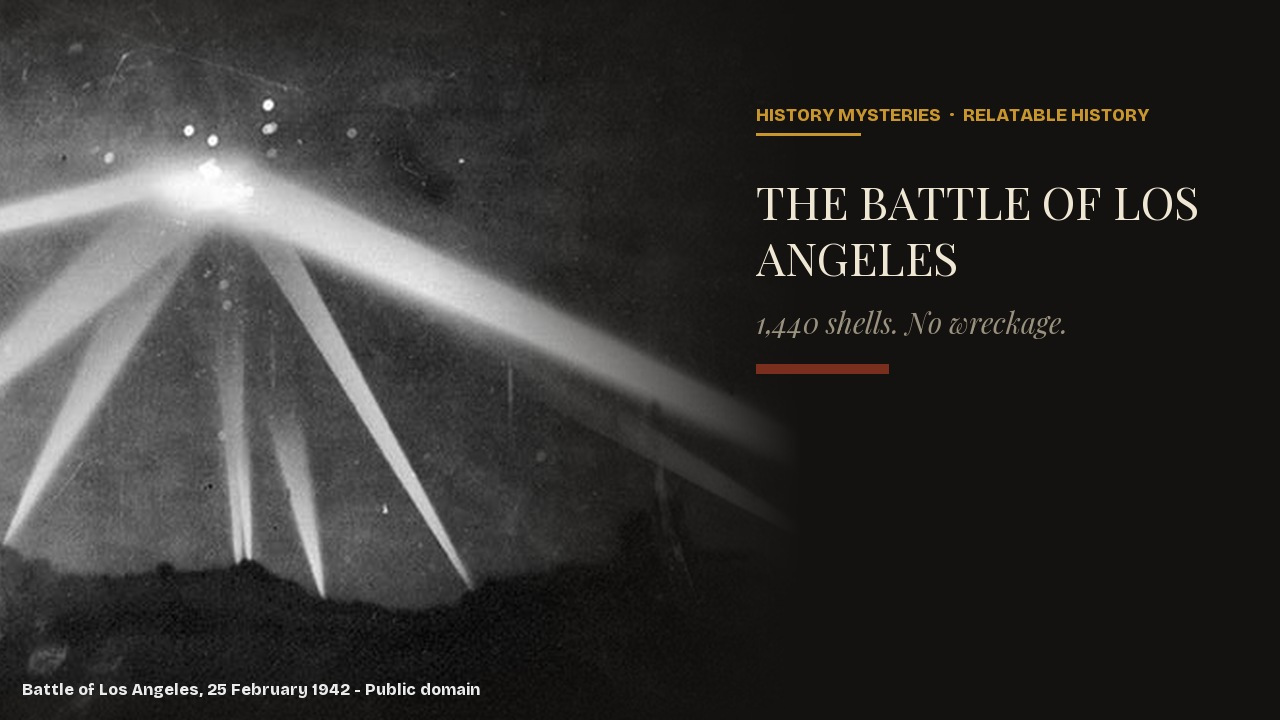
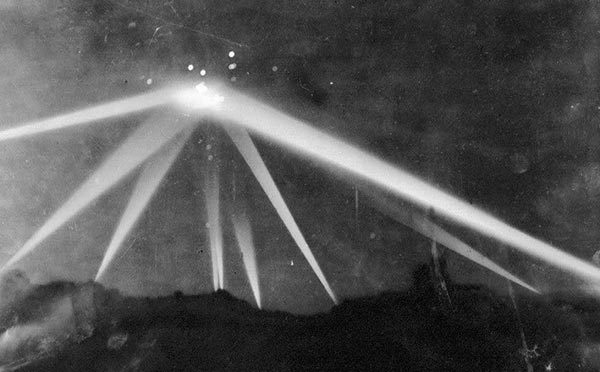
On the morning of 25 February 1942, the anti-aircraft guns ringing Los Angeles fired for nearly an hour at something that was never identified, never recovered, and — eighty-plus years later — still isn’t named in any surviving military record. Somewhere between 1,430 and 1,440 rounds went up. Shrapnel came down on houses, a garage in Santa Monica, and parked cars across the county. Five people died that night, all of them from the blackout and the barrage rather than from anything an enemy dropped. No bomb fell. No aircraft was brought down. No wreckage was ever found.
That much is settled and well documented. What isn’t settled is what the gunners thought they were shooting at, and in the decades since, that gap has been filled with everything from war nerves to a literal flying saucer. The extraterrestrial version is the one that circulates widest today, usually illustrated with a grainy, searchlight-crossed photograph from the next morning’s Los Angeles Times. It has a specific, checkable origin story, and that origin story is not 1942. It’s 1987 — forty-five years later — and it traces to a document that federal investigators spent years establishing was a forgery.
Here is the documented record on both sides of that gap: what the Army, Navy and War Department actually said in the hours after the raid, what the Air Force’s own historians concluded four decades later, and exactly how — and when, and by whom — the interplanetary version got attached to it.
Two Cabinet Secretaries Described the Same Night Completely Differently
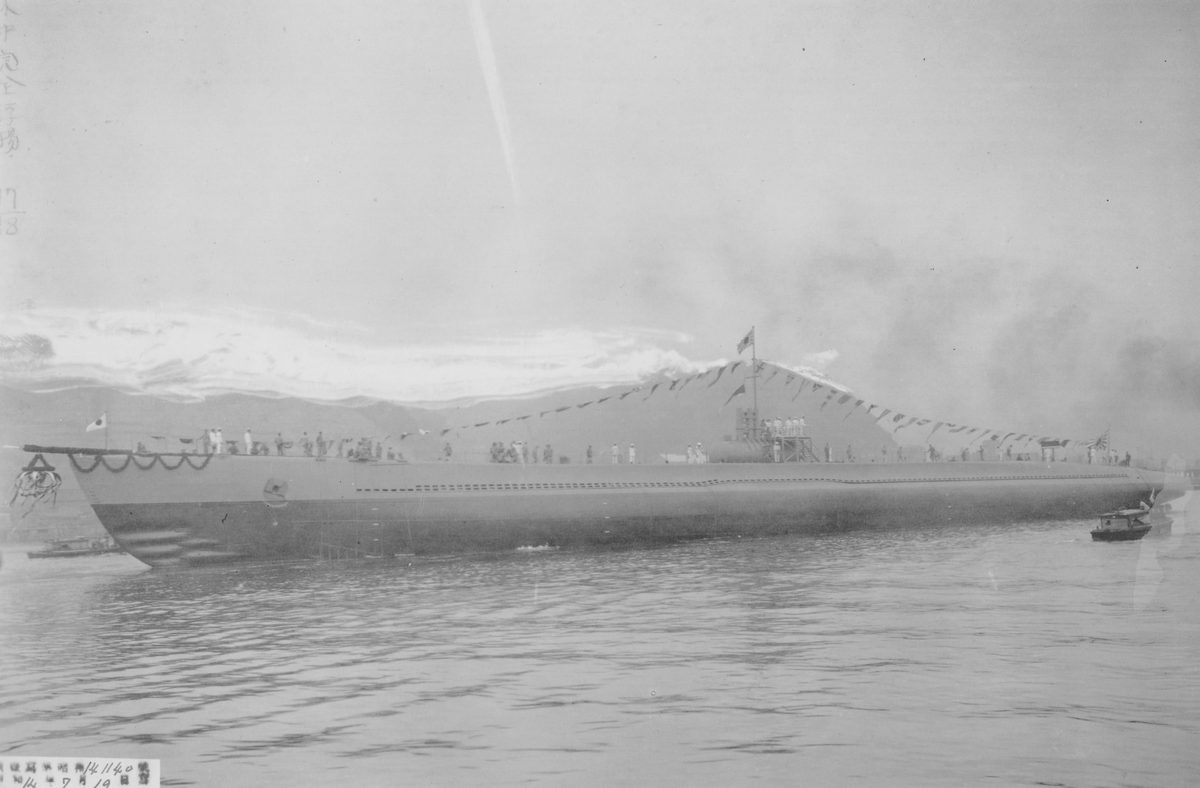
The raid did not come out of nowhere. Pearl Harbor was eleven weeks earlier, and the West Coast had spent the interval bracing for a second attack that wasn’t considered far-fetched: Los Angeles’s aircraft plants — Douglas, Lockheed, North American — were turning out a very large share of the country’s warplanes, and the 37th Coast Artillery Brigade had batteries dug into the surrounding hills specifically to protect them. Two nights before the Los Angeles raid, a Japanese submarine, the I-17, had surfaced off Goleta and shelled the Ellwood oil field with its deck gun — a few hundred dollars of actual damage, but the first shelling of the American mainland in the war, and proof the coast was not a hypothetical.
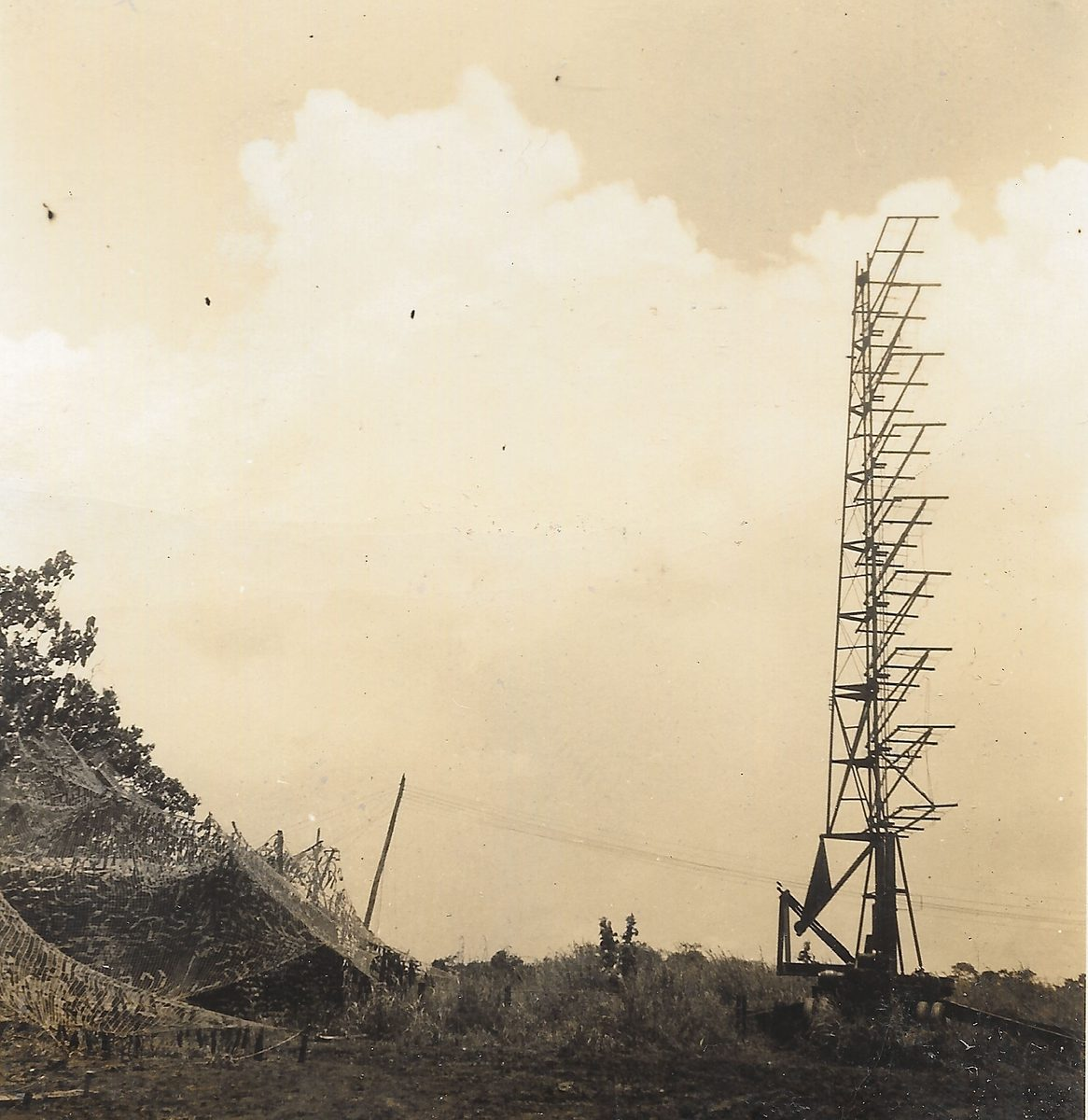
So when radar operators reported an unidentified contact roughly 120 miles off the coast in the small hours of 25 February, the response was immediate: a county-wide blackout, sirens across Los Angeles County, and batteries ordered to open fire. For the next hour the guns didn’t stop. Searchlights crossed. Shells burst at altitude. Nothing came down that any crew could identify.
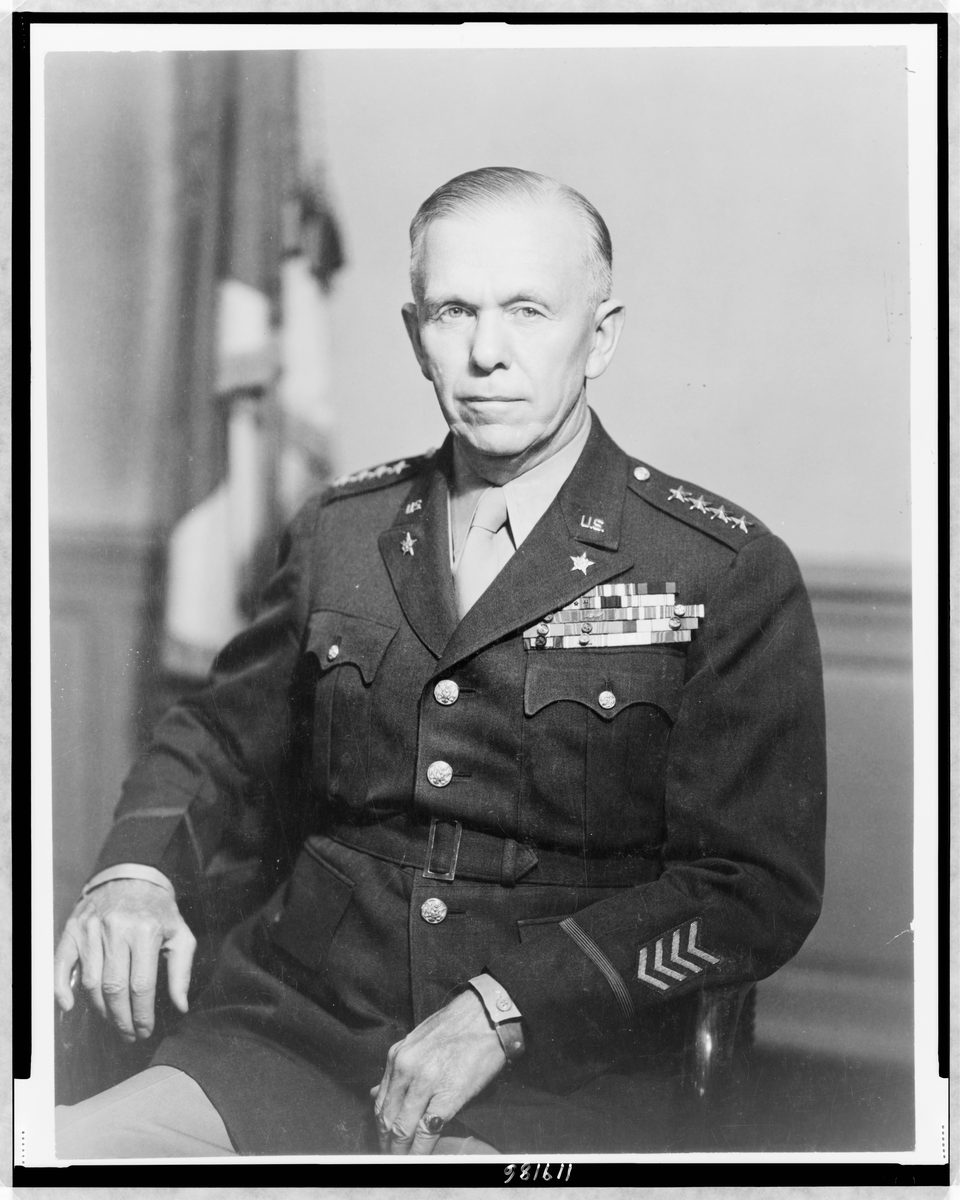
Within twenty-four hours, the government’s own account of the night split in two, in public, between two Cabinet departments. Secretary of the Navy Frank Knox held a press conference and called the whole thing a false alarm, the product of jittery nerves and nothing else. The War Department said the opposite: Secretary of War Henry Stimson, and a memorandum General George Marshall sent to President Roosevelt the next day, reported that unidentified aircraft — not Army, not Navy — had probably been over the city and tracked by the batteries. Sources differ on how many the War Department actually claimed: some accounts put Stimson’s figure at a handful, others at “as many as fifteen.” What no version of the War Department’s statement claims is anything of unidentified origin in the sense later writers would mean it. The dispute, as officially stated at the time, was entirely earthly: Japanese-launched aircraft, or enemy agents flying commercial planes to locate the defenses or spread alarm. Not alien.
The Barrage Likely Fed Itself, and the Army’s Own Later History Said So
The most mundane explanation is also the best-documented one, and it deserves more room than headlines usually give it. Around 1 a.m., roughly an hour before the alert, a meteorological balloon carrying a signal flare had gone up from a coastal battery to check wind conditions — standard practice for aiming guns. When the radar contact and then the first shots arrived, that balloon was still aloft.
The Army’s own official history of the war — Wesley Frank Craven and James Lea Cate’s The Army Air Forces in World War II, compiled under the Air Force’s own historical program and still the standard documentary account — put it plainly: meteorological balloons known to have been released over Los Angeles that night “may well have caused the initial alarm,” and anti-aircraft units were officially criticized afterward for having wasted ammunition on targets that moved far too slowly to have been aircraft at all. Once the first battery fired, the night stopped being empty. Smoke from a shell burst hangs exactly where it was and catches a searchlight beam; a neighboring crew, seeing a lit shape where a moment earlier there had been nothing, fires at it, producing a fresh burst for a third crew to fire at in turn. A sky holding dozens of searchlight beams and hundreds of shell detonations gives every gunner something to report honestly, without an aircraft anywhere in the stack.
Postwar reviews of Japanese naval records found no aircraft logged over Los Angeles that night. Japan did later fly a small number of missions against the American mainland — including a floatplane that dropped incendiaries on an Oregon forest that September — but nothing over Los Angeles in February. In 1983 the Air Force’s Office of Air Force History reviewed the full case file and reached the same balloon-and-war-nerves conclusion that stands today.
The UFO Theory Didn’t Exist Until a Forged Memo Surfaced in the Late 1980s
Here is the part almost no retelling of the Battle of Los Angeles mentions: for more than forty years, nobody connected to the event — not a gunner, not a reporter, not a Cabinet secretary — proposed that anything otherworldly had been in the sky. The extraterrestrial reading of the raid has an exact point of origin, and it is a forgery.
In the mid-1980s, UFO researchers William Moore and Jaime Shandera began circulating documents they said proved the existence of a secret committee called “Majestic 12,” created in 1947 to manage the government’s knowledge of recovered alien craft. Among the paper trail that grew up around that claim was a document dated 5 March 1942 — purporting to be a memorandum from Marshall to Roosevelt about the Los Angeles raid — which asserted that two aircraft had actually been recovered, one at sea and one in the San Bernardino Mountains, and declared: “This Headquarters has come to a determination that the mystery airplanes are in fact not earthly and according to secret intelligence sources they are in all probability of interplanetary origin.”
Nothing resembling that claim exists in the contemporary 1942 record — not in Marshall’s real memorandum, not in Stimson’s statements, not in a single wartime newspaper. Philip J. Klass, a skeptical investigator who spent years examining the Majestic-12 paper trail, identified specific forensic problems with the documents: officers were given incorrect ranks, the formatting did not match genuine wartime briefing papers, and the language included words — “media” in place of the period-correct “press” — that nobody wrote in 1942. The Air Force’s Office of Special Investigations told the FBI that no such committee had ever existed or been authorized, and in 1988 the Bureau’s own examiners marked the file bogus. Klass published his full case against the documents, including this specific memo, in the Skeptical Inquirer in 2000. The forgery still circulates today, nearly four decades on, on UFO websites that reproduce it without the FBI’s conclusion attached.
The Photograph Everyone Associates With the Case Predates the Forgery by Decades
If the forged memo supplied the words, a newspaper photograph supplied the picture, and the two have reinforced each other in the public imagination ever since — despite arriving more than forty years apart, from entirely unrelated sources.
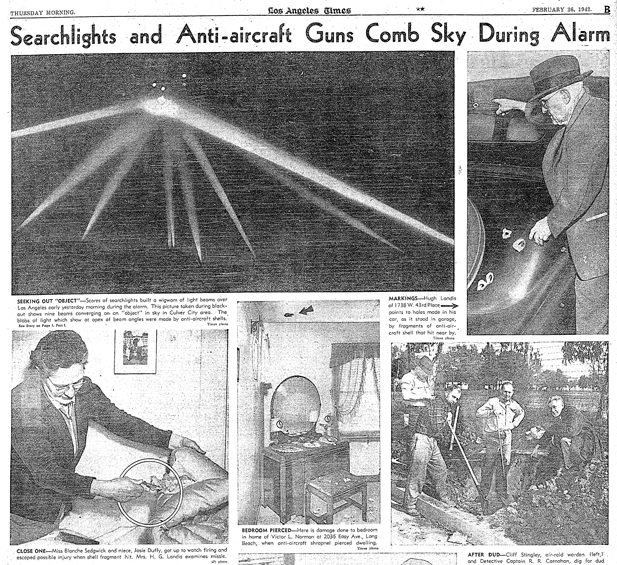
On the morning of 26 February, the Los Angeles Times ran a front-page photograph showing a cluster of searchlight beams converging on a bright point in the sky above the city. It has been reproduced constantly ever since as the visual evidence of the incident. It is also, by the standard newsroom practice of the day, a retouched image: 1940s newspapers routinely darkened and sharpened photographs in the darkroom so they would reproduce legibly on cheap newsprint halftone presses. That wasn’t concealment; every photo desk in the country did it. But it does mean the single most-reproduced image from the case is not a direct, unaltered record of whatever the searchlights were actually lit on — and whatever it shows, it predates any UFO claim about the event by more than four decades. Congressman Leland Ford of Santa Monica, whose own district had just taken the Ellwood shelling, called the whole affair “complete mystification” and pushed for a congressional investigation. It never happened.
The Raid Landed in the Middle of a Decision the Government Had Already Made
One piece of context belongs in this record and is often left out of it. Six days before the guns fired over Los Angeles, on 19 February 1942, President Roosevelt signed Executive Order 9066, authorizing the forced removal of Japanese Americans from the West Coast into incarceration camps. Leland Ford — the same congressman who would call the Los Angeles raid “complete mystification” — had been the first member of Congress to demand that removal from the House floor a month earlier, and had pressed the administration toward signing the order. The raid didn’t create the wartime fear that made that policy possible; it landed inside a climate where that fear had already produced one, and for the Japanese American families who would be forced from their homes along that same coast beginning weeks later, the panic in the sky above Los Angeles was not a curiosity. It was the same fear, now pointed at them.
What’s Actually Left Unresolved
Strip out the forged memorandum and the claims it generated, and what’s left is smaller than the legend, but still genuinely unresolved in its particulars: a radar contact 120 miles offshore that no surviving record identifies; an hour of uncoordinated fire from a barrage that likely sustained itself once it started; eyewitness accounts that can’t be reconciled with one another on the number, speed or altitude of anything in the sky; and two Cabinet departments that, on the record, in public, a day apart, could not agree on whether there had been anything there at all. Every one of those documents is public today. None of them mentions a recovered craft, an alien pilot, or an interplanetary origin — that material was manufactured in a hoax more than four decades after the fact, and government investigators proved it.
What the real record leaves is a weather balloon, a very jumpy coast artillery brigade, and a city shooting at its own shell smoke for the better part of an hour. Something over fourteen hundred rounds went up over Los Angeles that night. What do you think they were firing at?
Watch the full history
The long-form video walks through the raid minute by minute, from the Ellwood shelling to the 1983 Air Force review, in just over nine minutes.

Related reading
- The Rendlesham Forest UFO Case: What the Evidence Actually Shows
- What Was Project Mogul? The Secret Program Behind the Roswell Myth
- How Project Blue Book Investigated UFO Reports
- What the Records Actually Show About the Shag Harbour UFO
Works cited
- Craven, Wesley Frank, and James Lea Cate, eds. The Army Air Forces in World War II, Vol. I. Office of Air Force History, 1983 (orig. University of Chicago Press, 1948). Link.
- California State Military Department. “The Battle of Los Angeles.” California State Military Museum. Link.
- Boissoneault, Lorraine. “The Great Los Angeles Air Raid Terrified Citizens—Even Though No Bombs Were Dropped.” Smithsonian Magazine, January 19, 2018.
- “The WWII Mystery Behind the 1942 Battle of Los Angeles: Axis Planes, Aliens or Mass Hysteria?” Military.com, November 13, 2025. Link.
- Klass, Philip J. “The New Bogus Majestic-12 Documents.” Skeptical Inquirer, May 2000. Link.
- Dunning, Brian. “The Battle of Los Angeles.” Skeptoid, Skeptoid Media. Link.
- Eghigian, Greg. After the Flying Saucers Came: A Global History of the UFO Phenomenon. Oxford University Press, 2024.
- Nakagawa, Martha. “Leland Ford.” Densho Encyclopedia. Densho.
- National Archives. “Japanese Relocation During World War II.” (Executive Order 9066.) Link.