
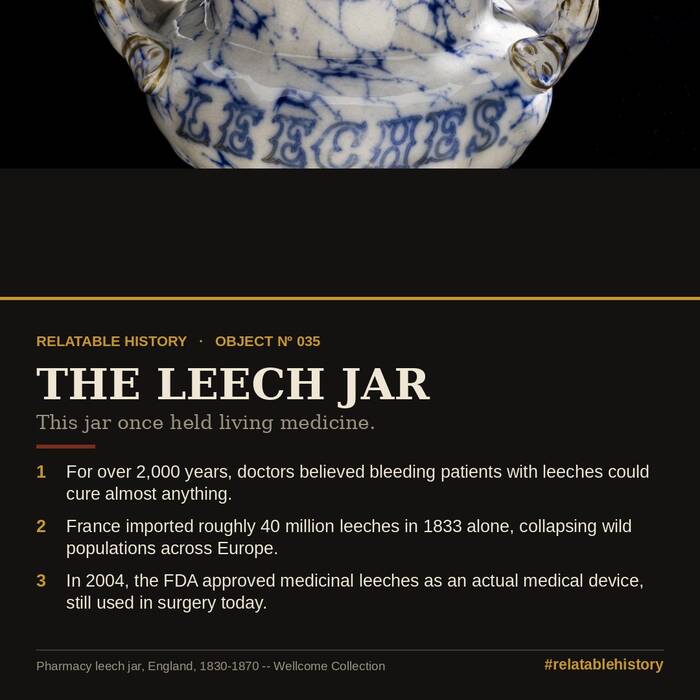
The medicinal leech is a single species of parasitic worm, and in the early nineteenth century the demand for it got so large that it nearly disappeared from the wild across Western Europe. That is not an exaggeration for effect. By the 1830s, overharvesting and the draining of the wetlands it bred in had wiped it out across much of Ireland, England, Wales and the Netherlands, and the animal is still listed as Near Threatened today.
What drove that collapse was not folk superstition. It was a specific, named medical theory, championed by a specific Parisian physician, that turned a bloodsucking invertebrate into one of Europe’s largest pharmaceutical commodities. France alone was importing some 33 million leeches in a single year at the craze’s height. This is the story of how that happened, what finally ended it, and why the same animal is back in American operating rooms today with the U.S. Food and Drug Administration’s blessing.
Blood was considered the body’s master switch
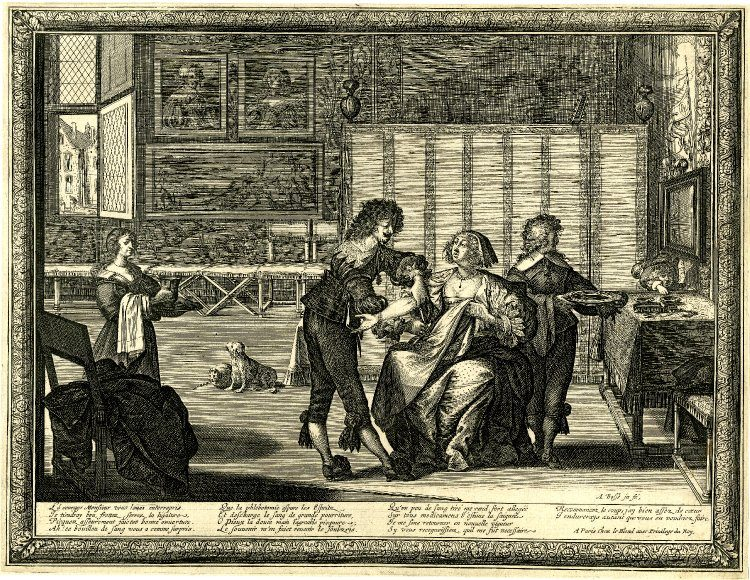
Bloodletting itself is far older than the leech craze. Hippocrates, writing around the fifth century BCE, taught that health depended on a balance among four humors — blood, phlegm, black bile and yellow bile — each tied to a season, an organ and a temperament. Galen, writing some six centuries later, went further and made blood the dominant humor of the four, which meant that almost any illness could plausibly be treated by removing some of it. His writings on the subject held authority in European medicine for well over a thousand years, cited by physicians who had never read a word of the anatomy underneath the theory.
For most of that history, bloodletting meant a lancet, a bowl and a vein. Leeches had a place in the tradition too, prized because they could draw blood from spots a blade could not easily reach — around the eyes, inside the mouth, along inflamed joints — and because the practice of applying them, called hirudotherapy, had been described since antiquity and carried through Greek and Islamic medical texts into medieval Europe. Removing blood was only half of the humoral toolkit; purging the bowels was the other, which is how the same theory later produced the French court’s own enema craze at Versailles. A physician choosing between the lancet and the leech was choosing between a controlled, immediate loss of blood and a slower, more targeted one; leeches were the tool for precision work. What changed in the 1820s was not the theory. It was the scale.
One doctor made bleeding the cure for almost everything
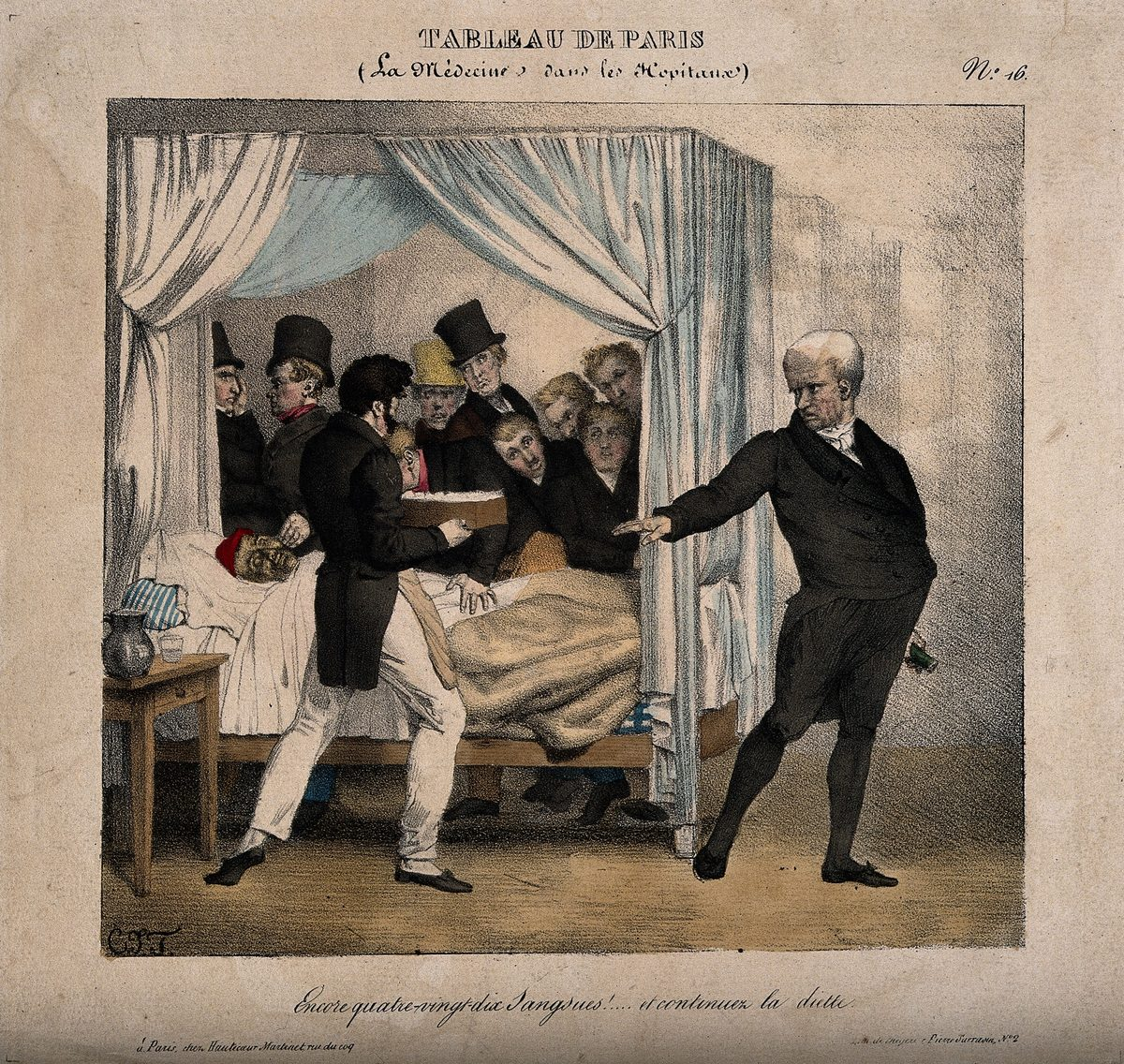
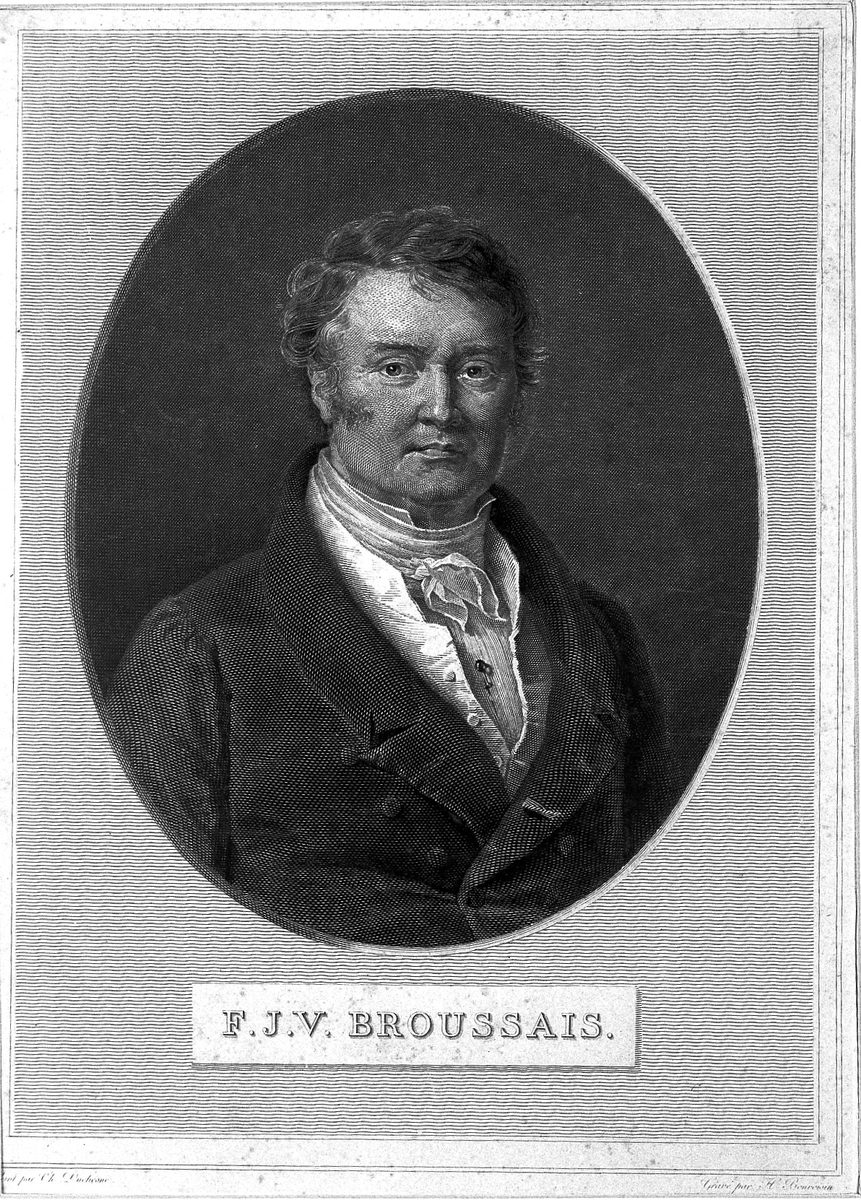
François-Joseph-Victor Broussais trained under some of the leading anatomists of his generation, served as a military surgeon under Napoleon, and by 1831 held the chair of pathology in Paris. His contribution to medical theory was to collapse the whole diagnostic map into a single mechanism: nearly every disease, he argued, began as inflammation and irritation of tissue, most often starting in the gastrointestinal tract, and the correct response to inflammation was to reduce it by drawing blood away from the affected site. Fevers, nervous complaints, digestive trouble and skin eruptions could all, under his system, be traced back to the same inflamed irritation and treated the same way — a single-cause theory confident enough that it would not look out of place a century later next to Walter Freeman’s lobotomies, another one-mechanism answer to nearly every mental ailment a patient could present with.
Because that theory made almost any ailment a candidate for bleeding, and because leeches could be applied repeatedly and precisely without a surgeon’s cut, they became Broussais’s instrument of choice. A single leech, once attached, draws roughly 15 milliliters of blood over about thirty minutes and then drops off on its own; the bite continues to bleed afterward for hours, so one application could cost a patient on the order of 120 milliliters of blood in total. Broussais’s patients were sometimes bled with dozens of leeches in a single sitting, applied and reapplied until he judged the inflammation subdued, and contemporaries described some of them leaving his wards visibly marked by the bites.
The theory created an industry almost overnight
Demand on that scale required a supply chain, and France built one fast. Historian Jessica Martucci, writing for the Science History Institute, puts French imports at roughly 33 million leeches in a single year at the craze’s peak; other accounts of national consumption during the period put the Paris hospitals’ annual use alone in the five-to-six-million range. Leeches that had cost around seven pounds per hundred in Britain before the Napoleonic Wars fell to as little as fifteen shillings per hundred once French supply reopened after 1815, and a single documented shipment in 1817 brought forty thousand leeches from France into the port of Brighton in one week.
The trade became genuinely international. Live leeches were gathered from marshes across Russia, Prussia and Scandinavia, shipped through the hub at Hamburg, and redistributed through English ports such as Hull to retailers as far away as Dublin and Belfast. Medical historian Roy Sawyer, tracing the Irish end of that network, describes a business moving tens of millions of animals a year to every inhabited continent by the second half of the century — a commodity chain built entirely on a worm that pharmacists could not farm reliably and had to keep alive in transit. Even at those prices, Sawyer notes, leeches remained too costly for Ireland’s poorest patients, who went without the era’s standard treatment simply because they could not afford it.
The jar was built to sell the cure, not just store it
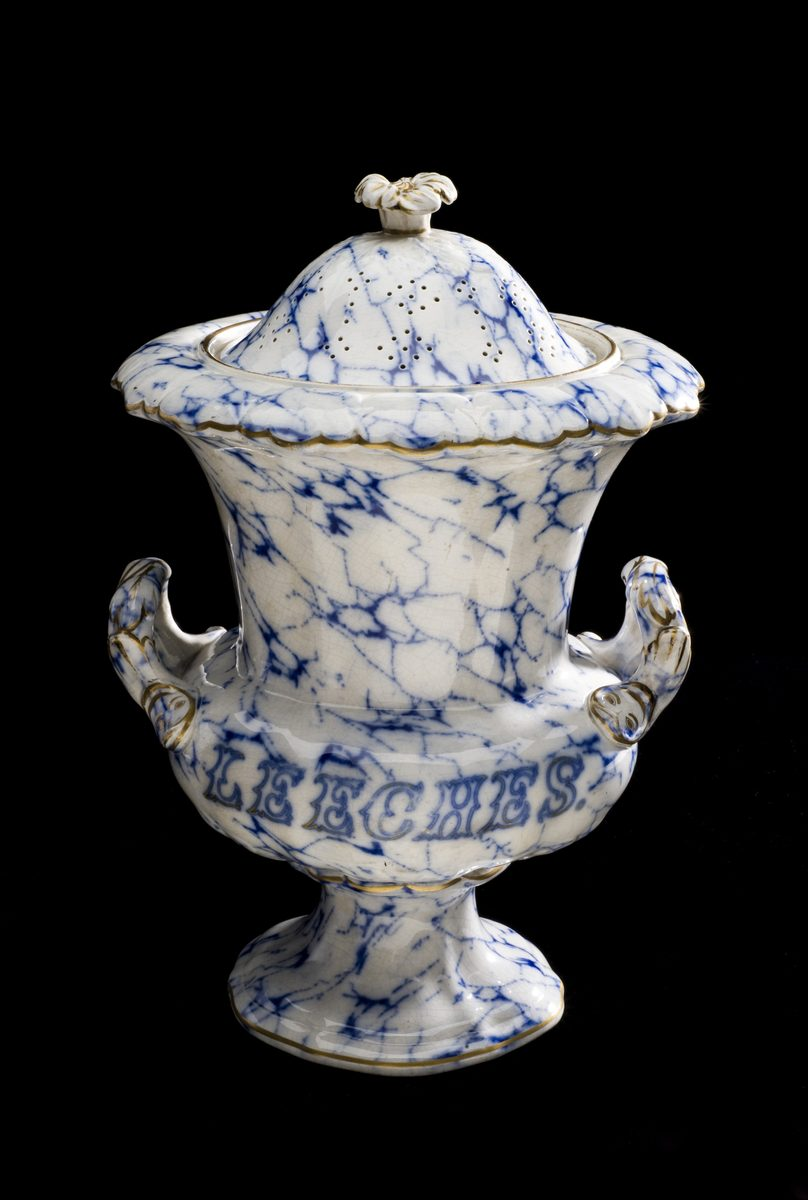
That live-storage problem is exactly what produced the object this video is about. Surviving examples, such as the marbled and gilt earthenware jar now in the Science Museum Group’s Wellcome Collection, date to the 1830s through the 1870s and are built around one functional requirement: a tight-fitting, perforated lid that let air reach the leeches inside without letting them escape. That particular jar stands 360 millimeters tall and weighs 3.43 kilograms, a substantial piece of earthenware for what amounts to a fancy terrarium. A nearly identical jar in the Smithsonian’s own medical history holdings, also Staffordshire-made, carries the same design.
Pharmacists did not need the jars to be beautiful. They chose to make them beautiful anyway, in marbled glazes and gilt trim, and displayed them in shop windows the way a modern business displays a sign. In a market where every chemist on the street sold the same commodity, the jar was the advertisement: proof, visible from the pavement, that this particular shop kept its leeches alive and ready. Museums now treat the surviving jars as medical ceramic-ware worth collecting in their own right, which is a strange afterlife for an object originally built to hold worms.
Supply ran out before demand did
Wild leeches cannot be harvested indefinitely, and by around 1830 European demand for them had already begun outrunning the supply. Professional leech collectors, often poor rural women, waded into ponds and let the animals attach to their bare legs before pulling them off one at a time; William Wordsworth’s poem “Resolution and Independence” memorializes an old leech-gatherer who describes the trade dying out from “pond to pond” as stocks thinned. Some collectors drove livestock through marshes instead, since leeches would attach to a cow’s or a donkey’s legs as readily as a person’s; one farm is recorded driving upwards of two hundred cows and dozens of donkeys through its marsh each season, then combing the animals afterward to collect what had attached.
Attempts to farm the animal in captivity struggled badly. One breeding operation reportedly lost 20,000 leeches to a single day’s visit from migrating ducks, and captive stocks were chronically prone to disease and poor water oxygenation. The wild population never recovered the ground it lost. Hirudo medicinalis is extinct in Ireland today, survives in only a few dozen scattered sites across Great Britain, and is formally protected there under the Wildlife and Countryside Act, which makes it illegal to collect one without a licence. The species that pharmacies once could not stock fast enough is now one conservationists work to keep from disappearing altogether.
A hospital study, not a change of heart, ended the craze
What eventually broke bloodletting’s medical authority was not a new theory of disease but an argument about evidence itself. The French physician Pierre-Charles-Alexandre Louis began publishing what he called the “numerical method” in 1828: the claim that a treatment’s value could only be judged by comparing outcomes across groups of patients treated under genuinely comparable conditions, rather than by a physician’s clinical impression. Applied to 77 pneumonia patients at the Hôpital de la Charité, divided by whether they were bled early in the illness or several days in, his results were, in his own words, “startling and apparently absurd”: the early-bled group recovered a few days faster on average, but 44 percent of them died, against 25 percent of the patients bled later.
Louis’s numbers did not prove bloodletting worthless outright — he still allowed it some narrow value in severe cases — but they were the first systematic evidence that the practice’s benefits had been badly overstated, and they arrived just as Broussais’s personal influence was already fading. By the second half of the century, germ theory gave physicians an actual mechanism for infectious disease to replace humoral balance, and the leech jar went from a shop’s proudest fixture to an antique curiosity within a single generation.

Watch the short
No long-form video exists for this topic yet; the original short covers the jar itself, the French leeching craze, and the 2004 FDA approval in about a minute and a half.

What the jar still has to say
It is tempting to read the leech jar as a joke at the expense of nineteenth-century medicine, and there is a joke in it. But the object is better read as evidence of something more durable: a wrong theory, confidently held and institutionally backed, can build real infrastructure — shipping routes, price lists, a whole livestock-based harvesting economy — long before anyone collects the data needed to test whether the theory is true. A century later the same pattern sold radium water as a tonic, in what became the case of Eben Byers, on no better evidence. Broussais did not have to be right to move 33 million leeches a year. He only had to be believed.
Pierre Louis’s pneumonia study is arguably the more important artefact of the two, even though no museum keeps a copy of it in a display case next to the jars. It is one of the earliest clinical trials in the modern sense, and the habit of mind it represents — count the outcomes, compare the groups, trust the arithmetic over the impression — is the direct ancestor of the controlled trials that now decide whether any treatment, leech or otherwise, actually works.
And the leech itself never left the pharmacopoeia; it just waited for a narrower job. In 2004 the U.S. Food and Drug Administration cleared Hirudo medicinalis, supplied by the French firm Ricarimpex, as a medical device in its own right, for exactly the kind of localized, precisely targeted bleeding that made it useful to physicians two thousand years earlier — relieving venous congestion in a skin graft or a reattached finger or ear, so the tissue does not die while new veins have time to grow back in. Reconstructive surgeons still rank that as the leech’s primary indication today. It is, in that sense, in the same company as the iron lung: an object medicine was supposed to have outgrown, still quietly doing its one job somewhere. The jar on the pharmacy counter is gone. The animal inside it is still on the payroll.
Related reading
- The Strange History of the Enema Craze That Swept Versailles
- The Radium Water That Dissolved Eben Byers’ Jaw
- How the Iron Lung Worked, and Who Was Still Breathing Inside One in 2026
- How Many Lobotomies Did Walter Freeman Actually Perform?
Shop the styles/items featured in this video
- Quackery: A Brief History of the Worst Ways to Cure Everything (book)
- Vintage-style blue and white ceramic apothecary jar (decor)
- The History of Medicine documentary collection
Works cited
- Houschyar, Khosrow S., et al. “Medical leech therapy in plastic reconstructive surgery.” Wiener medizinische Wochenschrift 165 (2015): 419–425. Link.
- Sawyer, Roy T. “History of the leech trade in Ireland, 1750–1915: microcosm of a global commodity.” Medical History 57, no. 3 (2013): 420–441. Link.
- Pearce, J.M.S. “Leeching and François-Joseph-Victor Broussais.” Hektoen International: A Journal of Medical Humanities, Summer 2021. Link.
- Science Museum Group / Wellcome Collection. “Pharmacy leech jar.” Object A637617. Link.
- Smithsonian National Museum of American History. “Leech Jar,” object nmah_736008, mid-1800s, Staffordshire, England.
- U.S. Food and Drug Administration. 510(k) Premarket Notification K040187, Medicinal Leeches (Hirudo medicinalis), Ricarimpex SAS, cleared June 21, 2004. Link.
- Greenstone, Gerry. “The History of Bloodletting.” BCMJ 52, no. 1 (Jan/Feb 2010): 12–14. Link.
- Martucci, Jessica. “Medicinal Leeches and Where to Find Them.” Distillations, Science History Institute. Link.
- Buglife — The Invertebrate Conservation Trust. “Medicinal Leech” species factsheet. Link.
- James Lind Library. “Pierre-Charles-Alexandre Louis and the evaluation of bloodletting.” Link.