
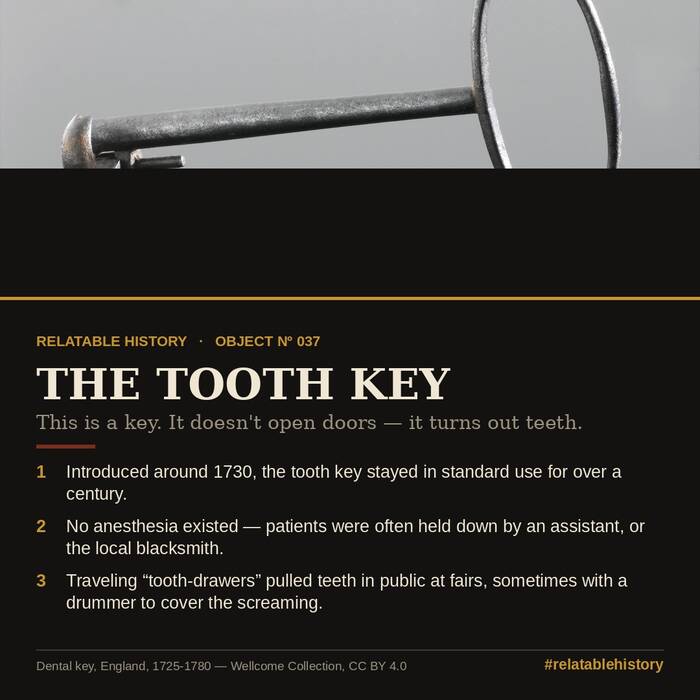
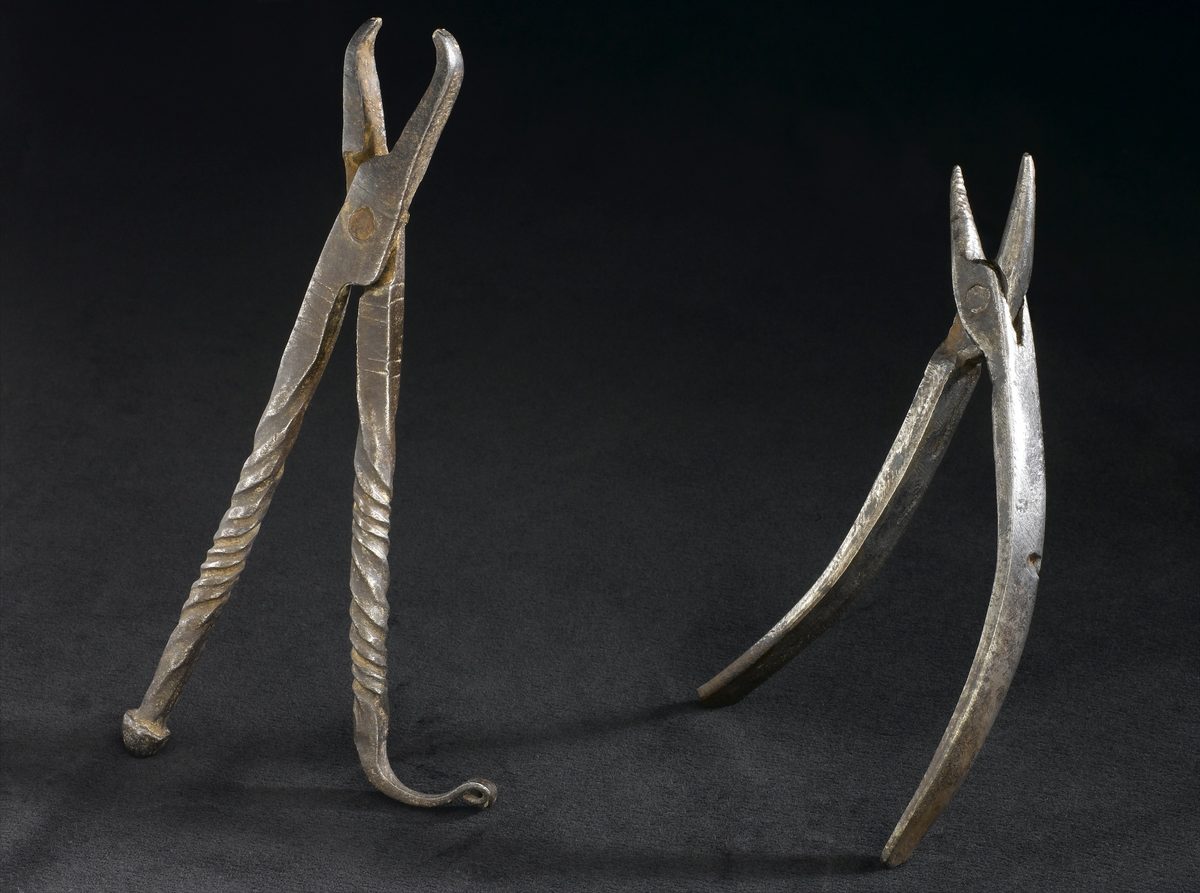
This is a key that never opened a single door. Starting around 1730 and continuing for roughly a hundred and twenty years, dentists and barber-surgeons across Europe and America used it to turn teeth out of jaws, in a motion its own era compared, without much irony, to unlocking a stubborn door. No anesthesia existed for any of that run. The tool worked by leverage and torque alone, and how well it worked depended entirely on the steadiness of the hand holding it.
How the dental key worked is, mechanically, simple enough to describe in a sentence: a claw gripped the tooth, a small bolster braced against the gum as a pivot, and the operator rotated the whole handle like a key in a lock until the tooth came free. What takes longer to explain is everything that could go wrong between the first turn of the wrist and the last — and why, for over a century, enough people judged the odds worth it that the key became the standard tool of a trade with no licensing exam, no anesthetic, and very little agreement on how hard was too hard to turn.
The pelican came first, and it worked like a crowbar
Before the key, tooth extraction belonged to the pelican, a hooked instrument named for its claw’s resemblance to a pelican’s beak, in documented use from at least the fourteenth century through the nineteenth. The pelican did not turn; it pried. The operator hooked its claw around the crown of the tooth, braced the tool against the jaw as a fulcrum, and levered the tooth sideways out of its socket, in essentially the same motion as prying a nail out of a board with a claw hammer.
That motion was crude and hard to aim. Leverage applied in one direction tends to keep going in that direction, and a pelican’s force frequently landed on more than the intended tooth, chipping or loosening the one beside it. The French surgeon Pierre Fauchard, whose 1728 textbook on dentistry is often credited with founding the field as a distinct discipline, favored a gentler rocking or “shaking” motion with his own instruments where he could, which suggests at least some practitioners were already looking for something less violent than a straight pry. The key, when it arrived, was partly a response to exactly that problem.
The key turned a tooth instead of prying it loose
The instrument is usually traced to around 1730, and one of the earliest clear written descriptions of it comes from the French surgeon René Jacques Croissant de Garengeot (1688–1759), whose name stuck to it for decades afterward as the “Clef de Garengeot,” or Key of Garengeot. English sources of the same period sometimes called it the Fothergill Key instead, after the London physician John Fothergill, in a 1742 account by the anatomist Alexander Monro — a reminder that an instrument with one basic design could still travel under two or three competing names depending on which city’s dentists were doing the naming.
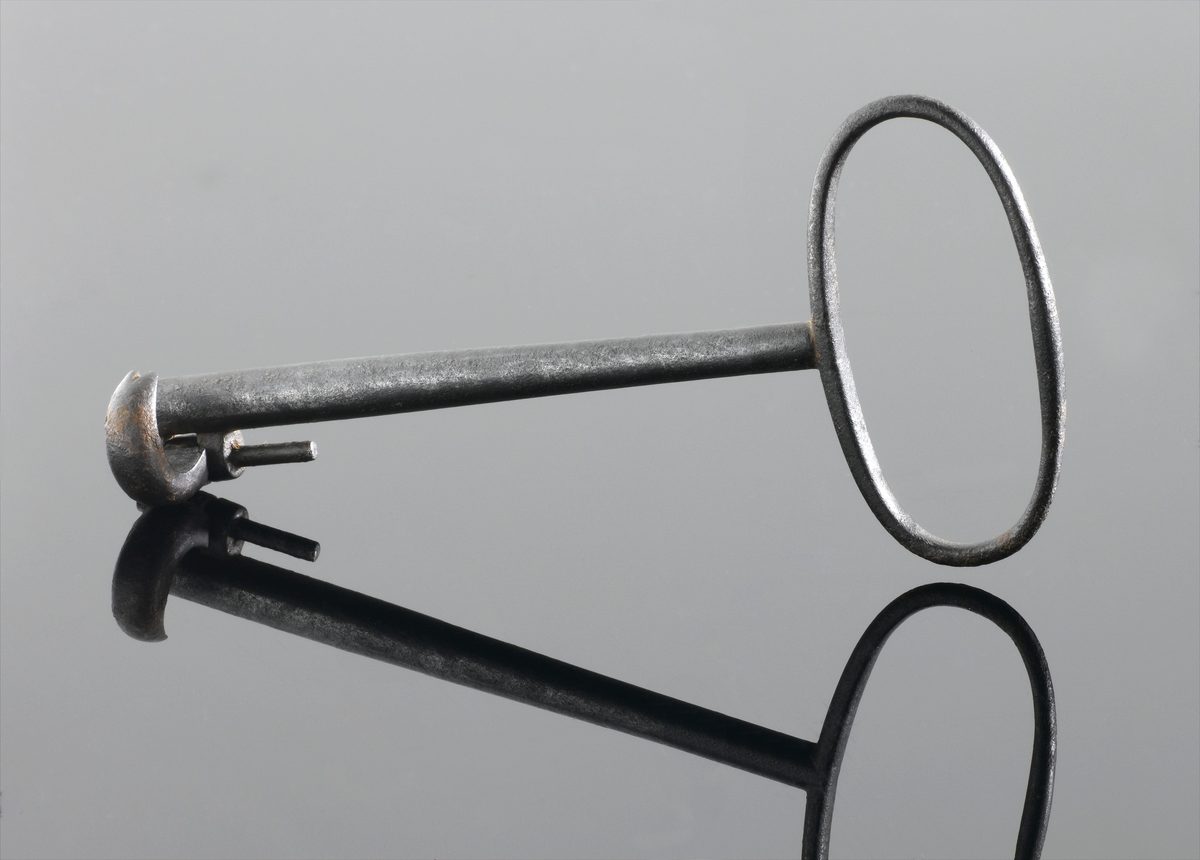
Mechanically, the shift from the pelican was real. A key consisted of a straight metal shaft, a large ring-shaped handle at one end, and a hinged claw at the other, built along a bolster that sat against the neighboring gum. The operator slid the claw around the base of the target tooth, let the bolster settle against the gum as a pivot point, and rotated the handle the way you would turn a key stuck in an old lock. Rotation, not straight prying force, is what levered the tooth from its socket — a change that, done well, could be faster and more controlled than the pelican’s sideways wrench. Done badly, it was just as capable of taking the crown off the tooth, cracking a neighbor, or tearing the gum.
A single bend separated a clean extraction from a broken jaw
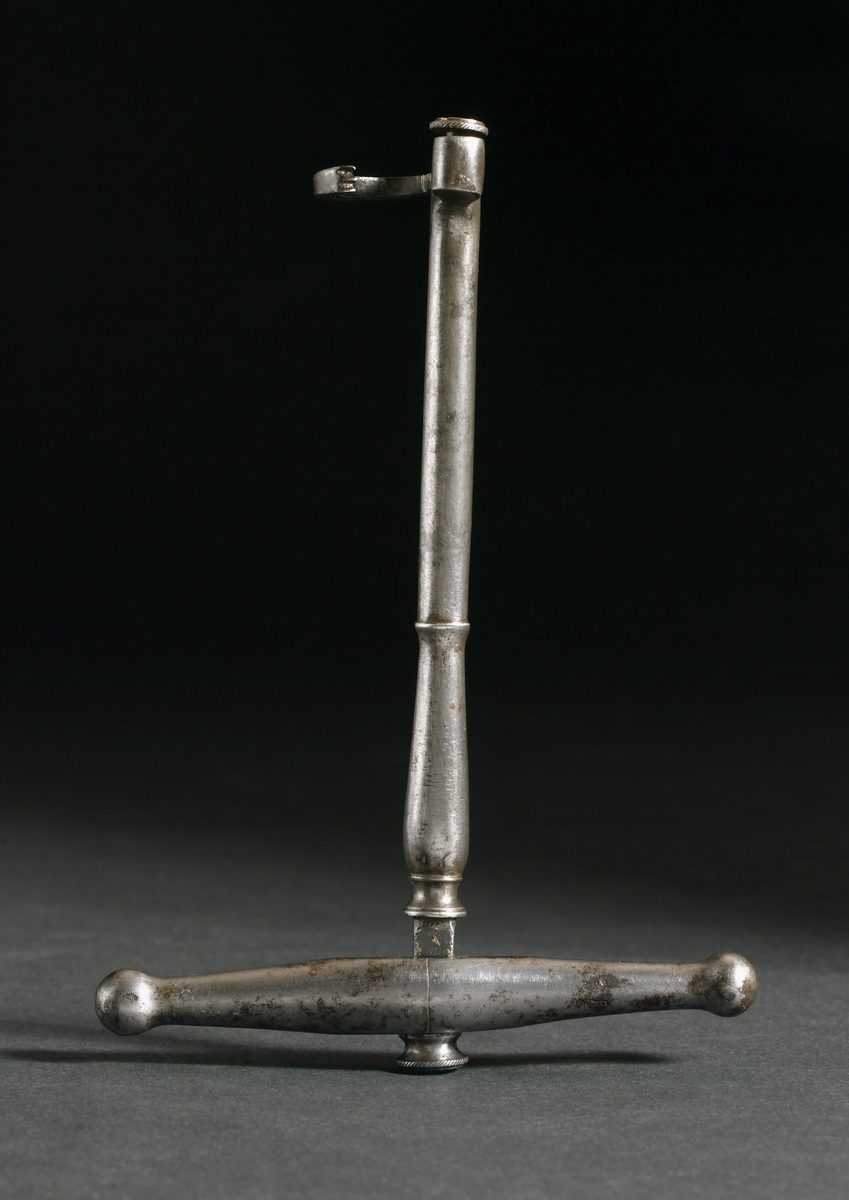
Instrument makers spent most of a century trying to make that margin between done-well and done-badly less of a gamble. Around 1770, English makers introduced what became known as the key of “Common Construction”: a single bend placed in the shaft near the bolster, which reduced the excessive torque the straight earlier design transmitted through the tooth and into the gum and jawbone. Despite being an English refinement, it kept being sold under the Garengeot name anyway.
The London instrument maker Savigny published Britain’s first fully illustrated catalogue of surgical instruments in 1798, and in it he put his finger on exactly why the bolster mattered so much: its depth, he wrote, “even in the smallest, describes in its action so large a circle as to occasion unavoidable inconvenience.” A deeper bolster swept a wider arc as it turned, and that wider arc was what fractured the alveolar process — the bone that holds the tooth socket — rather than simply freeing the tooth. Savigny’s redesigned, shallower bolster aimed to lift a tooth nearly straight up out of the jaw instead of levering it sideways, cutting down on exactly that kind of collateral bone damage.
Refinements kept coming for decades after that. By the early 1800s, better keys secured an interchangeable claw with its own screw, stored inside a hollow two-part handle along with a small screwdriver, so a single key could be fitted with a different claw for a molar, a premolar, or an incisor. Claw edges were hollowed and serrated to bite into the tooth’s root rather than slip off it. As late as 1859, long after the key’s heyday had already passed its peak, the dentist B. F. Killiam patented a version with a movable, screw-controlled bolster — a sign that some practitioners were still trying to perfect the key’s mechanics even as the rest of the profession was already moving on to something else entirely.
Pulling teeth was public theater, and the drummer was not incidental
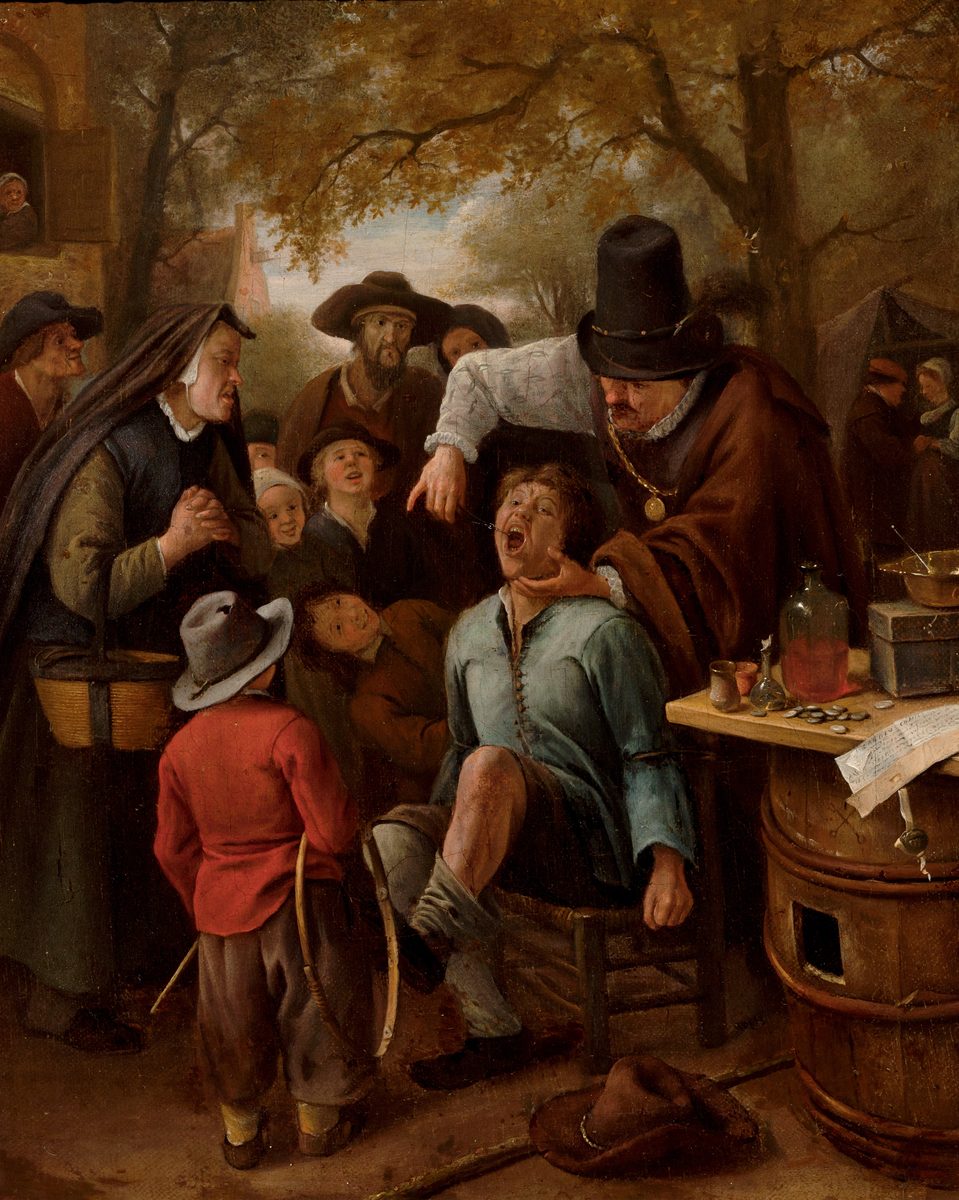
For most of the eighteenth century, dentistry was not a licensed profession in any formal sense. Pulling teeth was one more service a barber-surgeon offered alongside haircuts, bloodletting and lancing boils, and it traveled easily because the key made the job fast. Itinerant tooth-drawers set up at fairs and market days across England and the Continent, pulling teeth in front of a crowd as a kind of grim public entertainment — part medical service, part sideshow. Some brought a drummer or trumpeter along, nominally to attract customers, but just as usefully to cover the sound of the patient. Painters of the period returned to the scene often enough that it became close to its own genre: Jan Steen painted it in 1651, and Gerard Dou and Giovanni Domenico Tiepolo both returned to the same crowded, half-comic tableau of a pinned patient and a gathered audience.
None of it was gentle, because nothing yet could make it gentle. No anesthetic of any kind existed before the 1840s, so patients were routinely held in place by an assistant, or simply by whichever bystander had the strongest grip. Even inside the respectable end of the profession, the risks were well documented rather than whispered about. Thomas Berdmore, dentist to King George III, laid out the hazards of extraction at length in his 1768 treatise on the teeth and gums — evidence that even a dentist with the most prestigious client in the country was working with a tool that broke the wrong thing often enough to need a chapter on it.
The key caused more injuries than any dental tool before or since
That is not rhetorical flourish; it is close to a direct paraphrase of the dental historian John M. Hyson’s verdict, as cited in a 2018 survey of dental keys in the Delaware Journal of Public Health: the key, Hyson argued, caused more accidents and injuries than every other contemporary extraction instrument combined. It stayed in use anyway, for the plainest possible reason — it was still the fastest extraction method available, and speed mattered enormously to a practitioner working without any way to numb the pain a slow procedure would prolong.
The specific failure modes were consistent across the sources that documented them: a claw that slipped could crack the crown and leave the root behind; a bolster seated too deep, or a wrist turned too far, could fracture the alveolar bone or wrench out the healthy tooth standing next to the target. None of this required a careless operator. The instrument’s leverage was powerful by design, and powerful leverage in a confined, irregularly shaped space — a human mouth, on a patient who was very likely flinching — is difficult to control precisely no matter how practiced the hand holding it.
Two breakthroughs in the 1840s ended its reign
What finally displaced the key was not one invention but two, arriving within a few years of each other. The first was a better tool. The English surgeon John Tomes, while House Surgeon at Middlesex Hospital in 1839 and 1840, invented a new generation of forceps with jaws shaped to match the actual necks of different teeth, gripping the crown directly and working it free with a controlled rocking motion rather than a single leveraged turn. Tomes was not the first person to use forceps — they are among the oldest dental instruments in existence — but working with the instrument maker Jean Marie Evrard, he is credited with popularizing anatomically precise versions that could be matched to a specific tooth, which the key’s one-size-fits-most claw never really achieved. Tomes went on to found the Odontological Society, help secure England’s first Dentists Act in 1878, and become the first president of the British Dental Association in 1880.
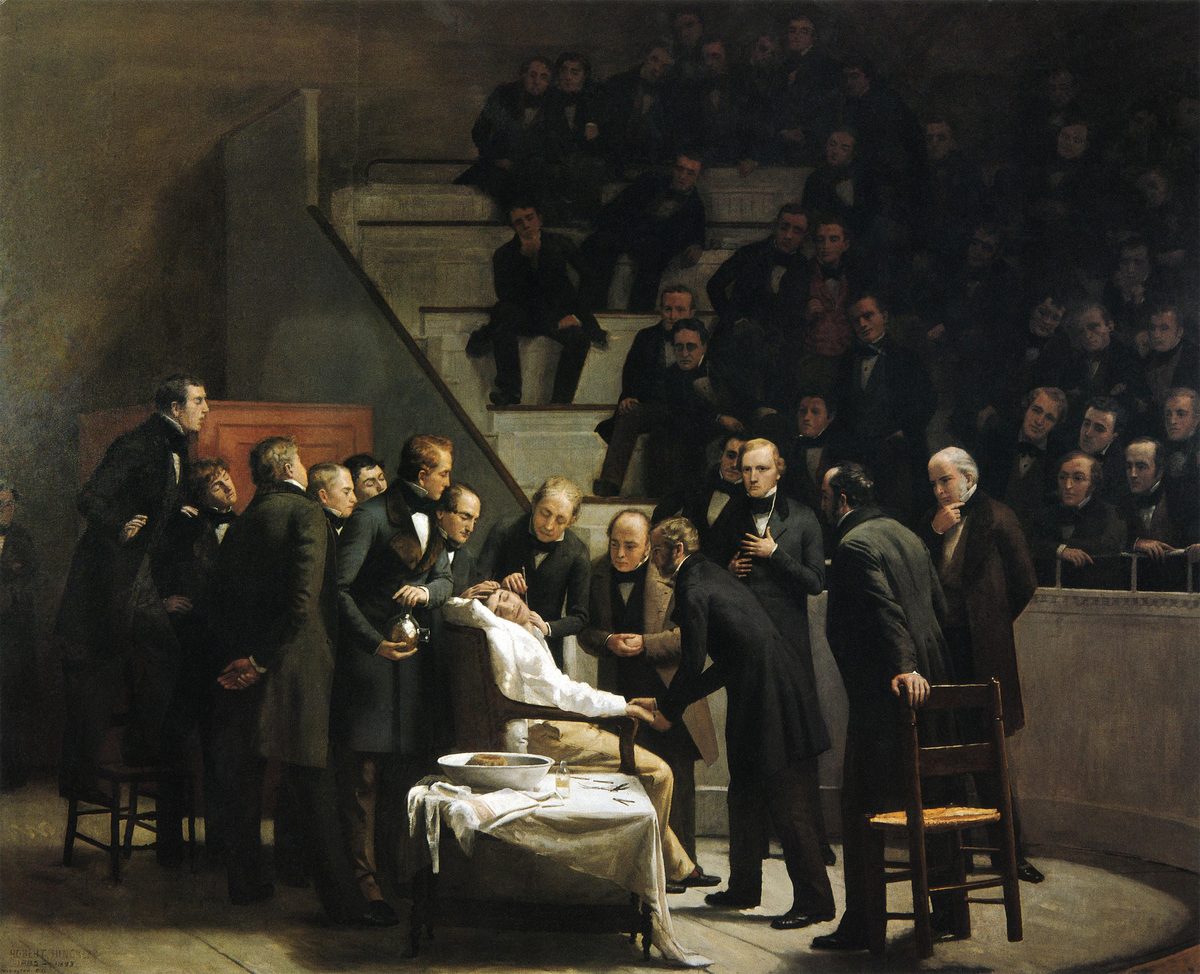
The second breakthrough was anesthesia, and it arrived almost as a false start before it arrived for real. On December 11, 1844, the Hartford dentist Horace Wells had one of his own teeth pulled under nitrous oxide, administered by a colleague, in a self-experiment that worked. His attempt to repeat that success in public, in January 1845 at Massachusetts General Hospital, did not go nearly as well. Not quite two years later, on October 16, 1846, in the same Massachusetts General Hospital operating theater, the dentist William Morton administered sulfuric ether by sponge while the surgeon John Collins Warren removed a tumor from a patient named Edward Gilbert Abbott, who stayed still through a three-inch incision. Warren is said to have turned to the watching crowd afterward and declared, “Gentlemen, this is no humbug.” The room became known from that morning on as the Ether Dome, and the date is still marked as Ether Day.
Watch the short
No long-form video exists yet for this topic; the original minute-and-a-half short covers the key’s claw-and-bolster mechanism and the century it spent in standard use.

Once patients could be numbed instead of merely held down, and once forceps could be matched to the tooth being pulled instead of relying on one claw shape for everything, the market-square spectacle of the key lost both its speed advantage and its rationale at roughly the same time. The switch was not instant. Poorer regions and traveling practitioners kept cheap, durable keys in service for decades after urban dentists had largely moved to forceps, and the tool is not generally considered obsolete until around 1900. But the direction of travel was set by the mid-1800s, and it never reversed.
Surviving keys now sit mostly in museum collections — the Wellcome Collection in London holds dozens, in steel, with handles in wood, ivory, horn and mother-of-pearl, sorted by claw shape and decade. What a case full of them actually documents is less a single invention than a century-long argument, conducted in metal, over how much torque a human jaw could be asked to absorb before the tool needed to change instead of the patient. Berdmore’s patients, and Savigny’s customers, and whoever sat down in front of Jan Steen’s tooth-drawer in 1651, were all, in a very literal sense, testing that question with their own mouths. The forceps and the ether sponge are the record of what the answer eventually turned out to be.
Related reading
- Who Discovered Ether Anesthesia? — the feud over the breakthrough that helped end the dental key’s reign.
- The Evolution of Toothbrush Bristles, From Boar Hair to Nylon — another dental-care object with a rougher past than it looks.
- Why Doctors Drained Blood to Treat Almost Any Illness — another pre-anesthesia medical standard with its own long list of injuries.
- The Radium Water That Dissolved Eben Byers’ Jaw — a very different way a 20th-century jaw ended up destroyed by its own treatment.
Shop the styles/items featured in this video
- The Excruciating History of Dentistry (book)
- Antique-style dental key replica / collectible
- Wellcome Collection historic medical instrument print
Works cited
- Rodilla, Vicent, Alicia López-Castellano, and Cristina Ribes-Vallés. “Tooth Extraction in Art: From the Dental Key to the Forceps.” Hektoen International: A Journal of Medical Humanities, Summer 2019. Link.
- University of the Pacific, Arthur A. Dugoni School of Dentistry, Ward Museum. “Toothache and Trauma: A History of the Toothkey” (online exhibit). Link.
- University of the Pacific, Ward Museum. “Key of ‘Common Construction,’ Circa 1770” (object A147.161), Toothache and Trauma online exhibit. Link.
- Royal College of Physicians and Surgeons of Glasgow. “Dental Instruments of the Late 18th/Early 19th Centuries.” Heritage Blog, February 27, 2014. Link.
- Science Museum Group Collection. Dental Key, object A3199, Germany, 1801–1850. Link.
- Royal College of Surgeons of England. “Tomes, Sir John (1815–1895).” Plarr’s Lives of the Fellows Online.
- Berdmore, Thomas. A Treatise on the Disorders and Deformities of the Teeth and Gums, with Cases and Experiments. London: printed for the author, 1768.
- Gross, Benjamin. “Scientist of the Day — Ether Dome.” Linda Hall Library, October 16, 2019. Link.
- Hartford Medical Society Historical Library. “Horace Wells, D.D.S. (1815–1848).” Digital portrait archive. Link.
- Lenart, Kate. “Dental Keys.” Delaware Journal of Public Health 4, no. 1 (January 9, 2018). Link.