
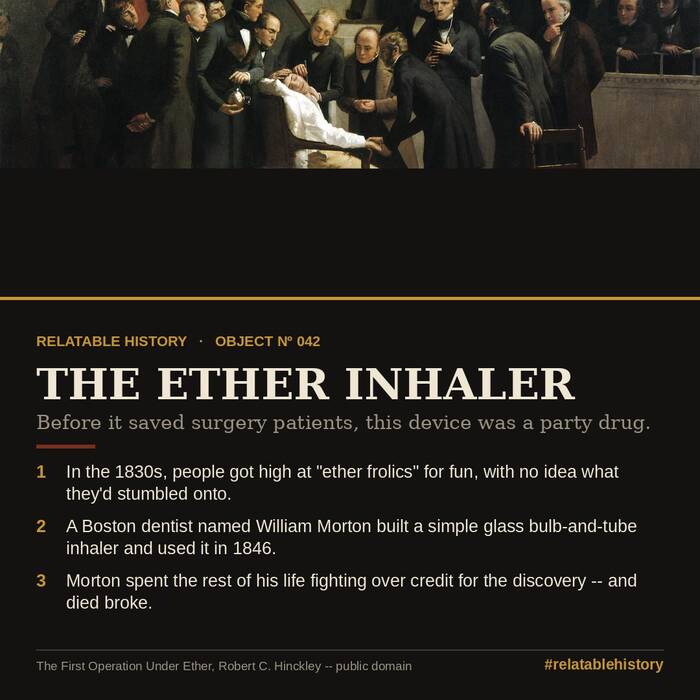
In December 1844, a Hartford dentist named Horace Wells stood before an audience of Harvard medical students and faculty at Massachusetts General Hospital and asked for a volunteer to have a tooth pulled while breathing nitrous oxide. The patient groaned partway through the extraction. The room decided the whole thing had been staged, shouted “Humbug” and “Swindler,” and ran Wells off. For almost two years afterward, the idea that a gas could switch off surgical pain was treated as a joke.
Less than two years later, in the same city, a different gas and a different delivery device produced the opposite result. On October 16, 1846, a Boston dentist named William Morton administered sulfuric ether to a patient through a glass globe of his own design, a surgeon cut into the patient’s neck, and the patient did not move. The surgeon, astonished, told the room this was no humbug. Word of what became known as Ether Day reached London within ten weeks.
What that story usually leaves out is who actually got there first, and what happened to every man who said he had. By the time the argument over who discovered ether anesthesia finally wound down, it had run through four separate claimants, consumed two of their fortunes, cost one of them his sanity, and ended one of their lives outright. This is the version with that part left in.
Ether had been a party drug for two decades before anyone used it medically
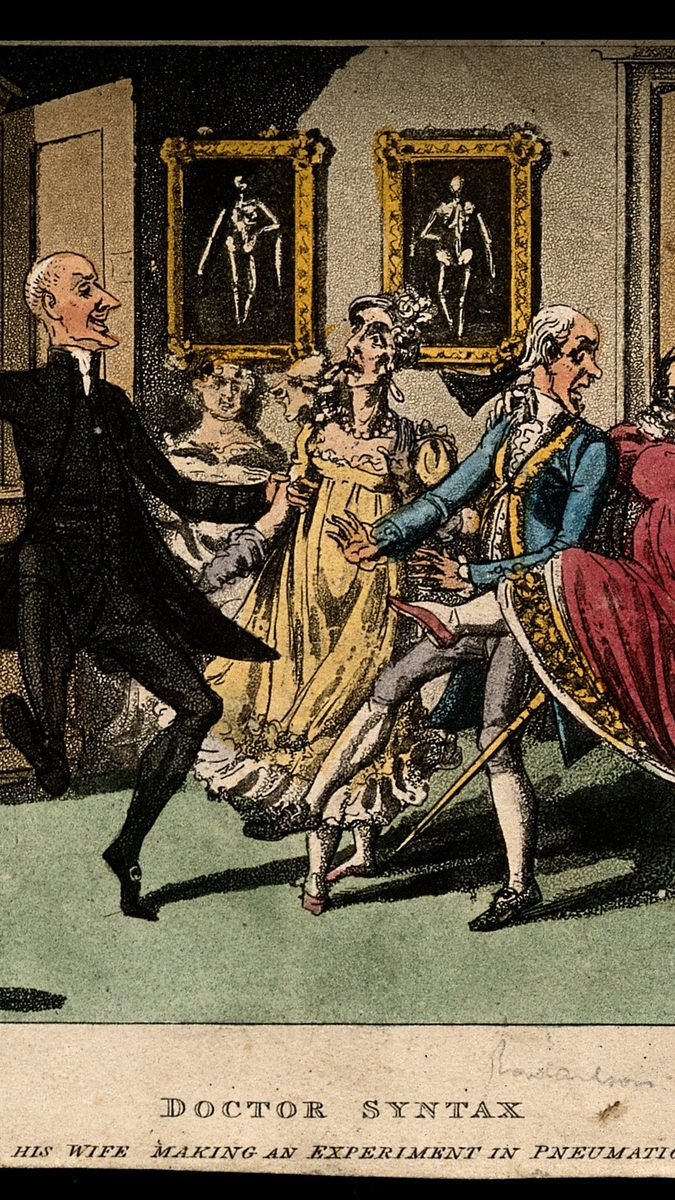
Diethyl ether was cheap, easy to make, and intoxicating well before anyone thought to operate under it. Through the 1820s and 1830s, “ether frolics” were a fixture of American and European student life: partygoers inhaled the fumes from a soaked cloth or a bottle, got giddy and unsteady, and performed for each other the way a room does on nitrous oxide at a dentist’s office today. In parts of Ireland, where the temperance movement had made alcohol socially costly, people drank ether outright as a substitute — it was sold openly in pubs and shops until it was finally classified as a poison in the 1890s.
Crawford Long, a young Georgia physician, took part in exactly this kind of party as a medical student at the University of Pennsylvania. What he noticed was not the euphoria. He noticed that people who stumbled into furniture and bruised themselves badly during a frolic seemed genuinely unaware of it until the ether wore off. That observation, made at a party and not in a clinic, is the entire premise an operating-room anesthetic would eventually be built on.
A Georgia doctor used it first, in 1842 — and said almost nothing for seven years
On March 30, 1842, in his office in Jefferson, Georgia, Long removed a cyst from the neck of a patient named James Venable, in front of three witnesses, using sulfuric ether as the anesthetic. Venable reported feeling nothing. By any reasonable accounting, this was the first surgery performed under anesthesia anywhere in the world — four and a half years before Boston’s Ether Day.
Long did not publish it. Part of the reason was genuine scientific caution: most physicians of the period doubted a gas could reliably block pain at all, and Long wanted more cases before he staked his name on the claim. Part of it was social — some of his neighbors reportedly attributed what he was doing to witchcraft or to defying the natural order of suffering. He kept quietly using ether on further patients, including in his own obstetric practice, for years, gathering evidence almost no one else saw.
It was reading newspaper accounts of Morton’s Boston demonstration in late 1846 that finally pushed Long to document his own earlier work. He presented his findings to the Medical College of Georgia in 1849 and published them that December in the Southern Medical and Surgical Journal, complete with patient affidavits attesting to dates he could no longer prove any other way. The National Eclectic Medical Association formally recognized him as anesthesia’s discoverer in 1879 — the year after he died. March 30 is now National Doctors’ Day because of him.
A failed demonstration, then a glass globe that solved the dosing problem
Horace Wells’s humiliation at Massachusetts General in January 1845 was not really a failure of nitrous oxide as an idea. It was a failure of dosing: the bag was pulled too soon, the patient got less gas than he needed, and he groaned at the wrong moment in front of the one audience that mattered. Wells had gotten the underlying insight right two months earlier, numbing his own wisdom-tooth extraction with nitrous oxide administered by the showman Gardner Colton. He just could not yet make the dose reliable in front of strangers.
William Morton, who had briefly been Wells’s dental partner in Boston and had studied chemistry under Charles Jackson at Harvard, spent the summer of 1846 testing sulfuric ether first on animals and then on himself. On September 30, 1846, he used it to extract a patient’s tooth painlessly in his own dental office — a smaller, private version of exactly the demonstration that had destroyed Wells’s reputation two years earlier.
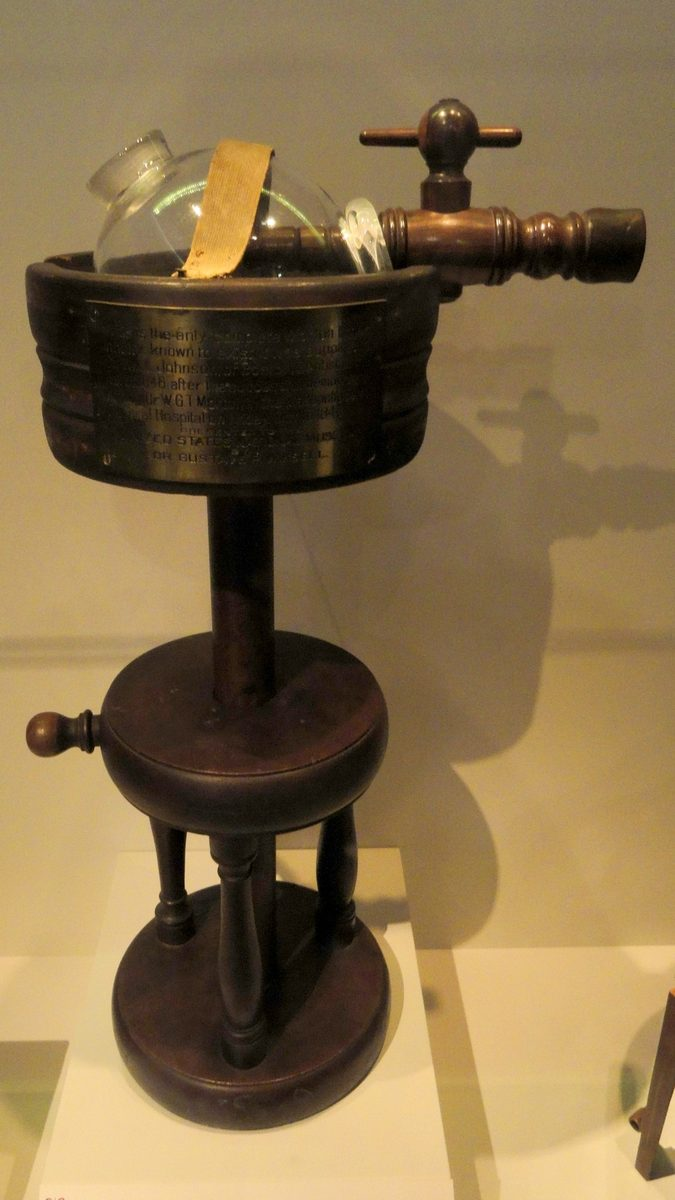
The difference this time was the device. Morton’s inhaler was a glass sphere holding a natural sponge soaked in ether, with two tubular openings on its sides. One opening had a removable brass cap for pouring in more ether; the other connected, through a short brass tube fitted with a non-rebreathing valve, to a glass mouthpiece the patient closed their lips around. Because Morton could open and close that mouthpiece, he could titrate the dose in real time — give a patient more air when they needed it, more vapor when they didn’t — instead of simply flooding them with gas and hoping. It was a crude piece of glassware, but it was the first ether delivery system anyone had built that a nervous surgeon could actually trust.
Ether Day: October 16, 1846
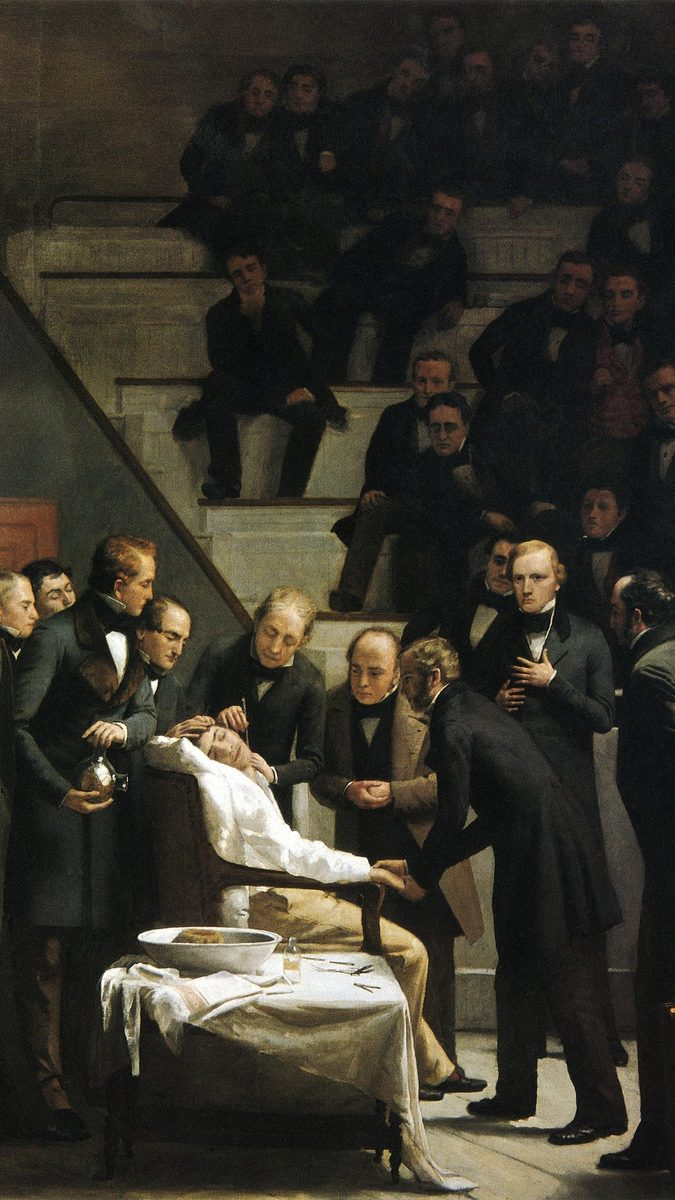
Surgeon John Collins Warren invited Morton to bring his device to the operating theater at Massachusetts General Hospital to treat Edward Gilbert Abbott, a Boston housepainter with a vascular tumor under his jaw. Morton administered ether through the glass globe; Warren made a three-inch incision beneath Abbott’s jaw. Abbott did not flinch, cry out, or move.
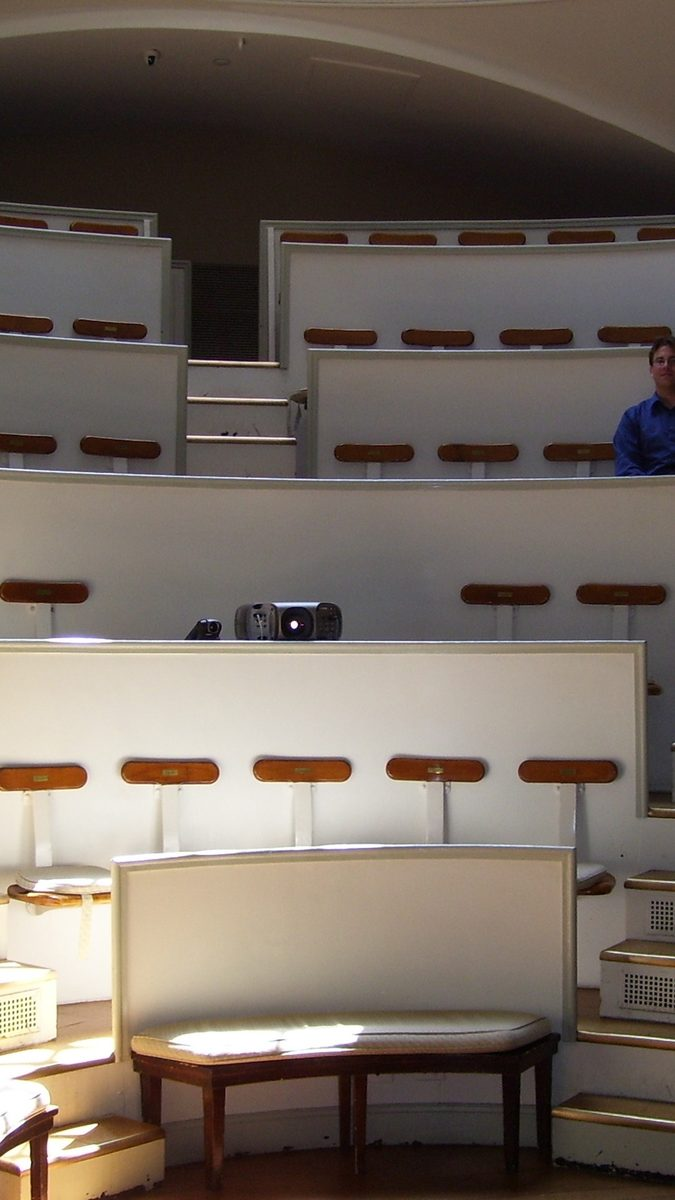
Warren turned to the packed gallery of students and physicians and said, “Gentlemen, this is no humbug.” In his own journal, now held at the Massachusetts Historical Society, he was more reserved, logging it simply as “an interesting operation.” The amphitheater where it happened has been called the Ether Dome ever since, and it stayed in active surgical use until 1867. Before this, serious surgery had been judged almost entirely on speed — the same brutal calculus that made a skull trepanation something a patient might live through mainly because the surgeon worked fast.
News traveled remarkably fast for 1846. The London Medical Gazette carried reports by late January 1847, and on December 21, 1846 — barely ten weeks after Boston — surgeon Robert Liston performed Britain’s first operation under ether at University College Hospital, amputating the leg of a footman named Thomas Churchill. Liston is remembered as telling his students afterward that “this Yankee dodge beats mesmerism hollow,” though no one present could later confirm he used those exact words. What isn’t in dispute is how quickly hospitals on both sides of the Atlantic adopted the method once they had seen it work.
A patent built on hiding the one fact that mattered
Eleven days after Ether Day, on October 27, 1846, Morton and Charles Jackson jointly filed for a patent on the anesthetic. It was issued on November 12 as U.S. Patent No. 4,848 — and it deliberately did not name the active ingredient as plain sulfuric ether. Morton branded it “Letheon” and tried to sell it as a proprietary compound, with licenses issued personally and a fee attached to every use.
Jackson’s name ended up on the patent because he had discussed ether’s anesthetic properties with Morton that summer and insisted on a stake in whatever came of it; Morton agreed, on the advice of others, and regretted it almost immediately. The “Letheon” branding collapsed within weeks anyway — practicing physicians would not use an anesthetic whose ingredients were kept secret from them, and ether’s role was obvious to anyone who smelled the vapor. Hiding an active ingredient behind a brand name was not a new trick even then, and the same logic kept tapeworm diet pills on American store shelves decades after regulators should have caught on.
Being a co-patentee was not enough for Jackson. In December 1846 he wrote to the French Academy of Sciences announcing himself as sole discoverer, without mentioning Morton at all, and repeated the claim before the American Academy of Arts and Sciences the following March. When the French Academy later awarded its Montyon Prize — 5,000 francs — jointly to Morton and Jackson, Morton refused it outright, insisting the discovery belonged to him alone. In Washington, two separate bills to award Morton a $200,000 national prize for the discovery were introduced across three sessions of Congress. Neither passed; the argument over who deserved the credit paralyzed the reward meant to settle it.
So who discovered ether anesthesia? Three of the four claimants paid for the answer
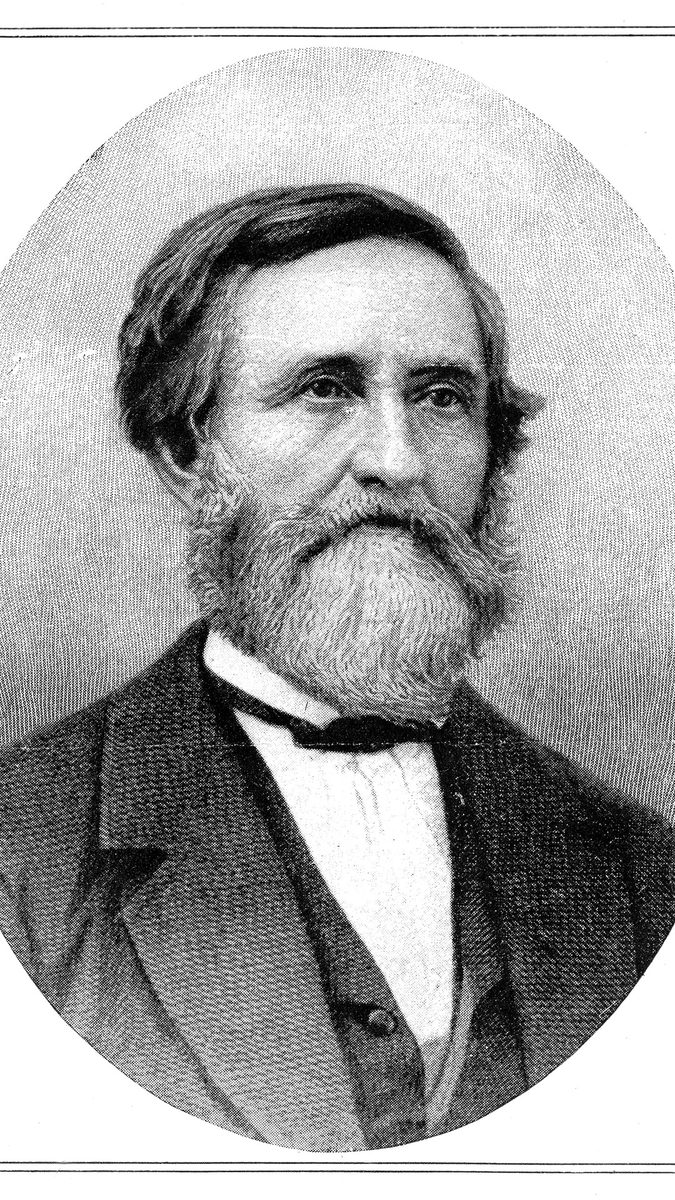
Morton spent his final twenty years in controversy and litigation. Several of the plans floated to compensate him financially — the Congressional bills, a public subscription fund raised in 1857 — produced honors rather than money. During the Civil War he served as a volunteer anesthetist attached to Grant’s forces, personally administering ether to more than 2,000 wounded soldiers, work that briefly restored some of the reputation the patent fight had cost him. He died of a stroke in 1869, at forty-nine, with the question of credit still unresolved — twenty years of litigation that looks almost brisk next to how long medicine kept prescribing the mercury cure for syphilis after better treatments existed.
Charles Jackson’s later career unraveled on its own terms. His tenure as U.S. Geologist surveying the Lake Superior region, begun in 1847, was consumed by professional disputes and ended in resignation in 1849; colleagues increasingly described him as paranoid and impossible to work with. In 1873 he was committed to a Massachusetts asylum, where he died seven years later, in 1880.
Horace Wells fared worse and faster. Seeking the recognition Boston had denied him, he moved to New York in January 1848 and, isolated and increasingly dependent on the ether and chloroform he had once championed as medicine, lost the ability to distinguish waking life from the effects of the drugs. On his thirty-third birthday he was arrested after throwing acid on two women in the street, damaging only their clothing. In his cell, he self-administered a large dose of chloroform and took his own life. He was thirty-three.
Only Crawford Long, who had gone first and said the least, lived out an ordinary span — a Georgia country practice, twelve children, service as a Confederate surgeon, and a death in 1878 that arrived a year before the recognition he had never fought very hard to claim. Of the four men who could plausibly say they discovered ether anesthesia, the one who stayed quietest is the only one the fight didn’t destroy.
Watch the short version
The short covers the frolics-to-operating-room jump in about ninety seconds; this article is the four-way fight over who gets credit for it.

Related reading
- Why Ancient Trepanation Survival Rates Were So High — surgery’s other long argument about pain, speed, and survival
- The Mercury Cure for Syphilis Lasted Four Hundred Years — a case study in how long medicine can keep a wrong answer in circulation
- How Ear Trumpets Worked: The Physics, the Disguises, and What a Brass Horn Really Did for Hearing — another 19th-century medical device built around a single clever mechanical trick
- How the Violet Ray Machine Worked, and Why It Took Decades to Debunk — what happened when a medical claim outran the regulation meant to check it
Shop the styles/items related to this history:
- Ether Day: The Strange Tale of America’s Greatest Medical Discovery (book)
- Antique-style glass apothecary bottle
- The History of Anesthesia (illustrated reference)
Works cited
- Linda Hall Library. “Scientist of the Day: The Ether Dome.” Linda Hall Library of Science, Engineering and Technology. Link.
- “Crawford Long (1815–1878).” New Georgia Encyclopedia. Georgia Humanities and the University of Georgia Press. Link.
- “Dr. Crawford W. Long and Anesthesia for Surgery.” Georgia Historical Society historical marker record. Link.
- “The Battle Over Ether Anesthesia.” National Museum of Civil War Medicine. Link.
- Office for Science and Society, McGill University. “Before Ether Was a Potent Painkiller, It Was a Hit With Revellers.” Link.
- Smithsonian Institution, National Museum of American History, Archives Center. Morton Family Collection, NMAH.AC.0118, finding aid.
- Wood Library-Museum of Anesthesiology. “Replica of Morton Inhaler,” object record and construction notes.
- Blocker History of Medicine Collections, Moody Medical Library. “William T.G. Morton.” University of Texas Medical Branch, Osler Hall of History. Link.
- “Physician/Chemist/Geologist Charles Thomas Jackson’s Life of Conflict and Controversy.” Journal of Geological Education 43, no. 1 (1995), via the USGS Publications Warehouse. Link.
- Connecticut Humanities. “Horace Wells Discovers Pain-Free Dentistry.” ConnecticutHistory.org. Link.
- The Old Operating Theatre Museum. “Ether, Anaesthesia and the Old Operating Theatre.” Link.