
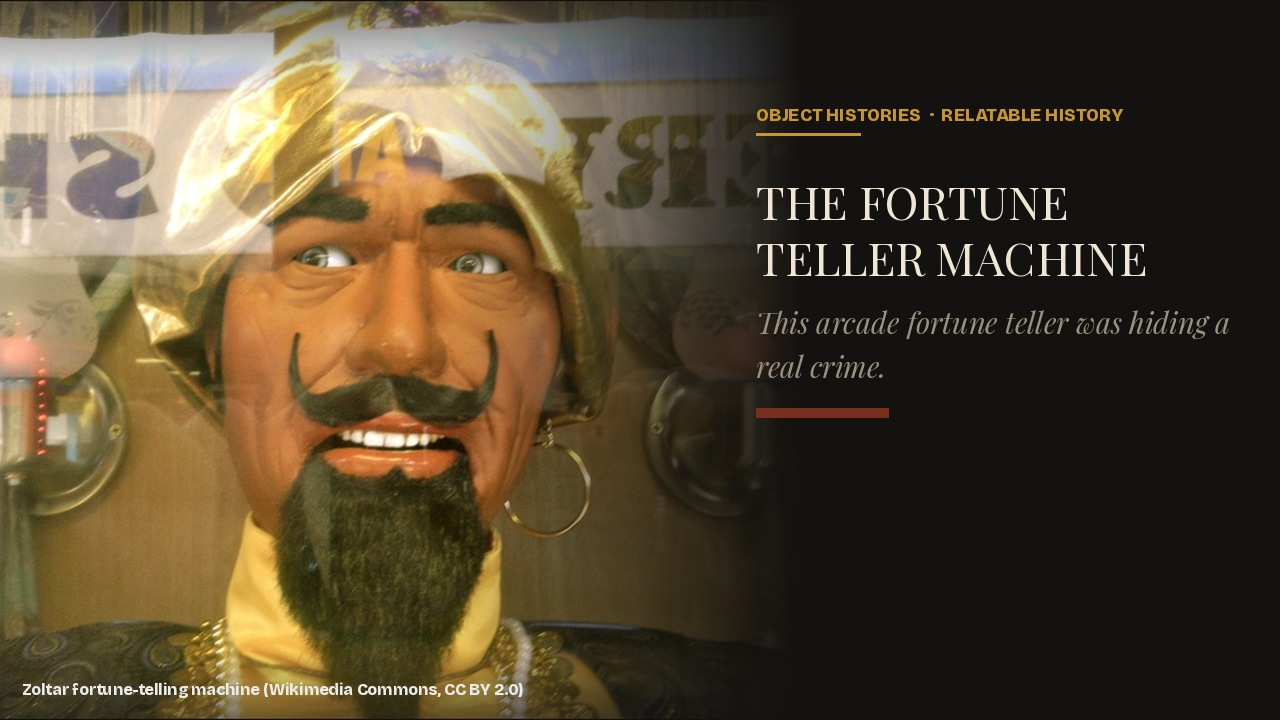
The real history of the fortune teller machine starts with a coin, a spinning wheel, and a trick nearly as old as the idea of a mechanical oracle itself: make people believe a box can know something they don’t. Drop a coin into a modern Zoltar machine and a carved wizard nods behind glass and prints you a fortune. It reads as harmless boardwalk fun. For a good stretch of the twentieth century, some machines wearing that exact costume were doing something else entirely: operating as real gambling devices, hidden in plain sight behind a crystal ball.
A History of the Fortune Teller Machine Starts With a Patent Race
Coin-operated fortune telling is often said to trace back to an 1867 patent, but no verifiable record of one turns up under that date. What does survive, in the U.S. Patent Office’s own record, is a near-simultaneous race between two separate inventors a generation later. On October 30, 1893, Fred F. Dennis of Worcester, Massachusetts, filed for a “Coin-Operated Fortune-Telling Machine”: a dropped coin fell into a bucket on a rotating wheel, its weight spun the wheel, and a magnet caught it so a printed motto lined up in a viewing window. The very next day, October 31, 1893, Adolph Waldman of St. Louis had his own version issued, an “Electric Coin-Controlled Fortune-Telling Machine” that used a coin’s weight to close a circuit, spin a motor-driven pointer, and let it coast to a stop on phrases like “Good luck” or, more bluntly, “Buy stock.” Neither man’s version used the word “Egypt” or a wizard. Both just wanted a coin to produce an unpredictable printed phrase, which is the entire mechanical core the next century of fortune machines would keep building on.
The Fraud Automata Came Even Earlier
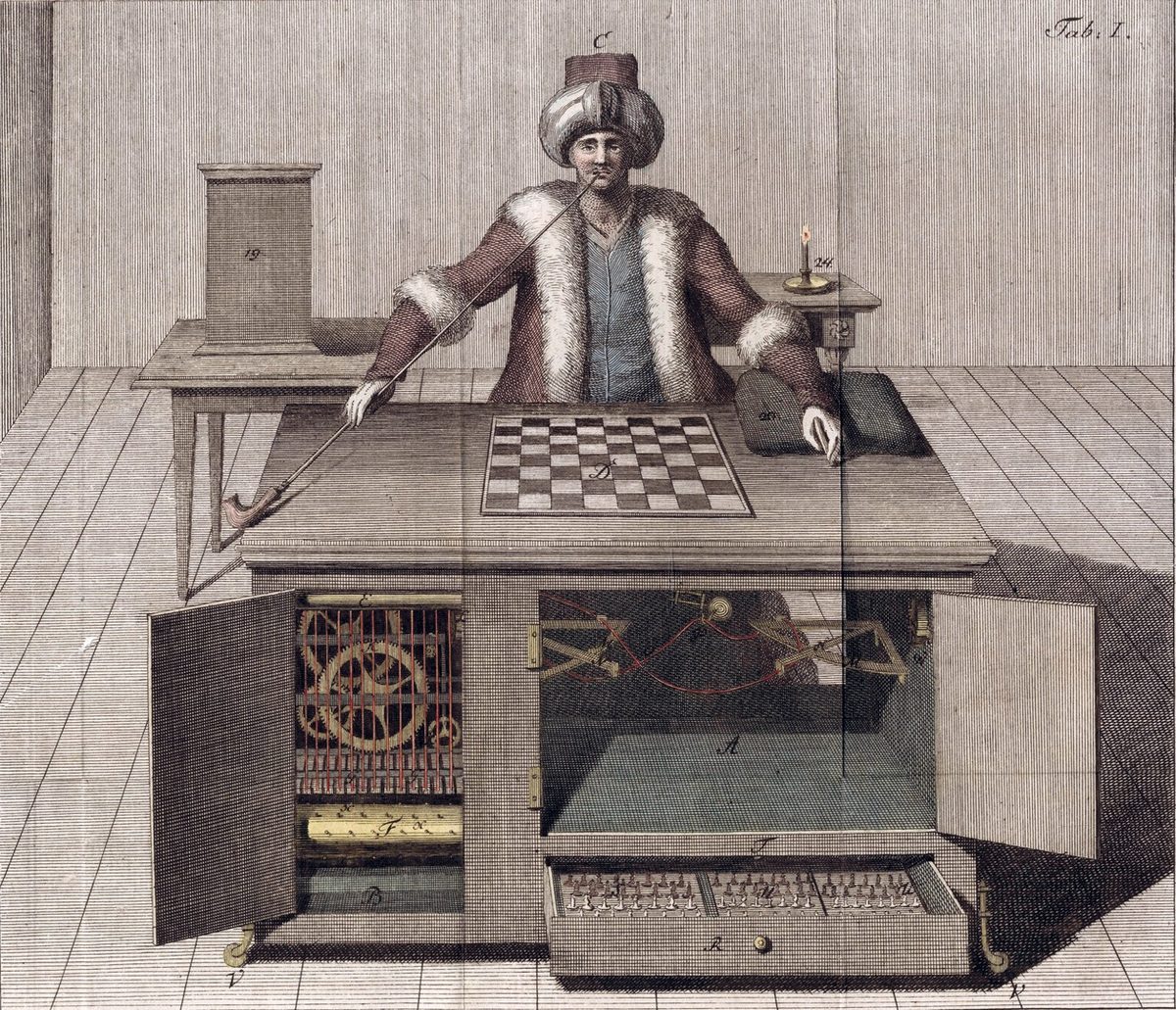
Long before any patent, the idea of an oracle in a box had already been thoroughly road-tested as a con. Touring fairs across Europe and America featured supposedly mechanical fortune-tellers and prediction devices that were, in the oldest sense, simply frauds: a person hidden inside, working levers by hand, faking a machine’s apparent intelligence. The most famous example of the same core trick wasn’t even a fortune-teller: the Mechanical Turk, a chess-playing automaton that toured Europe and America from the 1770s onward astonishing audiences, including Napoleon and Benjamin Franklin, by beating them at chess. Its cabinet hid a skilled human chess player inside the whole time. Audiences paid to be fooled by a machine that knew things no machine actually knew, and mostly, they were, for decades, before anyone built a version that worked without a person concealed inside it.
The Penny Arcade Boom Gave Fortune Machines a Home
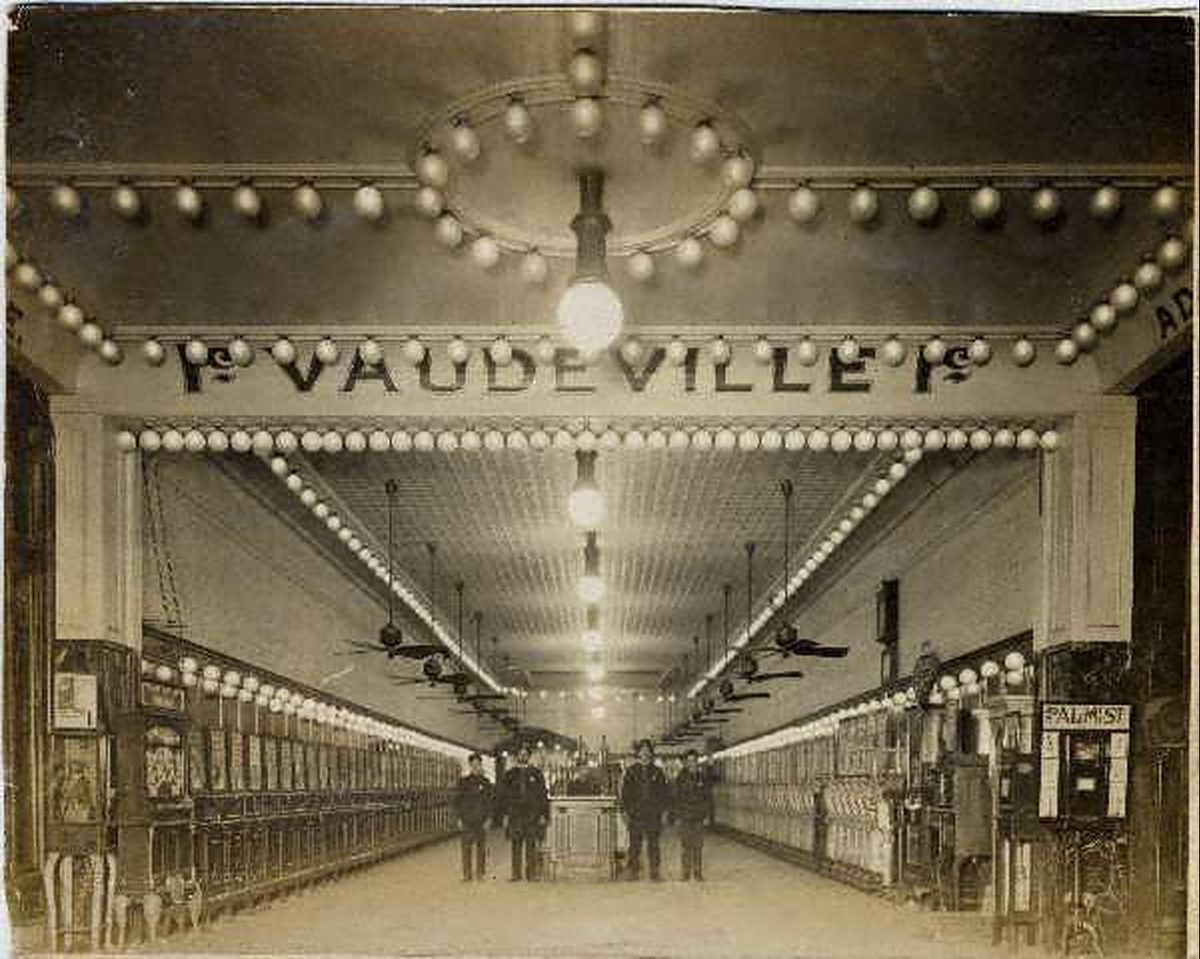
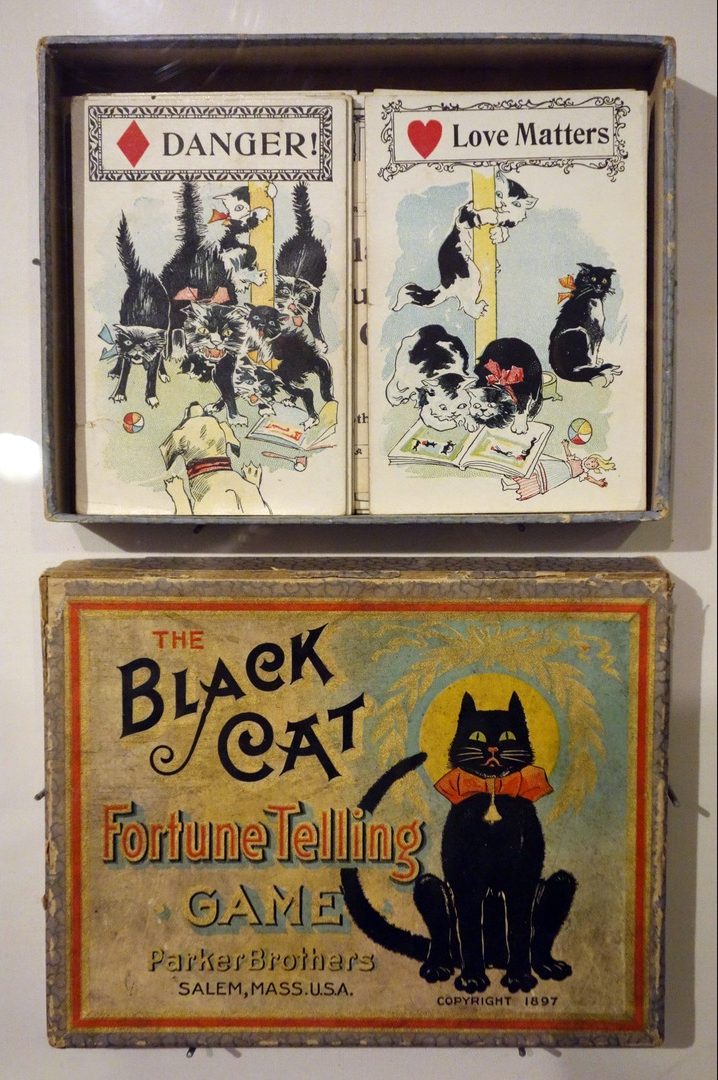
Once the mechanism was real, it needed somewhere to live, and American cities supplied exactly that through the 1900s and 1910s: the penny arcade. Mills Novelty Co., a Chicago manufacturer that had built coin machines since 1896, released a Verbal Fortune Teller by 1912, standing in arcades alongside its other machines like vending gum dispensers and strength testers. Fortune machines took on whatever exotic persona sold best to arcade crowds, wizards, mummies, gypsies, devils, even a wisecracking cat, anything mysterious enough to make a printed card feel like real insight rather than a random mechanism. None of this required any actual connection to real divination practice; it only required a costume exotic enough that a stranger’s penny felt like it was buying contact with something beyond an ordinary coin slot. Printed fortune-telling had, of course, existed without any machine behind it for just as long, sold as parlor games and novelty sets long before anyone wired a motor to the idea.
Manufacturers Disguised Gambling as Fortune Telling
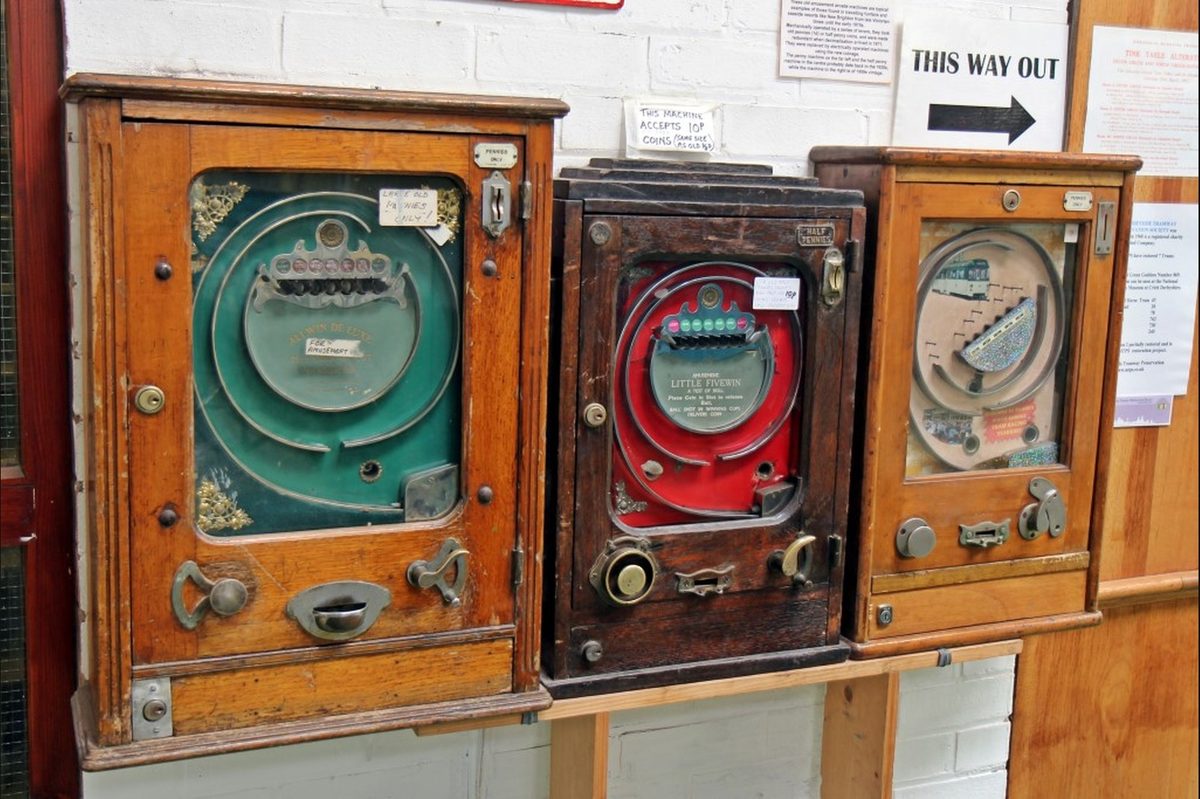
By the 1920s, cities and states were cracking down hard on slot machines, and manufacturers of what the trade called “trade stimulators” responded by hiding gambling payouts behind a cover story. The classic version dressed a payout machine as a vending machine, pitched as a token toward a mint or a cigar, even when everyone involved understood the real transaction was a wager. Some makers built that same evasion directly into fortune-telling reels: a well-known line of machines from manufacturer Groetchen, including a model nicknamed the Bell Boy, paired a gumball with a printed fortune that, by contemporary accounts, carried another meaning for the bartender behind the counter entirely separate from whatever the card said. A prediction and a payout could be made to look identical to an inspector walking past, which is most of why the format survived as long as it did. The risk of that strategy showed up clearly in 1937, when Groetchen dropped the gumball cover entirely from a model nicknamed Ginger and simply paid out a token directly, a design the trade itself recognized as, in plain terms, a gambling device wearing almost no disguise at all. That the company shipped it anyway suggests how comfortable manufacturers had grown with the idea that enforcement would lag behind the hardware, an assumption that, for a remarkably long run of decades, kept proving correct.
Grandmother’s Predictions Brought a Human Face to the Cabinet
The genre’s most recognizable figure arrived through International Mutoscope Corp., which began producing “Grandmother’s Predictions” around 1925, with production continuing into the 1930s: a nodding, blinking automaton grandmother behind glass, scanning a deck of cards before a printed fortune emerged. A separate company, William Gent Manufacturing, built its own rival grandmother-themed machine around 1929, close enough in concept that the two are still mixed up by collectors today, a reminder that “grandma” was simply the most trusted-looking face 1920s arcade manufacturers could put on a coin machine. Figures like these, friendly, domestic, and unthreatening, gave the whole fortune-machine genre a wholesome cover that made it an easy fixture of family boardwalk trips through the 1930s and 40s, whatever any individual cabinet actually had wired up inside it. Surviving grandmother machines are serious collector’s items today: recorded auction results for the original William Gent version run from the low five figures up to a median price around $14,870, and the fiercest competition is often between collectors who simply want the friendliest-looking face in the lineup, not the rarest mechanism.
Zoltan, and the Zoltar Origin Story That Isn’t Quite True
After the Second World War, pinball and jukeboxes crowded fortune machines out of most arcades, and the format nearly disappeared. It found an unlikely second life starting in 1967, when Robert B. Bourque and Robert Cottle, working in Massachusetts under the name Prophetron, built a machine called Zoltan, manufactured into the early 1970s. A customer dropped a dime, pressed one of twelve zodiac buttons wired in parallel, and picked up an attached phone handset to hear one of fourteen prerecorded fortunes, delivered in Cottle’s low, Hungarian-accented voice while a crystal ball glowed. The recordings covered the usual fortune-teller territory, the future, lucky numbers, favorable colors, looping on an endless tape cartridge built by a specialist manufacturer, a genuinely clever piece of engineering for a novelty most customers assumed was simpler than it actually was. Only a modest number of Zoltan units were ever built, which is exactly why the survivors are prized by today’s collectors and restorers.
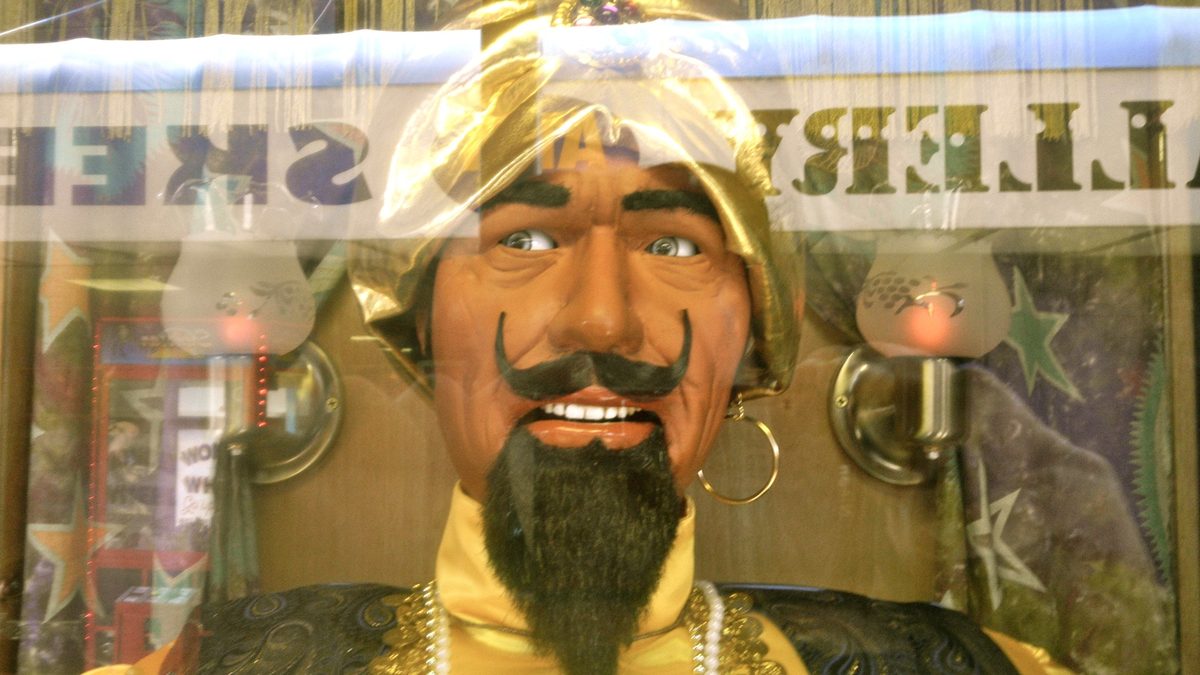
Here is where the popular version of this story gets ahead of the evidence. It’s widely repeated, including in earlier coverage on this very channel, that Zoltan directly inspired the fortune machine prop in the 1988 film Big, the one that grants Tom Hanks’s character his wish to be an adult. But the people who actually restore and document Zoltan machines today say the two are “nothing alike” in looks or operation, and call the claim that one inspired the other simply not true: the movie prop took a coin rolled into its mouth rather than a dropped dime, was built as a full animated figure rather than a phone-handset unit, and dispensed a printed card instead of an audio recording. The name “Zoltar” itself only became attached to real, sellable machines starting in 2002, when a builder named Olaf Stanton, running a company called Characters Unlimited, made a wizard automaton he originally called “Swami,” then renamed Zoltar once he discovered nobody had trademarked the movie’s name. Two genuinely different machines, a generation and a coincidence of similar names apart, got folded into one tidy origin story along the way.
What actually connects a 1893 patent clerk’s wheel-and-magnet gadget to the wizard on a modern pier is not a straight line of invention so much as a hundred and thirty years of the same con redressed for each new decade’s audience: a coin, a character, a printed promise, and just enough theater that nobody looks too closely at the mechanism doing the actual work. The crime, when there was one, was never really fortune telling. It was always whatever the box had been built to hide behind it.
Watch the full history
The five-minute video below covers all of this in more visual detail, including the machines themselves in motion.

Related reading
- How Tarot Became Fortune Telling, 300 Years Later
- Who Really Invented the Ouija Board?
- How Iceboxes Worked Before the Electric Refrigerator
- What Was in Victorian Smelling Salts
Works cited
- Dennis, Fred F. “Coin-Operated Fortune-Telling Machine,” U.S. Patent 514,418, filed October 30, 1893, issued February 6, 1894. Google Patents. Link.
- Waldman, Adolph. “Electric Coin-Controlled Fortune-Telling Machine,” U.S. Patent 507,768, issued October 31, 1893. Google Patents. Link.
- Museum of the Game. “Verbal Fortune Teller,” Mills Novelty Co., 1912. Link.
- Museum of the Game. “Grandmother’s Predictions (1st Year, Ugly Woman),” International Mutoscope Corp., 1925. Link.
- Kislingbury, interviewed in “Machines, Myths & Legends: Trade Stimulators.” RePlay Magazine, March 2017. Link.
- “Trade Stimulators.” Penny Arcade (penny-arcade.info). Link.
- “1969 Prophetron Zoltan Fortune Teller.” Pinrepair.com. Link.
- “Zoltar: The Origin of Those Fortune-Teller Robots.” Attractions Magazine. Link.