
In 249 BCE, the Roman consul Publius Claudius Pulcher stood off the coast of Sicily preparing to attack the Carthaginian fleet sheltering at Drepana. Before any major action, Roman commanders were required to consult the sacred chickens their fleet carried for exactly this purpose. The birds were offered grain, and if they ate eagerly enough that a few kernels fell from their beaks, the omen was good. That morning, they would not eat at all. Pulcher’s response, recorded by the historian Valerius Maximus, was to have the birds thrown over the side. “Since they do not want to eat,” he is said to have remarked, “let them drink.”
The battle went about as badly as a commander can manage: of roughly 120 ships, more than ninety were sunk or captured, and Pulcher was recalled and tried for impiety. The birds Rome consulted that morning were the same domesticated fowl whose forked chest bone — the furcula, as it’s known scientifically — is what two people now pull apart at a Thanksgiving table and call the wishbone. The science of that bone and the superstition built around it turn out to have almost nothing to do with each other, which is the real subject here.
The full chain runs through a Roman state religion with its own bureaucracy, a ribald joke in a 1607 London stage comedy, a word two American newspaper writers couldn’t agree how to spell a decade apart, and a paleontological argument that took most of the twentieth century to settle. All four survive because the bone itself is unusually durable, both structurally and symbolically, and because almost nobody who has handled it over the last two thousand years has used it for quite the same reason as the person before them.
Rome ran a standing office for reading chickens
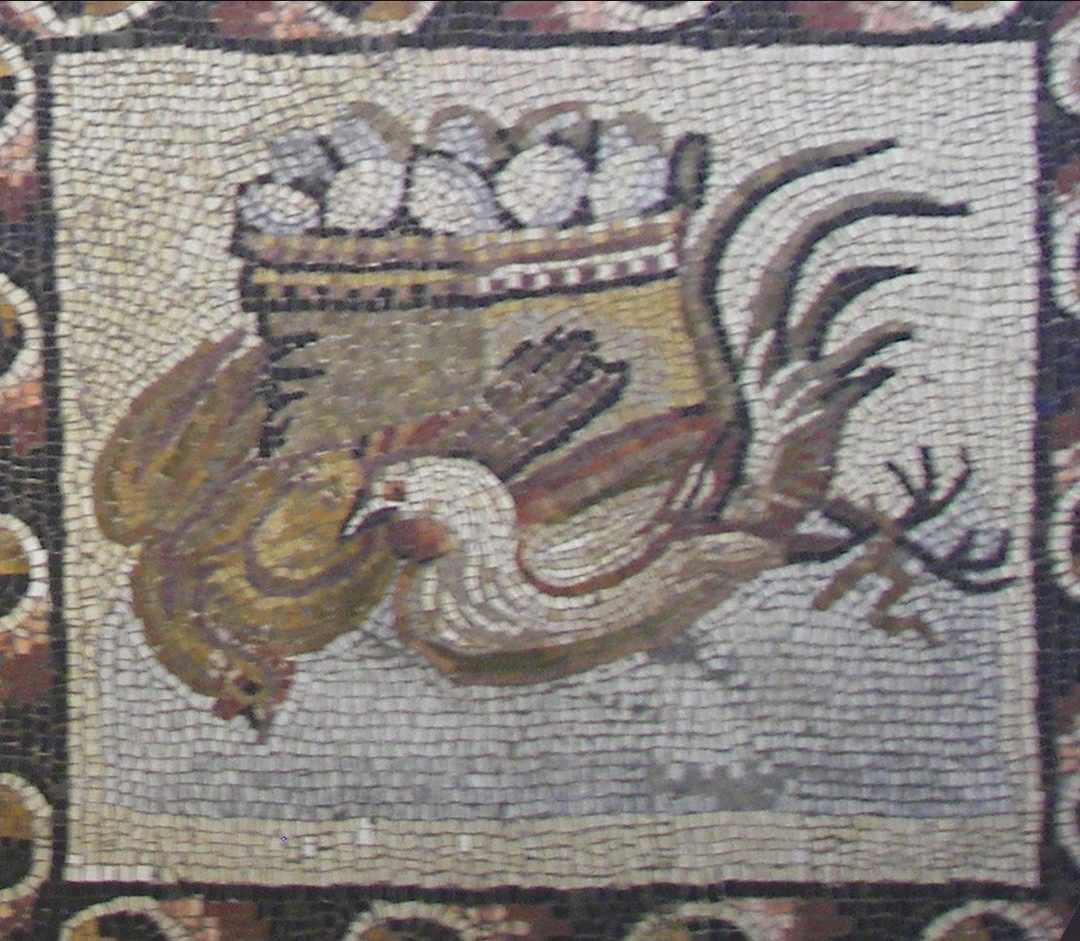
The sacred chickens were a recognized part of Roman state religion, not a folk habit tolerated at the edges of public life. Keepers called pullarii traveled with the army and the fleet specifically to tend them, and a magistrate who wanted to act — fight a battle, hold an election, convene the Senate — was expected to take the auspices first by watching how the birds behaved around their feed. Ignoring an unfavorable reading, as Pulcher did, was not merely reckless. It was a breach of religious duty that Romans treated as seriously as any failure of military judgment.
Ancient writers didn’t all tell the story the same way. Centuries after the battle, the biographer Suetonius repeated a version of Pulcher’s remark in his life of Tiberius, an emperor descended from the same Claudian family. Cicero, writing in his treatise De Divinatione, used the whole episode as his standard example of a commander who got exactly what his impiety deserved. Valerius Maximus adds a detail the others leave out: Pulcher was tried afterward, and while he avoided the worst of it, a sudden, violent rainstorm that broke out just as the vote against him was being taken was itself read as a sign, and credited with saving him.
What the birds were actually being asked
The ritual had nothing to do with the bone itself; it was entirely about appetite. Before a reading, the chickens were kept hungry in their cage, and grain was scattered in front of them. If they rushed to eat and a few kernels spilled from their beaks as they did, Romans called it a tripudium solistimum — the most favorable sign available short of an outright miracle. If they merely pecked without enthusiasm, the sign was muted. If they refused outright, as happened to Pulcher, the undertaking was expected to stop. The hens were instruments for reading intent while alive, not souvenirs kept afterward.
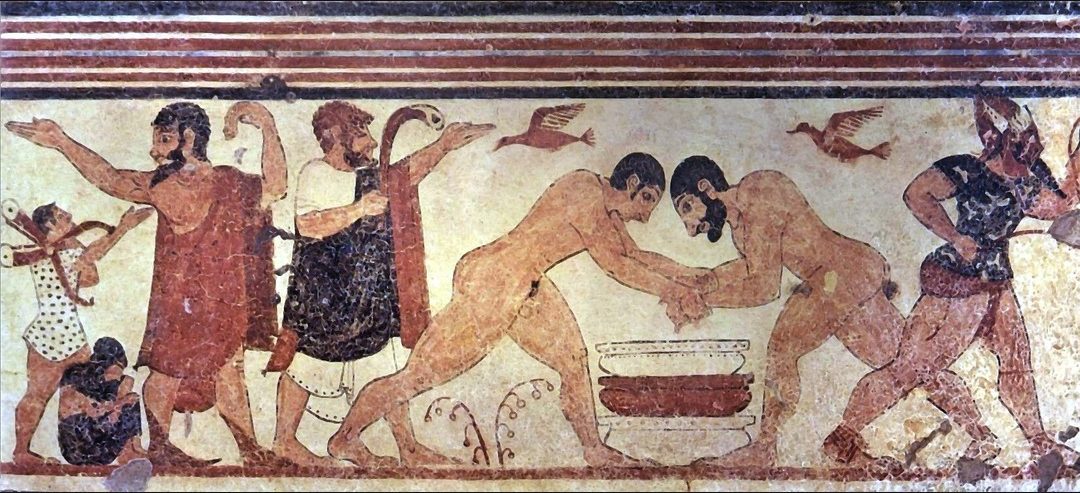
A related but separate tradition existed one peninsula over and centuries earlier, among the Etruscans, whose religious specialists were known across the ancient Mediterranean for augury of every kind — reading flight patterns, reading a sacrificed animal’s liver, and, in at least one folk practice, letting hens peck grain scattered over marked letters to spell out an answer, a method later writers called alectryomancy and which bears an odd family resemblance to the letter-spelling board later sold commercially as the Ouija board. It’s in this Etruscan tradition, rather than the Roman military rite, that the dried bone itself first shows up as an object of attention: it was kept after the bird was eaten and stroked for luck, not broken. Breaking it in competition — two people pulling until one piece came away larger — is usually explained as a Roman-era change driven by simple supply: a shortage of birds meant more people wanted a share of one bone’s luck, and splitting it let two people have a piece instead of one.
England turned it into an off-color joke, then scrubbed it clean
By the time the custom reached England, the bone had its own name, and it wasn’t yet “wishbone.” The lexicographer John Florio recorded “merrythought” in his 1598 Italian-English dictionary, A Worlde of Wordes, and the word turns up again soon after in a context that makes its original flavor unmistakable. In the 1607 stage comedy North-ward Hoe, by Thomas Dekker and John Webster, a character named Kate says she “longd for the merry thought of a phesant” — a line Jacobean audiences would have caught as innuendo rather than a culinary aside. Francis Quarles used the same pun in a 1633 poem.
What the double meaning actually referred to got written down plainly by the antiquary John Aubrey, working in the 1680s: he explains that the bone was called the merrythought because its shape resembles a part of female anatomy. The Oxford English Dictionary, compiling its first edition more than two centuries later in 1906, preferred a tidier account — that the name simply “alludes to the playful custom of two persons pulling” the bone apart for a wish. Both describe the same object in the same century; they just disagree about which fact the name was recording, which says less about the bone than about what a Victorian-era dictionary preferred to print.
Americans couldn’t agree how to spell it either
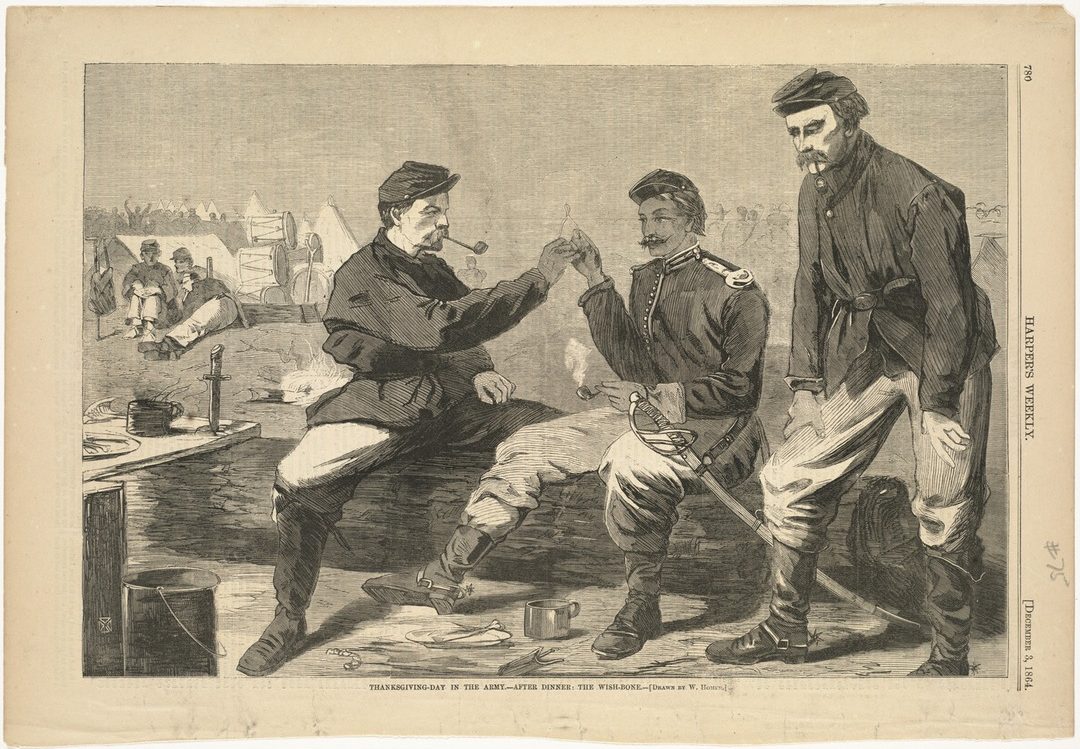
“Wishbone” is an American coinage, and its first appearance in print is harder to pin down than the tidy dictionary dates suggest. The Oxford English Dictionary‘s own citation, by way of Bartlett’s 1860 Dictionary of Americanisms, dates the word to 1860. But American newspapers and novels had been using “wish bone” and “wishing bone” for Thanksgiving dinners at least two decades before that. The word-history researcher Barry Popik has traced a run of them: a “wish bone” reference in the Vermont Phoenix in 1839, a British novel using “wishing bone” in 1840, a Thanksgiving story in the National Era using “wish-bones” in 1847, and a line in The American Penny Magazine in 1846 noting that the sternum is “commonly called the breast bone, or wishing bone” — all of it evidence that the word was already ordinary kitchen-table vocabulary a generation before any dictionary thought to record it.
The spelling wasn’t settled either. Through the 1840s and ’50s the same object turns up as “wish bone,” “wishing-bone,” and “wishing bone” depending on the writer, and a competing regional name, “pulley bone” (also “pully bone” or “pull bone”), took hold in the American South and is still what some families call it there. None of the disagreement slowed the custom down. The same instinct for turning a shared harvest meal into a small, luck-based ritual shows up elsewhere on the American table too — in the lore around finding a red ear of corn at a husking bee, for instance. By the time Thanksgiving became a fixed national holiday in the 1860s, pulling the bone for a wish was already routine for people who had no reason to know the English once called the same object something a lot less innocent.
The furcula: how science settled an argument about where birds came from
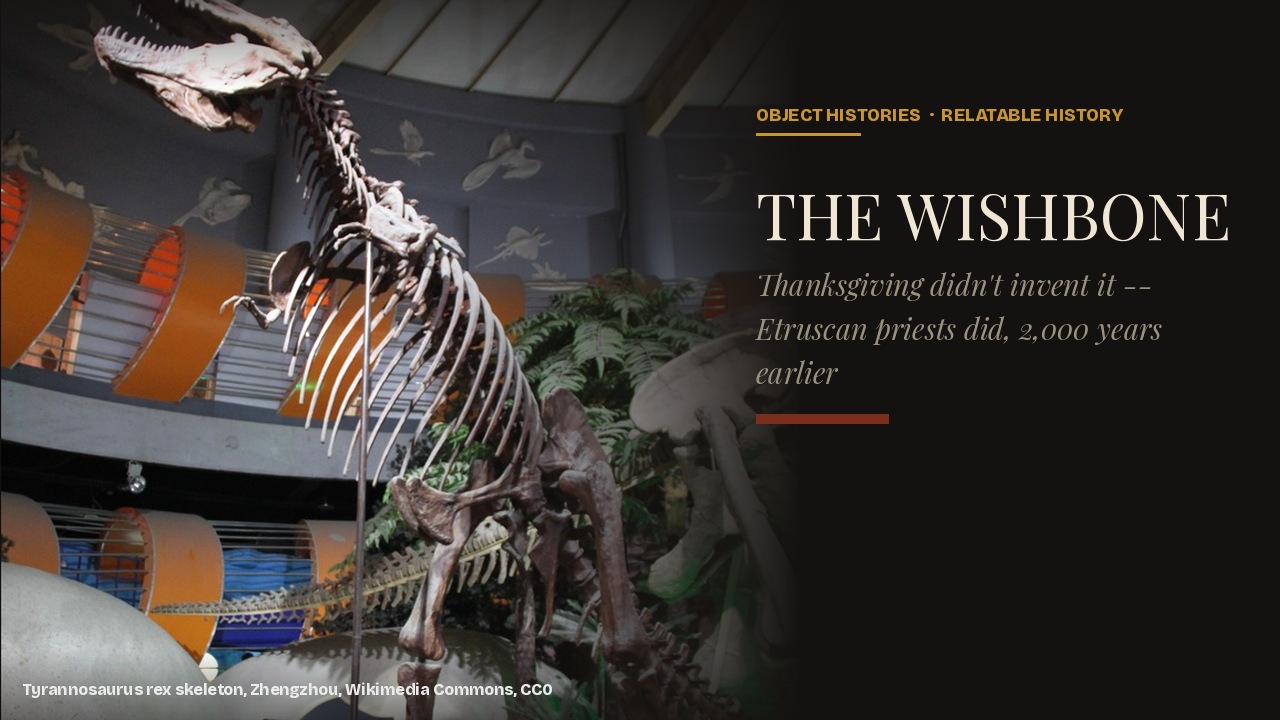
Scientifically, the wishbone is the furcula — Latin for “little fork” — formed by the fusion of a bird’s two collarbones into a single springy strut across the chest. It flexes slightly with every wingbeat, acting as a kind of mechanical spring that helps power flight. For most of the twentieth century, though, its fossil record was read as evidence against, rather than for, one of paleontology’s now-settled conclusions: that birds descended from dinosaurs.
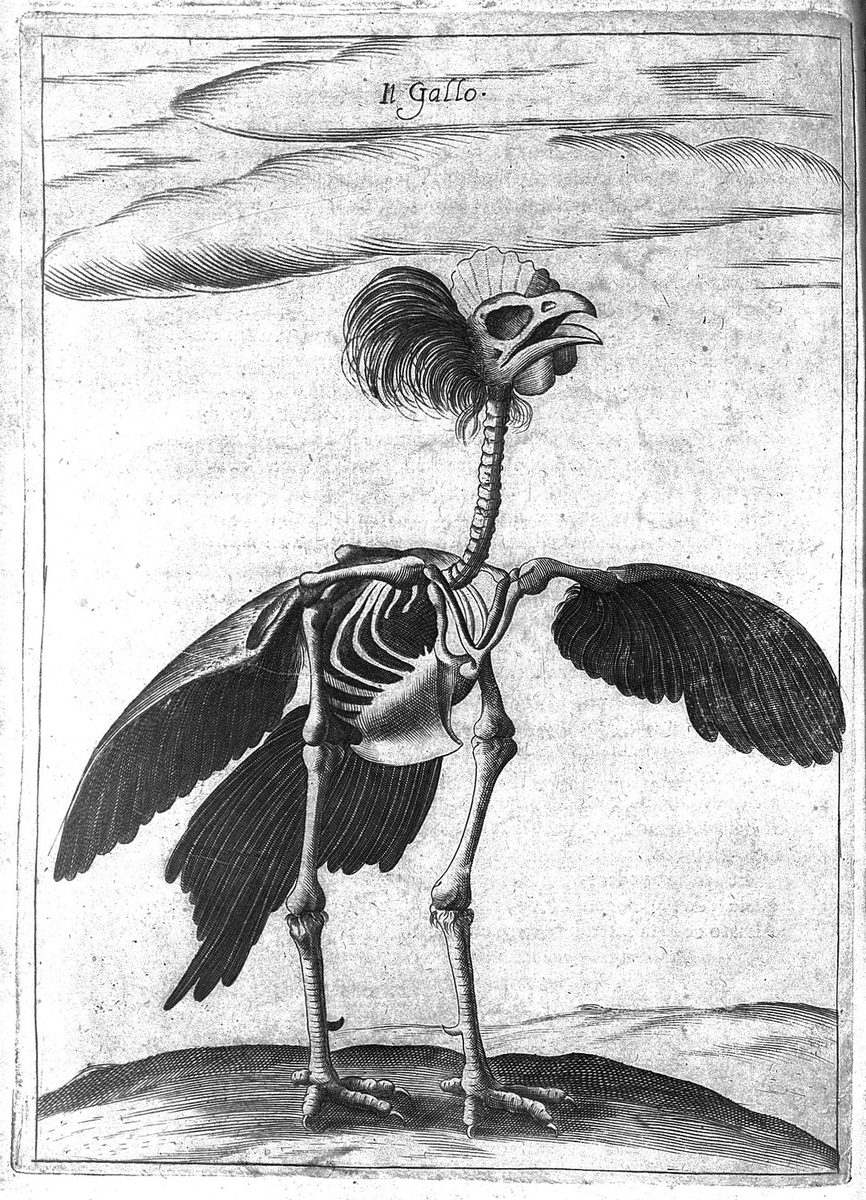
In 1926, the Danish illustrator and amateur paleontologist Gerhard Heilmann published The Origin of Birds, a study influential enough that scientists kept citing it for decades. Heilmann argued dinosaurs could not be the ancestors of birds specifically because no dinosaur skeleton had ever turned up with a furcula or a pair of clavicles — a basic bird feature that, on the fossils available to him, dinosaurs simply lacked. He proposed a different, non-dinosaurian ancestor instead, and the idea held for most of the century even though it rested on an absence that wasn’t really there. A furcula-like bone had already turned up, in 1924, in a skeleton of the dinosaur Oviraptor described by the American paleontologist Henry Fairfield Osborn, who simply mislabeled it an “interclavicle,” a different structure. Another one surfaced in 1936 in the small predatory dinosaur Segisaurus. Neither discovery changed anyone’s mind at the time.
It took a systematic re-examination of theropod dinosaur skeletons, decades later, to overturn Heilmann’s argument on its own terms. A 2007 study in the Journal of Paleontology by Christine Lipkin, Paul Sereno, and John Horner, examining furculae in Suchomimus tenerensis and Tyrannosaurus rex, confirmed that an ossified wishbone was present across nearly every major group of theropod dinosaurs, missing only in the very earliest and most primitive ones — meaning the bone had likely existed in that lineage for upward of 215 million years before any bird used one to fly, let alone before anyone pulled one apart at a table. A further study in 2021, led by the paleontologist Andrea Cau and examining a strange, long-necked predatory dinosaur called Halszkaraptor, went further still, arguing the furcula isn’t simply a fused pair of collarbones at all but evolved from a different ancestral bone, the reptilian interclavicle — a finding that changed how paleontologists understand the bone’s job in the skeleton, not just its age.
Watch the full history
The video version covers the Etruscan ritual, the English pun, and the dinosaur connection in a little under six minutes.

None of this was known to the people actually pulling the bone apart at any point in its two-thousand-year documented history. The Romans who watched their chickens eat or refuse grain before a sea battle were not thinking about clavicles. Neither was John Aubrey, nor the Vermont Phoenix‘s anonymous 1839 contributor, nor, in all likelihood, most of the people doing it at a table this year. What has stayed constant through all of it is only the bone’s shape and its two uneven halves — forked by the same growth process in a Thanksgiving turkey, a Jacobean pheasant, a Roman temple chicken, and, if the 2021 study holds up, a feathered dinosaur that died tens of millions of years before there was a Rome to have a state religion in the first place.
So the next time the smaller half comes away in someone else’s hand, the losing side is in old company: Pulcher’s chickens didn’t get a say either, and the Roman Senate still put him on trial for not listening to them.
Related reading
- The Real History of the Fortune Teller Machine
- How Tarot Became Fortune Telling, 300 Years Later
- Why the Fork Was Once Considered Sinful
- The Overlooked Evidence for the Etruscan Language
Shop
Superstitions Surrounding Wishbones (Scoop on Superstitions) by Janie Havemeyer, for readers who want the fuller folklore record.
Works cited
- Valerius Maximus. Memorable Doings and Sayings, 1.4.3 and 8.1.absol.4, on Publius Claudius Pulcher and the sacred chickens at Drepana.
- Cicero. De Divinatione, Book 2, Chapter 33, citing the Pulcher episode as an example of impiety.
- Williams, Andrew N. “Why Did the Chickens Refuse to Eat Before the Roman Defeat at Drepana, 249 BC?” Hektoen International: A Journal of Medical Humanities, Spring 2024. Link.
- Sheridan, Paul. “The Sacred Chickens of Rome.” Anecdotes from Antiquity, 8 November 2015. Link.
- D’Este, Madeleine. “Origins of Breaking the Wishbone: Horseshoes, Groins and Chicken Ouija Boards.” FolkloreThursday. Link.
- Tréguer, Pascal. “Origin of ‘Merrythought’ (‘Wishbone’).” Word Histories, 22 August 2017.
- Harper, Douglas. “Wishbone.” Online Etymology Dictionary.
- Popik, Barry. “Wishbone (Wish Bone; Wishing Bone).” The Big Apple. Link.
- Black, Riley. “This Thanksgiving, Make a Wish on a Dinosaur.” Smithsonian Magazine, 24 November 2010.
- Lipkin, Christine, Paul C. Sereno, and John R. Horner. “The Furcula in Suchomimus tenerensis and Tyrannosaurus rex (Dinosauria: Theropoda: Tetanurae).” Journal of Paleontology 81, no. 6 (2007): 1523–1527.
- Cau, Andrea, Vincent Beyrand, Rinchen Barsbold, et al. “Unusual Pectoral Apparatus in a Predatory Dinosaur Resolves Avian Wishbone Homology.” Scientific Reports 11 (2021): 14722. Link.