
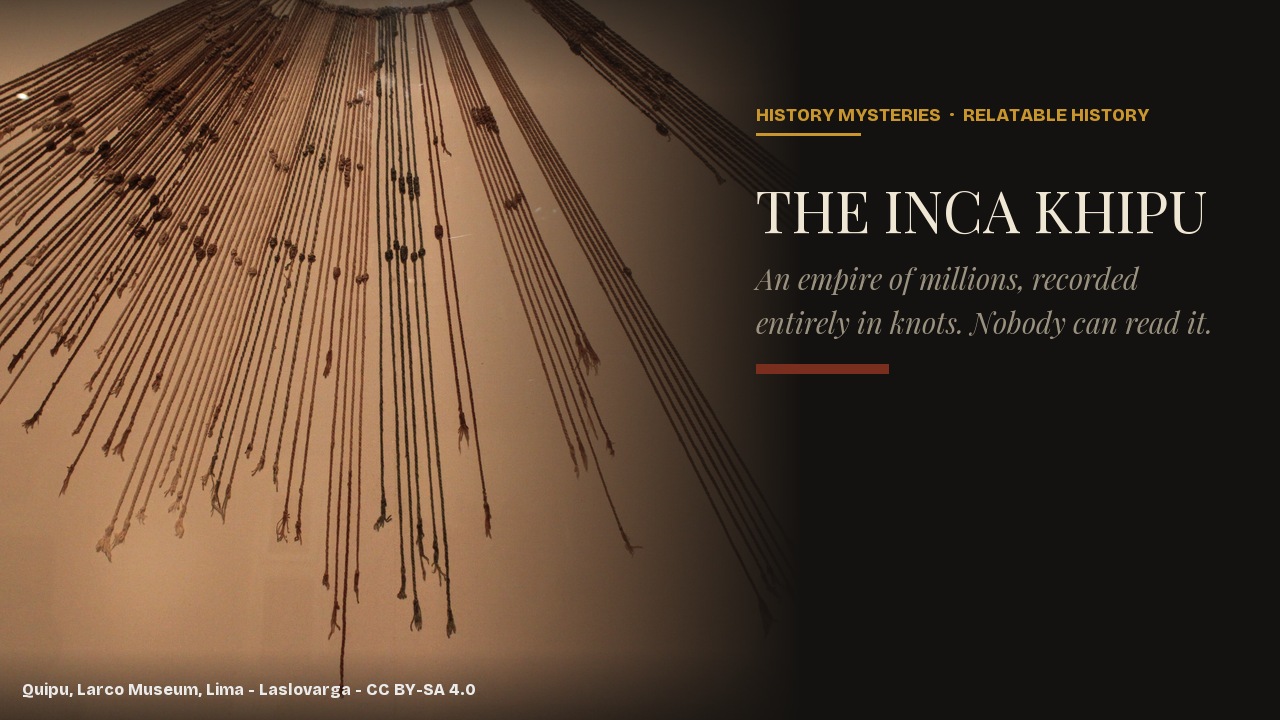
More than 1,380 Inca khipu survive in museum and private collections around the world, and in over a century of organized study, researchers have never produced a plain-language sentence read out of one. That is the strange fact sitting at the center of the Inca record-keeping system: the part of it that works is thoroughly solved, and the part that might be writing has resisted every attempt to open it.
The Inca state governed something on the order of ten million people across a territory running the length of the Andes, tied together by a road network of roughly 25,000 miles, and it did this without an alphabet or a single carved glyph. Its paperwork was string: cords of spun cotton or camelid wool, dyed in dozens of colors, knotted at specific points and hung from a thicker horizontal cord. The Inca called the device khipu, Quechua for knot, and for roughly a century the instrument used to run an empire has also functioned as a cold case.
What follows is the actual state of that case: how a khipu is physically built, the one layer of its code that a mathematics teacher cracked in 1912, the church order that tried to burn the rest of the evidence, and the separate research threads — an excavated administrative complex, a colonial census match, a village’s own account of its khipu, and a 2025 hair sample — that have spent the last twenty years trying to read past the numbers.
How a Khipu Is Actually Built
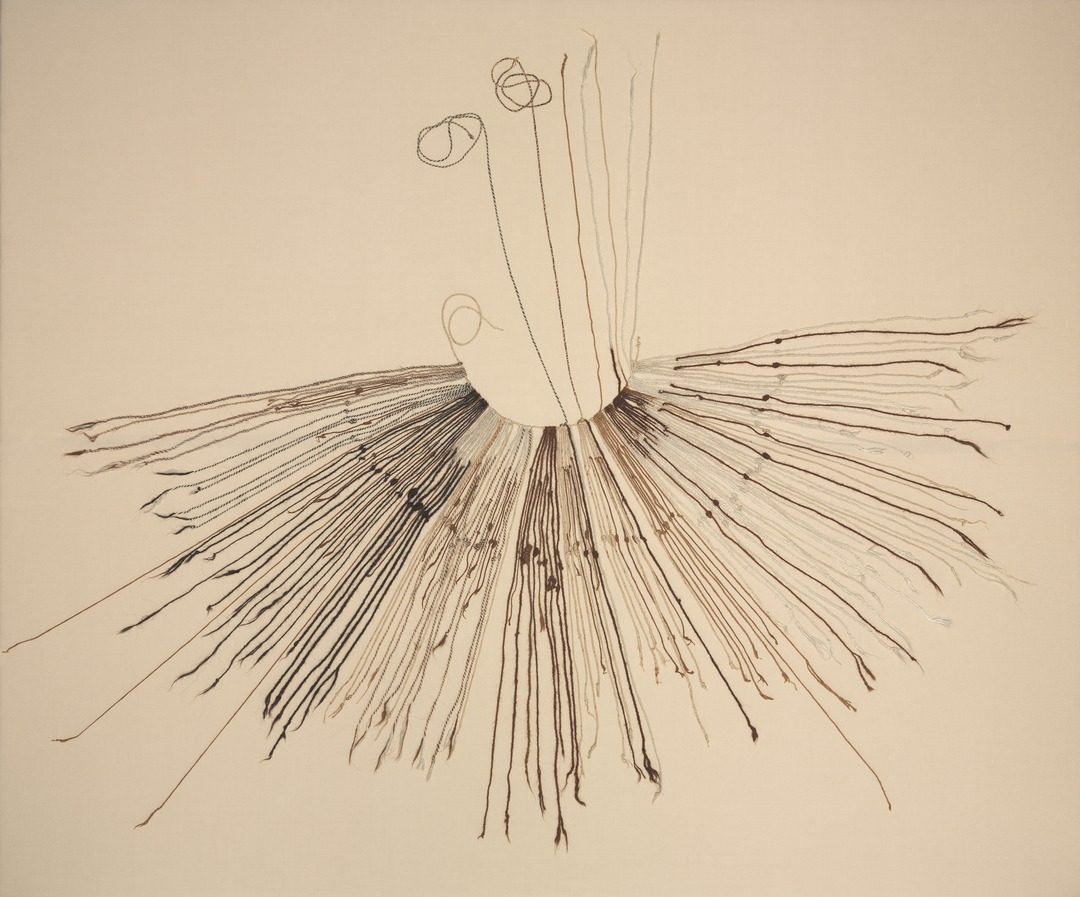
A khipu starts with a single thick horizontal cord, usually around a third of an inch across, called the primary cord. Everything else hangs from it. Thinner pendant cords are tied on at regular intervals along its length — a large khipu can carry well over a thousand of them — and a pendant can itself carry subsidiary cords knotted onto it in turn, sometimes running two or three levels deep. A smaller number of khipu also carry a top cord, running the opposite direction from the primary, which appears to total the values recorded below it.
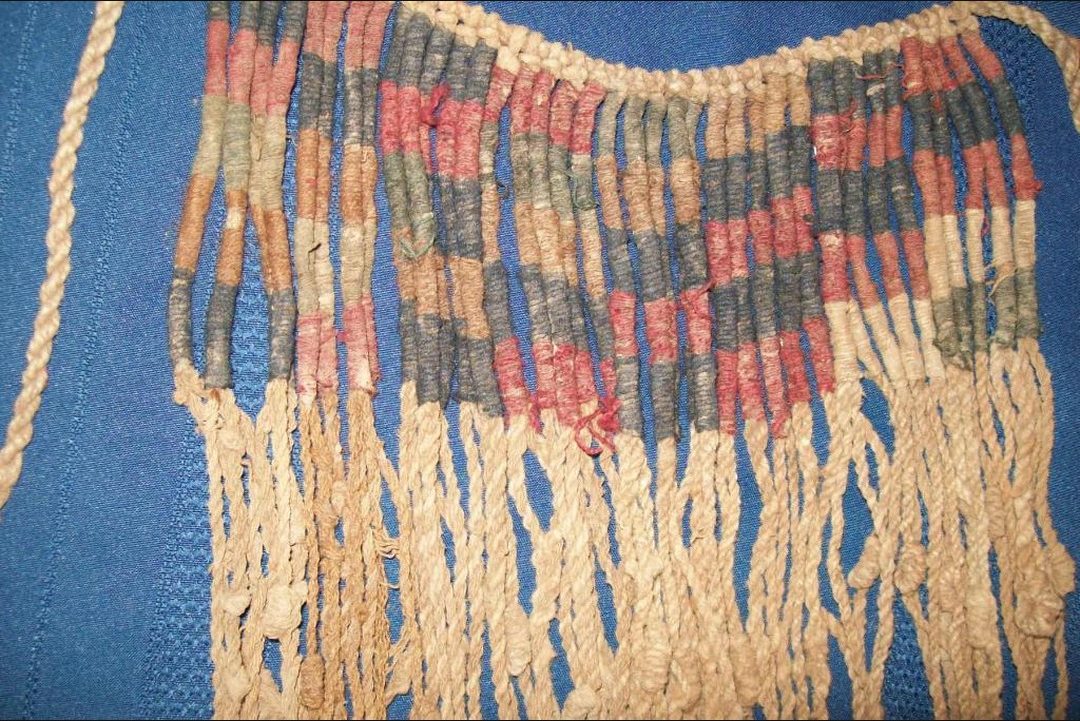
The fiber is cotton or the wool of a camelid — llama, alpaca, sometimes vicuña — spun into yarn and plied into cord. Spinners had a choice at two separate stages, and khipu makers used both deliberately: the direction the yarn is spun, a twist running up to the right (Z) or up to the left (S), and the direction two or more strands are plied together afterward. A pendant cord can also be barber-poled, two differently colored yarns twisted around each other so the color itself changes along the cord’s length. Dye came from cochineal insects, indigo, and a range of plant sources, and khipu makers worked in dozens of distinguishable shades, often in combination.
Knots were tied in specific types, at specific heights, in specific clusters — and that part of the structure, unlike the fiber, the color, and the twist direction, has an agreed, demonstrated meaning. It is also the only part that does.
The Khipukamayuq: A Profession Built Around Reading String
Reading a khipu was not a skill every Inca subject had. It was a state office. The khipukamayuq, literally the knot-keeper, trained for years to hold and interpret khipu for a province or an institution, and Spanish colonial administrators, who needed largely the same figures the Inca state had needed, kept using them. Felipe Guaman Poma de Ayala, an Indigenous Andean chronicler, drew a khipukamayuq around 1615 holding a khipu open in both hands, a grid of counting markers — a yupana — laid out at his feet, the two instruments used together: one to calculate, one to record the result.
Colonial court records describe khipukamayuq being brought before Spanish notaries for decades after the conquest, to read tribute accounts and population counts aloud from the cords, with their testimony entered into the written record as evidence. That detail matters more than it looks like it should, because it means the Spanish had direct access, for most of the sixteenth century and well into the seventeenth, to trained readers translating khipu into Spanish in real time — and, so far as the surviving paperwork shows, nobody thought to have a khipukamayuq read a single cord aloud, knot by knot, while a notary transcribed which knot meant which word. The translation survives. The key to the translation does not.
That gap, a living reading practice that was never itself recorded for its own sake, is the single biggest reason the rest of khipu research has to work from inference rather than translation.
The Decipherment of the Inca Khipu’s Number System
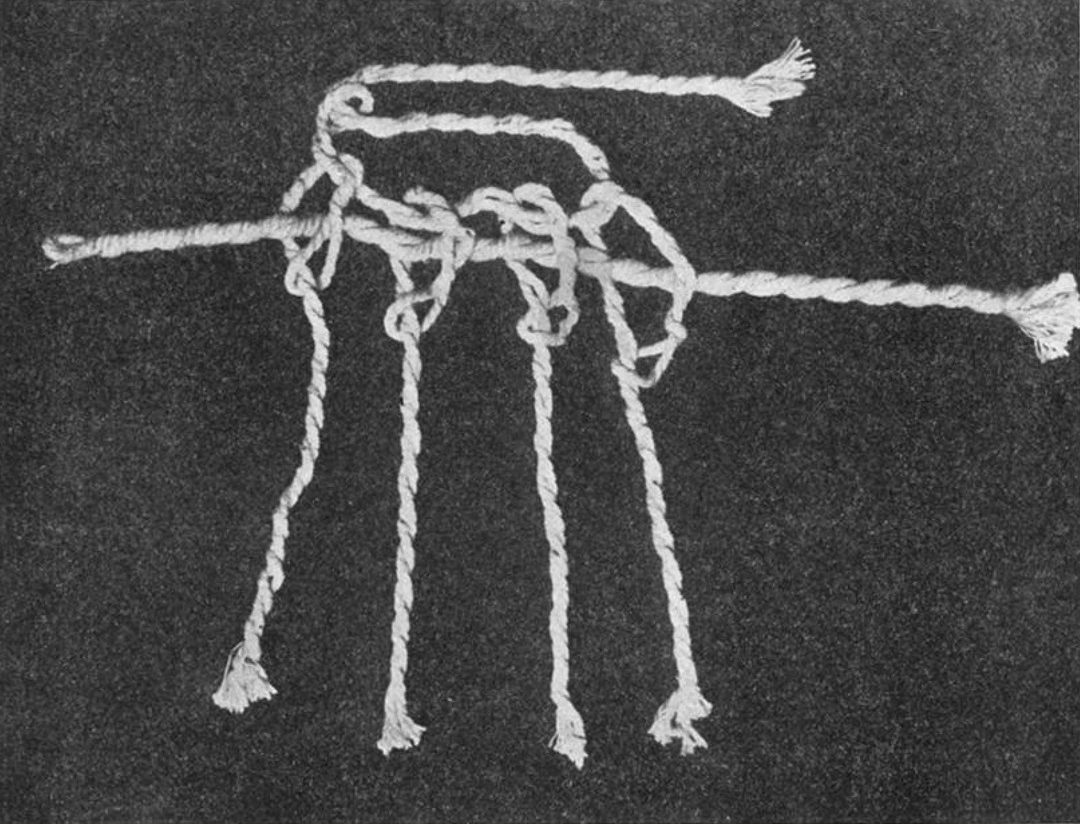
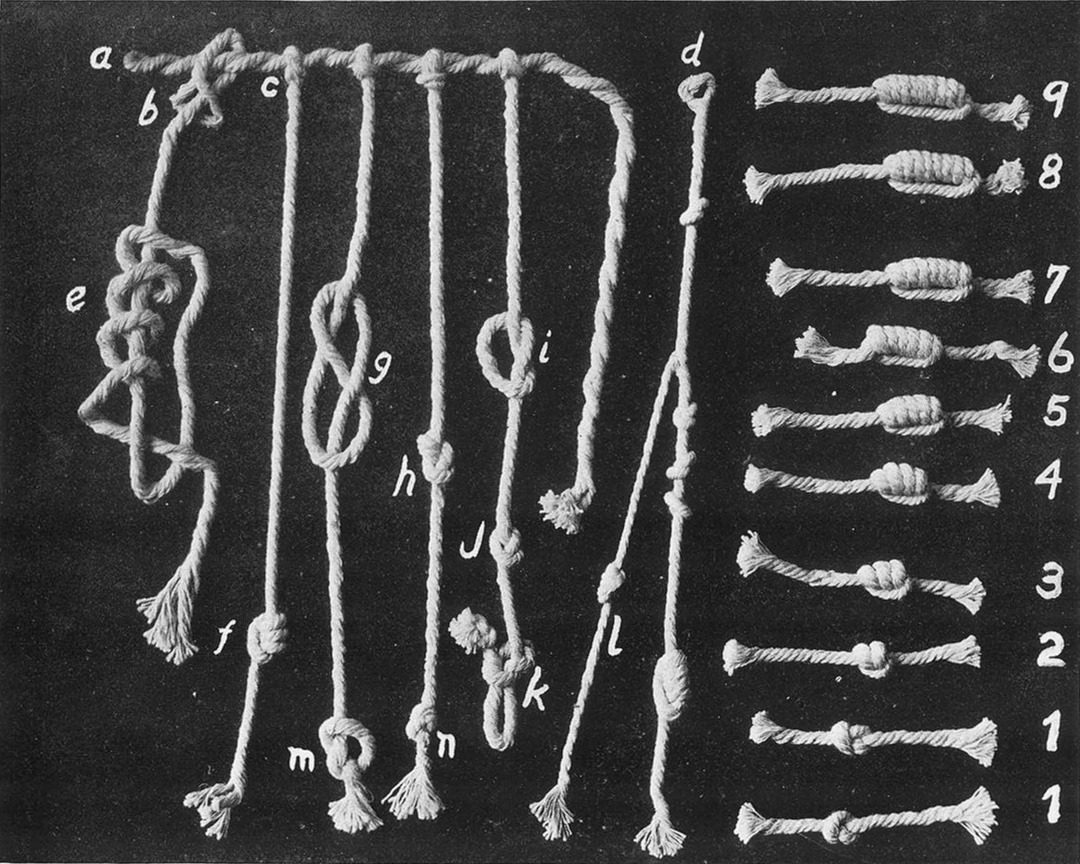
In 1912, a New York mathematics teacher named Leslie Leland Locke proposed, and in a fuller 1923 study for the American Museum of Natural History demonstrated, that the knots on a khipu’s pendant cords encode a base-ten positional number — the same logic as a modern place-value system, written in knot type and knot position instead of digits. A figure-eight knot standing alone means one. A long knot, a single knot with the cord wrapped an extra time before it is pulled tight, gives any value from two through nine depending on how many extra wraps it carries, and sits in the units position, closest to the primary cord. Clusters of ordinary overhand knots, stacked at specific heights further up the pendant, carry the tens, hundreds, and thousands. Zero is not a symbol. It is an empty stretch of cord where a cluster would otherwise sit.
Locke could add the values recorded on a set of pendant cords and watch the sum reappear, tied into the primary or a top cord — confirming the reading against the khipu’s own arithmetic rather than against any outside document. That is what makes this a genuine decipherment rather than a guess: it is checkable, and it checks out, consistently, across the roughly four hundred khipu that survive in good enough condition to test. What it reads is a ledger — census counts, tribute obligations, storehouse inventories of maize and cloth and sandals, labor obligations under the Inca’s rotational mita service. It is the paperwork of an empire, and more than a century after Locke, that paperwork can be read with confidence.
1583: The Church Council That Ordered the Archive Burned
The Third Council of Lima, an assembly of Catholic bishops that met in the Peruvian capital from August 1582 to October 1583, took direct aim at khipu as part of a wider campaign against what colonial authorities classified as idolatry. Khipu judged to record offerings, genealogies, or ritual content tied to pre-Christian religion were ordered destroyed outright. Officials administering tribute and population counts kept using the purely numerical khipu for Spanish colonial bookkeeping for decades afterward — the state still needed that information, and a column of knotted numbers served it as well as it had served the Inca — but the category of khipu most likely to have carried non-numerical, narrative content was exactly the category singled out for the fire.
Nobody kept a count of how many were destroyed. What survived into the twentieth century and beyond is a population skewed by that history: overwhelmingly numerical, overwhelmingly administrative, and drawn disproportionately from dry coastal burial sites where fiber had a chance of lasting five hundred years, rather than from the ceremonial or narrative contexts the Council’s order targeted hardest. The khipu counted in collections worldwide today are not a representative sample of what once existed. They are what a sixteenth-century order and five centuries of weather happened to leave behind.
What the Decimal Code Leaves Out — and the Hunt for a Second Layer
Locke’s decimal reading uses one variable: the knot. It has nothing to say about everything else a khipu physically encodes — color, fiber choice, spin direction, ply direction, which side of the primary cord a pendant is attached to, which direction its knots face. Gary Urton, who has spent decades cataloguing several hundred khipu held across North America and Europe, has argued those variables carry real information of their own, and that a khipu ought to be read as something closer to a structured record than a plain tally.
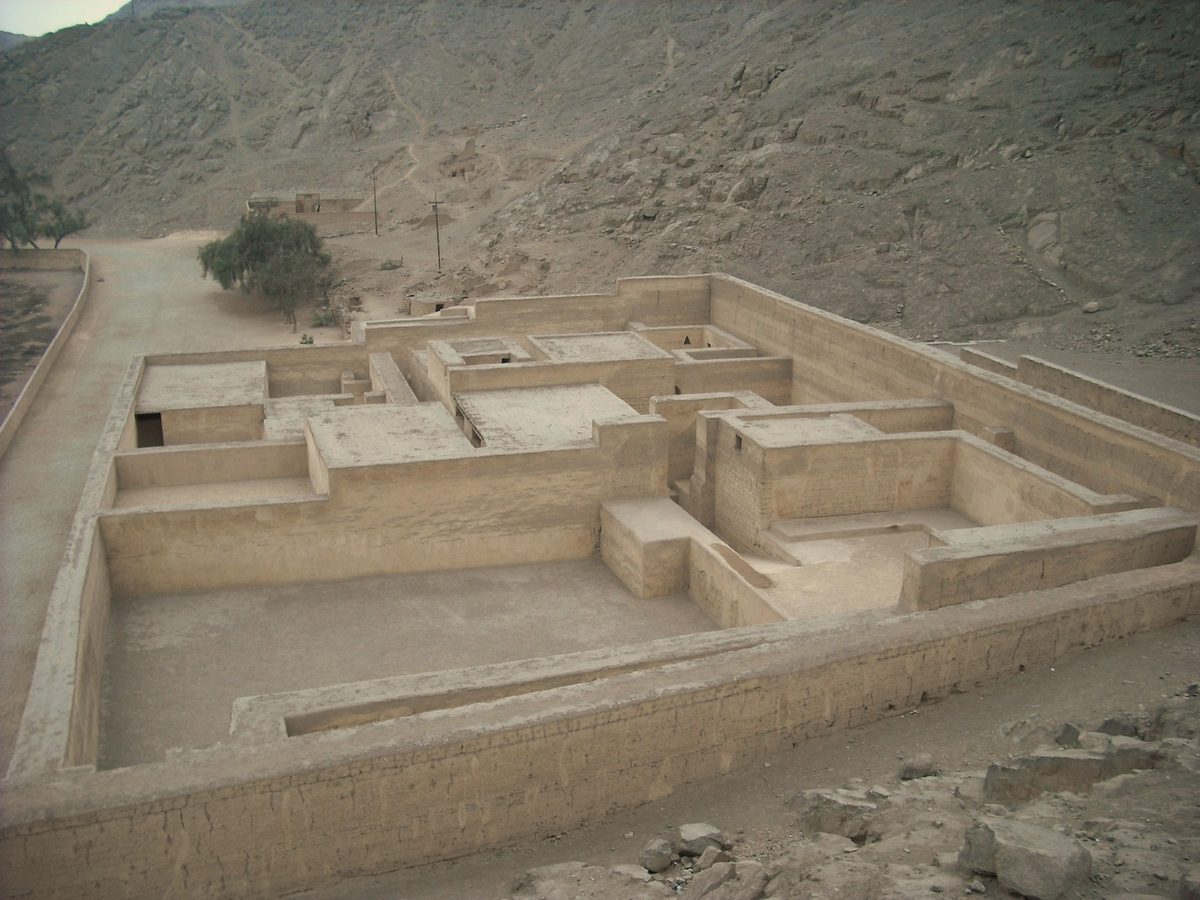
In 2005, Urton and Carrie Brezine published an analysis in Science of khipu excavated at Puruchuco, an Inca administrative complex on Peru’s central coast. They found a real hierarchy: sums recorded on one khipu reappeared as individual line items on another, the way a village total rolls up into a provincial one — evidence that khipu were organized into an actual bureaucratic filing system, not kept in isolation. At the start of one cord sequence they also found three figure-eight knots in a position the decimal arithmetic can’t explain. Their proposed reading was a label rather than a number: possibly a place name, conceivably Puruchuco’s own.
The most ambitious attempt at a second decipherment centers on six khipu acquired in the mid-twentieth century by the collector Carlos Radicati di Primeglio. In 2011, Urton proposed that their cord structure lines up with a Spanish colonial census — a 1670 revisita of the town of San Pedro de Corongo, listing 132 named tributary men across six lineage groups. The khipu organize their cords into bands of six, and the tribute totals on the first cord of each band appeared to match the census figures. In 2017 and 2018, the Harvard undergraduate Manuel Medrano worked with Urton on what the pendant cords’ attachment side might carry, proposing that whether a cord ties to the front or back of the primary recorded which half, or moiety, of the community a man belonged to — the first claim that information had been read from a khipu’s physical attachment rather than its knots. A 2024 study by Mackinley FitzPatrick refined the pattern further, counting 133 six-cord groups against the census’s 132 men. The match is close rather than exact, and the khipu were not recovered from a documented excavation, so their own origin can’t be independently confirmed — a gap a very different decipherment claim has also run into. It remains the nearest thing khipu studies has to a bilingual text, and it is still an argument rather than a settled reading.
A different kind of case came from the highland village of San Juan de Collata, where in 2017 the anthropologist Sabine Hyland was shown two khipu kept in a wooden box and described by the community itself as letters, exchanged between local leaders during a colonial-era rebellion. Hyland proposed that their fiber type and color combinations encode syllables, and read two lineage names out of the cords on that basis — a genuinely phonetic reading, if it holds. Her own caveat is the important one: these are colonial-made objects, by people who had already seen Spanish alphabetic writing, so they may represent an Andean adaptation of the idea of writing rather than a surviving pre-Hispanic practice, much as Easter Island’s own script may have emerged only after writing itself arrived on a European ship.
A 2025 Hair Sample Rewrote Who Was Allowed to Make One
In August 2025, Hyland and three co-authors published an isotope analysis in Science Advances of a roughly five-hundred-year-old khipu whose primary cord was spun, unusually, from human hair rather than cotton or camelid wool. Hair records diet as it grows, locked into its carbon, nitrogen, and sulfur ratios, and the signature in this cord showed almost no maize and almost no meat — the diet of someone eating tubers and greens at an altitude between roughly 2,600 and 2,800 meters, nowhere near the coast. Radiocarbon dating placed the object firmly in the Inca period.
That is not the profile of an elite khipukamayuq, who as a state official would be expected to eat at least some of the maize and meat that moved through Inca storehouses. It is the profile, the researchers concluded, of a low-ranking commoner. Guaman Poma had written, in his 1615 chronicle, that women also kept khipu in Inca society — a claim later historians mostly filed away as unverified. This single hair cord doesn’t prove who specifically made it, but it does independently support the broader claim the chronicler made four centuries ago: khipu literacy wasn’t confined to a trained state bureaucracy. More people than the historical record credits appear to have been able to make one.
Khipu also never fully stopped. The Peruvian village of Tupicocha still keeps khipu for use in local governance ceremonies, though the current holders don’t claim to read them as text, and the village of Rapaz maintains a bundle in a dedicated ritual building, inherited rather than actively decoded. What connects the professional reader in a sixteenth-century Spanish courtroom to the villager holding a khipu in Tupicocha today is the same unresolved question: whether the object in their hands was ever meant to be read on its own, or whether it was always a prompt for something a trained person already knew.
Watch the full history
The video version walks through the knot system and the empire it recorded in about ten minutes.

Related reading
- Linear Elamite’s Decipherment Evidence Has a Provenance Problem — another script where the decisive evidence has an unrecorded origin, the same problem the Santa Valley khipu run into.
- Why Nobody Can Read Easter Island’s Own Writing System — a second New World record system nobody has fully cracked, for the same reason: no bilingual key ever survived.
- Why Nobody Can Read the Voynich Manuscript — a manuscript whose script, unlike the khipu’s numbers, has resisted every reading so far.
- Why No One Can Read the Phaistos Disc — or Agree That It’s Real — another single object carrying a sign system with no second example to check it against.
- The Mystery of the Beale Ciphers, Explained — a different kind of coded record — numbers standing in for letters rather than quantities — that has also outlasted every attempt to open it.
Shop the books behind this research
Mathematics of the Incas: Code of the Quipu, Marcia and Robert Ascher’s study of the decimal system, is available in a Dover paperback: Mathematics of the Incas on Amazon. Gary Urton’s Inka History in Knots: Reading Khipus as Primary Sources covers the Puruchuco and Santa Valley research in full: Inka History in Knots on Amazon.
Works cited
- D’Altroy, Terence N. The Incas. Blackwell Publishing, 2002.
- Locke, L. Leland. The Ancient Quipu or Peruvian Knot Record. American Museum of Natural History, 1923.
- Ascher, Marcia, and Robert Ascher. Code of the Quipu: A Study in Media, Mathematics, and Culture. University of Michigan Press, 1981.
- Urton, Gary, and Carrie Brezine. “Khipu Accounting in Ancient Peru.” Science 309, no. 5737 (2005): 1065–1067.
- Urton, Gary. “Tying the Archive in Knots, or: Dying to Get into the Archive in Ancient Peru.” Journal of the Society of Archivists 32, no. 1 (2011): 5–20.
- Medrano, Manuel, and Gary Urton. “Toward the Decipherment of a Set of Mid-Colonial Khipus from the Santa Valley, Coastal Peru.” Ethnohistory 65, no. 1 (2018): 1–23.
- FitzPatrick, Mackinley. “New Insights on Cord Attachment and Social Hierarchy in Six Khipus from the Santa Valley, Peru.” Ethnohistory 71, no. 4 (2024): 443–469.
- Hyland, Sabine. “Writing with Twisted Cords: The Inscriptive Capacity of Andean Khipus.” Current Anthropology 58, no. 3 (2017): 412–419.
- Hyland, Sabine, Kelly Lee, Hannah Koon, and Sara Laukkanen. “Stable Isotope Evidence for the Participation of Commoners in Inka Khipu Production.” Science Advances 11, no. 33 (2025): eadv1950.
- Medrano, Manuel. “Keys to Mathematical Treasure Chests: Andean Khipus.” Convergence, Mathematical Association of America.
- Salomon, Frank. The Cord Keepers: Khipus and Cultural Life in a Peruvian Village. Duke University Press, 2004. Link.
- Guaman Poma de Ayala, Felipe. Nueva corónica y buen gobierno. c. 1615. GKS 2232 4º, Royal Danish Library, digital facsimile. Link.