
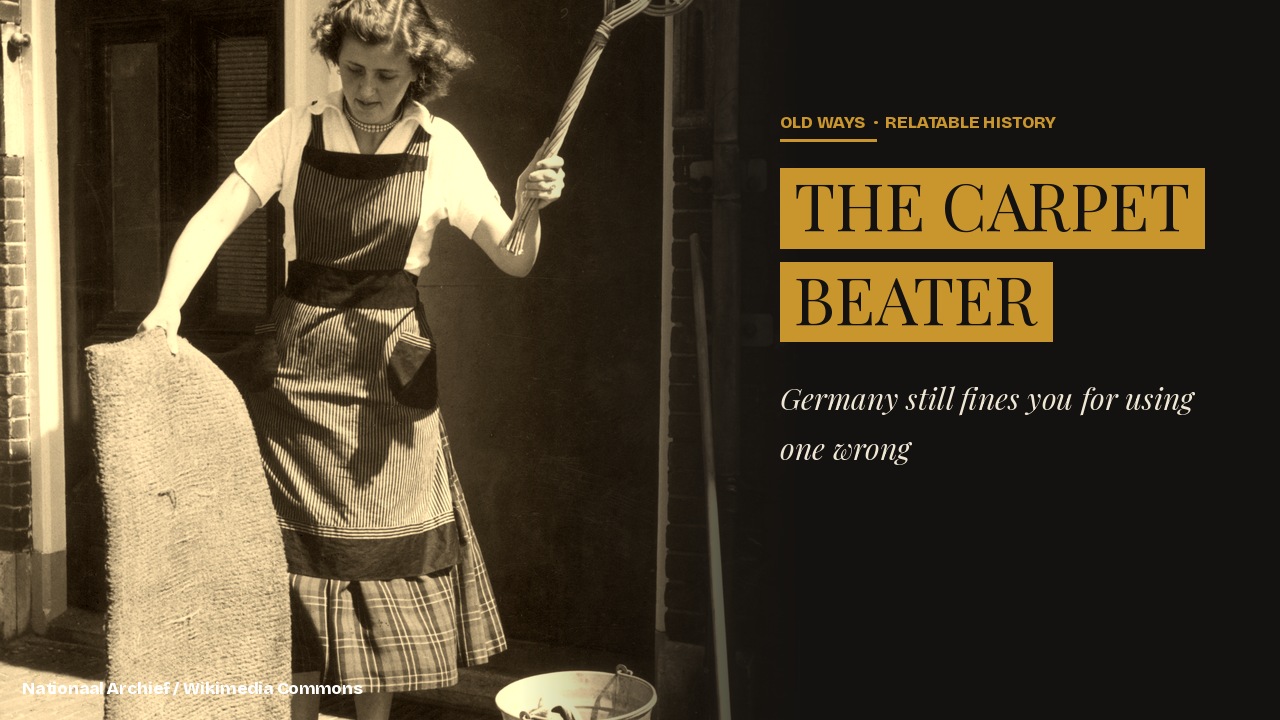
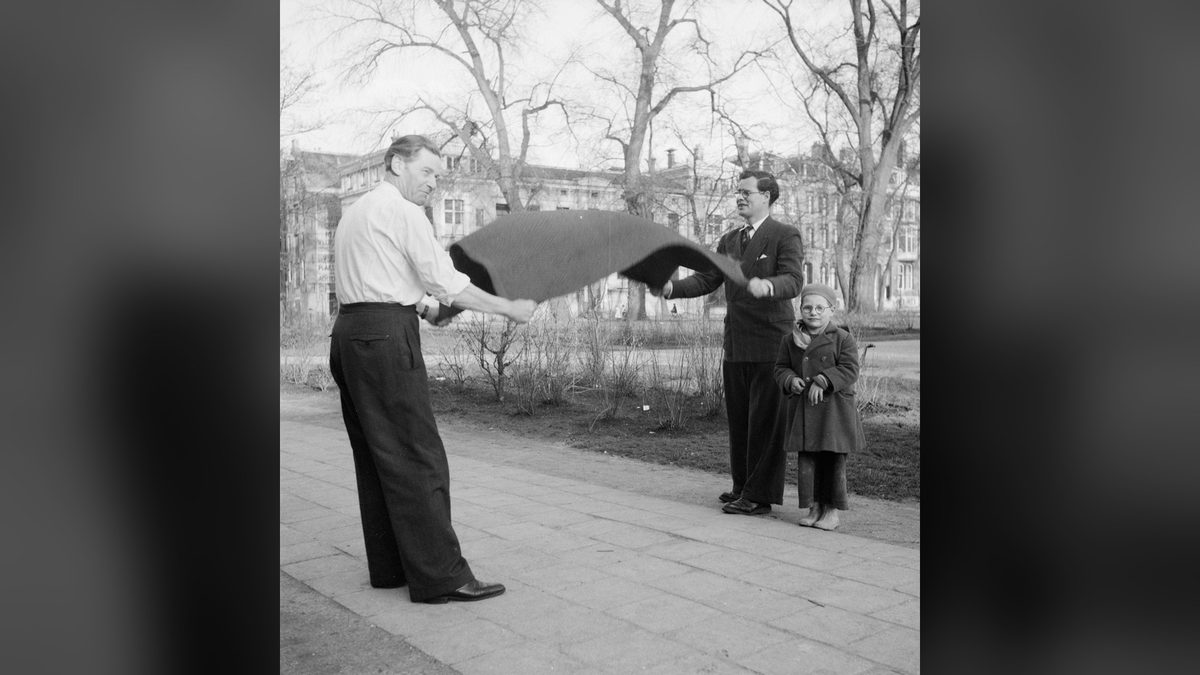
As late as 1950, just over half of American households owned an electric vacuum cleaner — 51 percent, according to the Smithsonian’s own catalog of the technology. The other half were still doing it the way their grandparents had: hauling the rug outside, hanging it over a line or a rail, and beating it with a loop of wire or woven cane until the cloud of dust stopped rising. That’s how carpet beaters worked, for most of a century, in nearly every house with a rug. Mechanical suction had existed in some form since before the First World War. It took another three decades to actually take over most households, because for most of that time a beater cost next to nothing and a vacuum cost real money.
Two American patents, four years apart, map out how the simple hand tool settled into the shape everyone still pictures today — and a separate, far more ambitious patent shows that engineers were trying to beat carpets by machine well before the ordinary household beater even existed.
This is the story of how carpet beaters worked: the patents behind the design, the physics of why an open weave outperforms a solid paddle, the purpose-built architecture some households put up just to hold a rug steady for beating, and the slow, name-brand-by-name-brand process by which the vacuum actually took the job away — a process that, in at least one country’s tenancy law, never entirely finished.
A Chicago Patent Fixed the Shape in One Afternoon
On April 18, 1876, the U.S. Patent Office granted Royal Morris of Chicago patent number 176,191, for what the filing calls, plainly, a “Carpet-Beater.” The drawing is almost comically simple: two long loops of wire, mirror images of each other, mounted side by side on a turned wooden handle. But the actual claim in the patent isn’t the loop shape — open wire paddles for beating carpet already existed in rougher forms. What Morris patented was the joint. Each loop is bent at its midpoint into the beating shape, and its two ends are bent again, at a right angle, into a pair of pivots. Those pivots drop into a hole drilled straight through the handle near its end, and a metal collar called a ferrule slides over the assembly and clamps everything in place — no screws, no solder, no separate fasteners. It’s a design built to be stamped out cheaply and repaired by anyone with a vise, and Morris’s filing says exactly that: he was after something “durable, cheap, and convenient.”
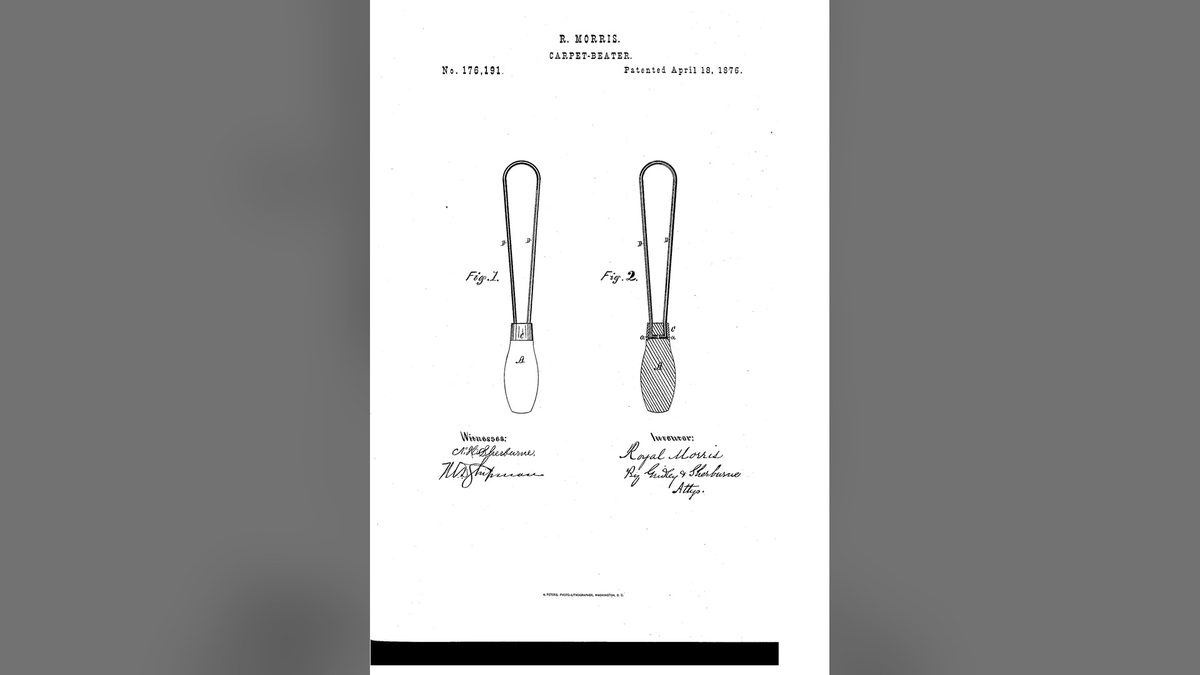
That joint is why the carpet beater barely changed in appearance for the next hundred years. Earlier household versions, improvised rather than purpose-built, used whatever springy material was already on hand — a bundle of willow switches, a length of cane, a handle whittled from a broom. Morris’s version, and the wave of similar wire patents that followed it through the late 1870s, gave manufacturers something that could be stamped out, assembled, and sold for pennies. From that point on, “carpet beater” meant, specifically, this shape: one or two wire loops on a stick.
A New York Inventor Tried to Automate the Job First
Four years before Morris’s simple hand tool, a very different answer to the same problem had already been patented. James Hothersall of New York received patent 134,059 in December 1872 — itself an improvement on an earlier Hothersall patent from that same April — for a carpet-cleaning machine meant to replace hand-beating with gearing. A carpet was fed on rollers through a wooden frame and pulled across a slatted platform by a driving shaft geared to turn two long brushes, one on each side. In the gap between the platform and the brushes, a separate beating mechanism — coiled-wire arms ending in cross-bars, driven through a set of recoil plates by a crank-shaft — struck the carpet in rapid, repeated motion as it passed through. Loosened dirt fell through the slats into a box underneath; the brushes caught whatever the beaters missed.
It’s a genuinely clever machine on paper, and the patent is careful to claim the coiled-wire arms specifically because they flex enough not to tear the fabric while still landing a real blow. What it was not, in practice, was a household object. A geared, crank-driven cabinet with rollers and two brush shafts was built for commercial carpet-cleaning operations, not a front porch, and nothing suggests it ever got cheap enough to compete with a woman standing at a clothesline with a wire loop. Its real significance is in the timing: a machine this elaborate existed four years before Morris patented the tool that actually won the household market, which says something about how seriously manufacturers were already taking the problem of carpet dust.
How Carpet Beaters Worked: an Open Weave Beats a Solid Paddle
The mechanical case for the beater’s odd lattice shape is straightforward once you think about what a carpet actually does to dust. A rug’s pile is a forest of fiber loops, and dust works its way down between them with every footstep, lodging well below the surface. A broom, and later a vacuum nozzle, mostly reaches only what’s sitting on top. Getting at what’s buried deeper takes a different kind of force: a sharp, repeated mechanical shock carried through the weave, which is exactly what a swung beater delivers and a sweeping motion doesn’t.
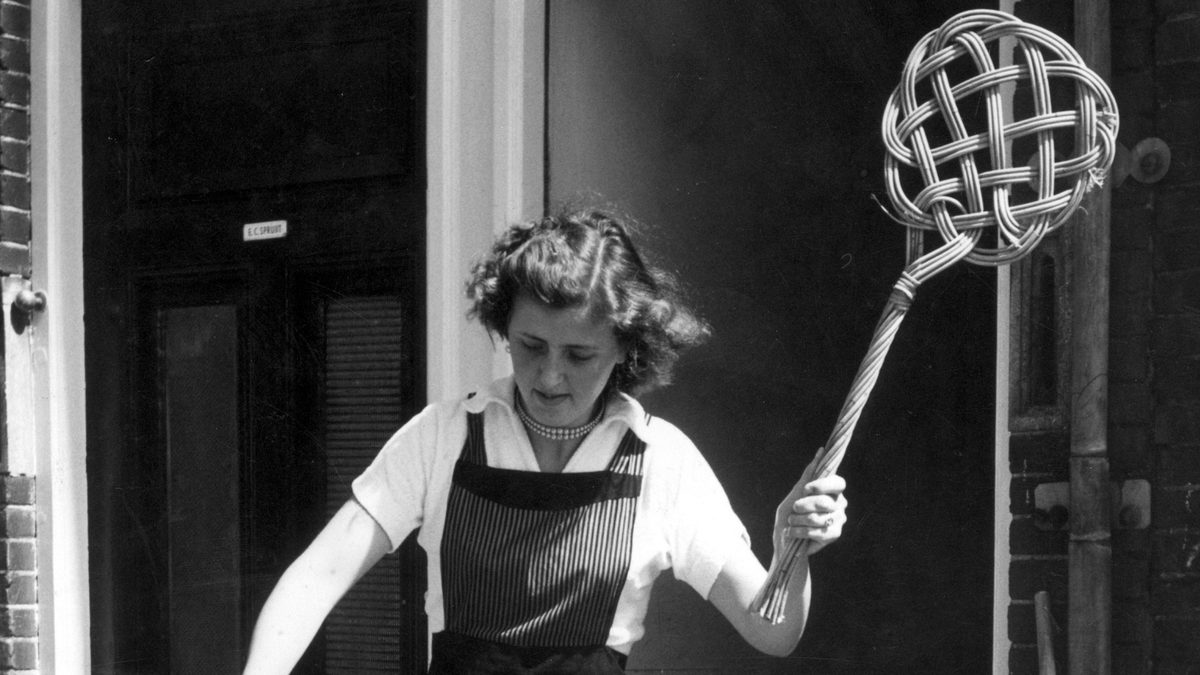
The open design is what makes that shock work in the beater’s favor rather than against it. A solid paddle striking a hung rug mostly just displaces air, pushing a cushion in front of itself that blunts the blow and can shove loosened dust straight back down into the pile it just left. An open lattice lets the air, and the dust riding in it, pass clean through the strike instead of bouncing back. The Smithsonian’s own 19th-century specimen in its decorative arts collection is three rattan switches bent into a five-loop paddle around a wire-rod handle, and the museum’s own catalog notes that fewer, thicker switches made for a stiffer beater and a harder blow, while more, thinner ones made for a gentler tool better suited to a delicate weave — which is why well-stocked households often kept more than one.
The Architecture Built Just to Hold a Rug Still
Beating a carpet requires hanging it somewhere first, and across parts of Europe that problem got its own purpose-built furniture. A German patent filed in November 1922, DE 364431, describes a Teppichklopfgerüst — literally a “carpet-beating scaffold” — a freestanding rack of two upright iron posts set in concrete, holding a frame that pivots on a central shaft. The clever part is in the bearings: the top of the frame bends forward into two curved supports holding a separate rod, longer than the frame itself, so a carpet rolled onto that rod hangs completely clear of the structure behind it. Tilt the frame down, roll the carpet onto the rod, tilt it back up and lock it with a pawl, and the rug hangs free on both sides — exactly the condition the beating itself needs, since a carpet pressed flat against something solid just bounces dust back into its own pile instead of releasing it.
Plainer versions of this kind of rack still stand in the courtyards of older apartment buildings across Germany, Austria, and parts of Eastern Europe — a permanent piece of shared infrastructure, built around a chore that, in most of those same buildings, nobody still performs with a beater. Where American and British households mostly made do with a clothesline or a porch rail, continental apartment blocks built the hardware in.
The Sweeper, the Vacuum, and a Decades-Long Price Gap
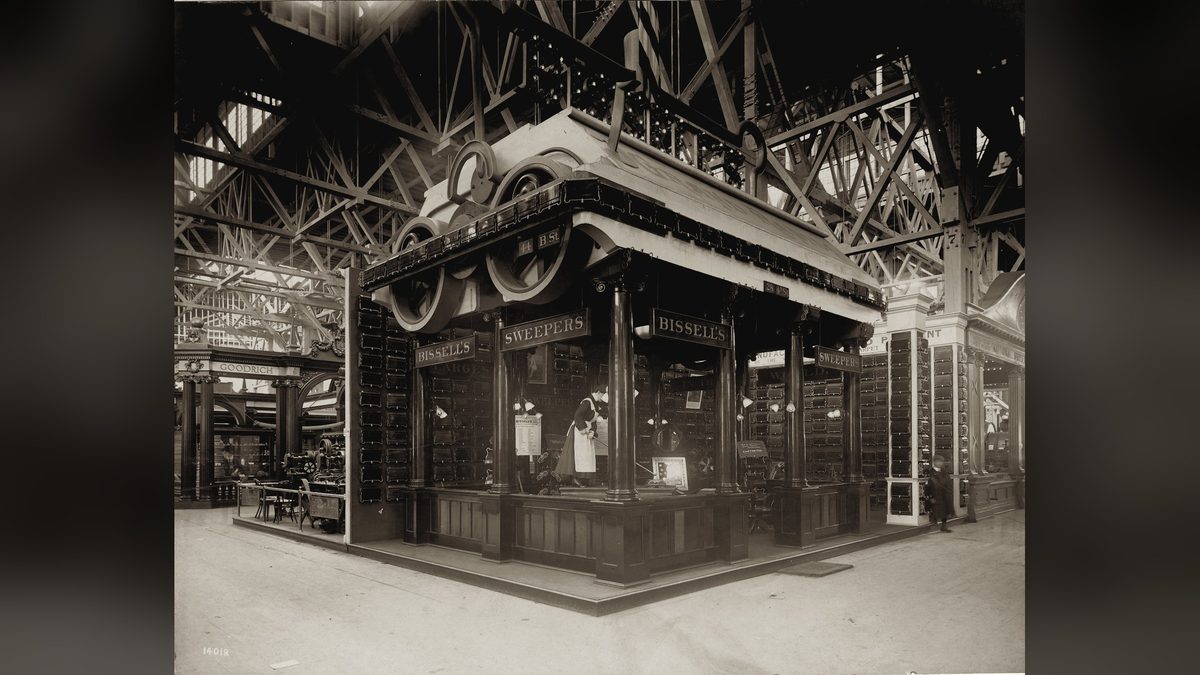
The tool that eventually replaced the carpet beater didn’t arrive as a single invention so much as a slow relay of increasingly expensive machines. The first real rival wasn’t even a vacuum. In September 1876 — five months after Morris’s beater patent — Melville Bissell, a Michigan crockery-shop owner, patented a carpet sweeper after dust from the shop’s packing straw aggravated his wife Anna’s health. His design pushed a central roller of hog-bristle tufts, set in hot pitch, across the floor on rubber wheels; it lifted loose surface dirt as it rolled but did nothing for what was already worked down into the pile, so it supplemented beating rather than replacing it. The company Anna Bissell built after Melville’s death in 1889 was successful enough that by 1904 “Bissell’s Sweepers” had its own ornately columned exhibition pavilion at the World’s Fair in St. Louis.
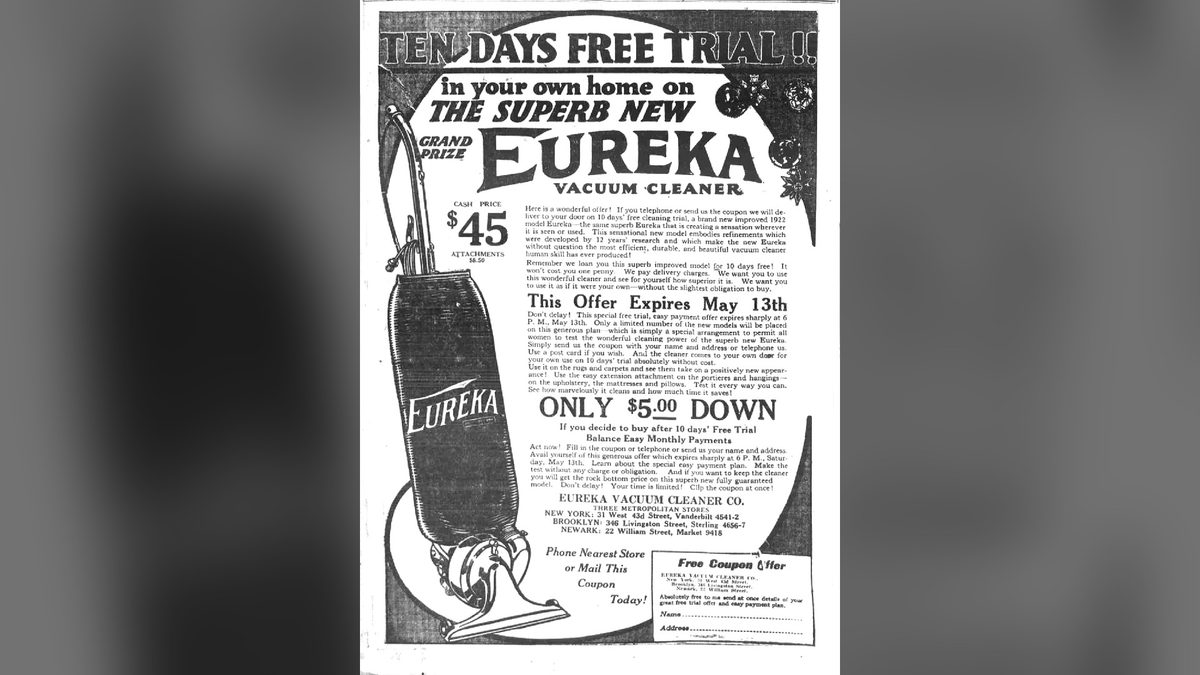
Actual suction took longer to reach ordinary houses, and it stayed expensive once it arrived. A 1910 magazine advertisement for the Regina Company’s vacuum aimed squarely at households that could afford a servant to operate it; by 1922, the Eureka Vacuum Cleaner Company was advertising its model at a cash price of $45, with a ten-day free trial and an installment plan — five dollars down, the rest in easy monthly payments — because even by 1922 the company knew full price up front was still a hard sell against a tool that cost almost nothing. That price gap is most of the explanation for why, as late as 1950, barely half of American homes had actually made the switch.
Watch the full history
The video version covers Morris’s patent, the winter trick of beating a rug face-down in the snow, and the one country where the household rule never quite left the books, in about seven minutes.

The Law That Outlived the Chore
The carpet beater itself has mostly vanished from daily use, but in Germany the legal framework built around noisy household chores never fully retired the idea of a lawfully wrong hour to clean — the beater just isn’t the main offender anymore. Under Paragraph 906 of the German Civil Code, a neighbor can object to any impact on their property that’s more than minor, and German courts have applied that same standard to ordinary household noise for decades: a Munich district court ruling in 2014 (Amtsgericht München, 424 C 28654/13) held that shaking out bedding counts as normal use of a rented flat, provided nothing falls onto the balcony or windows below, echoing a near-identical 1994 decision out of Kassel. That’s a narrow legal allowance, not a blank check — it still leaves room for a building’s own house rules, a Hausordnung, to ban shaking carpets or bedding from a balcony or window outright, and a tenant who ignores that kind of clause risks a formal warning or, in a serious enough case, eviction.
The same legal culture produces the designated quiet windows — Ruhezeiten — that get summed up abroad as a quirky German habit: no vacuuming roughly between midday and three in the afternoon or after ten at night, no mowing on Sundays, and in some buildings no laundry or drilling during a midday Mittagsruhe. None of it specifically targets a wire paddle and a rug anymore, because almost nobody is swinging one — but the underlying legal instinct that turned “you’re cleaning too loudly, and at the wrong hour” into something a neighbor could actually act on predates the vacuum cleaner by a long way, and it’s still standing.
Put the pieces next to each other and the carpet beater looks less like a single tool and more like a century-long negotiation between a genuine household problem — dust works its way deep into a rug and has to be forced back out — and whatever technology was cheap enough, at a given moment, to solve it. Hand beating won that negotiation for most of a century not because nobody had thought of anything better; Hothersall had, four years before the ordinary beater was even patented. It won because a bent piece of wire that cost almost nothing beat a machine that cost a great deal, for exactly as long as that price gap held.
What’s left of the chore today is scattered: a beater or two still for sale in a European household shop, a worn iron rack standing unused in an apartment courtyard, and, in Germany’s layered tenancy law, a set of rules about acceptable noise and acceptable hours that still quietly assumes someone, somewhere, might be cleaning something the hard way. The tool is gone from most houses. The hour it was and wasn’t allowed to be loud never entirely left the books. How long do you think you’d have lasted at it before calling the rug clean?
Related reading
- Did Franklin Invent the Franklin Stove?
- How the Washboard Became a Musical Instrument
- Wash Day Before Washing Machines Started With a Patent Fight
- How Farms Rendered Lard to Last a Whole Winter
Works cited
- Morris, Royal. U.S. Patent 176,191, “Improvement in Carpet-Beaters.” April 18, 1876. Link.
- Hothersall, James. U.S. Patent 134,059, “Improvement in Carpet-Beaters.” December 17, 1872. Link.
- German Patent DE 364431, “Teppichklopfgerüst” [Carpet-Beating Frame]. Filed and published November 24, 1922. Link.
- Bissell, Melville R. U.S. Patent 182,346, “Carpet-Sweeper,” September 19, 1876, as discussed in “Date: September 19, 1876.” Hagley Museum and Library. Link.
- National Museum of American History, Smithsonian Institution. “Carpet Beater,” object ID nmah_324261, 19th century.
- National Museum of American History, Smithsonian Institution. “Suction Sweeper, Reeves Vacuum Cleaner Company,” object ID nmah_323023, c. 1910 (cited for the 1950 U.S. vacuum-ownership figure).
- Islington Education Library Service. “Carpet Beaters, Victorian, Original.” Object Lessons. Link.
- ERGO Versicherung AG, Rechtsportal. “Vom Teppichklopfen und Bettenschütteln.” Link.
- Goodman, Imogen. “10 Ways You Will Accidentally Annoy Your German Neighbours.” The Local Germany, November 15, 2023 (updated January 13, 2025). Link.
- Bundeszentrale für politische Bildung. On Theodor Lessing and the Deutscher Lärmschutzverband, founded October 1908. Link.