
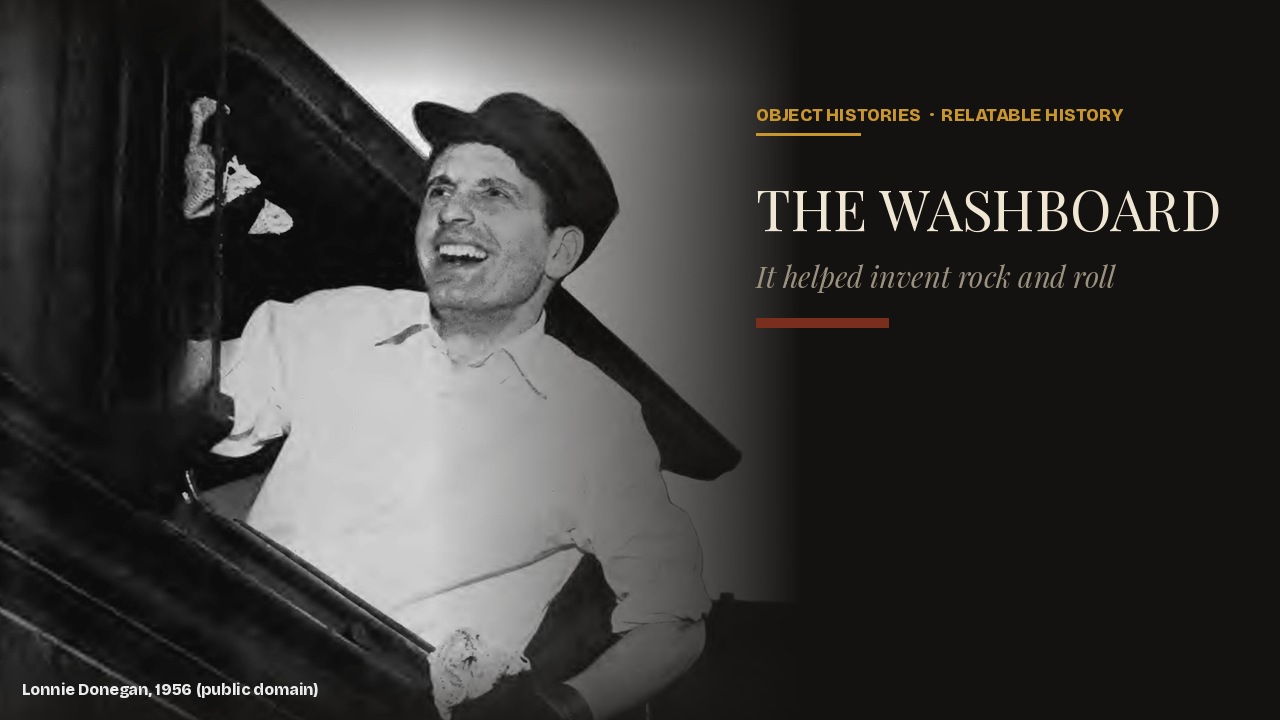
In 1833, somebody in the Ohio country patented a board with ridges cut into it, and the region’s tinsmiths, wood turners, potters and cabinetmakers all had the same idea within months of each other. More than a century later, two musicians who never met — a welder in a Texas oil refinery and a generation of teenagers in postwar Britain — independently arrived at the same second idea: that the same ridged board, held the right way, was a washboard as a musical instrument.
Those two reinventions happened an ocean apart and about a decade apart, with no connection between them beyond the object itself. One produced zydeco’s signature percussion sound. The other helped launch the band that became the Beatles. Neither musician was trying to save the washboard from obsolescence — the electric washing machine had already made sure of that — they just needed something loud, free and already lying around.
Before the washboard, laundry day meant a river, a rock, and a boiling kettle
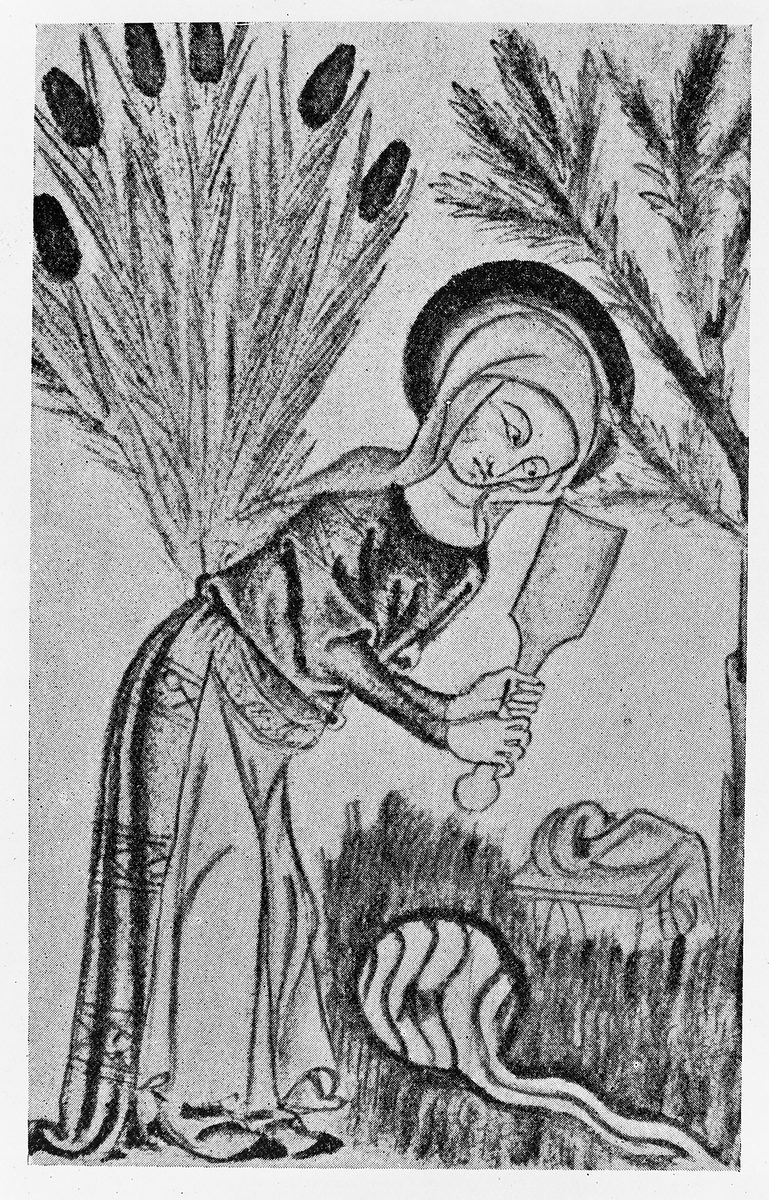
For most of history, doing the laundry meant carrying it to the nearest creek or river and beating the dirt out of it against a rock. At home, clothing and bedding were boiled in iron kettles — often the same pot a family cooked in — with a forked stick used to lift and turn the garments so every surface met the boiling water in turn. The first real improvement on bare rock was the scrub stick: a narrow, heavy wooden board with one side cut into coarse grooves for rubbing out stains, the American version fitted with a turned handle.
One 1833 patent turned laundry into a cottage industry overnight
The scrub stick’s ridges were the right idea pointed the wrong way: cut them into a flat panel instead, set the panel in a frame, and the fabric could be rubbed against a fixed ribbed surface with both hands free to do the scrubbing. The patent that formalized this in 1833 triggered what one regional-history account calls a stir across the Ohio country’s artisan community — suddenly every tinsmith, wood turner, potter and cabinetmaker had a way in. Tinsmiths crimped sheet metal into ribs but needed a joiner to build a frame sturdy enough to keep it from bending; turners shaped wooden rollers that revolved inside wooden frames; potters rolled out stoneware clay, pressed it with a tinsmith’s crimped sheet, and fired the ridged slab before a joiner mounted it.
Washboards were readily adopted in villages and outlying farms, and once larger manufacturers began turning out cheaper versions, plenty of the handmade ones ended up retired to a cellar or a shed. What the washboard did not change was the rhythm of the work itself: washing stayed fixed to Monday — “blue Monday,” as rural households called it — and some kept right on using washtubs and forked laundry sticks alongside it.
By World War I, the washboard was a branded, patented “soap saver”
By the early twentieth century the washboard had gone from artisan novelty to mass-manufactured appliance. A board in the collection of the Henry Ford museum, dated to around 1918, is made of wood, glass and tin and stamped “NATIONAL WASHBOARD CO.,” with plants in Chicago, Saginaw and Memphis listed on the metal top alongside the slogan “SOAP SAVER” and a run of patent numbers from 1,152,766 to 1,283,148. Some models swapped metal ridges for ribbed glass panels, on the claim — plausible, if never independently tested here — that glass would not rust or snag delicate fabric the way a corroding metal edge eventually would — one more version of the same incremental re-engineering a clothes wringer went through down the hall.
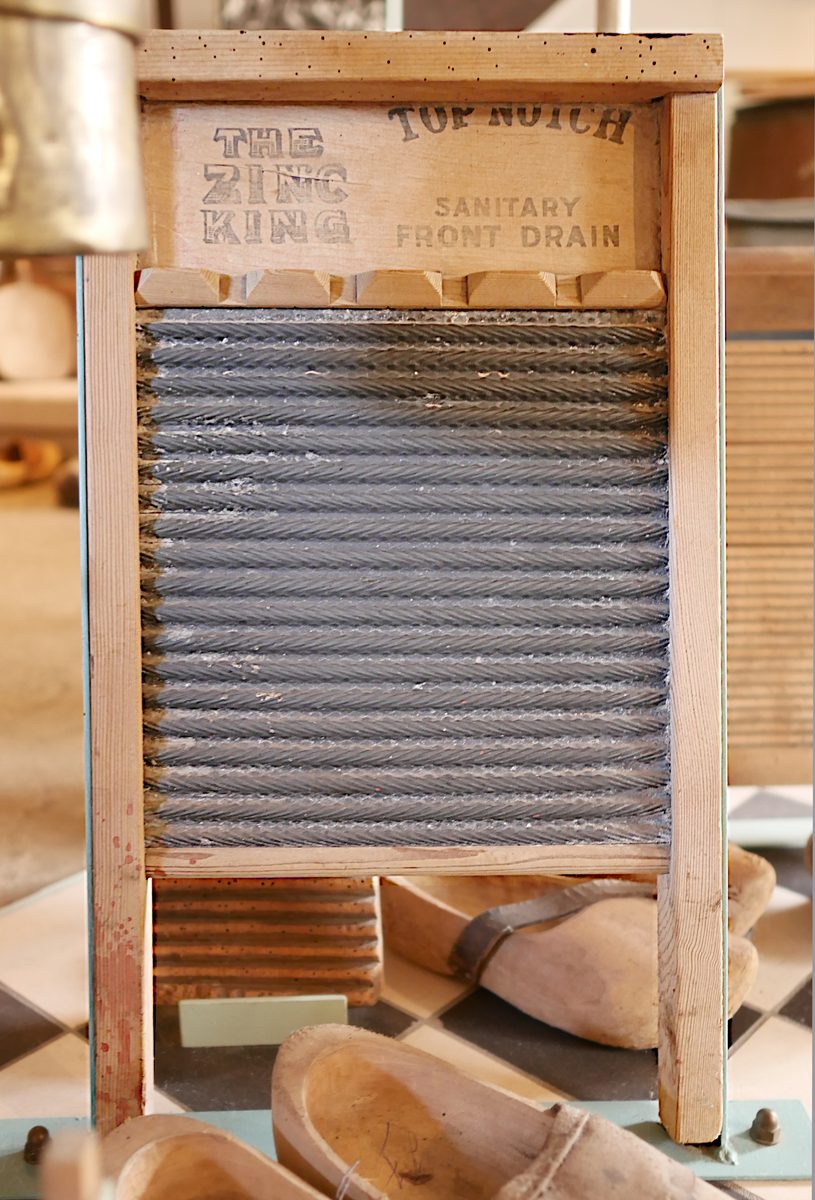
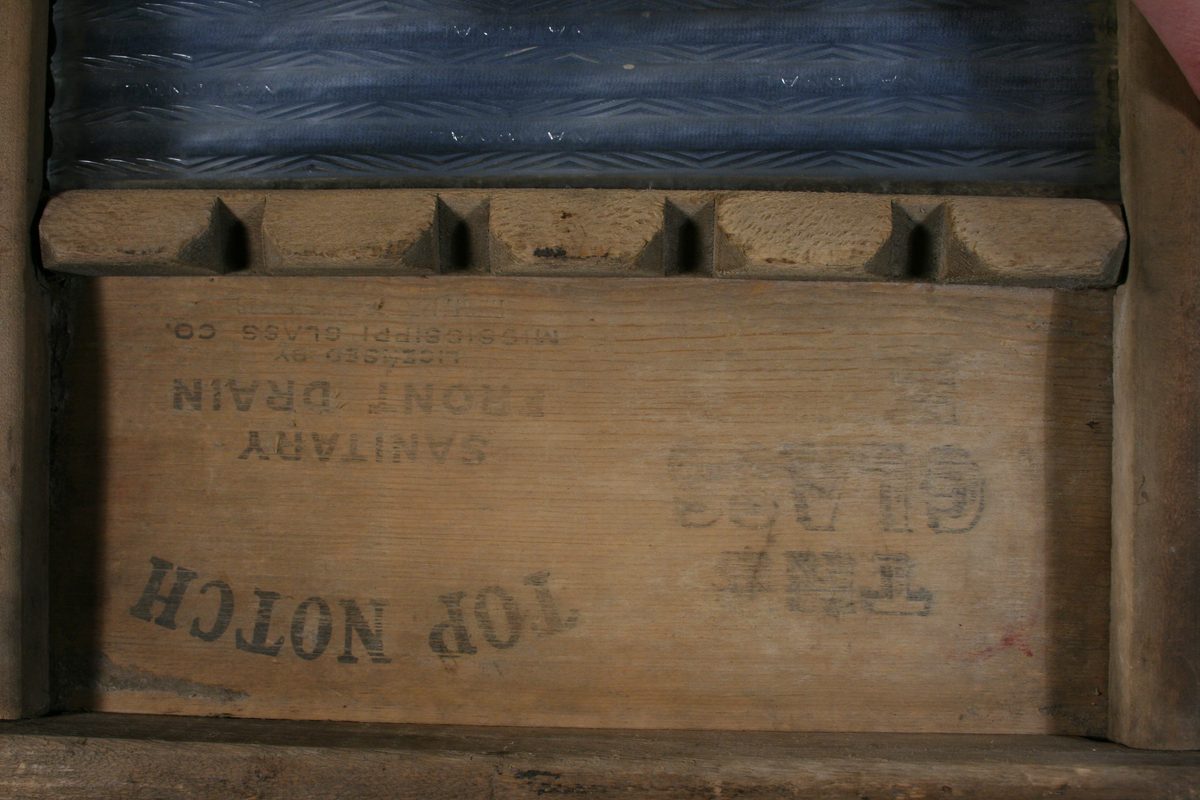
The mechanical idea behind every version was the same: a fixed, rigid, ribbed surface lets a washer apply friction to one spot of fabric at a time with real pressure, instead of relying on water alone to lift dirt out of the weave. It is a simple machine with no moving parts, which is exactly why it was still sitting in cellars, largely idle, decades after electric washing machines took over the actual laundry — and exactly why it was so easy for someone to pick one up and use it for something else entirely.
When electric washers made it obsolete, the washboard became a musical instrument in Philadelphia blues
Robert Young, a blues musician born in Marshall, Texas, in 1900, had worked his way through the Carolinas and Virginia before settling in Philadelphia in the early 1940s, where he performed alongside Brownie McGhee, Big Bill Broonzy, Sonny Terry and Buddy Moss. A stroke eventually left him unable to play guitar or trombone well enough, and — according to his bandmate, the guitarist Ted Estersohn — that is what pushed him toward the washboard as his main instrument, performing under the name Washboard Slim.
Young’s contribution was mechanical as much as musical: he bolted a board to the washboard’s base so he could sit on it, wedge the whole rig between his knees while it balanced on a chair, and leave both hands free to work it with whatever was on hand — door hinges and thimbles, in his case, as improvised drumsticks. His “full-dress” washboard, now in the Smithsonian’s National Museum of American History, went further still: two washboards bolted together and hung with frying pans, a hubcap, pot lids, a wood block, a cowbell, tin plates and a car horn with a rubber bulb. He played Mardi Gras in Philadelphia with the Wild Bohemians into his eighties; the city’s mayor declared a Washboard Slim Day for a 1990 memorial concert held just before his death, days short of his ninetieth birthday.
In Louisiana, a welder built the first washboard made strictly as a musical instrument
Washboard Slim’s rig was still, mechanically, a laundry tool pressed into service. What happened next in southwest Louisiana was different: an instrument designed from scratch, built for music and nothing else. In 1946, Willie Landry, a master welder and metal fabricator at the Texaco refinery in Port Arthur, Texas, met brothers Cleveland and Clifton Chenier, who also worked there. Cleveland had been playing a hand-held washboard, strung around his neck on a rope, to back his younger brother’s emerging accordion music. Clifton proposed a purpose-built version; Landry, working from that idea, welded a corrugated metal vest that hung from the shoulders and left both hands free to strike it with spoons or bottle openers — the frottoir, played as a stroked percussion instrument, typically eight to sixteen strokes per four-beat measure.
Clifton Chenier, born in Opelousas in 1925 and taught accordion by his father at local fais do-do dances, was already playing alongside Cleveland by age sixteen. He switched from the small diatonic accordion to the larger piano accordion, signed to Specialty Records in 1955, and recorded two tracks in 1954 — “Louisiana Stomp” and “Clifton’s Blues” — now counted among the earliest recordings of what became known as zydeco: French Creole dance music fused with rhythm and blues. His 1963 sessions for Arhoolie brought him national recognition, and he won a Grammy in 1984. Louisiana’s state legislature has since recognized the frottoir as one of only a handful of musical instruments genuinely original to the United States, and two of Landry’s handmade rubboards now sit in the Smithsonian’s permanent collection — not far, as it happens, from Washboard Slim’s.
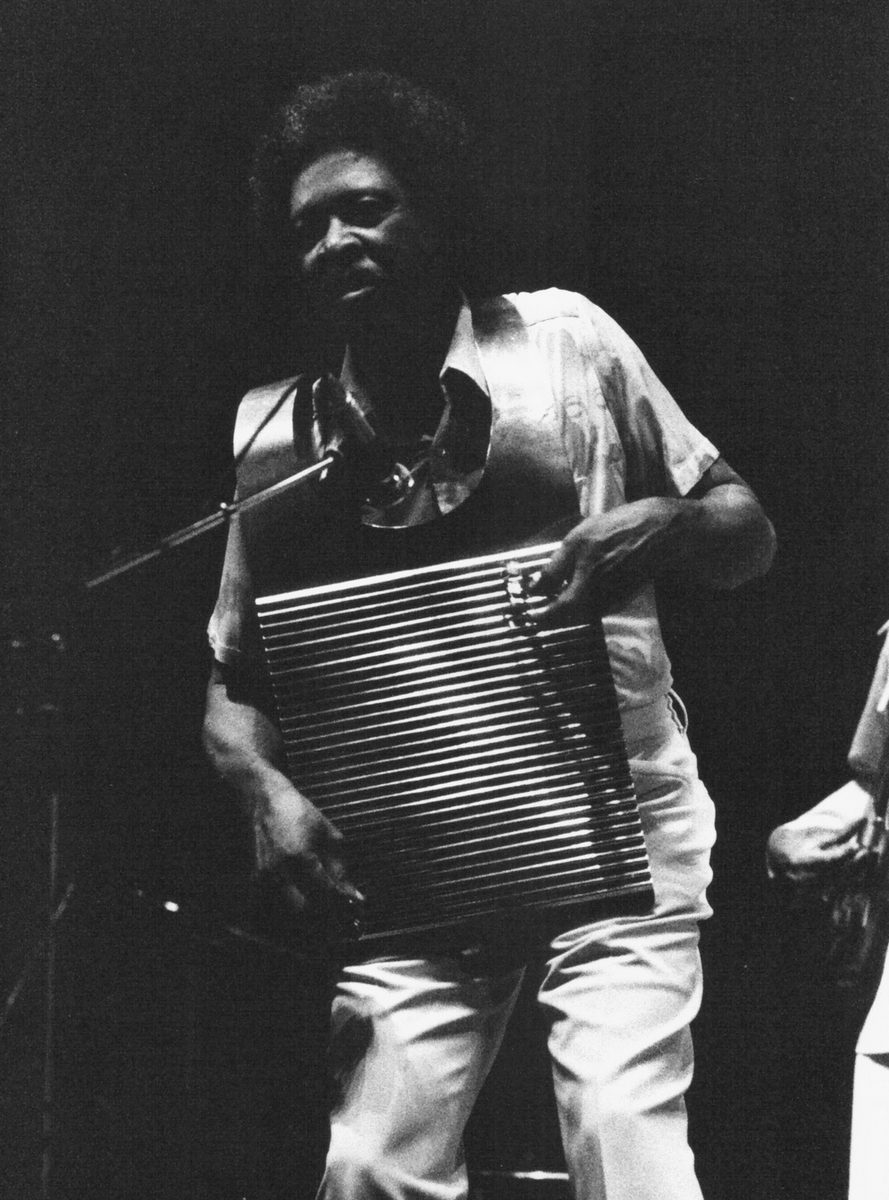
In Britain, the same humble object helped launch skiffle, and skiffle launched the Beatles
Neither Washboard Slim nor the Chenier brothers had any contact with what was happening, almost simultaneously, among British teenagers listening to American blues records. The connective tissue there runs through the Library of Congress: in 1934, the folklorist John Lomax recorded Huddie “Lead Belly” Ledbetter singing a work song called “Rock Island Line” among prison work gangs in Arkansas, and the Library’s folk archive later issued those field recordings commercially. Copies reached the U.S. Information Service’s lending library in London, where a young banjo player named Lonnie Donegan — playing at the time with Ken Colyer’s Jazzmen and later Chris Barber’s band — heard them.
Donegan recorded his own “Rock Island Line” with Barber’s band in 1954; reissued as a single in late 1955, it became one of the biggest British hits of 1956, built on nothing more than guitar, a homemade bass made from a tea chest, and a washboard scraped for rhythm. That stripped-down lineup — cheap enough for any teenager to assemble — was skiffle, and Donegan’s success set off a wave of copycat groups playing whatever American folk and blues material they could find, all pulled together into makeshift bands around that same trio of guitar, tea chest and washboard. One of them, formed in Liverpool in 1956, was John Lennon’s Quarrymen.
At a church garden fete at St Peter’s, Woolton, in July 1957, the Quarrymen performed and a fifteen-year-old named Paul McCartney, in the audience, was introduced to Lennon afterward. Lennon was looking for a better guitarist and asked him to join. George Harrison was in by 1958, and over the next few years the group’s name changed to the Beatles. Harrison later put the chain of causation in blunt terms: no Lead Belly, no Lonnie Donegan; no Lonnie Donegan, no Beatles. The skiffle craze itself lasted only a few years before American rock and roll swept it aside — but by then it had already done the one thing that mattered, which was put a washboard, a guitar and a sense that anyone could do this into the hands of exactly the right teenagers.
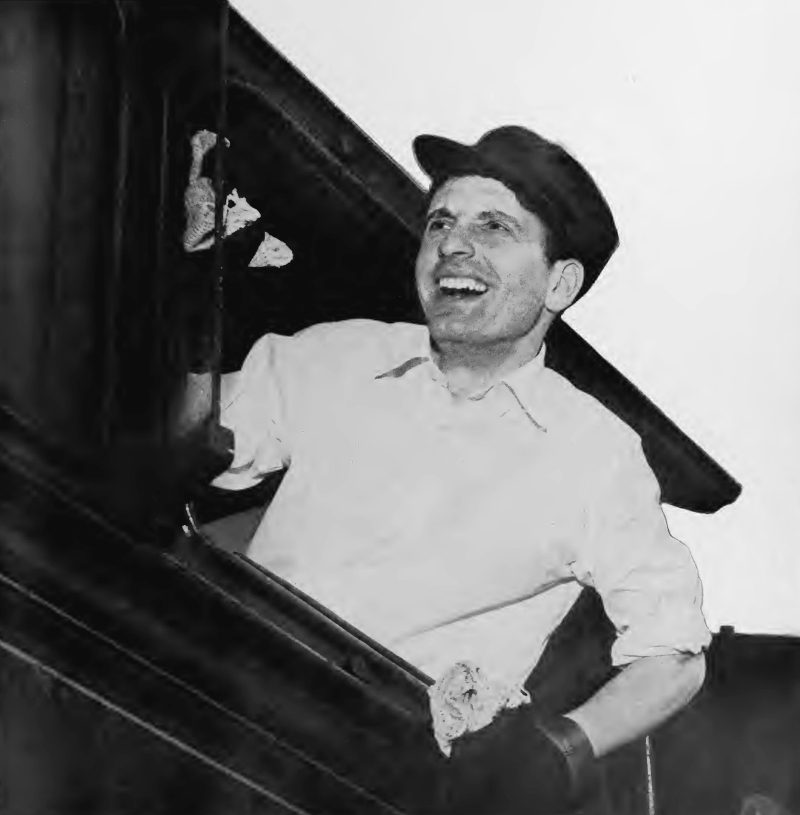
Watch the full history
The short version of this story — the 1833 patent, the glass ridges, and the leap from laundry room to rock and roll — runs about fifty seconds.

What one laundry tool ended up proving
Willie Landry’s welded frottoir and the washboard scraped by a Liverpool teenager with a thimble have nothing to do with each other. Nobody involved in either reinvention had heard of the other one. What they share is a single object that an 1833 patent put into nearly every household in reach of a tinsmith, and that stayed there, mostly idle, for a century after it was outcompeted by the machine it was named for — a soap saver with nothing left to save once the electric washer arrived.
That idleness turned out to be the opening. A washboard too obsolete to matter was also a washboard nobody minded being bolted, welded, or scraped half to pieces, and cheap or free enough that a refinery welder in Texas and a Liverpool schoolboy could both get hold of one without asking anybody’s permission. Two different countries’ popular music ended up running a surprising distance on that accident of economics. Would you have guessed a laundry tool helped invent both zydeco and rock and roll?
Related reading
- The Contested History Behind Blue Monday Washday
- Wash Day Before Washing Machines Started With a Patent Fight
- Clothes Wringer History: From Courtship Gift to ‘Wringer Arm’
- What Washing Before Indoor Plumbing Really Looked Like
- Why Player Pianos Outsold Real Pianos in 1924
Shop the styles/items featured in this video
Washboard-style musical rubboards
Zydeco rubboards
Histories of rock and roll
Works cited
- Locher, Paul. “How the 1833 Washboard Patent Changed Early American Laundry.” Farm and Dairy, August 2, 2026. Link.
- Locher, Paul. “Coming Clean About Clothes Washing Chores in the Early Ohio Country.” Farm and Dairy, July 20, 2026. Link.
- The Henry Ford. “Washboard, circa 1918.” Digital Collections, object ID 62.71.42. Link.
- Edwards, Owen. “Art and Soul.” Smithsonian Magazine, October 2007.
- Louisiana State Senate. Senate Concurrent Resolution No. 81, 2014 Regular Session, recognizing Sunset, Louisiana, as the “Rubboard Capital of the World.” Link.
- National Endowment for the Arts. “Clifton Chenier.” NEA National Heritage Fellowships. Link.
- Library of Congress. “Inquiring Minds: Folklife Center Shines a Light on the Skiffle Craze.” Library of Congress Blog, September 2017. Link.
- National Trust. “History of the Beatles’ Childhood Homes.” Link.
- Farbenbloom, Frank. Review of Roots, Radicals and Rockers: How Skiffle Changed the World, by Billy Bragg. The Syncopated Times, February 28, 2022. Link.
- Brocken, Michael. “Was It Really Like That?: ‘Rock Island Line’ and the Instabilities of Causational Popular Music Histories.” Popular Music History 1, no. 2 (2006): 147–166.