
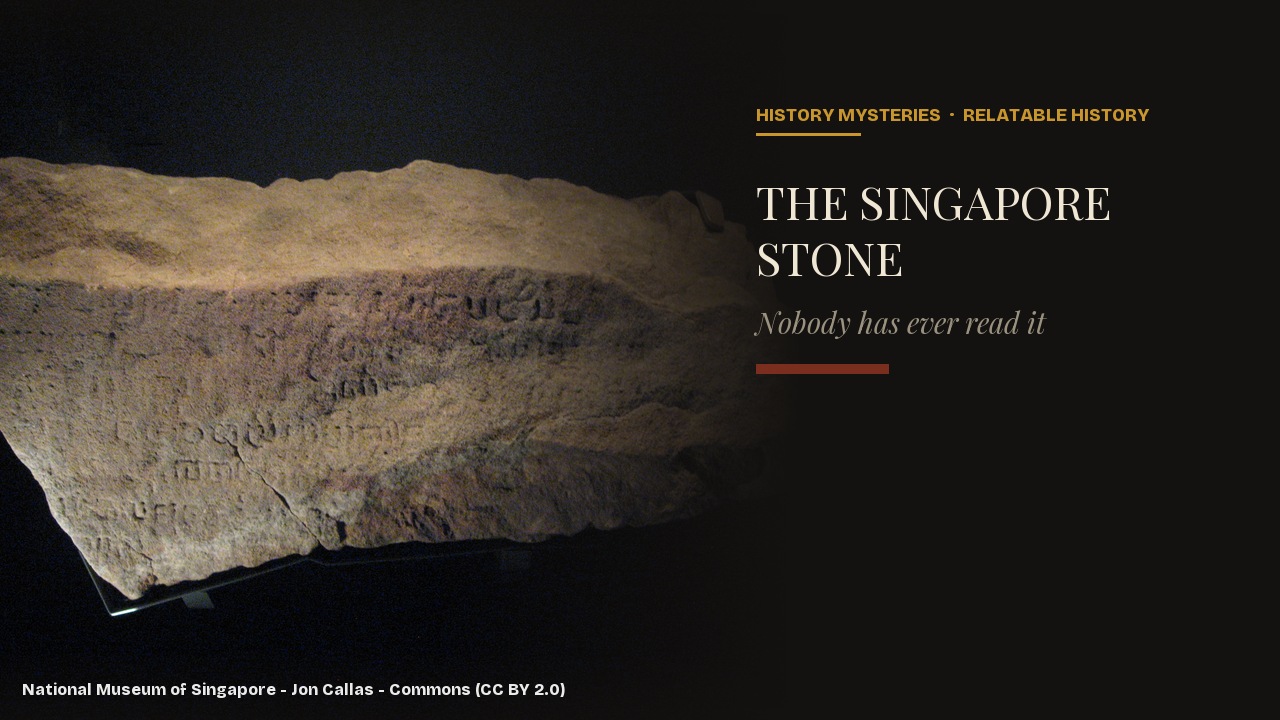
In a display case in the Singapore History Gallery sits a block of sandstone sixty-seven centimetres tall and about eighty kilograms, one face carved with a few dozen letters worn nearly flat. It is the oldest written object ever found on the island. In roughly two hundred years of trying, nobody has translated a sentence of it, agreed on the language it records, or settled on a century for when it was cut — published estimates range across three hundred years, from the tenth century to the thirteenth.
The reason the puzzle is this hard is not mystery for its own sake. What stands in the museum case is a fragment of a fragment. The original monolith was a slab of coarse sandstone roughly three metres high and three wide, its dressed face carrying some fifty lines of script across an area about a metre and a half high and just over two metres wide. In January 1843, a British officer had almost all of it blown up.
What follows is less the story of an unsolved mystery than the story of how one got made. It runs through a colonial acid test, a strongman legend that may have been bolted onto the stone after the fact, a set of dough impressions that are now the closest thing to an original, a demolition charge laid for a bungalow, and, currently, an attempt to get a machine-learning model to finish a sentence no human has ever been able to start.
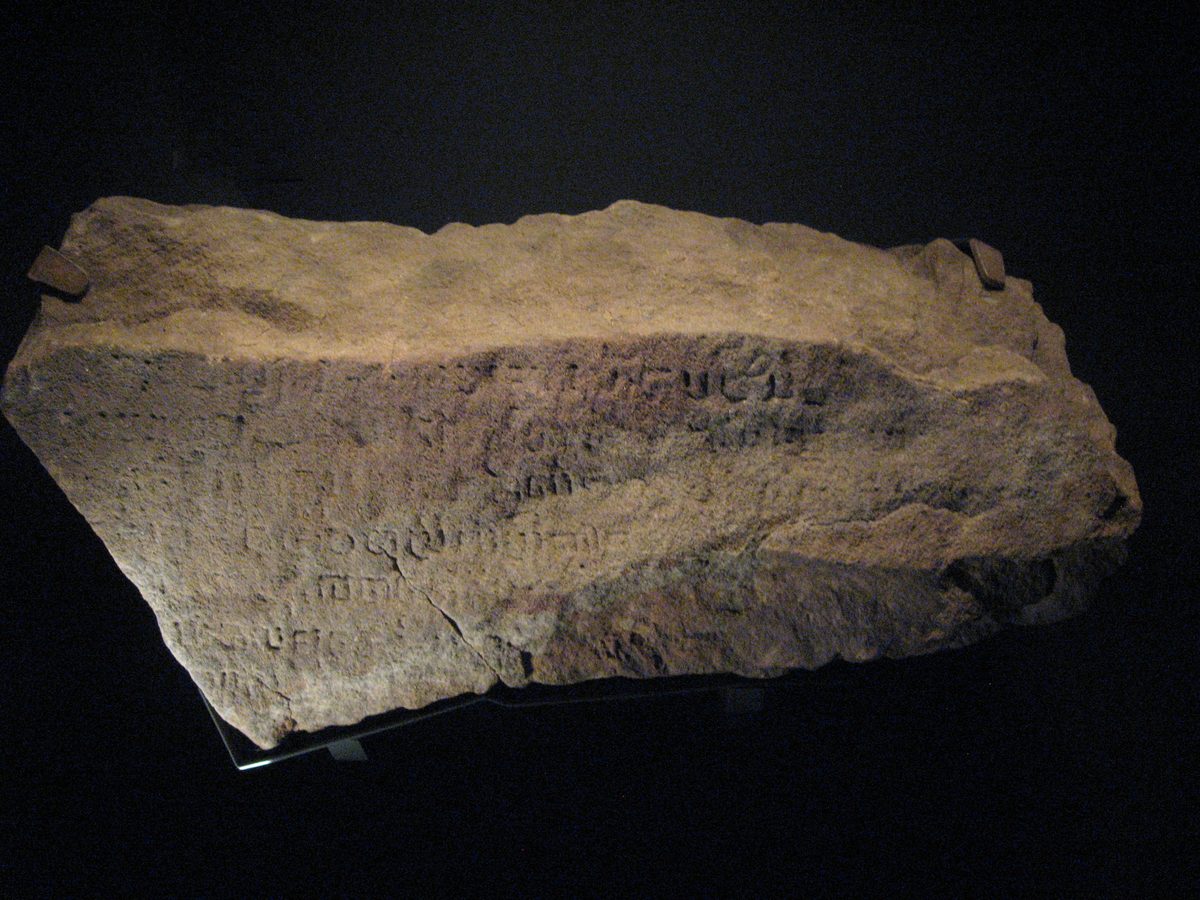
The inscription was already unreadable when colonial settlers found it
The stone was found in June 1819, five months after Stamford Raffles landed and claimed the settlement for the East India Company. Labourers were clearing jungle on a promontory at the southeast side of the Singapore River mouth — a spot later known as Rocky Point and then Artillery Point, close to where the Fullerton Building stands today — when they cut back the trees and found the boulder standing in place. An early account by the colony’s surgeon, William Montgomerie, says the men who first uncovered it were Bengal sailors working for Captain Francis James Bernard Flint, Singapore’s first Master Attendant, and that the writing frightened them badly enough that Chinese labourers had to finish the clearing.
Here is the detail that gets lost every time the story is retold as a decipherment problem: the writing was not freshly discovered and then lost to vandalism. It had already weathered for centuries at a tropical river mouth by 1819, and the earliest written descriptions do not complain that the text defied translation. They say the letters themselves were worn away. Whoever eventually solved this was always going to be reading a ruin, not a document.
Raffles tried acid on it, and still guessed the wrong continent
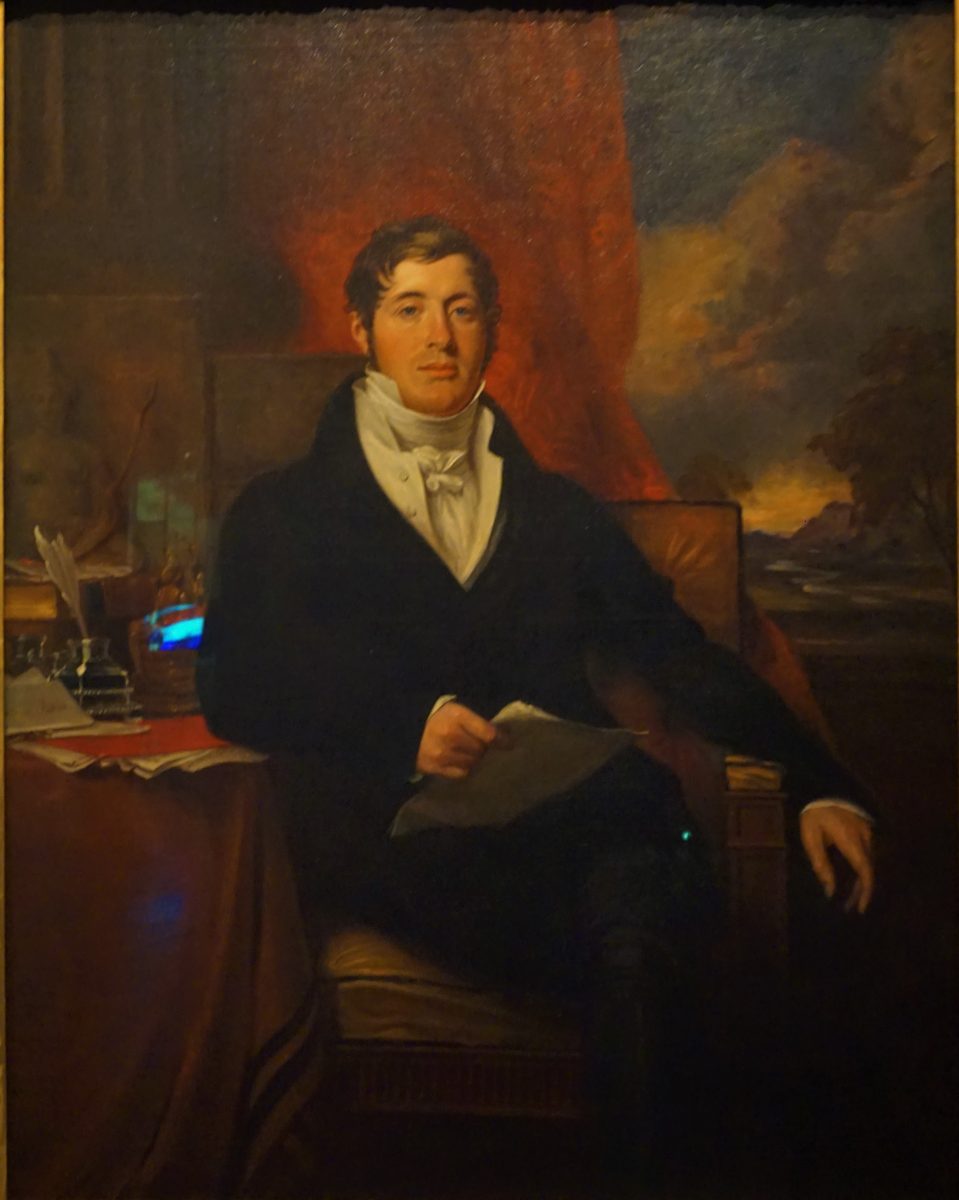
Raffles went to see the stone himself in October 1822, together with the missionary Claudius Henry Thomsen. According to the Malay writer and translator Abdullah bin Abdul Kadir, who knew him and recorded the visit, Raffles tried strong acid on the carved face to try to raise the worn letters, and got nothing legible for his trouble. His working guess was that the script was connected to early Hindu settlement in Java, Bali and Siam.
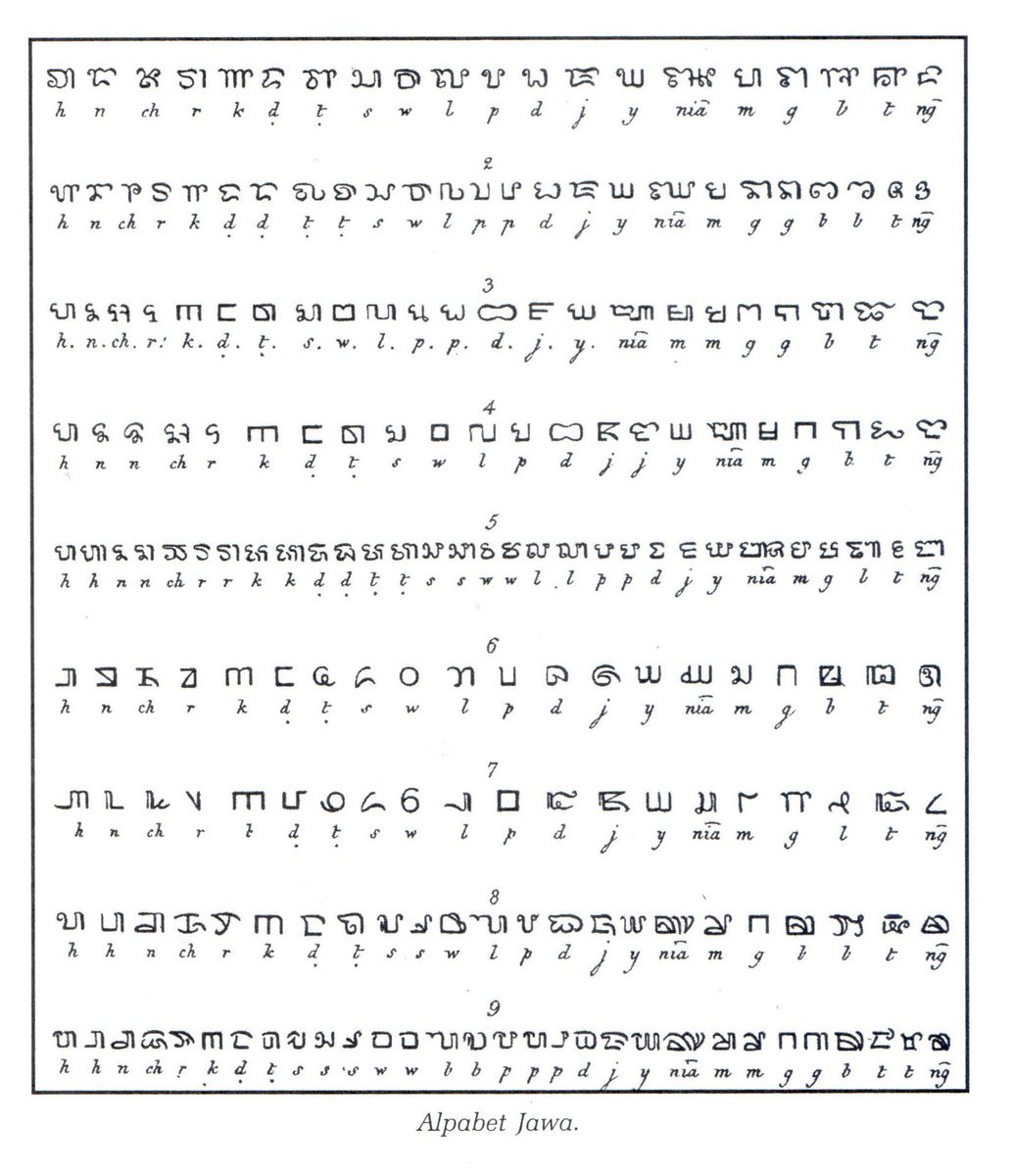
It is a genuinely strange footnote that Raffles himself had just published the table that would eventually crack the identification. His History of Java, which appeared the same year, prints the Kawi alphabet — the Old Javanese literary script used across the archipelago for several centuries. He had the comparison chart. He looked at the stone with acid in hand. He still did not connect the two, which says something about how differently a worn, eroded carving reads next to a clean printed table of the same letters.
A strongman’s legend attached itself to the stone, and may not belong there
The most famous story about the stone has nothing to do with decipherment. The Sejarah Melayu, the Malay Annals, tell of Badang, a servant of superhuman strength who defeated a champion sent from Kling — the old Malay name for India’s Coromandel coast — by hurling a massive boulder roughly 850 metres from Fort Canning Hill to the mouth of the Singapore River. The annals add that when Badang died, the Rajah of Kling sent two stone pillars to mark his grave.
In 1834 the artillery officer and writer Peter James Begbie tied that legend directly to the boulder at the river mouth, in his book The Malayan Peninsula. But recent research complicates the popular version of that story in a useful way. Begbie never actually assigned a date to the stone from the legend, and he was openly sceptical of the tale itself, calling it “fabulous and childish” even as he reported it. The Sejarah Melayu text he was working from does not mention any writing on Badang’s stone at all — that detail was added by later retellings. Historian William L. Gibson’s 2025 study for the National Library Board goes further, asking whether the whole Badang–stone connection might be a colonial-era invention grafted onto a pre-existing local tradition, noting related Tamil-inscribed stones at Barus and on Pulau Karimun Besar that may have supplied the template for a travelling strongman motif rather than a fact specific to Singapore.
One man’s dough impressions are the only reason there is still a text to argue over
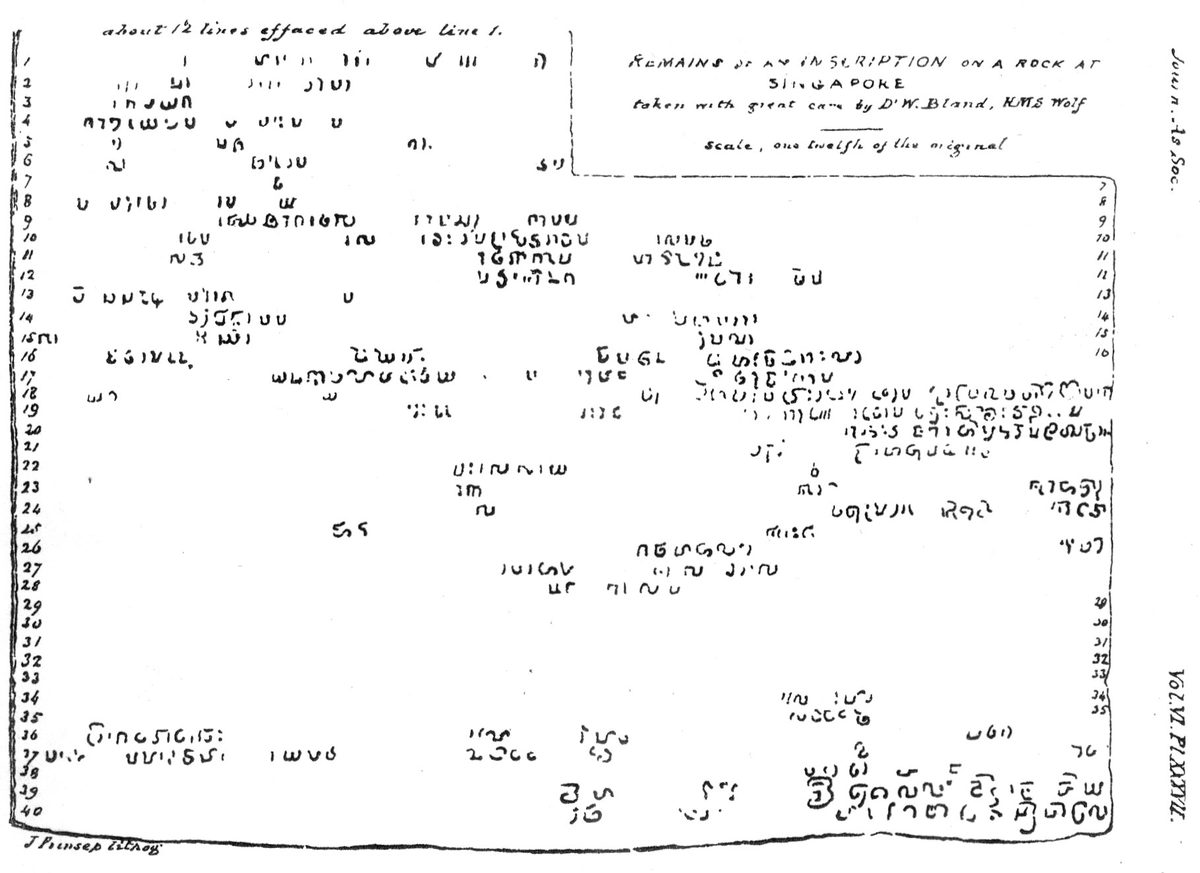
In 1837 the surgeon William Bland did the single most valuable thing anyone ever did with this object: he recorded it before it was gone. He pressed dough into the carved face to take impressions and worked the casts up into facsimile drawings. Those drawings are the reason there is anything left to study at all, because six years later the stone they copied stopped existing in that form.
Bland thought the letters looked like ancient Ceylonese or Pali, and sent his facsimiles to James Prinsep, secretary of the Asiatic Society of Bengal in Calcutta. Prinsep was, at that moment, in the middle of cracking Brahmi and Kharosthi and making the edicts of the Mauryan emperor Ashoka readable for the first time in a thousand years — arguably the best epigrapher working anywhere in the world that decade. He looked at Bland’s drawings, agreed the script resembled Pali, identified a handful of individual letters, and guessed the text might record the spread of Buddhism. That is as far as the single most capable reader of ancient scripts in the British empire got from a facsimile of the stone while it still, barely, existed.
It was destroyed to build a bungalow, not out of malice
In January 1843, the acting Settlement Engineer, Captain Stevenson, had the boulder blown apart, to widen the river mouth channel and clear ground for Fort Fullerton and its living quarters. Lieutenant-Colonel James Low had petitioned beforehand for the stone to be spared and was told it stood exactly where a planned bungalow was going. Popular blame has stuck for generations to George Drumgoole Coleman, the settlement’s superintendent of public works and its first trained architect — but the documentary record is specific that he was on leave when it happened and had nothing to do with the order.
Low reached the site after the charge went off and salvaged what fragments still carried legible letters, eventually sending pieces to the Royal Asiatic Society’s museum in Calcutta, where they arrived around June 1848. A separate fragment turned up in the meantime doing service as a seat on the Treasury verandah, and was recovered later by Colonel William John Butterworth, by then the settlement’s governor. A larger block hauled up to Government Hill met an even less dignified end: it was broken down for road gravel.
A century of careful, contradictory near misses
In 1848 the orientalist John Clark Marshman Laidlay took Butterworth’s and Low’s salvaged fragments and rubbed charcoal dust into the carved grooves to lift the worn letters out of the stone — a technique that, decades later, produced the identification that has stuck. Laidlay matched the script to Kawi, the exact alphabet Raffles had printed a table of in 1817 without recognising it on the boulder in front of him. Laidlay still could not read the text.
What followed was a sequence of serious, specific, mutually contradictory judgments, each advancing the problem without solving it. The Dutch epigrapher Hendrik Kern read a few isolated character clusters and dated the carving to around 1230, without being able to name the language. N. J. Krom, working from the 1848 rubbing, judged the letterforms close to Majapahit writing but older than 1360. J. G. de Casparis read one or two actual Old Javanese words and placed the stone in the tenth or eleventh century. Boechari dated it no later than the twelfth century, judged the carving style closer to Sumatran than Javanese traditions, and proposed the underlying language was Sanskrit rather than Old Javanese at all.
The physical evidence kept thinning even as the scholarship progressed. In 1918 Singapore’s Raffles Museum wrote to Calcutta asking for the fragments back; Calcutta agreed to return one, which reached Singapore the following year. The archaeologist John Miksic has argued the remaining pieces are very likely still in Kolkata, uncatalogued or unidentified. The single fragment now on display is not the Singapore Stone in any complete sense. It is what happened to survive of an object that was already most of the way to unreadable before Raffles ever reached it with his acid.
The newest theories point toward India, and toward a machine
The argument is still live, and it has shifted direction twice in recent years. In 2019 the independent epigrapher Iain Sinclair, a former Visiting Fellow at Singapore’s ISEAS – Yusof Ishak Institute, proposed reading a character sequence as kesariva, part of parakesarivarman, a royal title used by several kings of the Chola dynasty of southern India. Sinclair also reads a passage of the Sejarah Melayu‘s founding story as an echo of Chola ancestry, and has argued that the Badang tale is, in his words, the version of events “most emphasised in Singapore today, in spite of its obvious unbelievability.” If Sinclair is right, the inscription points toward the early eleventh century and toward a Tamil-speaking political presence at the Strait of Singapore — a genuinely different proposal from the Old Javanese and Sumatran readings that came before it, reached by a completely different route.
In 2023 the linguists I-Shiang Lee and Francesco Perono Cacciafoco published a close comparison between the surviving characters and the Calcutta Stone, a dated 1041 Kawi inscription held in India. They found real stylistic similarities, consistent with a “Later Kawi” dating — and also real differences in how diacritical marks are used, the kind of split result that narrows the field without closing it. The same year, a separate paper by Kelvin Cahya Yap, Tony Wenyao Jiao and Perono Cacciafoco assembled the entire documented chain, from the 1819 discovery through the 1843 demolition to the current state of the scholarship, in one place for the first time.
Perono Cacciafoco’s research group at Xi’an Jiaotong-Liverpool University is now building what they call Read-y Grammarian: a program trained on the characters that do survive, intended to propose statistically reasonable reconstructions of the parts that do not. The stated rationale, laid out in a June 2024 piece for The Conversation, is that a program carries none of a human epigrapher’s interpretive habits or theoretical attachments. The immediate goal is not translation. It is to generate a fuller, more reliable text to run frequency analysis and pattern-matching against — the basic groundwork decipherment usually needs and this inscription has never had enough surviving material to support. As of this writing, no decipherment has been announced.
What a dead end looks like when nobody will call it one
It is worth being precise about what two centuries of serious attention has actually produced: no translated sentence, no agreed language, no agreed century, no named author, no identified commissioning ruler. Scripts are normally cracked one of two ways — a bilingual twin, the way the Rosetta Stone and the Behistun inscription worked, or a corpus long enough for statistical patterns to emerge. The Singapore Stone has had neither, and Bland’s facsimiles — the main record of the fuller original text — copy a surface that was already degraded, made by a man who could not read what he was copying, which means nobody can be fully certain he transcribed it accurately in the first place.
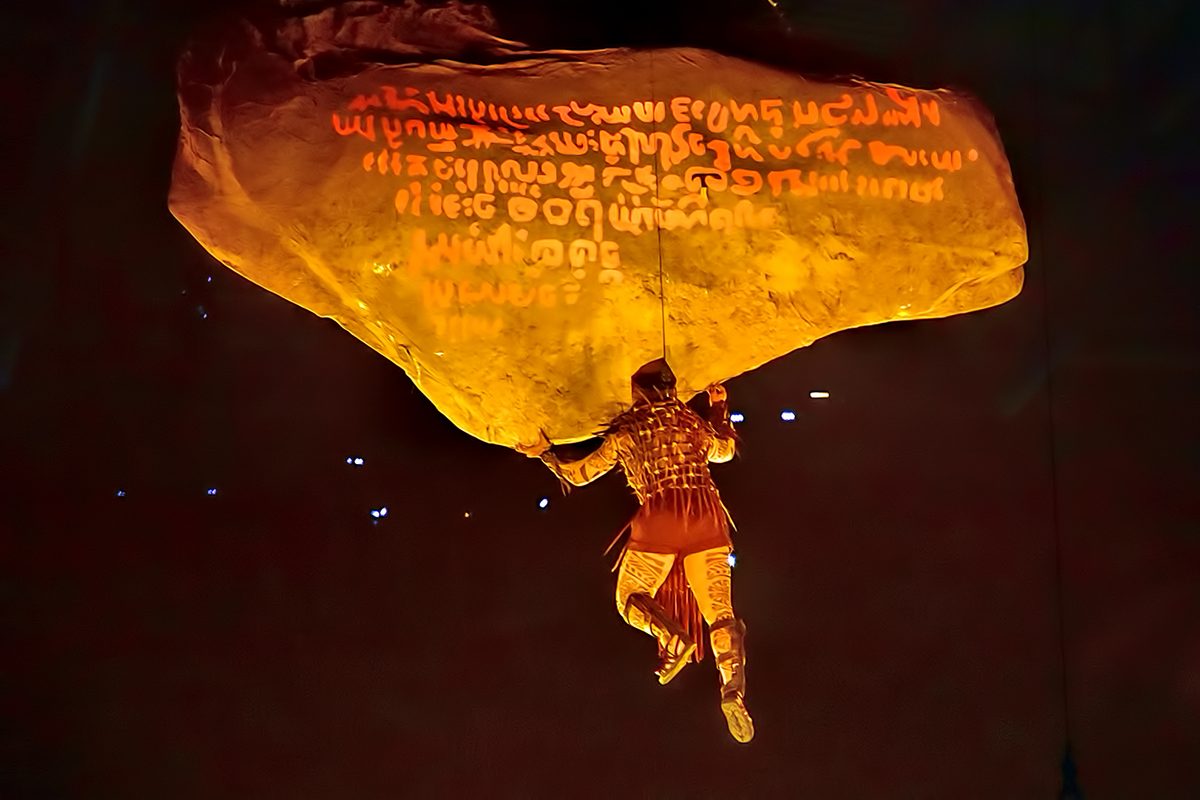
Singapore kept the fragment anyway. It holds pride of place in the National Museum’s Singapore History Gallery, and in 2016 the National Day Parade restaged Badang hurling the boulder in front of the whole country — a nation choosing a vivid legend over an actual blank. The blank is total: the oldest sentence ever carved on the island says something, in some language nobody can name, about an event nobody can place, inside a window of roughly three hundred years. Most of the only copy of it was broken up to pave a road.
Watch the full history
The video covers the discovery, the demolition and the century of competing readings in just under nine minutes.

Related reading
- Is the Cascajal Block Really Writing? Inside a Twenty-Year Argument
- Why Linear A Still Can’t Be Read
- Why Nobody Can Read the Voynich Manuscript
- Inside the Decipherment of the Inca Khipu
Works cited
- Yap, Kelvin Cahya, Tony Wenyao Jiao, and Francesco Perono Cacciafoco. “The Singapore Stone: Documenting the Origins, Destruction, Journey and Legacy of an Undeciphered Stone Monolith.” Histories 3, no. 3 (2023): 271–287.
- Lee, I-Shiang, and Francesco Perono Cacciafoco. “Unravelling the Mystery of the Singapore Stone: A Comparative Analysis with the Calcutta Stone and the Possible Kawi Connection.” Histories 3, no. 3 (2023): 261–270.
- Gibson, William L. “Uncovering the Origins of Badang the Strongman.” BiblioAsia 21, no. 1 (April–June 2025). National Library Board, Singapore. Link.
- National Heritage Board. “Inscribed Sandstone Known as the ‘Singapore Stone.’” Roots.gov.sg collection record.
- National Heritage Board. “Networks Through Time: Singapore Stone.” The Singapore Story Through 60 Objects.
- National Library Board, Singapore. “The Singapore Stone.” Infopedia, 26 January 2005.
- Indian Heritage Centre. From the Coromandel Coast to the Straits: Revisiting Our Tamil Heritage. Exhibition brochure, 2019. Link.
- Perono Cacciafoco, Francesco. “The Singapore Stone’s Carvings Have Been Undeciphered for Centuries — Now We’re Trying to Crack the Puzzle.” The Conversation, 10 June 2024. Link.