
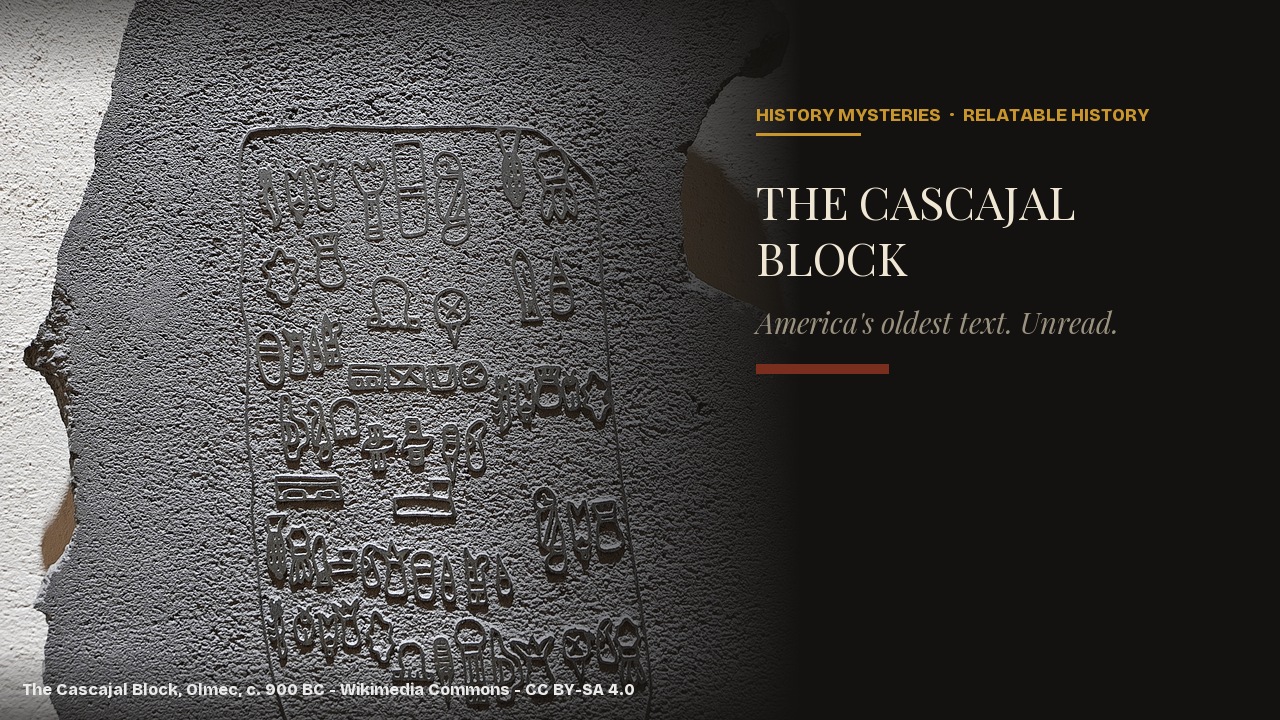
Every serious argument that the Olmec could write comes down to one object, found once, with no twin anywhere. That is the whole case, and it is also the whole problem: a scholar asking whether the Cascajal Block is genuine writing cannot check it against a second example, because as far as anyone has found, there isn’t one.
Since 2006, that single question — is the Cascajal Block writing — has split Mesoamerican archaeology roughly three ways. One camp says yes, a real script centuries older than anything else known in the hemisphere. A second says the carvings are real and ancient but aren’t language at all, just a record of ritual objects. A third says the find is too compromised by how it turned up to settle anything. None of those positions has gone away, and a 2019 laboratory study that settled one part of the fight left the other two wide open.
The Cascajal Block writing question started with a road crew
The block surfaced in 1999, torn out of a mound along with ordinary quarry gravel at Lomas de Tacamichapan, a settlement in the municipality of Jáltipan, Veracruz. Local residents noticed the carved stone in the debris and alerted Mexico’s National Institute of Anthropology and History, which registered the find and gave the site its own name, El Cascajal. Archaeologists María del Carmen Rodríguez Martínez and Ponciano Ortíz Ceballos took charge of it, and for roughly seven years almost nothing about it reached print while the team built its case and lined up collaborators.
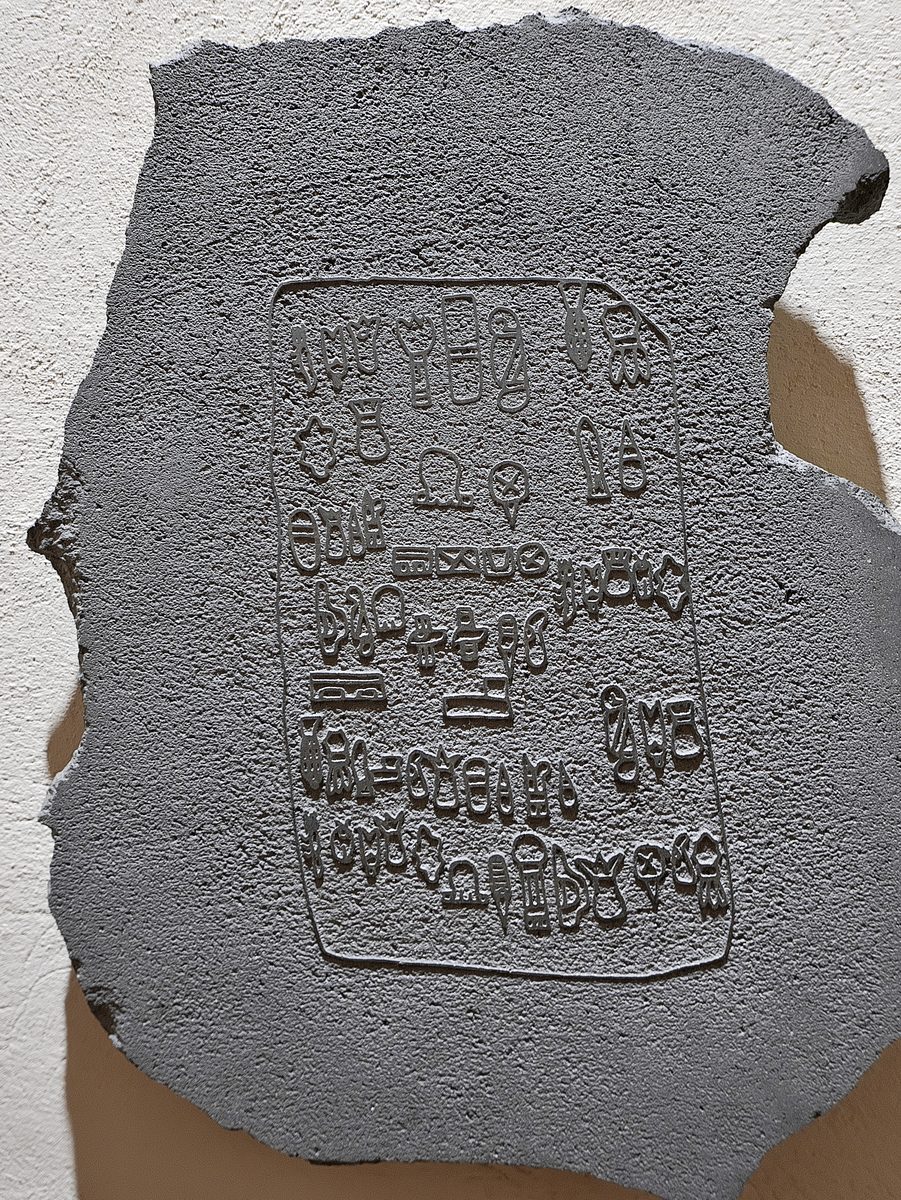
Measurements of the block vary slightly by source — roughly 36 by 21 by 13 centimetres and 11.5 kilograms, or about 26 pounds on a side just under fifteen inches long — but its shape is unusual in a way nobody disputes. Picture a rounded brick: five sides swell outward in a soft convex curve, while the carved face alone curves the other way, worn down into a shallow hollow. The original team read that hollow as the signature of use — a surface carved, scraped clean, and carved again, many times over, rather than inscribed once and set aside.
Because the stone came out of disturbed fill rather than a controlled excavation, the first thing the team had to rule out was an obvious one: that someone had faked it recently and dumped it to be found. Geologists from the Institute examined the carved lines under magnification and reported mineral deposits built up inside the cuts themselves — the kind of weathering that does not accumulate in a channel cut last year. That finding, more than any stylistic argument, is why almost nobody in the field has argued the object itself is a modern fabrication. The argument that followed was never really about whether the stone is old. It was about whether what’s cut into it is language.
Twenty-eight shapes, repeated in patterns nobody can explain yet
The scooped face carries sixty-two individual marks, but many of them are the same shape used more than once: on the original team’s count, three signs appear four times each, six appear three times, twelve appear twice, and seven are used only once, leaving twenty-eight genuinely distinct forms. A later re-examination revised that signary slightly — more on that below — but the basic shape of the pattern, a small alphabet-sized set of signs used over and over in varying combinations, is exactly what you would expect from writing and not from decoration, which tends toward either constant repetition of one motif or one-off uniqueness.
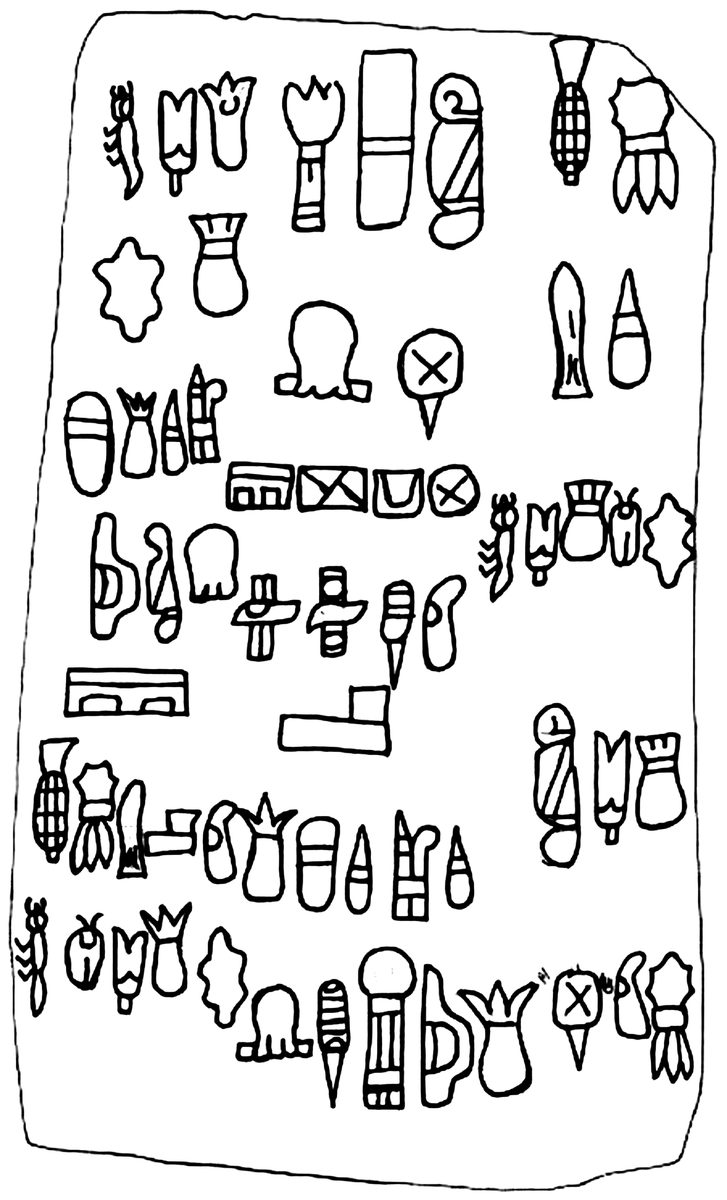
A handful of the signs are recognisable as pictures: a corn kernel, what looks like a biting insect, a fish outline, a strung bead, a sharpened spear-point, a wide staring eye, something that might be a woven seat of rank. Most are abstract — boxes, bands, blobby shapes with no obvious referent. One sign in particular, nicknamed “the cootie” for its bug-like silhouette, became a flashpoint: critics called it too strange to be genuinely ancient, until the original team pointed out that the identical shape, in three dimensions, already existed carved onto San Lorenzo Monument 43, a separately excavated Olmec monument at the same site with no authenticity question hanging over it — a hard coincidence to wave away.
The signs run left to right in horizontal bands rather than the vertical columns every later Mesoamerican script used, which is part of why some specialists doubted it at all. The original authors proposed that certain repeated pairings — an eye sign next to a mat-and-throne sign, for instance — might be paired phrases rather than coincidence, the kind of deliberate word-pairing that shows up constantly in later Mesoamerican poetry and oratory. If that reading holds, the block would carry not just the oldest writing in the hemisphere but its oldest surviving verse.
The date comes from pottery lying nearby, not from the stone
Stone doesn’t carbon-date. What actually anchors the Cascajal Block in time is everything found around it in the same disturbed fill: potsherds and fragments of clay figurines. By the original team’s accounting, roughly three-quarters of that material belongs to the Formative-period occupation of San Lorenzo, mostly its earlier San Lorenzo phase, with the remainder dating to many centuries later. If the block travelled with the earlier material, it falls at around 900 BCE, toward the end of San Lorenzo’s heyday as the leading Olmec centre on the Gulf coast.
That is the thinnest link in the whole argument, because association is not excavation: a sherd beside a stone in a bulldozed pile proves the two were dumped together, not that they started out together. The team’s strongest supporting evidence is comparative rather than direct — similar signs turn up incised on small Olmec-style figurines from Cantón Corralito, in Chiapas, in deposits placed in roughly the same centuries, though accounts differ on exactly how many depending on which radiocarbon calibration is used — a small disagreement that is a fair measure of how little here is actually locked down.
Five scholars said no, in print, and the rebuttal was immediate
The block’s authenticity as writing was challenged formally within months. Archaeologists Karen Bruhns and Nancy Kelker published a letter in Science built on five separate complaints. A find pulled from bulldozed rubble cannot carry a trustworthy date. Nowhere else, on any other piece of Olmec serpentine, has anyone found writing or drawing of this kind. The way the signs sit on the page follows no arrangement documented anywhere else in Mesoamerica. Several of the individual shapes show up on other objects purely as ornament, never as text. And the cootie sign, stacked on top of everything else, struck them as less like an undeciphered word and more like a joke that slipped past peer review.
Other specialists raised narrower doubts: David Grove, at the University of Florida, on the layout alone; Christopher Pool, at the University of Kentucky, on the find being unique — one data point asked to found an entire writing system; archaeometrist Max Schvoerer, on the date resting entirely on indirect ceramic association; Philip Arnold, who called the signs merely “suggestive” pending comparable marks elsewhere; and linguist John Justeson, who allowed they might be close to writing without being “fully formed” writing yet.
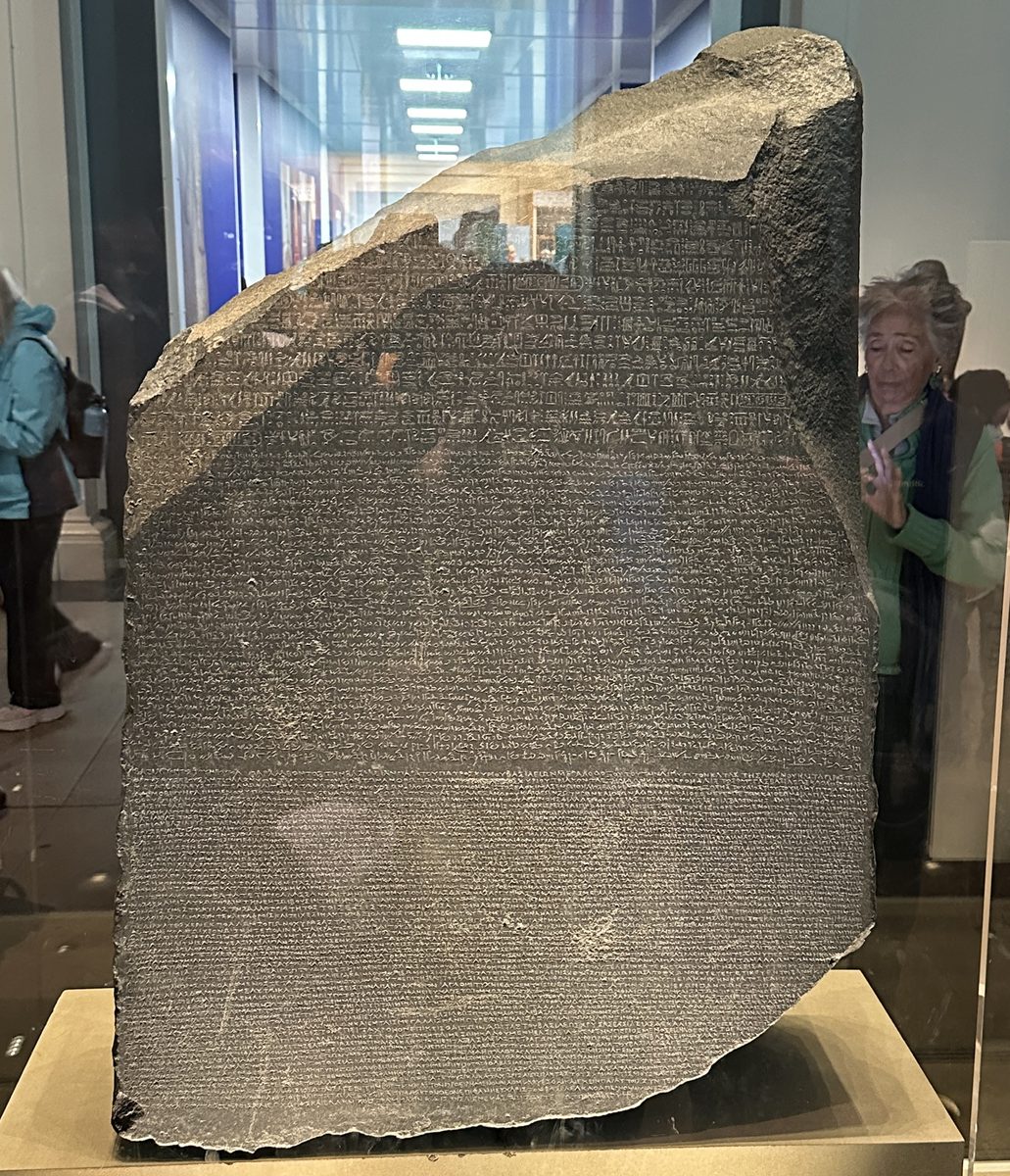
The original research team pushed back in the same pages, answer for answer. To the provenance complaint, their comeback was that the Rosetta Stone has no excavated findspot of its own, and nobody uses that to call it fraudulent. To the cootie complaint, they pointed again to its match on Monument 43. To the layout complaint, they argued that a culture inventing writing for the first time owes nobody an existing convention to follow. None of it changed a single mind on either side, and the dispute simply sat there, unresolved, for more than a decade.
A rival theory: not a text, but an inventory of sacred bundles
In 2010, Mesoamericanists David Freidel and F. Kent Reilly III proposed a third reading that accepted the stone’s age while rejecting that it was writing at all. In many Mesoamerican societies, precious and ritually charged objects — jade celts, feathers, cloth, the bones of ancestors — were wrapped into bundles treated as the physical seats of sacred or political authority, unwrapped only at specific ceremonies. Their proposal was that the block’s sixty-two signs aren’t a sentence at all, but a schematic inventory of exactly this kind of bundle content, arranged in three registers for ritual reference rather than reading.
Their reading came with its own instructions for scanning the lines: not uniformly left to right, but in a serpentine, back-and-forth pattern, each row reversing direction from the one above it — the field-plowing pattern epigraphers call boustrophedon. The appeal of this reading is that it never requires the Olmec to have invented writing at all; the stone can be exactly what it looks like without the hemisphere’s oldest script needing to exist. That is part of why it has stayed in circulation as a live third option rather than being absorbed into either the pro-writing camp or the forgery camp.
A laboratory settled the forgery question, and only that question
The breakthrough that actually moved the debate arrived from materials science rather than epigraphy. In 2019, the archaeologist Joshua Englehardt and six co-authors re-photographed the carved face using a technique called polynomial texture mapping, which combines dozens of raking-light exposures into one image, raising shallow, worn detail that a single photograph or even the naked eye under normal light simply cannot catch. The resulting corrected line drawing reinterpreted two signs as a knuckleduster shape and a torch.

Then they tested the stone itself. A handheld X-ray fluorescence spectrometer matched its chemistry, on traces of chromium, manganese and nickel, to serpentine deposits at Tehuitzingo, in the state of Puebla — a source Olmec stoneworkers are independently known to have used. X-ray diffraction confirmed the match down to a signal at 4.47 kilo-electron-volts, a 1.52-angstrom gap between atomic planes, shared by the block and the quarry samples. Polymer casts of the incised lines then went under a scanning electron microscope, showing incision widths matching obsidian tools and abrasion matching sandstone — a toolkit consistent with securely excavated Formative Olmec stonework, not a modern fake.
None of that tells you what the signs mean. What it tells you is that the object is exactly what it appears to be: a genuine piece of Olmec-period work, carved by someone using Olmec-period tools on stone from an Olmec-period quarry. The forgery hypothesis, never the majority position but never fully closed either, is the one question this analysis actually answers.
What the sign-by-sign count actually supports
Published alongside the lab study, a second 2019 paper by the linguist David Mora-Marín went after the question the chemistry couldn’t touch: whether the pattern of signs behaves like language. Working from the same high-resolution imaging, he produced an independent line drawing, revised the signary — folding two previously separate signs together, splitting another, adding one that earlier drawings had missed — and then ran a distributional analysis: which signs repeat, which cluster next to each other, and which never appear side by side at all.
His case is that two of the recurring signs function as logograms, standing for whole words, while several shorter signs behave like phonetic complements — signs spelling out part of a word’s sound rather than its meaning, flexibly placed before, after, or around the logogram they support. He compared this to a documented pattern in later Maya writing, where the word WAY could be written with optional syllabic signs wa and ya clipped on in varying positions without changing what was being said. Earlier critics had pointed to exactly this kind of positional inconsistency as evidence against the block being real language; Mora-Marín argues that inconsistent placement is what flexible phonetic spelling looks like, not a strike against it.
He frames all of this as a testable hypothesis rather than a decipherment, and notes that several of his own patterns would disappear under other scholars’ alternative ways of formatting the text — including the boustrophedon layout Freidel and Reilly had proposed. Two serious analyses of the same sixty-two marks, published in the same academic year, still don’t agree which direction to read them in.
Why there’s no second block to check any of this against
The nearest confirmed, uncontested Mesoamerican writing belongs to the Zapotec of the Valley of Oaxaca, carved on monuments at San José Mogote roughly four centuries later than the Cascajal Block’s proposed date. Between those two points lies the gap every argument about this stone is really about: if the 900 BCE date and the writing interpretation both hold, something in the Gulf lowlands was recording language for four hundred years before anyone else in the hemisphere that the archaeological record can currently prove. If either one doesn’t hold, the oldest confirmed writing in the Americas stays with the Zapotec, and the Cascajal Block becomes either a very old non-text or a disputed outlier.
What makes the case so hard to close either way is the thing every side of it keeps running into: there is exactly one of these. Scripts that specialists have actually cracked were cracked because there was enough repeated material lying around to find a grammar in — thousands of clay tablets, a bilingual inscription, a long run of related texts spanning generations. Here, whatever the sixty-two carved shapes turn out to be, there is no larger body of writing for them to be a sample of. They may simply be all that survives of whatever this was, start to finish.
So the honest answer is that the people best qualified to judge it have spent two decades producing careful, mutually incompatible answers, and the one thing that would resolve it — a second inscribed object from the same tradition — is exactly what nobody has found. Until someone does, every reading of this stone is a hypothesis resting on a sample size of one.
Watch the full history
The video traces the find, the sixty-two signs and the forgery question in under ten minutes; the argument over what, if anything, they say runs a good deal longer in the academic record below.

Related reading
- Why No One Has Ever Deciphered the Indus Valley Script — far more surviving signs, and still undeciphered
- Why Linear A Still Can’t Be Read — thousands of signs, and still unread
- Why No One Can Read the Phaistos Disc — or Agree That It’s Real — a single object whose authenticity is argued the same way
- The Overlooked Evidence for the Etruscan Language — rebuilt from inscriptions, with no bilingual text
- Why Nobody Can Read the Voynich Manuscript — another one-of-a-kind document argued over the same way
Works cited
- Rodríguez Martínez, María del Carmen, Ponciano Ortíz Ceballos, Michael D. Coe, Richard A. Diehl, Stephen D. Houston, Karl A. Taube, and Alfredo Delgado Calderón. “Oldest Writing in the New World.” Science 313, no. 5793 (2006): 1610–1614.
- Bruhns, Karen O., and Nancy L. Kelker. “Did the Olmec Know How to Write?” Science 315, no. 5817 (2007): 1365.
- Englehardt, Joshua D., Mirta A. Insaurralde Caballero, Emiliano R. Melgar Tísoc, Luis R. Velázquez Maldonado, Viridiana Guzmán Torres, Henri Noel Bernard, and Michael D. Carrasco. “Digital Imaging and Archaeometric Analysis of the Cascajal Block: Establishing Context and Authenticity for the Earliest Known Olmec Text.” Ancient Mesoamerica 31, no. 2 (2020): 189–209. Link.
- Mora-Marín, David F. “The Cascajal Block: New Line Drawing, Distributional Analysis, and Orthographic Patterns.” Ancient Mesoamerica 31, no. 2 (2020): 210–229. Link.
- Freidel, David, and F. Kent Reilly III. “The Flesh of God: Cosmology, Food, and the Origins of Political Power in Ancient Southeastern Mesoamerica.” In Pre-Columbian Foodways: Interdisciplinary Approaches to Food, Culture, and Markets in Ancient Mesoamerica, edited by John E. Staller and Michael Carrasco, 635–680. New York: Springer, 2010.
- Skidmore, Joel. “The Cascajal Block: The Earliest Precolumbian Writing.” Mesoweb Reports. Precolumbia Mesoweb Press, 2006. Link.
- Bower, Bruce. “Scripted Stone: Ancient Block May Bear Americas’ Oldest Writing.” Science News, September 16, 2006. Link.
- “Items from the Cascajal Block.” Foundation for the Advancement of Mesoamerican Studies (FAMSI). Link.
- “Script on Stone Could Push Back Date of New World’s Oldest Writing System.” Brown University News, September 15, 2006.