
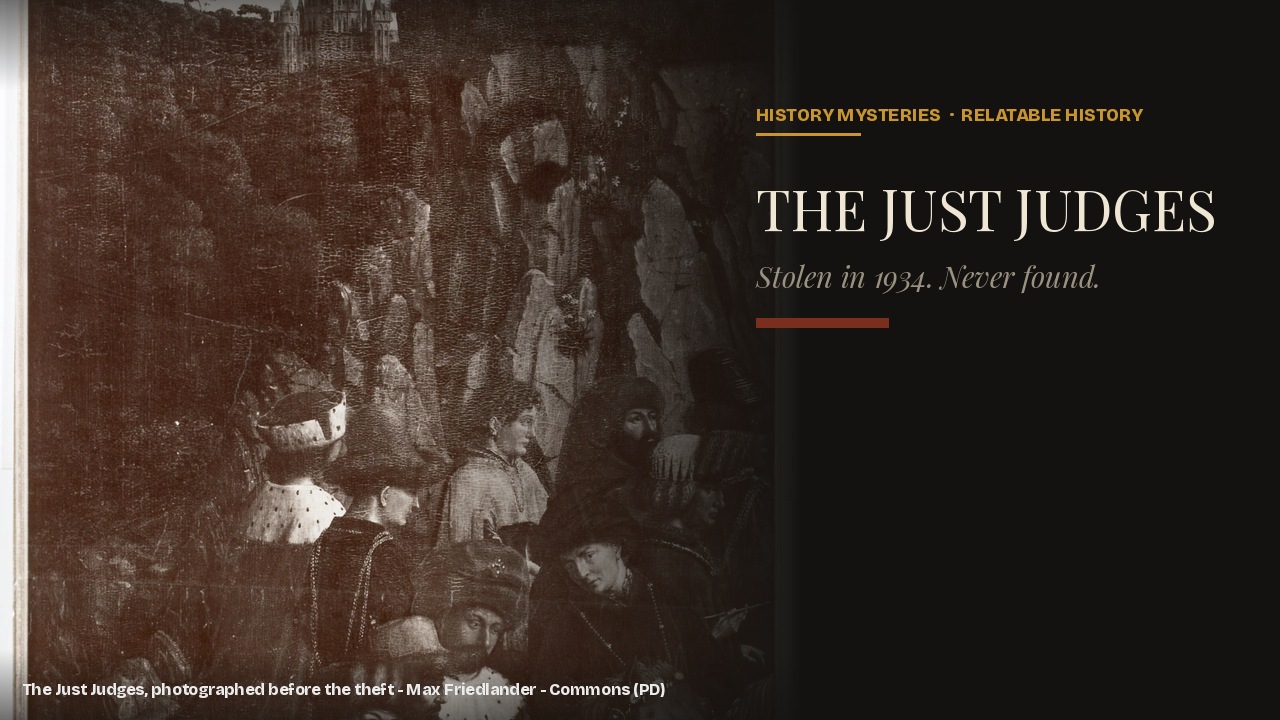
Ghent’s public prosecutor’s office has kept the Just Judges panel investigation open for roughly ninety years, and for the last twenty of them one specific prosecutor, Caroline Dewitte, has carried the file personally. In January 2025, acting on a tip a federal police unit had spent months assessing for credibility, an investigating judge ordered searches of a villa in East Flanders. Officers found nothing. Dewitte told reporters afterward that she still saw a “glimmer of hope” because outright destruction of the panel seemed unlikely to her, but that any real breakthrough would need more than the physical evidence collected ninety years earlier.
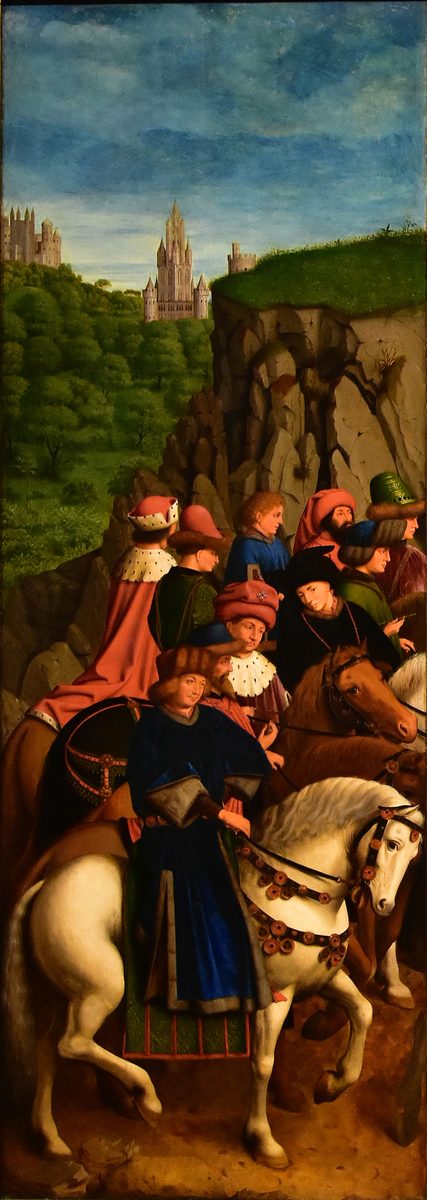
The object at the center of that file is a single oak panel, roughly a metre and a half tall, showing five mounted judges riding toward the Adoration of the Lamb in Jan and Hubert van Eyck’s altarpiece at Saint Bavo’s Cathedral. It was cut from its frame on the night of 10 April 1934 and has not surfaced since. The theft itself, and the ransom letters that followed it that spring, are a familiar enough story. Less familiar is what Belgian investigators, Nazi art hunters, and a wartime restorer-forger each did with the case over the following ninety years — and why the file, officially, has never closed.
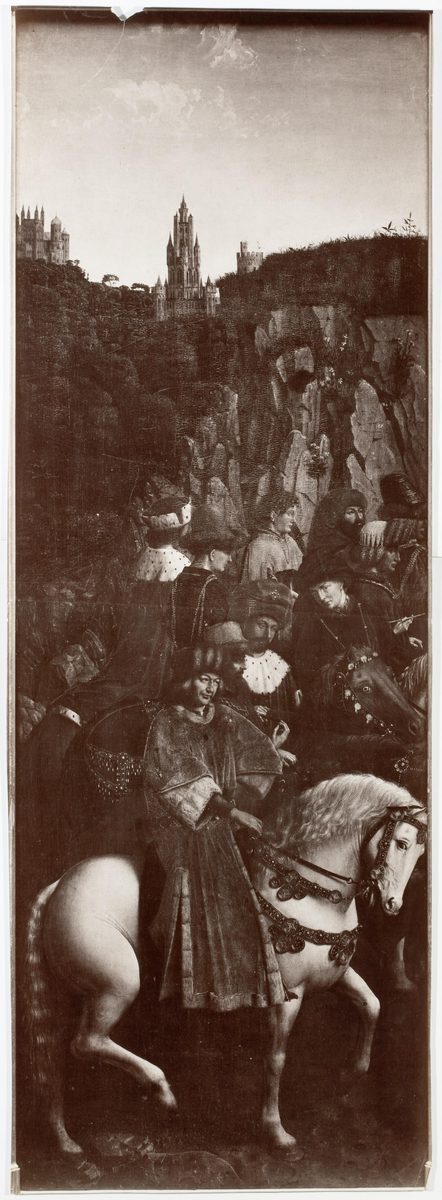
The Just Judges panel investigation has outlived everyone who was there in 1934
Dewitte is not the first prosecutor assigned to the case and will almost certainly not be the last. A dedicated Ghent police officer has carried an investigative role continuously since the theft, and the bishopric of Ghent — which still owns the altarpiece — receives unsolicited tips most years, some of which get passed on to police. What makes the January 2025 search notable is not that it happened, but that it followed the same procedure any live case follows: a tip assessed by a specialist unit, a formal request to an investigating judge, and a search warrant executed on a private home, ninety years after the alleged crime.
That procedural normality is itself the story. Most art thefts this old are treated as closed, folklore, or both. The Just Judges case is still logged, staffed, and funded as an open file, which is part of why new tips keep arriving: people who think they know something still have somewhere official to take it. A retired Ghent police officer, Karel Mortier, is credited by investigative journalist Noah Charney with having run down more of those leads personally than anyone else outside the force itself.
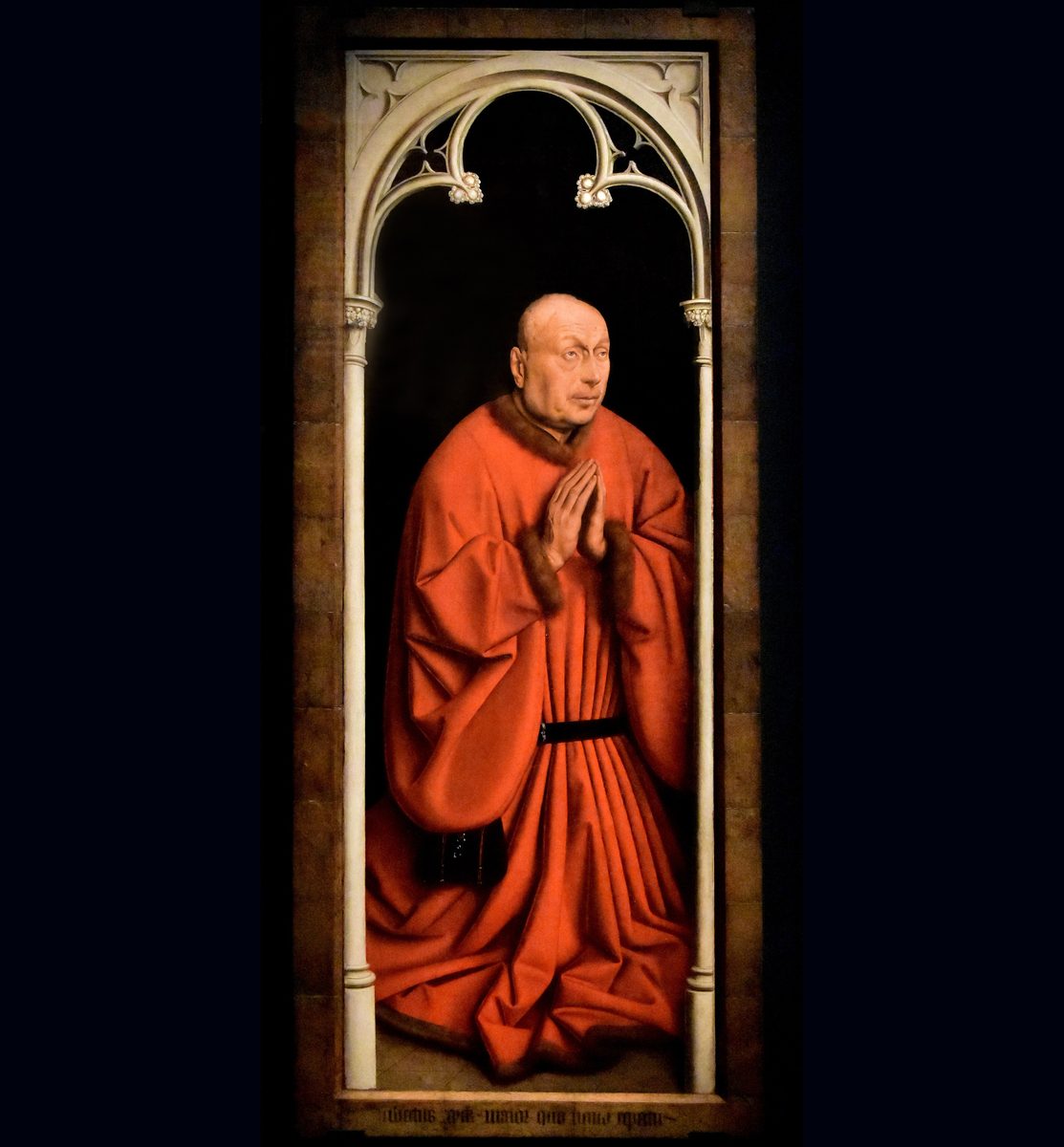
A nineteenth-century repair is what made the theft possible
The altarpiece’s outer wings were painted on both faces so that one scene showed when the altarpiece stood closed and another when it opened. That meant each wing panel began as a single thick board. In 1894, while the panels were on loan to the Kaiser Friedrich Museum in Berlin, conservators sawed each wing through its own thickness, splitting one board into two thin panels so both painted faces could be framed and displayed side by side rather than hinged together.
The conservation logic was sound: visitors could now see both images at once instead of only the one facing out. But it also turned a single immovable board into two panels light enough for a person to carry under one arm. Thirty years later, that is exactly what happened. Whoever forced the lock on the Vijd chapel in April 1934 only had to lift off the panels’ hinges and walk out with two thin boards, not saw through a thick one in the dark. The 1894 repair is not mentioned in most short accounts of the theft, but without it the crime is close to impossible.
Thirteen letters and a confession that explained nothing
Over the following months, Bishop Honoré Coppieters received thirteen letters signed with the initials “D.U.A.,” demanding one million Belgian francs and, in one, returning half of what had been stolen as proof of good faith. The negotiation broke down in the autumn, and on 25 November 1934 a Wetteren money-changer named Arsène Goedertier collapsed after a political speech in Dendermonde. Dying at his brother-in-law’s house, he told his lawyer, George de Vos, that he alone knew where the panel was, and gave him four words to find a folder: desk, key, cupboard, health-service.
The folder held carbon copies of all thirteen letters and a fourteenth that had never been sent, saying the panel was somewhere that could not be retrieved without attracting public attention. It named no location. The case against Goedertier as sole author of the letters is considered strong; the case against him as the physical thief is not. He was in his late fifties, by most accounts unathletic, and is described in several retellings as having had weak eyesight — not an obvious profile for someone who scaled a cathedral wall or forced a chapel door undetected. Whether he had an accomplice, and whether that person is the reason the panel is still missing, is exactly what ninety years of investigation has failed to settle.
The altarpiece survived Hitler’s looting network; the missing panel did not get the chance
Six years after the theft, as Germany invaded Belgium, the surviving eleven panels were sent to the Vatican for safekeeping, then on toward Italy. When Italy entered the war on Germany’s side the convoy was diverted, and the panels sat out most of the war hidden in a museum in Pau, in unoccupied France. That hiding place held until July 1942, when Hitler personally ordered the altarpiece moved to the Einsatzstab Reichsleiter Rosenberg’s depot at Neuschwanstein Castle, with the cooperation of the Vichy government. As Allied bombing intensified, the panels were moved again, this time to the salt mine at Altaussee in Austria, where Allied Monuments, Fine Arts and Archives officers found them in 1945 along with thousands of other looted works.
The missing panel had no part in any of that, because it was never recovered in the first place. But it was not forgotten. According to the Monuments Men and Women Foundation, Joseph Goebbels dispatched a Nazi art investigator, Heinrich Köhn, specifically to track down the Just Judges as a gift for Hitler. Köhn failed — he was hunting the same kind of trophy German looting agencies pursued across occupied Europe, including the Amber Room panels taken from outside Leningrad a few years later, which also never resurfaced. The eleven recovered panels were flown to Brussels on 21 August 1945, and on 3 September the United States ambassador formally returned the altarpiece to Belgium’s Prince Regent in a ceremony where Dwight Eisenhower and General Walter Bedell Smith were decorated in front of the painting. A Te Deum service marked its return to Ghent on 30 October 1945. The twelfth panel was not part of any of it.
The altarpiece was restored twice more in the following decades, and each time the attention fell entirely on the eleven panels that had come back. The first full postwar treatment, agreed in 1950 after conservator Paul Coremans found lifting paint and dulled varnish during an inspection two years earlier, brought together an international committee that included the Fogg Museum’s George Stout, Philip Hendy of London’s National Gallery, the Louvre’s René Huyghe and the Italian conservation theorist Cesare Brandi; Hendy was replaced partway through by Harold Plenderleith. Coremans’ laboratory eventually took more than 230 paint cross-sections and found, among other things, a dove of the Holy Spirit hidden under old overpaint in the central panel. A second, far larger restoration ran from 2012 to 2020 under Belgium’s Royal Institute for Cultural Heritage, funded in part by the Getty Foundation, and used dendrochronology and infrared imaging to show that two of the surviving panels were cut from the same tree and to uncover an unexplained face hidden in the sky of one interior scene. Both projects advanced what is known about van Eyck’s workshop in detail the 1930s investigators could not have imagined. Neither touched the one panel that was not there to examine.
The man who painted the replacement had already been caught reworking a van Eyck
The panel visitors see in Ghent today is a copy, begun by the restorer Jef Van der Veken sometime around 1939 and finished in 1945. He worked from Michiel Coxcie’s authorized sixteenth-century copy of the whole altarpiece, made for Philip II of Spain and still intact, rather than from any trace of the lost original. Van der Veken was not a neutral choice of restorer. He had already drawn scholarly criticism for his earlier cleaning of van Eyck’s Portrait of Canon van der Paele in the 1930s, work later judged to have gone well past conservation into invention. He nonetheless examined the altarpiece in 1945 and sat on the first international expert committee convened for its major 1950-51 restoration — before being removed from that project shortly after its first meeting, once the full extent of his earlier interventions on other Flemish masters became clear to the committee.
Whatever his record, Van der Veken made sure his 1945 panel could never pass as the original: he gave one of the five mounted judges the face of King Leopold III, who had not been born when van Eyck painted the altarpiece and who reigned while the copy was made. It is a deliberate, documented tell, sitting in plain sight in a six-hundred-year-old procession.

Three theories, a street excavation, and a twenty-million-franc rumor
Investigators and journalists have circled three mutually exclusive explanations for ninety years. One holds that the panel was destroyed; Belgian journalist Rudy Pieters dated this to 1971 in a book on the case, though by his own account he is not fully convinced of his own theory. A second holds that a wealthy Ghent family has held it privately since 1934, a claim historian Paul De Ridder has pressed since at least 2014, sourced to the late constitutional scholar Robert Senelle, who reportedly tried and failed to broker its return. In 2015, Ghent prosecutors searched the home of relatives of law professor and politician Matthias Storme on this theory; Storme called the idea “insane.” A former bank director, Jan Bosselaers, has separately said that in the 1980s a lawyer approached Kredietbank offering to sell the panel for twenty million Belgian francs, roughly half a million euros at the exchange rates of the time — an offer the bank did not pursue.
A third theory places the panel in the royal crypt at Laeken, unprovable because the palace has never permitted a search there. In May 2019, city workers acted on a more concrete lead and dug up a section of Kalandeberg square near the cathedral, following a theory two novelists had just published in a young-adult book. They found an old iron ladder and nothing else, and filled the hole back in. None of the three theories has produced the panel, and none has been ruled out — a standoff that has an echo in the case of the Honjo Masamune, a legendary Japanese sword that vanished from Allied custody after the Second World War for reasons that are just as disputed. Amateur historian and television producer Jelle De Beule, who has studied the case and backs the Ghent-family theory, put the plainest version of the appeal on record in 2024: “Give it back, it is world heritage and it belongs to all of us.”
Watch the full history
The video version walks through the night of the theft itself, the ransom negotiation, and Goedertier’s deathbed confession in just over ten minutes.

Related reading
- What Actually Happened to the Amber Room
- The Honjo Masamune Disappearance: What Happened to Japan’s Lost Sword
- The Copper Scroll Treasure Map: What Sixty-Four Lost Hoards Say
- The Mystery of the Beale Ciphers, Explained
Works cited
- Charney, Noah. Stealing the Mystic Lamb: The True Story of the World’s Most Coveted Masterpiece. PublicAffairs, 2010.
- Charney, Noah. “Lost Art: Chasing the Elusive Ghent Altarpiece Panel.” The Art Newspaper, 22 August 2018. Link.
- Graham, Jenny. “The Ghent Altarpiece after World War II: Restitution, Restoration, and Redemption.” International Journal of Cultural Property 28, no. 3 (2021): 343–367. Link.
- Clapson, Colin. “The Mystery of the Disappearance of the Just Judges, 90 Years On.” VRT NWS, 13 April 2024. Link.
- “Excavation Work to Find the Just Judges Draws a Blank.” VRT NWS, 7 May 2019. Link.
- “Nieuwe huiszoekingen in Oost-Vlaamse villa na tip over gestolen paneel Lam Gods.” VRT NWS, 7 January 2025. Link.
- “Villa bij Gent doorzocht na tip over in 1934 gestolen paneel van het Lam Gods.” NOS, 7 January 2025. Link.
- “The Righteous Judges.” WWII Most Wanted. Monuments Men and Women Foundation. Link.
- “The Disappearance of the Just Judges Panel.” City of Ghent (Visit Gent). Link.
- Royal Institute for Cultural Heritage (KIK-IRPA). Press conference: results of nine months of conservation, restoration and study of the Ghent Altarpiece. 27 June 2013. Link.
Shop
Noah Charney’s book-length account of this theft and its aftermath: Stealing the Mystic Lamb: The True Story of the World’s Most Coveted Masterpiece.