
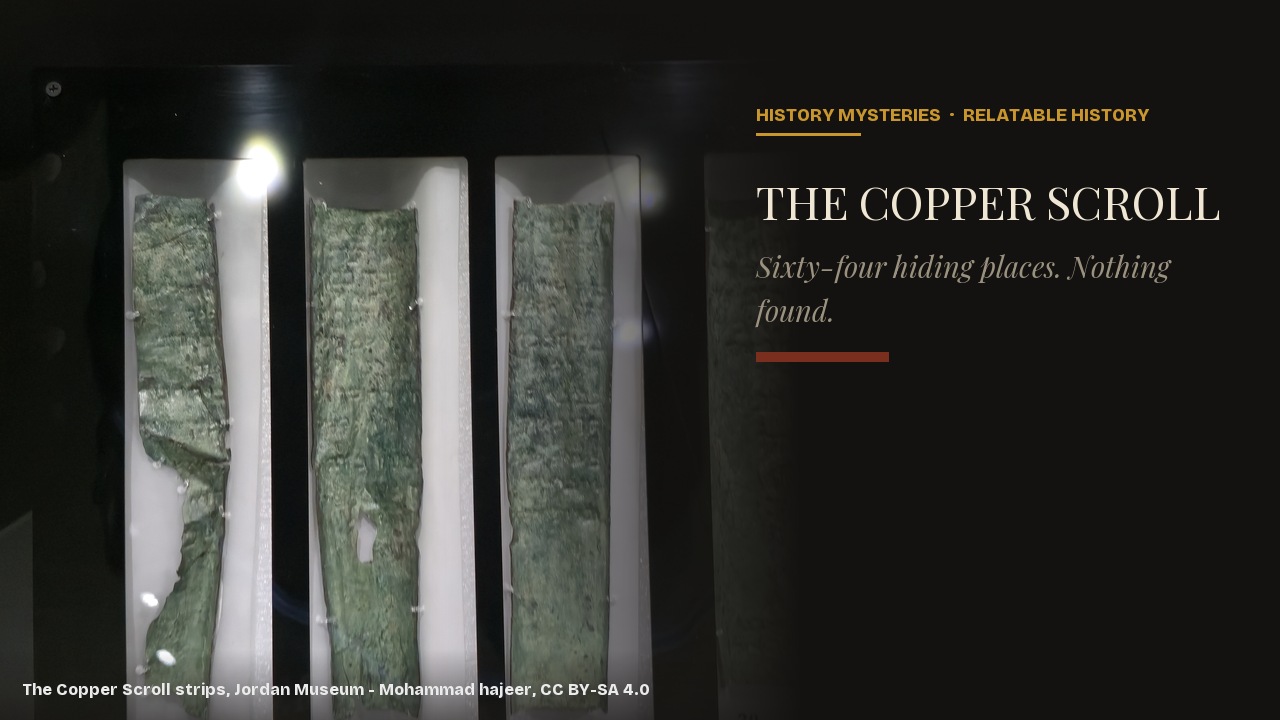
Of everything pulled out of the caves above the Dead Sea, exactly one object is made of metal rather than skin or reed paper, and it is the one that lists where the money is buried. Converted from the ancient weights it records, the sixty-four entries on the copper scroll treasure map add up to an estimated twenty-six tons of gold and sixty-five tons of silver. Not one ounce of it has ever turned up.
That alone would make it an oddity. What makes it something stranger is how little agreement there is about what it actually is. One serious scholarly camp reads it as the real, hidden wealth of the Second Temple. Another ties it to the community that produced the rest of the Qumran scrolls. A third dates it to a later Jewish revolt against Rome. And the very first scholar to study it thought the whole thing was folklore — a legend about treasure, set down in the form of a ledger because that was the most convincing way to write one.
Getting to that argument at all took three years and an engineering workshop in the north of England, because the object was unreadable before anyone could even start disagreeing about it.
The fifteenth manuscript was not like the other fourteen
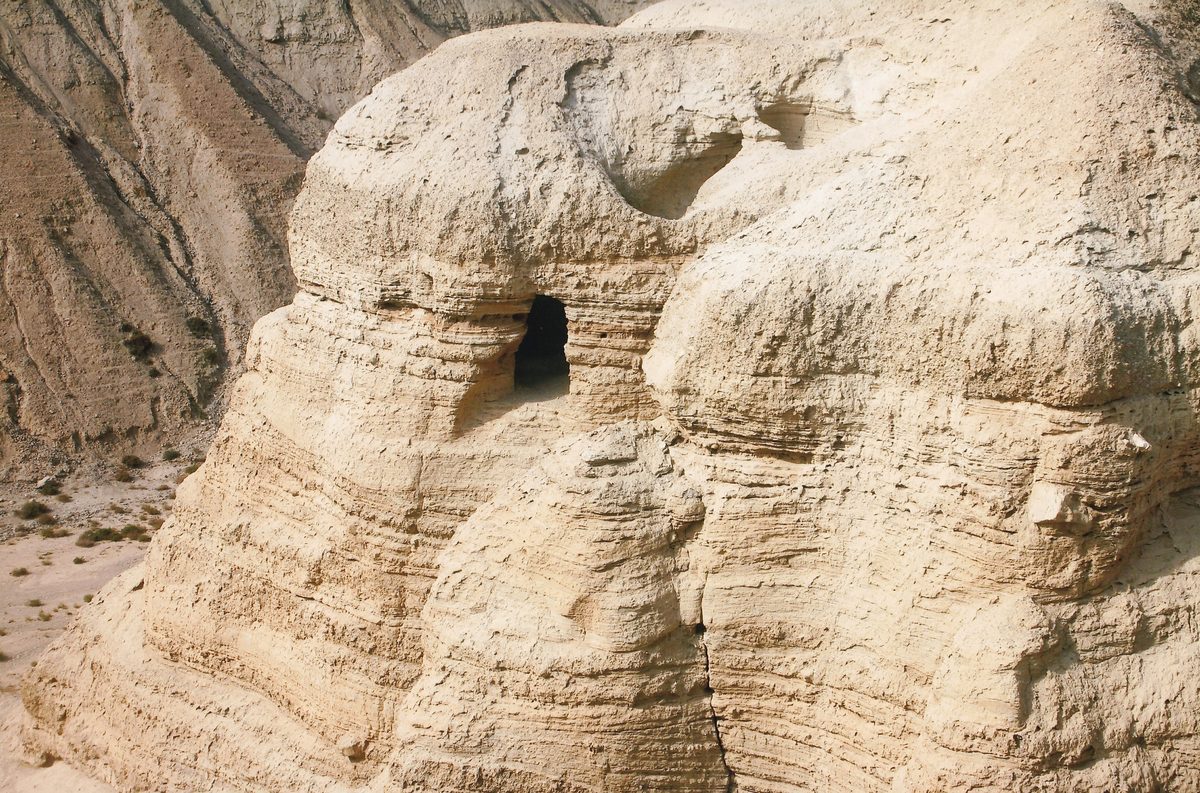
Its discovery broke the usual pattern for these finds. Most of the Dead Sea Scrolls reached scholars secondhand, dug up by local Bedouin and sold piece by piece to antiquities dealers. The Copper Scroll went straight from the ground to the record books: professional excavators turned it up on 14 March 1952, resting on a ledge toward the rear of Cave Three near the ruined settlement of Khirbet Qumran, and it entered the scholarly catalogue the same way every other find from that cave did, as the fifteenth document recovered there — given the shorthand 3Q15.
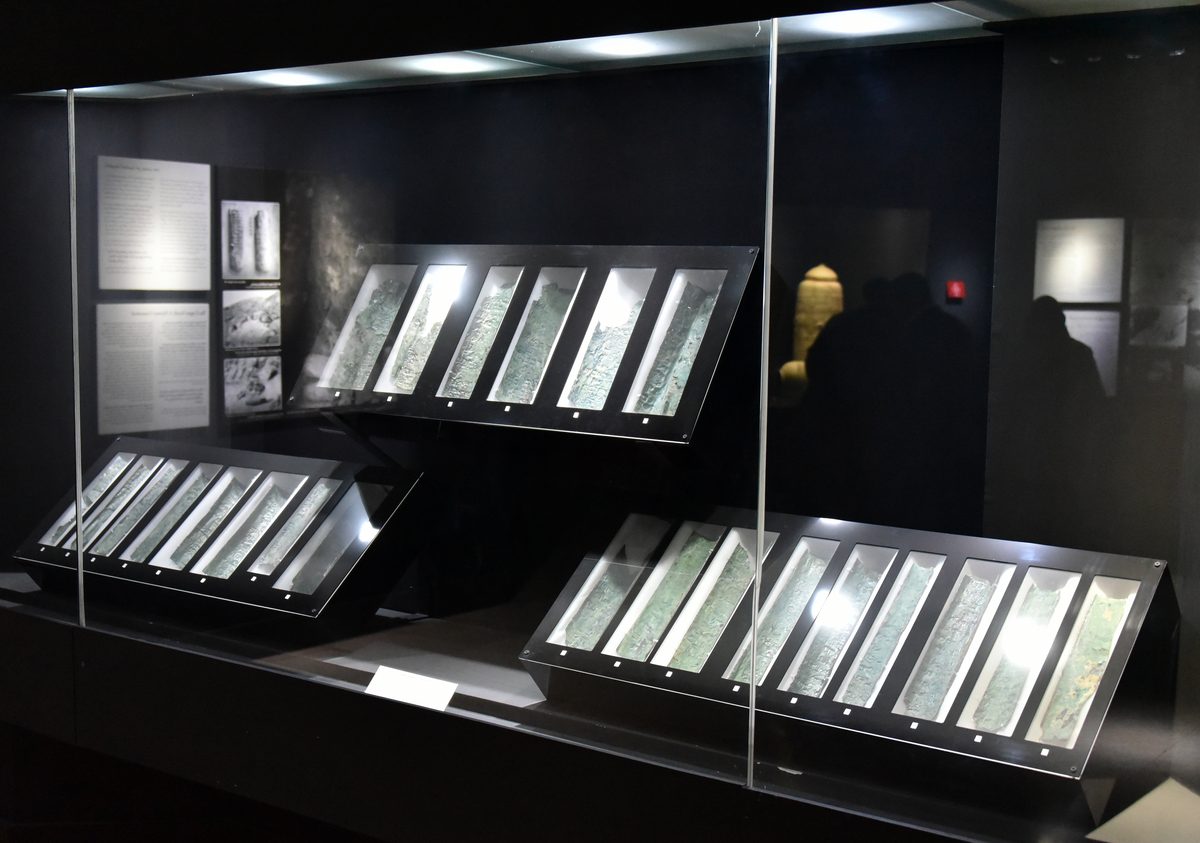
Laid flat, the two pieces join into a single strip of sheet metal: around eight feet end to end, less than a foot wide, the alloy ninety-nine parts copper to one part tin, built up out of three separate sheets fastened together with rivets rather than cast or rolled as one piece. There is no ink or pen stroke anywhere on it. Every one of its roughly three thousand characters was driven into the surface with a hammer and a narrow punch, a method that leaves letterforms blocky and inconsistent in a way a trained scribe’s pen work never is — this was someone working metal, not writing. The split into two rolls has an unglamorous explanation: one seam of rivets failed under the strain of being coiled for storage, parting the sheet roughly down the middle.
Corroded solid, and sawed open in Manchester
For three years after it was catalogued, the scroll was a known object that nobody could actually consult. Two millennia underground had converted the copper, end to end, into a crumbling green compound with none of the original metal’s strength left in it. Prying the rolls open by hand was out of the question; the inscribed surface would have crazed and come away in flakes before a single full line could be exposed.
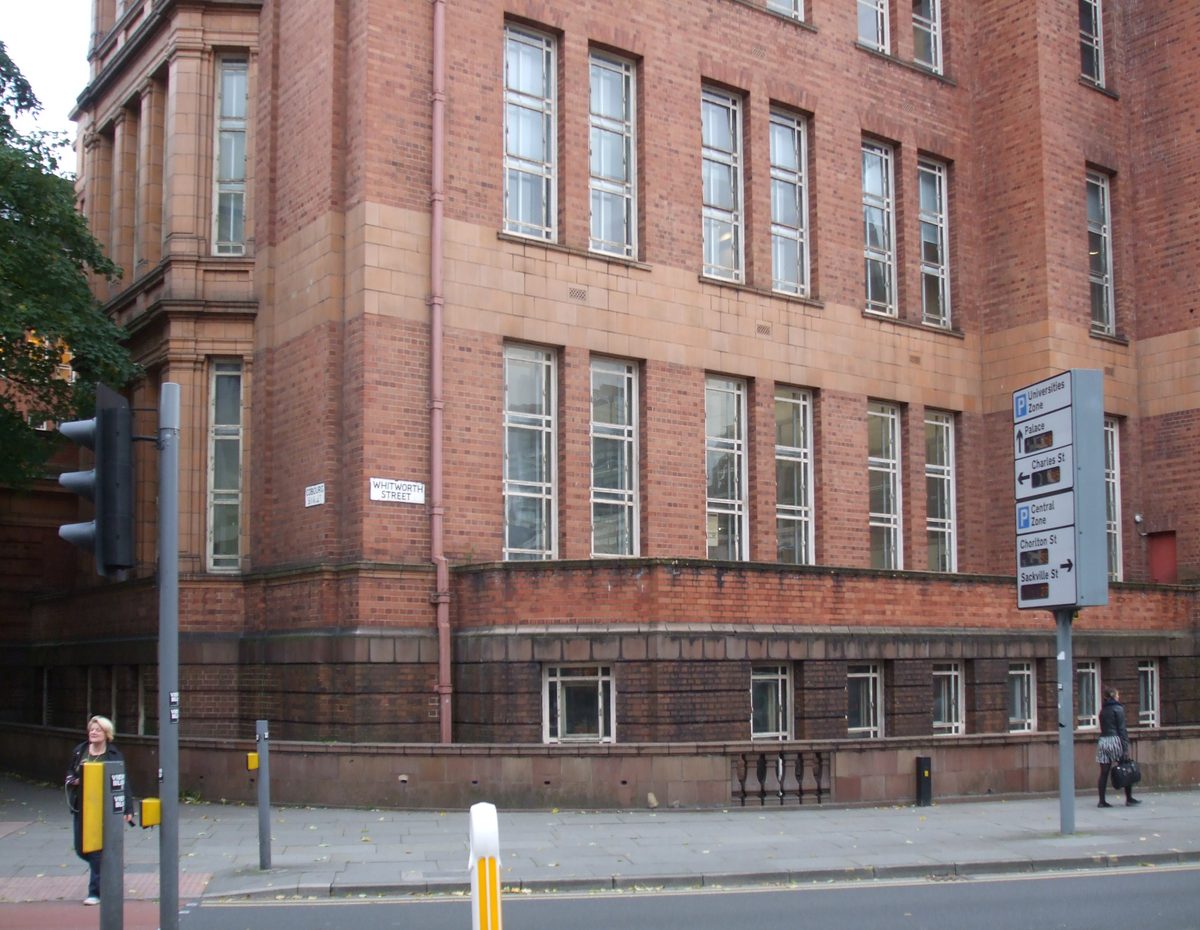
The eventual solution did not come from a papyrologist. Jordan’s government, acting on a suggestion from John Marco Allegro, sent the two rolls to the College of Technology on Sackville Street in Manchester and handed the problem to H. Wright Baker, a lecturer in mechanical engineering with no background in ancient texts at all. Over 1955 and 1956 Baker treated it as a materials problem: he stiffened each roll with a bonding agent, fixed it to a rotating frame, and worked a fine-toothed rotary blade along its length, peeling the brittle metal into twenty-three separate curved panels rather than trying to unroll it. The cutting could never be reversed — there would be no putting the scroll back together as a single sheet — but for the first time since 1952, the writing on it could simply be read off the panels in order.
What the Copper Scroll treasure map actually says
What came off that saw was not theology. It is a list, arranged in twelve columns, of locations paired with instructions and quantities, repeated sixty-four times over. Entry number one puts a chest holding seventeen talents of silver beneath an eastern staircase, in a ruined building in the Valley of Achor — and every entry after it follows the same three-part shape: where, how deep or in which direction, and how much. The locations fan out from the hills around Jericho across the wider Judaean countryside.
A talent is a weight, not a coin, and these entries are not shy about quantity — one location alone is credited with nine hundred talents of silver, on the order of thirty tons. In 1993 the biblical scholar Manfred Lehmann converted the full list and put the total at twenty-six tons of gold and sixty-five tons of silver; other conversions push the figure higher still. Sixty-three of the sixty-four entries list gold or silver. A handful list something else — vessels set aside for tithes, three scrolls, and in one case what appears to be a set of priestly garments.
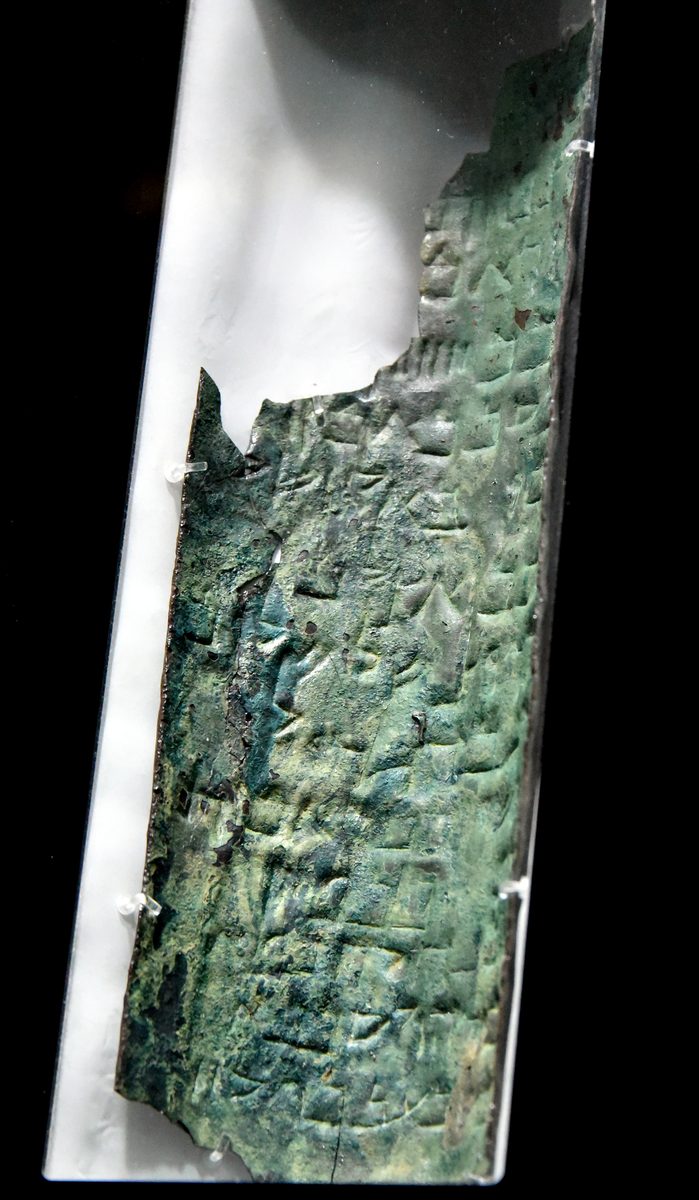
Linguistically, the scroll is an outlier among the Qumran manuscripts rather than a typical member of the set. Its phrasing leans toward the later, practical Hebrew of rabbinic law rather than the more formal literary Hebrew the other scrolls use, and its sentence structure has drawn comparisons to Greek temple inventories — the inscribed accounting lists ancient sanctuaries kept of their own stored property. Short appendages of Greek letters crop up after a cluster of early entries and then vanish for the rest of the document; depending on who you ask, they were numbering a now-lost cross-reference, marking initials, or serving some other filing purpose nobody has reconstructed — a small, contained puzzle in the same family as scripts that still resist full translation despite having plenty of surviving text to work from.
Two rival editions, and a dig that came up empty
Publishing the text took far longer than cutting it open had. Allegro, who had championed the Manchester approach and watched Baker carry it out, rushed his own translation into print in 1960 and revised it four years later. Jozef Milik, the scholar formally responsible for the scroll within the official Qumran publication project, did not produce his edition until 1962, hampered by transcriptions and photographs that were barely legible. The two men disagreed fundamentally about what they had: Milik’s early verdict was that the whole thing was invented, a folk tale about Temple wealth dressed up as an inventory, while Allegro was confident enough in its reality to mount his own excavation in 1962, targeting sites he thought he had matched to entries in the text.
His team came away empty-handed, and so has everyone since — making this one of a small club of documented treasure claims that have outlasted every search mounted for them. Part of the difficulty is structural: the entries were written for a reader who could already recognise a given ruin, cistern, or flight of steps on sight, in the way one neighbour might give directions to another rather than to a stranger. A number of the technical terms for these landmarks show up nowhere else in surviving ancient writing, leaving scholars uncertain of even the basic vocabulary for a handful of entries. Two thousand years of changed landscape have done the rest of the damage.
Four explanations, and the oldest one may be the best
Nobody can date the scroll directly; the letter forms are all there is to go on, and the specialists who have tried disagree by decades. Frank Moore Cross placed it at 25 to 75 CE, William Albright argued for 70 to 135 CE, and Milik himself eventually settled near 100 CE. Every one of those ranges touches the year 70, when Roman forces under Titus destroyed the Second Temple in Jerusalem, which is what makes the Temple-treasury reading the default assumption: the tithe vessels and the priestly garments on the list line up with a working sanctuary’s own property in a way almost nothing else would.
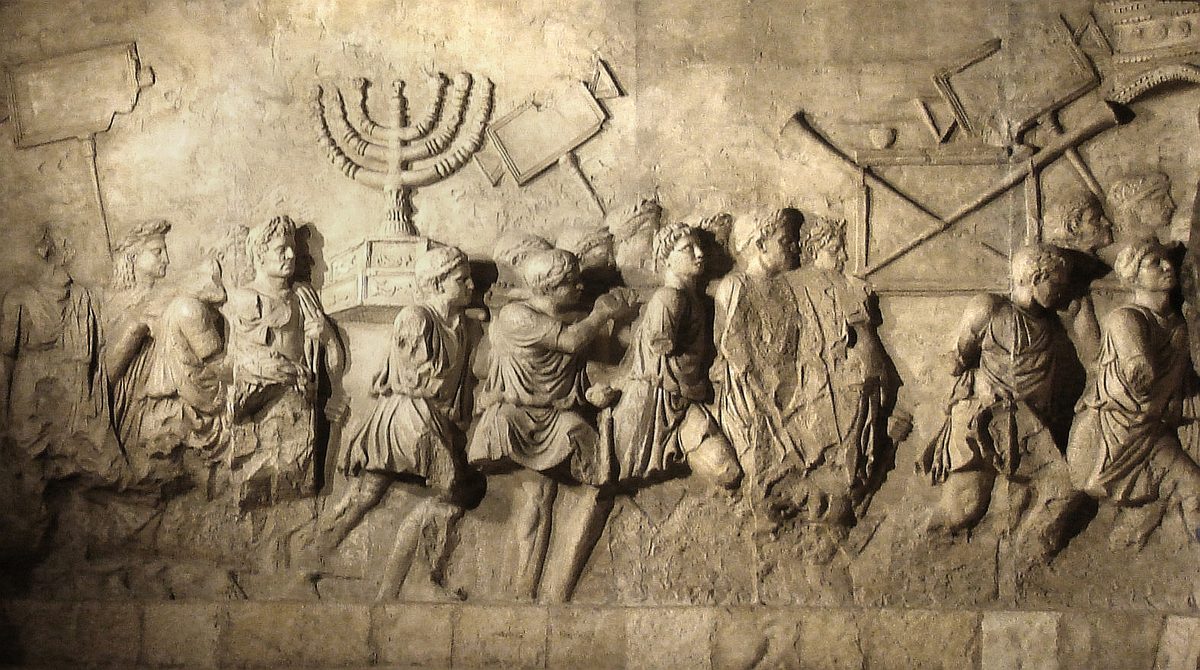
But the ancient witness who was actually there complicates that story rather than confirming it. Josephus, describing the fall of Jerusalem in The Jewish War, writes that the Temple’s treasury chambers — stuffed with money and valuables that wealthy families had deposited there for safekeeping — burned with the building. Separately, in his account of the triumph celebrated in Rome, he describes the Temple’s own golden table and its great lampstand being carried through the streets as spoils, which is the scene still visible on the Arch of Titus today. On Josephus’s own account, the Temple’s valuables either burned in place or were paraded in public. Neither fate leaves much room for a clerk to quietly bury tons of it in the Judaean hills beforehand, unnoticed and unrecorded by anyone else.
A second reading keeps the wealth close to where it was found and argues it was the Qumran community’s own. The case runs into simple arithmetic: the group most scholars connect to the site is usually pictured as living communally and simply, and a few dozen tons of precious metal sits awkwardly against that picture. Émile Puech, who supports a version of this theory, resolves the tension by treating the wealth as untouchable — set aside for a restored, purified Temple that the community expected but never lived to see.
A third option pushes the date forward past the Temple’s destruction entirely, to the Bar Kokhba revolt of 132–135 CE, on the logic that an uprising that struck its own coins would also need somewhere discreet to store them. The later end of the palaeographic estimates allows for this, though it sits awkwardly with a scroll found in a cave that, on the standard chronology, had already been empty for decades by the time of that revolt.
The fourth theory is the one Milik held before anyone had so much as picked up a shovel: the whole thing is invention. Writing in 2009, the archaeologist Robert Cargill pushed this further than Milik ever had, making the case that the scroll has no business sitting in the same category as the rest of the Qumran corpus at all — its metal support, its legal-register Hebrew, its probable date, and its list-like form each point away from the biblical and sectarian manuscripts it is normally filed alongside. It is worth taking that argument seriously precisely because it is the least dramatic one on offer. Legends about buried Temple gold were nothing unusual in ancient Jewish writing; turning one into three thousand hammered letters on an un-rottable sheet of metal was. Somebody paid that price for this specific story. That tells you something was taken very seriously, whatever the treasure itself turns out to have been — in the same way that a wartime disappearance with real documentation behind it can still end up permanently unresolved.
A second restoration, decades later
The Manchester cut saved the text but did not stop the metal’s decay; a 1977 conservation study found the strips still deteriorating under their 1950s backing. In the mid-1990s, Jordan’s Department of Antiquities sent the segments to a materials laboratory run by the French utility Electricité de France, outside Paris, for a proper conservation pass: condition assessment, X-rays, cleaning, and a full set of silicone moulds taken directly off each strip. The French team’s casts and photographs became the basis for a new scholarly edition by Émile Puech, published in 2006, nearly half a century after Milik’s.
A commercial facsimile followed in 2014, built from those same moulds by reconstructing the strips’ hidden rear faces and hand-finishing an aged copper replica — a reminder that the scroll has now generated almost as much specialised metalwork in its conservation as it describes in its text. The strips themselves stayed in Jordan throughout, and have been on public display at the Jordan Museum in Amman since 2013, laid flat under glass, still faintly green.
None of that restoration work has moved the treasure count off zero. What it has done is confirm, strip by strip, that the list is exactly as precise as it first appeared — which is itself the detail that keeps this particular legend, if that is what it is, more durable than most.
Watch the full history
The video version walks through the discovery, the Manchester cutting, and the rival theories in just over eight minutes.

Related reading
- The Mystery of the Beale Ciphers, Explained
- What Actually Happened to the Amber Room
- Why Linear A Still Can’t Be Read
- Why No One Has Ever Deciphered the Indus Valley Script
- What Happened to the Lost Colony of Roanoke?
Works cited
- Milik, Jéozef T., Roland de Vaux, and H. Wright Baker. Discoveries in the Judaean Desert, III: Les Petites Grottes de Qumrân. Oxford: Clarendon Press, 1962.
- Allegro, John Marco. The Treasure of the Copper Scroll. 2nd ed. London: Routledge & Kegan Paul, 1964.
- Cargill, Robert R. “On the Insignificance and the Abuse of the Copper Scroll.” Bible and Interpretation, July 2009. Link.
- Lehmann, Manfred R. “Where the Temple Tax Was Buried.” Biblical Archaeology Review 19, no. 6 (November/December 1993).
- McCarter, P. Kyle, Jr. “ReViews: Copper Scroll Conservation,” reviewing Daniel Brizemeure, Noël Lacoudre, and Émile Puech, Le Rouleau de cuivre de la grotte 3 de Qumrân (3Q15). Biblical Archaeology Review 33, no. 5 (September/October 2007).
- Brooke, George J., and Philip R. Davies, eds. Copper Scroll Studies. London: T&T Clark, 2004.
- VanderKam, James C. The Dead Sea Scrolls Today. 2nd ed. Grand Rapids: Eerdmans, 2010.
- Josephus, Flavius. The Jewish War 6.282–284, on the treasury chambers burned with the Temple, and 7.148–150, on the golden table and lampstand carried in the Roman triumph. Link.
- Weitzman, Steven. “Absent but Accounted For: A New Approach to the Copper Scroll.” Harvard Theological Review 108, no. 3 (2015): 423–447.