
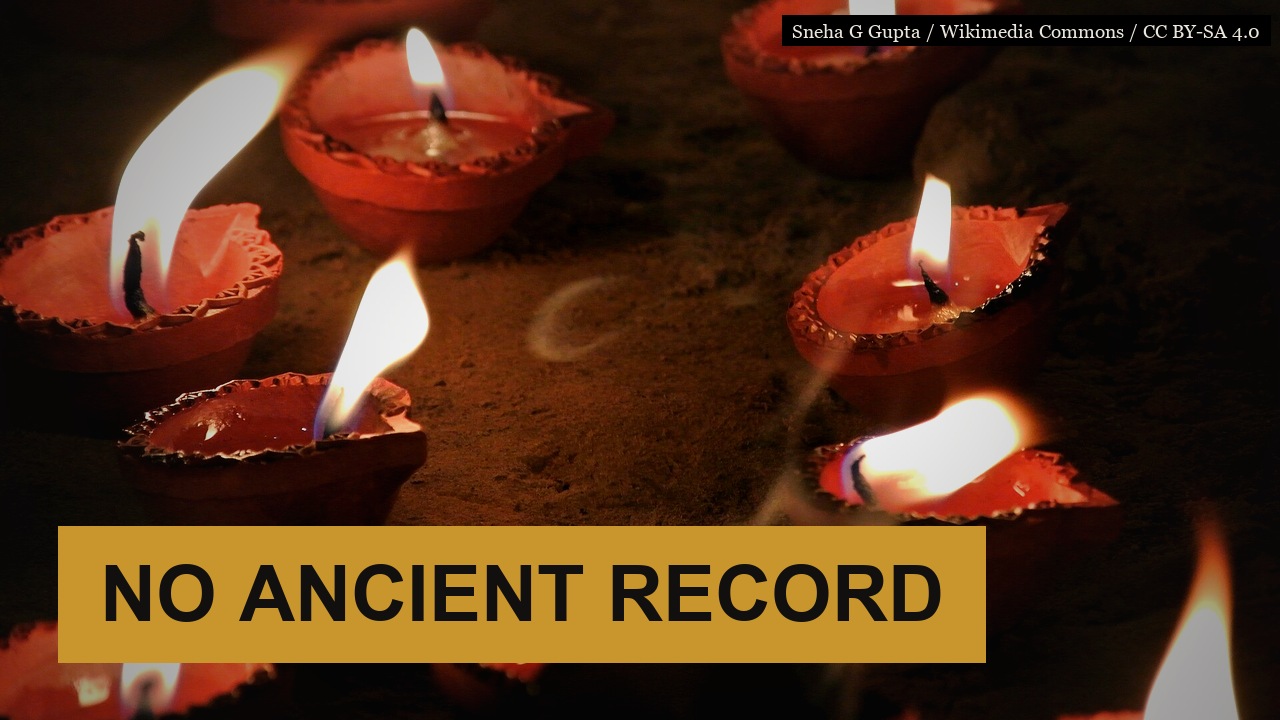
How old is Diwali, really? Nobody has actually found where it starts. Five thousand years is the figure most popular accounts repeat, which would place its first lamp lit before writing reached South Asia at all. The scholar who went looking for whatever evidence could actually support a date, the Sanskritist P. K. Gode, published his findings in 1946 after tracing the festival’s name and its various regional titles word by word through roughly two thousand years of literature, stone inscriptions, and foreign travelers’ notebooks. What that search turned up was not a founding moment. It was a scatter of names, possibly for the same festival, with the oldest candidate resting on an identification nobody actually made until roughly eight centuries after the text it identifies was written.
That gap, between a word appearing in a text and a later reader deciding what the word meant, is the central problem running through Diwali’s documented history, and it recurs at every stage of the record that follows: in the handful of early texts, in the dated stone inscriptions that are supposed to settle the question, and in the four separate religious communities that now keep the same autumn nights without agreeing on what any of them are actually commemorating.
Here is what the retrievable record contains, source by source: the disputed first reference and why Gode accepted it, what a dated inscription can prove that a poem cannot, the outside scholar whose travel notes became the first independent confirmation, the four unrelated founding stories that now share a calendar, and how a modest lamp-lit street fair became, within living memory, a line on a New York City school calendar.
How Old Is Diwali? The First Written Trace Is Eight Centuries Younger Than It Looks
Gode’s leading candidate is a single word, yaksharatri, roughly “night of the yakshas,” used in the Kamasutra to describe an autumn festival. Vatsyayana’s text is usually placed somewhere in the first four centuries of the common era, which would make it the earliest reference to anything resembling Diwali by a wide margin over every other candidate. The trouble is that the Kamasutra never says the word means Diwali. That equation was made by Hemachandra, a Jain monk and lexicographer working in the twelfth century, in a dictionary of regional Sanskrit vocabulary called the Desi-nama-mala. Hemachandra glossed yaksharatri as Diwali roughly eight hundred years after Vatsyayana wrote it down — a documentary gap not unlike the one that undoes so many confident claims about who actually wrote a given historical document, where the paper everyone relies on turns out to be younger than the event it supposedly records.
The festival’s actual name shows up on its own terms considerably sooner than that, though still not early. A Kashmir text called the Nilamata Purana and a Sanskrit court drama written for the emperor Harsha both use some form of the word in the sixth or seventh century — roughly five hundred years ahead of Hemachandra’s gloss, and five to eight centuries behind the Kamasutra‘s possible dating. So the honest shape of the evidence is two separate “firsts”: the earliest plausible reference to the practice, which depends on an identification made centuries later, and the earliest reference to the festival’s actual name, which is unambiguous but five or six hundred years younger.
What a Dated Stone Can Prove That an Undated Poem Cannot
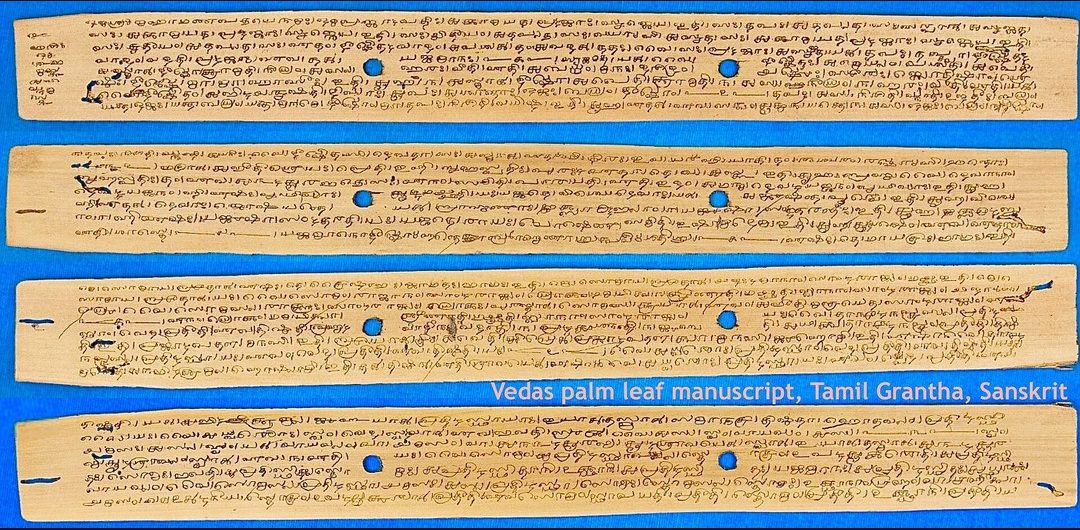
Literary works are a weak clock. Scholars estimate when the Kamasutra, the Nilamata Purana, or Harsha’s play were composed from internal evidence, literary style, and reference to other datable works, which is why their dates are usually given as a century-wide range rather than a year. Inscriptions are a different kind of source entirely: a land grant or temple donation is normally dated to a specific regnal year of a specific king, which modern chronologists can usually convert to a calendar year with real confidence. An inscription that names a festival, issued in a known year, is worth more as dating evidence than a much older poem whose own composition date is itself a matter of argument — much the same evidentiary gap that separates a dated royal grant from the undated, unsigned iron-smithing on the Delhi Iron Pillar, whose makers never left a document explaining their own work at all.
By that standard, the record firms up noticeably in the second millennium. A Kannada inscription issued under the Chalukya ruler Tribhuvanamalla in 1119 names the festival outright. Records from Kolhapur, in the western Deccan, show it under observance by the eleventh century. Neither inscription explains what the festival meant to the people who funded it, which is the limit of epigraphic evidence; a stone can fix a date and a place, not a motive. What inscriptions add is exactly what literature cannot supply on its own: independent confirmation, pinned to a year, that by the eleventh and twelfth centuries the festival was established enough, in enough different kingdoms, to be worth a formal record.
An Outsider’s Account, Then a Word Enters English
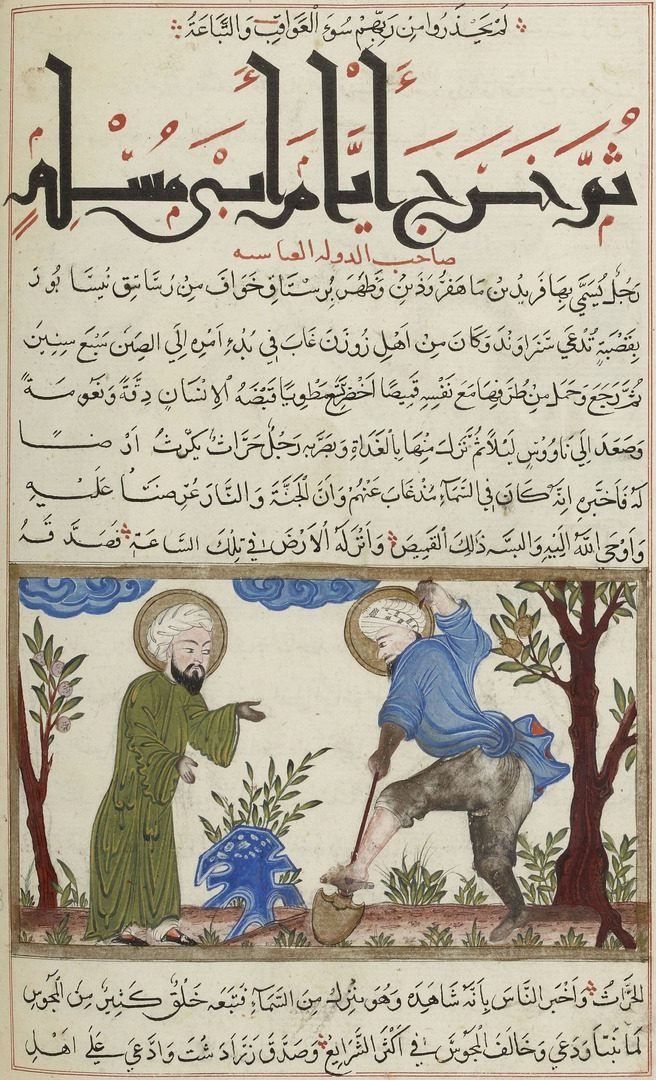
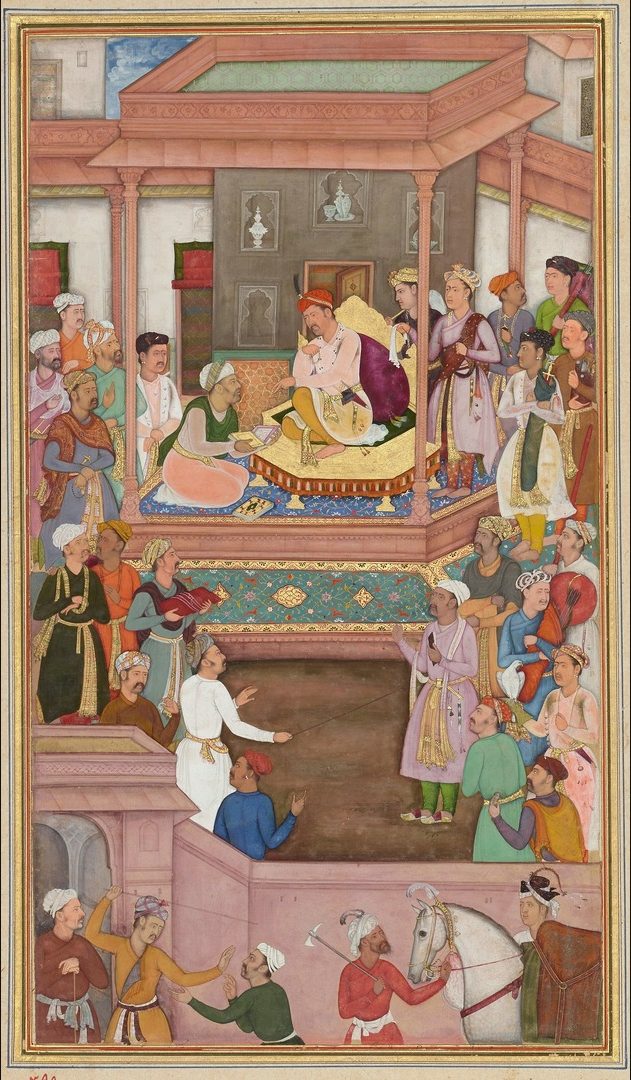
The first confirmation from someone with no religious stake in the festival came from outside India altogether. Al-Biruni, a Khwarazmian polymath who spent roughly a decade in India in the early eleventh century, wrote that Hindus celebrated a festival on the new-moon day of the month of Kartika. What makes al-Biruni’s testimony unusually trustworthy for the period is that he was not simply repeating secondhand travelers’ gossip: he learned Sanskrit, read Indian astronomical and religious texts in the original, and consulted Brahmin scholars directly, at a time when most chroniclers passing through India did neither. A description of the same festival surviving independently in the work of someone outside the tradition, writing around 1030, is a genuinely different category of evidence from a Sanskrit text written by and for people already inside it. Five centuries later, Akbar’s court chronicler Abul Fazl noted in the Ain-i-Akbari, the official administrative record of Akbar’s reign compiled around 1590, that Diwali night was kept somewhat like the Islamic occasion of Shab-i-baraat — a comparison that shows the festival had become familiar enough, even at a Mughal court, to be explained to a Muslim readership by analogy.
The word itself entered English through colonial contact, and that trail is unusually well documented because English lexicographers cared enough to trace it. Henry Yule and A. C. Burnell’s 1903 glossary of Anglo-Indian vocabulary, Hobson-Jobson, traces the English spelling “Dewally” back to European travelers’ accounts beginning in 1613, describing it as an autumnal feast tied to the honoring of various divinities. A separate eighteenth-century Maratha chronicle, from the era of the Scindia ruler Mahadji Scindia, records the festival being kept at court, which shows the practice persisting continuously through the centuries between al-Biruni’s account and the first English descriptions, even where the documentary record for any single century is thin.
Four Religions, Four Explanations, and No Agreement on Which Came First
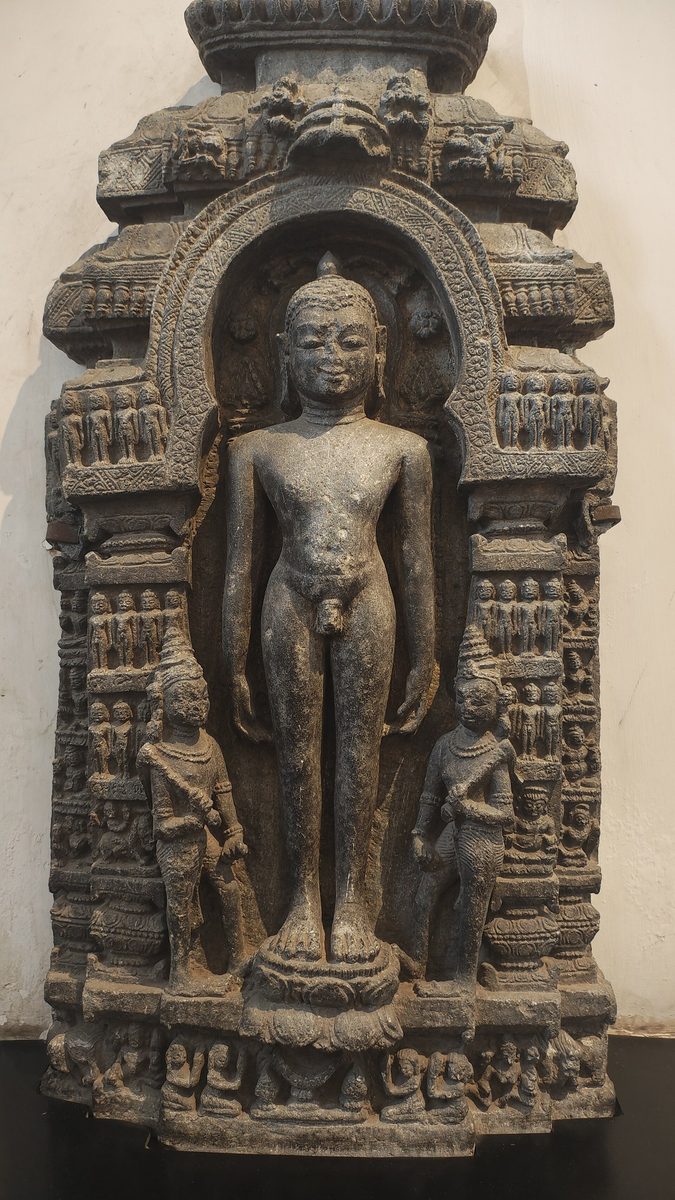
By the time the festival had a settled written history, it also had four separate religious communities attaching four unrelated explanations to the same handful of nights, and none of the earliest sources for any of them treats its own explanation as the one that needs to be chosen over the others. For Jains, the day marks Mahavira’s nirvana — his final liberation from rebirth — traditionally dated to 527 BCE. What’s notable about that date is not that it’s disputed inside the Jain tradition; according to the historian Kailash Chandra Jain, Jain writers have used it with real consistency since at least the fifth century CE, repeated across generations by authors including Jinasena, Nemichandra, and Merutunga, in a way Buddhist writers never managed for the date of the Buddha’s own death. The genuine uncertainty sits one level down, in how confidently that traditional count can be converted into a Western calendar year at all — a long-running argument among Indian chronologists over whether supporting eras cited in later sources, such as a proposed “Ananda Vikrama Era,” ever actually existed as a counting system, rather than over whether Jains have the date right by their own reckoning.
For Sikhs, the same days mark Bandi Chhor Divas, commemorating Guru Hargobind’s release from imprisonment at Gwalior Fort and his return to Amritsar — an observance that, by most historical accounts, dates only to the eighteenth century, making it by a wide margin the youngest of the four traditions layered onto the festival rather than a separate point of origin. For Buddhists, Diwali is not a primary observance in most regions, but some communities mark the same day as the anniversary of the emperor Ashoka’s conversion in the third century BCE, and Vajrayana Buddhists among Nepal’s Newar community keep their own multi-day autumn festival alongside it. None of these four traditions were drawing on each other’s texts when their own earliest sources were written, which is itself informative: a festival that four unconnected religious communities could each attach a separate story to, without friction, looks less like one tradition with a disputed founder and more like a shared seasonal occasion — lamps lit at the point in the year when the monsoon ends and the air turns cold, not unlike the way Mexico’s ofrenda tradition layers Catholic and Indigenous practice onto one shared autumn date — that each community later explained in its own terms.
From a Lamp-Lit Lane to a City Council Line Item
The festival’s modern civic life is better documented than its ancient origin by an enormous margin, if only because the record is just decades old. Leicester’s Diwali lights switch-on, now one of the largest Diwali celebrations held outside India, began in 1983 as a short string of lights on Belgrave Road; a 2015 redesign grew it into more than fifty separate events run over two weeks, including fireworks, a Ferris wheel, and cooking demonstrations organized through the city council’s own events office. By October 2022, tens of thousands of people were turning out for the switch-on alone. In November 2023, New York governor Kathy Hochul signed legislation closing New York City’s public schools for Diwali, calling it, in her signing statement, “an opportunity for our children to learn about and celebrate traditions from across the world” — the first time the city’s school calendar had formally recognized the holiday.
The one part of the festival’s story that is still actively being argued over, rather than settled by old documents, is how to keep it. India’s Supreme Court has restricted the traditional firecrackers long associated with Diwali night in Delhi, permitting only lower-emission “green” versions developed by a government research institute; researchers quoted in recent coverage of the debate still warn that even those release considerable fine particulate pollution. It’s a reminder that the festival, whatever its disputed beginning, is not a fixed historical artifact. It is still being renegotiated, loudly, every autumn.
What the documented record actually supports, once the later identifications and retrospective explanations are set aside, is not a single origin obscured by time so much as a loose convergence: several distinct regional and religious observances, clustered around the same point in the agricultural and lunar calendar, that only slowly acquired a shared name, and only much later still, a shared set of founding stories that none of the earliest sources ever needed to reconcile. The Kamasutra‘s possible mention, Hemachandra’s twelfth-century gloss, the dated inscriptions, al-Biruni’s travel notes, and four religions’ separate explanations are not five versions of one story competing for the title of true origin. They are five different kinds of evidence, each with its own limits, describing what may always have been several related practices rather than one.
Which of the stories do you think came first?
Watch the full history
The video companion walks through the same written trail in order, from the earliest disputed reference to the inscriptions that finally pin the festival to a year and a place.

Related reading
- Who Built the Delhi Iron Pillar? The Question Nobody Signed Their Name To — an equally undated monument whose makers never signed their own inscription either
- Who Wrote the Monteagle Letter? Six Suspects, No Confession — a different documentary mystery, where the surviving paper trail is also younger than the event it describes
- How an Ofrenda Is Actually Built — another festival built from several regional and religious customs that only later acquired one shared name
- Why Sugar Skulls Get a Name Written on the Forehead — a smaller ritual detail with the same evidentiary problem: a practice far older than any text that explains it
Works cited
- Chawla, Noor Anand. “A History of Diwali.” JSTOR Daily, October 29, 2024. Link.
- Gode, P. K. “Studies in the History of Hindu Festivals: Some Notes on the History of the Divali Festival.” Annals of the Bhandarkar Oriental Research Institute 26 (1946): 216–262.
- “Diwali.” Encyclopaedia Britannica.
- Jain, Kailash Chandra. Lord Mahavira and His Times. Delhi: Motilal Banarsidass, 1991. Link.
- Office of Governor Kathy Hochul. “Governor Hochul Signs Legislation Making Diwali a School Holiday.” New York State, November 14, 2023.
- “40,000 Celebrate Diwali Light Switch-On in Leicester.” ITV News (Central), October 10, 2022.
- Harrison, Suzy. “The Development and Management of a Transnational Tradition: The Case of Diwali in Leicester.” Ritual Year 12, no. 1 (2021): 186–200.
- Tyagi, Rajeev. “India Readies Diwali Celebrations as Pollution Sparks Debate Over ‘Green’ Firecrackers.” ABC News / Good Morning America, October 19, 2025. Link.