
In 1530, Henry VIII’s personal inventory listed sixteen pomanders among his jewelry — more than his tally of rings. They held nothing more technical than crushed herbs, musk, and a waxy substance pulled from the gut of a sperm whale, sealed inside a hinged gold ball small enough to close in a fist. The king was not collecting curiosities. Under miasma theory, the medicine of his day, he was carrying a functioning piece of protective equipment.
For roughly five hundred years, educated Europeans subscribed to miasma theory: the idea that disease travelled on bad air, rising off rot, sewage, and the unburied dead. If a smell could reach you, in that theory, so could the sickness riding inside it, and the obvious defence was to keep a stronger, pleasant smell between your nose and the world. That belief built an entire category of object, worn by everyone from monarchs to magistrates, and it is the reason a sitting English judge could, within living institutional memory, open a session of court holding a bunch of flowers for exactly the same reason a plague doctor wore a beaked mask.
This is the story of that object: how a ball of amber and musk became a status symbol, how it very nearly got an English courtroom killed rather than saved, and how a habit built on an idea medicine abandoned more than a century ago is still, in one specific building in London, observed today.
The pomander ran on miasma theory, an idea that lasted three thousand years
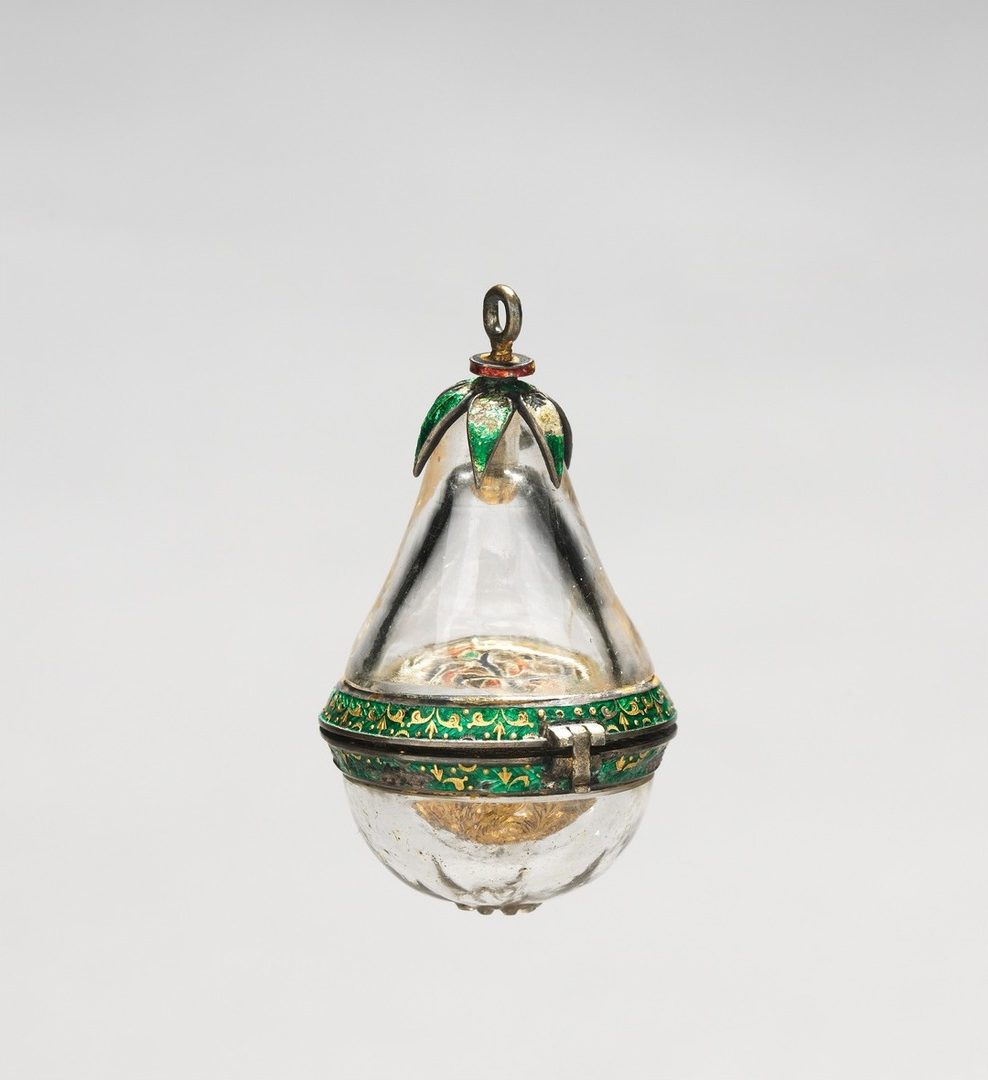
The name comes from the French pomme d’ambre, literally “apple of amber” — not amber the fossil resin, but ambergris, a waxy secretion from the digestive tract of the sperm whale that washes up on beaches and, once cured, smells far better than its origin suggests. The earliest pomanders, from the 1300s, were little more than a lump of this material carried loose in a pouch or caged in simple metal wire.
European goldsmiths spent the following two centuries turning that lump into engineering. By the 1500s and 1600s a pomander was typically a hollow metal sphere, hinged like a tiny orange, that opened into several wedge-shaped compartments — the Victoria and Albert Museum’s own example from around 1600–10 divides into six, each engraved on the inside with the name of what it held. A plainer version split into fewer sections; the costliest were a miniature spice rack worn on a chain.
The scent itself was never meant to be subtle. It needed to overpower the street, the sickroom, or the body beneath the clothes, and it needed to last for months rather than minutes — which is most of why ambergris, a substance scraped from a whale, became a luxury good traded across Europe and the Middle East for several hundred years.
A piece of jewelry you could smell someone’s income in
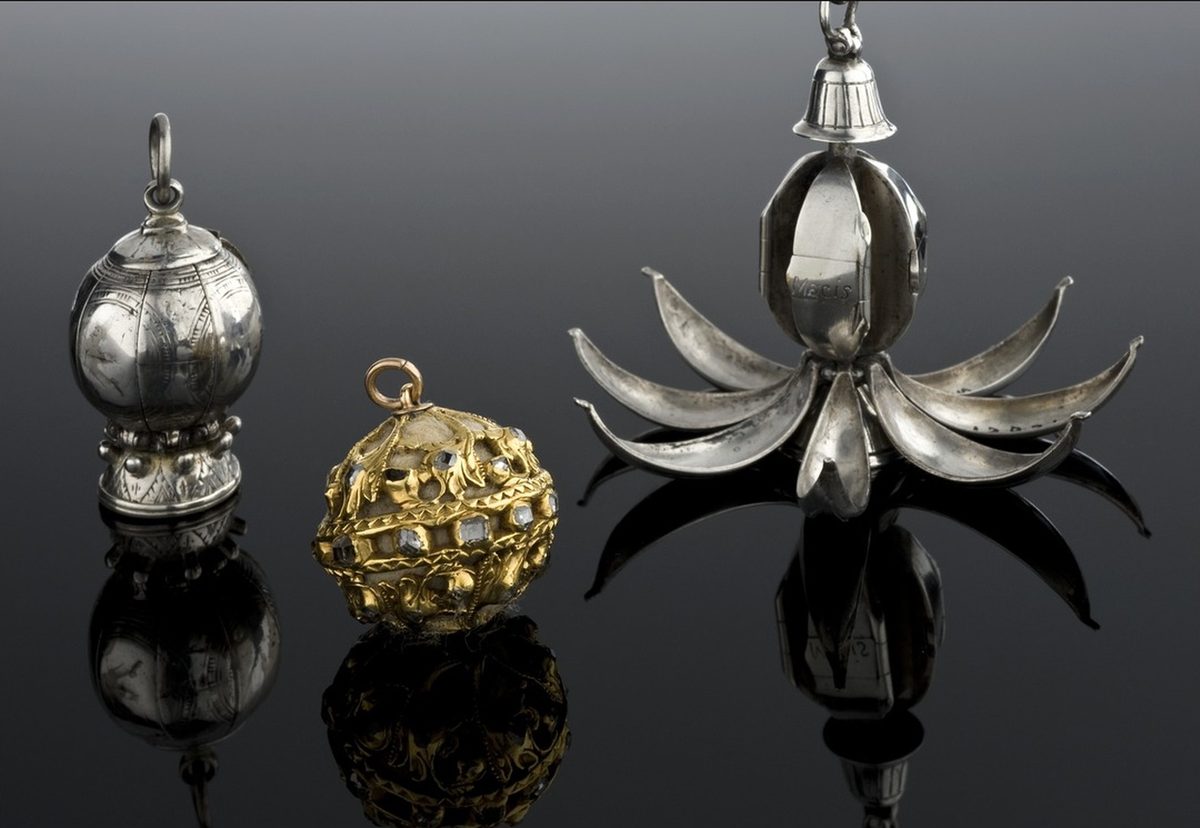
A pomander’s material told you everything about its owner before anyone opened it. The poor carried a twist of cheap herbs in a rag, worn against the skin and kept out of sight. Merchants could afford silver. The nobility carried gold, sometimes set with pearls or cut stones, engraved with ornamentation that had nothing to do with function. Henry VIII’s sixteen pomanders sat in the same 1530 inventory as his collars and rings, catalogued the same way, because to a Tudor courtier that is exactly what they were.
Women at the top of that hierarchy wore them just as visibly. Elizabeth I is reported to have worn a pomander pendant among her other jewels, and portraits of her and her contemporaries routinely show a small round object at the waist or neck alongside crosses, lockets, and other pieces of comparable scale — jewelry that, unlike most of what survives from the period, was also believed to be doing a job.
That double duty is what makes the object interesting now. A pomander was never purely medical the way a modern inhaler is purely medical, and it was never purely decorative either. It occupied a category that barely exists today: a visible, expensive object its owner genuinely believed was keeping them alive, which also happened to be the clearest available way to announce how rich you were.
Doctors leaned on the same theory hardest
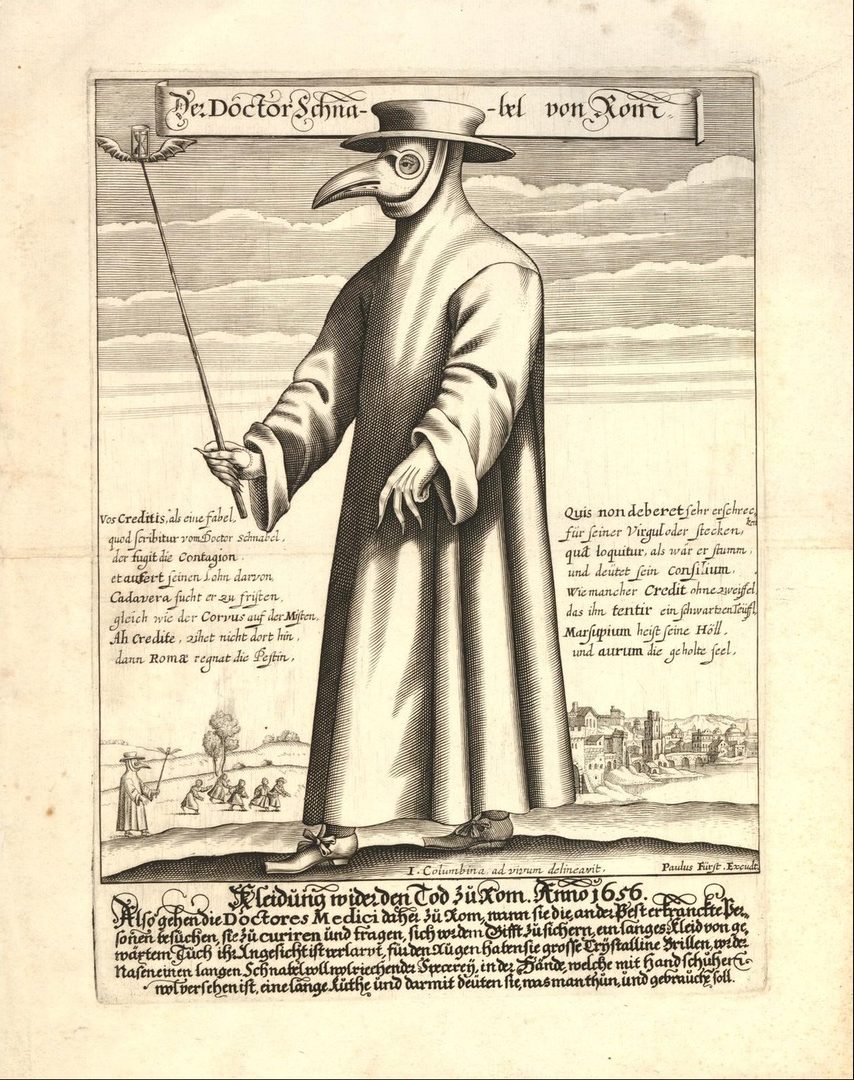
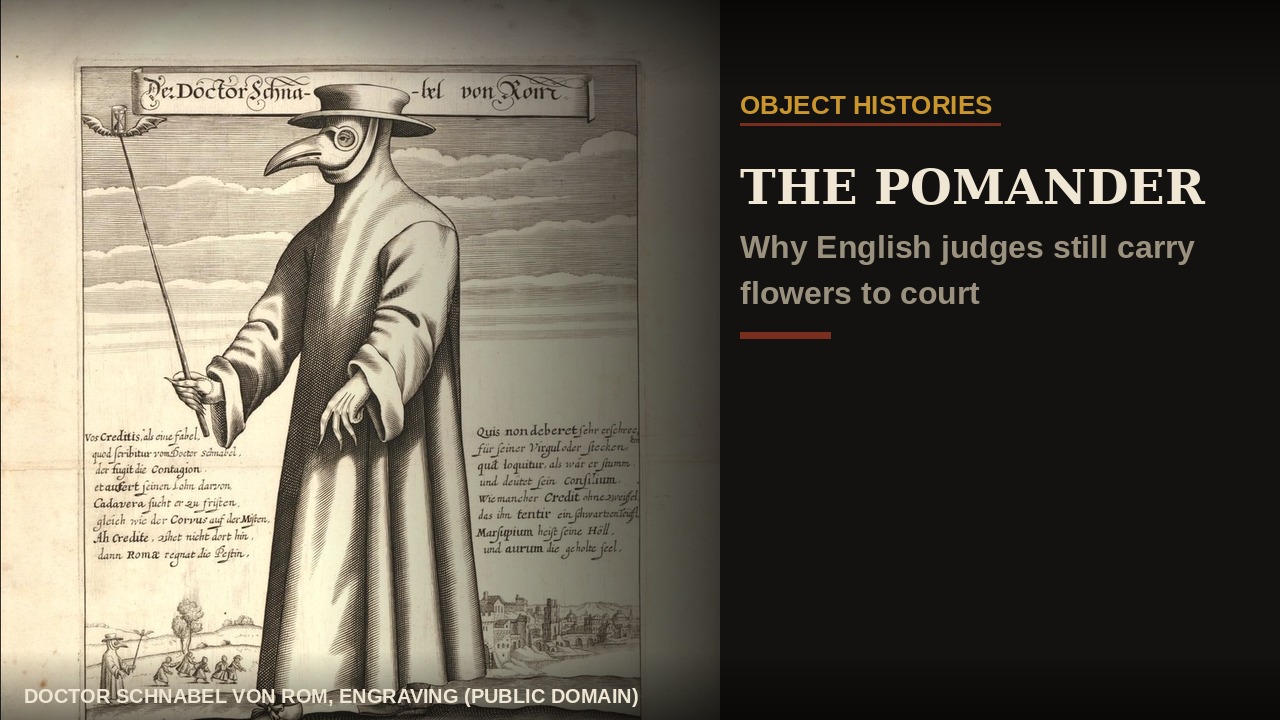
Nobody staked more on miasma theory than physicians, and nobody did more to turn the pomander into something closer to protective equipment than jewelry. The plague doctor’s beaked mask — the costume most people now recognize from seventeenth-century engravings — was not theatrical. The beak was a long, stuffed nose cone, packed with dried flowers, herbs, and spices on exactly the same reasoning behind every pomander: put a wall of strong, pleasant smell between the wearer and the air believed to carry death.
A physician who could afford one also carried a separate pomander for ordinary rounds, lifting it to the face before leaning over a patient — a gesture closer to a modern clinician reaching for a mask before entering a room than to any fashion statement. The ritual mattered as much as the material; nothing in a ball of musk and amber does anything to a pathogen, but raising it at the bedside was taken as seriously as any other part of the examination.
It is worth resisting the urge to read miasma theory as simple ignorance and move on. It was wrong, but it was not stupid: physicians had watched disease cluster around filth, crowding, and stench for centuries, and smell was the one signal available to the naked senses that correlated, however indirectly, with where sickness actually was. The pomander was the period’s best available technology for acting on a real pattern, built on the wrong mechanism.
English courts had their own epidemic, and it kept killing judges
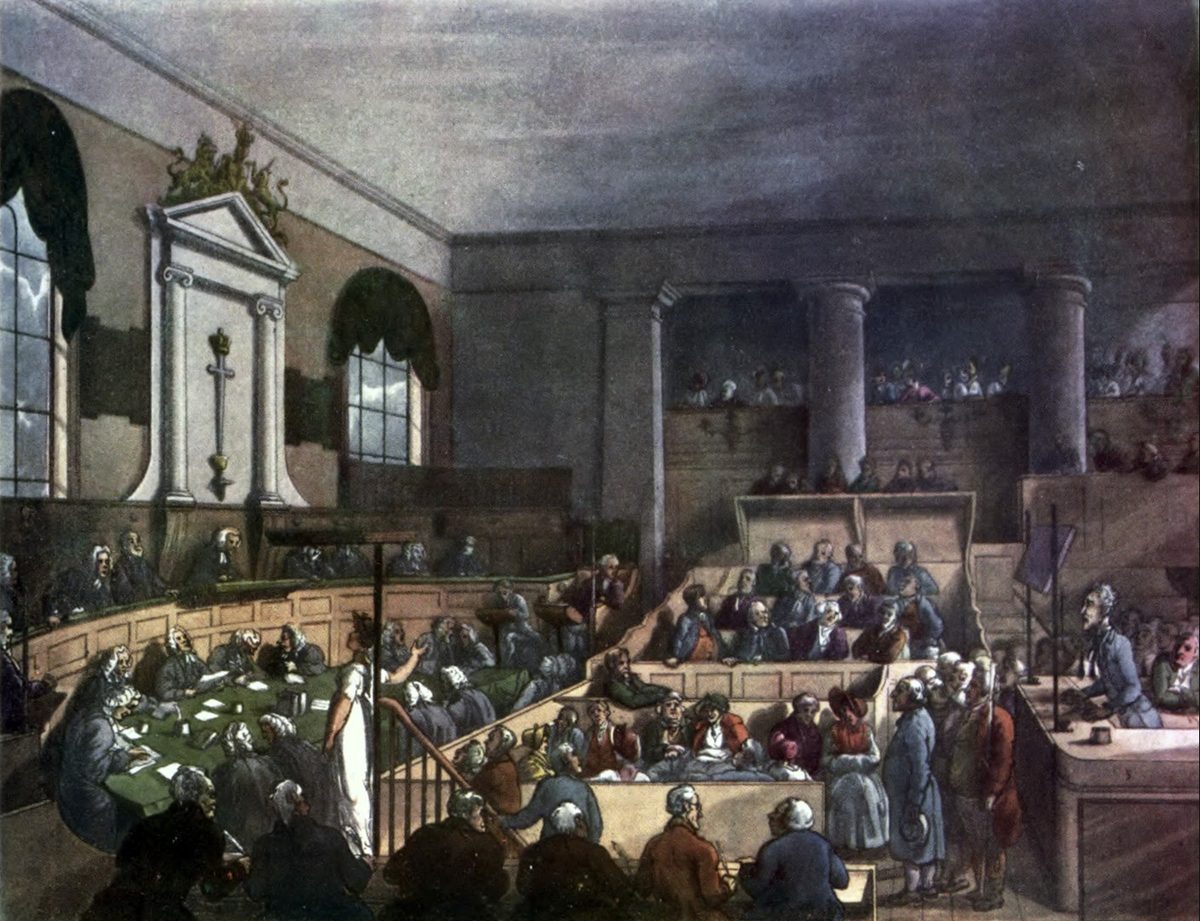
Nowhere tested miasma theory harder than an English assize court, because nowhere else packed sick, unwashed people into a small enclosed room with the officials deciding their fate. Prisoners held for months awaiting trial, with no real sanitation, carried typhus — “gaol fever” to contemporaries, who knew neither the word typhus nor that it travelled on lice rather than air — straight into the courtroom with them, and the results were occasionally catastrophic.
At the Oxford assizes in July 1577, a sitting judge, the Lord Chief Baron of the Exchequer, the county sheriff, and roughly three hundred other people died within weeks. Some contemporaries blamed a curse supposedly laid by one of the accused, a bookbinder named Rowland Jenks; historians studying the outbreak since have generally favored gaol fever carried into court by the prisoners on trial. Nine years later, a similar outbreak at the Exeter assizes killed a sitting judge, Serjeant Flowerdew, along with several other officials. The presiding judge’s response, by a contemporary account, was to start holding trials more often, so prisoners spent less time rotting in gaol before they ever reached a courtroom.
London’s own Old Bailey was built with this exact danger in mind: its original 1670s courtroom was left open to the outside air on one side specifically to let a stench, and whatever it carried, dissipate rather than concentrate. That design held for roughly sixty years, until the court was enclosed in 1737 to keep out the weather, at the cost of its one real defence. The gamble caught up with it in 1750, when a fever outbreak traced to the dock killed around sixty people, the Lord Mayor and two judges among them.
From a solid ball to a vinegar-soaked sponge
In the century after that outbreak, the pomander itself began to disappear — not because anyone stopped believing in miasma, but because fashion and practicality moved past the object’s original form. Through the 1700s the heavy scented ball shrank into something lighter and far easier to carry in a waistcoat pocket: the vinaigrette, a small hinged box with a decoratively pierced inner grille, holding a sponge soaked in aromatic vinegar rather than a solid paste of musk and amber. The scent was sharper, and the whole object was a fraction of the size and weight.
Courts adopted the same shift institutionally, rather than leaving it to individual judges. Following the 1750 outbreak at the Old Bailey, judges began the practice of spreading nosegays and aromatic herbs across the bench and the dock rail before each session, with fresh posies — small hand-tied bundles of strong-smelling flowers and herbs — cut and handed to the bench. It was a formal, repeated gesture built directly into how the court opened, not a personal habit a magistrate happened to keep.
Germ theory ended it almost overnight, and one piece survived
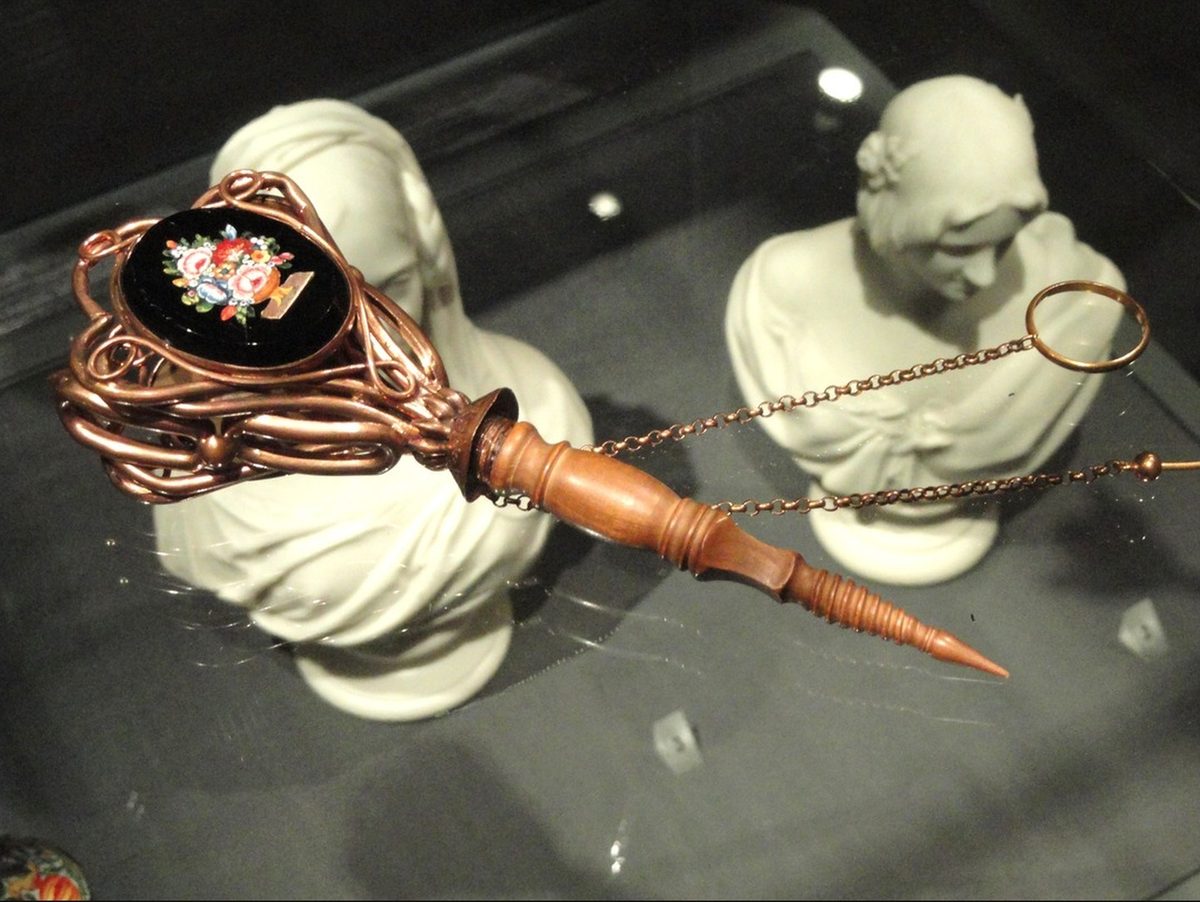
What actually killed the pomander, and eventually the vinaigrette behind it, was not a change in fashion but a change in medicine. Through the middle and later 1800s, researchers including Louis Pasteur and Joseph Lister built the case that disease spread through living microorganisms rather than bad-smelling air, and physician John Snow’s mid-century work tracing a London cholera outbreak to a contaminated water pump did some of the most direct damage to miasma theory specifically, by showing disease could travel through something entirely odorless. Once doctors accepted that lice, water, and microbes were the actual vectors, there was no reason left to carry a ball of amber against a smell that had never been the danger in the first place, and the object fell out of medical and fashionable use within a generation.
The courtroom gesture, remarkably, did not follow it all the way out. The practice that began after 1750 — judges handling a cluster of flowers and herbs before taking the bench — survives at the Old Bailey as a ceremony that, by the court’s own account, continues to this day, long after anyone involved believes the flowers are doing anything except marking where the custom began. Almost nobody watching it now could tell you why it exists at all.
The word itself outlived the object by an even wider margin. Every December, households across Britain and North America make what they still call “pomanders” — an orange studded all over with whole cloves and left to dry — with no memory that the name once belonged to a piece of jewelry a king counted alongside his rings, or that it was once the only thing standing, in the mind of the person wearing it, between them and a disease they could not otherwise fight.
Watch the full history
The video traces the pomander from Henry VIII’s jewelry box to the Old Bailey dock, and the court custom it left behind, in under six minutes.

Related reading
- Everything People Used to Hide Inside a Fur Muff
- Shugborough Inscription Theories: What Each Explanation Actually Claims
- The Dangerous History of Face Powder — From Roman Lead Paint to a Flapper’s Compact
- Who Wrote the Monteagle Letter? Six Suspects, No Confession
What makes the pomander worth tracing across five centuries isn’t the object itself, which did almost nothing its owners believed it did. It’s how long a wrong idea can stay load-bearing once it’s attached to wealth, ritual, and institutional habit. Miasma theory was overturned by the 1880s. The Old Bailey’s flowers are still handed to the bench.
That gap — between when an idea is proven wrong and when the behavior it produced actually stops — is where most of this object’s real history lives. A pomander told you someone’s income at a glance, armed a doctor at a plague bed, and, for one English court, briefly decided whether the next outbreak would be blamed on gaol fever or on a bookbinder’s curse. None of that required the theory to be true. It only required enough people to act as though it were, for long enough, that the habit outlasted the belief.
Would you have trusted a flower to stop a disease? The judges who still carry one, nearly three centuries later, have never quite had to answer that question for themselves.
Works cited
- Victoria and Albert Museum. “Pomander.” Collection record, object O156619, Rosalinde and Arthur Gilbert Collection. Link.
- Metropolitan Museum of Art. “Pomander Bead from a Rosary or Devotional Pendant.” Collection record, object 17.190.325, Gift of J. Pierpont Morgan, 1917.
- Science Museum Group / Wellcome Collection. “Gilt pomander.” Collection record, object A629413. Link.
- Science Museum Group. “Silver vinaigrette.” Collection record, object co133215. Link.
- Birkwood, Katie. “Disease is in the Air: Exploring the Relationship Between Health and Smell.” Royal College of Physicians, History of Medicine blog, 6 September 2019.
- Young, Fi. “#AdventBotany 2018, Day 3: The Pomander.” University of Reading Herbarium (RNG) blog, 3 December 2018. Link.
- Kesselring, Krista J. “Gaol Fever Stories.” Legal History Miscellany, 28 April 2020.
- “History of the Old Bailey Courthouse.” Old Bailey Online (Universities of Hertfordshire and Sheffield).