
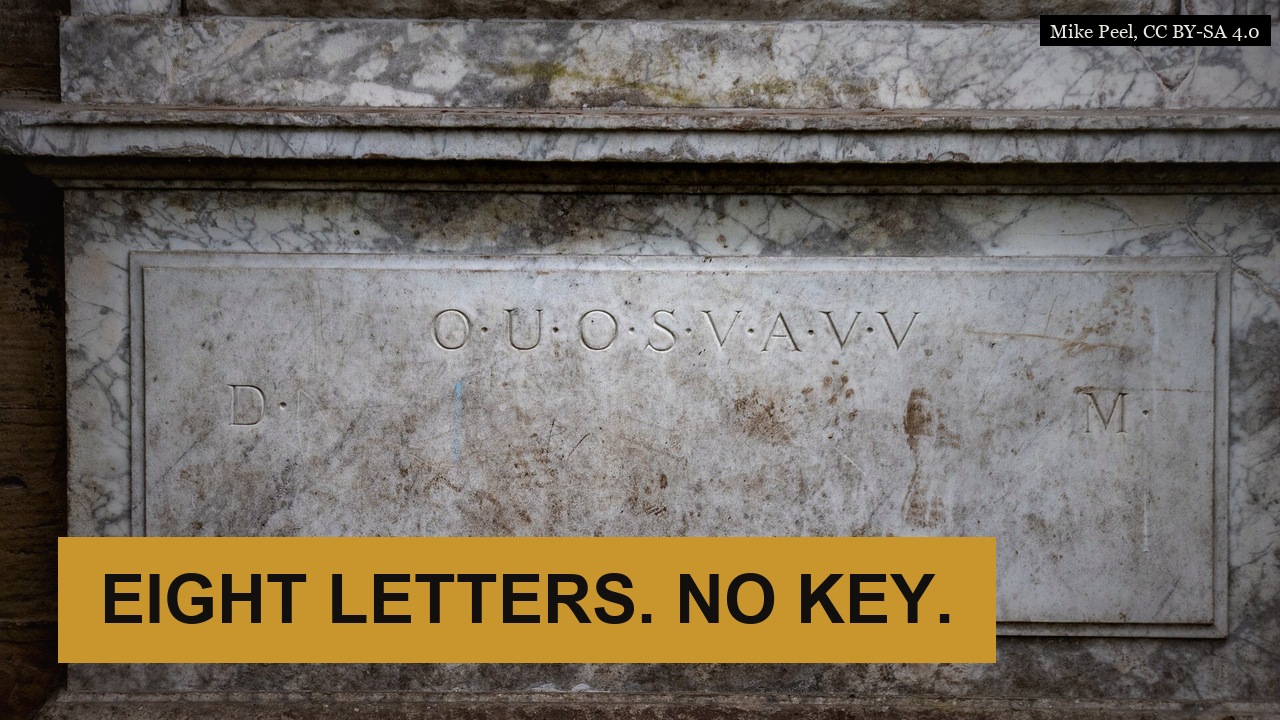
Ten letters are cut into a plain marble panel in a Staffordshire garden: eight in a row — O, U, O, S, V, A, V, V — flanked by a D and an M. The monument they sit on has stood since the 1750s. Nobody wrote down what the letters meant at the time, and nobody has produced a reading since that a second, disinterested person can actually verify. That hasn’t stopped people from trying. Wartime codebreakers from Bletchley Park judged a public appeal that drew thousands of answers. Classicists, a former American intelligence linguist, military historians and the family’s own descendants have all taken a run at it. The National Trust, which now manages the site, says it still fields several submissions a week.
What follows is not a verdict. Nobody who has looked at this seriously claims to have one. It is, instead, an honest map of the monument itself, the gap in the written record that makes the puzzle possible, and the half-dozen competing readings — including the two most carefully argued, from 2011 and 2022 — that have been offered in the two hundred and seventy years since the carving went up.
A garden folly carries a deliberately reversed Poussin, with a tomb added that isn’t in the original
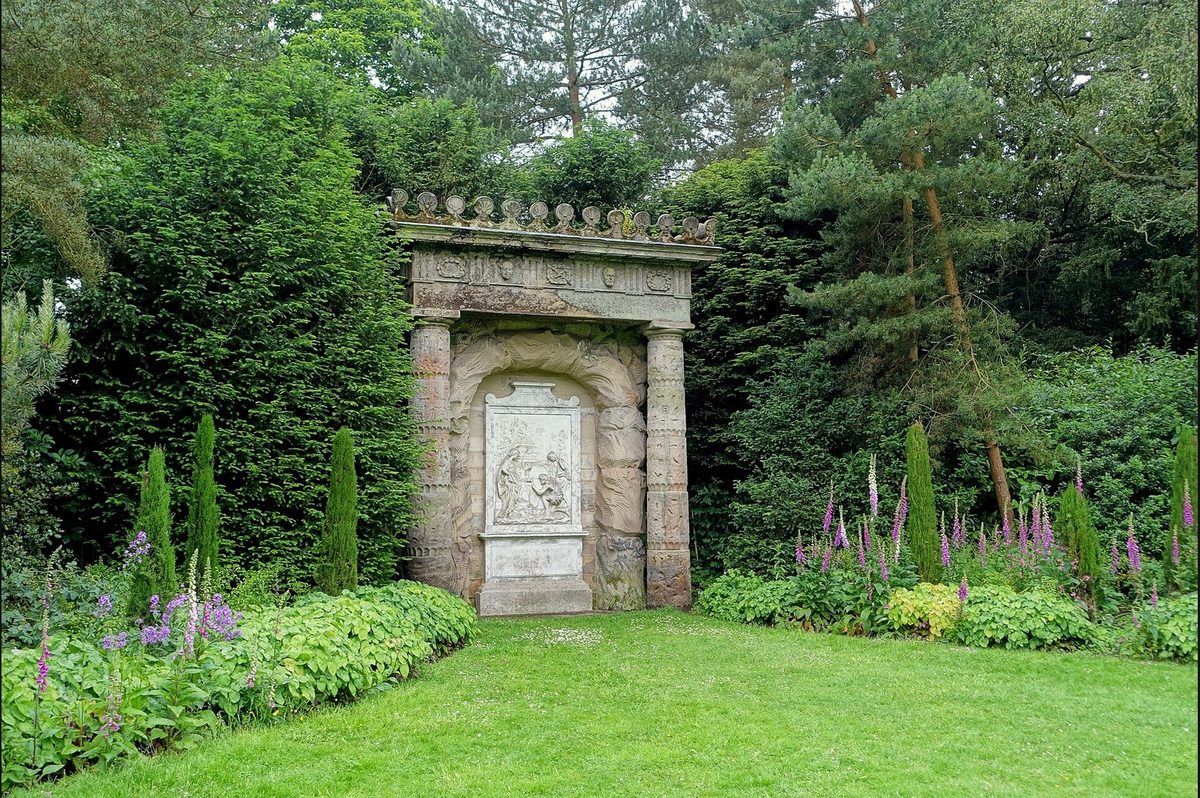
The object at the centre of this is known as the Shepherd’s Monument, and it stands in the gardens at Shugborough Hall on the edge of Cannock Chase in Staffordshire. It was built in two phases. The first, a rustic stone arch closer to a grotto than a doorway, went up sometime between 1748 and 1756, to a design by Thomas Wright of Durham — an astronomer and garden designer whose pattern book, Universal Architecture, published the same arbour design in 1755. Wright drew it to be built in timber. Whoever actually built it used stone instead, and the design is now Grade II* listed in its own right.
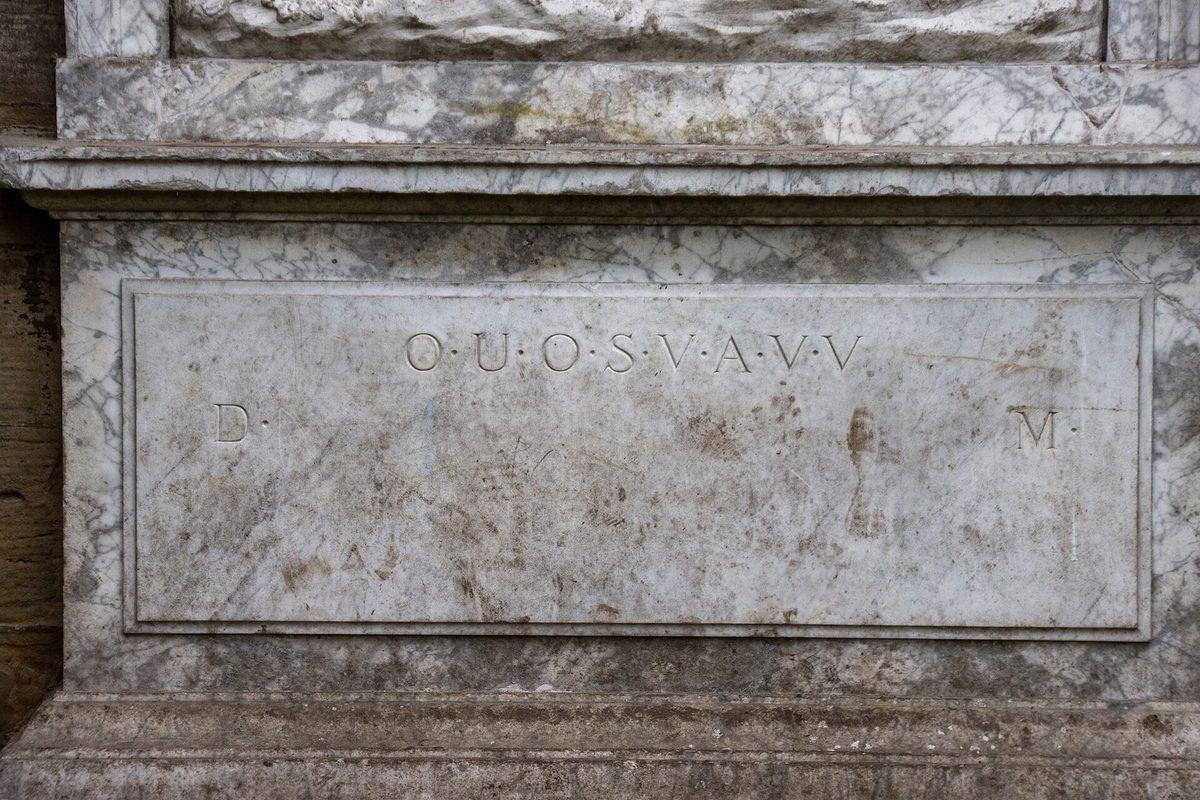
Around 1763 a classical portico was added in front: two Doric columns under a frieze of laurel-wreath medallions, with two carved heads worked into the stonework — one a smiling, balding man, the other wearing the horns of Pan. Under the arch sits a marble relief by Peter Scheemakers, a Flemish sculptor working in London, copied from Nicolas Poussin’s Et in Arcadia Ego (the second version, painted in the late 1630s and now in the Louvre). Three shepherds and a woman stand around a tomb; two of the shepherds are pointing at words cut into the stone, Et in Arcadia Ego — “Even in Arcadia, there am I.”
The carving is a mirror image of the painting. Everything on the painting’s left appears on the relief’s right, and vice versa. A second sarcophagus has also been added, sitting on top of the one in the original scene, which is not in Poussin’s composition at all. The reversal gets less weight than it used to: a sculptor working from an engraving rather than the canvas itself — which is exactly what a London-based artist copying a painting kept in France would have done — would produce a mirror image automatically, because prints reverse their source unless an engraver deliberately corrects for it. It is evidence that a print was the source, not a planted signal.
The D and the M aren’t the mystery — the eight letters between them are
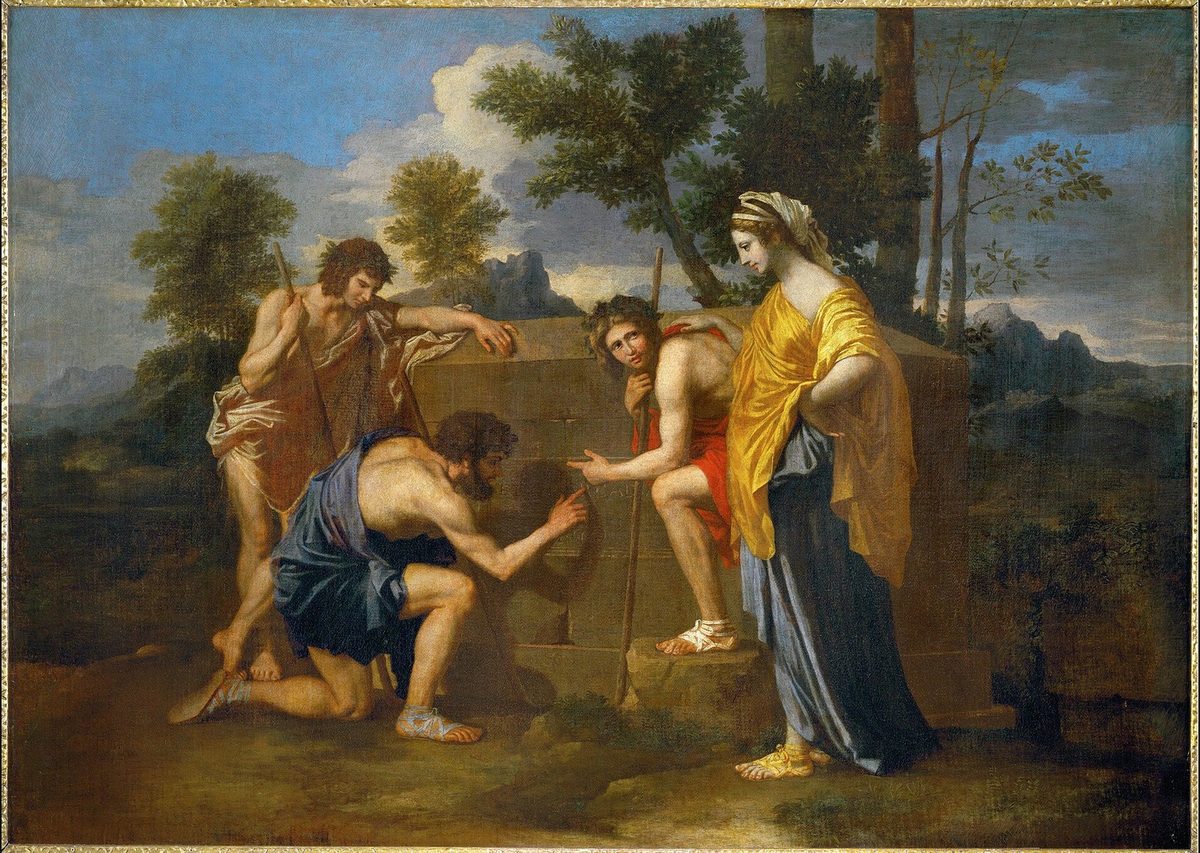
Below the relief is a plain panel. The main line reads O·U·O·S·V·A·V·V. Set apart from it, one at each end of a lower line, are a D and an M. Those two letters are the least mysterious thing on the monument: Dis Manibus, “to the spirits of the dead,” is one of the single commonest formulas on a Roman tombstone, abbreviated so routinely that two letters did the job. Their presence tells you the monument is being presented as funerary — a memorial to someone — and that whoever commissioned the carving had the kind of classical education that made the abbreviation legible without explanation.
It’s the eight letters in between that have resisted every reading. Eight characters is a punishingly short string to work with — the same length problem that has kept Kryptos K4 unbroken for decades. There is no statistical grip on a sequence that length: too many short Latin, English and French phrases can be made to fit eight initials, which is exactly why the proposed solutions multiply rather than converge. Whatever the eight letters stand for, the eight letters alone will not tell you — you need an independent reason to prefer one reading over the others, and that is precisely the thing nobody has supplied.
Thomas Anson built it, explained nothing, and his brother’s silver is probably beside the point
The man who commissioned the monument was Thomas Anson (1695–1773), MP for Lichfield and owner of Shugborough. After a Grand Tour that reached further east than most of his contemporaries’ — Cyprus, Greece, Cairo — he spent decades from the late 1740s turning the grounds into a Rococo and then early Greek Revival showground, filling them with garden buildings, a Chinese House and a deliberately artificial ruin. He never married, and according to Andrew Baker, whose book-length study remains the standard modern account of Anson’s life, there is no surviving document — no letter, no bill, no drawing — that explains the Shepherd’s Monument’s origin at all.
His younger brother is the reason treasure keeps entering the story. George Anson circumnavigated the globe between 1740 and 1744, lost most of his ships and the greater part of his crew to disease, and came home having intercepted a Spanish galleon carrying a fortune in silver from Peru. That prize money is what actually paid for Thomas’s garden improvements, which is a real and documented fact. What is not documented is any connection between that silver and the eight letters themselves — the claim, made in a 2016 book, that the inscription encodes the coordinates of an island where George buried part of the hoard, rests entirely on how you choose to read the letters, which is the very question in dispute.
The letters don’t appear in writing until 1817 — six decades after the arch went up
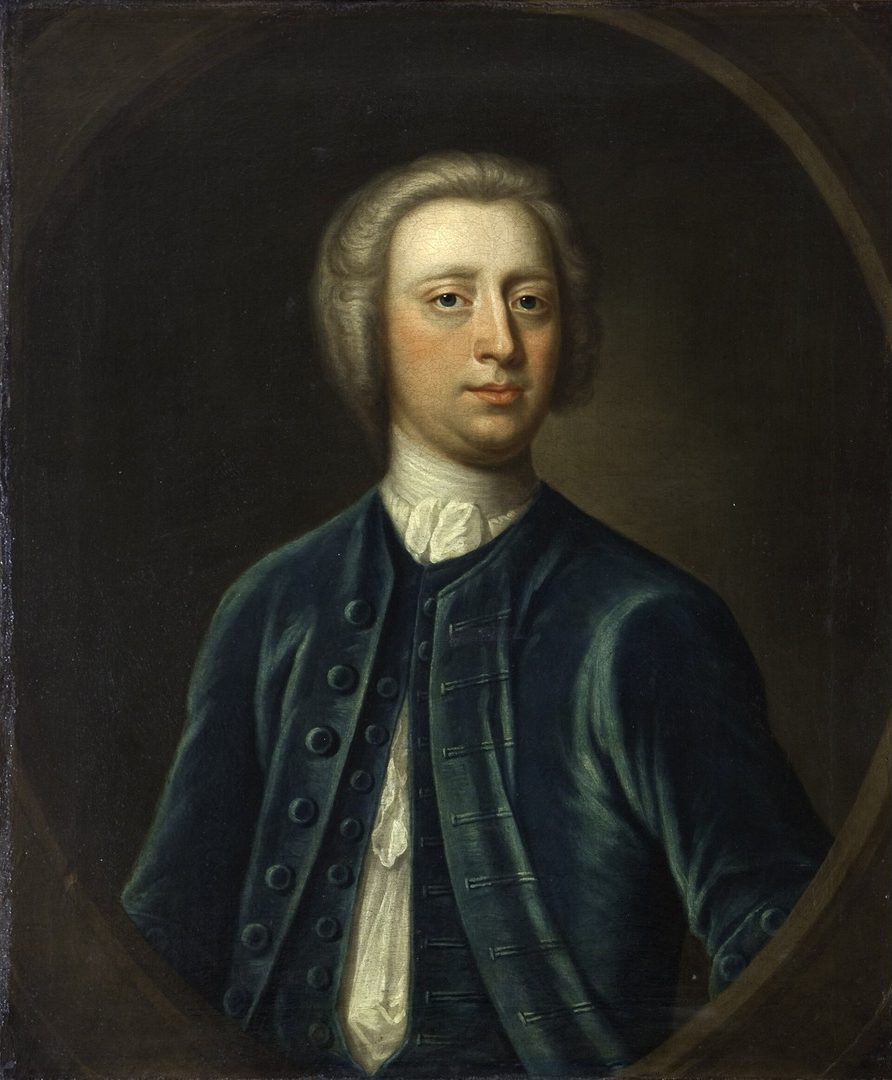
This is the detail that makes the whole puzzle possible, and it gets less attention than the letters themselves. The inscription is not recorded in print anywhere before 1817, when two local antiquarians, Sir Thomas Clifford and Arthur Clifford, printed it in a history of the neighbouring Tixall estate. That is fifty to seventy years after the arch itself went up, and well after Thomas Anson’s death in 1773. Everyone who could have explained the letters firsthand was already gone — the same silence that has kept the Monteagle Letter’s author unidentified for over four centuries.
That gap cuts both ways. It means there is no eighteenth-century witness to confirm any reading of the letters as original to the monument’s construction. It also means there is no eighteenth-century witness to rule that out. In 2011, the historian A. J. Morton argued that the simplest resolution is to take the gap seriously: the letters, he suggested, are not from Anson’s time at all but are nineteenth-century graffiti, added by relatives of the family — he named George Adams and his wife Mary Vernon-Venables, who lived at Shugborough later — commemorating local names rather than ciphering a hidden message. The dating gap supports the idea. The letter-by-letter match to those names is looser, and has not displaced the Anson-era readings so much as sat alongside them.
In 2004, two of Bletchley Park’s own codebreakers judged a public appeal — and their real answer was that it can’t be done
By the early 2000s the monument had acquired a pop-culture afterlife it never asked for. The Holy Blood and the Holy Grail (1982) linked Poussin to an invented secret society and mentioned the monument in passing, without proposing any solution to the letters. Dan Brown’s The Da Vinci Code (2003) drew on that earlier book and sent its sales soaring, without ever mentioning Shugborough at all — it didn’t need to; the association had already been made for it.
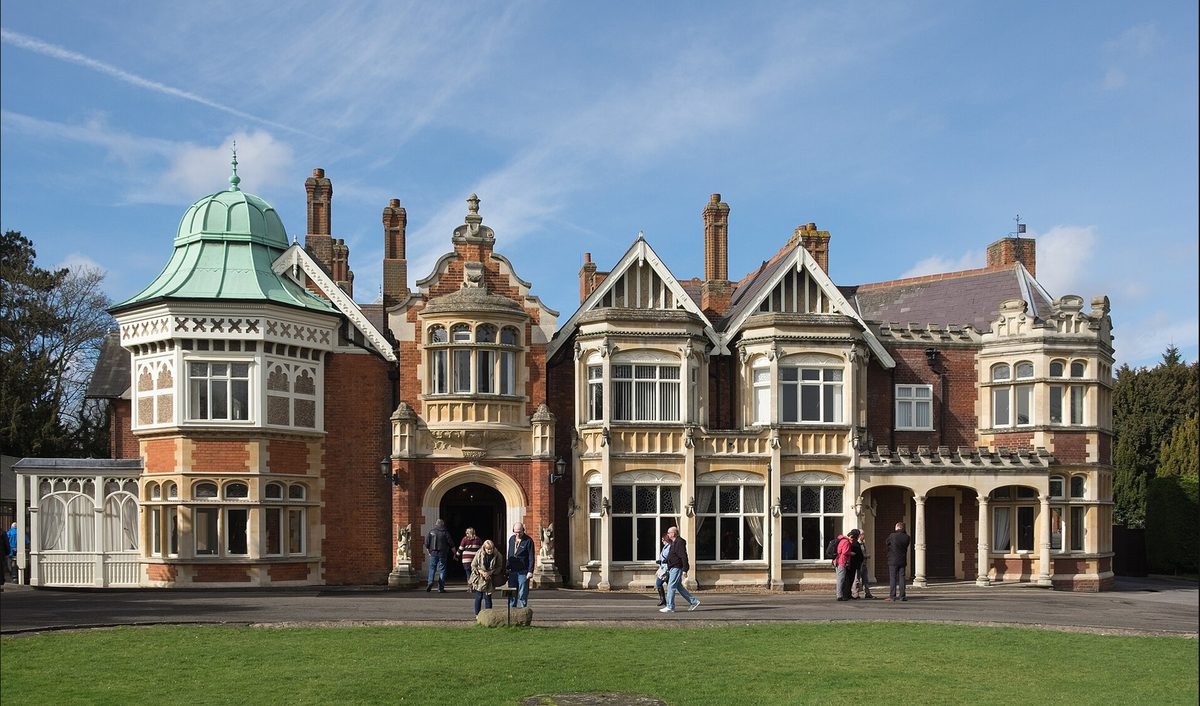
Shugborough’s estate management ran with that attention. In May 2004, working with Bletchley Park’s museum, they launched a public appeal and recruited two genuine wartime codebreakers to judge the submissions: Oliver Lawn, who had worked against both the Enigma and the Lorenz ciphers, and his wife Sheila, a linguist who had worked alongside him. Thousands of answers arrived from around the world, in multiple languages, built on classical Latin, English wordplay and biblical quotation alike.
No answer was accepted, which puts the Shugborough letters in the same company as the 450 handwritten pages of the Rohonc Codex — proof that volume alone does not guarantee a solution, and its absence does not rule one out. What the Lawns actually concluded is the single most useful thing anyone has said about the inscription, and it’s a negative result: eight letters is too short a string to crack by cryptographic method. There’s no statistical foothold at that length, and the sheer number of short phrases in several languages that can be made to fit is exactly why submissions kept arriving without any of them converging on one answer. Their working guess was that the key — if there is one — most likely sat in a family paper or a specific book that nobody has since identified. Sheila Lawn personally favoured the oldest proposed reading; Oliver gave cautious credit to one submission while stressing how much it assumed. Bletchley Park’s involvement lent the appeal real codebreaking credibility. It did not produce a code that could actually be broken.
Six readings, two of them carefully argued, and still no agreement
The oldest attributed reading is the novelist Oliver Stonor’s, from 1951: that the eight letters are the initials of a Latin dedication, roughly “a most loving widower dedicated this to the virtues of an excellent wife, an excellent sister.” Critics have long pointed out that the Latin grammar doesn’t quite hold together this way, and that no widower fitting the description has been identified among the Ansons at the relevant date. Margaret, Countess of Lichfield, proposed in the 1980s that the letters spell out English rather than Latin — a line about a sweetheart named Alicia, with the U standing in for “you” — but nobody has ever traced the source poem she was quoting. Two further readings turn the letters toward scripture: one as a Latin rendering of Ecclesiastes (“vanity of vanities, all is vanity”), the other, floated by a former American intelligence linguist, as a prayer drawn from John’s Gospel. Both have been faulted on their Latin, and the Gospel reading has the added problem of sitting a Christian prayer between the pagan D M formula on either side of it.
The two most carefully worked proposals are also the most recent. In 2012, the classicist Duncan Fishwick argued in the peer-reviewed journal Religious Studies and Theology that the letters are best read as standard Latin funerary abbreviations rather than any kind of code at all, while leaving open that the Ansons’ circle had an interest in fraternal societies. And in April 2022, writing in the classics magazine Antigone, Jack Mitchell proposed that the eight letters expand to Optimae Uxoris Optimi Sodalis Viri Annae Venables-Vernon — “to Anne Venables-Vernon, the excellent wife of an excellent friend.” Anne Lee had married George Venables-Vernon of Sudbury Hall, sixteen miles from Shugborough, in 1741 and was dead within the year, at twenty-one; Venables-Vernon had held the Lichfield parliamentary seat immediately before Anson did, and the families were later linked again by marriage. It is the only reading that names a real, documented young woman who died near the right place at roughly the right time, and it fits the grammar of a genuine Roman dedication more cleanly than Stonor’s phrase does. Mitchell is also the most candid about its limits: the friendship between Anson and Venables-Vernon is assumed rather than proven, Venables-Vernon had remarried by the time the relief went up, and the article’s own conclusion is that nothing here can actually be proved.
Watch the full history
The video version walks through the monument, the 2004 Bletchley Park appeal, and the rival readings in just under eight minutes.

Related reading
- Rohonc Codex Deciphered? Inside a 450-Page Mystery — another undeciphered text with far more pages and just as little agreement about what, if anything, it says.
- Who Wrote the Monteagle Letter? Six Suspects, No Confession — a different piece of unexplained eighteenth-century writing, this one with a body count attached.
- The 160-Word Letter That Undid the Gunpowder Plot — what a short, ambiguous piece of writing can set in motion when the stakes are real.
- Why Kryptos K4 Is Still Unsolved, Even After a $962,500 Sale — a modern sculpture that has outlasted its own codebreakers the same way Shugborough has.
Works cited
- Baker, Andrew. Thomas Anson of Shugborough and His World. Self-published, 2020, rev. 2021.
- Fishwick, Duncan. "A Secret Code at Shugborough Hall?" Religious Studies and Theology 30, no. 1 (2012): 83–100.
- Mitchell, Jack. "Shug Days: Cracking a 270-Year-Old Epigraphical Mystery." Antigone, April 28, 2022.
- Historic England. "Shepherd’s Monument at Shugborough Hall, Colwich." National Heritage List for England, List Entry 1374124.
- National Trust. "History of Shugborough Estate." Link.
- Wright, Thomas. Universal Architecture: Book I, Six Original Designs of Arbours. 1755. The Metropolitan Museum of Art, Elisha Whittelsey Collection.
- "Experts Examine Aged Inscription." Associated Press, in The Spokesman-Review, May 13, 2004. Link.
- "Shepherd’s Monument Code Was 19th Century Graffiti." The Daily Telegraph, February 1, 2011.