
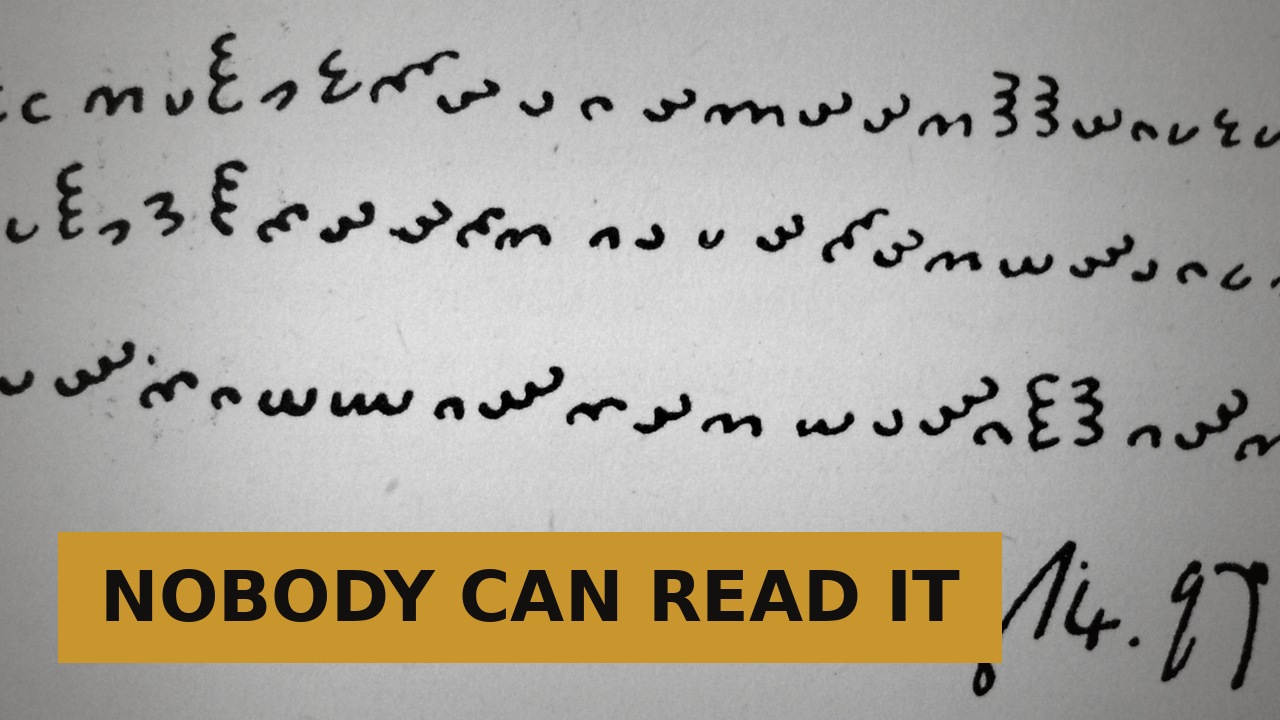
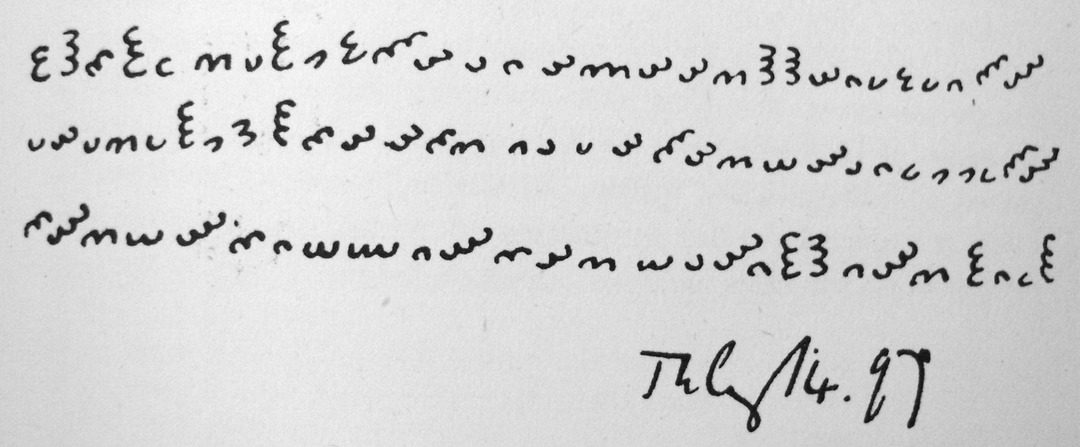
In July 1897, Edward Elgar slipped a second sheet of paper into his wife’s thank-you note to a family near Wolverhampton. It carried no greeting and no signature, just three lines of small curved symbols — eighty-seven characters in all — and two words pencilled on the back: “Miss Penny.” The young woman who received it, twenty-three-year-old Dora Penny, put it in a drawer and left it there for forty years, certain it was a private joke she was meant to work out. She never did.
Neither has anyone since. More than a century later, the Dorabella cipher is still unsolved, and not for lack of trying: a Shakespeare scholar who had worked as a wartime codebreaker, a panel of musicologists judging a cash prize, and, in the last few years, two separate teams of computer scientists running modern cipher-solving software against it. Each produced a verdict. None has produced a reading the others accept.
What follows is the record as it stands: what the symbols are built from, what Elgar is independently known to have done with ciphers before and after this one, what every serious attempt at a solution has actually claimed, and what the newest computational work has managed to rule out — which, so far, is a great deal more than it has managed to rule in.
A cipher inside a thank-you note
Elgar was forty in the summer of 1897, living near the Malvern Hills and teaching violin to make a living; the Enigma Variations, the piece that would make him famous, was still two years away. Dora Penny was the daughter of the rector of a parish near Wolverhampton, a family friend who stayed with the Elgars often and whom Elgar had known for about twenty months. He had already sent her two other notes. This one was different.
It travelled inside a letter his wife, Alice, wrote to thank Dora’s family for their hospitality. Elgar added his own folded sheet, three lines of symbols with a small dot after the fifth character on the third line, and nothing else — no key, no explanation, no later acknowledgment of what it said. Dora kept it, assumed it was some kind of cipher, and by her own account never had the slightest idea how to read it.
Elgar had already been hiding ciphers for years
The note reads less strangely once you know what Elgar did for amusement. He was, by every account from people who knew him, a compulsive maker of puzzles, acrostics and private codes, the kind of person who built his daughter Carice’s name out of fragments of his wife’s, and who turned a family surname into a small musical motif rather than just writing it down. Cryptography specifically was already a habit by 1897, not a one-off.
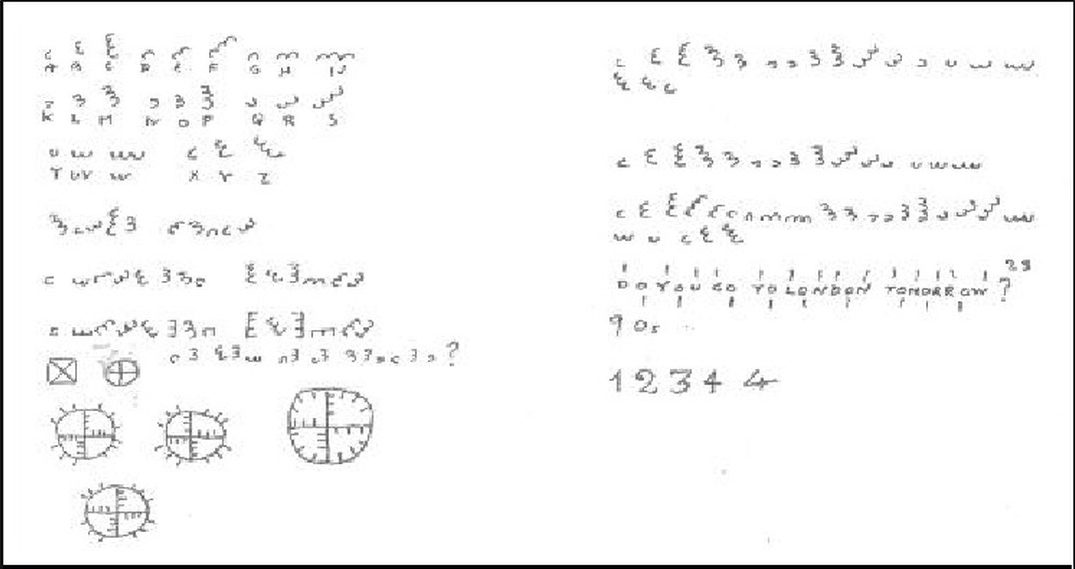
The clearest evidence is a cryptographic puzzle that the publication Pall Mall Magazine put to its readers in 1896, which Elgar solved. The solution became part of a set of cards that laid out his working, step by step. The same curved, rotated symbol-shapes that make up the Dorabella note also turn up elsewhere in his papers: an eighteen-character fragment he scrawled on a concert programme in 1886, more than a decade before the note to Dora, and again in a notebook from the 1920s alongside diagrams that look like clock faces. None of those other fragments has been read either, but their existence settles one question before it can be asked: whatever the Dorabella cipher is, it was not an isolated impulse. It was one instance of something Elgar did for decades, to more than one person, using more than one version of the same private system.
What the alphabet is actually built from
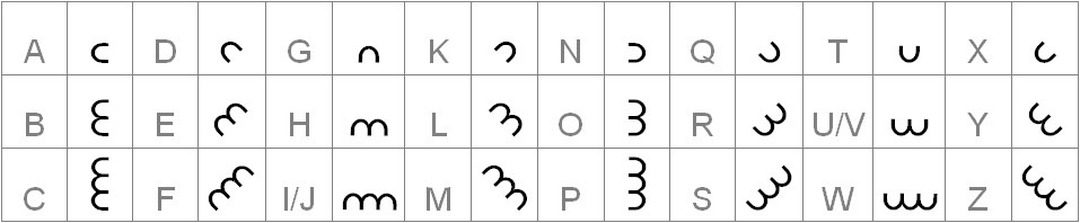
Set the mystery aside for a moment and look at the mechanics, because they are oddly elegant. The cipher uses roughly two dozen distinct shapes. Every shape is built from one, two or three small semicircles, and every shape is rotated to face one of eight compass-like directions. Read the count of curves, then read the angle, and you have identified one character. A handful of the orientations in Dora’s copy are ambiguous enough that different researchers have transcribed them differently, which matters more than it sounds: on a message this short, misreading even two or three characters can change which decryption looks plausible.
That copy is, in fact, the only version of the cipher that survives at all. Elgar’s original sheet was lost at some point after he sent it. The only reason anyone can study the Dorabella cipher today is that Dora, by then Mrs. Richard Powell, printed a facsimile of it in the back of her own 1937 memoir, admitting plainly that she had never solved it. Every attempt made since — cryptographer, amateur, algorithm — has worked from her reproduction, not from anything Elgar wrote.
Eric Sams said he had it. The judges weren’t convinced
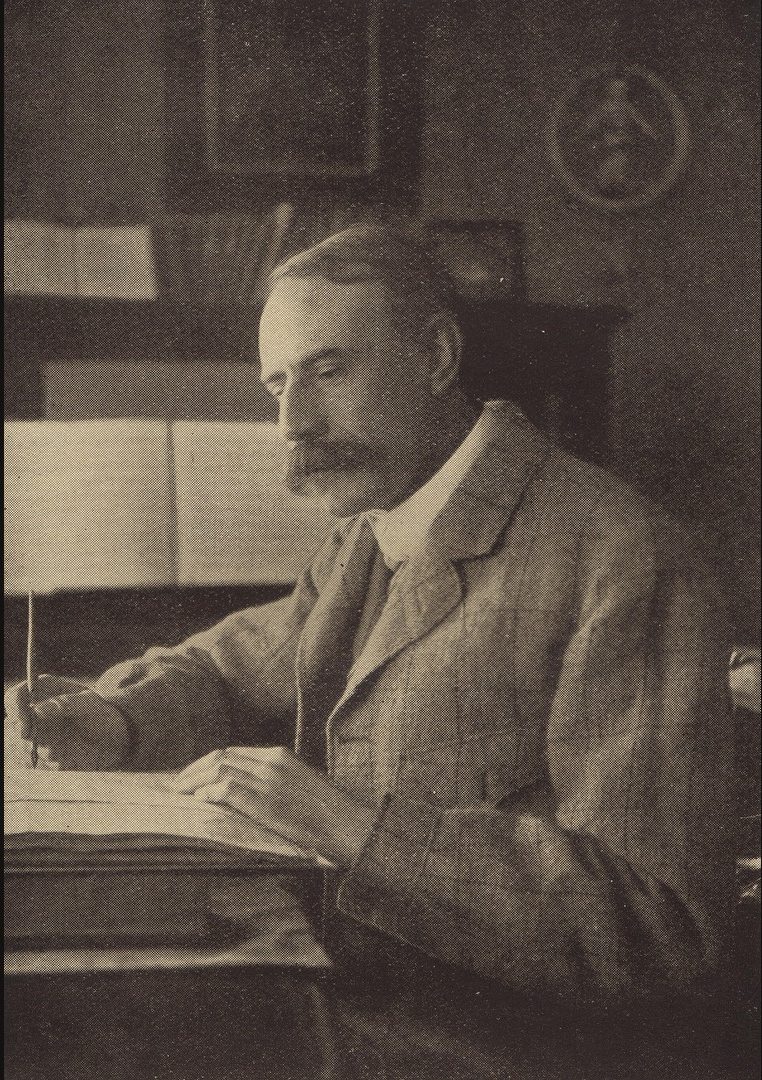
The first solution of consequence came in 1970, from Eric Sams, a Shakespeare scholar and musicologist who had worked in British military intelligence during the Second World War. Writing in The Musical Times, Sams proposed that the cipher was a deliberate double disguise: some symbols stood for letters outright, others stood for the sounds of letters or Greek characters, and the message switched between the two systems every few words. His reading opened “STARTS: LARKS! IT’S CHAOTIC” and ran on from there, eventually mentioning Dora’s own nickname for Elgar, “E.E.” It was taken seriously by other cipher researchers for decades. It was also, on close inspection, about 109 letters long — roughly a quarter longer than the 87 or 88 characters actually on the page, a gap Sams explained by arguing that his phonetic layer implied extra letters the symbols didn’t literally contain. Not everyone found that convincing, and no later researcher has reproduced his reading from the same method.
In 2007, to mark the hundred and fiftieth anniversary of Elgar’s birth, the Elgar Society put up a prize of £1,500 for a convincing solution. Seven serious entries were judged by a panel chaired by Kevin Jones, then Emeritus Professor of Music at Kingston University, who said beforehand that a winning answer would have to be methodically sound and, in his word, “glaringly obvious.” None of the seven met that bar. Jones praised some of the entrants for ambitious, careful work, but he had no patience for the phonetic-substitution approach that Sams had pioneered: in his verdict, those readings amounted to little more than a “disconnected chain of bizarre utterances.” Nobody has claimed the prize since, though several more solutions have been announced in the years after — including one from a serving police officer in 2016 — and none has displaced the others.
What happens when you point software at it
The newest attempts don’t propose a reading at all. In 2021, a team at the University of Alberta ran the Dorabella cipher through statistical language models and automated substitution-cipher solvers built to crack short English texts. One of their solvers correctly decrypts about 88 percent of test ciphers this short when the plaintext is ordinary English. Against the Dorabella note, it and every other solver they tried produced nothing readable at all.
The same study flagged something else, almost by accident. The note contains thirteen pairs of mirror-image symbols — consecutive characters with the same number of curves facing opposite directions. In 100,000 randomly generated English samples of the same length, only 123 had thirteen or more such pairs; the average was under four. That is a roughly one-in-a-thousand coincidence, which argues against the note being meaningless scribble, without saying what the mirroring is actually for. It might mark doubled letters. It might be decorative. Nobody has shown which. A separate language-identification test the same team ran ranked Latin as the single most probable language behind the note, with English third among 380 candidates tested — and ranked English well ahead of Elgar’s own music, evidence against the popular theory that the symbols secretly encode a melody rather than words.
Two years later, the cryptologist Viktor Wase reached a related but distinct conclusion in the journal Cryptologia, after running a different set of modern cipher-solving algorithms: whatever the Dorabella cipher is, he argued, it is unlikely to be a straightforward substitution of plain English or Latin text. Between the two studies, the likeliest and the least likely explanations have essentially swapped places since Eric Sams’s day. A simple substitution cipher in English, the obvious first guess, is now the reading the evidence argues against hardest. And the same Alberta group came back to the music idea anyway in 2025, not to claim the symbols are a real tune Elgar wrote down, but to generate one from the cipher’s structure as a piece of music in its own right — treating the unsolved note as raw material for a new composition rather than a message waiting to be unlocked.
Why the Dorabella cipher is still unsolved
It is worth being precise about what is actually missing, because it is less than people assume. There is no lost key sitting undiscovered in an archive: nobody who has gone looking, and several people have, has found one in Elgar’s papers or anyone else’s. There is no disputed transcription hiding the answer: the ambiguous symbols matter at the margins, not at the core. What is missing is simpler and more stubborn than either of those. The note is short. Cryptanalysis leans on repetition — the commonest letters in a language give themselves away over a long enough stretch of text — and eighty-seven characters is nowhere near long enough to force that kind of confession out of a cipher honestly built to hide one.
Dora Penny died in 1964, thirty years after Elgar. If the two of them shared a private reference that made the note legible — a joke from their twenty months of acquaintance, a place they had walked together, something that needed no key because it lived only in memory — it went with them. Everything that has happened since, the Shakespeare scholar’s reading, the £1,500 prize, the solvers that crack ciphers shorter than this one eight times out of nine and fail completely on this particular eighty-seven characters, has been an argument about a note whose only confirmed author never once said what it meant.
So the honest state of the Dorabella cipher in 2026 is this: better evidence than ever before about what it almost certainly isn’t, and no agreement at all about what it is. What do you think Elgar wrote?
Watch the full history
The video version covers the note, Elgar’s long habit of hiding ciphers in plain sight, and the chain of failed solutions in just under eight minutes.

Related reading
- Why Nobody Can Read the Voynich Manuscript
- The Mystery of the Beale Ciphers, Explained
- Why Kryptos K4 Is Still Unsolved, Even After a $962,500 Sale
- Shugborough Inscription Theories: What Each Explanation Actually Claims
Works cited
- Sams, Eric. “Elgar’s Cipher Letter to Dorabella.” The Musical Times 111, no. 1524 (1970): 151–154. Link.
- Bauer, Craig. Unsolved! The History and Mystery of the World’s Greatest Ciphers from Ancient Egypt to Online Secret Societies. Princeton University Press, 2017.
- Penny, Dora (Mrs. Richard Powell). Edward Elgar: Memories of a Variation. London: Methuen, 1937.
- MacNamara, Mark. “The Artist of the Unbreakable Code.” Nautilus, October 10, 2013. Link.
- Hauer, Bradley, Colin Choi, Anirudh S. Sundar, Abram Hindle, Scott Smallwood, and Grzegorz Kondrak. “Experimental Analysis of the Dorabella Cipher with Statistical Language Models.” Proceedings of HistoCrypt 2021. Link.
- Wase, Viktor. “Dorabella unMASCed: The Dorabella Cipher Is Not an English or Latin Mono-Alphabetical Substitution Cipher.” Cryptologia 49 (2023): 15–24.
- Hauer, Bradley, Colin Choi, Abram Hindle, Scott Smallwood, and Grzegorz Kondrak. “Dorabella Cipher as Musical Inspiration.” University of Alberta preprint, 2025. Link.
- Packwood, Wayne. “Elgar as Cryptographer – Tuning and Turing.” Musical Opinion 143 (2020): 34–37.