
In 1902, Congress set two different tax rates on the exact same product. A pound of margarine that stayed its natural pale color was taxed a quarter of a cent. A pound dyed to look like butter was taxed ten cents — forty times more. A retail dealer named Leo McCray challenged that rate in a case that reached the Supreme Court, and in 1904 the Court gave an answer that is still cited today whenever a legislature wants to know how far a tax can go in strangling a product without technically banning it: there is no limit at all, as long as the lawmakers call it a tax.
That ruling was not the end of the fight. It was roughly the midpoint. The companion video linked below follows the object at the center of the dispute — the carved wooden stamp a farm family pressed into every pound of butter they sold, and the chemist’s invention that eventually threatened it. This article follows the legal side of that same story in more detail than six minutes of narration can hold: how a prize competition in an emperor’s menagerie produced a product built from the start to be mistaken for butter, how more than thirty state legislatures tried to regulate it out of existence by 1902, which of those laws the Supreme Court actually struck down and which it let stand, and why the whole fight dragged on for almost a hundred years before anyone backed down for good.
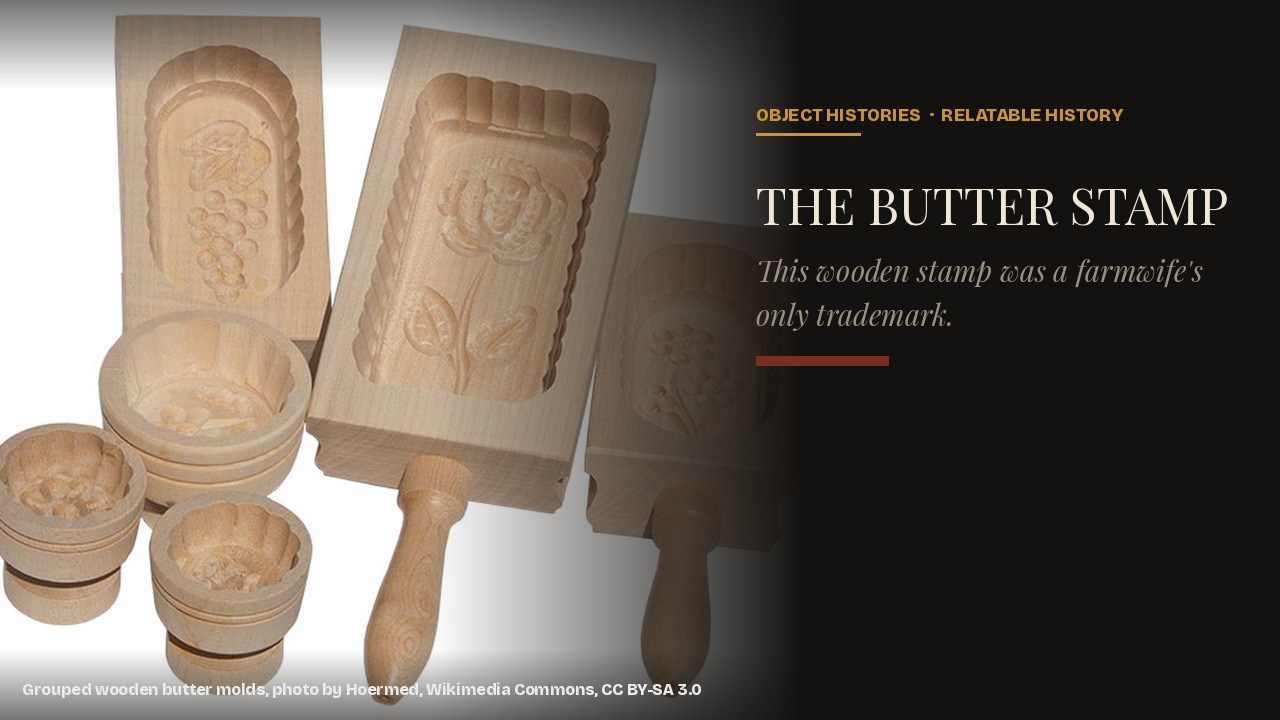
A carved stamp was the only trademark a dairy family had
Before anything called a brand existed in American commerce, a farm family’s reputation traveled to market riding on a lump of butter with a design pressed into its top. The historian Joan Jensen, studying mid-Atlantic farm account books, found that butter had become the fifth most valuable agricultural commodity in the region by 1840, and that almost all of it still came from individual household churns rather than anything resembling a factory. The income from it belonged specifically to the women who made it: they used butter money to buy household goods while the men of the family spent grain and livestock money on land and equipment, a financial split sturdy enough that Jensen calls butter a dependable “cushion” through the economic downturn of the 1820s.
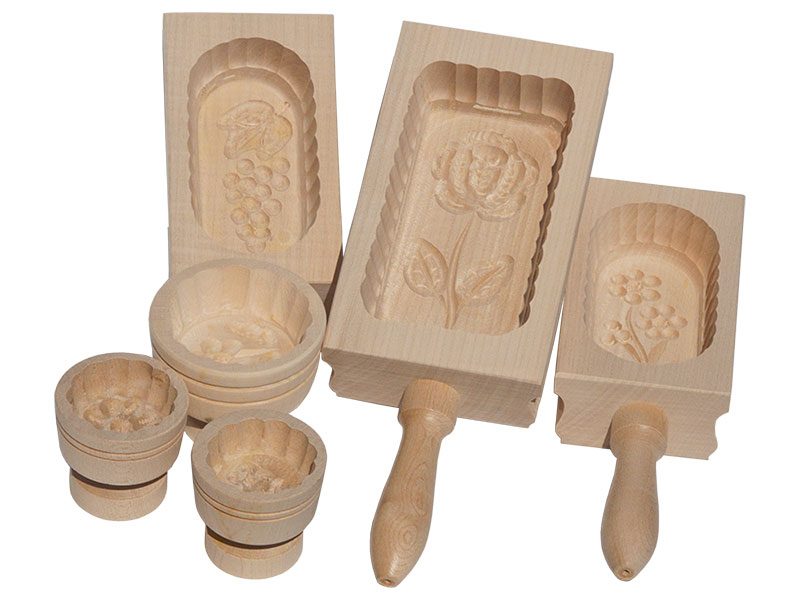
The stamps themselves were ordinary objects of local woodworking: chip-carved from pine, walnut, or butternut, by a neighbor who was good with a knife rather than by a specialist trade. A one-pound mold in the Winterthur Museum’s collection, dated 1813 and carved in Pennsylvania, carries nothing more elaborate than a pair of initials and the year — evidence, cataloguers note, that the maker wanted the pat traceable back to one farm and no other. The designs that spread this way — eagles, tulips, cows, wheat sheaves — turned a block of wood into what the DAR Museum’s own curators now describe simply as “a sort of butter brand,” decades before trademark law gave farmers any other way to claim one.
A handful of states never fully let the habit go. Connecticut’s General Statutes still require, in Section 21a-21, that anyone selling a wrapped print of butter mark the package “in letters or figures not less than one-half inch in height, in plain Gothic type,” showing the net weight inside. The rule has outlived the carved stamp it was written to regulate by well over a century.
An emperor’s prize produced a rival built to be mistaken for butter
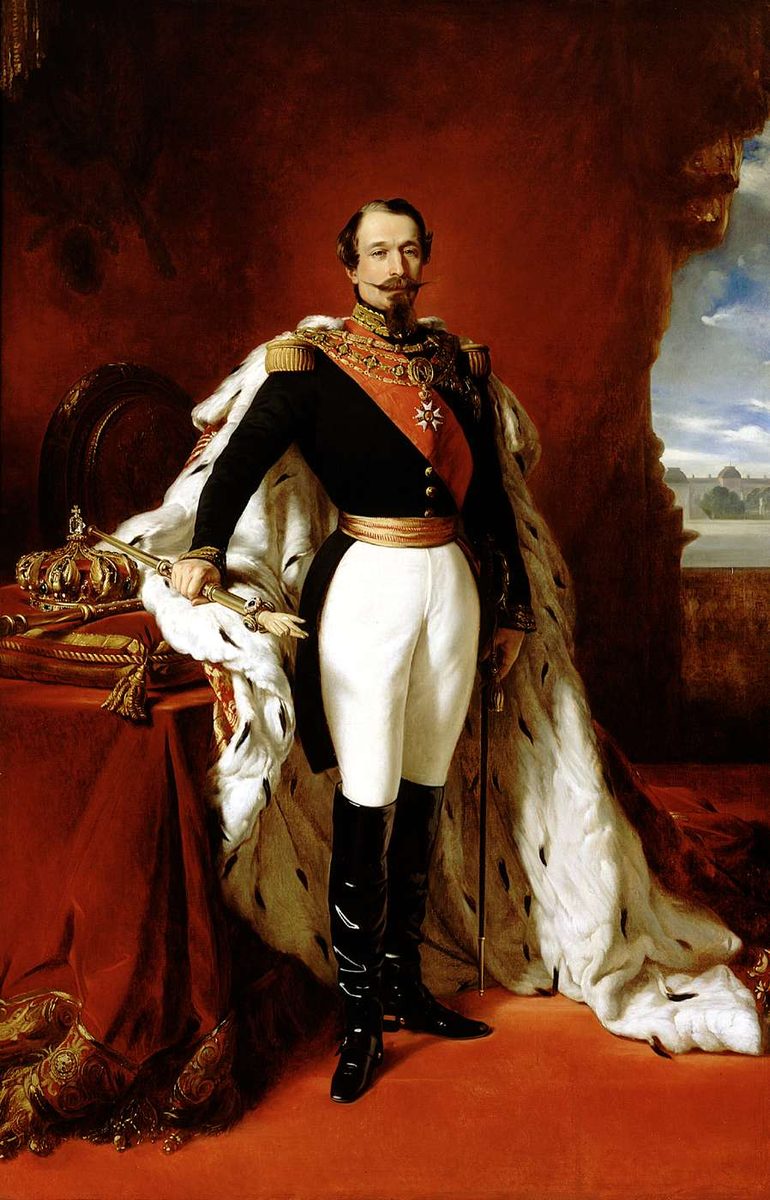
The product that eventually forced the issue did not emerge from a dairy at all. Napoleon III, worried about keeping his army and his poorer subjects fed with a cheap butter substitute, had been funding research at his Imperial Farm at Vincennes since around 1867. A chemist there named Hippolyte Mège-Mouriès worked out a process that began with fresh beef suet, minced and washed, then broken down with artificial gastric juice so the softer fat could be pressed free and churned together with skim milk, milk casein, and a little bicarbonate of soda. The French government granted him a fifteen-year patent on the process on July 15, 1869; a British patent followed two days later, and a United States patent, No. 146,012, in January 1873. He named the result after margaric acid, a fatty compound first described by the chemist Michel-Eugène Chevreul decades earlier.
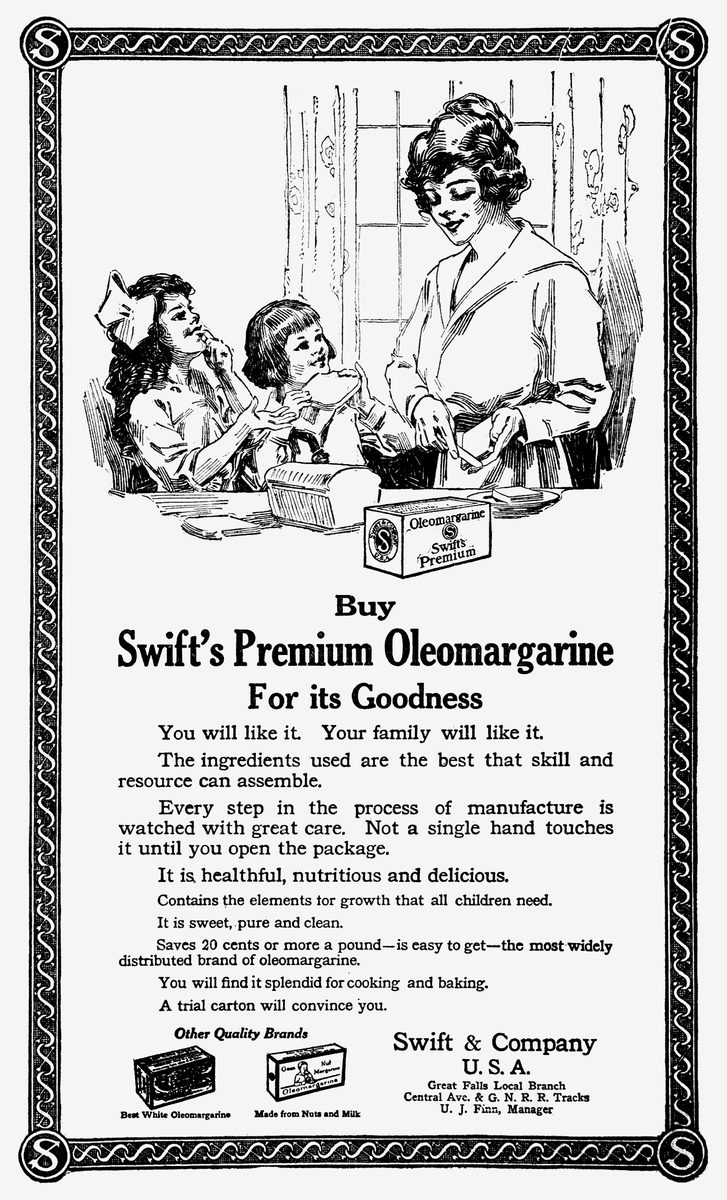
The new product’s whole selling point was substitution, not distinction. It was priced to undercut butter and, left to itself, colored and textured closely enough to pass for it on a grocer’s counter. By 1880 at least fifteen American factories were turning it out, several built deliberately next to the Chicago meatpacking houses that supplied the tallow. A century of locally built trust, one carved stamp at a time, was suddenly up against a nationally distributed product designed to borrow that trust without earning it.
Congress wrote the first law to tax by color, not by content
Dairy interests pushed back through Congress rather than the market, and on August 2, 1886, they got the Oleomargarine Act. The statute did real definitional work — it specified that butter had to come exclusively from milk or cream, and it defined oleomargarine as any mixture of tallow, suet, lard, or vegetable oil colored or otherwise finished “in imitation or semblance of butter” — and then it taxed that imitation heavily: licensing fees as high as $600 a year for a manufacturer, plus two cents a pound on everything produced, enforced by the Commissioner of Internal Revenue with the help of a staff analytical chemist and microscopist whose entire job was telling margarine from butter under magnification.
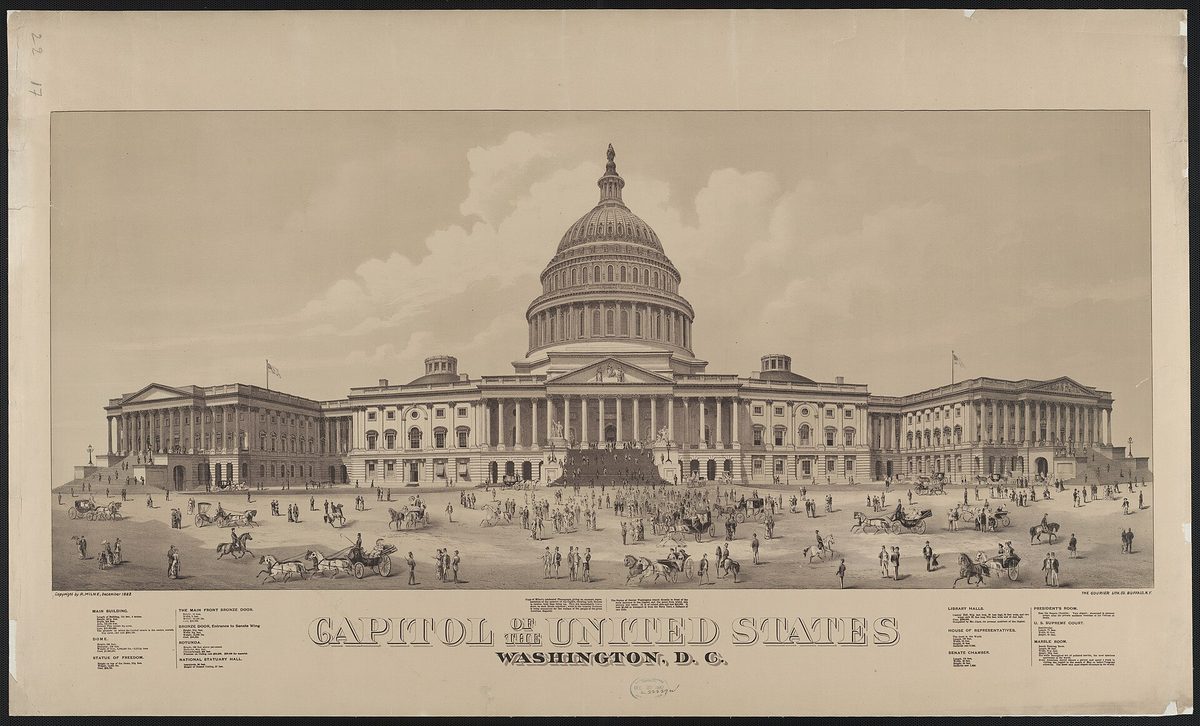
States did not wait for Washington. By 1902, by one count, thirty-two of them had passed their own color restrictions on top of the federal law. Most simply banned yellow margarine outright. A few reached for something stranger.
New Hampshire tried pink, and the Supreme Court called it a ban in disguise
Vermont, South Dakota, and New Hampshire went furthest, requiring margarine sold as a butter substitute to be dyed pink. New Hampshire’s version, under its Public Statutes, carried a fine of up to $100 or sixty days in jail for selling it any other shade. A traveling agent named Collins was convicted in Manchester for selling an uncolored ten-pound package shipped in from Chicago, and his case reached the Supreme Court in 1898.
The Court threw the conviction out. Writing for the majority, Justice Rufus Peckham reasoned that since pink is not margarine’s natural color, a law forcing sellers to dye it pink was not really a labeling rule at all — it was a disguised prohibition, since no customer would knowingly buy a pink spread. A law that technically permitted sales while guaranteeing none would happen amounted to a ban, and as a ban on goods shipped in from another state, it ran straight into Congress’s own power over interstate commerce. New Hampshire’s law fell. Ordinary bans on yellow coloring, which did not depend on forcing an unnatural color onto the product, were left standing.
The Court drew a very different line for the federal tax six years later
Logic that doomed a state’s pink law did not touch Congress’s own power to tax, and that distinction is what made McCray different. By 1902 the federal tax schedule set a quarter-cent-per-pound rate on uncolored margarine and a ten-cent rate on anything colored to look like butter “of any shade of yellow.” Leo McCray, a retail dealer, had stamped a package at the low rate on the theory that its yellow tint came from butter blended into the mix, not from dye added directly to the margarine. The government fined him $50 and insisted the higher rate applied regardless of where the color came from.
The Supreme Court sided with the government on both the narrow question and the much larger one. Justice Edward Douglass White’s opinion held that the statute covered any artificial coloration, however it got there, and then went further: courts, he wrote, have no business second-guessing a tax as unwise, oppressive, or even destructive of an entire industry, and no business probing Congress’s motives for passing it. Because states were already free to ban colored margarine outright, a federal tax that made the same product commercially unsellable violated nothing. Three justices dissented, unpersuaded that a forty-to-one tax gap was really about raising revenue rather than destroying a competitor. The majority’s reasoning has outlived the dispute that produced it, and still gets cited today whenever a tax’s real purpose, rather than its stated one, is at issue.
The fight outlasted two world wars before anyone gave up for good
None of this got resolved quickly. The federal tax and licensing scheme stayed on the books through the Depression and both world wars, finally repealed by Congress in 1949 and 1950. Most states dropped their own remaining restrictions by the end of 1953. Wisconsin, the country’s leading dairy state, held out until 1967 — nearly a full century after Mège-Mouriès first won his prize in France, and sixty-three years after the Supreme Court told the dairy industry its tax advantage was perfectly legal.
By the time the last restrictions fell, the thing that had made the fight worth having in the first place — a farm family’s own carved mark on its own butter — had already mostly disappeared for unrelated reasons. Industrial creameries and USDA grading had replaced the carved stamp as the thing a buyer trusted well before Wisconsin’s legislature acted. The law finished settling an argument about an object that had, by then, largely become an antique.
Watch the full history
The video traces the stamp itself — what farm families carved and why — and compresses this entire legal fight into a little over five minutes.

Related reading
- How Arbuckle’s Ariosa Coffee Ended a Weekly Farm Kitchen Chore — a carved brand on coffee sacks, the same trust problem butter stamps solved
- Who Invented the Electric Toaster, Really? — another everyday kitchen object with a surprisingly contested legal history
- Why Waffles Have a Grid Pattern (It’s Not About the Syrup) — a kitchen tool shaped by a pattern nobody questioned until someone did
- The Quilting Bee Was Already a Punchline by the 1860s — the household economy that made a farmwife’s butter money her own
Shop this history
- Butter Prints and Molds by Paul E. Kindig (the definitive collector’s reference cited above)
- A hand-carved wooden rooster butter mold, in the same carving tradition described here
- A carved wooden ram butter mold and press
Works cited
- Kindig, Paul E. Butter Prints and Molds. Exton, PA: Schiffer Publishing, 1986.
- Jensen, Joan M. “Butter Making and Economic Development in Mid-Atlantic America from 1750 to 1850.” Signs 13, no. 4 (1988): 813–829. University of Chicago Press.
- Winterthur Museum. “Butter mold,” object no. 1963.0063, Pennsylvania, 1813. Link.
- Blough, Carrie. “Butter Prints.” DAR Museum, Daughters of the American Revolution.
- Connecticut General Statutes § 21a-21, print butter net-weight marking requirement.
- List, Gary R. “Hippolyte Mège (1817–1880).” Inform 17, no. 4 (April 2006): 264. American Oil Chemists’ Society. Link.
- Lee, Jessica. “I Can’t Believe It’s Not Oleomargarine.” Text Message (National Archives blog), November 3, 2015. Link.
- Collins v. New Hampshire, 171 U.S. 30 (1898). Link.
- McCray v. United States, 195 U.S. 27 (1904). Link.
- Blakemore, Erin. “Women Made Butter a Behemoth.” JSTOR Daily, March 11, 2019. Link.
- Rupp, Rebecca. “The Butter Wars: When Margarine Was Pink.” National Geographic, August 13, 2014. Link.